Audacy expands Dave Jackson‘s footprint into Tennessee. The longtime Greenville executive now leads stations in two states.
What We Know: Audacy has tapped Dave Jackson as the new Brand Manager for 105.5 KISS FM (WKXJ-FM) in Chattanooga. He’ll continue leading B93.7 (WFBC-FM), The Block (WFBC-HD2) and Magic Upstate (WFBC-HD4) in Greenville at the same time. Jackson oversees content strategy, talent, operations and branding at the Top 40 outlet. He started in radio in 1999 as a mixer and producer, later rising through programming roles at Cox Radio and Summit Media before rejoining Audacy in 2014.
What They Said: Top 40 Format Vice President Molly Cruz pointed to Jackson’s partnership with Dex and Barbie T at B93.7 as proof he’s ready for the new challenge. She said his success in the south, paired with his creative energy and tech-forward mindset, made him the right choice for KISS FM. Jackson echoed that confidence, saying the station already carries a strong legacy in Chattanooga and that he wants to help shape what comes next. He added that the goal is straightforward: stay rooted in the local community while finding fresh ways to connect daily with listeners.
What Remains Unclear: Audacy hasn’t specified when Jackson’s expanded duties officially begin. The company also hasn’t addressed who held the Brand Manager role before this announcement. Meanwhile, it’s unclear how he’ll divide time between Chattanooga and Greenville. Staffing adjustments to support both markets remain unannounced as well.
What It Means: This appointment reflects Audacy’s growing reliance on cross-market leadership within its Top 40 portfolio. By pairing one proven brand manager with two markets, the company maximizes Jackson’s reach without adding headcount. For Jackson, it’s a clear vote of confidence following more than a decade back with Audacy. Ultimately, it signals that consistency and proven results matter more than market size when building format-wide strategy.
Barrett Media produces daily content on the music, news, and sports media industries. Sign up for our newsletters to stay updated and get the latest information right in your inbox.
MLB Network is expanding its Draft Combine roster with a familiar front-office face. According to Sports Business Journal, former Washington Nationals GM Mike Rizzo will join the network as an analyst for its June 23-25 coverage.
What We Know: Rizzo served as GM and president of baseball operations in Washington until mid-July 2024, when the organization let him go. During his tenure, he selected star players such as Stephen Strasburg and Bryce Harper with consecutive first overall picks. He also guided the franchise to a 2019 World Series title. Rizzo joins fellow ex-GM Dan O’Dowd as part of MLB Network’s Draft Combine analyst team.
What Remains Unclear: Rizzo’s specific on-air role and whether his Draft Combine appearance leads to a longer-term MLB Network presence remain unknown. Additionally, it’s unclear how frequently he will contribute beyond the MLB Draft Combine.
What It Means: The Draft Combine takes place June 23 at Chase Field in Phoenix, now hosting the event for a fourth straight year. Typically NBA and NFL draft combine coverage speaks to the niche audiences of those sports. However, MLB Network is attempting to elevate the coverage of the sport’s combine this year. Adding Rizzo gives MLB Network genuine front-office credibility during one of the sport’s most talent-focused weeks.
Barrett Media produces daily content on the music, news, and sports media industries. Sign up for our newsletters to stay updated and get the latest information right in your inbox.
The Grammys are evolving again. The Recording Academy unveiled five new categories and several rule changes for 2026 on Tuesday.
What We Know: The academy added best Asian pop music performance, honoring K-pop, J-pop, C-pop and beyond. Additionally, best traditional pop vocal performance joins the lineup for artists outside current pop trends. Meanwhile, best Latin song now recognizes songwriters behind Spanish-language Latin hits. Folk also splits into best contemporary folk album and best traditional folk album, similar to last year’s country shift.
What’s at Stake: Best new artist eligibility expands from three submissions to four. However, artists with prior Grammy nominations remain ineligible for the category. Instead, a screening committee will judge whether an artist had already reached major industry impact. Furthermore, qualified members can also vote in more categories than before.
What Remains Unclear: Notably, the academy hasn’t set a cap on prior releases for best new artist hopefuls. As a result, that leaves the screening committee with significant discretion over each case. It’s also unclear how many voters will gain expanded category access. Therefore, the impact on competitiveness in expanded categories isn’t clear yet.
What It Means: Overall, these changes signal the academy’s push toward global and underrepresented genres. For instance, Asian pop and Latin songwriting now get dedicated recognition on music’s biggest stage. Meanwhile, the best new artist shift could help slow-building careers compete for the trophy. Ultimately, the updates point toward a broader, more inclusive Grammy field in 2027.
Barrett Media produces daily content on the music, news, and sports media industries. Sign up for our newsletters to stay updated and get the latest information right in your inbox.
One of basketball’s most iconic voices is considering slightly altering his workload and slowing down. Mike Breentold John Ourand of Puck Media he plans to reduce his demanding dual workload — but isn’t ready to walk away.
What We Know: Breen, 65, has served as ESPN/ABC’s lead NBA play-by-play voice since 2006, calling 21 consecutive NBA Finals. He has simultaneously called New York Knicks games locally on MSG Network since 1997. That dual role created an extraordinary seasonal workload. At his peak, he’s handled upwards of 110 games annually between both assignments. Recently, he has already begun trimming that number.
What They Said: Mike Breen on his workload moving forward (via Puck Media): “For a long time, between ESPN and the Knicks, I was doing, some years, as many as 110 games during the course of the season—playoffs and regular season—and I’ve cut it back a little bit. But I’m going to have to cut it back a little bit more. Clearly, I still love it so much, and there’s nothing better than doing the big national games… So, yes, I might cut back soon, but I still love it too much. As long as the people at ESPN and MSG still want to hear me yapping away, I’m good with that.”
What Remains Unclear: Breen has not specified which role he might reduce first — his local Knicks duties on MSG or his national ESPN/ABC assignments. Additionally, no timeline was offered.
What It Means: Breen is the rare broadcaster who has sustained elite performance at both the local and national levels simultaneously for decades. Furthermore, his comments signal a natural transition is approaching for one of sports media’s most distinguished careers. ESPN and MSG will eventually need succession plans. For now, though, Breen’s passion clearly still drives the bus as he celebrates his hometown Knicks first championship in 53 years.
Barrett Media produces daily content on the music, news, and sports media industries. Sign up for our newsletters to stay updated and get the latest information right in your inbox.
Paramount Skydance is set to acquire Warner Bros. Discovery, meaning it will own CNN. That doesn’t work for Kara Swisher, who plans to depart CNN as soon as she can.
What We Know: It is not the first time Kara Swisher has mentioned her intention to leave CNN. Earlier this year, she shared that she “refused” to work for Larry and David Ellison. At the time, she called Larry Ellison a “terrible person”. Currently, she serves as a contributor to the network. She also hosted a weekend show called Kara Swisher Wants to Live Forever. In a recent podcast episode with Scott Galloway, she reiterated her plans to exit CNN as soon as possible.
What They Said: “There are a lot of other options. I’m under contract with them until the end of the year. And I’m hoping they’ll let me out early because I don’t want to affiliate with them. I left James Murdoch, too. This is not a new, fresh thing for Kara Swisher to flounce out and do better.” -Kara Swisher
What Remains Unclear: Whether or not CNN will grant that request. The network has yet to publicly respond to the repeated comments from Swisher about her standing with the organization.
What It Means: Swisher has continually shared her intention to exit CNN. It certainly appears as if her money is where her mouth is.
Barrett Media produces daily content on the music, news, and sports media industries. Sign up for our newsletters to stay updated and get the latest information right in your inbox.
The 2026 Stanley Cup Final on ABC averaged 5.2 million viewers across six games. That makes it the most-viewed Final since the 2019 Boston Bruins-St. Louis Blues series.
What We Know: The Final surged 106% over 2025 and 26% over 2024, the last ABC airing. Every game set a multi-year viewership high, with Game 5 drawing 5.8 million — the most since 2018. Game 6 peaked at 7.2 million viewers in the 10:45 p.m. ET quarter-hour. Carolina’s championship-clinching win was the franchise’s first title in nearly 20 years. The Stanley Cup Final capped a historic postseason across ESPN platforms, as ESPN delivered its most-watched Stanley Cup Playoffs ever (1994-2002, 2021-present). Across 43 games, the NHL Playoffs on ESPN networks averaged 2.2 million viewers, up 127% vs. 2025 and up 19% vs. 2024.
What Remains Unclear: How specific regular season viewership following the Olympic break factored into added interest for the NHL playoff viewership. Also, how much the viewership totals changed incorporating the Big Data + Panel measurement this year.
What It Means: The 2026 postseason was ESPN’s most-watched Stanley Cup Playoffs since holding NHL rights from 1994–2002. Moreover, across 43 games, ESPN networks averaged 2.2 million playoff viewers — up 127% over 2025. In addition, social engagement climbed 32% year-over-year, with shares jumping 49%. The numbers can also be reasoned with added exposure of the Cup Final on ABC with the viewership and cross promotion with the New York Knicks NBA Championship run.
Barrett Media produces daily content on the music, news, and sports media industries. Sign up for our newsletters to stay updated and get the latest information right in your inbox.
Hubbard has locked in its morning team in West Palm Beach. Kevin Rolston, Virginia Sinicki, and Jason Pennington will continue hosting “The KVJ Show” on Hot AC 97.9 WRMF.
What We Know: The trio has anchored WRMF mornings since July 2014. Before that, KVJ spent fourteen years on CHR “Wild 95.5” WLDI from 1999 to 2013. A brief nine-month stint at “Hits 97.3” WFLC Miami followed. Altogether, the renewal extends a 27-year run together in South Florida radio.
What They Said: Rolston credited the company’s culture for the long partnership. “KVJ has always been family but so has Hubbard,” he said, adding that the last several years with the company have been the show’s favorite. Meanwhile, Sinicki kept things lighthearted, joking that her co-hosts “get to look at my beautiful face for many years ahead.” Hanna echoed that sentiment, calling the show “unpredictable, wildly entertaining, and never dull.”
What Remains Unclear: Hubbard hasn’t disclosed contract length or financial terms. Additionally, the company didn’t specify whether programming changes are planned alongside the renewal. Therefore, it’s unclear if the show’s format or staffing will shift down the road.
What It Means: The renewal secures continuity for one of West Palm Beach’s top-rated morning shows. Furthermore, it signals Hubbard’s continued investment in established local talent over turnover. Ultimately, keeping KVJ intact strengthens WRMF’s competitive footing heading into the next ratings cycle.
Barrett Media produces daily content on the music, news, and sports media industries. Sign up for our newsletters to stay updated and get the latest information right in your inbox.
The New York Knicks are your NBA champions. The NBA Finals delivered the best television viewership since The Last Dance, when Michael Jordan left Bulls fans for good. Lord Stanley’s Cup has been raised to the heavens in Raleigh, North Carolina, for the second time in just over two decades. That, too, followed impressive viewership numbers not seen in years. Baseball is in full swing, and the NFL is on hiatus. Welcome to June, where sports radio discussions often stray away from games on the field and into the evergreen territory of Mount Rushmore discussions and G.O.A.T. debates.
It’s a dangerous landscape to navigate, especially this summer. For the next five weeks, sports radio talent will likely settle into that familiar summer rhythm. Stations will lean on additional syndication. Plus, if you’re not in an MLB market, there’s likely a shortage of local, day-to-day headlines that command the collective attention of your audience.
However, this summer provides an opportunity. One that only arrives every few years, and this year it’s taking place on American soil.
It’s a decision that isn’t easy to make. Should sports radio be more embracing of the World Cup in casual conversation? Each market is different, and so is its talent. Not every host could name a single player on the USMNT, and some may not even know what the acronym means.
What’s fascinating, however, is how the approach is judged.
The Audience Leads Your Content
Most sports radio stations were glued to the NBA Finals. The series involved the largest market in the United States. The presentation was full of celebrity. Every game was micro-analyzed from pregame through postgame. NBA basketball is familiar to most Americans. It draws a broader audience than most sports because of its history in the country.
That’s why the NBA Finals are always must-see television and frequently become topics of discussion on sports radio across the country.
The Stanley Cup Final didn’t feature major U.S. markets. In fact, two of the league’s youngest franchises battled for the Stanley Cup. However, viewership surged to unexpected levels. The Stanley Cup Final will likely go down as the most-watched Cup Final in more than a decade despite the lack of familiarity and star power.
Viewers showed interest, yet most sports radio stations chose the NBA over the Stanley Cup Final when it came to topics, discussion, and social engagement.
For both events, viewership was strong. However, they competed against one another for airtime among sports radio brands across the country. The World Cup doesn’t have that competition, but will sports radio make it a day-to-day topic over the next five weeks?
If viewership is your guide, Americans are watching.
Ball Don’t Lie
The United States’ win over Paraguay was the most-watched USMNT FIFA World Cup telecast in English-language U.S. history. Nearly 16 million people watched the U.S. dismantle Paraguay while scoring a record four goals in a single World Cup match.
For comparison, the Stanley Cup Final will likely average just over 4.5 million viewers. The NBA Finals finished with an average audience over 20 million.
If viewership is your guide, doesn’t the World Cup make sense for sports radio to embrace? If the goal is to follow what your audience is watching, shouldn’t content selection reflect that same approach?
We always talk about lost opportunities when it comes to sports radio’s ability to connect with audiences in different ways. Sure, the NFL drives the bus when it comes to cume and TSL. However, when there’s no NFL and limited NBA, NHL, and, in many markets, MLB storylines to discuss, you need to get creative with the opportunities in front of you.
The World Cup is exactly that opportunity. It’s not just a soccer event. It’s a cultural one.
Content Angles Are There
There is plenty of star power and no shortage of discussion points involving sponsorships, commercials, commentators, and social media reactions. Every United States match resonates with people differently as the country celebrates its 250th birthday leading into July 4.
Have you seen how visitors from other countries are sharing their American experiences online? That’s content in itself. Connect with those people online, book them as guests, and reveal the uniqueness of their journeys to your audience.
The World Cup provides numerous ways to lean into the entertainment value that sports radio delivers. If you don’t know much about the game, be curious. Be ‘Ted Lasso’ for your audience and ask questions. You may learn something along the way while connecting with listeners on a level you haven’t experienced before.
Yes, there will be NBA free agency. Of course, the NHL will generate headlines as well. And the Midsummer Classic will always be a focal point for sports radio. However, America is telling sports radio what it cares about right now. The question is whether sports radio is listening.
Embrace, Not Evade
Sports radio has always been at its best when it meets audiences where their passions already exist. It doesn’t require every host to become a soccer expert overnight, nor does it mean abandoning the sports that traditionally drive ratings.
It simply means recognizing what is unfolding right in front of us.
The numbers suggest Americans are watching. The crowds suggest they’re engaged. The social media conversation suggests they’re invested. When millions of people are tuning in to the biggest sporting event on the planet, hosted in your own backyard, sports radio doesn’t have the luxury of pretending it isn’t happening.
Five weeks from now, the World Cup will be gone. The opportunity to be part of the conversation will disappear with it. Sports radio can either treat it as a niche event and watch from the sidelines, or embrace the curiosity, energy, and cultural relevance it has created across the country.
If every indication points to the World Cup being the defining sports story of the summer, sports radio shouldn’t ignore it. It should embrace it.
The biggest sporting event of the summer is already commanding attention, generating conversation, and attracting millions of viewers. Sports radio doesn’t need to become soccer radio. It simply needs to recognize where the audience is spending its time and meet listeners there. When every sign points to the World Cup becoming the story of the summer, the smartest move isn’t to avoid it. It’s to embrace it.
Barrett Media produces daily content on the music, news, and sports media industries. Sign up for our newsletters to stay updated and get the latest information right in your inbox.
Survival in the sports podcast industry is not easy. Every day, hundreds of new competitors enter a space that many already consider to be oversaturated. It’s a battle of identifying your audience, creating unique content for consumers, and navigating every change and shift in the evolving ways that content is distributed. A battle that the Locked On Podcast Network continues to win year after year for the last decade.
Yesterday, Locked On celebrated the network’s tenth anniversary. What began as a project by founder David Locke to find a way to pay the fees for his children’s ski academy has grown into a model the rest of the industry continues to marvel at.
“The initial conversation with my wife about this included two rules when I started Locked On. One, I couldn’t do anything that would harm us financially. Two, I had to admit it when it wasn’t working and stop working on it,” explained Locke, who still serves as the President of the Locked On Podcast Network. “We never would have thought what if it works, and ten years later you’re still running it. That was never a discussion point.”
What started as a single team-focused podcast hosted by Locke on the Utah Jazz, the team for which he serves as play-by-play voice, has grown into a behemoth of on-demand local voices providing daily content about nearly every team in every professional league. The Locked On Podcast Network currently consists of 275 daily programs. The network relies on hosts who bring firsthand knowledge of their local markets and teams to every show.
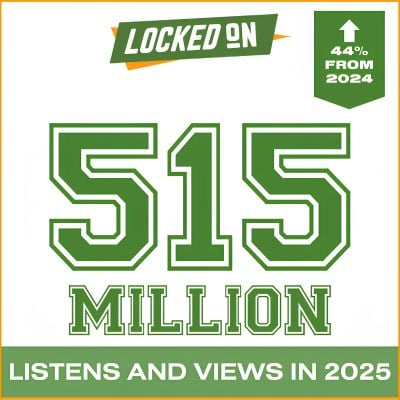
Last year, Locked On set new records with 515 million listens and views and is currently pacing to eclipse one billion listens, views, and social engagements in 2026.
“It’s local passion on a national scale,” said Locke. “Our local hosts connect with each local fanbase, connecting fans with a product they care about most in life: their sports team.”
Investing For Success
Locke says his vision to launch his own company with the Locked On model stemmed from his time working alongside Carl Weinstein, who now serves as Locked On’s COO. When Weinstein launched his SeasonTicket.com company near the turn of the century, his approach sparked Locke’s creative mindset while he was working in local sports radio in Seattle and Salt Lake City.
After Locke began building Locked On, the two remained in touch throughout the process. So much so that Weinstein was impressed by the model and decided to join the Locked On team just two years after its launch.
Locked On 2025 Stats (Social Screenshot)
“I was at a point in my career where I wanted to get my hands dirty again. I love building businesses,” said Weinstein about what attracted him to joining Locked On. “It was a perfect mix of my sports, media, and entrepreneurial backgrounds. I always try to be involved with building what’s next. Podcasts were the next thing. Plus, doing something on a large scale with integrity and professionalism was appealing.”
Identifying the podcasting boom so early has played a major role in the success of the Locked On model. Equally important was identifying how the company could stand out from the competition. Locked On prides itself on a talent-friendly model. The company identifies and hires talent who are deeply passionate about the teams they cover while maintaining an objective perspective.
In return, Locked On supports its talent with assets, coaching, data, and technology, much like Locke experienced during his sports radio programming days. That investment has helped the company retain a large percentage of its talent across the country. Those hosts have reinforced the bond between creator and consumer for years, contributing to the success Locked On enjoys today. It’s a story the company isn’t afraid to share.
“We get to tell that story because we’ve been fortunate and smart. Nonstop growth for ten years, that’s a great story to tell,” explained Weinstein. “There’s a tendency that businesses have to hold things close to the vest… David and I don’t believe that’s a good strategy. Telling our story is important for everyone involved with Locked On.”
Earning Consumer Trust
For the last decade, Locked On’s approach has been to improve the local sports fan experience through daily content from trusted voices offering objective and informed opinions. For Locke, maintaining that objectivity remains essential.
Especially as the lines continue to blur between creators, influencers, and talent in the podcast industry.
“Our talent are not influencers,” said Locke. “We can offer unique perspectives because we have experts on every single team… We have always sided on the side that our content must be great but also authentic to be successful.”
Another key to Locked On’s continued success was its forward-thinking decision to expand all content to video distribution platforms. In 2021, the company went all-in on video. It ensured every Locked On program was either recorded or streamed live on YouTube while also being available across podcast platforms.
“We give ourselves permission to win, as well as permission to fail,” said Locke. “We try a lot of things. The audience will tell you where they want your content.”
More recently, research has shown a growing audience for podcast content on video platforms, while audio remains a strong consumption channel. Because of that forward thinking five years ago, Locked On today is operating from a position of strength compared to many of its competitors.
“We’ve seen massive growth on video while continuing to see growth on audio. To us though, it’s all podcast. Some people like to differentiate where one is audio, one is video. It’s all podcast, because the consumer defines it that way,” said Weinstein. “Locked On has always embraced bottom-up thinking. Companies often try to drive corporate objectives toward the way consumers actually behave. We choose to listen to the audience. They told us they were watching and listening to podcasts.”
Navigating Challenges Of Change
With success comes greater demand for more content. When that demand increases, Locked On leans on its talent-friendly approach when adapting to AI.
Locke says the company is “robust” in its use of AI. While the company embraces AI when it leads to greater productivity, it has not ventured into using AI to create Locked On content.
However, content discoverability faces new challenges because of AI. Consumers increasingly rely on AI instead of traditional search. Weinstein says Locked On is responding aggressively, viewing the technology as an opportunity and another way to identify what’s next for the company.
“The world has changed with AI. The tools we used to drive search don’t work the way they used to. The whole search business is a shell of what it used to be,” explains Weinstein. “With every technology, there are still opportunities. So, we’re constantly evaluating how people are using AI to find the information or content they want. At the end of the day, we serve local sports fans. How we ultimately do that could come in a variety of forms, especially in the AI era we live in.”
The future of Locked On also comes with plenty of questions. The company was acquired by TEGNA in 2021. TEGNA was then acquired by Nexstar Media Group in March, though a recent court order halted the acquisition just one month later. Weinstein noted his understanding that TEGNA is owned by Nexstar, but the two companies currently continue to operate separately.
The delay in the acquisition hasn’t diminished Weinstein’s optimism about the future of Locked On.
“We’re optimistic about the prospect of being a part of a much larger media company with a bigger footprint. Also, the ability to do some bigger things with some assets we didn’t have previously,” said Weinstein, noting Locked On worked with Nexstar for only three days before the court order. “We’re operating as usual, and pretty good at that. Being part of TEGNA was a great move for us, but they let Locked On be Locked On. We’re grateful for that.”
Focus Towards The Future
Ten years after David Locke launched a single Utah Jazz podcast with no guarantee it would ever become a business, Locked On finds itself in a position few media companies ever reach. The network has survived industry consolidation, platform shifts, changing consumer habits, and now the emergence of artificial intelligence.
Through each challenge, its core mission has remained remarkably consistent, supported by a powerful commitment to that mission.
“Without the commitment of everyone involved. Especially those that joined Locked On early when they weren’t making a dime. Had those people bailed, there’s no next day for Locked On,” said Locke. “Our success is literally because of them, and their willingness to believe there is something down the road. They’re the people and a big part of the reason we’re still here ten years later.”
In an era when many media companies chase scale by becoming broader, Locked On has grown by becoming more specific. The company bet that local fans would always crave trusted voices who understand their teams, markets, and communities.
A decade later, the numbers suggest that bet was right.
The next ten years will undoubtedly bring new platforms, new technologies, and new questions about how audiences consume content. But if Locked On’s first decade proved anything, it’s that while distribution methods may change, passionate sports fans still want the same thing they’ve always wanted: reliable voices who share their obsession and understand what matters most to them.
As long as that remains true, Locked On appears well-positioned to keep finding ways to meet fans wherever they are, locked on.
Locked On Podcast Network 10 Anniversary (Canva | Locked On Press)
Barrett Media produces daily content on the music, news, and sports media industries. Sign up for our newsletters to stay updated and get the latest information right in your inbox.
News/talk radio has a competitive advantage it’s barely tapping into, and the data from the podcast world proves it. According to the Mintel Podcast Listening Report, 55% of podcast listeners say that sharing what they listen to helps them start conversations and connect with others — often introducing them to new perspectives and cultures along the way.
That’s a powerful number. It’s also a number that should make every program director and morning drive host stop and ask themselves a pointed question.
Think about what that statistic actually means. More than half of podcast listeners aren’t just consuming audio — they’re using it as social currency. They’re walking into the office, sending a text in the family group chat, or nudging a friend with, “You’ve got to hear what this person said.” That’s organic, word-of-mouth marketing that no ad budget can manufacture. And here’s the thing: podcasting didn’t invent this phenomenon. Talk radio did.
At its core, a podcast is spoken-word audio. So is news/talk radio. The formatics are different — the length, the structure, the release cadence — but the fundamental product is identical. If podcast listeners say their medium sparks conversation at a 55% clip, there’s no logical reason radio can’t achieve the same result. The content just has to earn it.
What Are You Actually Giving Listeners to Talk About?
Here’s the question every host needs to ask themselves before they walk out of the studio: “What in my show created that for my listeners today?” Specifically — what piece of information, what opinion, what story did you share that someone felt so moved by that they’d bring it up with a coworker or fire off a text about it?
If the honest answer is “I don’t know,” that’s the problem worth solving. Hosts who consistently generate talk-worthy moments don’t stumble into them. They build their content around them. They ask themselves what’s genuinely surprising, what’s emotionally resonant, what’s going to make someone laugh or get angry or see the world a little differently. Those are the moments that travel. Those are the moments that grow audiences.
The irony is that news/talk radio is uniquely positioned to manufacture these moments at scale. A country station’s DJ can’t play a Drake track and keep their job. A pop host can’t drift into a 12-minute conversation about local zoning laws because it’s interesting. But a news/talk host? The format is wide open. Politics, pop culture, sports, human interest, local controversy, national outrage — the subject matter is genuinely endless. That’s not a small thing. That’s a massive structural advantage.
Stop Playing It Safe With the Format
Too many news/talk stations are operating like the format has rules it doesn’t actually have. They’re sticking to the obvious topics — national politics, the same syndicated voices, the familiar narratives — when the format’s greatest selling point is its flexibility. Listeners don’t just want to be informed. They want something to feel. They want content that gives them something to say.
Use that freedom intentionally. Branch into the unexpected. Make your audience feel like insiders by taking them somewhere they didn’t anticipate. Give them a story they hadn’t heard yet, a perspective that reframes something familiar, or a moment of humor that breaks the tension of a heavy news cycle. Those are the moments that convert casual listeners into loyal ones — and loyal listeners into advocates who do the marketing for you.
Podcasting has figured this out, even if it hasn’t always articulated it clearly. News/talk radio already has the tools, the talent, and the infrastructure to do the same.
The only thing missing is the intentionality. Start building toward shareable moments every single day, and don’t be surprised when the audience grows. There’s a reason the data looks the way it does — and it’s time talk radio started acting like it understands why.
Barrett Media produces daily content on the music, news, and sports media industries. Sign up for our newsletters to stay updated and get the latest information right in your inbox.