

Home Blog Page 165

X96’s Todd Nuke’Em Explains Why Alternative Radio Must Reclaim Its Pre-Nirvana Roots

0

Every radio programmer in every city across the country will tell you their market is different than all the others. But few can prove it like Todd Nuke’Em. And they are, to a degree, because every city has unique histories and local quirks. But some places, like Salt Lake City — home of Broadway Media Alternative KXRX (X96) and Program Director Todd Noker, known to listeners as Todd Nuke’Em — truly stand apart.

Being the home of the Mormon Church has an outsized impact on the values of the market, giving it a highly conservative undercurrent. But that doesn’t mean there aren’t big city liberal influences as well. “It’s a different sort of culture,” Todd explains. “You have conservatives, but Salt Lake City proper is quite liberal and even in Salt Lake County you start to see things branch out.”

That’s the background where Todd has been involved with programming Alternative music since his career. He started in the late ’80s at KJQ-FM. According to Todd, the station “collapsed” in 1990, but by February of 1992 he, along with the morning show and other staffers, launched X96. Since that time, he has risen through the ranks to Program Director, a title he’s held since 2003. “That’s 23 years, wow! What have I done with my life?” he jokes.

The Music Guy

While he manages the highly successful morning show Radio from Hell. Which still features the people who came from KJQ, he also charts the musical course of X96. “In many ways I’m the music guy and even more so the historical music guy because I was there when Nirvana was a baby band,” says Todd.

He’s putting that knowledge to good use as X96. Along with a couple of other stations like 91X in San Diego and 99X in Atlanta, recently started featuring more first wave, pre-1991 Alternative product in the music mix.

“We started to see what was happening on Spotify and Tik Tok with younger people discovering that music again. And we realized era doesn’t matter to listeners,” Todd explains. “If it was a huge hit then, it’s a huge hit now.”

Reclaiming What Alternative Radio Left Behind

Bands like The Police, Tears for Fears, and The Talking Heads have come back onto the radio station, breaking the typical Alternative radio narrative. That narrative separates music into before and after Nirvana, with the earlier product being all but ignored by the format. This is something Todd disagrees with.
Youtube

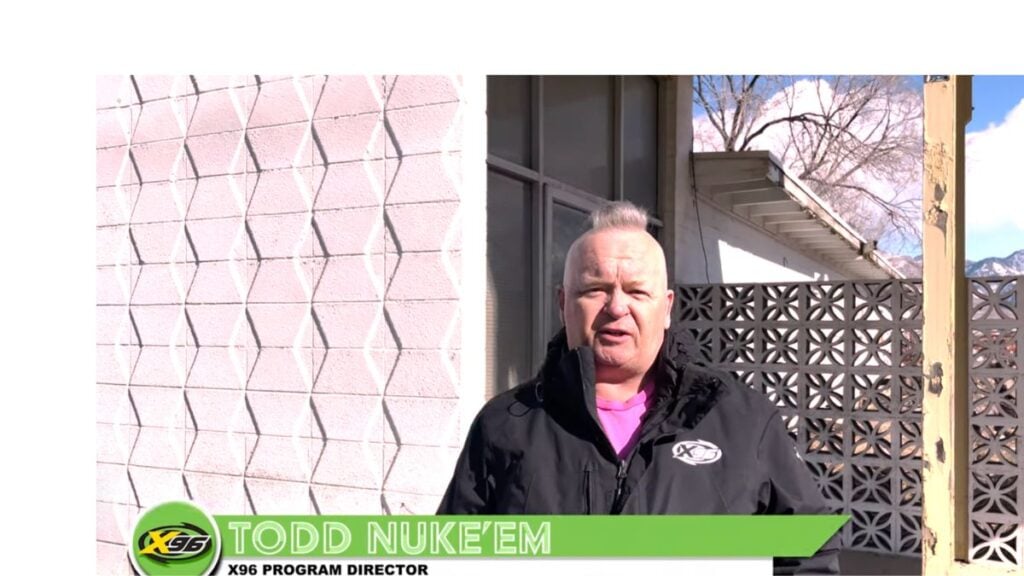
“It’s all alternative. Who cares if it’s from 1989? We just ignore that self-imposed stigma at the format of how we just can’t play anything that’s from 1990 or before,” he says. “You should not let the Classic Rock station steal U2 from you. That’s your band.”

He also adds that he isn’t talking about just a token song once an hour. The station tries to do something memorable at least once each quarter-hour. “Nobody remembers the station that only plays the top-researching songs. They remember when you break the rules. That’s what sticks with people,” explains Todd. “Yes, you still have to play the hits 80 to 90% of the time, but you’ve also got to break the rules sometimes and make a moment.”

Sometimes the Unexpected Is the Point

Part of the strategy for being memorable includes taking a lesson from Adult Hits stations. Much like how those formats purposely put songs next to each other that might not fit together. Todd isn’t afraid to play disparate songs back-to-back. “I think we as programmers can get sort of bogged down with which two songs shouldn’t play next to each other. But as the Jack FMs and the Bob FMs have shown us, sometimes those train wrecks are delightful.”

To be clear, by no means has the station abdicated playing new music. But like with the gold songs, X96 isn’t necessarily following the rest of the format’s lead when it comes to currents. Todd sees a lot of tracks being labeled Alternative that he feels are pop tracks being pushed to the format for market share. “You have to be careful when you start looking at streaming numbers to determine your playlist,” Todd says. “I’ve seen what my eleven-year-old niece does on Spotify and if you start programming your station based on that you’re going to be in trouble.”

Modest Mouse to Sleep Token — Old and New Can Coexist

While he has played pop-crossover tracks like Sombr’s “Back to Friends” and Hozier’s “Too Sweet,” he is also embracing the large number of new releases from legacy acts like Modest Mouse, Muse, Evanescence, and Sublime. Todd is also seeing success with some acts that come from the Active Rock side of the spectrum. Artists like Bad Omens and Sleep Token have been successful for the station. “I think those acts vibe really well on a station that plays Linkin Park.”

But he stresses that this approach might not work for everyone. Between his experience in the market and station research, the music on X96 is dialed in to fit Salt Lake City, where there has been at least one if not a couple of Alternative stations on the air since the 1980s. “I would emphasize that our approach works because we are locally programmed. We don’t care if this recipe works anywhere other than Salt Lake City, that’s where our meters are.”

In fact, when it comes to X96 programming, being locally focused goes far beyond the music. “We work hard to throw our arms around Utah, and I think listeners feel that,” says Todd. He believes committing to localism is the only real hope for radio’s future. “Being local is the only way radio survives. If it all gets homogenized into the same playlist on 50 stations with some overworked voice tracker, it dies.”

A big part of that local approach is having a morning show that’s celebrating its 40th anniversary this year. Radio From Hell is led by Bill Allred, Kerry Jackson, and Gina Barberi, who have built a large, devoted following and are not showing any signs of slowing down.

Unscripted, Unfiltered, and Unmistakably Local

The show is liberal and is not at all afraid to discuss politics. According to Todd, what really makes the mornings special are the segments spent discussing their lives, which, of course, take place in Salt Lake. “It’s like an episode of a local reality TV show. They have these discussions that aren’t planned about life that are the golden moments of the show. That’s where their natural talent for comedy and the chemistry of being together for forty years shines through.”

Another factor that allows X96 to stay intensely local is the freedom that comes with Broadway Media’s ownership rather than being part of a large radio conglomerate. Todd sees that independence as a major advantage. “They can’t be local. They’re centralized, homogenized, and automated. You can beat them by being deeply local.”

Barrett Media produces daily content on the music, news, and sports media industries. Sign up for our newsletters to stay updated and get the latest information right in your inbox.

Can Podcasts Be Defined Better for Advertisers in 2026 and Beyond?

0

What is a podcast in 2026? Is it an on-demand audio file recorded from earlier live broadcast content? Could it be defined as on-demand audio taped and edited for distribution? Is a podcast audio? Video? Or a combination of the two? Can it be downloadable or only streamed? There are so many factors tied to a singular question that doesn’t have a straightforward answer.

That’s why I had to chuckle a bit when I read there’s currently a “secret taskforce” made up of twelve podcasting leaders discussing this very question since July of last year. People who work for Spotify, SiriusXM, YouTube, among others, are meeting to figure out exactly what distribution platforms can agree on when it comes to answering the question: What is a podcast in 2026?

We here at Barrett Media had the same issue. When compiling our Barrett Media rankings nominees late last year, we debated what defines a podcast. Does a program, show, or podcast such as The Mina Kimes Show featuring Lenny belong in the same rankings as The Pat McAfee Show or First Take? We knew many of the shows we placed on the list had a digital-first approach with little to no additional distribution compared to others.

It’s not just a dilemma we faced at Barrett Media. It’s also a controversy in other parts of the sports media landscape. Advertisers allocate budgets for different types of advertising in the digital space, and they require specialized attribution that’s more uniform across platforms.

It’s no different than if my local body shop placed ad dollars with a radio station but received four different types of attribution data: one for over-the-air radio and others for on-demand audio, streaming video, and social media.

Advertisers need clarity, and a lot of advertising dollars are on the line.

Is This Worth The Time?

Hence why I chuckled when I read the report that this “secret taskforce” has debated this issue for almost a year, yet still hasn’t produced an official answer.

Keep in mind, the term podcast is rooted in Apple’s signature “pod” era of the early 2000s. Without personally knowing whether there’s Apple representation in the “secret taskforce,” one has to wonder: if there is, could some politicking over a potential brand change be taking place?

Wouldn’t you love to be a fly on the wall in that room?

The singular hurdle all these companies need to overcome is how to measure success and attribution on their individual platforms. Data is the currency that drives advertising dollars. The more data points, the better. Even more valuable is a clear picture of attribution tied to point of sale, which is huge for securing additional advertising dollars.

Each of these companies invested in dynamic analytics tailored to fit its own business model. On the surface, one company’s metrics don’t match what another company is selling. As a result, advertisers have budgets available but often hesitate to spend because of confusion over which budget bucket the content belongs in. Is it video or audio? Is it creator content or something else entirely?

According to a survey from podcast advertising agency Oxford Road, 76% of brands said they’d increase their podcast ad buys if YouTube attribution were standardized with audio. The on-demand audio space already has its formula. The issue is video never asked for the cliff notes, nor should it have to.

Video metrics are different from audio metrics. Downloads are different from watch time. Time spent listening is different from average percentage viewed.

Advertisers are demanding action. Why? Because a potential additional $1 billion in ad spend is on the line.

Getting Answers Soon?

The best part of the story I read, however, was the following: (via The Hollywood Reporter)

“The chosen definition and metrics are to be determined by a vote of members, who’ve met at least monthly since the group’s inception. But because there were competing interests at play within the task force, as well as proprietary information and advantages companies may want to retain, Oxford Road CEO Dan Granger noted that members who disagree are also allowed to attach a dissent. Proposing standardized metrics and a definition also doesn’t mean it will automatically be adopted across the industry or even by every company in the taskforce.”

So, let me get this straight.

Advertisers are demanding clarity and uniformity from distribution platforms.

Those distribution platforms formed a “secret taskforce” to address those demands.

The “secret taskforce” can propose clarity and uniformity but can also offer dissent, preventing a sweeping ruling on the matter.

Then you’re telling me the proposed metrics and definition of podcasting still might not be adopted universally?

What’s the point of this “secret taskforce” then?

Maybe that’s the real answer to the question of what a podcast is in 2026. A podcast is whatever each platform needs it to be at that particular moment. Audio companies want audio metrics. Video platforms want video metrics. Creators want the widest possible reach. Advertisers want one clean and simple explanation for where their money is going.

Yet every company involved also wants to protect the proprietary data and business advantages they’ve spent years building.

That’s why this “secret taskforce” feels less like a solution and more like a group project where nobody wants to share their notes. Everyone agrees the industry needs clarity, but nobody wants to surrender control of the scoreboard.

So while the “secret taskforce” debates definitions, dissent clauses, and standardized measurements, the rest of the industry keeps moving anyway. Audiences aren’t sitting around wondering whether they’re consuming a podcast, a video show, a digital broadcast, or creator content.

They’re just hitting play.

Ironically, consumers already solved the problem. It’s the companies making money off them that still can’t decide what to call it.

Barrett Media produces daily content on the music, news, and sports media industries. Sign up for our newsletters to stay updated and get the latest information right in your inbox.

How Jason Rantz Became a Cable News Regular

There’s a version of this story where a Seattle-area radio host stays in Seattle. Jason Rantz isn’t living that version. The Seattle Red 770 host has quietly built one of the more remarkable cable news footprints in local radio, logging more than 1,000 appearances on Fox News since 2019 and showing up regularly on CNN, NewsNation, and Fox Business.

He doesn’t treat the television circuit as a distraction from his day job. Instead, he treats it as an extension of it — and the numbers bear that out.

The hustle isn’t incidental. Rantz actively courts the chaos that comes with constant travel, rapid-fire topic changes, and stepping into debates with people he’s never met hours before airtime. Yet, he says none of it feels like a grind.

“It’s always fun,” said Rantz. “It’s busy, there’s no doubt. But I don’t normally view it as busy work, if that makes sense. I enjoy doing the TV debates. I enjoy travel. And I enjoy talking about issues that I actually care about. So I get a lot of excitement out of it.”

Built for the Format

Not everyone thrives under the conditions cable news imposes. Panels move fast. Hosts change topics mid-thought. Bookers hand you a subject two hours before you go live. Rantz doesn’t just survive those conditions — he’s built for them. Growing up in Los Angeles and now planting his flag in one of the country’s most liberal cities has, paradoxically, prepared him well.

“I’ve never really felt uncomfortable in that situation,” Rantz stated. “I think that’s mostly because I grew up in Los Angeles and now live in Seattle. I’m surrounded by people who disagree with me on pretty much everything, so I’m always in that same position where I have to defend a view I hold. You’re either naturally comfortable or you’re not. And I’m lucky that I’m naturally comfortable in those positions. I’m open to it. Not everyone has the personality that wants to defend their positions, and it’s certainly easier to monologue than it is to debate, but I enjoy it. I legitimately enjoy talking to people I disagree with.”

That comfort translates directly into how he navigates multi-guest panels, where time is scarce and discipline matters. He’s learned to let the host run the show — something he says isn’t always easy for people who are used to controlling their own airspace.

“On the TV side specifically, if I’m on a panel and not leading a segment, I don’t control the interview, nor do I try to control it,” the Seattle Red 770 host shared. “I want the host to control it the same way I would want to control the conversation if I were the host. So I go with the flow. I don’t make up positions. If I don’t have a strong position, you’re not going to hear me fight passionately on behalf of something. But as someone in talk radio, I usually have a position on everything and a lot to say about everything.”

More Than a Media Hit

There’s a business case behind every cable hit, and Rantz makes no effort to hide it. Each appearance on CNN, Fox News, or NewsNation reaches audiences who’ve never heard of Seattle Red 770 — audiences he can convert into podcast subscribers and readers of Seattlered.com, his Pacific Northwest news outlet launched last year.

“You get in front of people who either haven’t heard the perspective or have no idea who you are,” Rantz said. “My show is local to Western Washington, but it’s available on podcast platforms, and we talk a lot about issues that matter to national audiences. It continues to grow, presumably because I’m doing these kinds of appearances. Someone finds out who I am in Texas or Oklahoma or New York and becomes a podcast subscriber. Beyond that, I do a lot of work in the digital space. We launched Seattlered.com last year, and that covers more than just Seattle — it covers the Pacific Northwest. There’s certainly value in getting in front of national audiences who don’t even realize I have a radio show.”

Then comes the feedback loop. A Fox News hit on Tuesday becomes content fuel for Wednesday’s radio show. The two platforms don’t compete with each other — they feed each other.

“When you host a solo show, you’re reacting a lot,” stated Rantz. “If I do a segment on CNN the night before or with Laura Ingraham on Fox News, which I just did yesterday, I can come onto the show the next day and talk more about some of those issues. Regardless of what show you do, there’s only so much time dedicated to a topic. You can expand and make points you weren’t able to make on television or build on points you already made.”

Rantz shows up on Fox and Fox Business two to three times weekly, CNN every other week, and does a regular slot on NewsNation’s Katie Pavlich Tonight. He credits his continued bookings to a simple approach: stay honest, argue in good faith, and don’t hog the mic.

“I think it has a lot to do with whether or not you’re approaching things in good faith,” Rantz said. “If you are honest in your takes, people can disagree with you, but there are basic sets of facts. If you’re going to make stuff up, I imagine people aren’t going to want to book you or hear you. I think there’s more respect for people who engage in fact-based opinions. You start with facts and analyze from there. As long as you’re able to do that, and the audience, bookers, producers, and hosts respond positively, they’ll ask you back.”

Barrett Media produces daily content on the music, news, and sports media industries. Sign up for our newsletters to stay updated and get the latest information right in your inbox.

92 PRO FM’s Bekah Berger is Riding the Real Housewives of Rhode Island Wave

0

When The Real Housewives of Rhode Island came to Providence, one radio station was already there waiting.

Seeing It Coming Before Anyone Else

Most local media outlets waited for Bravo to make it official. Bekah Berger didn’t.

The 92 PRO-FM morning show host and entertainment reporter started tracking the story in summer 2024, when a vague casting notice surfaced seeking Italian American women entrepreneurs in Rhode Island. No network. No franchise name. Just a whisper.

Berger brought listeners along for the ride anyway. Through her daily entertainment segment “Bekah’s World,” she tracked every rumor as it surfaced. “I took listeners on the same ride I was on,” she said. She covered it on social media, sparking conversations that were, by her own description, “always engaging and sometimes even a little divisive — if you can believe that.”

By the time Bravo formally announced Real Housewives of Rhode Island in May 2025, 92 PRO-FM had already built an audience that was primed and ready.

That kind of early investment is rare. It paid off.

Building Something Bigger: The Real Talk Rhody Podcast

When the official announcement dropped, station management didn’t just encourage more coverage. They pushed Berger to launch a dedicated podcast.

Real Talk Rhody was born. It airs weekly and focuses on RHORI episode recaps, cast interviews, and spotlights on local people connected to the show. Outside of the season, it pivots to covering Rhode Island and Southern New England more broadly.

Berger had wanted to launch a podcast for years. She’d considered a parenting-and-pop-culture concept — “Mom and Pop Culture,” she called it — but it never clicked. Then RHORI arrived and everything aligned. “As soon as it was officially announced and management and my family encouraged me, it really felt like it was all meant to be,” she said.

The podcast gives her room the morning show format doesn’t allow. Longer takes. More freedom with timing. Deeper conversations. Berger edits her own audio and pulls sound clips herself — skills that give Real Talk Rhody a tighter feel than many local podcast efforts. “I’ve always asked the question: what is a podcast anyway? Isn’t it just a long form radio show?” she said. “I believe it is.”

A Station-Wide Effort

This wasn’t a solo operation. 92 PRO-FM went all in as a team.

Afternoon host Jess Schiano used her existing relationship with Twin Oaks — the iconic Rhode Island restaurant — to lock in a premiere party venue. Personalities Barbi Jo DiMaria and Kim Zandy contributed their own connections and presence. The promotions team handled logistics before and during the event.

Berger is generous in crediting her colleagues. “Really all of the 92 PRO-FM personalities embraced the coverage,” she said. When a local story this big lands in your backyard, that kind of unified response matters.

The Twin Oaks Premiere Party

The event itself delivered something money can’t manufacture: authenticity.

The station hosted a season one premiere party at Twin Oaks, a restaurant woven into Rhode Island’s cultural fabric. They kept one detail quiet — some of the cast would actually be there. Jo Ellen, Kelsey, and Liz showed up despite a packed evening of obligations. “We never actually announced that some of the housewives would be in attendance,” Berger said. “The fact that they took the time to come to our event meant a lot to us, Twin Oaks, and the listeners.”

What unfolded was, as Berger described it, “wonderfully meta.” Listeners watched the housewives watch themselves on screen. The room held fans, cast members, and local pride all at once. “I want to replay that moment over and over,” she said. “It embodied what Rhode Island should be about — local connections and support for one another.”

Covering the Skeptics, Too

Not every Rhode Islander is a Bravo fan. Berger knows this and doesn’t pretend otherwise.

“I’m very well aware that not everyone lives in a Bravo bubble like I sometimes tend to,” she said. She balances RHORI coverage with everything else her audience expects. She’s watched skeptical listeners gradually come around, and she respects those who haven’t. “I also know Rhode Islanders love hearing about fellow Rhode Islanders doing major things. That’s why Real Talk Rhody has been such a safe space for me — and a great option for those who want more coverage on RHORI.”

That balance is part of why the coverage lands. She’s a credible entertainment reporter first. The RHORI enthusiasm feels earned, not performed.

What’s Coming Next

The momentum isn’t slowing. Berger has a full guest lineup ready for Real Talk Rhody, including more cast interviews. On June 20th, she’s hosting a live Q&A panel at Bally’s Casino in RI featuring cast members Jo Ellen, Liz, Alicia, and Kelsey in a Watch What Happens Live-style format.

On Real Talk Rhody, Berger has already had strong conversations with the new “Bravo-lebrities” Liz McGraw, Alicia Carmody, and Rosie Woods DiMare. “They didn’t skip a beat,” she said. “They’re fun and funny and genuinely themselves.”

As for whether Berger herself might appear in a future season? She deflected with the self-deprecating humor that makes her good at her job. “I shop very often at the Dollar Store. I currently have two loads of laundry to fold. Trust me — they don’t want me.”

Rhode Island does, though. And 92 PRO-FM made sure to show up for it.

Barrett Media produces daily content on the music, news, and sports media industries. Sign up for our newsletters to stay updated and get the latest information right in your inbox.

The Podcast Definition Project Is an Exercise the Industry Needs — But Can’t Win

Nobody asked for a rulebook on what counts as a podcast, and yet, here we are. Oxford Road, a podcast advertising agency, has assembled a 12-member task force featuring representatives from Spotify, SiriusXM, YouTube, Libsyn, and Podscribe to do exactly that — define what a podcast actually is. It’s a noble goal. It’s also, almost certainly, a futile one.

To be fair, the impulse makes sense. Advertisers have poured serious money into the podcast space, and they’d like to know exactly what they’re buying. Publishers want credit for every listen. Platforms want to protect their turf. Everyone has a stake in how the word “podcast” gets used. But wanting a clean definition and getting one are two very different things.

The medium has always resisted easy categorization. Podcasting grew up outside the system — no FCC license required, no Nielsen ratings to chase, no program director standing between a creator and their audience. That renegade spirit isn’t just lore. It’s baked into the DNA of the format.

The Definition Problem

So what happens when Oxford Road’s taskforce actually delivers a definition? The most likely outcome is something broad enough to include on-demand audio and video — which, functionally, describes nearly everything that doesn’t air on terrestrial radio or TV. That’s not a definition so much as it’s a description of the modern media landscape.

YouTubers will bristle at being lumped in with traditional podcast publishers. Traditional podcast publishers will bristle at being compared to YouTubers. And advertisers — who drove the entire demand for clarity in the first place — will likely find themselves no better equipped to make buying decisions than they were before the taskforce convened.

The tension here isn’t just semantic. It’s structural. Video podcasts, audiograms, serialized radio content dropped into an RSS feed, live-streamed recordings edited for on-demand release — these formats all exist on a spectrum, and drawing hard lines means leaving someone out. Someone with lawyers, lobbyists, or at minimum, a very loud social media presence.

Will Anyone Actually Follow It?

Even if the taskforce lands on a workable framework, adoption is far from guaranteed. Podcasting’s history is littered with industry attempts at standardization that never quite stuck — measurement standards, download definitions, attribution models. Progress has happened incrementally, but rarely because someone issued a decree.

The creators who built this medium from scratch didn’t wait for permission, and they’re not likely to reshape their identity around a definition they didn’t author. Advertisers, meanwhile, will keep buying what performs — definition or not. The market has its own logic, and trade definitions tend to matter most to people inside the trade bubble.

That doesn’t mean the exercise is worthless. Getting Spotify, SiriusXM, YouTube, and Libsyn in the same room — or at least the same taskforce — is genuinely significant. If the group can establish even a baseline vocabulary that advertisers and publishers use consistently, that’s a real win. But the bar should probably be set there, not at some sweeping redefinition of what counts as a podcast.

The industry needs this conversation. It just shouldn’t expect a resolution that makes everyone happy. Some definitions don’t resolve debates. They only move them to a different conference room.

Barrett Media produces daily content on the music, news, and sports media industries. Sign up for our newsletters to stay updated and get the latest information right in your inbox.

Social Media Algorithms Are Killing the News — Here’s What to Do

I got good news and bad news for you. The good news? Most Americans know what it takes to be a good consumer of news. The bad news? The news is irrelevant. And perhaps social media is to blame.

Almost halfway through the year, we’ve seen multiple outlets hand out layoffs. And last week, we held a funeral service for CBS News Radio. While 47% of Americans believe it’s important for people to regularly get news, the other half of the country says they get news “mostly because they happen to come across it.”

Read that again. Half the country, a large majority of whom are young adults, gets news “mostly because they happen to come across it.” This spells disaster for our future unless we act.

This data comes from Pew Research’s latest “short read.” Quietly, this month, the outlet released “What Americans Think It Takes to Be a Good News Consumer.”

The Good News

The great news is that people know what it takes not to become a brainwashed partisan consumer.

Pew reports 20% of those polled believe “being discerning or skeptical” is part of being a good consumer of news. They added, “Another common description of a good news consumer is someone who remains informed.

The 17% of responses that included this idea said things like “Follow the news on a daily basis” and “Try to stay informed on current events.”

Other key phrases people put forth as hallmarks of a good news consumer include “find reputable outlets” and getting news from “a variety of sources.”

The Bad News

The “short read” opened up like the 1984 version of Apple Writer II and can be easily overlooked. In part because it doesn’t have the visuals we’ve become accustomed to. But also because it isn’t one of Pew’s top three data points when you visit their media page. It didn’t hit the home page; to be honest, it’s a little buried.

The report comes as a follow-up to February’s data dump about America’s relationship with the news. The media as a whole can’t survive if people are flippantly coming across their latest and greatest report amid doomscrolling. Literally, if you play craps, roulette, or blackjack, you’d have higher odds of winning than of popping up in someone’s compulsive scrolling.

So for us, as curators of the news, our goal shouldn’t be to make the most explosive news — even though that’s seemed like the go-to approach since Buckley vs. Vidal in 1968. Instead, we should Make America Care Again.

The MACA Plan

Why should we make America care again? Because as mysterious as Meta, Google, and any other tech company is about their algorithms, it all comes down to a very simple, stupid science: overstimulate the brain with dopamine to keep you coming back for more. That’s it.

I don’t care what any tech nerd has to say about algorithm technicalities. Social media — where most people are getting their news — is designed like a slot machine. Don’t like what you see on your Twitter feed? Pull down, and it’ll populate more stuff you care about.

And there’s that word again: care. The internet knows what our audience — or potential audience — cares about. The algorithm nerds won’t be changing anything in our favor. So unless something on our end changes, there will come a day when people won’t “happen to come across” news anymore.

This is why you need to meet people where they are with the news.

Meet People Where They Are

Here’s a prime example. In April, New York State lawmakers passed a law banning potassium bromate, red dye number 3, and propylparaben. So what did every single news outlet do? They went and talked to restaurant owners. The story became about how this will affect a small business’s bottom line — and, of course, the world’s best pizza and bagels.

Not a single outlet in the number one market went and talked to regular people about the change. This is one of the most obstinate failures to meet people where they are.

All you had to do was turn to any customer in that restaurant and ask, “Do you think this legislation will affect your daily bagel and smear?”

There are more than seven local TV stations in various languages, plus multiple radio news and digital and print outlets in that market. How not one news director, managing editor, reporter, or photographer thought to ask a customer whether they were concerned about the taste of their food is beyond me. You failed to make the audience care.

Instead, reporters filed a report and hoped that with the right SEO phrases and algorithm tricks, it would magically appear in every New Yorker’s news feed. Well, it didn’t. You made it about the business, not the customers who keep the business alive. You didn’t give regular people a reason to care.

Sure, lots of people will care about lots of different things. But the one thing everyone in this world cares about is the impact anything — legislation or otherwise — will have on their life.

The best example I can give you is this: as a mom, I care about the food legislation because my born-and-bred New York kids won’t taste red dye #3 on their Sunday morning rainbow bagel with strawberry cream cheese.

When they say, “Mommy, this tastes different — I don’t like it, can I have something else?” and I have to buy a whole other breakfast because red dye #3 was replaced with beet root powder and the potassium bromate is gone, that’s when I’ll start to care. Sure, I’ll be happy it’s healthier, but at the end of the day, this change is going to affect my bottom line, and that’s why I care.

So yes, you can make people care about the news. You just need to think outside the box and get the audience involved. It’s not about you, and it’s not about whatever local business you’re interviewing. It’s about the community in which that business is built.

People “happen to come across news” when it affects their community. That’s when people will care. Just one extra question can expand your reach tenfold.

Barrett Media produces daily content on the music, news, and sports media industries. Sign up for our newsletters to stay updated and get the latest information right in your inbox.

WROR-FM Launches New Morning Show Starting June 1st

0

Boston’s 105.7 WROR-FM has a new morning show. The ROR Morning Show with LBF and Adam 12 debuts Monday, June 1st.

What We Know: Lauren Beckham Falcone, a WROR morning staple since 2011, teams with Adam 12, a 30-year broadcast veteran. Adam 12 previously ran programming at WBOS-FM and produced the Toucher & Hardy Show at 98.5 The Sports Hub. Together, they’ll air weekdays on-air and via the free WROR app. The show features two recurring segments: Supah Smaht in 60 Seconds (weekdays at 8:05 a.m.) and DM Disasters (6:40 and 7:40 a.m.).

What They Said: Adam 12 called the pairing a dream come true, saying he’s “WROR is a dream come true. I know we’re going to have an absolute blast.” Meanwhile, Falcone echoed the excitement, describing the opportunity as “truly special.” Station Program Director Scott Morello added that the combination creates a morning show that’s “energetic, funny, and incredibly engaging.”

What Remains Unclear: Beasley hasn’t disclosed ratings targets or a full content roadmap beyond the two named segments. Additionally, no details exist yet about potential guest bookings or community partnerships. However, both features suggest an audience-interactive format is central to their strategy.

What It Means: This pairing signals Beasley’s confidence in familiar local talent over outside hires. Boston radio listeners get a homegrown show built on chemistry and market knowledge. Furthermore, promoting from within reinforces station loyalty and brand continuity. Ultimately, WROR is betting that authenticity — not flash — wins Boston mornings.

Barrett Media produces daily content on the music, news, and sports media industries. Sign up for our newsletters to stay updated and get the latest information right in your inbox.

ESPN Digital, Social Earns Strongest Month Yet Reaching 82% of U.S. Adults

0

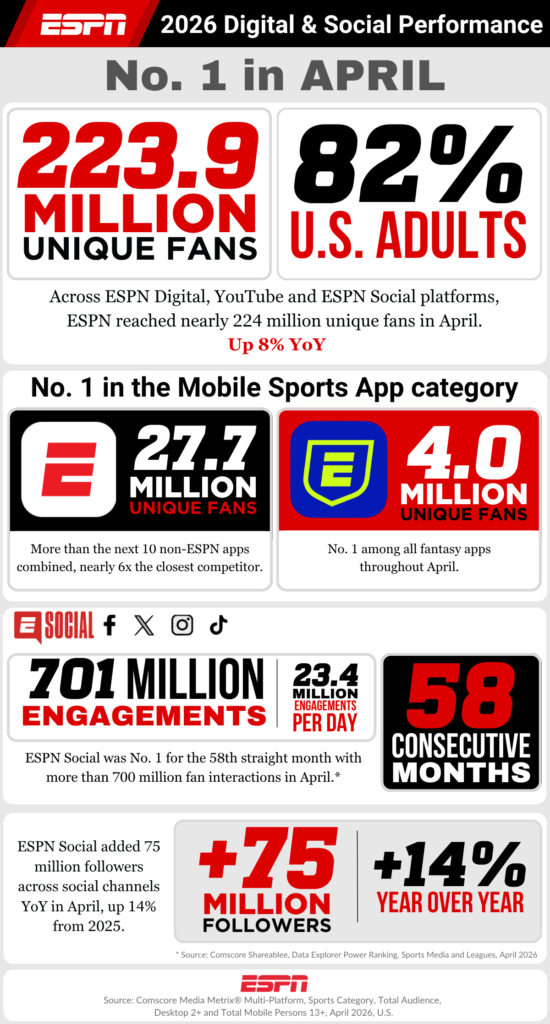
ESPN dominates on digital extending the network’s streak to 58 straight months finishing number on in sports digital. The network reached 223.9 million unique fans in April 2026. That figure represents 82% of all U.S. adults — up 8% year-over-year.

What We Know: April was ESPN’s strongest digital month yet. Across ESPN Digital, YouTube, and social platforms, total unique fan reach jumped 8% compared to April 2025 — growing from the 196.6 million reported in March. The network’s App drew 27.7 million unique users, topping the next 10 non-ESPN apps combined. Additionally, ESPN Social surpassed 701 million engagements — averaging 23.4 million per day — while adding 75 million new followers, up 14% year-over-year.


What The Numbers Show:

ESPN Digital & Social Graphic April 2026 (Courtesy: ESPN Press)

What Remains Unclear: Specific platform-by-platform breakdowns aren’t detailed in the data. The release does not specify which sports events drove April’s significant traffic surge. Furthermore, ESPN.com drew 62.3 million unique visitors — up just 1% year-over-year — suggesting slower web growth compared to app and social gains.

What It Means: ESPN’s digital dominance continues to widen among it’s competitors. Holding the No. 1 social spot for 58 consecutive months signals consistency, not just a hot streak. Moreover, reaching 82% of U.S. adults makes the network nearly inescapable for sports fans. For anyone competing in the digital sports media space, these numbers are a serious benchmark. It shows deep fan engagement beyond passive consumption. For competitors, the gap isn’t closing. It’s growing.

Barrett Media produces daily content on the music, news, and sports media industries. Sign up for our newsletters to stay updated and get the latest information right in your inbox.
NBA Reportedly Hires Matt Volk as Newly Created General Manager of Local Media

0

The NBA is attempting to address the local media rights of it’s franchises ahead of the upcoming season this fall. According to the Sports Business Journal, the league has hired veteran media executive Matt Volk as a newly created role of general manager of local Media, effective June 22.

What We Know: Volk arrives from NESN and SportsNet Pittsburgh, where he served as COO for three years. He will lead a newly formed local media group covering both the NBA and WNBA. His team will handle live game production, broadcast operations, programming, and commercial execution across all team markets.

What’s At Stake: A national streaming package expected to launch in 2027. Meanwhile, the focus for Volk will be maintaining standing with local teams. Headed into the new season this fall, 13 NBA teams will no longer lean on FanDuel Sports Network as their local distribution model. This was the fallout from the collapse of Main Street Sports Group. Following incidents of not making financial payments to it’s partner franchises in early 2026.

What Remains Unclear: The full scope of Volk’s job duties is unknown. It is unclear how many staff members his team will ultimately include. However, a national streaming package for local NBA games will likely launch for the 2027-28 season. How local rights agreements with individual teams are structured around that launch remains an open question.

What It Means: The NBA understands that local rights are just as vital as the national rights. With thirteen teams aiming for a new local distribution home, the league is allocating assets to assist in aligning for a national streaming package to launch the season after next. Volk brings deep experience from ESPN, Audacy, and NBC Sports Washington among other places. His background spans both sides of the NBA and WNBA. The league is clearly building infrastructure ahead of a major shift in how fans access local games in the very near future.

Widespread Changes at 60 Minutes as Cecilia Vega, Senior Leaders Exit

0

Major changes were announced to 60 Minutes on Thursday, days after the 58th season of the news magazine ended.

What We Know: Correspondent Cecilia Vega has exited 60 Minutes. Her departure comes as Sharyn Alfonsi announced she would not be back with the program on Wednesday. Additionally, senior executives from the news magazine are also departing. Executive Producer Tanya Simon has been fired, according to a report from Puck’s Dylan Byers. Nick Bilton replaced her in the role. Executive Editor Draggan Mihailovich and Senior Producer Matthew Polvoy have also departed.

What They Said: “Tanya has dedicated more than three decades to 60 Minutes, and she has served the institution with enormous care, professionalism, and devotion. She led the broadcast during an extraordinarily challenging period with grace and steadiness, and we are deeply grateful for her contributions to the show and its legacy. The reality facing journalism in 2026 is not easy. Information is fragmented. Algorithms reward outrage. AI-generated misinformation is proliferating. Audiences are overwhelmed. And they have lost trust in legacy media. That reality makes the mission of 60 Minutes more important than ever.” -CBS News Editor-in-Chief Bari Weiss and President Tom Cibrowski in joint memo to staff

What Remains Unclear: If any other on-air personnel changes will take place before the next season of the show. Anderson Cooper has already announced he will not return. With the revelation of Vega and Alfonsi also departing, it remains to be seen who will be added to the program. Only four of the seven correspondents from the past season remain.

What It Means: Reports continually surfaced that Bari Weiss was unhappy with the direction of 60 Minutes. Those reports ultimately proved to be true. Widespread changes to a program that finished as the most-watched news television show back up those claims.

Barrett Media produces daily content on the music, news, and sports media industries. Sign up for our newsletters to stay updated and get the latest information right in your inbox.