CNN has announced the promotion of Lisa Respers France to Senior Entertainment Reporter.
Respers France was previously elevated to Entertainment Reporter in January 2024.
She has worked on a variety of programming and content offerings for CNN during her tenure. In 2023, she provided insights for the Taking on Taylor Swift documentary.
She also previously hosted the Lisa’s Desk franchise that included newsletters and podcasts. She co-hosted the CNN podcast Lisa, Sandra and Kristin Go to the Movies, which was published in 2019.
The network says Lisa Respers France will report across its entire suite of platforms. She’ll continue to cover the intersection of entertainment and culture.
Before her time at CNN, Respers France worked at both the Los Angeles Times and The Baltimore Sun.
Barrett Media produces daily content on the music, news, and sports media industries. Sign up for our newsletters to stay updated and get the latest information right in your inbox.
Libsyn has announced it has entered into agreements with five new podcasts to serve as the exclusive hosting and advertising partner.
Under the agreement, Libsyn will host and monetize each show for both the audio and video versions of the programs.
The new shows are Locked In with Ian Bick, Unlearned Wisdom with Johnny Chang, Restricted Handling, Was I In a Cult?, and The Joe Vulpis Podcast.
“When you look at what Ian, Johnny, Ryan, Glenn, Tyler, Liz, and Joe have built, you see creators who didn’t wait for permission, they went and found their audiences and earned their loyalty,” said Libsyn Senior Vice President of Business Development Stephen Perlstein. “That’s exactly who Libsyn is built for. We’re here to give those creators the infrastructure, the ad revenue, and the distribution, including through our direct integrations with the Spotify Partner Program and Apple Podcasts video, to turn what they’ve built into a real, lasting business.”
The New Shows
Locked In with Ian Bick actively brings forward conversations with people directly impacted by the justice system, while also shining a light on voices and experiences that often go unheard.
Unlearned Wisdom with Johnny Chang, meanwhile, is led by former gang member turned pastor Johnny Chang, who guides listeners through themes of spirituality, transformation, and emotional healing.
Restricted Handling features hosts Ryan Fugit, a former CIA and U.S. Army officer, and Glenn Corn, a retired CIA Senior Intelligence Service officer; together, they deliver insider perspectives on global events and security issues.
Was I In a Cult? is helmed by documentary filmmaker Tyler Measom and writer/comedian Liz Iacuzzi, who together unpack the complex realities of cult environments through compelling firsthand accounts.
The Joe Vulpis Podcast, meanwhile, tracks the latest in entertainment, celebrity, and viral trends, keeping listeners closely connected to the cultural conversation.
Barrett Media produces daily content on the music, news, and sports media industries. Sign up for our newsletters to stay updated and get the latest information right in your inbox.
The WNBA made it official. All 44 Indiana Fever games will air on national television in 2026. That means every Caitlin Clark appearance reaches a national audience.
Broadcasts will span ABC/ESPN, NBC/Peacock, Prime Video, CBS, ION, USA Network, and NBA TV.
Commissioner Cathy Engelbert set the tone clearly. “The WNBA is coming off a landmark season in 2025, one that was defined by incredible basketball and countless memorable performances,” she said. “The WNBA’s unprecedented lineup of linear and streaming partners will shine a light on must-see matchups.”
The league knows star power drives eyeballs. It’s delivering accordingly. The full schedule features a record 216 nationally distributed games. New media partners NBCUniversal and USA Network join returning partners Disney, Amazon, CBS Sports/Paramount+, and Scripps/ION.
Disney leads with 30 games. ABC carries 13, its most ever, including the All-Star Game. The season opens May 9 on ABC with Indiana hosting Dallas at 1 p.m. ET.
NBC returns to WNBA coverage for the first time since 1997. Seven Sunday games highlight its slate. Indiana visits Las Vegas on July 12 at 9 p.m. ET — a marquee primetime window.
ION again leads all partners with 50 games. Its Friday Night Spotlight doubleheaders deliver consistent weekly appointment viewing. USA Network follows with 48 games anchored by Wednesday and Monday nights. Prime Video carries 31 games, including the Commissioner’s Cup Championship on June 30.
Barrett Media produces daily content on the music, news, and sports media industries. Sign up for our newsletters to stay updated and get the latest information right in your inbox.
Audacy’s V-103 in Atlanta is making moves. The legendary urban station announced a series of programming updates effective May 11.
The biggest addition is Francesca Amiker. The four-time Emmy Award-winning broadcaster joins The Big Tigger Morning Show as co-host, weekdays from 6–10 a.m. ET.
Amiker brings over 16 years of experience, most recently as a host and correspondent for E! News. Before that, she anchored mornings at 11Alive and created The A-Scene, a first-of-its-kind TV and film franchise in local news.
“Joining V-103 feels like stepping into history while helping shape its future,” Amiker said. “I’m excited to return home to Atlanta with a station that truly puts the people first.”
VP of Programming and Brand Manager Reggie Rouse called Amiker a powerhouse.
“This new lineup reinforces V-103’s position as the city’s most influential station,” he said.
Also returning is Frank Ski. The veteran media personality comes back as a weekend host Sundays from noon to 4 p.m. ET. Ski’s original V-103 run spanned three decades, including a celebrated morning show stint from 1998 to 2012.
DJ Sturgess earns a promotion. The former producer on Greg Street Afternoons moves to night show host, weeknights from 7–10 p.m. and Saturdays. Sturgess rose from intern to leading a number-one-rated show. His civic work through The Sturgess Foundation adds credibility beyond the mic.
The updated weekday lineup slots Danie B middays, Greg Street in afternoons, and Joyce Littel handling the late-night Quiet Storm.
Barrett Media produces daily content on the music, news, and sports media industries. Sign up for our newsletters to stay updated and get the latest information right in your inbox.
FOX Sports has reportedly finalized a deal to re-acquire the broadcast rights to the 2026 Big Ten Championship Game from NBC, according to On3.
NBC received between $45 million and $55 million for the game. FOX will also hand NBC one additional Big Ten game this season as part of the arrangement.
Jon Miller, NBC Sports President of Acquisitions & Partnerships, told Puck’s John Ourand that NBC had “interests from streamers” for the broadcast. However, according to the report, NBC’s only real option was to air the game if FOX Sports passed.
NBC had no authority to block FOX from buying back the rights. FOX Sports wanted desired the game, and reportedly have closed the deal for it.
Under its current Big Ten deal, FOX Sports now controls the championship game in five of seven years. CBS Sports holds the other two.
The 2025 title game between undefeated Indiana and Ohio State drew 18.3 million viewers — the sixth most-watched college football game last season and the top-rated game of championship weekend. It topped the SEC title game between Georgia and Alabama by nearly 1.5 million viewers. FOX also owned the two biggest regular-season games. Ohio State vs. Michigan pulled 18.4 million viewers. Ohio State vs. Texas drew 16.6 million.
NEWS: FOX officially buys back 2026 Big Ten title game rights from NBC, sources tell @On3
The kicker? NBC had no choice but to sell if FOX wanted it back. It did.
Last year’s Indiana-Ohio St game was most watched title game (18.3 million viewers)https://t.co/s5IOYsAzCl
Barrett Media produces daily content on the music, news, and sports media industries. Sign up for our newsletters to stay updated and get the latest information right in your inbox.
ESPN’s debut of live WWE programming on its linear networks delivered encouraging early results. WrestleMania 42 simulcast windows on ESPN and ESPN2 averaged 1.72 million viewers Saturday and Sunday evening, according to Ryan Glasspiegel of Front Office Sports.
Those numbers exclude ESPN Unlimited viewers, where the full event streamed exclusively.
This was the first time a WWE WrestleMania event was broadcast on traditional liner television. Wednesday, the WWE noted the two-night event was one of the highest grossing events in company history. Gate, sponsorship, merchandise, and digital metrics all hit record or near-record levels
ESPN is currently paying a reported $325 million annually for WWE Premium Live Events on their ESPN Unlimited plan.
The pre-show countdown specials also performed well. The one-hour lead-in on Saturday attracted 676,000 viewers, while Sunday’s countdown show reached 750,000 viewers. These figures add further context to WWE WrestleMania 42 viewership, showing steady interest leading into both nights.
With the event placed against both NBA and NHL postseason play on other networks, the viewership should considered positive being it was a company first. ESPN has not released any additional data on the number of added subscriptions the ESPN Unlimited plan received during the two-night event.
These were the TV ratings for the WrestleMania simulcasts on ESPN2 (Saturday) and ESPN (Sunday). Note these numbers do not include everyone who was watching on the ESPN Unlimited streams, which had the whole shows both nights. @FOS
Barrett Media produces daily content on the music, news, and sports media industries. Sign up for our newsletters to stay updated and get the latest information right in your inbox.
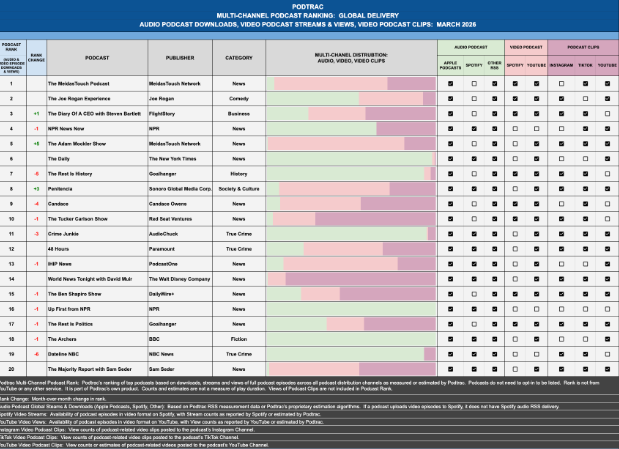
Podtrac has released its March multi-channel podcast rankings. It shows The MeidasTouch Podcast besting The Joe Rogan Experience for the top spot.
The MeidasTouch Podcast and the show from Joe Rogan remained steady in their positions from the February rankings.
However, the two shows have drastically different distribution methods to earn the top two positions. The majority of consumption for The MeidasTouch Podcast comes from video. It utilizes both Spotify and YouTube for its video distribution. Consumers use clips of the podcast on platforms like TikTok and YouTube more than they use Apple Podcasts and other RSS feeds for the audio-only version, Podtrac data shows.
Meanwhile, just over half of The Joe Rogan Experience‘s consumption comes from the audio version of the show. Similar to MeidasTouch, Joe Rogan’s show also has a strong video podcast component with Spotify and YouTube. A significantly smaller portion of Rogan’s audience consumes the show through clips.
Elsewhere in the top 10 shows, NPR News Now dropped one spot to fourth. It was jumped by The Diary of a CEO with Steven Bartlett. The Daily, which features an audience almost exclusively of audio listeners, was fifth.
Both Candace Owens and Tucker Carlson saw their programs slide during March. Owens’ show fell four places to ninth, while The Tucker Carlson Show fell one position to 10th.
Barrett Media produces daily content on the music, news, and sports media industries. Sign up for our newsletters to stay updated and get the latest information right in your inbox.
Yesterday, change began at Boston’s sports radio WEEI as Andy Hart and Nick ‘Fitzy’ Stevens departed their roles in afternoon drive. For almost two years, Hart, Stevens, and former New England Patriots linebacker Ted Johnson attempted to tackle the giant behemoth that is Felger & Mazz on 98.5 The Sports Hub.
The experiment failed, much like its predecessors. Going up against a show on your direct competition that has been together since the summer of 2009 is difficult. Finding an audience and leaping ahead of the Sports Hub for the first time since the spring of 2011 is even more strenuous. Combine that market equity and ratings success, then add in the rights to three of Boston’s four major sports properties. There’s an old saying: that’s a tough hill to climb.
However, the formula for WEEI has been in constant flux over the last several years. The station has made changes to the afternoon drive daypart five separate times since 2018, including yesterday. Now, with an announcement coming Monday morning on The Greg Hill Show, the question isn’t who will be in afternoons. Instead, it’s whether WEEI can ever regain its presence in a space dominated by the Sports Hub.
While speculation is already rampant about who could be the next voices in afternoons, a bigger question faces the team at WEEI. With as much turnover as the station has had in recent years, what defines a win?
98.5 The Sports Hub has morphed into the 1927 New York Yankees. Yes, I’m using that comparison because of the level of domination the Sports Hub has possessed since its launch. While the competition was closer with dynamic personalities like Kirk Minihane and Gerry Callahan, the gap has widened since their departures.
Change Is Constant
The most recent changes should come as no surprise. WEEI afternoons was often the lowest-rated show on the weekday lineup. The show had little momentum against Felger and Mazz, and constant change versus consistency is never a winning formula.
Don’t let a dust-up between Stevens and Johnson last week fool you. If an announcement is already planned for Monday, the changes have been in the works for some time. Boston is not a fly-by-the-seat-of-your-pants market. Changes are planned, lined up, and timed.
Maybe the writing was on the wall for Hart and Stevens, and that may have played into the exchange between Stevens and Johnson last week.
However, what defines a win when you’re down 17 runs in the first inning? That’s what Audacy management must decide.
Think Differently
It’s not a concession to understand and acknowledge that the ratings battle may already have been won, and decisively. However, where WEEI can chip away at its competitor’s advantage is by creating a program that generates noise, engages on social, and finds new ways to drive revenue through connection and personalization.
It needs something with an it factor that provides lift, not only in ratings but also in prestige, curiosity, and reach. WEEI can’t beat The Sports Hub on legacy talent, but it has the opportunity to dominate in areas where its rival does not.
For instance, when I first began with Barrett Media, one of the first pieces I wrote compared how WEEI and 98.5 The Sports Hub reacted after the Boston Red Sox made a late-night signing of Alex Bregman. I examined how both stations addressed the news when it mattered most: morning drive. WEEI was far ahead of its competition in content, social, and digital engagement.
Those are the types of wins that carry weight moving forward in defining success for sports radio. It’s no longer about capturing an extra quarter hour or meter. It’s about the impact you make where the audience and ad dollars are going.
So, can WEEI find its mojo once again? Of course it can. It just requires thinking differently than it has before. Five changes to the daypart in the last eight years tell the story. The thought process and approach in those instances—chasing the next shiny object—didn’t amount to much in Beantown.
At some point, WEEI has to stop trying to out-‘Felger & Mazz’Felger & Mazz in afternoons. That game was decided years ago.
The path forward isn’t about catching up—it’s about carving out something different, something that cuts through in ways the competitor doesn’t. Because in 2026, winning isn’t just about ratings books. It’s about relevance, reach, and revenue. When a brand wins on connection, creativity, and consistency, the definition of victory changes.
WEEI doesn’t need to win the old battle. It needs to pick a new one—and commit to it.
Barrett Media produces daily content on the music, news, and sports media industries. Sign up for our newsletters to stay updated and get the latest information right in your inbox.
If you follow the NFL, you know Richard Sherman. His career began in Compton, California and rose to prominence at Stanford. It continued through eleven seasons at the highest level in the National Football League. Sherman’s success has carried into his post-playing career, reaching rare heights at just 38 years old.
Since his playing days, Sherman has become one of sports media’s fastest-rising personalities. Recently, he earned his second Sports Emmy nomination in the Outstanding Sports Personality category for emerging on-air talent. As he enters his fifth season as one of Prime Video’s Thursday Night Football analysts, he remains humbled by the recognition.
“Grateful that people are recognizing the hard work you’re putting in year after year. It’s also a testament to the people you have around you,” said Sherman. “It’s a fun job to come to with Prime Video, and it’s good that people can see that.”
For Sherman, a role in sports media was always part of the plan. Football is a game he grew to love at a young age, and he couldn’t imagine not being around it in some capacity as a career.
While still a player, Sherman took advantage of opportunities such as the NFL Broadcast Bootcamp, alongside others including Jason Kelce, Nate Burleson, and his partner during the event, Jason McCourty.
Utilizing that training, Sherman received a call about a potential opportunity with Prime Video before deciding to sign with the Tampa Bay Buccaneers in 2021. Since stepping away from the league after that season, he says he has grown “leaps and bounds” as an analyst. He transitioned immediately from the field to broadcasting.
“It was a lot easier to grow because Ryan Fitzpatrick and Andrew Whitworth were doing the same thing that I was doing. Going straight from the field to the desk. That made it easier because it provided a locker room type of environment,” said Sherman. “We’ve grown together in our roles with great help from producers and staff who constructively critique your performance to help you improve.”
Those critiques are ones Sherman holds in high regard. He remains a student of the game. Sherman says he’s always looking to incorporate characteristics and approaches from his colleagues in media into his own work on Prime Video. While there’s no true formula for what makes a great analyst, Sherman says his approach centers on three key principles.
“Being honest, organic, and genuine to who you are. Not trying to create some character of who you are, but being transparent and simplifying the game,” said Sherman. “Not every fan knows the game as well as we do. So, to take complex points and simplify them for people so they can understand and enjoy the game as much as you do… That’s key.”
Branching Out the Brand
That same approach carries over to his highly successful Richard Sherman Podcast. For nearly four years, Sherman has teamed up with The Volume to provide another outlet for fans to connect with him on a deeper level.
“When you do a podcast, it allows you to be more variable and wider breath of opinion than when I was a player during press conferences,” said Sherman. “The podcast space is pretty crowded today. There’s a variety of opinions and perspectives out there. I just try to give my best version of what I think and see the game.”
Sherman says the podcast focuses on the game while highlighting the stories of the players who compete. While he admits he isn’t overly focused on data related to consumption, he emphasizes the importance of connecting with the audience on a human level.
“You can admit when you’re right, but more importantly admit when you’re wrong. People have a respect level for that when you admit you’re wrong. Nobody is perfect. These are human beings, and things can change in a heartbeat,” said Sherman. “You must be flexible and adapt to the environment you’re given while remaining authentic. People respect that.”
While he surveys the digital landscape for additional information to help shape his weekly discussions, Sherman says he does not base his opinions on the views of other creators. However, he does study how other podcasters present content and conduct their shows, believing there is always something to learn.
As a former player, Sherman avoids making his critiques personal. While some creators lean heavily into personal criticism, his experience in the locker room provides a different perspective.
“In terms of players that are playing, I try not to take any personal shots. I will try to keep it about the game. I’ve probably fallen victim once or twice to going after a guy that I wasn’t playing well… But that was something I tried to avoid when I entered this industry, because I know what it’s like to be personally attacked,” explained Sherman.
Offering Advice to the Next Generation
With success on and off the field, Sherman isn’t afraid to offer advice to those who seek it. With the NFL Draft beginning this evening, he reminds every player selected that the draft is only the start of the journey.
Sherman was drafted in the fifth round of the 2011 NFL Draft. He understands how easy it can be for players to feel they’ve arrived. However, his advice is to stay grounded and focused on what lies ahead.
“Keep the main thing the main thing, and stay focused on the bigger picture,” said Sherman. “it’s realizing a dream, and there should be excitement and celebration around that. If you get too lost in that, that’s when you start to slip and things start to move really fast.”
During his time traveling with Prime Video over the past four seasons, Sherman has also shared this advice with current players, especially those interested in pursuing a media career after their playing days.
“I have a lot of those conversations, and I try to advise and mentor as best I can. There’s only so many seats on television, and so many spots in sports media overall,” said Sherman. “That’s why I always suggest the NFL Broadcast Bootcamp that I attended run by Tracy Perlman… You have to get your reps. Not everybody is going to get the opportunity fresh off the field like I was blessed to get.”
Although Sherman is content in his current role with Prime Video, he hasn’t ruled out a future in the broadcast booth. He prefers the desk for pregame and postgame coverage. Even if he’s auditioned for booth roles with FOX Sports and CBS Sports.
However, he felt he did not yet have enough experience to meet his own standards at the time of those auditions. He remains open to future opportunities as they arise.
With a continued desire to stay connected to the sport he loves, Sherman hopes to keep adding new experiences to his resume.
“Long term, I want to be near the league. If there’s other avenues that I can help the NFL, I’m also open to those. I’m going to try to shadow a few general managers. I’d like to start exploring that avenue to see if that’s a fit for the future… I want to be as well-equipped as I can be if that opportunity ever arises,” said Sherman. “I’m kind of playing it by ear and staying prepared for any opportunities that are out there. But I’m enjoying my time with my teammates at Prime Video and see myself doing that for the foreseeable future.”
In many ways, Richard Sherman’s second act looks a lot like his first—driven, intentional, and rooted in preparation. The same traits that carried him from Compton to Stanford to an All-Pro NFL career are now shaping a voice that resonates just as strongly off the field.
Whether it’s on Thursday nights, behind a microphone, or mentoring the next generation. Richard Sherman isn’t chasing relevance—he’s building it, one honest, thoughtful rep at a time.
Barrett Media produces daily content on the music, news, and sports media industries. Sign up for our newsletters to stay updated and get the latest information right in your inbox.
A few weeks ago while listening to new music, I watched the video for Kacey Musgrave’s Dry Spell. She’s wandering around a grocery store in a baggy hoodie and basketball shorts, looking exactly how the broadcast radio industry feels right now.
She sings, “It’s been a real long 335 days, and the last time it wasn’t good anyway.” If that doesn’t sound like your last few revenue pacing meetings, you’re lying.
What if it’s just a dry spell? Between headlines about massive mega-corporate bankruptcies, layoffs, and companies spreading their local teams so thin you can see right through them, it’s easy to feel sorry for ourselves. What if we are, as Kacey puts it, “Lonely with a capital H… sitting on the washing machine”? Do we think waiting for some magical spreadsheet or corporate mandate will make us feel alive again? The spin cycle just ended. DO SOMETHING!
She sings, “Ain’t nobody’s tool up in my shed.” And yeah, when the big corporate entities strip away resources to save a buck, the shed feels pretty empty.
But how do you actually end a dry spell?
You definitely don’t do it by walking the aisles in your metaphorical sweatpants, crying about how nobody wants to take you home anymore, and publishing think-pieces about your own irrelevance or the end of a medium that still reaches over 85% of Americans each week.
In the second verse, Kacey asks the million-dollar question: “What’s a self-respecting girl to do? … I think it’s time for me to take the bull by the horns.”
That right there is ownership. “If not us, then who?”
If you want to break the drought, you have to get out there and romance the audience again. You don’t win people over by playing it safe or phoning it in. You win by delivering an A+ experience. The programmers, talent, and managers who are actually ending their dry spells are putting on a damn show. They are leaning into their creativity, embracing the suck of the daily grind, and holding themselves accountable to an incredible standard.
They are out in the community, shaking hands, and reminding the market why local radio is the ultimate companion. They’re not waiting for permission to be great. They are putting actual boots on the ground (and under the bed).
And internally? We have to stop getting in our own way.
Kacey sings, “Ain’t nobody to roll with in the hay, and nobody but the chickens are getting laid.” You want to break the dry spell? Get ALL of your departments aligned. Sales and Programming need to metaphorically roll in the hay together. (What’s that HR on line 1?… err ok) When we collaborate to build campaigns that actually thrill both the client and the listener, everybody scores.
It is time to change out of the baggy hoodie. (although I do appreciate some baggy hoodie time)
Stop focusing on the constraints and start building the kind of local brand that makes you the envy of the industry. We have the most powerful, intimate medium in the world—we just have to be good enough for people to want to connect with us in the first place.
Now, if you’ll excuse me, I’m going to get off the washing machine and get back to work. We’ve got bacon to bring home, and if we don’t end this drought soon, the only things getting laid around here will be the chickens—and they don’t buy ad time or get Nielsen surveys.
Barrett Media produces daily content on the music, news, and sports media industries. Sign up for our newsletters to stay updated and get the latest information right in your inbox.