CNN is facing fire for reporting a statement from Iranian officials that differed from the one the Trump administration shared. FCC Chair Brendan Carr is calling for punishment for the network as a result.
After the United States, Israel, and Iran agreed to a ceasefire on Tuesday evening, CNN reported that Iran claimed it had “achieved a great victory.”
That report quickly drew the ire of President Donald Trump and the White House, who labeled the statement a “fraud.”
Trump then took to Truth Social, writing: “Authorities are looking to determine whether or not a crime was committed on the issuance of the Fake CNN World Statement. Or was it a sick rogue player? CNN is being ordered to immediately withdraw this statement with full apologies for their, as usual, terrible ‘reporting.’ Results of the investigation will be announced in the near future.”
Following Trump’s post, Brendan Carr also took to social media to lambast the cable network.
“More outrageous conduct from CNN,” Carr wrote. “Fake news is bad enough for the country, but pushing out a hoax headline in such a sensitive national security moment as this requires accountability. Iran put out an official statement that simply cannot be squared with the one CNN’s false headline attributes to them. Time for change at CNN.”
More outrageous conduct from CNN.
Fake news is bad enough for the country, but pushing out a hoax headline in such a sensitive national security moment as this requires accountability.
Iran put out an official statement that simply cannot be squared with the one CNN's false… https://t.co/IzQOiZkWIK
CNN pushed back and defended its reporting as legitimate. It argued it had obtained the statement directly from Iranian officials and would not issue a retraction.
“The statement in question was obtained by CNN from Iranian officials and reported on multiple Iranian state media outlets,” a CNN spokesperson said. “We received the statement from specific official Iranian spokespeople who are known to us.”
While Brendan Carr has called for “accountability” for the network, it isn’t likely to come from his commission. The FCC does not have jurisdiction over cable networks.
Barrett Media produces daily content on the music, news, and sports media industries. Sign up for our newsletters to stay updated and get the latest information right in your inbox.
After the United States, Israel, and Iran agreed to a ceasefire on Tuesday evening, CNN reported that Iran claimed it had “achieved a great victory.”
That report quickly drew the ire of President Donald Trump and the White House. Together, they labeled the statement a “fraud.”
Trump then took to Truth Social, writing: “Authorities are looking to determine whether or not a crime was committed on the issuance of the Fake CNN World Statement. Or was it a sick rogue player? CNN is being ordered to immediately withdraw this statement with full apologies for their, as usual, terrible ‘reporting.’ Results of the investigation will be announced in the near future.”
CNN pushed back and defended its reporting as legitimate. The network argued it had obtained the statement directly from Iranian officials and would not issue a retraction.
“The statement in question was obtained by CNN from Iranian officials and reported on multiple Iranian state media outlets,” a CNN spokesperson said. “We received the statement from specific official Iranian spokespeople who are known to us.”
The CNN report on Iran’s statement differs drastically from that of the Pentagon and the White House. That statement from the Minister of Foreign Affairs states that it supports a two-week ceasefire. It makes no mention of any victory.
Barrett Media produces daily content on the music, news, and sports media industries. Sign up for our newsletters to stay updated and get the latest information right in your inbox.
ESPN delivered one of its strongest audiences ever for the NCAA Division I Women’s Basketball Championship Game, continuing a surge in interest around the sport. The network averaged 9.9 million viewers for the title matchup, according to Nielsen and big data metrics. The broadcast peaked at 10.7 million viewers.
That performance ranks as the third-largest championship audience on ESPN since it secured exclusive rights in 1996. Only the 2024 and 2023 title games posted higher numbers, both fueled by record-setting viewership.
Year-over-year growth remained a key storyline. The 2026 championship audience increased 15% compared to last year’s game. ESPN also saw notable gains across several demographics. Women accounted for a 25% increase year over year and made up 46% of the total audience. Viewership among adults ages 18-49 rose 18%, while the 2-17 age group jumped 34%.
Additionally, ESPN expanded its presentation strategy. The Courtside at the Women’s Championship alternate telecast drew 771,000 viewers across ESPN and ESPNU. That figure added to the overall reach and reflected growing demand for alternative viewing experiences.
Meanwhile, the momentum extended beyond the championship game. The Women’s Final Four also delivered historic results for ESPN.
The national semifinals averaged 5.2 million viewers, marking the second most-watched Final Four round since ESPN began carrying the event in 1996. That figure represented a 47% increase from the previous year.
The matchup between South Carolina and UConn led the way. It averaged 5.4 million viewers and peaked at 7.7 million, ranking as the fourth most-watched Final Four game on ESPN networks. The other semifinal featuring Texas and UCLA also performed well. It averaged 5 million viewers and peaked at 5.2 million, making it the fifth most-watched semifinal on ESPN platforms. That game posted a 19% increase compared to last year.
Taken together, the results underscore the continued growth of women’s college basketball. Strong matchups, increased star power and expanded coverage options have all contributed to rising viewership.
Barrett Media produces daily content on the music, news, and sports media industries. Sign up for our newsletters to stay updated and get the latest information right in your inbox.
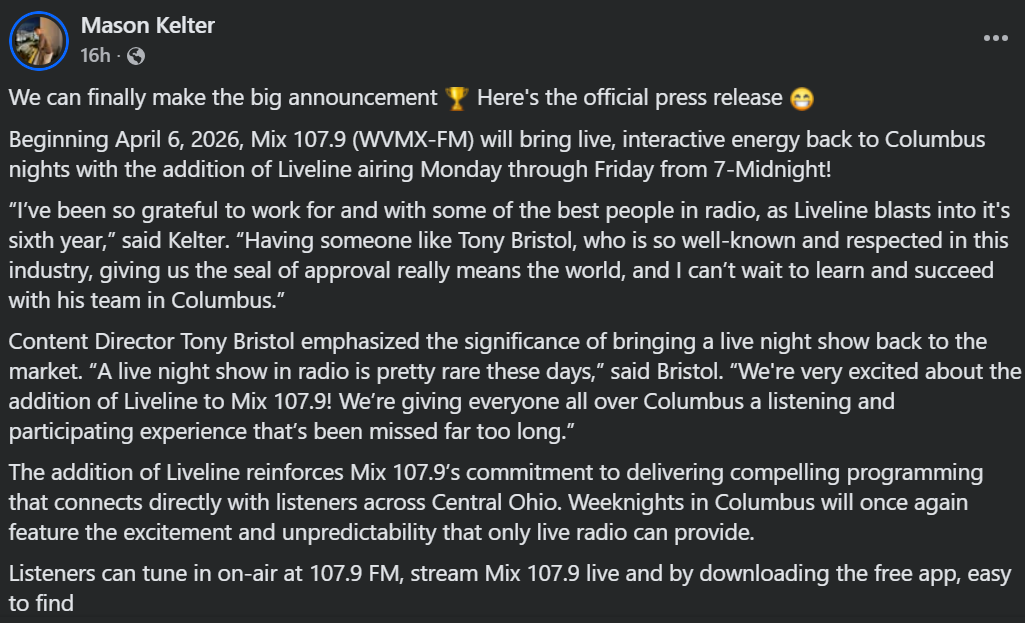
Saga Communications station Mix 107.9 will reintroduce live nighttime programming in Columbus beginning April 6 with the addition of Liveline. The show will air weekdays from 7 p.m. to midnight.
Hosted by Mason Kelter, Liveline enters its sixth year as it expands into the Columbus market. The program focuses on listener interaction, blending music, requests and real-time engagement. Kelter said the opportunity marks an important step as the show continues to grow its national presence.
“I’ve been so grateful to work with some of the best people in radio,” Kelter said. “Having the support of Tony Bristol and his team means a lot as we bring this show to Columbus.”
Content Director Tony Bristol said the move reflects a broader strategy to reconnect with audiences through live radio. He noted that live night programming has become less common across the industry.
“A live night show in radio is pretty rare these days,” Bristol said. “We’re excited to give Columbus listeners something they can actively be part of again.”
The addition strengthens Mix 107.9’s push to deliver more engaging and community-driven content. It also signals a renewed emphasis on real-time connection during evening hours. Listeners can access Liveline on-air at 107.9 FM, online and through the station’s mobile app.
Mix 107.9 operates as part of Columbus Media Group, which also includes Sunny 95, QFM96 and Rewind 103.5/104.3. The group is owned by Saga Communications, based in Grosse Pointe Farms, Michigan.
Barrett Media produces daily content on the music, news, and sports media industries. Sign up for our newsletters to stay updated and get the latest information right in your inbox.
Programming changes are underway at US 96.3 in Jackson, Mississippi as the station reshapes its on-air lineup. Program Director and afternoon host Traci Lee is moving back to morning drive on the country music outlet.
She will join incumbent morning personality Gordon “Gordo” Hultengren on the show. Lee previously built much of her career in the daypart, making the transition a familiar one.
The shift follows the departure of morning co-host Hannah Lane, who is heading to nights at New Country 96.3 in Dallas/Fort Worth, TX.
“It’s like coming home since I’ve done mornings most of my career,” Lee said to Country Aircheck. “I’ve really missed it. I didn’t realize how much until I got back in the studio.”
With Lee exiting afternoons, the station has yet to name a permanent replacement. In the interim, 97OKK morning host Quinn Alexander will handle the shift in afternoons.
Lane was paired up with Hultengren in mornings just last year, and spent seven months working together in the daypart. During her tenure, Lane helped lead US 96.3 to the top honor in the social media category at the 2025 Mississippi Broadcasters Association Awards.
The lineup adjustment gives US96.3 an experienced presence to start the day. Lee’s return also reunites her with a high-profile slot that remains critical for audience engagement and revenue.
No timeline has been announced for a permanent afternoon host.
Barrett Media produces daily content on the music, news, and sports media industries. Sign up for our newsletters to stay updated and get the latest information right in your inbox.
News/talk radio does a tremendous amount of good. Stations across the country raise money, awareness, and hope for causes that matter deeply to their communities. That’s not up for debate. But here’s the thing — that goodness is scattered. It’s individualized. And because of that, the format is leaving real impact on the table.
Consider what country radio built with Country Cares for St. Jude Kids. That partnership between country stations and St. Jude Children’s Research Hospital has raised over a billion dollars. A billion. Country radio didn’t stumble into that number. It got there because stations locked arms, pointed in the same direction, and pulled together with purpose. The format spoke with one voice — and the world listened.
News/talk can do that, too. It just hasn’t yet.
Right now, the format’s charitable work looks like a patchwork quilt. Station A is raising money for a local food bank. Station B is running a radiothon for a children’s hospital. And Station C is rallying around disaster relief. All worthy. All admirable. But none of it adds up to a movement — and there’s a significant difference between doing good and doing something historic.
When country radio unified around St. Jude, something remarkable happened beyond the dollars raised. Artists showed up. Collaboration between competing stations became natural. The cause created community within the format itself. A shared mission has a way of doing that — it turns competitors into teammates and turns a collection of stations into an industry.
News/talk doesn’t have country stars the way music formats do. That’s true. But it’s got something else — household names. Politicians, athletes, business leaders, and celebrities who align with the issues and ideas that drive the format’s audience would answer the call for the right cause. The right unified effort could bring those voices together in a way that amplifies the message far beyond what any single station can accomplish alone.
So what would that cause be? That’s the hard question. And honestly, it’s probably the biggest obstacle standing between the format and something truly transformational. Many markets have spent years building their own charitable identities. Those relationships are real. Those commitments mean something. And listeners expect and look forward to longstanding traditions. Asking stations to redirect their energy — even partially — isn’t a simple ask, and it shouldn’t be treated as one.
Maybe full unity isn’t realistic. Maybe it’s a little idealistic to think every news/talk station in every market would row in the same direction simultaneously. Perhaps that’s okay, though. Even a strong coalition of stations committed to a shared cause would represent more collective power than the format currently musters for any single effort. Start there. Build from there.
Here’s why this matters beyond the charity itself: radio needs a great story to tell right now. Advertisers want to partner with brands that move people. Communities want to rally around institutions that lead. A unified charitable push from news/talk radio tells both groups something important — this format isn’t just a platform for debate and information. It’s a force for genuine change.
Country radio figured that out a long time ago. Its billion-dollar commitment to sick kids isn’t merely a fundraising achievement. It’s a defining part of the format’s identity. Fans trust country radio, in part, because country radio showed up for something bigger than ratings and revenue.
News/talk has the audience. It’s got the reach. It’s certainly got the passion and the credibility. Now it needs the focus.
The format spends a great deal of time covering the problems of the world. Imagine if it committed — collectively and boldly — to solving one of them. Stations collaborating. Big names lending their voices. An entire format moving as one toward a cause that transcends politics and unites people around shared humanity. That’s a story worth telling.
More importantly, that’s a legacy worth building. News/talk radio already does good. It’s time to find out what great looks like.
Barrett Media produces daily content on the music, news, and sports media industries. Sign up for our newsletters to stay updated and get the latest information right in your inbox.
Most radio stations do not lose because the staff is lazy, because it’s too competitive, or because they are underfunded. They lose because the team is built wrong.
I have worked with winning teams and losing teams, and the biggest separator was not effort, intelligence, or budget. It was team composition. Over time, across hundreds of stations, in multiple countries, I built a team infrastructure simple enough to fit on an index card and powerful enough to change your cluster. Plus, I used to read liners off index cards, so I’ve always had a soft spot for them.
Every winning brand needs three types of people. The Creative. The Executor. The Culturalist.
If you have all three, you can build something people remember. If you are missing one, your station can still function, but it will underperform (unless you go with Function 104.3, “your home for the hits-ish”).
The Creative Makes It Interesting
The Creative is the person who makes the station interesting. This is the person who gives your brand shape, tone, surprise, energy, and texture. They know how to take the same songs, the same clock, the same assets, the same contests everybody else has, and turn them into something bigger. They create the little sparks that separate a station people have heard of from a station people talk about.
Right now, this is the most undervalued person in radio. Why? Because creativity is one part of the business data cannot immediately validate, and radio, like most industries, now treats data as currency. We trust what we can count. We lean on dashboards and KPIs. But even the best data only tells you what already happened. Creativity is what makes people notice you, remember you, and care about you in the first place. Only then is there something to measure. That is the order.
Without a Creative, you get a station that checks all the boxes and wins none of the heart. It is nobody’s favorite. And nobody’s favorite is not a strategy (unless you go with Nobody’s Favorite 104.3, “your home…for now”).
The Executor Makes It Real
The Executor is the one who makes sure it happens. This is the person who turns the Creative’s intent into action. They make sure the promo gets dubbed in, the weekly meter report is generated, the webpage gets built, the stop sets hit on time, and the talent and sales teams get what they need. They are the person who makes sure a concept does not die in a text chain after someone writes “great idea” or drops a flame emoji.
Every great station needs this person because great ideas without execution are just better-looking disappointments — which, ironically, is also how I’m described in my dad’s contact list.
Because execution is visible, it often gets elevated above everything else. It feels managerial. It feels measurable. But execution alone does not create relevance (unless you go with Relevance 104.3, “your home”).
When the Executor is missing, the station may sound fun, but things fall through the cracks. Deadlines slip. Details get missed.
Creatives need Executors, and Executors need Creatives.
Like Michael Jackson and Quincy Jones. One had vision. One knew how to turn that vision into something timeless. Separate, both brilliant. Together, dangerous. Ironically, Quincy did not work on Dangerous. Michael in theaters April 24. Not an ad. Just a reminder.
The Culturalist Makes It Matter
Then there is the Culturalist, which may be the most misunderstood role in the building. The Culturalist is the person who knows the event of the moment. Bieber doing small sets at the Troubadour. Ye doing back-to-back nights at SoFi. Thinking about how to use OutKast’s “Bombs Over Baghdad” on the air, depending on how tonight goes.
They understand how the audience feels, what is about to pop in culture before others catch it, and how to take a market’s temperature. They know the difference between what is happening somewhere and what matters here. Not every national story belongs on every station. Not every TikTok trend means something in your town. And not every viral meme deserves airtime.
The Culturalist knows what fits your audience and your market. They are the person who knows you have one shot, one opportunity, to seize everything your station ever wanted in one moment. They answer the question of whether you capture it or let it slip.
When that person is missing, stations sound late (unless you go with Late 104.3, “you’re not home”). Late to the things that form fandom in the first place. And when you get late enough, you find yourself doing what another station already did simply because it now feels okay. That is how brands stop leading. It is also how you end up using throwback hip-hop references to close your last two paragraphs and listening to your own station thinking “today was a good day.”
When Leadership Dives Too Deep Into the Data
Businesses overhire for data. They overhire for reporting, process, recaps, and all the things that are easy to defend in a meeting full of non-creatives.
Meanwhile, they underhire creatives because hiring managers often are not creatives themselves, so they have a kind of creativity blindness. Then they overlook Culturalists because culture is subjective. So they fill the building with responsible adults who wear their company lanyards, like the boss’s LinkedIn posts, and dress in the unofficial company uniform — expensive jeans, a blazer, and dress sneakers — then wonder why the station feels beige.
Although, to be fair, beige does pair nicely with a keycard hanging from a lanyard.
If you are a leader reading this, you know the answer now. Hire for function, but let people fly. Search for competence, but remember it also has to be compelling. Make sure it exists, but make sure that, to the audience, it matters.
Now, every once in a while, you find a unicorn — someone who can create, execute, and read culture at a high level. If you find one, hire them immediately. Pay them well. Keep them close. Let them work. They are rare, and one of them is still cheaper than the combined cost of the other three.
The Fix Is Simpler Than People Think
So if your station is underperforming, do not start with the corporate phrase about transformation. Start with the people.
Ask the hard questions: Who on this team makes us interesting? Who makes sure it happens? Who makes sure it matters to the audience in this market, in this moment? Get the mix right, and your station can be memorable. Get it wrong, and it is nuthin’ but a beige thang, baby.
—Phil “Unicorn” Becker [don’t ask about the horn]
Barrett Media produces daily content on the music, news, and sports media industries. Sign up for our newsletters to stay updated and get the latest information right in your inbox.
Insider trading is nothing new. The impact is permanent, and the practice is illegal. It involves nonpublic information being shared to provide an edge and an unfair advantage to another party. When Tom Brady wanted to purchase a small stake in the Las Vegas Raiders while working for FOX Sports, the NFL reacted. The league placed immediate restrictions on his access to team facilities, players, and coaches.
Troy Aikman’s current situation drew a “no comment” from the NFL, even though the Hall of Fame quarterback and ESPN Monday Night Football analyst is saying the quiet part out loud. Brady never did what Aikman has done, yet handcuffs were immediately placed on Brady. Aikman, meanwhile, walks through the front door unscathed.
What Troy Aikman is potentially engaging in is insider trading, not unlike someone with nonpublic information about a company that others can use to reap rewards with an unfair advantage. What boggles the mind is: where are the networks in all of this? Why hasn’t ESPN (and FOX Sports before them) made a better effort to ensure network access isn’t compromised by the actions of their own hired talent?
Access is everything to networks, radio stations, and media in general. Without access, there’s no ability to gain insight, report a story, or enhance content without engaging the proper figures involved. When Troy Aikman calls a Monday Night Football game for ESPN, that role grants him something other teams do not get.
There is massive value in access. With it, content receives a significant upgrade because of the information gained to provide the insight employers expect. Without it, you’re just another voice in the crowd. Buddy Ryan once said if you listen to the fans, you’ll be sitting up there with them.
That’s why access matters. Did it affect the end product that Tom Brady put out on FOX Sports when he didn’t have access to coaches, players, and facilities? Possibly. Would the average fan know? Likely not. However, principle is everything. Once you open Pandora’s box, there’s no going back.
In the end, the restrictions on Brady were lifted, even after visuals of Brady in the Las Vegas Raiders’ coaches box wearing a headset generated national headlines.
What Troy Aikman is doing is different. He didn’t buy his way into influence with the Miami Dolphins. The team brought him in and paid him for the information and insight he can provide.
Aikman helped the team secure its new head coach and general manager by the middle of January. That could have been the end of his responsibilities. However, he continues to serve as an advisor for the organization. He told Clarence E. Hill Jr. of DLLS Sports that he plans to be in the war room with the Dolphins for the NFL Draft. Aikman will also be around the team facility, continuing to provide services for the franchise that is paying him.
Then Aikman dropped this nugget in his conversation with DLLS Sports.
“I think the Dolphins were wise in understanding my relationships around the league and knowing that I have information that they don’t have or can’t get,” Aikman said. “And I think they were smart in taking advantage of that, whether it was through me or through somebody else.”
Aikman is plainly stating that the information he has—information the Dolphins can’t or don’t have—is being paid for. If any of that information comes from the access his ESPN job provides, it creates a potential unfair advantage for the Miami Dolphins. If the Dolphins use that information in any way, shape, or form, that is insider trading.
So why is ESPN not raising an issue with this? Don’t they have the Super Bowl this year?
If access is everything, and your own talent is cashing in on the access your employment provides. How can you not address it? For the NFL, this is clearly an issue because the league has allowed it to become one.
Let’s play this out. Suppose Troy Aikman continues to work for the Miami Dolphins in his current role while utilizing information gained through his ESPN position. Can Troy Aikman call a Monday Night Football game involving the Dolphins?
The excuse often cited in this discussion is that fans don’t care—it’s just a sports media gripe. But what if the Dolphins beat the Patriots and head coach Mike Vrabel raises concerns that information shared in a conference call contributed to that victory?
Would insider trading matter to networks and the NFL then—when it affects outcomes? If the NFL isn’t careful, that’s the outcome on the horizon.
If NFL broadcasters are profiting from information shared in confidential, closed-door meetings with competing teams, how is that not insider trading?
The NFL already faces significant questions, especially as the league prepares for media rights deals that could reshape the industry. However, if this ethical gray area continues, teams should push to restrict access to broadcast partners across every network.
Where the NFL has been passive in enforcing ethics and protecting access, Troy Aikman’s actions—and his own words—challenge the league directly.
If the league won’t act, then networks should. Stop paying top voices if they are going to leverage the access you provide for personal gain and influence within the league. That’s not fair to teams. Especially in an era where the integrity of sports is constantly questioned, it’s certainly not fair to fans.
At some point, this stops being a gray area and becomes a credibility crisis. You can’t sell fans on the integrity of the game while allowing those closest to it to blur the lines between access and advantage. Whether it’s called consulting, advising, or simply “relationships.” The result is the same. Information that isn’t supposed to be shared suddenly has value where it shouldn’t.
If that line isn’t clearly defined and enforced now, it won’t just be broadcasters or executives who pay the price. It will be the league’s credibility, the networks’ trust, and ultimately the fans’ belief that what they’re watching is fair.
Because once access becomes currency, the game stops being played only on the field.
Barrett Media produces daily content on the music, news, and sports media industries. Sign up for our newsletters to stay updated and get the latest information right in your inbox.
A lot can happen in 54 days. Markets rise and fall. Teams’ playoff hopes can be elevated or dreams shattered. For Emmanuel Acho, his release from FS1 last summer sparked a vision—the concept of a sports program that builds community and creates a safe space to fill a void he believed existed. In 54 days, Acho assembled the pieces and launched his independent creation, Speakeasy.
Now, nearly eight months into that vision, Acho is seeing better results than he imagined. While expectations often suggest things won’t go as planned, Speakeasy has proven otherwise.
“You launch a show seeing a void in the market. You capitalize on the void in the market. Then all of a sudden, we’re hitting goals ahead of schedule and we stopped setting goals from a numbers standpoint,” said Acho on the early success Speakeasy has seen in viewership on YouTube.
Speakeasy’s success stems from content consistency and the community it has built. Every evening, Sunday through Thursday, Acho and co-hosts LeSean McCoy, T.J. Houshmandzadeh, and Kieran Hickey-Semple deliver commentary on the day’s top issues in a late-night-style podcast atmosphere.
“We are creating a community of friends that come together to kick it every night. I’m not so egotistical that I think people are coming to watch me,” said Acho. “All I am is a catalyst for a safe space in a lonely world. For sports fans to come hang out and be heard.”
Growth And Expansion
The longform program centers on engagement—not just among the hosts, but also with the live audience. Acho describes the chat and super chats during each episode as the lifeblood that fuels the show’s energy. He says every element of the original vision has been refined over time.
First impressions were a major focus. Launching at the start of the NFL season, the show leaned into relationships Acho and his co-hosts had with current players. Each week, players joined Speakeasy for exclusive content that traditional networks couldn’t provide.
That access helped define the show’s early identity. However, branching beyond sports has also become a defining trait in the crowded live-content space.
“We’ve shown our dexterity. We’re not just a sports show with hard hitting analysis, but we’ll also meet you where you’re at,” explained Acho, admitting there was some initial hesitancy about expanding beyond strict sports content. “Some people would question a football player moving away from sports content. Those days are dead and gone. Are you an entertainer? I am an entertainer.”
Acho says the show isn’t afraid to cast a wide net, diving into pop culture and trending topics. His goal was to create a program that reflects the current era—one shaped by short attention spans and driven by authentic personalities who can deliver engaging conversations.
“If you want hardcore astute NBA analysis, there’s like ten other NBA shows for you. I’m not looking to expand like crazy,” said Acho in response to adding more sport-centric analysts. “If you drop a chat, we will chat back and you’ll feel like a part of the show. As opposed to being talked at, we aim to talk with… We have a family here and the vision long term is to be that late night show that ESPN swung and missed on.”
YouTube Vs Netflix
When Acho spoke with Barrett Media at Speakeasy’s launch last year, he said the goal was to build a model that networks would pursue through licensing deals, similar to ESPN’s agreements with Pat McAfee and Rich Eisen, or FOX Sports’ own partnerships.
Since launching on YouTube, however, Acho’s success has shifted his perspective.
“I love where I’m at with YouTube. The money you could make on YouTube is crazy if you’re pushing out content like us,” said Acho. “I would be hard pressed to go to a stream, but you still want to opportunity to go a streamer. At this point in time, they would have to make it worth our while. Something like Netflix could make sense. But I’m not as desperate as I was then.”
A potential deal with Netflix would require a different approach. The show would likely sit behind a paywall and could lose its live chat feature—something Acho values deeply.
An element Acho says he holds in high regard for the community Speakeasy serves.
“If you go behind a paywall, that’s not as important as making sure you can still talk to the chat. What makes our show unique is that we talk to the chat,” explained Acho. “I don’t care as much about the paywall as I do making sure we can still talk to the chat.”
Sports Media Drama
With success comes a spotlight. Like any locker room Acho experienced during his college and NFL career, conversations can spark drama. In sports media, that drama often drives attention—and Acho admits he engages with it more than he once did.
Since launching Speakeasy, Acho has drawn criticism from several sports media personalities, including Stephen A. Smith and Leonard Fournette. He says the reaction doesn’t surprise him and considers it part of the business.
“A lot of people don’t realize what it takes to have done what I’ve done. They assume either I was given it, or it was luck,” said Acho. “I’m not surprised by it, but it comes with the territory. I kind of like it. I care to be respected by people I respect. Outside of that, I’m not really in competition with too many people.”
At 35, Acho says his résumé already includes accomplishments many never achieve. A two-time Emmy winner and New York Times bestselling author, he sees his only competition as himself.
“I’m trying to get a Grammy, Oscar, and a Tony. I’m running my own race,” said Acho.
Still, the data tells a clear story. Audience interest spikes around sports media disputes. While Acho doesn’t feel compelled to respond to every criticism, he acknowledges the benefits.
“When you do respond, drama rates. Our highest rating conversations are drama, Sheduer Sanders, and anything Philadelphia Eagles,” revealed Acho. “Now I talk more drama than I ever used to. I dignify it a little bit because in large, drama rates. If I’m having a conversation with or about Cam Newton that will get over additional views on YouTube, I’ll do it.”
Remaining Independent
Speakeasy’s success has also removed any desire for Acho to return to traditional sports television. Following his FS1 exit, he says he no longer wants to answer to anyone but himself.
“I am not going to be controlled by the man again. I’m not about to be fired again. Also, just because you’re in a position doesn’t mean you know what you’re doing. What network executive would have been able to ideate Speakeasy? Then line up talent, build out the studios, and choose the timeslot for Speakeasy. I did that in 54 days,” explained Acho.
Instead, Acho continues exploring new ways to connect with and grow his audience. He believes Speakeasy’s success reflects a shift away from the traditional sports media model.
“Network people still think the audience is dumb. They’re not. Even if they are dumb, they don’t think they’re dumb,” said Acho. “Because they don’t think they’re dumb, that means they don’t want to be taught. They feel like they already know, but want to be made to feel. That’s what I had to learn… I’m not going to teach you. Instead, I’m going to get you mad or make you happy, and just make you feel.”
In just 54 days, Emmanuel Acho built Speakeasy as an answer to what he believed sports media was missing. Eight months later, its growth reinforces something bigger—that connection, not just content, drives the modern audience.
Acho is no longer chasing the old model. Instead, he’s betting on one where creators own the platform, the conversation, and the relationship with their audience. If Speakeasy continues on its current trajectory, it won’t just be a success story—it may become the blueprint.
Because in a landscape crowded with voices trying to be heard, Acho has found power in something simpler: making sure his audience feels like they already are.
Barrett Media produces daily content on the music, news, and sports media industries. Sign up for our newsletters to stay updated and get the latest information right in your inbox.
What if I told you that your 7:30 AM contest was only heard by 10% of your weekly morning drive cume? That’s probably not exactly true — it’s likely even less — but that’s what the Nielsen numbers would indicate when I dug into PPM metrics when I was programming radio day to day.
I looked at the morning total daypart weekly cume of stations versus the average quarter-hour persons between 7:30 and 7:45 AM and found the number to be about 10%. Some stations were lower, some slightly higher. Some days — when I broke it down by day in Nielsen — were hideously lower, some higher.
Go ahead, look for yourself at your station or show: weekly cume versus your biggest quarter hour of morning drive.
The old saying for radio advertising is “frequency sells.” When an advertiser buys six commercials a week, there is little chance of results. Up that to 60 spots and you’ve got a successful advertising campaign. Radio really drives results when it’s bought correctly. I’ve found that some folks in programming, and many air personalities, didn’t get that memo.
Great content should never be treated as one and done. If just a small portion of your weekly Nielsen cume hears it the first time, reuse it. Always remember that people generally listen at the same time every day. Also, keep in mind that, according to Nielsen, listening occasions are 8 to 12 minutes at a time, depending on the station.
When you’ve got something amazing, make sure you use it enough so your audience can hear it. And put it on social media or a podcast so non-daypart listeners can hear it too. If it is a scripted bit with actors followed by listener calls, air the scripted part again, but take different listener calls. That freshens the bit up for the few avid listeners — and there are very few — who never turn your show off.
Story arcs are more valuable than ever. News and sports radio live for the developing story. Music radio personalities must take a page from their book. The simplest things that happen to cast members can be turned into a show-long story or a 3-to-4-day storyline to keep listeners captivated for the week.
Don’t be the radio show where someone comes in on Monday and says, “I had a life-changing moment over the weekend.” No matter what it was — buying a car, getting engaged, deciding to take up yoga — live it on the radio and let the listeners be a part of it. And don’t forget to set up the storyline each day for those who missed it. A gentle reminder: if you’re not living your life on the radio, you may need to rethink your career choice.
Never do weak content. With audience turnover and time spent listening being what it is, there’s never a reason to just do something to fill a break. We’re at a point where only the very biggest shows can afford to waste a break. Even the big shows that waste too many breaks will lose audience.
Benchmarks must be daily. Every day at the same time. Some shows would rather do a different benchmark every day — there is no way that can work. I even worry about daily benchmarks done just once a day being effective. Karson and Kennedy, the biggest morning music show in Boston, play Can’t Beat Kennedy four times each morning. Now that’s a benchmark. And make sure you find ways to tease those benchmarks throughout the day to get the tune-in you need for success.
Contests are great for Nielsen PPM. While only a tiny percentage of your overall audience will play a contest, that percentage increases exponentially with meter holders. However, it is not the majority of listeners, which is why contests should be created for the non-contest player. Trivia-based games, guess the song, and secret sound contests are all great play-along formats. People who watch Jeopardy on TV are not winning anything, but they enjoy playing along and being the best on their sofa. National cash contests with keywords have mixed results depending on the market.
The key is to keep them non-intrusive so you don’t chase away those who don’t care. One more word on contests. They can be clutter. So don’t load your station or show up with too many. The casual listener is easily confused. They are listening for content, not contests. That’s why God invented your website.
Think about how many times you’ve asked someone if they heard a specific piece of content on your show or station. And how disappointed you were when they said no. Radio can be so effective. But you have to know how to use it.
Barrett Media produces daily content on the music, news, and sports media industries. Sign up for our newsletters to stay updated and get the latest information right in your inbox.