FOX Sports says it has held early conversations with Greg Olsen’s camp about a new contract. The network’s comments correct an earlier report claiming the two sides had not talked.
What We Know: Olsen, FOX’s former top NFL analyst, has a contract expiring after this season. Previously, Sports Business Journal’s Richard Deitsch reported FOX had held no negotiations with him. However, FOX management now says the network has held early contract conversations with his camp. Notably, Olsen has won multiple sports Emmys, most recently beating out Tom Brady.
What They Said: FOX Sports president/executive producer Brad Zager (via Richard Deitch on X): “We want Greg here for a long time. We are ready to pick up those conversations whenever they are ready.”
What Remains Unclear: Still, neither side has said how far those talks progressed. Olsen’s status ahead of next NFL season therefore remains open. Furthermore, the top analyst job could open at CBS, or ESPN. Additionally, Kirk Herbstreit’s new Prime Video extension reportedly gives Amazon an out but it’s unclear if Prime Video would court Olsen.
What It Means: Ultimately, the NFL analyst market looks crowded and unpredictable heading into this offseason. Troy Aikman appears headed away from Monday Night Football. Likewise, Travis Kelce could become the top target for any open lead booth. As a result, Zager’s comments signal FOX intends to compete for Olsen.
UPDATE: Spoke to Fox Sports management: They said early in the offseason they spoke with Greg Olsen’s representative where they laid out what the parameters of a new contract would be. So from the Fox Sports perspective, they say they've had some conversations about a contract.… https://t.co/GzFFuHSu34
Barrett Media produces daily content on the music, news, and sports media industries. Sign up for our newsletters to stay updated and get the latest information right in your inbox.
Rick Kaplan will leave the National Association of Broadcasters at the end of 2026 after 14 years with the organization. The NAB will consolidate its Government Relations and Legal units beginning in 2027, with Shawn Donilon leading the combined division.
What We Know: Kaplan has served as the NAB’s Chief Legal Officer and Executive Vice President of Legal and Regulatory Affairs for the past 14 years. His departure will coincide with an organizational restructuring that brings the association’s Government Relations and Legal operations together. Donilon will lead the consolidated division and assume the title of Chief Advocacy Officer in 2027. The move combines two key functions responsible for representing broadcasters on legal, regulatory, and legislative issues in Washington.
What They Said: “It has been a tremendous privilege to serve America’s broadcasters and be part of NAB for the past 14 years. I am enormously proud of what we have accomplished together, but what I will value most are the relationships I have built and the opportunity to work alongside such extraordinarily talented and dedicated colleagues.” -Rick Kaplan
“In an association as diverse as ours, Rick’s ability to understand member concerns, build consensus across differently situated groups and develop creative and impactful solutions will leave an indelible mark on our industry for years to come. His tireless advocacy — no matter how big or small the issue — has significantly benefited our members.” -NAB President/CEO Curtis LeGeyt
What Remains Unclear: Kaplan has not revealed if he will take on another role after his departure. Further information about how the consolidated division will distribute its responsibilities between legal affairs and government advocacy also remains unclear.
What It Means: The restructuring puts the NAB’s legal and government relations functions under one leader. Donilon’s expanded role will place both areas under a unified advocacy strategy, which could help streamline that advocacy.
Barrett Media produces daily content on the music, news, and sports media industries. Sign up for our newsletters to stay updated and get the latest information right in your inbox.
Vanessa Richardson is leaving the Houston Rockets broadcast for an expanded role at ESPN. The sideline reporter announced her departure from Space City Home Network on social media.
What We Know: After four seasons as the Rockets’ sideline reporter, Richardson is leaving SCHN. The local broadcast home of Rockets and Astros games. Her path to the role included seven months at ESPN Radio Houston as a radio host and NFL reporter. In addition, two and a half years as a sports reporter and anchor at KPRC. She remains a familiar voice at ESPN as co-host of Hoop Streams. Also, a host and sideline reporter for NBA coverage, and a contributor on ESPN Radio.
What They Said:Vanessa Richardson (via X): “Serving as sideline reporter of the Rockets for the past four seasons did not just change my career, it changed my life. The magic was not only in broadcasting the games, it was in the day-to-day. I watched every practice, every shootaround, and witnessed the players grow up in real time. Thank you to everyone I worked with. Especially my broadcast partners Craig and Ryan, John and Jim, and the MANY brilliant folks behind the scenes at SCHN. I’m proud that we covered the team with integrity had fun doing it.”
What Remains Unclear: Richardson’s announcement did not specify her exact title or responsibilities in the expanded ESPN role, or when she will begin. It is also unknown who will replace her on Rockets broadcasts, or whether SCHN has begun a search for a successor.
What It Means: Modern networks demand multi-hyphenate talent who can seamlessly pivot across TV, digital streams, radio, and social media. Moreover, Vanessa Richardson’s move to ESPN highlights this exact shift. By combining sideline reporting and TV feature work with digital hosting and radio hits, she delivers the cross-platform utility networks now require. In a multi-screen era, versatility isn’t just an added bonus—it’s the baseline.
Barrett Media produces daily content on the music, news, and sports media industries. Sign up for our newsletters to stay updated and get the latest information right in your inbox.
The WNBA and ESPN are celebrating a record-breaking postseason. ESPN’s playoff coverage is the most-watched in league history through the semifinals.
What We Know: ESPN networks averaged 1.4 million viewers across eight games through the semifinals, up 23% from last year. Meanwhile, the network reported that viewership among P2-17 and P18-49 rose 41%. The surge follows ESPN’s most-watched WNBA regular season ever, marking the third straight year of records. Across 29 games, ESPN networks averaged 1.37M viewers, up 17%, and five games topped 2M. Specifically, ESPN averaged 1.24M viewers across 17 games, up 32%, while ABC pulled 1.56M across 12 games, up 9%. Younger audiences grew, too, with P2-17 up 29% and P18-24 up 27%. The league is celebrating its 30th season.
What The Data Says:(All information via ESPN PR)
Metric
Viewers (Average)
Games
Change vs. Last Year
WNBA Semifinals (All ESPN Networks)
1.4M
8
+23%
WNBA Regular Season (All ESPN Networks)
1.37M
29
+17%
ESPN Specific
1.24M
17
+32%
ABC Specific
1.56M
12
+9%
2M+ Viewership
—
5
—
What Remains Unclear: ESPN hasn’t released WNBA Finals numbers, so it’s uncertain whether the record pace will hold. Streaming and linear viewing also aren’t broken out, which makes it tough to know where the new viewers came from.
What It Means: Women’s basketball keeps gaining mainstream momentum. In turn, growing viewership strengthens the WNBA’s negotiating power with broadcasters and streaming platforms and attracts more sponsors and advertisers. With games topping 2 million viewers the league is proving it can deliver large audiences.
Barrett Media produces daily content on the music, news, and sports media industries. Sign up for our newsletters to stay updated and get the latest information right in your inbox.
Jason Hammer has signed a contract extension with 93 WIBC, keeping the Indianapolis afternoon host with the station. Hammer co-hosts Hammer & Nigel weekdays from 3-7 PM on the Radio One news/talk outlet.
What We Know: Hammer hosts Hammer & Nigel alongside Nigel Laskowski from 3-7 p.m. on the Radio One Indianapolis news/talk station. The program launched on 93 WIBC in 2017 and has remained part of the station’s afternoon lineup. The extension keeps Hammer in place as the station continues to serve Indianapolis-area listeners with news, talk, and commentary.
What They Said: “I’m really happy with the outcome here. Thanks to the management team at Urban One and the best agent in the game, Heather Cohen, for making this happen!” -Jason Hammer
What Remains Unclear: The financial terms and length of Hammer’s new agreement haven’t been disclosed. He did note that it was a “multi-year” extension.
What It Means: Hammer’s extension provides continuity for 93 WIBC‘s afternoon programming. Since Hammer & Nigel debuted in 2017, the show has established a presence in the Indianapolis market during a key weekday listening period. Additionally, retaining an established host allows the station to maintain its existing lineup while continuing to compete for news/talk listeners. The announcement also highlights the relationship between Hammer and Radio One management, with the host publicly thanking the team at Urban One for helping finalize the agreement.
Barrett Media produces daily content on the music, news, and sports media industries. Sign up for our newsletters to stay updated and get the latest information right in your inbox.
Weezer will receive Billboard’s Legend of Live award at the November 10 summit in West Hollywood, California. The Grammy-winning band will also join Billboard‘s Co-Chief Content Officer Jason Lipshutz for a conversation at the event.
What We Know:Billboard announced Thursday that the Legend of Live award honors artists with lasting contributions to live music and touring. The 2026 Billboard Live Music Summit takes place Tuesday, Nov. 10, at the 1 Hotel West Hollywood. Past recipients include Usher, John Mayer, Elton John and Rush. Additionally, Lipshutz, Billboard’s co-chief content officer, will lead the talk with Weezer. Meanwhile, MSG Entertainment president Josephine Vaccarello, Billboard’s 2026 Touring Executive of the Year, will join a live taping of Billboard On The Record. Agency and festival executives will also lead panels at the event, and Hilary Duff will give an exclusive conversation.
What Remains Unclear:Billboard hasn’t shared the exact time of Weezer’s conversation or said whether the band will perform. Likewise, the announcement doesn’t say who will interview Hilary Duff or when. Moreover, it doesn’t reveal what Lipshutz and the band will discuss. The announcement also doesn’t include a statement from Weezer.
What It Means: For Weezer, this celebrates over three decades of touring, maintaining a massive cross-generational fan base, and consistently selling out shows since emerging in the 1990s. Additionally, it marks a major career milestone from a prominent mainstream music authority, cementing their legacy not just as a radio/recording band, but as a powerhouse live act.
Barrett Media produces daily content on the music, news, and sports media industries. Sign up for our newsletters to stay updated and get the latest information right in your inbox.
Listeners on YouTube Music will soon know when a song wasn’t made by a human. Starting this week, the platform is labeling tracks created primarily with generative AI.
What We Know: YouTube revealed the change Wednesday on its official blog. The label sits on a track’s player page. Listeners can tap it to see how AI contributed to the song. Eventually, the labels will expand to the main YouTube app as well.
The labels target songs where AI played a significant role. For example, a track that used a generative model for both the composition and the vocals would qualify. To find those songs, YouTube is combining input from music partners with its own detection tools. Partners disclose AI use through three categories: Fully Gen AI, Partly Gen AI and No Gen AI. Vocals touched up with pitch-correction tools like Auto-Tune still land in the No Gen AI bucket.
However, YouTube isn’t penalizing AI music. According to TechCrunch, AI involvement alone doesn’t make a track ineligible for monetization. That approach differs from the brand’s notable rivals. Deezer, for instance, keeps detected AI tracks out of algorithmic recommendations and editorial playlists. The service also reported receiving roughly 90,000 fully AI-generated tracks every day.
Meanwhile, other platforms are moving in the same direction. Spotify already uses AI labels and a spam filter. Additionally, Apple Music plans “Made With AI” labels later this year. TIDAL, by comparison, lets listeners switch off fully AI-generated recordings. Ironically, YouTube also experiments with AI music itself. Its Dream Track tool lets select creators use AI versions of participating artists’ voices.
What They Said: “Our goal is to make it as easy as possible for viewers and listeners to have the right information and clarity when it comes to the music they listen to. – YouTube
What Remains Unclear: YouTube didn’t say when the labels will reach the main YouTube app. It also didn’t explain how its detection tools work or how accurate they are. Additionally, it is unclear if listeners will eventually receive the option to filter out AI music completely.
What It Means: For the music business, labels are a first step. They are not a solution though. Artists already compete for attention against a growing flood of synthetic tracks. Clear disclosure helps listeners decide what they value. For radio, the shift carries a lesson. Programmers and personalities have long been trusted as human curators. As streaming fills with AI content, that human filter could become even more valuable.
For more on YouTube’s goals and plans for innovation, check out Oprah Winfrey’s conversation with CEO Neal Mohan.
Barrett Media produces daily content on the music, news, and sports media industries. Sign up for our newsletters to stay updated and get the latest information right in your inbox.
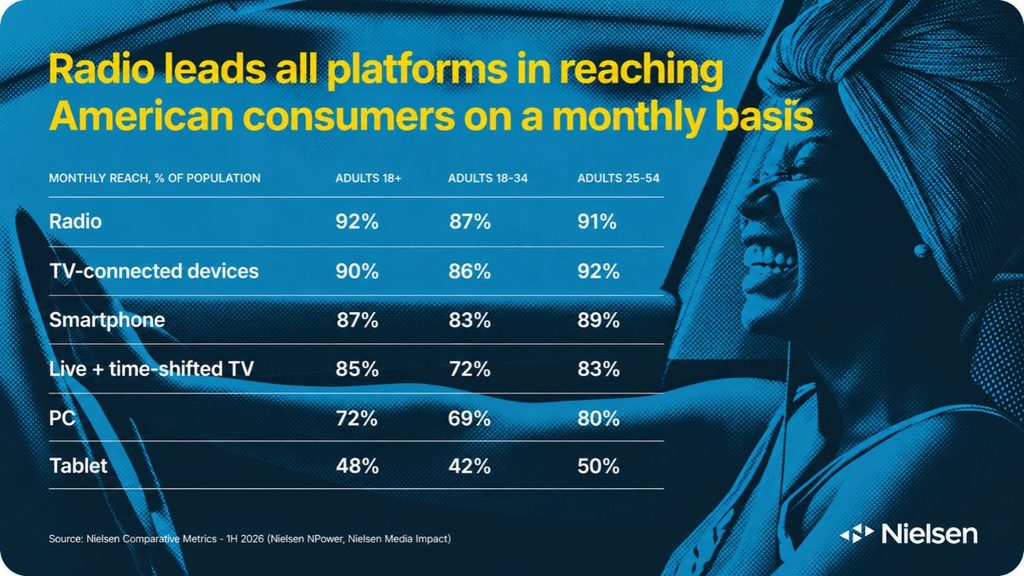
Radio still reaches more Americans than almost any other medium. In fact, Nielsen’s new “Everyone. Everywhere.” report gives radio sellers a fresh set of proof points for advertisers.
What We Know: According to Nielsen, radio reaches 92% of U.S. adults each month. That equals more than 242 million consumers. By comparison, TV-connected devices reach 90%, while smartphones reach 87%. Younger listeners are tuning in, too. Radio reaches 87% of adults ages 18 to 34 every month. Additionally, radio and podcasts combined reach 94% of that group. Radio also reaches 92% of Black adults and 93% of Hispanic adults.
The car remains radio’s stronghold. AM/FM claims more than 80% of ad-supported audio time in vehicles, according to Edison Research data cited in the report. Meanwhile, 65% of adult radio listening happens away from home. Nearly three-quarters of that occurs during weekday drive times. Radio and podcasts also dominate buyable audio. Together, they account for 82% of daily ad-supported listening time. Streaming music, by contrast, captures just 16%.
Perhaps most importantly, radio delivers results. Nielsen’s global benchmarks show radio returning $2 for every dollar spent. That ranks second among 10 measured channels, trailing only social media at $2.22. However, marketers ranked radio last among those same channels in perceived effectiveness. Nielsen also highlighted its own measurement. Its Portable People Meter now operates in the 48 largest markets. Additionally, a three-minute listening qualifier, in place since January 2025, raised measured average audience by 24%.
What They Said: “Radio reaches nearly all Americans, in nearly every place they go, on every device. Ease of measurement doesn’t always equal effectiveness. Any in-car data set offered as a standalone basis for buying radio deserves rigorous review.” – Nielsen
What Remains Unclear: Why marketers undervalue radio despite its strong returns isn’t easy to explain or understand for Nielsen or anyone else. The report also didn’t detail if agencies might shift advertising budgets based on these findings.
What It Means: For radio sellers, the information reinforces the medium’s ability to deliver scale and reaches consumers on the move. It also highlights radio’s effectiveness with producing meaningful returns. Those are talking points to use in every advertiser conversation. Still, the perception gap remains the industry’s biggest hurdle. Radio ranks near the top in ROI but last in perceived effectiveness. Consequently, the challenge isn’t proving radio works. It’s convincing buyers to believe the data.
Barrett Media produces daily content on the music, news, and sports media industries. Sign up for our newsletters to stay updated and get the latest information right in your inbox.
Joe Buck and Troy Aikman have spent nearly a quarter-century calling NFL games together. They’ve survived bad football, questionable officiating, endless replays and more production meetings than either care to remember.
Apparently, the one thing that could strain their relationship is more dangerous than third-and-long against the 2000 Ravens. Money.
ESPN gave Buck a reported six-year, $108 million extension, while Aikman has yet to receive a formal offer. Reports say the two even argued before Monday night’s broadcast. Then, on Thursday, Aikman said he’ll become a free agent after the season.
Nothing says 25 years of friendship like one guy getting $108 million while the other starts looking at real estate elsewhere.
The ‘Old’ Guard
The pair moved from FOX Sports to ESPN in 2022, with Aikman reportedly earning $18 million annually. That raises a bigger question: Should the days of paying former quarterbacks $18 million, $20 million or, in Tom Brady’s case, a reported $37.5 million annually to explain football be ending?
Nothing against Aikman. He’s prepared, credible and knows the game. But he’s not John Madden.
Buck and Aikman aren’t Madden and Pat Summerall. Madden was a phenomenon. He changed how Americans watched football, made offensive linemen celebrities, turned the telestrator into entertainment. He could make a Thanksgiving turkey sound like a scientific breakthrough. People tuned in partly because Madden was calling the game.
How many people turn on Monday Night Football specifically for Aikman? Probably fewer than ESPN’s accountants would like. The NFL is the attraction. Nobody cancels dinner because a different former quarterback might explain Cover 2.
Then there’s Cris Collinsworth.
Collinsworth is 67. He retired after the 1988 season, when Ronald Reagan was president. I’ve enjoyed Collinsworth for years. He’s smart and understands football, but lately, he sounds increasingly like a caricature of himself. The familiar delivery, predictable praise and breathless excitement over an ordinary block.
He’s lost something off his fastball.
This isn’t ageism. Experience matters, but it shouldn’t guarantee a lifetime reservation in the best booth. Aikman will be 60 next month and retired after the 2000 season. An entire generation of fans has grown up without watching him play.
A Needed Youth Movement
Analysts don’t need to have played last Sunday, but it might be nice if younger viewers remembered seeing them play at all.
Brady, meanwhile, is improving. His first season wasn’t especially impressive, considering FOX Sports’ reported $375 million commitment over 10 years. Now he’s more comfortable, conversational and willing to offer real insight. Encouraging, sure. Even the greatest quarterback ever needed time to learn television.
So why aren’t networks developing more new voices?
Greg Olsen is the obvious example, and Thursday brought another interesting development. According to Richard Deitsch, FOX Sports hasn’t held contract negotiations with Olsen, whose deal expires after this season. Olsen also had exploratory conversations with CBS two years ago. The 41-year-old Emmy-winning analyst, who has already called a Super Bowl, could become available just as ESPN faces uncertainty with Aikman and CBS searches for its long-term answer.
Olsen was excellent as FOX Sports’ lead analyst before Brady arrived and pushed him to the second team. He didn’t lose the job because he wasn’t good enough. He lost it because FOX Sports had already written a check the size of a small country’s defense budget.
Olsen should be a top analyst somewhere. Put him with Buck at ESPN or Jim Nantz at CBS. Either pairing would make sense.
CBS has an opportunity after moving on from Tony Romo. J.J. Watt has stepped into the lead booth alongside Nantz. Watt knows football, and fans remember him playing on Sundays, but, for me, he isn’t there yet. Solid isn’t the same as special. CBS can do better than assuming the next famous player automatically becomes its next great analyst.
Jason Kelce intrigues me more. He’s funny, fresh and, to my ear, better suited to calling games than sitting behind a desk before and after them. He needs polish. That’s what reps are for.
His brother Travis? Whenever he retires, television executives will be fighting over him. I can’t imagine him staying away from a camera.
Then there’s Pat McAfee. Love him, hate him or simply feel exhausted by him, he knows how to connect with an audience. ESPN keeps finding places to put him, and he’s already called games. This week, he pushed back on speculation about replacing Aikman. But I wouldn’t be surprised if he eventually lands in a prominent booth sooner rather than later.
Don’t forget Rams head coach Sean McVay. Every network executive probably has his number saved under “Please Call Me Back.”
He’s young, charismatic, a Super Bowl-winning coach and one of football’s sharpest offensive minds. Whenever he leaves the sideline, I think he’d be a star.
Thinking Differently
There’s a distinction between play-by-play voices and analysts. Finding another Buck, Mike Tirico, Jim Nantz or Kevin Burkhardt is difficult. They juggle timing, emotion, information and personalities, often across multiple sports. Elite play-by-play talent is stretched thin.
Analysts should be different. Every year, the NFL produces intelligent, articulate former players with recent experience. Some will stink on television. Others could be terrific. We’ll never know if the biggest jobs remain occupied indefinitely by familiar names.
Aikman’s comments don’t guarantee he’s leaving ESPN. But with Buck locked up, Aikman discussing his next destination and Olsen potentially available, networks have a chance to rethink what they’re paying for. I’m not proposing we escort Aikman or Collinsworth out with a gold watch and complimentary headset. I’m asking for competition, opportunity and imagination.
For years, networks have paid enormous premiums for recognizable names. At some point, they need to ask whether they’re buying better broadcasts or just more expensive ones.
Barrett Media produces daily content on the music, news, and sports media industries. Sign up for our newsletters to stay updated and get the latest information right in your inbox.
For over a decade, the word “podcast” has grown in popularity. It seems like everyone, at some point, decided they were going to be a podcast host. It was hot, it was fun, it was “the thing” to go do.
But as podcasting matures, there’s a trend developing: Podcasting is becoming more like radio. And the power of personality is winning out.
A Slowing Boom
According to Listen Notes, 563,571 podcasts have been active so far in 2026. That figure already more than doubles each annual total from 2024 and 2025. Meanwhile, only 113,332 new shows debuted through September, putting 2026 on pace for its fewest podcast launches in ten years. Additionally, AI-generated shows made up roughly 29% of third-quarter launches.
The podcast space appears to be slowing down in terms of pure volume, while the heavy hitters are driving much of the growth in listening.
That sounds a lot like radio.
Across the country, and in individual markets, there isn’t a massive boom of new, fresh, live and local personalities. But the established personalities are still driving ratings and revenue, both locally and nationally.
There’s nothing shocking about this. It was bound to happen.
The Myth of the Easy Podcast
Another conclusion is that the podcast game was never as easy as some wanted to make it out to be. The idea that any celebrity could attach their name to a show and automatically bring along a built-in audience was always a fool’s errand.
But that didn’t stop companies from throwing gobs of money at celebrities who couldn’t hold a candle to some great local radio talent in markets across the country.
Putting out a consistent product on a daily, or at least weekly, basis is hard. It’s not digging ditches, but it’s also not what many celebrities expected when they cracked a mic for the first time to record their inaugural podcast episode. Getting an audience to return every time in an increasingly crowded space proved even more difficult.
Personalities Get Followed
Every successful media platform eventually arrives at the same conclusion: Content gets sampled. Personalities get followed.
Some may conclude that simply means the rich are getting richer. That’s true. But that’s how radio has always worked. Howard Stern. Rush Limbaugh. Colin Cowherd. The list goes on. The best succeed because they keep people’s attention, and they keep them coming back for more.
Listeners build habits around personalities they care about and trust, not an RSS feed. And in radio, even a station brand, while still enormous and powerful, can become secondary in today’s fragmented media climate to the personality itself. We see it more every day as big personalities learn to thrive on their own without a large corporate backer.
Radio’s Superpower
That should be encouraging for radio talent. The skills required to win in podcasting — consistency, storytelling, preparation, audience connection and creating habitual listening — are skills great radio hosts have been developing for decades. The opportunity is there if radio personalities stop viewing themselves strictly as radio hosts and start viewing themselves as personalities who can reach an audience anywhere.
In news/talk radio, we sometimes obsess over technology. Apps. Streams. Social media. Digital distribution. Those things matter. But the biggest podcasts aren’t winning because they’re on a better platform. They’re winning because listeners feel connected to the host.
That’s always been radio’s superpower. The listener knows when you will be there, how long you will be there, and what you will be serving up. Oh, and as AI content grows in podcasting, listeners know their radio personality (at least in the news/talk format) isn’t some AI chatbot.
For years, radio has worried about podcasting replacing it. But as podcasting matures, it increasingly looks like radio’s business model with newer technology attached.
The podcast boom may be slowing. But the personality era is just getting started.
Barrett Media produces daily content on the music, news, and sports media industries. Sign up for our newsletters to stay updated and get the latest information right in your inbox.