There hasn’t been any love lost between former Daily Wire CEO Jeremy Boreing and Candace Owens since she left the outlet. That was on display on Thursday.
In recent weeks, Boreing has shared that he regrets granting Candace Owens the large platform that The Daily Wire provided. Those same sentiments resurfaced in a recent interview with the Daily Mail.
In the interview, Jeremy Boreing also spoke positively about Owens in some aspects. He claimed that she has much of “it” as anyone he’s ever seen.
However, he also argued that Candace Owens has no beliefs or principles and only reads where a given movement is heading before deciding on what her stance will be. He shared his belief that Owens is only interested in fame and nothing else.
Candace Owens didn’t respond kindly to those comments. The two traded several shots at one another on the X social media platform before the spat was quelled on Thursday evening.
Daily Mail asked me how I feel about what Candace has become.
I imagine I feel like everyone who has helped her on her journey.
Jeremy Boreing is a failed Hollywood actor. For a few years, he publicly pretended to be running a media company when in reality, he sat in himself in a hair and make up chair everyday, casting himself in every company project, still hoping for his big break.
Oh how we wished you would have relegated yourself to company narrator, but your obsession with the spotlight made that impossible. Please illuminate what I stated that is not factual. Did you not centrally cast yourself in everything? Were you allowed to address the employees… https://t.co/lP03KJb32j
She makes charge after charge after charge and places the burden of proof on the accused – as if 'guilty until proven innocent' is a reasonable standard, and as if I have any reason to defend myself against… https://t.co/uZlLhmgXII
🚨Let’s keep reminiscing, Jeremy. Remember when you double-sued me and Brett Cooper as a birthday present to yourself because you were upset that Reagan’s show failed? And then you sued me for interviewing a USS Liberty survivor after I was fired? Am I lying Jeremy? These are… https://t.co/z8tQXph9uL
Following the barrage of tweets at one another, neither Candace Owens nor Jeremy Boreing has shared any more comments about the situation as of this publication.
Barrett Media produces daily content on the music, news, and sports media industries. Sign up for our newsletters to stay updated and get the latest information right in your inbox.
The Dan Bongino Show made its return to the podcast world last month. And according to the Podtrac rankings, fans were glad to see it come back.
According to the February rankings from the company, Bongino’s show earned ninth place on the U.S. Unique Monthly Audience rankings. It was the first month his program was back following a yearlong stint serving as the Deputy Director of the FBI.
The Dan Bongino Show was bested by NPR News Now, The Daily, Up First From NPR, Dateline NBC, Fox News Hourly Update, Pod Save America, The Ben Shapiro Show, and Pardon My Take, in order.
The only changes inside the top 10 in the February rankings were that Pod Save America — like The Dan Bongino Show — made a move into the top 10 after previously not being seen in the rankings.
Elsewhere in the rankings, Today, Explained fell two positions to 13th, while the Shawn Ryan Show saw a one-position decline to 14th. The Ezra Klein Show from The New York Times dropped two spots to 16th, while Morning Wire from The Daily Wire jumped into the top 20, earning 17th place.
In the Top U.S. Podcast Publishers & Networks rankings, iHeart Audience Network and iHeartPodcasts earned the top two positions. Acast, NPR Sales Network, and Libsyn rounded out the top five.
Vox Media, Fox Audio Network, Disney, The Daily Wire, and PodcastOne also saw top 10 finishes in that category.
Barrett Media produces daily content on the music, news, and sports media industries. Sign up for our newsletters to stay updated and get the latest information right in your inbox.
The NBA is reportedly accelerating plans to reshape how local games reach fans, exploring the creation of a centralized streaming platform that could debut as early as next season. The concept would arrive ahead of the league’s previously expected timeline and reflects mounting instability across the regional sports network landscape.
According to a report by The Sports Business Journal, league executives have reportedly informed teams that conversations are underway with several major digital distributors about hosting local NBA broadcasts within a single streaming environment that aggregates multiple franchises.
Companies believed to be involved in early discussions include YouTube TV, DAZN, Amazon and ESPN. Although the structure of any eventual agreement remains under development as the league evaluates how many clubs would participate.
At the center of the urgency sits the financial distress facing Main Street Sports Group, which operates several regional sports networks that carry NBA games. According to the report, the company’s current structure will collapse or undergo significant restructuring in the near future. This is a development that could leave numerous teams without traditional television homes.
That situation has prompted the league to explore alternative distribution models capable of delivering local broadcasts while also stabilizing media rights revenue.
If implemented, the proposed service would resemble a league-wide streaming hub where fans could subscribe to watch local games in their respective markets. The report states that consumers could also potentially access games outside their region through bundled packages.
The potential participant pool could be substantial. Teams currently associated with Main Street’s networks — including 13 NBA teams. However, the list could grow considerably if additional franchises move away from traditional regional sports networks.
There also could be a possibility that teams currently carried by NBC Sports regional networks could eventually join the model should that company continue stepping back from the RSN business.
While the league works toward a long-term solution, many teams are simultaneously exploring backup plans to ensure their games remain accessible next season. Some organizations have opened conversations with local broadcast stations for over-the-air distribution, while others have examined direct streaming partnerships with emerging sports technology companies.
For now, uncertainty continues to surround the future of local NBA broadcasting. Yet the league’s push toward a centralized streaming hub signals a broader shift within professional sports media, one where leagues increasingly assume greater control over how games reach fans in an evolving digital landscape.
Barrett Media produces daily content on the music, news, and sports media industries. Sign up for our newsletters to stay updated and get the latest information right in your inbox.
As the National Football League begins shaping its next round of media rights agreements, early discussions with CBS Sports and its corporate parent Paramount Global have reportedly already started to take place.
According to a report by Puck’s Jon Ourand, executives tied to the newly formed Paramount Skydance organization, which emerged after David Ellison completed the acquisition of Paramount, confirmed that conversations with the NFL have begun regarding the future of the league’s Sunday afternoon package currently carried by CBS.
The existing agreement, which runs through the end of 2029, sees CBS paying roughly $2.1 billion annually to televise its slate of AFC games. That figure is expected to rise sharply once the next round of deals takes shape, according to the reporting.
NFL Commissioner Roger Goodell last year began hinting that the league would be open to discussing their media deals with partners as soon as this coming summer.
“I think our partners would want to sit down and talk to us at any time. And we continue to dialogue with them. I like that opportunity,” NFL commissioner Roger Goodell said to CNBC last year. “Obviously, it’s not going to happen this year. But it could happen as early as next year. That could happen.”
According to Ourand, analysts who track the sports media sector expect significant growth in NFL media rights. They estimate annual revenue could rise from about $10 billion today. Future deals could push that total to between $18 billion and $20 billion.
Should those projections prove accurate, the league’s upcoming negotiations would represent one of the largest rights escalations in the history of sports broadcasting.
The NFL has a contractual opt-out with most of its rights holders after the 2029 season. Before Super Bowl LX last month, NFL commissioner Roger Goodell said the league will be looking to maximize both reach and revenue in new pacts.
“What we focus on is ‘How do we reach the broadest number of people, on every broadcast? How do we make an event out of that?’” Goodell said. “We select our partners in part for that reason. Economics are obviously part of that, the value that’s created. But at the end of the day, we want partners who are going to broaden our audience.”
While initial expectations inside media companies suggested the league might wait until later in the year to begin formal negotiations, recent signals from league leadership indicate the NFL could attempt to finalize updated deals before the start of the next regular season. By accelerating the timeline, the league would avoid the uncertainty tied to the opt-out clauses built into its current agreements.
If a new arrangement with CBS emerges first, the NFL is widely expected to continue talks with FOX Sports, who holds the league’s other primary Sunday afternoon broadcast window.
Regulatory scrutiny could also play a role as negotiations progress. The Federal Communications Commission has begun gathering public feedback on the increasing shift of live sports toward streaming services, while lawmakers on Capitol Hill have raised questions about the long-term balance between traditional broadcast distribution and digital delivery.
With discussions now underway and billions of dollars at stake, the NFL’s next media rights cycle could define how professional football reaches audiences throughout the next decade.
Barrett Media produces daily content on the music, news, and sports media industries. Sign up for our newsletters to stay updated and get the latest information right in your inbox.
When people hear the word bankruptcy attached to Cumulus, many assume the worst. The mental picture is immediate and dramatic.
Stations go dark. Buildings empty out. A once-powerful company fades quietly into the ether.
That’s not what’s happening here.
In today’s media landscape, Chapter 11 rarely means the end of the road. Instead, it’s often a financial reset. The goal is to restructure debt, create breathing room, and give companies another shot at operating without crushing financial obligations.
Radio has already shown us how this story can unfold. Just last year, Audacy went through its own Chapter 11 restructuring. The process looked dramatic on paper. Headlines blared about bankruptcy. Outside observers predicted doom. Yet the company came out the other side still operating its stations, still producing content, and still competing in the marketplace.
Now Cumulus is stepping onto that same path.
For employees, competitors, and industry watchers, the first reaction is understandable. Bankruptcy carries a stigma that’s hard to shake. In most industries, it historically meant failure and liquidation.
But media companies have increasingly used Chapter 11 differently. It’s become a financial tool rather than a final chapter.
After speaking with high-level industry sources Thursday, there’s reason to believe the restructuring process could move relatively quickly. Some believe Cumulus could emerge as soon as the third quarter.
If that timeline holds, the company would suddenly find itself with significantly more financial flexibility.
One number continues to jump out. Cumulus has been spending enormous sums servicing its debt. Once that burden is restructured, roughly $50 million per year could be freed up. That’s money that no longer has to go toward paying down obligations tied to past decisions.
Think about that for a moment. $50 million dollars every year. That’s not pocket change for a radio company navigating a difficult advertising market. It’s the type of financial breathing room that can change the direction of an entire organization.
What Cumulus decides to do with that money is an entirely different conversation.
Do I have ideas? Sure I do. Plenty of them, actually. And at some point, I’ll probably sit down and write about those possibilities. Investments in digital products. Strengthening local brands. Reimagining talent development. There’s no shortage of places where new resources could make a difference.
But that’s a discussion for another day. Right now, the more important point is simpler.
Bankruptcy does not equal disappearance.
Employees across the company are understandably nervous. Anytime the word “bankruptcy” appears in a corporate memo, anxiety spreads quickly through hallways and Slack channels. Competitors, meanwhile, often start quietly sharpening their knives. In radio, rivals rarely mind seeing another company stumble.
Still, neither side should assume Cumulus is headed for extinction. The company isn’t being dismantled. It isn’t about to be sold for parts. And it certainly isn’t fading into the abyss.
What it’s doing is pressing reset.
Other radio companies have already gone through that process. iHeartMedia did it. Audacy did it. Both organizations emerged leaner and with a chance to rethink how they operate.
Could Cumulus follow that same path? It’s entirely possible.
That doesn’t mean everything will stay the same. Bankruptcy restructurings almost always lead to changes. Leadership decisions get evaluated. Corporate strategies get revisited. Assets sometimes shift.
Now, I know what you might be thinking: “Didn’t Cumulus file for bankruptcy once before? If they’re going to return stronger from bankruptcy, wouldn’t logic tell you that they would have done that the first time?”
Yes, you’re absolutely correct. But my rebuttal would be: what about — well, anything — today is the same as it was in 2017, the last time Cumulus filed bankruptcy? Wouldn’t it be logical to think that since virtually everything about the business today is different than it was in 2017 that yesterday’s bankruptcy filing would mean it was different than the last one? I’ll take that leap of faith, despite being a steadfast believer in the idea that the best predictor of the future is the past.
One question worth watching involves CEO Mary Berner. Will she remain in that role after the restructuring? That’s far from guaranteed. Leadership transitions often happen during or after bankruptcy proceedings.
David Field led Audacy into Chapter 11 but didn’t remain CEO once the company emerged. Could Berner chart a different course and keep the title? Sure, but we’ll find out soon enough.
Regardless of who occupies the corner office, the bigger picture remains clear.
Cumulus isn’t disappearing.
The company still owns valuable stations in important markets. Its Westwood One network remains a major national audio distributor. And its brands still reach millions of listeners every day.
Those assets don’t vanish simply because lawyers and bankers restructure a balance sheet.
If anything, this moment could represent an opportunity. Less debt means more flexibility. More flexibility means more strategic choices. And more choices create the potential for a stronger organization on the other side. That doesn’t guarantee success.
Radio’s challenges aren’t going away anytime soon. Advertising remains volatile. Digital competition grows every year. Listener habits continue evolving faster than many companies can adapt.
Still, a reset can matter. For Cumulus, Chapter 11 may ultimately become less of a crisis and more of a turning point.
And if history is any guide, it wouldn’t be surprising to see the company emerge from bankruptcy looking a lot stronger than many people expect today.
Barrett Media produces daily content on the music, news, and sports media industries. Sign up for our newsletters to stay updated and get the latest information right in your inbox.
Somewhere between cable dying and streaming taking over, watching sports became a second job. No benefits, no vacation days, and the onboarding process involves downloading four apps, resetting two passwords, and arguing with your television.
I know this because my inbox tells me so every single week, and a suspicious number of those complaints come from AOL addresses.
The federal government has finally noticed too. The FCC has issued a formal public inquiry into the distribution of live sports on television. They’re asking whether the current broadcast landscape serves the public. Whether media contracts violate federal law, and if the Sports Broadcasting Act of 1961 — written when color TV was still a novelty — needs a complete overhaul.
Now here’s the thing that’s going to surprise you. Those inbox complaints from the AOL crowd almost always come from NFL fans. While I have sympathy for their confusion, I’m about to tell them something they won’t want to hear.
NFL fans have absolutely no idea how good they have it.
Why? The NFL is not the hardest sport to find on television. Not even close. Want to know which fans are really suffering?
Let’s start with the NFL, which is complicated but manageable — if you’re under 50.
Yes, the NFL put games on ten different platforms this past season.
CBS, Fox, NBC, ABC, ESPN, Amazon Prime, Peacock, Netflix, YouTube, and NFL Network. Watching every game costs roughly $823 in subscriptions annually. It’s not cheap, but the NFL knows you’re addicted. The games will likely all be streaming sooner rather than later.
Sorry, gramps.
If you have Amazon Prime, you found Thursday Night Football. If you have Netflix — which 300 million people do — you found the Christmas games. The NFL’s “fragmentation problem” is mostly generational. Fans under 40 aren’t lost. They’ve got the apps, they know the passwords, and they’re watching. The ones who can’t find the game are navigating streaming services by calling their grandchildren.
The FCC’s inquiry focuses directly on whether leagues are serving all fans — not just the ones who know which button does what on a Roku remote.
For decades, Americans enjoyed turning on their TV & quickly finding the game they wanted to see.
Yet watching your favorite team play isn’t as easy these day. Many games are still on broadcast, but an increasing number are on a range of different online platforms.
It’s a valid question, but NFL fans aren’t leaving. There is no price point that makes an NFL fan tap out. The NFL could broadcast games exclusively from a submarine, and fans would buy a submarine.
Now let’s talk about the NBA, which somehow managed to make the NFL look simple.
Fresh off its $77 billion media rights deal, the league debuted a new broadcast universe this season. It is glorious. It is also completely baffling. NBC and Peacock own Mondays and Tuesdays. ESPN has Wednesdays. Amazon Prime takes over Thursdays once the NFL clears out in January and shares Fridays with ESPN all season.
ABC gets Saturday nights. NBC and Peacock close out the week on Sundays. The Play-In Tournament? Amazon exclusively. The Finals? ABC.
There are 247 national games this season, up from 172 last year. That’s more basketball than ever — accessible to anyone who has four subscriptions and has memorized which service airs on which night of the week.
Here’s the sport nobody expected to come out looking reasonable: hockey.
The NHL’s national setup — ESPN, ABC, and TNT/TBS — is genuinely manageable. No streaming exclusives at the national level, Peacock playoff surprises, or Netflix Christmas specials. There are 172 national games, mostly on channels you’ve heard of.
The Stanley Cup Final requires ESPN. If you don’t have it on cable, ESPN Unlimited is $30 a month to stream, which stings. But compared to every other sport on this list, the NHL is practically broadcasting in the town square.
Now Major League Baseball — sweet, nostalgic, completely unwatchable baseball.
A sport so committed to being hard to find that it secured a deal with Roku last year for exclusive Sunday afternoon games. The Roku Channel is free, which is the nicest thing you can say about it. That’s now over.
This season, MLB has three-year media deals beginning with ESPN, Netflix, and NBC. National games and events on each. Then when you get to the postseason, a different network every round. Good luck.
The real disaster is local. FanDuel Sports Network — formerly Bally Sports, formerly Fox Sports Regional Networks — is shutting down this spring. After missing rights fee payments, all remaining nine of its MLB clubs — the Braves, Reds, Tigers, Royals, Angels, Marlins, Brewers, Cardinals, and Rays — have already terminated their contracts.
https://www.youtube.com/watch?v=5Pr2ykBjo0A
MLB says it will step in and produce games for at least six of those teams through its own media arm. Whether those solutions arrive on time, at a fair price, and are actually findable is genuinely unknown. Opening Day is only three weeks away.
College football, oddly enough, is the one that mostly works.
There are 130 teams, dozens of conferences, and a rotating cast of networks. Somehow, it’s one of the sturdier landscapes in sports media. ESPN owns a massive chunk. FOX Sports has the Big Ten. CBS does too. Playoff games are spread around but mostly remain on linear TV. You can still watch a lot of college football with a plain antenna and a couch.
The biggest issue is that so many good games are on at the same time on a Saturday, but that’s what the quad box is for.
So, who saves us?
The FCC’s inquiry asks whether any of this serves the public. Also, whether local broadcasters are meeting their legal obligations, and if the Sports Broadcasting Act of 1961 needs updating. The world is different than all those years ago. Today is a world where your team’s game appears on a stick plugged into your television that also streams cooking shows.
The cynical answer: the FCC probably can’t do much. Its jurisdiction over streaming is murky. Netflix and Amazon don’t answer to it the way broadcast stations do. The agency’s sharpest weapon is noise — enough of it that Congress eventually acts.
Which, knowing Congress, puts meaningful reform somewhere around 2041.
The market is already doing some of the FCC’s work. The RSN collapse is ugly, but what’s replacing it — league-produced broadcasts, direct-to-consumer apps, and over-the-air local deals — could end up more accessible than the old “pay $8 a month for a regional sports network you can’t stream” model ever was.
If MLB consolidates local rights into a clean package without blackouts, that’s genuinely better for the cord-cutter. That won’t be till at least 2029 if ever.
The NFL fan will pay whatever it costs and figure out whatever platform is required. Always has. Always will.
The baseball fan, the NBA fan, and the hockey fan watching their regional network go dark need someone — the FCC, the leagues, anyone with authority and a sense of urgency — to make this coherent before the last regional sports network flickers out and the game just… disappears.
Barrett Media produces daily content on the music, news, and sports media industries. Sign up for our newsletters to stay updated and get the latest information right in your inbox.
There’s nothing that brings a smile to my sports radio programmer face like a radio research project that points out the obvious, yet is often forgotten by those in power. When Audacy published its latest research concluding that it’s time to expand its target demographics to older listeners, it was a smile-and-nod moment for something programmers have known for at least a decade. Yesterday, I read Crowd React Media’s latest findings about what happens when a favorite radio show disappears and how listeners react.
Once again, it was a smile and a nod to something those on the ground floor understand, yet many in the C-suites often forget.
The data shows something that has been mentioned before: listeners pay attention. The way decision-makers cut talent without a proper chance to say goodbye matters to the stability and health of the brands they leave. More importantly, the research underscores why it’s more important than ever for talent to start thinking selfishly about their own future, rather than relying solely on the brands that house them (for now).
Let’s start with some stats from our friends at Crowd React Media. More than 3,100 people were surveyed, with 85% saying they would notice show changes within the first 24 hours. That’s a massive number and represents a couple of important realities that talent must understand.
The people who tune you in care about you and everything you entertain them with. Radio is a personal, one-on-one connection that invites the audience into your party.
The findings also show that the majority of the people listening to you are engaged with what you are doing at all times. That engagement doesn’t stop at the radio signal. It extends to the social side as well. Your listeners want real connections with you in everything you do.
The second key finding focuses on where listeners go if their favorite show suddenly disappears. Fifty-one percent say they would look for another radio station offering something similar. In most markets, however, there are far fewer sports radio options than there are music formats. Twenty-nine percent say they would move to a streaming service, 17% would find podcasts, and 3% would choose silence.
I feel personally sorry for those 3%, and someone should probably reach out to them soon.
The most striking part of this data is the group searching for another radio station with similar content. The podcast number is equally important. Both findings highlight why it’s long past time for sports radio talent to start thinking more selfishly about their own future than the brand that currently signs their paycheck.
Sports radio isn’t classic rock. It’s not Top 40 or even Hot AC. Even in conversations with Cumulus Media and Westwood One Chief Insights Officer Pierre Bouvard, he notes that sports radio thrives because the content is new every time a listener tunes in.
Sports radio talent already hold an advantage when it comes to audience engagement because the format itself invites it. Sports fans naturally engage with voices that represent their passions and their teams. Just like fans follow their favorite band and celebrate every new release, sports audiences rally around personalities they trust.
If half of those surveyed say they would search for another sports option, they may struggle to find one on traditional radio. Only about 10% of radio listening occurs on the AM band. That means searching for another sports option often involves digging through static. If your station is on the FM dial, listeners are unlikely to switch to AM just to find something similar.
Listeners don’t want to work to find their entertainment.
That’s why more sports radio talent need to think about how they contribute content in the places audiences go when they aren’t listening to the radio.
The podcasting metric reinforces this point. When I managed talent — even while working for a large broadcasting company — I always encouraged them to think outside the walls. There’s far more opportunity to learn, grow and shape your media future if you think about how to build the mansion on another island.
Which raises a critical question: if your listeners move to podcasting when your show disappears, do you have a podcast that keeps that relationship alive?
Some sports radio talent have already started that process while still benefiting from the megaphone of radio. Far too many wait until the megaphone disappears.
If you wait for the pink slip, you start from scratch without the platform that once promoted you. That does a disservice not only to your audience but also to yourself. Why allow your audience to drift away entirely when attention spans are shorter than ever?
The reality is that radio brands are not investing nearly enough in building podcasts around their own talent. Instead, they lean on time-shifted audio and repackaged on-demand segments. That approach doesn’t create a podcast your audience can latch onto if — or when — the decision to cut staff arrives.
Don’t let that growing 17% go find a podcast that isn’t yours.
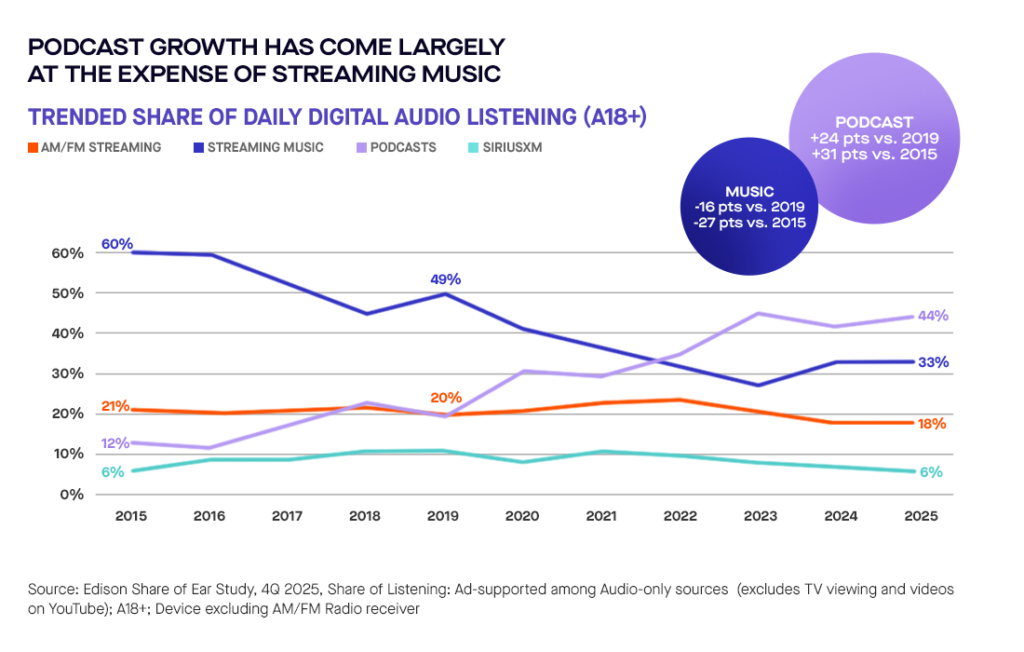
Audacy released a study yesterday showing that podcast consumption among adults has increased nearly fourfold over the past decade. Today, more adults 18 and older spend time with podcasts than with streaming music, streaming AM/FM radio or satellite radio.
And it’s not just about listening. It’s about revenue.
According to Audacy’s findings, 76% of podcast listeners say they have purchased a brand after hearing a host-read advertisement.
Sports radio talent are among the most trusted voices on broadcast radio. Taking your brand into podcasting now gives you the opportunity to capture a larger share of that advertising pie rather than relying solely on talent fees tied to a base salary.
If you don’t own the migration path now, it will only be because you chose not to.
That alone should bring a smile to the face of every sports radio talent. The real question is simple: if not now, when will you start building your future?
If there’s a lesson buried in all of this research, it isn’t complicated. Listeners notice. Listeners care. And listeners follow people far more than they follow logos.
That’s the part spreadsheets often miss.
The connection that powers sports radio has never been the transmitter, the brand name on the building or the corporate strategy outlined in a quarterly earnings call. It’s the host behind the microphone building a daily relationship with an audience that chooses to spend time with them.
Crowd React Media’s data simply confirms what the best programmers and talent have always understood: when a show disappears, the audience doesn’t just shrug and move on. They go looking for the voice they trusted. If they can’t find it on the dial, they’ll search somewhere else.
In 2026, “somewhere else” is no longer hard to find.
That’s why the smartest sports radio talent aren’t waiting for the industry to catch up. They’re already building their audience everywhere the audience already is — podcast feeds, social platforms and whatever comes next.
Because when the day comes that a station decides the show is over, the relationship doesn’t have to be.
And if this latest research proves anything, it’s that the audience would prefer it that way.
Barrett Media produces daily content on the music, news, and sports media industries.Sign up for our newsletters to stay updated and get the latest information right in your inbox.
SiriusXM Satellite Radio host Madison on the Alt Nation channel, believes in new music. The fresher, the better.
New music isn’t just a first love, Madison says she believes it’s Alt Nation’s kink.
Even if Madison didn’t directly say it was her personal kink too, new alternative rock is clearly her passion.
“New music is really my thing,” said Madison. “For an old lady like myself, I skew very young in terms of what I like.”
Madison is as busy as ever at the satellite radio giant. In addition to her six weekly Alt Nation shows, Madison also hosts five shows a week on SiriusXM’s ‘90s-alternative-focused channel Lithium. The one aspect of her job that she enjoys most is the opportunity to introduce listeners to new artists.
“The people who listen to these decade-focused channels and don’t branch out get me frustrated,” notes Madison. “There’s so much good new music right now. You just have to open your mind to it.”
She does try to convert her Lithium listeners into new music fans. Madison’s pitch usually revolves around the specialty show she is synonymous with, the Alt18 Countdown. A program built around an eighteen song countdown of all new tracks for the genre.
“I’ll say just give us an hour on Saturday. Listen to the Alt18,” says Madison. “You might hear a new Green Day, or new Nine Inch Nails song. Also, you could hear something that sounds like the music you grew up with.”
Madison says that with time, she doesn’t attend as many concerts as she once did. However, when a new band she cares about comes to town—like Inhaler, which is fronted by Bono’s son—she will still go above and beyond. Braving the elements and the costs associated with seeing a musical act today.
“I don’t go out a lot, but I live in New Jersey, and the show was in Brooklyn,” explained Madison about her recent trip in support of Inhaler. “I spent like $180 getting home in an Uber, but it was worth it because they’re so good.”
New music is only part of the equation with Madison. She has a unique on-air persona unlike anyone you’ll hear on the air. Satellite or terrestrial.
She’s high-energy, and often speaks in non-sequiturs. Frequently talking about things unrelated to the music. There’s also moments where she’s singing on the air, which can be entertaining but sometimes rubs listeners the wrong way.
“It turns a lot of people off, but there’s a ton of people who love it,” explained Madison. “They’ll send in voice memos saying, ‘Madison sing to me.’ When I meet people at festivals, they tell me ‘I love it when you sing.’ People do enjoy it.”
Her outlandish persona began when she joined SiriusXM nearly twenty-four years ago, when the audience was still small for the satellite radio brand. She says her approach on the air has rarely been questioned. Even as the subscriber base has grown significantly, management still supports her one-of-a-kind delivery.
“Thankfully I’ve been given the freedom to just be freaky and be insane,” says Madison.
Like many hosts, though, the person you hear on the air isn’t the same person off the air. For example, while she sounds supremely confident behind the mic, that’s not necessarily true in real life. Madison admittingly has dealt with confidence in performance for much of her career. Never been one to give herself credit, he says that the energy listeners hear during her show isn’t there all day long.
“It is a character to a degree. When I’m on the air, I’m so upbeat. I’m not that chipper in my real life,” said Madison. “On the air, I turn it up. Nobody wants to listen to my misery. In fact, I should be more like this in real life. Just walking around singing a tune.”
Like all talent, there are days when she finds the energy but can’t quite make herself sound happy. She says there are some days where the mood just isn’t right, and thus she takes it out on the listeners. Her audience however takes the jabs in jest as part of the entertainment, with Madison always apologizing in the end.
Pushing creative boundaries endears her to many listeners, but not all. In today’s instant-feedback world, critics are quick to respond and sometimes even quicker to be mean. Listening to her show, you might think that type of criticism would roll off her back. Behind the character, Madison isn’t quite that tough.
“It 100% gets under my skin. It hurts my feelings. Some of it’s nasty,” said Madison. “About a month ago some guy wrote some nasty stuff, but the grammar was so bad that it was fun to goof on. So, I made an example of him online, and my fans came to my defense.”
Not all the feedback is negative, however. Madison says she and the other Alt Nation hosts actively encourage audience interaction. Often times more a request, and she jokes sometimes through begging. The reason goes back to the same passion that fuels the channel: new music.
Alt Nation’s roster of talent want to know what listeners think about the songs hitting the airwaves.
“Do you like it? Is it a piece of s**t? We even give them incentives to participate,” explained Madison. “Send a voice memo and you’ll probably end up on the air. They love that.”
In addition to a polarizing personality, Madison also holds strong political views. Occasionally this angers some listeners, but she says she only expresses those opinions on social media and never on the air.
“There are people unfollowing me because they don’t want to hear it. They don’t have to, but I’m not saying it,” said Madison. “If I’m doom scrolling and I see something about the ‘Monster in Chief,’ I’m going to post it.”
She suspects some executives at SiriusXM might wish she were less outspoken. Albeit, she has plenty of people encouraging her to keep sharing her views despite the reaction it’s receiving. Which often times surprises her that so many care about her thoughts on issues unrelated to music.
Madison has also occasionally rubbed musicians the wrong way. One example involves actor and 30 Seconds to Mars front man Jared Leto. One time while mentioning the band, she quipped about Leto saying “at least he’s good looking.” Then an opportunity came when Leto and his brother Shannon later visited the SiriusXM studios.
Madison was eager to meet him. The meeting did not go well.
“I walk in and he looks at me and says, ‘Oh you’re Madison. You’re not very nice. We listen to you and we don’t like some of the things you say about us,’” explained Madison. “I turned like a shade of a plum. I’ll never forget it.”
On the other hand, it makes for a great story—and a badge of honor for the longtime personality.
“I’ll talk about that on the air from time to time,” explained Madison. “There is an Oscar winner who hates my guts. How many people outside of Hollywood can say that?”
Madison knows her style isn’t for everyone. But if even a few listeners stick around long enough to hear a new band they end up loving, then the singing, the chaos, and the occasional yelling are all worth it. After all, as she sees it, the next great song is always out there—you just have to be willing to press play.
Barrett Media produces daily content on the music, news, and sports media industries. Sign up for our newsletters to stay updated and get the latest information right in your inbox.
March is here, which means March Madness is right around the corner. Spring is upon much of the country, winter is at least starting to be in the rearview mirror, and the excitement across the college basketball scene in the weeks to come is unmatched in sports.
It’s the Cinderella story. The blue bloods. It all comes together in a convergence of 16 games on Thursday, 16 games on Friday, in what is one of the craziest back-to-back days on the sports calendar.
And the best part? Even people who haven’t watched a minute of college basketball are interested. They’re filling out a bracket, placing a sports bet, and watching players they could not pick out of a lineup. After the Super Bowl, it may be the second-most-watched casual sports event in the country, because of how it’s set up.
This is always a gold mine for sports talk. But is there an equivalent for news/talk? We have a Presidential election every four years, and in between, we have the midterms in the even, non-Presidential years. Of course, we find ourselves in one of those right now.
How can we take advantage in news/talk with content and/or listener-engaging events that can engage beyond the die-hard political base?
Think about how sports are able to hyper-engage their audience and grab the casual sports fans as well. What are our options?
I’m not sitting here sharing what I think are the best ideas, but they may trigger you to come up with better ideas for your station. How about a news equivalent of a fantasy football draft? Your top hosts “draft” the issues, candidates, cities, counties, or movements you think will “win” in November. Do one with listeners, and one with local personalities (sports guys, realtors, chefs, business owners).
How about “The Road to November” on your station? Similar to “The Road to March,” you see sports brands use all the time. Could a local “issues” bracket work that involves fans on social media? Daily 60-second breakdowns of key issues tied to sponsors. A weekly casual-voter call-in segment may work as well.
Does the branding around a “Road to November” work with an Election Guide? And this doesn’t mean endorsements from hosts. I’m generally not a fan. If Obama and Trump can endorse people who lose, why do ours matter? Cover the candidates, rip or praise them based on what they do, but endorsements have never made sense to me.
But a one-sheet with our logo and branding with registration deadlines, how to vote early, top local issues, zero spin, and all clarity. These will appeal the most to those who casually pay attention. Your die-hard fans will already know this information. But it’s not intended for them. And these things can go viral on social media and get shared in your market.
Other ideas: Social media polls are a no-brainer, too. Fans love them, social media algorithms push them out, and they can be seen by thousands of people who might not otherwise be familiar with your station or digital platforms.
The point is, there are many ideas better than mine that you probably have spinning around in your head, or that may cater better to your specific market. If so, that’s great.
But think as sports brands think about their big benchmarks of the year. And while there’s plenty of activation opportunities for the superfan listener, the chance to broaden the umbrella as people start paying more attention approaching November’s midterms can lead to cume growth and engagement, which can grow the station in the long term.
And while it’s only March, and many of us in news are just thinking about our NCAA Tournament brackets, November is going to be here before we know it. Get planning.
Barrett Media produces daily content on the music, news, and sports media industries. Sign up for our newsletters to stay updated and get the latest information right in your inbox
I’ve worked for both large and small operators, also owned my own firm. I’ve had just about every job imaginable in the industry, from overnight jock to market manager to corporate executive.
What I’ve always been most interested in the challenges facing smaller broadcast companies that have survived by simply doing what they do best. Serving local communities and building relationships with wonderful reach efficiency. The hard part for these smaller companies rests in a dramatic shift in the environment.
The question for them used to be whether digital advertising really mattered. Today, it’s whether their companies can survive without expanding into digital strategies and tactics.
The honest answer seems to be that it is possible in the short term. However, it will become increasingly difficult, if not extremely unlikely, in the long term. The biggest reason points to basic economics.
Like geese heading back north, the ad dollars have migrated. Giants like Google and Meta dominate even local conversations. Why? Because they offer targeting, attribution, and measurable ROI. Whether the data is entirely believable hardly seems to matter.
What does matter is that traditional media often struggles to point to much more than an increase in cash-register activity.
Local small businesses, which have traditionally been at the core of local direct dollars for radio and TV, have come to expect digital dashboards, clicks, and the ever-so-idolized conversion metrics. The perplexing part is that I’ve seen many who don’t even understand it, much less review it.
They simply feel a level of comfort in knowing they receive it. I have honestly talked to people who want to be sure they get their data but never bother to review it.
In a Westwood One article a few weeks ago on Inside Radio, Cumulus Chief Insights Officer Pierre Bouvard notes the extremely high ROI efficiency of audio — specifically AM/FM radio — while also pointing to the dichotomy of its perceived effectiveness.
Pierre is quoted as saying, “Audio has entered a golden age of measurement with a wide array of firms now quantifying audio sales effect, brand lift, search and site attribution, and creative effectiveness.”
In my mind, the issue is more about getting advertisers to accept that.
What Pierre so deftly proves is that broadcast audio has not lost its inherent value. Quite the opposite. Traditional AM/FM audio still offers scale, credibility, emotional storytelling, and brand-building power that digital platforms often cannot replicate — all at one of the most efficient CPMs available. Couple that with the many studies showing that combining it with digital significantly improves campaign effectiveness, and the issue is no longer relevance — it’s completeness.
Smaller broadcasters that depend solely on spot revenue now face increased risk factors. Revenue concentration is when more than 80 percent of revenue comes from traditional spot sales. Any economic downturn threatens local spending even more. Those shifts can create instability in revenue.
When a competitive disadvantage occurs, agencies and advertisers increasingly look for integrated solutions. Those selling only spots compete against companies offering SEO, SEM, social, streaming, video, display, CTV, OTT, and attribution in one comprehensive bundle.
Perhaps the biggest threat isn’t financial at all. It’s psychological. As noted in the Westwood One article, advertisers have perception issues seeing AM/FM radio below most other media on the list. Despite the fact its ROI efficiency ranks second only to social media.
The narrative suggests radio is outdated, even if the audiences remain strong.
Hyper-local smaller companies with dominant market positions, high-profile personalities, continued community trust, and limited competition can likely continue generating enough revenue to move forward. Niche formats in rural markets may maintain advertiser loyalty longer than many others.
Cost structure is also a factor. Privately owned stations with little debt and lower expenses certainly have more flexibility than others. Still, survival without any digital offerings — or at least a plan for digital growth — carries real risk.
The realistic strategic question isn’t whether you should enter the digital sales realm. It’s how fast and how far you can jump in. Successful smaller broadcasters usually adopt one of three approaches:
Local Value Added
This approach offers streaming sponsorships, social media assistance, and basic digital or display ad products on your own websites to enhance traditional spot sales. All of these can be done internally without a huge investment.
Agency Model
This means transitioning into a full-service local marketing partner offering SEO, SEM, social, programmatic, CTV, OTT, video, and more. It likely requires hiring a local digital strategist or technical expert to assist with these services.
Partnership Strategy
Many medium and larger companies operate this way in the digital space. It typically involves contracting with a third-party digital vendor to expand offerings without heavy internal investment while also helping train the sales team. There is no shortage of vendors available, including several that specialize in broadcasting.
Digital success for broadcasters will come from utilizing existing strengths: trusted relationships, local knowledge, and storytelling expertise.
Keep in mind that many local sellers may be seasoned pros who have had little exposure to this form of advertising beyond seeing it on their own phones. This creates a different kind of hurdle. Many small broadcast companies were built around programming and local spot sales, not digital marketing. Shifting that mindset is often the most difficult part.
The companies that thrive no longer consider themselves “radio stations” or “TV stations.” Instead, they view themselves as true marketing partners for their clients, using every available tool to connect businesses with customers.
Digital isn’t replacing broadcast. It has become the price of remaining competitive alongside it in a changing world. So, can smaller broadcast companies survive without a larger investment and deeper entry into the world of this shiny new toy?
For a while, yes. Forever? It certainly wouldn’t be easy.
Barrett Media produces daily content on the music, news, and sports media industries. Sign up for our newsletters to stay updated and get the latest information right in your inbox.