ESPN’s Scott Van Pelt attempted to add nuance to the criticism surrounding CBS Sports after a shaky finish to its coverage of The Masters. During Sunday’s final round, CBS failed to track Rory McIlroy’s second shot on the 18th hole. Viewers were left without clarity on where the ball landed during a defining moment.
The network also struggled to present a clean angle of McIlroy’s winning putt, compounding frustration.
Speaking on his SVPod, Van Pelt acknowledged both the disappointment and the difficulty of the situation. He emphasized that capturing golf shots, especially in real time, remains one of the most challenging tasks in sports television.
“Shooting golf is an amazing skill,” Van Pelt said. “You’re following that ball through the air and the ball is coming from a place you can’t see. You’re trying to find it, and in that instance they didn’t. That’s an awfully difficult time to have that happen.”
Van Pelt went on to explain that golf presents a unique production environment. Unlike football or basketball, where the ball is easier to track, golf often requires cameras to anticipate shots from obstructed views and unpredictable angles.
“You’re not in a gym following a basketball,” he said. “Imagine a quarterback standing around a corner hidden from trees. Here comes the ball. I don’t know where it’s coming from. I’m not making excuses, I’m giving context.”
That context did not erase the moment. If anything, it highlighted how rare such mistakes feel on a stage like Augusta National. CBS has long been praised for its Masters presentation, which made the miscues stand out even more. Criticism came quickly from fans and media observers alike which questioned how a production of that scale could lose track of such a critical shot.
The expectation, fairly or not, is that every moment is captured cleanly. Van Pelt agreed that timing played a major role in the reaction. The errors occurred at the worst possible point, with McIlroy on the verge of a signature achievement.
“That was a really tough time to have that happen,” Van Pelt said. “So I understand the people’s frustration in that moment.”
Van Pelt often walks the line between fan and broadcaster, and this instance was no different. He acknowledged the audience’s expectations while also pulling back the curtain on the realities of live production. The situation serves as a reminder that even the most polished broadcasts are not immune to error. In golf, those challenges are magnified by terrain, visibility and timing.
Barrett Media produces daily content on the music, news, and sports media industries. Sign up for our newsletters to stay updated and get the latest information right in your inbox.
After less than a year, Lionel has departed The Other Side of Midnight on 77 WABC. He’s being replaced by Walter Sterling.
Lionel began hosting the daypart last June following the exit of Frank Morano. Morano departed to run for a seat on the New York City Council representing Staten Island, which he ultimately won. Morano hosted the show for nearly five years before leaving.
Lionel hosted the program as normal on Friday evening. However, Walter Sterling helmed the first two shows of the week. The show’s branding has reflected the change, as has the 77 WABC lineup on its website and podcast platforms.
Sterling is not a stranger to the show or the 77 WABC audience. In recent weeks, he has been hosting Another Side of Midnight, the weekend version of the show previously anchored by Lionel.
Red Apple Audio Networks distributes both overnight versions of the show as nationally syndicated offerings. The Other Side of Midnight airs weekdays live from 1-5 AM ET, while Another Side of Midnight airs live from 2-5 AM ET on weekends.
With the addition of The Other Side of Midnight to his duties, it appears as if Walter Sterling will still host Sterling Every Damn Night from 10 PM-1 AM on 1210 WPHT in Philadelphia.
Barrett Media produces daily content on the music, news, and sports media industries. Sign up for our newsletters to stay updated and get the latest information right in your inbox.
Audacy is expanding its morning lineup in Cleveland with an earlier start to local sports talk programming. Beginning Monday, April 20, 92.3 The Fan will add a new hour of weekday content at 5 a.m.
The station announced that Jeff Thomas will host a new show titled The Fan Warmup, designed to ease listeners into the day with a fast-paced recap of the latest local sports news.
Thomas shared that the program on 92.3 The Fan will take a different approach than a traditional talk format.
“It’s going to be a little different,” Thomas said. “It’s not going to be quite like a sports talk show. In fact, it’s going to be more like highlights and postgame recap. We’ll let listeners know what’s going on with clips from some of the other shows.”
The added hour positions the station to capture an audience that is already tuning in before its traditional morning programming begins. Morning host Anthony Lima said the decision came directly from audience behavior.
He noted that listeners have consistently engaged with the station’s digital platforms well ahead of the current start time.
“We’re excited because we’ve noticed it with a lot of our listeners,” Lima said. “They’re there on YouTube, they’re there on the stream. Sometimes a half hour early or 45 minutes early. We feel like at times we may not be getting the needs met for our listeners. Now, with this extra hour, I think we’re going to be able to do that.”
The Fan Warmup will act as a lead-in to the station’s established morning show, The Ken Carman Show with Anthony Lima. The format aims to provide quick-hitting updates while maintaining a strong connection to the voices and content already familiar to Cleveland sports fans.
Barrett Media produces daily content on the music, news, and sports media industries. Sign up for our newsletters to stay updated and get the latest information right in your inbox.
Dave McGinnis, a longtime NFL coach and voice on Tennessee Titans radio broadcasts, died Monday following an illness that led to a hospitalization in March. He was 74. The Tennessee Titans confirmed McGinnis’ passing, bringing an end to a football career that spanned decades on the field, sideline and airwaves.
McGinnis spent more than 30 years coaching in the NFL. His career included a four-season run as head coach of the Arizona Cardinals from 2000-03. He first stepped into the role on an interim basis before earning the full-time position.
Cardinals owner Michael Bidwill praised McGinnis’ passion for the game and the impact he had on players and colleagues alike. He described McGinnis as someone who embodied the spirit of a true “ballcoach,” noting his energy, character and love for football.
McGinnis built a reputation as a defense minded coach. He held roles as a linebackers coach and defensive coordinator across several organizations. His NFL stops included the Chicago Bears, Cardinals, Titans and the Los Angeles Rams. He worked under notable head coaches, including Mike Ditka and Jeff Fisher.
After his coaching career, McGinnis returned to Tennessee in 2017 and transitioned into broadcasting. He became a gameday color analyst for Titans Radio, a role he held through the 2025 season. His insight and personality made him a familiar voice to fans across the region.
Before reaching the NFL, McGinnis began his coaching journey at Texas Christian University in 1973. He later worked at Missouri, Indiana State and Kansas State. His transition to the professional level came in 1986 with the Bears, where he coached linebackers during a successful era for the franchise.
McGinnis nearly became Chicago’s head coach in 1999. However, he stepped away from the opportunity after learning of plans to announce his hiring before finalizing a contract. He remained with Arizona and later secured his only NFL head coaching role there.
Throughout his career, McGinnis coached and mentored numerous standout players. That list included Hall of Famers Mike Singletary, Aeneas Williams and Emmitt Smith. Those who worked with him often pointed to his authenticity and commitment to helping players grow both on and off the field. His influence extended well beyond game plans and broadcasts.
McGinnis leaves behind a legacy rooted in football, relationships and a lifelong dedication to the sport.
Following the news of McGinnis’ passing, sports media shared their remembrances via social media.
We extend our deepest condolences to the family of Dave “Coach Mac” McGinnis, who passed away Monday afternoon in Nashville with family at his side. pic.twitter.com/akNxD0PcHB
Always loved visiting with Coach before games and at the Combine. Great stories galore! And he could not have been nicer to me, Andre and @jharrisfootball. Deepest condolences to the family and Titans Radio. God bless Coach Mac
I’m just heartbroken 💔 Coach Mac was the absolute best…always championing me in my career, always teaching me ball, and always there to lend an ear. Constantly checked in on my family. A dear friend to SO MANY. Man we were lucky we got to spend his second career with him ❤️❤️❤️ https://t.co/RaCm7TZgWe
Always enjoyed our press box visits over the years. Just a very kind, sweet man who loved football. Praying for his family & friends. https://t.co/rhVjFXdFNN
Oh man … this one hurts. Mac was the man, every room he ever walked into got happier with his presence alone. Best to his friends and family. https://t.co/Suk3o0mCan
A Legendary Man/ Coach/ Friend that lived life the only way The Mac Daddy could… with no regrets!!!! Love ya Coach Mac!!! Coach'em Up big guy!!! 🙏🏾🙏🏾 https://t.co/vnNr6KR227
Not going to pretend to know Coach Mac as well as many sharing their stories and condolences but he was the unique person who made you feel better about yourself or your circumstance every time you saw him. A truly humble, gracious, and engaging man. Prayers for his family. 🙏 https://t.co/ze7niguELZ
I met coach Mac in 2009 my rookie year in Nashville, he was our LB coach and was always a friendly face and a reassuring voice in the building.
Nothing changed once I retired, I loved seeing coach Mac at Titans games and reminiscing about our time together and me catching him… https://t.co/y9JckX1r6t
I’m in such shock and so sad to see this news. I had the privilege of working with Coach Mac at 104.5 and he was always so kind to me. Coach was one of a kind and he’ll never be forgotten. We will miss you Mac 🙏🙏🙏 https://t.co/150SPTEuSP
What a blessing this man was and will always be to anyone who met him. I’m gonna miss you, Coach. I’ll always try my best to keep my powder dry. Prayers up to his family, his friends and to all of the people his life touched. #RIPCoachMachttps://t.co/DxPKimAsHQ
Decades ago I was a kid covering Titans. Prax ends one day & Coach Mac yells- “Sara Walsh get over here!” Kinda worried, I walk out on field, he says- “Heard you’re up for a job in Az. How can I help, who can I call?” That’s who Coach Mac was. Never forgot his kindness. #titanshttps://t.co/WI1doiv8jt
This makes me so sad. Mac was the best not just coaching ChicagoBears LBs but years later, he never forgot and treated you with respect. Very sad. God Bless. This was our @TSAHSPod episode with Dave … @jasonkinander https://t.co/GxzFkcXmtZhttps://t.co/HUkEQQtg7n
Sad to hear this. I once spent a Sunday at a Cardinals vs Cowboys in 2002 in Phoenix at old Sun Devil Stadium and somehow ended up at Dave McGinnis’ house in Scottsdale after the game. One of the nicest guys you’ll ever be around. https://t.co/0JNIPGNnLP
Condolences to the former Bears' linebackers coach (1986-1995), who was nearly their head coach in 1999 before an ill-timed hiring press conference announcement caused McGinnis to back out. . Dave would become the head coach of the Cardinals the next year through 2003. https://t.co/at4pghI5Km
Barrett Media produces daily content on the music, news, and sports media industries. Sign up for our newsletters to stay updated and get the latest information right in your inbox.
Private equity firm TPG is reportedly nearing a deal to acquire a controlling stake in Learfield, positioning itself as a major player in the evolving college athletics business, according to a report from Sports Business Journal.
Sources familiar with the deal told SBJ the purchase price is expected to fall between $1.8 billion and $2 billion. The transaction is anticipated to close in the third quarter of 2026, pending regulatory approvals and standard conditions. As part of the agreement, current co-owner Charlesbank Capital Partners will retain a minority stake, while Fortress Investment Group is expected to exit its position.
Learfield leadership is expected to remain intact. CEO and President Cole Gahagan will continue to lead the company, and no immediate operational changes are planned. Additionally, the company does not intend to divest key assets such as its licensing arm or ticketing platform.
Instead, the focus will center on growth. TPG plans to leverage its operational experience to expand Learfield’s reach across media, technology and NIL-driven opportunities.
Learfield has spent months exploring strategic options. Those discussions ranged from maintaining the status quo to bringing in new capital or selling a controlling interest. Ultimately, strong financial performance combined with increased investor demand pushed the company toward a sale.
Learfield currently partners with hundreds of Division I programs, including major brands like Alabama, Michigan, Ohio State and Texas. Its business spans multiple verticals, including multimedia rights, licensing, ticketing, digital platforms and marketing services.
In recent years, Learfield has diversified beyond its traditional rights model. The company has invested heavily in digital media, NIL services and content creation. The timing also reflects broader changes across college sports. Private equity interest in the space has surged as conferences and schools seek new revenue streams.
For TPG, the acquisition offers immediate scale. Rather than building relationships school by school, the firm gains access to Learfield’s expansive network and established infrastructure.
Meanwhile, the multimedia rights landscape continues to evolve. Companies like Learfield, Playfly Sports and JMI Sports remain key players. However, more schools are exploring in-house models, creating long-term uncertainty around traditional structures.
Even so, Learfield has adapted. The company has shifted toward revenue-sharing agreements and expanded its role in NIL strategy and sponsorship activation. With new backing from TPG, Learfield appears positioned to deepen its influence. The partnership signals continued momentum for outside investment in college athletics, as the industry searches for sustainable growth in a rapidly changing environment.
EXCLUSIVE: Private equity firm TPG is finalizing the purchase of Learfield to make it the majority owner of one of the most prominent multimedia rights and technology providers in college athletics, @SBJ has learned. https://t.co/7iHp9NlUgW
Barrett Media produces daily content on the music, news, and sports media industries. Sign up for our newsletters to stay updated and get the latest information right in your inbox.
There’s a question quietly gaining traction across the media landscape, and it centers on whether Nexstar Media Group is ready to take a page from a proven playbook.
Specifically, is the company preparing to extend the NewsNation brand to the local level in the same way ESPN successfully did with ESPN Radio?
It’s not a wild theory. In fact, it might be one of the most logical moves Nexstar could make.
For years, ESPN has demonstrated the power of brand licensing across local markets. You can drive through some of the smallest towns in America and still find an “ESPN Radio” affiliate. In many cases, those stations adopt localized branding — “ESPN [City Name]” — and instantly gain credibility. That strategy didn’t just expand reach. It created consistency, familiarity, and trust across vastly different markets for both the local stations and for ESPN.
And it worked. No one can argue that.
ESPN didn’t need to own every station outright. Instead, it built a network of affiliates that carried its identity, its tone, and its programming philosophy. As a result, the brand became ubiquitous. Listeners knew what they were getting, whether they were in New York City or a place most people couldn’t find on a map.
Nexstar already has the infrastructure in place. The company owns or operates more than 200 television stations across the country. It owns stations in 116 markets. That’s an enormous footprint. Yet, for all that reach, NewsNation still feels like a national brand trying to break through in a crowded cable news space.
So, what’s the missing piece? Local integration.
It feels like a natural marriage between NewsNation and Nexstar’s local stations. On one hand, NewsNation could benefit from the promotional lift that comes with localized branding. On the other, Nexstar’s stations could gain a stronger national identity by aligning with a growing cable news brand.
That kind of relationship isn’t just beneficial, it’s symbiotic.
Imagine turning on your local station and seeing “NewsNation [City Name]” as part of the identity. Immediately, there’s a connection between local reporting and national storytelling. Viewers aren’t just consuming isolated content. Instead, they’re participating in a broader network that feels cohesive.
That’s where the real value lies.
Branding matters more than ever in today’s fragmented media environment. Audiences are overwhelmed with choices, and recognition often drives decision-making. If Nexstar leans into the NewsNation name at the local level, it could create a unified presence that stands out.
Moreover, the company has the ability to put serious weight behind the effort. This isn’t a startup trying to build from scratch. Nexstar already has the resources, the reach, and the relationships needed to execute at scale.
That’s why the comparison to ESPN is so compelling.
ESPN Radio didn’t become a national force overnight. It grew by embedding itself into local markets, one affiliate at a time. Over time, that strategy paid off in both brand equity and audience loyalty. And the brand helped elevate local markets and the national brand, simultaneously.
NewsNation could follow a similar path.
Of course, there are differences. Sports content tends to translate more easily across markets than news. Local news is inherently tied to community-specific issues. However, that doesn’t mean a unified brand can’t work. In fact, it might enhance the overall product by providing a consistent framework while still allowing for local customization.
There’s also a promotional advantage that can’t be ignored. Local stations branded under the NewsNation umbrella could serve as constant marketing vehicles for the national network. At the same time, the cable channel could spotlight local reporting, creating a two-way street of exposure.
That kind of synergy is hard to replicate.
So, is Nexstar actually heading in this direction? There hasn’t been a sweeping announcement — yet. Still, the signs are there. Nexstar Media Group is ending agreements with wire services from the likes of ABC, CBS, and NBC, reportedly, with the idea of utilizing segments from NewsNation as a replacement. The company has already shown a willingness to invest heavily in NewsNation. Expanding that brand into local markets feels like the next logical step.
And if history is any indication, it’s a step worth taking.
Don’t be surprised if you start seeing more NewsNation branding pop up on local stations in the near future. The groundwork is already in place. The strategy has a proven track record. Most importantly, the upside is too significant to ignore.
Sometimes, the smartest move isn’t reinventing the wheel. It’s recognizing what works — and adapting it to your own playbook.
Barrett Media produces daily content on the music, news, and sports media industries. Sign up for our newsletters to stay updated and get the latest information right in your inbox.
The direction of a career in sports media is never a straight line. Experience comes through the ups and downs of every opportunity. For ESPN’s Peter Schrager, life looked very different just a year ago. He departed his roles with FOX Sports and the NFL Network, where he helped launch Good Morning Football in 2016. His destination was ESPN, the network he grew up watching and came to love.
“It’s been an unbelievable experience so far,” said Shrager. “I, like so many of us, grew up watching ESPN. That’s the gold standard. When I made the move, it was a bit of a leap. But I would be lying if I told you it wasn’t a 100 out of 100 experience and I’ve absolutely loved it.”
The decision allowed Schrager to trade the trendy shirt look on Good Morning Football for the suit-and-tie experience at ESPN. Since joining the network, he has made an impact across several daily programs. He appears regularly on shows ranging from Get Up to The Pat McAfee Show and everything in between.
For Schrager, leaving the place where he established his voice at NFL Network did not come easily. He said the decision reached an inflection point when the network abruptly moved Good Morning Football from New York City to Los Angeles. That shift prompted him to consider the network’s long-term stability.
“I had a year left on my contract [when Good Morning Football moved to LA], and I had been doing the same thing at NFL Network. It looked like I would continue doing the same thing at NFL Network for the next twenty years. That was kind of a shock to the system,” explained Schrager. “I was reading the writing on the wall seeing the resources cut from the NFL Network at every different angle.”
During the final year of his agreement, Schrager remained a model employee, continuing to deliver the same quality content. At the same time, he began exploring other opportunities.
NFL Network Under ESPN Umbrella
He ultimately chose ESPN, the network that now oversees the production and distribution of NFL Network content. Schrager noted that, in his final years at NFL Network, many felt a sense of uncertainty surrounding a potential sale.
Now, with ESPN taking control as part of a partnership with the NFL, he believes a renewed sense of excitement has emerged about what lies ahead.
“It’s a great life raft for the NFL Network,” says Schrager. “My dear friend Daniel Jeremiah has said that ESPN is adopting the NFL Network. That’s a good way to look at it. I don’t know where it goes from here, but it’s an amazing opportunity for everybody on the NFL Network. Quite frankly, I don’t think the resources were going to be put to it [NFL Network] over the next several years. Now with ESPN, there’s actual support.”
With any new acquisition comes speculation, especially given Schrager’s ties to both NFL Network and ESPN. While he said he has not had formal conversations about a possible reunion with his former Good Morning Football teammates, he still holds them in high regard.
“There’s nothing but fond feelings for everyone on screen and behind the scenes. I’m a regular on Get Up now, that’s my show. Until I’m told otherwise, I’ll be on Get Up,” said Schrager. “But I still pop in Good Morning Football once in a while. I look at it like it’s my baby, and I left the nest. I have fond feelings for that show, but there haven’t been any conversations on any sort of reunion.”
There is also speculation about adding NFL Network insiders under the ESPN umbrella. Schrager is already part of a team led by Adam Schefter, Dan Graziano, and others.
With the potential additions of Ian Rapoport, Mike Garafolo, and Tom Pelissero, Schrager believes the depth and balance of coverage will only improve and benefit everyone involved.
“This will work out and will be great. It’s going to be awesome for every party involved,” said Schrager. “I have been able to cross that bridge and do it seamlessly. I have no doubt that this will all work out for the best. If anything, it will enhance and embolden the ESPN NFL coverage to a way where you don’t have to go anywhere else.”
Magic With McAfee
Even before officially joining ESPN, Schrager had been a regular guest on The Pat McAfee Show. He said those appearances have expanded his brand to a broader audience that may not have been familiar with his previous work.
“I am blown away by McAfee’s energy, but also his inclusiveness. He makes everyone on that show like they’re part of one big party,” said Schrager. “The amount of people who stop me everywhere tell me they love me on McAfee’s show. It dwarfs anything that I ever got on Good Morning Football or my days working with FOX. His reach is amazing, giving off the feeling they’re a part of the show.”
Last month, Schrager participated in an expanded version of McAfee’s program during the start of NFL free agency. The goal was to capture the breaking news and excitement of a new league year while embracing McAfee’s unique style.
As part of the collaboration, Schrager, along with Dan Orlovsky and Adam Schefter, joined the show on-site in Indianapolis for a two-day broadcast. The reaction earned rave reviews for its fresh approach to one of the NFL calendar’s most chaotic news cycles.
“We have done television the same way for so many years. McAfee flipped free agency on its head, and said let’s have some fun with it,” said Schrager. “The genius of Pat McAfee is taking something that feels very serious, urgent, and newsworthy and making it fun. It was a blast.”
Finding Home at ESPN
That energy and approach drew Schrager to ESPN a year ago, even though he initially had concerns about how he would fit in.
“I was worried it was, ‘Hey, this is going to be your role because it’s what Adam Schefter does.’ It’s been the opposite. Instead of trying to force me into roles because of others, it’s been, ‘Hey, you’re Peter Schrager. Let’s build around your skillset and get the most out of you,’” explained Schrager. “ESPN has accepted me and my voice… It doesn’t have to be how do I adjust to these shows. It’s been these shows are going to adjust to what you want to do also. That’s been the greatest thing to flex different muscles.”
Schrager credits his first-year success to the support of ESPN’s top talent and producers. He pointed to Mike Greenberg, Stephen A. Smith, Pat McAfee, Laura Rutledge, and Scott Van Pelt as key figures who made his transition seamless.
“Each one of those individuals took me in and boosted me up right away. They supported me and made me feel comfortable to by myself on air,” said Schrager. “My greatest fear was I was going to lose my editorial voice or lose any opportunity. For those hosts, each one of them have wrapped their arms around me and made me better. There is a selflessness about that that I truly admire.”
With the NFL Draft just weeks away and another season approaching, Schrager is eager to see how ESPN embraces its first Super Bowl broadcast. During his career, he contributed to Super Bowl coverage while working for FOX Sports.
When he chose to join ESPN, he knew a Super Bowl broadcast would soon be part of his future.
“I took a lot of pride in the work that I had on Super Bowl broadcasts, and FOX Sports did it like no other,” said Schrager. “One of the reasons jumping to ESPN became a lot easier is that I knew they had a Super Bowl coming. Any way they want to use me, I’ll do it… I mean this. As much or as little as they want to use me, I’ll jump right in one hundred percent. I’ll be so excited to be a part of that coverage whatever it is.”
Ultimately, Schrager’s journey serves as a reminder that growth in this business rarely comes from staying comfortable. It comes from recognizing when the landscape shifts, trusting your instincts, and betting on yourself when the path forward is not fully defined.
A year removed from that leap, Schrager has not only found a new platform, but also an environment willing to evolve with him.
“I just want to be the guy you want to sit next to on a plane and talk sports with,” says Schrager. “My goal is you see my face on ESPN and you say, ‘Oh s**t. Schrager’s on today, what’s he got. This is going to be fun.’”
As ESPN continues to evolve its NFL coverage, his story underscores a larger truth for anyone in sports media: the biggest opportunities often arrive the moment you are willing to leave something good in pursuit of something greater.
Barrett Media produces daily content on the music, news, and sports media industries. Sign up for our newsletters to stay updated and get the latest information right in your inbox.
I love the feel of the hometown sports play by play call. It doesn’t matter the sport. When the biggest moments happen with the teams you love, the sound of a hometown call is a symphony unlike any other. However, when the playoffs arrive, opportunities on television for that hometown call cease to exist. ESPN’s Mike Breen, who also calls New York Knicks telecasts on MSG Network, has been the most vocal critic, despite serving as the national voice of the NBA Finals.
“I just think the fans deserve to be thrown a bone once in a while,” said Breen on a recent telecast of Knicks basketball.
That got me thinking: where can fans get a hometown call of all the postseason action, no matter the sport? It wasn’t hard to find an answer, as your local sports radio station always provides it. Maybe it’s just me, but this issue already has a solution—and a million-dollar idea behind it.
Needless to say, technology continues to evolve in an effort to make the user experience as personalized as possible. That’s why so many companies now lean on AI to deliver what you want to see and how you want to see it, based on your preferences.
This trend is also impacting sports radio stations that broadcast play-by-play. Earlier this year, the Tampa Bay Rays and New York Mets became the latest teams to introduce real-time, in-venue radio broadcasts for fans who want to hear the hometown call while sitting in the stands.
The broadcasts were delivered to those in attendance through the MLB Ballpark app at no cost to fans.
For the Rays, the move to real-time broadcasts stemmed from my former station relocating to a new facility. In our previous building—where the station operated for many years before I arrived—we had full control over the delay mechanism for the broadcast. That control allowed fans attending games with AM/FM radios and headphones to hear a high-quality broadcast in real time.
Once we moved, several things changed, including our ability to fully manipulate delays across all broadcasts. As a result, fans in attendance could no longer listen in real time the way they once had.
Needless to say, I received plenty of emails from frustrated Rays fans about the issue. Unfortunately, the move created a problem. A problem that the Rays, along with several other clubs, have worked since to solve with companies like ProWire and SportsBug.
Now, leagues themselves are creating a different challenge through new television deals. Local calls will no longer air on television for the NBA, which is why Breen has been so outspoken.
This is where sports radio stations need to take action.
First and foremost, if a station has the local call, it needs to market it. Promos, live liners, and social media mentions should only be the beginning. Every sports radio outlet should also use its sister stations to drive listeners to the local call for every game of every series. This kind of cross-promotion is a simple way to involve multiple brands in the excitement of postseason sports.
The second step involves working closely with partners and the team itself. The postseason is when an entire city rallies behind its team. Every partner brings its own audience. If the organization values its hometown call, it will eagerly promote where and how to listen. If these efforts haven’t started yet, there’s no time to waste.
The third step is where sports radio and technology must meet. For generations, stations have told listeners to turn the TV down and the radio up. Having access to the hometown call at all times remains a massive advantage that television partners can’t replicate.
That’s why sports radio brands must now find every possible way to create a seamless at-home experience—watching the game on TV while listening to the radio call.
Mike Breen: "1st time ever…entire playoffs exclusive to national TV…poor decision…fans want to hear their home team announcers, at least 1st round…part of the family. I get networks pay a fortune…but fans deserve to be thrown a bone…This is our final telecast of the season" pic.twitter.com/knsUysK261
If franchises can solve this issue inside their own venues, there’s clearly an appetite to replicate that experience at home. Over the last decade, leagues have become more flexible with geofencing for streamed play-by-play. At the same time, access to audio has expanded through apps, gaming systems, and smart speakers.
Yes, sports fans deserve a bone thrown their way from time to time. Especially now, as watching games becomes more complicated and expensive. If teams are paying these broadcasters throughout the postseason, they should also market them through local sports radio partnerships, finding more ways to connect fans to championship moments.
Mike Breen is right, and sports radio must rally for the response. If technology allows franchises to figure out a solution to a problem, why can’t sports radio do the same?
In the end, the one thing that shouldn’t be out of reach is the voice fans trust most. The hometown call isn’t just an alternative—it’s an emotional connection, a familiar soundtrack to moments that matter. And while television continues to evolve and nationalize the biggest stages, stripping away that hometown feel, sports radio has an opportunity to double down on what makes it essential.
Because this isn’t about choosing radio over TV. It’s about giving fans the option to experience the biggest moments their way—radio doing exactly what networks are already trying to do.
If the technology exists—and it does—and the partnerships are in place, then the demand is undeniable. The next step is simple: meet the audience where they are and deliver the call they care about most.
After all, when the biggest moments happen, fans shouldn’t have to search for the sound of home—it should be right there waiting for them.
Barrett Media produces daily content on the music, news, and sports media industries. Sign up for our newsletters to stay updated and get the latest information right in your inbox.
Thank you for checking out ‘The Industry According To’. This series runs each Tuesday, and features radio and record industry executives, managers, programmers, talent, artists, and professionals from all areas of the business world. For future guest considerations, email me at keithblackboxgroup@gmail.com.
Today we check in at the executive level with a veteran programming leader who understands how to build content at scale across large markets and also in smaller communities. For decades, he served as Chief Programming Officer at Entercom and Audacy — Pat Paxton.
Currently, Pat is the SVP of Content at Saga Communications, overseeing content teams across more than 100 brands in nearly 30 markets. I’m especially glad that he joined this series. So much industry attention focuses on PPM markets but there are far more non-PPM markets in the U.S. doing great radio and producing some of the industry’s biggest success stories.
So, let’s dive in.
What Has Really Evolved?
Keith: Your programming career spans decades. Since the ‘90s, what’s the most important programming evolution radio has made?
Pat: I think that’s a moving target as there have been several “most important” breakthroughs since the 90’s. Let’s go back 42 years to 1984 when the 12-12-12 ownership rule was implemented. No company could own more than 12 AM stations, 12 FM stations, and 12 TV stations. This was up from 7-7-7. In 1990 the FCC upped the radio limits to 36 nationwide, 18 AM’s and 18 FM’s. Then in 1996 the business changed dramatically with “Telecommunications Act of 1996” which still stands today allowing one company to own up to 8 stations in a market evenly split between AM and FM. This Act was one of the greatest disruptions our industry has ever seen and is now 30 years old and being challenged by many ownership groups. There may be more deregulation on the way.
Let’s look at technology. The advances we’ve witnessed have been astounding. While the internet was officially invented in 1983, it wasn’t widely available until the early to mid 1990’s. Think about how that changed our world. I’ll skip forward to today as we’re witnessing another life changing technological advancement with AI. You can love it or hate it, but there is no question that it has or will change how we all think and do our jobs.
The last advancement I’ll mention here happened in 2007, the year PPM was introduced by Arbitron. This one changed everything we thought we knew. Everyone from CEO’s to part-time announcers to sales assistants to engineers had to think about our industry differently.
What’s next? Who knows. There’s no question that we’re not finished evolving. I hope we never are.
Coaching Without Data
Keith: Many stations can no longer afford research, and some markets don’t even receive ratings. How do you coach programmers to know if they’re heading in the right direction when traditional data isn’t there as a guide?
Pat: Between Audacy and Saga, I’ve had the incredible pleasure of working in America’s largest and smallest markets. The one constant shared by successful programmers (we call them Directors of Content, some call them Brand Managers) is their passion for what they do. It’s the love of what they do. Their dedication and belief in what they do help them deal with both the best times and the worst times. They network with other successful programmers. They use what tools are still available such as Mediabase. Most importantly they get to know their audiences and communities better than anyone so they instinctively know what works and what doesn’t.
One of the things that I’ve learned since joining Saga is that there is some amazing radio being done in smaller markets. Incredibly talented people who could be working in major markets but choose not to. They choose to stay home and stay near family. They make a lifestyle decision. I think they are underappreciated and underestimated in our industry.
Are We Overthinking?
Keith: The industry spends a lot of time debating radio’s future. But listeners just want something good to hear when they turn it on. Is the industry overthinking and spending too much time on the future instead of simply focusing on how a brand or show can sound better tomorrow — or is the balance about right?
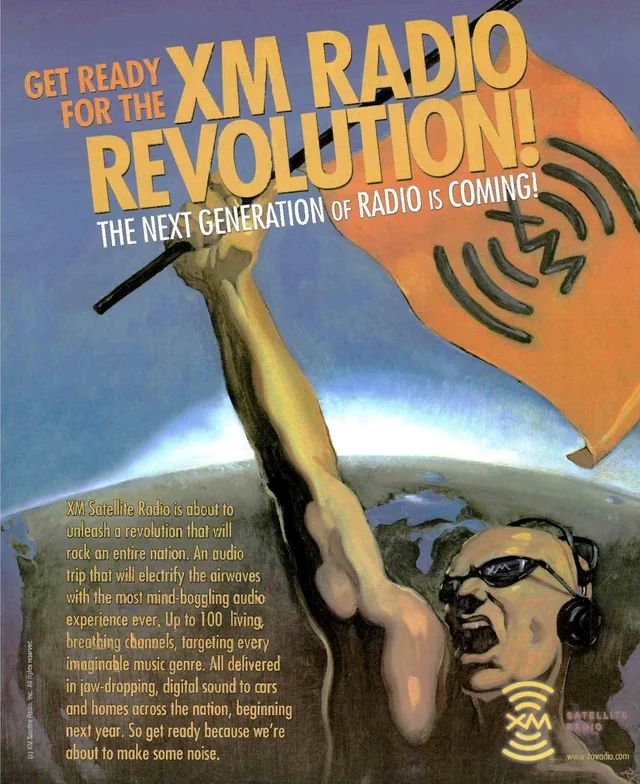
Pat: Two issues relating to your question come to mind. First is we, as an industry, have an inferiority complex. This all started in 2001 when XM Radio was born, followed quickly in 2002 by Sirius. XM Radio debuted with a $100,000,000 marketing budget, primarily focused on the “Radio to the Power of X” campaign largely featuring talking points about why they were better than traditional radio. Our response? Zero. Zilch. We were getting beat up, repeatedly punched in the face. Many started to believe the hype.
Photo Credit: Reddit
Since then we’ve seen the rise of streaming media. You Tube, Spotify, Apple, and too many others to mention have also, in part, aimed their guns at us. They want our listeners, but just as important is that they want our revenue. They want our dollars. The question I often ask myself is that if we’re so irrelevant and standing on the footsteps of extinction, why does everyone keep coming after us? If I want to make nickels, I’m not going to try to squeeze nickels out of a rock. I’m going to go where the nickels are to do my nickel hunting.
Which leads to issue #2. Perception. Some of you buy this, some of you don’t. But my position is (and it’s backed up by facts and numbers) is that we have hundreds of millions of people who engage with us every single week. Remember, we live in an “impressions” based eco-system today. No longer is our radio cume good enough. If you look at, collectively, the number of people we touch and engage with every day (radio, mobile, social, podcast, video, etc.), you realize what an amazing story we have.
The problem is that those who control a lot of dollars simply don’t believe this. Many marketers are entranced by whatever the newest, shiniest thing is, and the money follows that thinking. I wish I had a game-changing idea on how to fix this. I don’t. All we can do for now is to continue to be a megaphone for the industry and continue to chip away at this false narrative.
How Important is Local?
Keith: You’ve long believed in “live and local.” It’s a key cornerstone of Saga’s philosophy. In an industry where downsizing is the norm and voicetracking is now decades old, how important is local really? Is it more important in some markets than others? What is the real cost of losing that local connection?
Pat: It’s really important to note that I would take great national content over bad local content every time. It’s not good enough to just be local. All content needs to be great, compelling, engaging, etc. Add to that a local spin that relates to your listeners and community and you’ve won.
This is especially true with Saga and many smaller markets where interacting with your listeners is so important. Some of the larger companies have adopted a national approach because they have the scale to do so. I get it and totally understand their position. However, that leaves an opportunity for us (Saga) to pivot away from national and be as local as humanly possible in everything we do. That doesn’t mean we don’t voice track. We do, but we insist that our voice trackers create shows for each specific station and market. We also aren’t afraid to use talented syndicated hosts in certain situations.
Again, I’d take great national over bad local any day. There have been situations where hiring someone to do great local wasn’t a feasible option. In these few instances, we’ll go with a national show with great content.
Content Strategy
Keith: Every company talks about “content strategy,” but what does that actually mean in your office on a Tuesday afternoon at Saga? What strategies are you developing and directing across all those stations and markets?
Pat: Probably our most important strategic initiative today is our approach to content distribution and production. I think everyone realizes that we need to be available everywhere our listeners are. But not everyone knows how to do that. We are seeing some pretty positive results so far with video creation, mostly for social media. We have more than a few examples of talent making videos that create millions of views. Add to that the engagement these posts generate and you wind up with some pretty impressive numbers that can then be monetized. Our industry happens to employ some of the best local influencers available. Why wouldn’t we want to take advantage of their local “star” status and generate even more likes and followers than what we could generate using radio only?
The More Difficult Revenue Puzzle
Keith: You’ve been responsible for helping guide revenue in highly ratings-driven markets. Now you also oversee many markets that aren’t rated but still have revenue expectations. Which situation is more challenging, and why?
Pat: Honestly, neither is easy. Both have challenges, but the challenges are different. When I was at Audacy, it wasn’t so much about any individual market, but all about scale. How could we in programming help drive revenue across the board? Events are a good example. We could do one big show in New York, Detroit, or LA, and create millions of dollars in sponsorship revenue because we could scale similarly formatted brands to the event. It was a national, scaled play.
Saga, for the most part, is not as reliant on national dollars. We have a handful of PPM markets where ratings still drive significant revenue, but in many of our markets it’s more about the team. The GM, the sellers, the announcers, all use the relationships they’ve spent years developing to earn the trust of the local business community. Then we deliver. If we don’t do what we said we’d do, we lose that trust. Under promise and over deliver is always a good premise to work and live by.
The one area we all have to succeed in, no matter the market size, is digital. And the good news is that no other industry has the megaphone that we do to create digital demand. Our brands deliver unprecedented reach for our customers, one of which happens to be us! Creating awareness of our digital products and including our digital assets in every sales presentation are critically important. This isn’t to say digital is more important than radio. It’s not. But it has certainly become as important.
Los Angeles vs. Bucyrus, OH.
Keith: You’ve seen success in markets like New York and Los Angeles — “KRTH is #1 again.” What does programming success look like in a market like Bucyrus, Ohio? What makes the champagne bottles pop in a market like that?
Pat: It’s the recognition and satisfaction you get when you help your community. When you are thanked and appreciated by countless local residents for the fund drive you just did, for the community event you just put on, for keeping the community informed, for knowing you make a difference in countless lives. I’ve been fortunate enough to be part of many ratings “highs”…that adrenaline rush you get when you first download a book (assuming it’s good). I can honestly say that smaller markets experience the same kind of rush when doing something special for their communities. They feel the love. It’s very real.
Recruiting in 2026
Keith: When you need to fill an on-air position in a smaller market today, where are you looking? How are you finding and developing the next generation of talent for Saga?
Pat: Great question. It’s hard. We’ve had positions open for months before we found the right person. The traditional training grounds (overnights/weekends) are long gone. But, young people are still creating content. In fact they are doing it in record numbers. Social media and podcasting have created entirely new funnels with their ease of entry into content creation. The really good ones are not easy to find. But once you do, the value proposition we can offer them (massive exposure to their brand) is something that no one else can offer. Start by looking locally or regionally. You’re unlikely to convince influencers with millions of followers to come join your local morning show. But the ones with talent who are trying to build a following might just jump at the opportunity.
There are still plenty of young people interested in radio. Not as many as previous years, but they’re there. Many just need an opportunity…someone to take a chance on them like someone did for all of us years ago.
AI
Keith: AI clearly has the potential to help broadcast companies in several ways, but what’s one area you believe AI should just stay far away from radio?
Pat: AI personalities. I’m afraid of everything we put at risk, everything we lose, if we start replacing real personalities with AI. Listeners want engagement, companionship, and authenticity. It’s part of the relationship and commitment we’ve made to consumers, who in turn have chosen us to spend time with.
That said, I’m a big fan of AI. I use it all the time in both my personal and professional lives. I think it can be immensely useful in so many ways. But replacing personalities, to me, is a step too far.
Best Practices
Keith: Programmers often talk about Nielsen “Best Practices,” which some would argue hurt the listening experience. But you’re in a fascinating position: some Saga markets are Nielsen rated, some aren’t ratings-driven at all. Which Nielsen practices still matter in non-rated markets, and are there principles smaller markets follow that bigger markets may be overlooking?
Pat: Many PPM principles remain the same no matter the size the market. Reasons that cause tune out are mostly universal. When announcers talk about something no one cares about, people tune out. When a song is played that people don’t want to hear, consumers tune out. All the rules of music scheduling are the same in all markets. The art of programming applies in all markets. I used to use Media Monitors to find patterns driving tune out. We used this data to coach PD’s and talent.
For example, many personality driven rock morning shows felt they must have a sports person, or at least a detailed sports report because they are, after all, male focused brands. But the data shows that many male rock listeners don’t go to their favorite morning shows to hear about sports. There was consistent tune out when sports reports came on multiple rock morning shows. Another example was traffic reports on many music stations. Research might say that listeners want traffic reports, but tracking their behavior told a very different story. And, don’t even get me started on tune out that comes with morning shows interviewing comedians who went to bed an hour and a half ago.
I still use a lot of what I learned in markets where more tools were available, to coach PD’s and talent today.
Free Markets
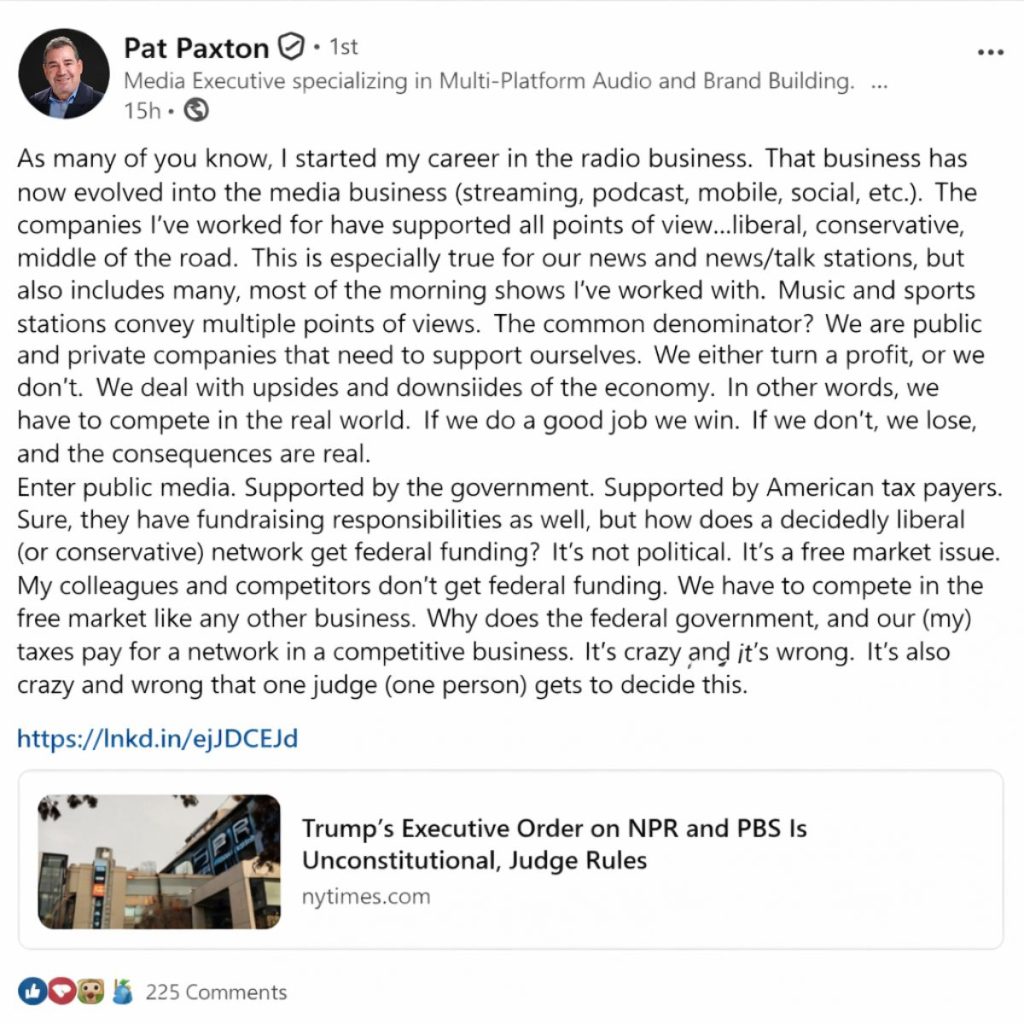
Keith: You recently posted on LinkedIn about the difference between commercial media companies that compete in the free market and public media organizations that receive government funding. Your post wasn’t political, although some commenters tried to steer it into a left vs. right debate. From your perspective, what’s the core issue here? What do you think people outside (or even inside) the industry misunderstand about that dynamic?
Pat: Yea. I kind of hopped into a hornet nest with that one. It’s a moot point as Congress has already defunded public media. I had one point to make, and only one. It was totally apolitical. Federal funding for public media began in 1967. The “1967 Public Broadcasting Act” mandate was and is “to provide educational, non-commercial programming and serve underserved audiences.” There are many great arguments for and against federal funding of public media but I’m not sure anyone would argue that public media is “non commercial”. Just because they say “underwritten by” before a toned down ad does not make them non commercial. That premise was abandoned years ago.
Regarding “educational” programming, the original argument was made because there were limited news outlets and children’s programming available. Today I couldn’t even count the number of news outlets available. Between radio and TV there are left leaning outlets, centrist outlets, and right leaning outlets, and everything in between. There is quite literally something for everybody in todays free market. The same goes for children’s programming. PBS gave us Sesame Street, Mr. Rogers and other great shows for kids. But today there are a plethora of media outlets serving children 24/7. And if you prefer the public media productions, no problem because they are still available on PBS. Or go to You Tube. It’s all right there.
An argument often used by those to support federal funding for public media is that it represents only a small fraction of the total NPR/PBS budget. That brings up two points. First, if the money is so inconsequential, why is it such a big deal? Most of us have been asked to cut a far larger percentage of our budgets over the years. Second is that the number that public media receives from taxpayers is $550,000,000. A year. I bet I could find a lot of non-public media CEO’s who would have no problem taking their share of that windfall.
Those of us in commercial media don’t get handouts. We have to survive on our own. If we don’t there are very real consequences as many of our colleagues have unfortunately experienced.
Finally, I have been swayed to the argument that there are communities that without public media would have no free media at all. For that I would carve out an exception. Public media goes after the same listeners and marketing dollars that commercial media does. To say that they are not competitors is simply not based in reality in 2026.
To be clear, I am NOT anti-public broadcasting. I think they do a great job in many ways. They have a place in todays world. I just don’t think tax payers should be funding them, creating an uneven playing field for the rest of us.
Barrett Media produces daily content on the music, news, and sports media industries.Sign up for our newsletters to stay updated and get the latest information right in your inbox.
The shutdown of CBS News Radio has sparked strong reactions across the audio industry, and few voices carry as much weight on the topic as Traug Keller.
The longtime media executive, who previously led ESPN Radio and ABC Radio Networks, didn’t hold back when discussing the decision. Keller believes the end of CBS News Radio reflects a fundamental misunderstanding of audio’s value and warns it could signal deeper issues for the broader radio business.
“I immediately thought of my old friend Charlie Osgood and said, ‘God, he must be rolling over in his grave,’” Keller said. “It’s such a — I’m searching for the words because I’m old now — but the history is so rich, and as a vehicle to keep so many Americans informed over decades, to see it just evaporate like that was very sad. I guess my initial reaction was that I was profoundly sad.”
While the emotional response came first, Keller quickly turned to the business implications. He didn’t mince words when evaluating the move.
“I think it’s a bad decision,” Keller said. “I understand that the world is going digital, but I think the decision represented a chronic misunderstanding of the value of audio in this country. Big companies, mainly headquartered in either New York or Los Angeles, don’t understand that 90% of the country still gets informed and entertained by terrestrial radio. Never mind the other audio platforms that, as a news provider, you can be ubiquitous on and promote your brand.”
That disconnect, Keller argued, isn’t new. However, he believes it’s become more pronounced as companies chase digital growth at the expense of legacy platforms that still deliver.
“Radio has always had problems convincing advertisers to use the medium, even in its heyday,” Keller stated. “Because it’s invisible, it’s somehow not thought of, yet it informs people on all things — what to wear in the morning because of the weather, for example. It’s still a vital form of information. I point to 1010 WINS in New York and the ratings success it’s currently having. Look at WTOP in Washington. Look around the country at some of these heritage AMs that moved to FM and the success they’re having. Listenership is still strong. It’s still a very effective medium.”
Even more, Keller emphasized that networks like CBS News Radio served a larger strategic purpose beyond direct revenue.
“News providers like ABC News Radio or CBS still have a role to play and benefit their corporate parents because it’s an inexpensive way to extend the brand, market, and move people into the digital ecosystem,” the longtime media executive said.
Despite the challenges facing radio sales teams today, Keller insisted the medium’s core strength hasn’t changed. In fact, he pointed to one of its most enduring advantages — habit.
“Radio listening is habitual. Audio listening is habitual,” Keller said. “I point to my days at ESPN Radio and before that at ABC, where people listened to Tom Joyner, or Sean Hannity, or Paul Harvey, or Mike and Mike. Today, you’ve got others where listeners develop a relationship with the talent.”
That connection, he added, is exactly what advertisers are buying — even if the platform has shifted.
“Advertisers are using podcasts — the Joe Rogan phenomenon is not new,” Keller said. “It’s just Paul Harvey in his day, moved over to podcasts. It’s still audio. Radio still has that. The key to advertising success is to tap into the talent that millions of people are listening to every day. It’s the age-old story: one person telling another person about the value of a product.”
However, Keller acknowledged structural issues have made it harder for radio companies to fully capitalize on that strength.
“Because of deregulation and the financial position many large audio companies find themselves in, they are hindered from really developing the best talent,” Keller stated. “I think iHeart probably does the best job of that right now. But radio still has the goods. It just requires that constant drumbeat, and I grant it’s much harder today than it’s ever been.”
Even so, Keller pushed back on the idea that CBS News Radio couldn’t be financially viable. From his perspective, the bar shouldn’t have been profitability alone.
“The CBS Radio Network business should at least break even,” Keller said. “I have some knowledge of that from having run ABC Radio. They should be able to do that, even in today’s environment, without losing money, while also serving as an incredible way to inform and move people into the company’s digital platforms.”
That leads to a broader argument — one Keller believes executives may be overlooking.
“Yes, I think it can work as a loss leader,” Keller said. “We did this exercise at ESPN. We might have been making X dollars in profit, but in addition to that, we were providing tens of millions of dollars in value — the equivalent of what it would cost in paid media to deliver the same number of impressions. That added up to tens of millions of dollars in value.”
Given that math, Keller said the decision to exit the space raises questions.
“I’d be shocked if CBS Radio Networks was losing significant money,” Keller said. “If it was, then there’s something else going on.”
Looking ahead, Keller believes CBS News Radio may be the first of its kind to exit — but he hopes it won’t be the last lesson learned.
“I would say it’s probably the first,” Keller said. “The people making these decisions have to make hard choices, but they don’t give radio a second thought, and that will be their mistake.”
Still, Keller sees opportunity amid the disruption. In fact, he believes competitors — both traditional and digital — should move quickly to fill the void.
“I think this is a huge opportunity,” Keller said. “There are digital platforms that would be smart to look at the gap that’s been created. There’s still a need for audio content, whether it’s terrestrial radio, particularly FM, SiriusXM, or Spotify. There are real opportunities here.”
He specifically pointed to established brands with infrastructure already in place.
“There’s certainly an opportunity for a brand like ABC, which is already strong, to step it up,” Keller said. “It should be a wake-up call — or it won’t be. I don’t know that it will be ultimately for the CEOs of these companies, because they’re not thinking about radio. You need strong, smart advocates internally to make sure leadership understands the value being provided.”
Finally, Keller made it clear that replacing CBS News Radio wouldn’t be as difficult as some might think.
“That could be done in 90 days, easily,” Keller said. “You’d be able to hire experienced people from CBS. That wouldn’t be hard. You combine that with the news infrastructure you already have, and you could partner with an affiliator like Skyview (Networks). You could put this together without it being a heavy lift on your existing business, and get out there using the expertise in the marketplace. I’d say you could do it in three to four months.”
Barrett Media produces daily content on the music, news, and sports media industries. Sign up for our newsletters to stay updated and get the latest information right in your inbox.