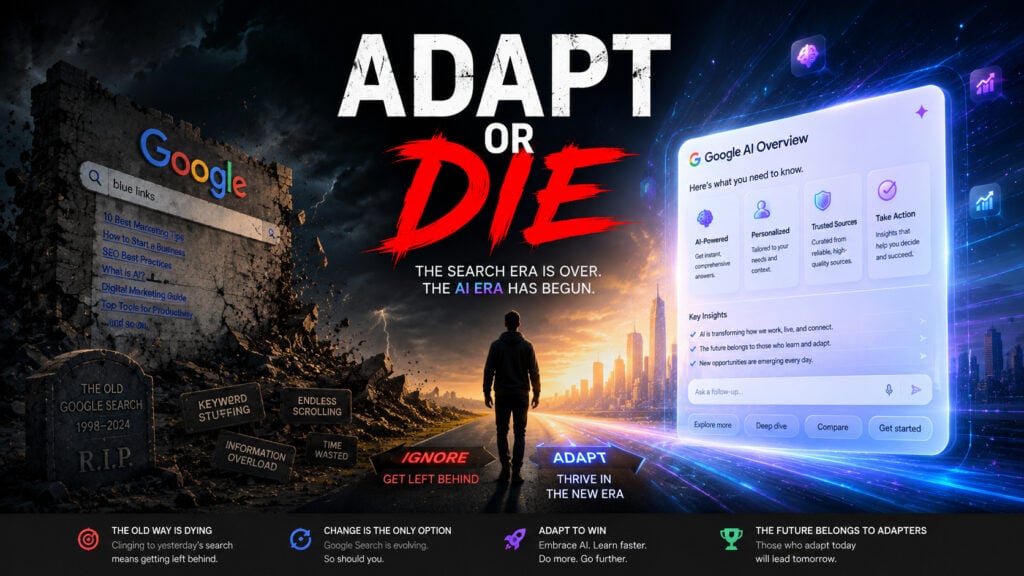
Google search as you know it is over. That’s not a clickbait created headline — it’s what Google announced at its I/O 2026 conference. The news may be unsettling, but it’s further confirmation that the industry will continue to rapidly change. When it does, you either adjust or suffer the consequences. Technology and business leaders don’t care about your feelings. They want long-term relevancy and larger profits.
Last week Google shared that the traditional search bar — the one that has driven traffic to media websites for nearly three decades — is being replaced by an AI-powered experience that condenses information, builds interactive tools, and dispatches background agents to track changes on your behalf. These changes will likely further decimate Google referrals to publishers.
Most who produce written content won’t be surprised by that. They’ve already suffered from declining referrals due to AI Overviews. It has led to some ad-dependent media operations going out of business.
Read that last line again. Out of business.
If you run a radio station, a television network, or any media brand that depends on website traffic for revenue — this development should have your full undivided attention. Larger discussions between executives, managers, and digital departments will be forthcoming. Until then though, let’s examine the situation a little deeper.
What the Numbers Already Show
First, this is not a future problem. The damage is already happening. Organic click-through rates have seen a sharp decline thanks to AI Overviews. Recent studies find that queries have dropped by 61% and paid click-through-rates are down 68%. Zero-click searches now lead the way, with nearly 60% of all Google searches ending without a click. In the US, Google search referral traffic to publishers has dropped by roughly a third.
Since AI Overviews were introduced, some websites have experienced search traffic declines ranging from 20% to 40%. Consequently, every media brand that built its digital business on Google search traffic is operating on a foundation that is actively eroding beneath them.
For radio and television brands specifically, this creates a mess. Host opinions, interviews, sports scores, news updates, music discovery — these are categories where AI Overviews are most aggressive. Google does not need to send a user to your website to tell them what happened on your airwaves. They already know. They just sift through your content at lightning speed, find the key details, and answer the users question without you.
What This Means for Revenue and Jobs
Digital departments were built to satisfy the existing economic model. They’ve focused on creating written content, ranking high on Google, generating traffic, and relying on programmatic advertising and direct sales to capitalize on that traffic. But if Google’s AI condenses your information, builds interactive tools, and dispatches background agents to track changes, the incentive for users to click through to your website declines further.
That diminished incentive doesn’t just hurt your pageviews. It directly threatens programmatic advertising revenue, sponsored content deals, and headcount justification for digital teams. Jobs in SEO, digital content production, and web strategy become more exposed. This is happening at a time when most media companies are already dealing with reduced digital margins.
The brands at risk most are those who built digital strategies entirely around Google traffic without developing owned audience relationships. This is why I sounded the alarm last week on the lack of content and business strategy for newsletters. It also carries over to apps, podcasts, and social communities. These are all areas that can survive a world without search referrals.
What Media Professionals Should Be Doing Right Now
The answer isn’t to gut your digital department or start panicking. It’s to get a firm understanding of what’s happening, and be ready to adapt. Then it’s time to accelerate in four directions.
First, build your owned audience aggressively. Diversifying your traffic sources is a must. If you didn’t see this train racing in your direction over the past two years, where were you? Facebook did this before. So did Twitter (X). Why would you assume anything you don’t own won’t change the rules and make it more difficult at some point? The pivot you’re going to have to make involves building a presence across AI search platforms, social media, email, and direct channels. Every newsletter subscriber, every viewer or listener, every app user is an audience relationship that algorithms don’t own. AI queries will be important for the near term until they too change the rules down the line. This is why I’ve said many times that one of radio’s biggest mistakes was devaluing the medium it owned over platforms it doesn’t.
Second, the brand position you own is going to matter a lot. Brands cited within AI Overviews earn 35% more organic clicks and 91% more paid clicks than those that aren’t. The goal is no longer about ranking — it’s about being the source Google’s AI trusts enough to cite. That requires authority, depth, and original reporting rather than volume-based content production. This is good news for sports and news brands with strong recognition and local content. Music stations lacking on-air personalities or original online content could be affected.
Third, rethink why your website actually matters. When Entercom was recruiting me to build 95.7 The Game in 2011, Pat Paxton asked me “why do we need a website”? I initially thought “what type of crazy question is that?” Upon thinking deeper though I understood his point – the website mattered to the audience to listen live and download a podcast to hear a prior show. Few people flocked to a radio station website to read show pages, AP articles or to see which promotional photos were uploaded.
Is your website primarily a traffic vehicle for programmatic ads? If so, that model is going to deteriorate quickly without a paid media plan. If they access your website directly rather than through search — it has a durable future. This is why your listen live button, podcasts, and videos are important. Those drive large audiences and provide advertising opportunities. Build for that type of website and be ready to explore advertising relationships that support those content sources.
Fourth, treat AI tools as operational infrastructure not optional enhancements. A new SEO trend called Generative Engine Optimization is becoming popular in 2026. GEO focuses on optimizing content for AI-generated search experiences instead of only traditional rankings. The brands that understand how AI systems evaluate and cite content will have a structural advantage over those still optimizing for a search experience that no longer exists.
Finally, do your homework on what type of content social platforms will and won’t push to your followers. I see so many stations still littering platforms with article posts. They don’t work. 3% or less of your audience see them. Referral traffic is small unless someone with a large following shares it or your brand pays to boost it. If you think the answer to search decline is flooding X, Facebook, Threads, Bluesky and LinkedIn with more article posts, guess again. Shouting in an empty forest only means nobody hears you. Study what types of content platforms reward with reach, and serve your audience that type of content. Sales and digital teams are going to have to adapt.
Final Thoughts
The media brands that survive this shift will be the ones that moved before they had to. Publishers have little time to adjust. A new search box is being rolled out this week and generative UI is coming this summer.
The window is not closing. But it is being resized and reshaped. The sooner you get comfortable with that, the quicker you’ll fall in love with your home again. You might even have some extra nickels left for additional upgrades.
Barrett Media produces daily content on the music, news, and sports media industries. Sign up for our newsletters to stay updated and get the latest information right in your inbox.