The Podcast Study 2026 offers audio executives plenty to consider. Strategic Solutions Research and Point-to-Point Marketing designed the research to build on year one. Overall, the results reveal both major opportunity and a few warning signs. Hal Rood, a Partner at Strategic Solutions Research, explained what the two groups wanted to learn.
“We also wanted to lean into new ideas for revenue generation, because spot load has been added to podcasts over recent years,” Rood said. “At what point are we going to hit the limit in terms of spot load?”
Beyond revenue, the researchers also wanted to segment the podcast fan base. As a result, they identified two key groups: super fans and prime prospects. Moreover, they wanted the study to add something new to a crowded field of podcast research.
Super Fans and Prime Prospects
Super fans quickly became a headline finding. However, they make up a modest share of the audience. Their influence far outweighs their numbers, though.
“Super fans are about one out of six listeners, but they’re giving outsized usage and engagement,” Rood said. “Not only are they consuming a lot of the content for podcasts, but they’re engaging. That is a really key factor because the podcast space is so crowded.”
Prime prospects tell an equally important story. These listeners engage with podcasts, but they don’t consume as much content as super fans. Notably, the group is just as large as the super fan segment.
“Prime prospects like the product to the point that they’re engaging in some way,” shared Rood. “So how do we get them to use more of our content?”
Consequently, converting that group could effectively double the super fan base.
A Flashing Yellow Light on Ad Load
Meanwhile, the study raised concerns about ad load. Only 9% of respondents said they could tolerate more ads. Larger groups said they’re hearing more ads and changing their behavior because of it.
“There definitely is a flashing yellow light for ad load,” said the Strategic Solutions Research Partner. “Now, is it a red alert yet? No, but we’re seeing the canary in the coal mine.”
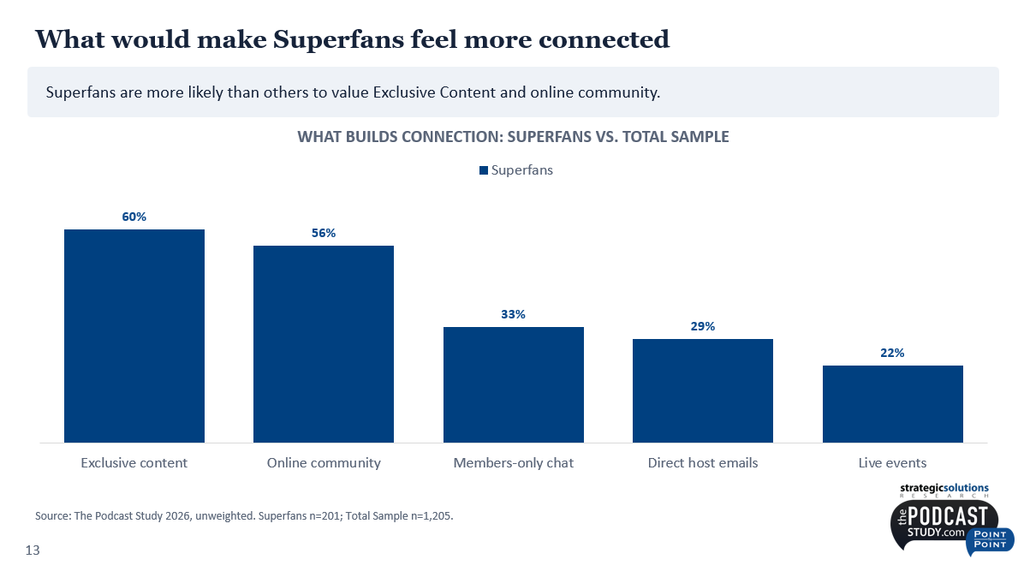
Fortunately, listeners appear willing to support content they love. Instead of adding spots, podcasters can offer subscription tiers and VIP clubs.
“Those are exciting opportunities,” Rood said. “Large groups of people want to join VIP clubs. Again, these are people who want to engage with the host and with the podcast in general.”
The Case for Charging More for Host Reads
Host-read ads emerged as another bright spot. In fact, the study found they deliver lasting value beyond a single spot. Listeners who hear a host endorse a brand remember that brand’s other ads better. They also think more favorably of it and show higher purchase intent.
“That host-read ad becomes fuel for better efficiency of an entire run-of-schedule campaign for that brand,” shared Rood. “That’s why I say, are we properly pricing the value of all of that? Advertisers should be paying extra, and a proper amount, for the value these host-read ads are providing.”
Rood believes the same logic applies in radio. Some stations already charge more for host endorsements, but he questions whether it’s enough.
“The question is, are we charging enough?” said the Strategic Solutions Research Partner. “Because the value is so obvious. It’s measurable.”
What Media Companies Should Do Now
So what should media companies do with all of this? Rood offered a clear starting point.
“First of all, find your super fans and make sure those super fans feel the love,” Rood said. “Find those prime prospects and get them deeper into the funnel, and ensure those prime prospects are more regularly using the brand or the podcast than they are right now. The regular usage from prime prospects, that’s what you’ve got to do. You’ve got to get these prime prospects more regularly consuming that podcast. That’s where you’re going to get the incremental growth.”
Notably, Rood also used a vivid image to describe the industry’s current position.
“The water in the harbor is rising at a rapid pace,” shared Rood. “But the water rising in the harbor is masking the fact that the boats in the harbor, to some degree, have leaks in their hulls. Some might have larger leaks than others, but across the whole space, we’re seeing leaks in the boats. What are those leaks? The leaks are content execution problems.”
Fixing the Content Leaks
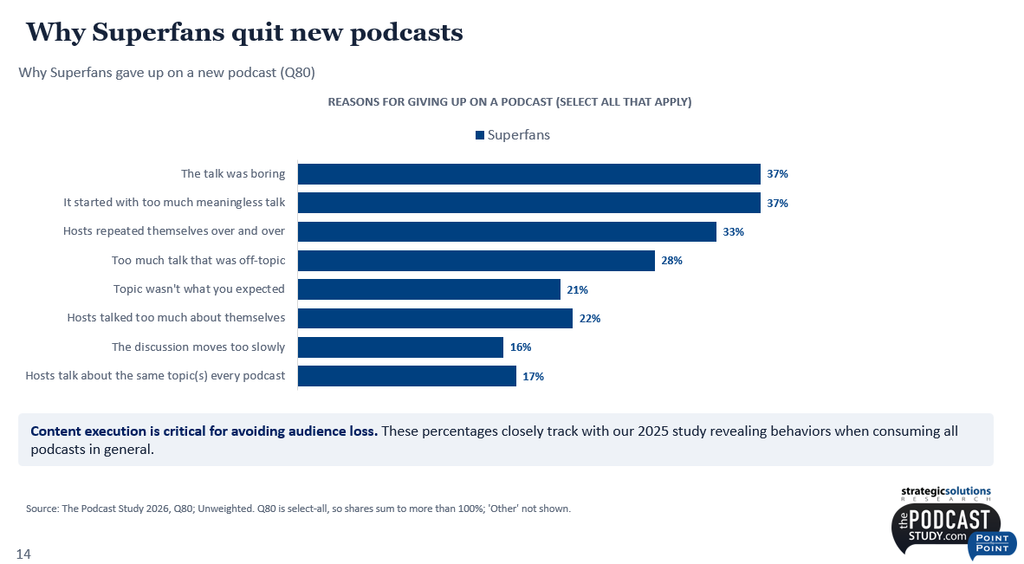
Those leaks cost podcasters real listeners. Specifically, roughly a third of people who try a podcast tune out. They cite slow starts, off-topic hosts and boring talk.
“If someone tries your podcast for the first time and they’re disappointed, chances are they’re not coming back,” Rood said. “Better than even. So let’s plug the leaks in our boat with better content execution, because that’s within our control.”
These problems might sound familiar to radio programmers. Indeed, Rood sees clear parallels with the firm’s earlier radio research.
“It’s a lot of the same things,” said the Strategic Solutions Research Partner. “The hosts repeat themselves. The hosts start too slow. They break too slowly.”
Ultimately, Rood hopes the research leaves a lasting mark.
“It’s free research we’re offering because we want to make the space better and contribute to the whole endeavor,” Rood said.
Barrett Media produces daily content on the music, news, and sports media industries. Sign up for our newsletters to stay updated and get the latest information right in your inbox.