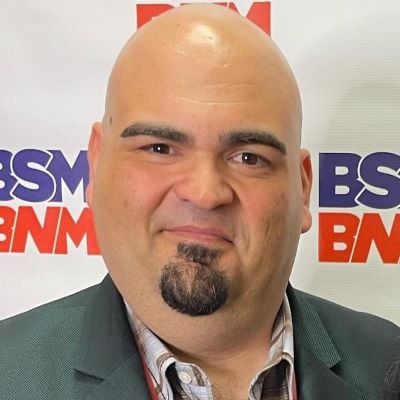
Sports fans in Cleveland know and trust Adam the Bull. That is why it was a shock to so many last year when he announced that he was leaving 92.3 The Fan. His opinions on the Browns, the Cavs, the Guardians and more were essential to their day.
Fortunately, no one had to wait too long for Bull to resurface. That includes Bull himself, who swears that he had nothing lined up when he decided it was time to step away from the radio station.
Within weeks, The Ultimate Cleveland Sports Show launched with Bull right at the center of the cast. That program, which is part of the Locked On Sports portfolio now has over 32,000 subscribers on YouTube. In March of this year, Adam added to his digital workload, joining BetRivers for not one, but two podcasts focused on Cleveland sports.
When we chatted last month, I asked him what lessons he could bring with him from legacy media, how his social media habits and goals have changed and so much more.
Demetri Ravanos: A lot of your shows are short compared to what some in this space are doing. How much of the show is you just turning on the mic and letting it rip as opposed to plotting out points and segments?
Adam the Bull: A lot of it is turn on the mic and go, depending on the day. Like right now, football season. I’m doing Sunday, Monday, Wednesday and Friday podcasts. The Sunday podcast is recorded around the end of the 4 pm game. So whenever that last 4 pm game ends, that’s just like I got my YouTube TV now. I got four screens up. I’m focusing a lot on the Browns, but I’m trying to watch as much of all the games as I can, so that’s just kind of rapid fire. All my thoughts for the games during the week.
Before it was football season, I spent a little more time in terms of prep, but I’ve always been someone who thinks you can be too prepped. I’ve always been about being natural. Some people like to have a million things written and that depends on your style. I worked with Steve Somers for years, who I love and adore, and he would, as I’m sure you know, write down longform speeches that he would do. It was amazing, but that was his style. My style has always been more off the cuff.
Even when I was doing a five hour radio show, I’d want to have, at most, an outline that said, “Browns running backs,” or whatever, but I don’t like to get bogged down. If something pops to mind in the middle of a podcast or middle of a show, I just want to go with it.
I just feel like most of the time it works and I’ll take the couple of Ls here and there when it doesn’t just to keep it free from restriction and sounding overproduced.
DR: Cleveland is a parochial place, right? But it’s also a place that a lot of people leave. I would imagine now you have greater reach with those, let’s call them Cleveland ex-pats, than you did on a traditional radio show. Are you hearing a lot more from people that grew up in Cleveland but now live in Tennessee or Texas or wherever it might be?
ATB: You know, it’s funny that you say that. I don’t have the exact numbers from my podcast, but as you know, I’m also doing the TV show, which you can find on YouTube, except now a half hour of it is on local channel here, but I know that our audience for the TV show is almost 50% outside of Ohio. At first sight that is stunning, but then when you think about it, it’s not because, as you say, a lot of people will move out of the area.
Obviously, the Browns are the most popular team here, but there’s a lot of older fans. Older fans don’t often turn to podcasts and YouTube over over traditional radio, but I think even they are adjusting somewhat. You’ll find a lot of like 60- and 70-year-old people that loved the Browns because they were kids when Paul Brown was there and Jim Brown was there. When football was first on TV, the Browns were on a lot. Even growing up in New York, I knew a decent amount of Browns fans from older people. So, I guess it in the end it wasn’t that surprising that that population exists, but I still was a little surprised that it was that high a number. My guess is that on the podcast, it’s maybe not quite that high, but probably not too far off.
DR: The follow up is a little bit twofold then, right? When you are more accessible to an audience like that and also when you are on a digital platform that isn’t worried about team partnerships or partnerships with advertisers that are also partners with the team, how does that change the way you can or do cover the local teams?
ATB: Well, you know, in my real life I curse. I think most guys – forget guys – most people when they talk about sports, cursing is part of the debate. So I think I curse more in terms of my coverage of the teams.
You know, when I was on the Fan, they let me be a harsh critic. We had, and still they have the Browns on the station. I have differences of opinion with traditional radio and, some parts, my old company. But the one thing I would say that they were very good about is I’ve always been a harsh critic when necessary and I wasn’t asked ever to back it off.
I’m not here to make friends with the players or make friends with the coaches or owners. Some people are in this business for that, but I’m not one of them. You’ve got to be able to give your honest opinion. The teams would complain once in a while, but I didn’t care and the station never made it hard, so I don’t think it’s changed that much.
DR: This doesn’t have as much to do with podcasting. Maybe this is just more about the social media age. But have you found the way you interact with your audience is different when you are primarily on digital platforms versus traditional terrestrial media?
ATB: One hundred percent. I don’t take calls on the podcast. We don’t take calls on our TV show. That was a staple of interacting with a radio audience. I’ll read a tweet.
When I was on the radio, I did obviously a lot of social media, but I wasn’t really promoting myself or the show that much. But now that’s huge. I mean, every time I put out a podcast, I’m pushing it on social media because that’s the only way I can get the word out.
I paid the stupid $8 a month for the dopey blue checkmark, which was probably stupid, but I did it just because that’s how I connect with people and that’s how I get the word out about what I’m doing. The more people that watch and listen, the better it is for me, obviously. I’m on social media a lot more than when I was on radio.
DR: Do you put the blue checkmark on display or have you decided to hide it?
ATB: Oh, I didn’t even know you could hide it. I do have it on display. I don’t like it.
What’s stupid is – I don’t mean to make a whole Elon Musk thing – but if you want to charge people to use Twitter, fine. I’ve got no problem with that. But there still should be a way to differentiate between – I was going to say “celebrities” – but I don’t really think of myself as a celebrity. But you need some way just so people know, “Oh, this is a real, credible person in the media and not some Joe Schmo in their home.”
DR: Speaking of of changes, has the way you do your part for getting a sponsor’s message out there changed? There is so much more of a buy-in to you and what you are saying that your listeners have now than they did on radio. They’re choosing to listen to and support you. What does that do to ad reads and other ways you encourage them to engage with sponsors?
ATB: Well, my podcast is part of the BetRivers Network, right? It’s me in Cleveland; Mike Francesa in New York; Mike Missanelli in Philly and all these guys who promote BetRivers in their markets. I actually think is a brilliant plan by BetRivers. I’m very excited to be a part of it. It’s a smart business plan.
They don’t really sell advertising on the shows. It’s about promoting them. Their advertising budget, if you will, is paying us instead of putting commercials on TV or whatever. I think it’s a smart plan because it gets the word out to more people without spending crazy advertising rates.
I’m used to doing endorsements on the radio and I don’t do that anymore. I don’t do that on the on the TV show, and I don’t do it on the podcast. So it’s very different. I still have relationships with some of the companies that I did business with, but it’s definitely changed.
DR: You mentioned the BetRivers relationship, and I wonder what success looks like when you’re doing a podcast for a company like that. Do you even bother figuring out how many people are listening or are they more concerned with that conversion rate of turning listeners into players?
ATB: Oh, it’s a combination. My podcast had just been audio and about a month ago we put it on YouTube. I can’t see the podcast downloads for the show. I get that info from my bosses at BetRivers. But on YouTube, I could see exactly how many people are watching the podcast. So I am paying attention to that. I’m sure everybody’s paying attention to that.
Now, what exactly BetRivers wants from each individual host? They’ve never given me a goal to reach; whatever certain amount of of viewers or listeners. They’ve been very supportive. They seem to be happy with the numbers I’m bringing in and it’s a great relationship. I love doing a 20-minute podcast and a two-hour TV show as opposed to doing a five-hour radio show. I loved radio. I’m not saying I would never do it again, but, you know, working half the hours is the way to go.
To learn more about Point-To-Point Marketing’s Podcast and Broadcast Audience Development Marketing strategies, contact Tim Bronsil at tim@ptpmarketing.com or 513-702-5072.