Dan Bongino is returning to radio with Westwood One for a new afternoon program alongside Shawn Farash. The Bongino Report PM will debut August 24 and air from 3-6 PM ET.
What We Know: The new program will feature Farash live during the first hour from 3-4 PM ET. Bongino will then host the second and third hours from 4-6 PM ET. Westwood One will distribute The Bongino Report PM to affiliates nationwide, marking Bongino’s return to radio after his previous nationally syndicated program. The show will focus on news, commentary, and stories that matter most to its audience. Meanwhile, Farash will bring his own voice to the opening hour before Bongino takes over.
What They Said: “I’m excited to partner with Shawn to bring listeners a daily program focused on the stories that matter most. Our goal is simple: deliver honest analysis and keep our audience informed and engaged. Radio remains one of the most powerful ways to connect directly with people, and I’m excited to be back on Westwood One!” -Dan Bongino
“This is an incredible opportunity for me to connect with listeners across the country every day. Working alongside Dan and the team at Westwood One allows us to bring a fresh, energetic approach to afternoons while staying focused on the stories our audience cares about most.” -Shawn Farash
“The Bongino Report PM brings together two distinctive voices with strong audience appeal and creates a compelling new destination for afternoon radio. Dan Bongino and Shawn Farash each bring a passionate following, and we are thrilled to offer affiliates a dynamic program that delivers timely content and engages listeners in afternoon drive.” -Westwood One President Collin Jones
What Remains Unclear: Westwood One hasn’t outlined how Bongino’s return will affect the broader afternoon syndication landscape. Currently, The Guy Benson Show from Fox News Radio is also offered in that timeslot.
What It Means:Dan Bongino‘s return gives Westwood One another recognizable conservative voice for afternoon radio. At the same time, pairing him with Farash creates a two-host format designed to build audience engagement across the three-hour window. The move also gives affiliates another prominent option for afternoon drive programming.
Barrett Media produces daily content on the music, news, and sports media industries. Sign up for our newsletters to stay updated and get the latest information right in your inbox.
ESPN‘s Marty & McGee is shifting timeslots for the upcoming college football season. Barrett Media has learned that ESPN is moving the show from 7-10 a.m. ET to a noon start on SEC Network for the upcoming football season.
What We Know: Beginning this season, SEC Nation will extend to a three-hour program, kicking off SEC Network coverage at 9 a.m. ET each Saturday throughout the fall. Additionally, Marty Smith and Ryan McGee will take on a larger SEC Nation role during the 9 a.m. – noon window. Following SEC Nation from noon-12:45 p.m., the Marty & McGee program will air as a lead in to the SEC Network’s college football game telecasts with 1 p.m. kickoffs. Previously, the program shifted to a 9am-10am timeslot for the football season as a lead in to SEC Nation. The program will shift back to the 7am timeslot in the football offseason.
Marty Smith joined ESPN in 2006, and Marty & McGee earned a regular ESPN Radio slot in 2015. Ryan McGee has co-hosted alongside him since then, and the pair added an SEC Network TV simulcast in 2018. In addition, McGee also contributes to high-profile studio programming, including SportsCenter,SEC Nation, SEC Now, College Football Live, College GameDay. Smith just recently signed a new multi-year extension with ESPN. He also continues to work on a variety of properties, including college football, golf, the NFL Draft, and much more.
What They Said:ESPN’s Marty Smith is excited for the shift to noon on Saturday’s (via Barrett Media): “Marty and McGee is moving to noon on Saturdays. That’s a shift from what we’ve been the last few years. Awesome. Our bosses believe [that we’re] going to flourish here. Okay, badass man. Strike the field. Let’s go.”
ESPN’s Ryan McGee (via Barrett Media): “I think I’m third only behind Tim [Tebow] and Paul [Finebaum] when it comes to tenure on SEC Nation. So, I’m really excited to be more involved in the show this year, getting back to my SEC Network roots. I can’t wait to use that noon hour to get out all over campuses. Nothing beats the energy of tailgaters pregaming while watching the early games. I’m gonna mooch so much smoked meat. And on live television!”
ESPN’s Marty Smith on shifting to Noon on Saturday’s on SEC Network (via Barrett Media): “I want to grow where I’m planted. Our bosses have given us these opportunities. And whatever that is, I want to try to dominate that box. Whatever that box is, I want to maximize it. I want to make it grow and bloom and flourish with resonance that far surpasses what I had maybe hoped for.”
What Remains Unclear: ESPN has not specified what will replace Marty & McGee on Saturdays from 7am-10am est for the football season. Previously, ESPN Radio shifts Hammer & Emmitt to the 7am timeslot on the radio side.
What It Means: The move signals real confidence in Marty & McGee’s pull beyond early mornings. Moreover, with the challenge now being the show will be going head to head against early college football games, it will be interesting to see how the show grows in the new timeslot. Ultimately, Smith’s response frames it as growth and a test of the show’s ability to draw attention. Still, listeners now trade a sunrise habit for a midday one — a genuine test of loyalty.
Barrett Media produces daily content on the music, news, and sports media industries. Sign up for our newsletters to stay updated and get the latest information right in your inbox.
What is a conflict of interest anymore when it comes to play-by-play broadcasting? Last year, this was one of the more debated topics in sports media. Now, it has new life. Friday, the NFL announced that the “Tom Brady Rules” will also apply to ESPN Monday Night Football analyst Troy Aikman.
Tom Brady is a minority owner of the Las Vegas Raiders. He also is the lead analyst for FOX Sports NFL coverage. The rules, at first, were simple. He couldn’t enter another team’s facility or observe its practices. He also couldn’t publicly criticize officials or other teams, and he couldn’t attend broadcast production meetings either in person or virtually. Last year, good behavior by Brady — and likely some pressure from FOX Sports — relaxed the rules on Brady. This year, the rules extend to Troy Aikman.
But the NFL’s explanation for why the extension to Aikman makes me wonder who these rules protect in the first place.
This past offseason, Aikman assisted the Miami Dolphins with hiring a new general manager and head coach. During a podcast episode featuring former WFAA sports anchor Dale Hansen, Aikman said his role with the Dolphins was approved by Commissioner Roger Goodell. He has also stated that he sees a day when he could be working for an NFL franchise in some capacity.
A Shift In Focus
The two situations are different. Brady owns a minority stake, so he’s financially invested in the success of a franchise. Aikman loaned his services but doesn’t have a financial stake in the Miami Dolphins’ success.
But in both cases, NFL broadcasters assisted NFL teams in some capacity. Therefore, the league couldn’t place restrictions on Brady without doing the same for Aikman. However, NFL spokesman Brian McCarthy’s explanation for the rule focuses the pressure on NFL team personnel, not those the rules are being placed on.
“There have been no issues with Tom over the last two seasons,” McCarthy told to Front Office Sports. “It is up to the coaches and clubs what they share with him. If they share information they shouldn’t, then that’s on them. The same parameters that pertained to Tom last season will continue this year and also will apply to Troy.”
Read that line again. If they [team coaches and club personnel] share information they shouldn’t, then that’s on them.
Wasn’t that the whole point of why these rules were instituted in the first place? To prevent people with ties to competing organizations from gaining access to information through their exclusively granted access as employees of an NFL media partner?
Now, the NFL is saying it’s the team’s fault if it provides information it shouldn’t? Because Aikman and Brady have ties to other teams, and the league knows that.
What are we doing here?
Admitting Conflict
After a year of people downplaying the level of information shared in these exclusive meetings, the larger point continues to be missed. Without FOX Sports, Tom Brady doesn’t have these meetings. Without ESPN, Troy Aikman doesn’t have these meetings. That matters.
Both Brady and Aikman have some level of ties to NFL teams outside of their broadcasting responsibilities. That doesn’t mean either broadcaster has done anything wrong. It doesn’t mean either has used information improperly. It does, however, create the appearance of a conflict when their employment by an NFL broadcasting partner gives them access to team personnel and information they wouldn’t otherwise have.
That’s precisely the issue the league created these rules to address.
Instead of preventing that potential conflict, however, the NFL is now pointing the finger at the teams and making them responsible for determining what information is appropriate to share.
“Where’s the conflict,” questioned NFL Commissioner Roger Goodell to CNBC last year. “He’s not hanging around in the [team practice] facilities. We don’t allow that.”
A Suggestion….
It makes me wonder why the NFL allows these meetings at all moving forward.
There’s an obvious complication when Brady and Aikman receive exclusive access they wouldn’t receive without employment by a league broadcasting partner. If the information shared in those meetings is insignificant, as some have suggested, then why maintain a system that requires the league to create special rules around who can attend and how they do?
And if the information is valuable, then telling teams to police themselves over what they reveal to broadcasters with potential ties to other NFL organizations makes even less sense.
The NFL cannot have it both ways.
It cannot create rules designed to address a perceived conflict of interest and then shift responsibility to the teams when that conflict becomes uncomfortable. If the league believes these relationships create a legitimate concern, remove the circumstance that creates the concern in the first place.
End the production meetings.
The league created these production sessions to give broadcasters access and insight that can make their coverage better. That makes sense when the people sitting across the table have no other relationship with the teams involved. But once those same broadcasters have acknowledged ties to NFL teams, the arrangement becomes unnecessarily complicated.
If the information shared in those rooms is truly insignificant, there is little reason to keep the meetings. Right? If the information is valuable, then asking teams to determine what they can safely share with broadcasters who have potential conflicts makes even less sense.
There is a simpler solution.
Let broadcasters prepare through the same channels available to every other member of the media has. Level the playing field. Give them access to the same public information, interviews and press conferences. Allow them to do their jobs without creating a separate access system that requires the league to determine which broadcasters can enter the room and what teams can tell them once they get there.
That would eliminate the need for a “Tom Brady Rule,” a “Troy Aikman Rule” or whatever version comes next. Because, more than likely, there will be a next.
More importantly, it would put the responsibility where it belongs — on the league to eliminate the potential conflict, rather than on its teams to avoid creating one.
Barrett Media produces daily content on the music, news, and sports media industries. Sign up for our newsletters to stay updated and get the latest information right in your inbox.
Scott Jennings has built one of the most recognizable brands in political media, and he’s done it without ever leaving the CNN panel desk or the Salem Radio Network microphone. So when reports surfaced that Jennings could be in the mix to replace Karoline Leavitt as White House Press Secretary, plenty of industry watchers assumed he’d jump at the chance. He shouldn’t. Jennings has spent years cultivating a platform that already does everything the podium in the briefing room promises, and trading it in for a government title would be a step down dressed up as a promotion.
Let’s start with reach. Jennings currently reaches CNN’s audience nightly, Salem’s national talk radio audience daily, and a social following that amplifies every clip within minutes.
That’s a media footprint most press secretaries spend years trying to build after they leave the job, not before they take it. Sean Spicer, Jen Psaki, and Kayleigh McEnany all left the briefing room and headed straight for a cable contract. Jennings already has his.
Why Efficiency Matters More Than Title
The press secretary role comes with a specific kind of power: the ability to generate headlines and push back against what the administration calls the “woke, liberal lamestream media.” However, Jennings already wields that power every single day. He does it on CNN, where he’s outnumbered and still manages to dominate the segment. He does it on Salem’s airwaves, where he’s speaking directly to a sympathetic, engaged audience. And he does it on social media, where a single well-placed clip can outrun anything said at a podium.
Consequently, the briefing room adds a layer of restriction, not amplification. A press secretary answers to a communications shop, a chief of staff, and ultimately the president himself. Jennings, by contrast, answers to his own instincts and a producer.
That’s a considerably freer lane, and it’s one that already delivers the same message with less interference.
The Money and the Long Game
Press secretary is a demanding job: early mornings, late nights, and a level of scrutiny that makes cable news look gentle by comparison. It also doesn’t pay like cable news or national radio syndication does. Jennings would likely take a real pay cut to trade his current arrangement for a government salary, and he’d be doing it while working considerably longer hours under a much brighter microscope. That’s not an easy sell for anyone, let alone someone who’s already established.
Beyond the paycheck, there’s the bigger question of where Jennings wants his career to go. Industry chatter has long pointed to ambitions beyond media, whether that’s a run for Congress or a future bid for governor of Kentucky. Neither goal benefits from a stint as press secretary. That job forces its holder to defend every policy and every off-script moment from the president, creating a paper trail that opponents in a future campaign would happily weaponize. Staying in media, meanwhile, lets Jennings keep building a favorable public profile without inheriting someone else’s baggage.
Additionally, timing matters in politics, and press secretary jobs rarely last long. The turnover in that seat has been rapid in recent years, and burning political capital on a short-term title doesn’t set up a longer campaign particularly well.
He Already Has What the Position Provides
Finally, and this part is admittedly a bit tongue-in-cheek: Jennings doesn’t need to leave cable news to end up in cable news. That’s the punchline of the modern press secretary track. Spicer, Psaki, and McEnany all left the podium and landed in front of a camera anyway, so the “reward” for surviving the briefing room grind is often just the job Jennings already has. Karoline Leavitt will almost certainly follow that same path once she departs, likely landing at Fox News or Newsmax as a contributor.
So why would Jennings volunteer for the detour? He’s already at the finish line other press secretaries are racing toward. Between the built-in audience, the financial trade-off, and the political ambitions reportedly on his radar, stepping behind the podium doesn’t upgrade his position. It complicates it.
Barrett Media produces daily content on the music, news, and sports media industries. Sign up for our newsletters to stay updated and get the latest information right in your inbox.
Thirty-one years as program director. Twenty-nine years as the morning show host. In radio, that’s not a resume line — it’s a commitment. Dale Carter has watched KFKF evolve from a regional country station into one of Kansas City’s most durable radio fixtures. He’s been the architect of nearly all of it. When you ask him how long he’s been there, he doesn’t lead with the job title. He leads with the number of years. “31 years as program director, and I just celebrated my 29th anniversary as the morning show host,” he says. The way he phrases it tells you something: these aren’t separate chapters in his career. They’re interwoven.
There’s a peculiar symmetry to his tenure. KFKF went on the air May 28, 1963. Dale was born in September that same year. “The station and I were born the same year. It went on the air in May of 63, and I was born in September of 63.” He’s not being sentimental. He’s being precise. That alignment — station and steward arriving at roughly the same moment in history — has shaped everything about how he thinks about the job.
The Spectrum Country Strategy
Kansas City’s country radio market is crowded. Three full-service country stations compete for the same audience. Meanwhile, the media ecosystem hasn’t stopped consolidating. KFKF and Q104 are owned by Steel City Radio Group. Audacy owns the third competitor. “Our strategy is clearly take our two and beat their one,” Dale says.
KFKF’s positioning is what Dale calls “Spectrum Country.” It’s a careful balance between heritage and currency. The station plays country that listeners know — reaching back to the ’90s, which is what he calls the sweet spot for the audience. But it’s not a museum piece. Importantly, new music gets added when it’s good enough. Right now, KFKF is rotating about 28 current records. Some weeks, that means passing on 12 songs from the top 30. These simply don’t fit the brand. “There’s a fitness test that has to happen there,” Dale explains. It’s an AC station approach applied to country radio.
Q104 operates on the opposite flank. Minimal gold exists there. Maximum exposure to new product is the focus. “In our world, the currents are kind of the spice. In the Q world, any gold that they play is the spice. If that makes sense,” he says. The two stations overlap on the biggest hits — you can’t avoid Ella Langley or Luke Combs — but they’re built to pull from different wells. When Steel City combines the weight of both stations for promotions, they punch above their weight. “We’re able to take the weight of our two stations and use it nationally, and you know, maybe get like a big flyaway for Kenny Chesney in Vegas, and we give away the same trip on both stations. So it gives us the leverage that some of the bigger groups have, but still you get a winner from Kansas City.”
The Three Musketeers
The air staff at KFKF reads like an organizational chart built for stability. Dale is doing mornings and running programming. Ed Walker handles middays and serves as music director. Jim Daniels does afternoons and handles imaging. They call themselves the Three Musketeers, and for good reason.
Ed came to KFKF to do afternoons in 2011. When music director Tony Stevens retired, Ed moved into middays. He also took on the music director role. Jim’s arrival came when Tony’s departure left a gap. Dale had worked with Jim years ago. Jim was his morning show producer for 10 years before budget cuts forced a reduction. When the opening materialized, Dale made a call. “He was the morning host at WIBW for 17 years in Topeka. I called him when we had the opening, and I said, ‘Hey, how would you like to come back? And he said, ‘Yeah, I think I could do that.'” Jim is now doing afternoons. He also took over the imaging responsibilities Ed used to handle.
It’s not flashy, but it’s cohesive. Three people understand not just their own role. They understand how their work threads into the whole. Now, Dale programs both stations to eliminate strategy drift. “The problem that we had in this dual station strategy was two different programmers running it, and you know they might drift into my lane, I might drift into their lane, and now I’m doing it for both stations. So I have two great people implementing it: Ed Walker on KFKF and Cody Allen on Q, but it’s very much my strategy.”
Building Q104 From Within
Q104’s air staff tells a different story — one about developing talent from the ground up. Codie Allen came from WDAF’s Wolf Morning Show. “She was part of the Wolf Morning Show at WDAF, we’ve essentially traded morning people because Jenny Matthews is doing mornings at WDAF, and we got Codie on our station,” Dale says. Codie brings experience, format knowledge, and genuine connections in country radio.
The rest of the Q104 lineup is homegrown in a way that’s increasingly rare. Mallory K is doing middays. Lydia Taylor is in afternoons. It’s an all-female staff. “It’s an all-female staff. Something not a lot of stations are doing, but you know we are.” More than a scheduling novelty, it reflects Dale’s philosophy about where radio talent comes from these days.
He didn’t hesitate when discussing this approach. “I came into radio in 1979 as a 15-year-old kid doing midnight to six on Sunday mornings on an AM country station, and that door doesn’t exist anymore. Doesn’t exist in my building.” No weekend live shifts. No entry point exists for young broadcasters hungry to learn. Instead, Steel City Radio gets interns from universities around Kansas City. They funnel them through the promotions department.
Importantly, Steel City’s Operations Manager, Steve Serrano, has led the charge on building this intern pipeline. Dale’s role is selective — identifying which interns have on-air potential. He gives them the shot. “That door doesn’t exist anymore in my building — no weekend live shifts,” Dale says. “So we’re finding a different entry point, right, than it used to be.”
The St. Jude Partnership
Radio lives on events and community anchors. At KFKF, the biggest one is St. Jude Children’s Research Hospital. Dale brought it with him when he came to Kansas City from Hartford. How long has this been going on? “Oh, hang on a second. Could it be 30 years? I think it’s 30 years now.” The annual radiothon has become a tentpole. “We’ve raised between all the things that we do probably close to $12 million for St. Jude.”
Beyond that, there’s Summer of Freedom — a patriotic programming initiative. It runs from Memorial Day through September 11. “We’re very patriotic. That’s another part of what we do: red, white, and blue. Support the military and all that. So we’ve crafted out the area between Memorial Day weekend and 911.”
And the numbers are moving in the right direction. Recently, KFKF had its best monthly in over a year. “We just had the best monthly that that we’ve had in over a year in July, so we feel pretty good about that.” The loyalty matters more than raw tonnage. “When listeners find us, we get a lot of quarter hours from them because we do have that loyalty,” Dale says.
The Industry Reckoning
But success at one station doesn’t insulate Dale from what’s happening elsewhere. At nearly fifty years in radio, he’s watching the business consolidate, cut, and contract. iHeartMedia and Cumulus have been firing people “left and right.” It’s heartbreaking to him because this business was supposed to sustain careers. “I never thought that I would get to the point where I’m about five years from when I’m thinking about retiring and wondering if the business is still going to be there when I’m ready to retire. It’s really a sad time, and you know I pray for all of my friends who are out there looking for jobs, and I hope they all land somewhere.”
He’s lived through consolidation before. When the Wilks group acquired the station from CBS, he got a list on day one. Six people had to be gone by 5 p.m. “People I’d worked with for over a decade who did absolutely nothing wrong, but they just didn’t fit into the numbers for Wilks.” The worst day of his career was the day they handed him that list. He had to fire six people by 5 p.m.
Yet Dale keeps building. He keeps developing. He keeps plucking interns from the universities and putting them on air. It’s an act of faith in a business that doesn’t always return it. But that’s the job. That’s always been the job — to be present, to build consistency, and to believe there will be a generation of radio people coming up behind you. They need to learn the craft the way you learned it. For Dale Carter, thirty-one years of consistency says something: he still believes.
Barrett Media produces daily content on the music, news, and sports media industries. Sign up for our newsletters to stay updated and get the latest information right in your inbox.
It was just a normal Tuesday in our nation’s capital. Washington Commanders training camp was underway. The Nationals were set to host the Chicago Cubs for a three-game series. Thus, Andy Pollin was doing what he’s done for the last seven years at ESPN 630: being the guiding voice of the D.C. sports fan in the late morning, discussing the headlines and topics fans cared about.
However, that normal Tuesday took a turn immediately following Pollin’s signing off from another day of programming.
“As I was wrapping up the show, the station manager came inside the studio. Which he’s done in the past often with a smile and a compliment on the show. I could tell by the look on his face that wasn’t it,” explains Pollin. “He said he didn’t want to do this, but it came from Cumulus.”
In an instant, Pollin went from wrapping up another Tuesday in D.C. to having his time at ESPN 630 come to an end. He found himself part of the nationwide Cumulus Media layoffs that had already begun a week earlier.
An Uncertain Feeling
During the first week of cuts, Pollin was on vacation, observing the headlines circulating in radio trades and on social media. When he returned from vacation, Pollin says he texted station assistant program director Mike Callow to see if he had heard whether Pollin should plan on hosting programs this past week. With no signs of impending cuts, Pollin moved forward as if it were a normal week.
“There wasn’t going to be a massive layoff in the building. We had only two employees on the station including me. Now they’re down to one. That tells you the scope of what might have happened,” said Pollin.
As I often say, “in this business, you don’t retire, they retire you.” Cumulus just did that to me. I’m open to opportunities, but sadly that’s unlikely at my stage of the game. I’m thankful for the last 7 years at 630 and look forward to what’s next
The meeting was quick after the news. Pollin met with the station manager in his office while Cumulus human resources joined via Zoom from Atlanta. Following the meeting, Pollin returned home and alerted his social media following.
After a nearly five-decade career in radio, including the last seven years at ESPN 630, this time felt different.
At 68 years old, Pollin posted on X that in this business, “You don’t retire. They retire you.” The tweet was shared online, and news began to spread. As a founding team member of both WFAN in New York City and WTEM in Washington, D.C., Pollin understood his removal from the station was part of the industry.
“The last six months we’ve had two employees. They let me do my show, which I enjoyed doing. Given that the overhead was two salaries, which I can say mine was not back breaking. I thought maybe they were making enough to survive,” noted Pollin. “It didn’t happen. This is a company going through a restructure, and I’m a line item. I’ve been through this multiple times. It’s part of the business.”
At 68, Pollin says he continued to host the show not for the money, but because of his passion for sports and his connection with the audience. In fact, he had targeted February 2028 as the time when he planned to retire, marking 50 years in the industry. That goal was something he didn’t just share with his audience, but also with the same station management that delivered the news about his dismissal.
“The person who let me go; he didn’t want to do it. He really liked my work and told me that quite often. He knew my goal, and that was the hope. But I always told people I didn’t know if I would,” said Pollin.
Moving Forward
While he says he leaves with no regrets, Pollin told Axios following the news that he had hoped to do a farewell program for the listening audience. In the days following his dismissal from ESPN 630, Pollin’s longtime friend Kevin Sheehan provided him that opportunity.
The two taped a podcast together, and Sheehan shared the recorded audio on his program last Thursday. Although Pollin didn’t get his planned ESPN 630 exit, Sheehan gave him the send-off at Team 980 he truly wanted.
“Frankly, that’s the station I wanted to do my farewell on anyway since it’s the station I started in 1992,” says Pollin. “I have no ill will toward Cumulus Media or at ESPN 630. That’s not an issue. But if the chat with Kevin [Sheehan] is my last appearance on radio, so be it. If not, we’ll see what happens.”
Layoffs are a part of the radio industry. Pollin understands that. After more than four decades in the business as both talent and management, he understands that some decisions aren’t yours to make.
What Pollin questions more today is how success in the industry is defined. While the race for Nielsen ratings has primarily been a focus for talent, he says it’s more confusing than ever today to understand what matters.
“I haven’t heard a word about ratings in years,” said Pollin, who argues other metrics outside of traditional ratings have become more the norm for judging success. “Measuring success in radio now, I don’t know how you do it. Other than if you’re able to sell it successfully, I don’t know how that works today. I’m not saying radio is dead or dying, but it’s not the same type of industry that it used to be.”
In Reflection
Over his radio career, Pollin has experienced nearly every way a radio career can change course: a format change, a nonrenewal and now his third layoff.
This time is different, as he’s not chasing the next steps in his immediate future. Instead, he’s approaching another football season more as a fan than with a critical eye. Pollin says he’ll miss Monday’s following football because of the fast-paced and live environment of it. He says he remains open to opportunities, including additional appearances on platforms with former teammates of his, including Sheehan and Steve Czaban.
But in 2026, Pollin understands that his book may already be written and finished in an industry that continues to evolve every day.
“I don’t have any regrets. I started my career in Port Arthur, Texas. My break in and story couldn’t happen today,” said Pollin. “I don’t think I could have carved out a better path in my career. There’s been highs and lows just like anyone else, but I couldn’t have done anything more enjoyable.”
The ending may not have come on Andy Pollin’s terms, but his story continues to live on among those he impacted. After nearly five decades in radio, including helping build two of the country’s most influential sports radio stations. He leaves ESPN 630 with something more valuable than a planned farewell. The knowledge that he gave the industry everything he had and built a connection with listeners that no ratings book or balance sheet can measure.
Radio may have decided when Pollin’s final show would be, but it doesn’t get to decide what his career meant. If his conversation with Kevin Sheehan turns out to be his final appearance behind a microphone, Pollin can walk away knowing he didn’t leave radio because he was ready to stop loving it.
He simply ran out of time on someone else’s clock.
Barrett Media produces daily content on the music, news, and sports media industries. Sign up for our newsletters to stay updated and get the latest information right in your inbox.
I saw an Instagram reel this weekend from Gaby O’Connor who works for Audacy in Miami, currently hosting mornings on 102.7 The Beach but was formerly a major part of 104.3 The Shark. It’s been a full year since radio station 104.3 The Shark in Miami flipped from Alternative to Sports and O’Connor says she’s still being asked what happened to the station.
It got me thinking. If your station went dark tonight, flipped formats, ceased to exist – what would the market actually lose? Not what would go quiet. What would really be missed?
The Replaceability Test
Try this exercise. Pull up Spotify, Apple Music, SiriusXM, a podcast app and Instagram. Then ask how much of your station’s experience a listener could recreate using only those five tools. If the honest answer is 90% or more, the remaining 10% is the only thing you’re actually selling. Everything else is inventory a listener already owns.
This isn’t a “radio is dying” argument. Plenty of stations pass this test easily. The ones that don’t tend to share a pattern. They’ve outsourced their personality to a streaming algorithm or downsized enough staff to no longer have a physical presence in the community, keeping only the FCC license as proof they existed.
Saying the City’s Name Isn’t Local
A local station reads a weather liner, files a traffic report and mentions the hometown team before kickoff. None of that makes a station feel rooted. It makes a station sound like it read a script about the city, instead of showing up in it.
Real local means participation. Did the station’s tent show up at the summer festival? Did a local charity gain a partner it can count on, not just a PSA slot? Would a small business owner recognize your morning host if they walked in for coffee? That’s a different scorecard than AQH, and it’s a much harder one to fake. Some reading this may say it doesn’t matter anymore. That we live and die by PPM. But with community connection being one of the main things that sets radio apart from the streaming platforms, I vote it still matters.
What Belongs to You
Every format now has access to the same music catalog. So what separates a station that matters from one that’s merely available? The list of things a listener associates with that station alone. A morning show with a real point of view. A benchmark bit. An annual concert. A charity drive with its own history. A contest people still talk about. A personality some listeners have grown up with.
Strip away the music, the imaging package and the syndicated programming. Those are the parts every competitor can license too. Then ask what’s left. If the answer is “not much,” that’s the real diagnosis, and no amount of tighter rotation fixes it.
Would the Personalities Be Missed?
If every jock at your station vanished tomorrow, would the audience notice within a week? That’s not necessarily a knock on the talent. Often, it’s a sign of how little room they get. They rarely have the freedom to build a real relationship with listeners, one segment at a time. That matters more than hitting marks between songs.
I recently interviewed Annie Camp, who is currently the only live personality on her station. That’s not a small detail. Every other daypart on her station is, by definition, replaceable by any streaming service. And I’m not knocking the syndicated jocks on her station, because I know they provide great content. But I’m just not sure it’s enough for the future nostalgia we’re talking about here. Camp is the one variable a listener can’t get anywhere else.
That’s the sharpest version of the replaceability test there is. One person, carrying the entire argument for why the station still needs to exist.
Heritage Isn’t a Free Pass
A station can carry 40 years of history and still be irrelevant today. Heritage only counts as an asset when a station keeps creating things worth remembering. Otherwise, it’s just a longer resume attached to a station nobody would miss.
I saw this up close. In the mid 2000’s, I worked for WWKX Providence, known at the time as Hot 106. It was a Hip-Hop leaning Rhythm station that had built its identity in Southern New England since 1988. In November 2024, Cumulus flipped it to Classic Rock as 106.3 The Wolf. Thirty-plus years of brand equity, and the format was gone in a weekend of stunting. Even so, heritage didn’t save it, because heritage was never the thing keeping it alive. What mattered was what the station did with that heritage, year over year.
Create Future Nostalgia
Here’s the challenge that matters most, and it’s not about defending radio’s past. It’s about building radio’s future memories.
Let’s go back to Gaby O’Connor’s Instagram post about The Shark in Miami. Yes, a year later and people still ask her what happened to the station. Most of them find her at alternative concerts, which makes sense, since that’s the audience the format built. What shocked her was a sixth grader asking the same question. A kid too young to have been a longtime listener still knew something was gone.
Her read on why people keep asking: “because it meant something to people.” Her reflection 365 days later on the flip itself: “sad that it ended, happy that it happened.”
That’s the whole argument in one sentence. A station doesn’t earn that kind of attention by playing a well-researched playlist. Instead, it earns that by being the kind of thing a sixth grader notices is missing.
Pull your music out of the equation. Pull the imaging package out. Pull the syndicated programming out. What’s left that’s uniquely yours?
If the list is short, that’s not a ratings problem. That’s the whole problem.
Barrett Media produces daily content on the music, news, and sports media industries. Sign up for our newsletters to stay updated and get the latest information right in your inbox.
August has opened some eyes with respect to survey research. First came the Michigan Democratic primary for a vacant U.S. Senate seat on August 3. The polls showed that Dr. Abdul El-Sayed, a left-wing progressive, was a shoo-in for the nomination, expected to win by double digits. He won the nomination over Representative Haley Stevens, but by only a single percentage point.
Last Tuesday, Wisconsin held its primary. The polls showed another left-wing progressive, this time a card-carrying member of the Democratic Socialists of America, State Representative Francesca Hong, would cruise to a win to be the Democratic candidate for governor of Wisconsin, likely by double digits, just as was expected for El-Sayed. When the votes were counted, she lost by a whisker to Terry Crowley, the county executive of Milwaukee County.
When the Polls Miss the Mark
The point here is not to opine about whether progressives or socialists are suddenly in or out of vogue in the Midwest, but rather the question of how the polls could be so far off from election results. This applies to our world, because ratings are dependent on survey research.
Two articles published after the primaries raised some red flags. The Financial Times ran a piece on Wednesday, “Shock Wisconsin Vote Triggers Doubt Over US Election Polling,” and a Nate Cohn column on Friday in the New York Times asked, “Can Polls Measure the True Strength of the Left?”
The articles pointed to multiple issues in political polling, so let’s define a couple of terms used in survey research — not just for political polls, but for ratings as well.
Bias vs. Error: Getting the Terms Right
I’ve always felt that survey research has a terminology issue, using words like “bias” and “error.” To the layperson, “bias” refers to a “lean” in one direction or another — for example, Fox News and Newsmax lean right or conservative, while MS NOW and The New York Times can be said to lean left or liberal. These are political biases and are more deliberate. In survey research, the word “bias” means the results went a particular way that may be misleading, but not through any deliberate attempt by the survey outfit to create a predetermined set of results.
One element is “non-response bias,” which is whether those who responded to a survey held similar views to those who didn’t respond. If the respondents who answered were very different from those who didn’t, the results can be way off, as in Michigan and Wisconsin. The FT article also noted that according to the polls, Andrew Cuomo should be living in Gracie Mansion in New York City today, not Zohran Mamdani. Cuomo was beaten solidly by Mamdani in the NYC Democratic primary.
Then there is “error.” If you think back to the famous play in Game 6 of the 1986 World Series between the Red Sox and the Mets, a ball went between Bill Buckner’s legs as he was trying to field it at first base. That was an “error,” which in baseball means a mistake.
In survey research, “error” refers to a range around the estimates in the survey that would likely include the truth, assuming we could survey everyone in the population we’re trying to measure. It’s not a “mistake” by the people conducting the survey.
The Shrinking Response Rate Problem
For all surveys, it’s harder than ever to reach people. When I started, the gold standard was an in-person interview, which was rarely done because of the expense. Phone surveys worked because most everyone had a landline phone and was likely to respond when randomly chosen.
Then multi-phone households started to appear, which added a “bias” — in this case, if you had two phone numbers, your home was more likely to be called than a home with one number. Next came cell phones and a shift toward individuals having phone numbers rather than households. More bias.
Meanwhile, the Telephone Consumer Protection Act of 1991, which prohibited the use of automatic dialing equipment to call known cell phone numbers, hampered phone surveys. Political calls were exempted, but not legitimate survey research. Arbitron was one of the first companies to start calling known cell phone numbers in 2009, through an expensive two-step process to comply with the law.
Costs became so steep that a lot of survey research went online, with all the problems and pitfalls that entails. Meanwhile, response rates continued to decline, so survey companies were left with a demand for data while having a huge problem collecting it.
Opt-In Surveys and the Rise of Bots
In some cases, the answer has been opt-in online surveys, which carry all kinds of risks.
The FT article suggested that those who respond to these surveys are “more politically engaged than the average citizen,” and this method also raises the issue of bots.
The FT article carried a quote from a polling expert at Georgetown: “They’re a wacky group of people, if they’re people at all.”
Weighting as the Imperfect Fix
The answer, if there is one? More weighting than ever. Arbitron and now Nielsen radio data are weighted for age/sex, race/ethnicity, geography, and language among Hispanics, depending on the market. PPM added two more weighting variables: presence of children and employment status. That’s a lot of weighting, but it may be necessary in most cases.
Political surveys often add other weighting variables: Will the voters who say they support a candidate show up and vote? What is the strength of their support? What is their party affiliation, if any? Is one group of voters more energized before the election and more likely to respond to a political survey, creating a bias (there’s that word again)? Did the respondent vote in previous elections? How about the undecideds? Will they vote, will they stay home, do they lean toward a certain candidate?
I was on a Zoom call last week with one of my former bosses, and we agreed that we’re glad we’re not doing surveys for a living anymore. It’s a very tough business, and all these factors can cause some strange results. Whether it’s a socialist leading by ten points and then losing a primary, or a country station showing up as number one among 25–54 African Americans, this happens. Even though political polls measure intentions and ratings measure behavior, the problems are the same. Caveat emptor.
Barrett Media produces daily content on the music, news, and sports media industries. Sign up for our newsletters to stay updated and get the latest information right in your inbox.
It all started with a dream. Lewis Kalb from Medford Lakes, New Jersey wanted to be a play-by-play announcer for the Philadelphia Phillies. So he bid heavily in the Phillies Phantastic Auction. He won the chance to call the third inning of a recent game against the Washington Nationals.
According to an article on Awful Announcing, the seventy-three-year-old Kalb sat down and sounded like he’d been calling games his entire life. His delivery sounded like a throwback to days gone by.
He could have been compared to the greats like Vin Scully with the Dodgers. Similarly, Ernie Harwell — whom I remember calling Tigers games on WJR when I was growing up in Detroit — delivered with the same polish. You can hear Kalb’s call in the video below.
Football Fans Get Their Moment
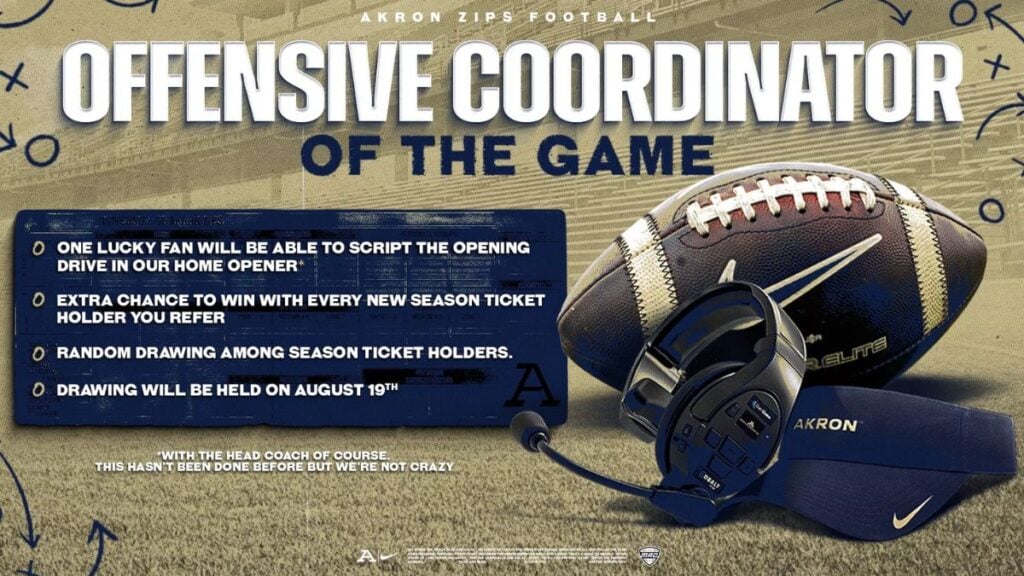
Moving to football, the Akron Zips unveiled a promotion to make another dream come true. Specifically, the Zip’s Offensive Coordinator of the Game giveaway gives one season ticket holder a unique opportunity. They will help script the first offensive series for the team’s home opener.
An article in the Sporting News quotes Athletic Director Andrew Goodrich as saying, “This is about giving one of our most loyal supporters a seat at the table, right alongside our coaching staff, on the biggest night of the season.” Head Coach Joe Moorhead, who could easily hate this idea, gave the promotion his seal of approval. “This will give our fans a behind-the-scenes experience that has never been done before anywhere, so I’m excited to show them how to put together the opening script and see what they can do.”
The Power of Fan Passion
Sports fans are a special breed. These opportunities give them a chance to get closer to their favorite teams. Similarly, Classic Rock fans are a special breed that love their team. Just like sports fans, they passionately debate other people for hours. They discuss the greatest guitarist or best album. That’s why countdowns work so well on our stations. That’s also why promotions like what the Phillies and Zips did are such amazing opportunities.
There is no shortage of ways to get your listeners involved with the station. First, you can bring in listeners to be guest hosts, just like the Phillies did. Moreover, you can let them pick the music for a segment. Alternatively, you can let them be the announcer and talk about the songs they get to play. Furthermore, bring them behind the scenes and let them help with scheduling a log. If your station does two-for-Tuesday, this is a great way to pick the second half of the set. Definitely, let a fan of your station make some of those decisions. Ultimately, there are a million ways to bring listeners into the fold.
Making the Most of Limited Budgets
This type of promotion is especially valuable in an age when there are no marketing budgets. Your station needs exposure to get people to tune in. This gives you a way to tap into your listener’s networks. Consequently, a good promotion like the ones described above should lead to plenty of material the listener can post on their favorite platforms. That will spread to their friends and followers. Your station becomes a topic of conversation — something I’m sure it is not on the average day.
Of course, I do understand the concerns. Listeners, especially the ones who really value an opportunity like this, can be a lot. The fear they could steer the station off course is not unfounded. However, with the proper guardrails baked into the promotion, there is no reason you shouldn’t keep things under control. Plus, like the squirrel I wrote about recently, maybe occasionally being a little out of control isn’t the worst thing you can do.
Barrett Media produces daily content on the music, news, and sports media industries. Sign up for our newsletters to stay updated and get the latest information right in your inbox.
Tom Bauerle is leaving 930 WBEN after 24 years with the Buffalo station. His contract was set to expire next week.
What We Know: Bauerle confirmed his exit after spending more than 40 years in radio. His career included stops in St. Louis and Tampa before he established himself in Buffalo.The longtime broadcaster previously worked at 550 WGR before moving to 930 WBEN in 2002. Most recently, Bauerle hosted afternoons from 3-6 PM. He spent 42 years combined at Buffalo’s two stations, including his time at WGR. Over the years, he became a prominent voice in the market. However, Bauerle said he was fired after returning from a sold-out trip to Italy with listeners. He acknowledged that his contract had been set to expire next week.
What They Said: “Thank you for a great 42 years combined at those two Buffalo stations. Your support and support of sponsors has been like a great dream. This was the life I chose, and no matter how loyal ANYONE is to ANY employer, EVERY ONE gets popped eventually. MY SITUATION IS NO DIFFERENT THAN OR MORE IMPORTANT THAN ANYONE ELSE’S! Nothing ever happened to me that didn’t work out for the better, and every day I spend with my wife Richelle Derrah Bauerle I am reminded of that. Yes I was FIRED, one day after returning from a sold out Italy trip with fans.
“My original ego-saving defense mechanism wanted this to be a ‘retirement’ spin, and after a 45 year career I was in temporary denial. Richelle properly knocked sense into me and said, ‘Tom, why bullshit your listeners? That makes YOU like Soros fake news! That isn’t who you are and you know it!’ I apologize for my 6 hour moral lapse, and Friday conversations with certain others knocked sense back into me.” -Tom Bauerle
What Remains Unclear: Bauerle hasn’t revealed what’s next for his radio career. He did, however, make clear that he intends to remain active in the industry. The veteran host said he will be a competitor, potentially signaling another Buffalo radio opportunity.
What It Means: Bauerle’s departure marks the end of one of the longest-running relationships between a Buffalo host and a major local station. Now, 930 WBEN will need to determine how it fills the afternoon slot. Meanwhile, Bauerle’s next move could quickly become a major story in the Buffalo radio market.
Barrett Media produces daily content on the music, news, and sports media industries. Sign up for our newsletters to stay updated and get the latest information right in your inbox.