Scott DeLucia is set to leave WTAW and radio after nearly 60 years. The Bryan Broadcasting news/talk station has found his successor.
What We Know: Young originally began his career at WTAW as a news reporter in 2003 before moving on to music radio roles. During his career, he’s worked at CHR and country formatted stations. Most recently, he helmed mornings at 100.3 The Bull in Houston until being included in company-wide layoffs by Audacy. He’ll step into the role at WTAW vacated by the retirement of Scott DeLucia. He is leaving after spending the past 36 years in morning drive.
What They Said: “I was excited by the opportunity, mostly because growing up in College Station and Bryan and around the area, if you listen to radio, you would listen to (Scott), and Jay, and Tom, and everybody else. So this is kind of like being on the radio show of record for the Brazos Valley.” -Tucker “Frito” Young
What Remains Unclear: When Young’s official start date will be. DeLucia’s final day on the air is scheduled for Friday, June 5th.
What It Means: It’s proof you can go home again. After spending nearly a quarter-century in other formats, Tucker “Frito” Young is going to give the news/talk format a try as full fledged host. His familiarity with the market and station should set him up to clear those early hurdles.
Barrett Media produces daily content on the music, news, and sports media industries. Sign up for our newsletters to stay updated and get the latest information right in your inbox.
The 47th Annual News & Documentary Emmy Awards were held on Wednesday night. Lincoln Center’s Frederick P. Rose Hall hosted the event. A total of 41 awards were bestowed upon the best in news television.
What We Know: Comedian Amber Ruffin hosted the 47th Annual News & Documentary Emmy Awards. Presenters included Jim Cantore (The Weather Channel), Linsey Davis (ABC News), Jeremy Diamond (CNN), Hallie Jackson (NBC News), Scott Pelley (CBS News), and Jen Psaki (MS NOW). ABC News anchor Martha Raddatz was honored with the Lifetime Achievement Award for her contributions to the space during her career.
What They Said: “When the revolutionary generation put pen to parchment 250 years ago, they chose to align themselves to a vision of public freedom reinforced a decade later by the First Amendment. Generations of writers, publishers and broadcasters have rightly joined together to push back ever since. Journalists are torchbearers for the public right to know and to speak.” -National Academy of Television Arts & Sciences President/CEO Adam Sharp
What Stood Out: Big winners on the night included ABC News (8 awards) and National Geographic (7 awards). Several single news items, like the war in Gaza and coverage of California wildfires, led to award victories, as well.
And the Winners Are…
Outstanding Live News Program ABC World News Tonight with David Muir ABC News
Outstanding Recorded News Program The Whole Story with Anderson Cooper CNN Worldwide
Outstanding Live Breaking News Coverage U.S. Army’s Grand Military Parade ABC News Special Report ABC News
Outstanding Extended Breaking News Coverage The Fires 60 Minutes CBS News
Outstanding Live News Special American Catastrophe: LA Burning 20/20 & ABC World News Tonight ABC News
Outstanding Recorded News Special The Children of Gaza ABC News Live ABC News
Outstanding Continuing Coverage: Short Form Earthquake in Myanmar BBC News
Outstanding Continuing Coverage: Long Form Along the Green Line The Guardian
Outstanding Light Feature: Long Form Operation Babylift: The 50 Year Journey 20/20 & ABC News Live ABC News
Outstanding Hard News Report: Short Form The War in Gaza 60 Minutes CBS News
Outstanding Hard News Report: Long Form Chasing a Ghost: The Search for Austin Tice CNN Worldwide
Outstanding Investigative Coverage: Short Form DOGE Package The New York Times
Outstanding Investigative Coverage: Long Form Strike On Iran: The Nuclear Question FRONTLINE PBS [The Washington Post | Bellingcat | Evident Media]
Outstanding News Discussion & Analysis Deport Them All: Who’s to Blame for Springfield’s Immigrant Crisis? More Perfect Union
Outstanding Interview: Short Form CNN’s Jeremy Diamond Presses Hamas Official on Suffering in Gaza CNN Worldwide
Outstanding Interview: Long Form Eric Dane Speaks ABC News
Outstanding War or Violent Conflict Coverage Kids Under Fire Fault Lines Al Jazeera International USA
Outstanding Science & Tech Coverage Scam City Trafficked with Mariana van Zeller Muck Media [National Geographic]
Outstanding Climate, Environment or Weather Coverage Shark Hunters Trafficked with Mariana van Zeller Muck Media [National Geographic]
Outstanding Health or Medical Coverage The Tranq Dope Underground Trafficked with Mariana van Zeller Muck Media [National Geographic]
Outstanding Arts, Culture or Entertainment Coverage Underground Street Racing Trafficked with Mariana van Zeller Muck Media [National Geographic]
Outstanding Business, Consumer or Economic Coverage The Zombie Debts Making Wall Street Rich Bloomberg Investigates Bloomberg Originals
Outstanding Social Issue Coverage Black Market Love Trafficked with Mariana van Zeller Muck Media [National Geographic]
Crackdown: Deported Under Trump Fault Lines
Outstanding True Crime Coverage Wicked Game: Devil in the Desert ABC News Studios
Technical Excellence: News Live from the Southern California Fires ABC World News Tonight with David Muir ABC News
Outstanding Journalist in Spanish Language Victor Valles Mata TelevisaUnivision
Outstanding News Program in Spanish Jorge Ramos: Asi Veo las Cosas I’m Back Tres Alebrijes LLC
Outstanding Breaking News Story in Spanish Cobertura de los Incendios en Los Ángeles Noticias Telemundo con Julio Vaqueiro Noticias Telemundo
Outstanding Investigative News Coverage in Spanish Sobreviviendo al CECOT ProPublica | The Texas Tribune [ProPublica | The Texas Tribune | Alianza Rebelde Investiga | Cazadores de Fake News]
Outstanding Feature News Story in Spanish Estatus: Venezolano ProPublica | FRONTLINE FEATURES [ProPublica | FRONTLINE] Outstanding Writing: News Kids Under Fire Fault Lines Al Jazeera International USA
Outstanding Research: News Brides for Sale Trafficked with Mariana van Zeller Muck Media [National Geographic]
Outstanding Direction: News Black Market Love Trafficked with Mariana van Zeller Muck Media [National Geographic]
Outstanding Video Journalism: News Filmed In Gaza NBC News
Outstanding Editing: News Filmed In Gaza NBC News
Outstanding Graphic Design: News Johnny Harris Newpress
Outstanding Cold Open or Title Sequence: News How New Magnets Could Power the Future Bloomberg Primer Bloomberg Originals
Outstanding Promotional Announcement: News The Substance and Soul of the South AJC [Jam Entertainment]
Outstanding Regional News Story: Investigative Inspecting the Inspectors KMOV-TV
Barrett Media produces daily content on the music, news, and sports media industries. Sign up for our newsletters to stay updated and get the latest information right in your inbox.
Keith Cunningham’s Black Box Group is arming radio teams with a new weapon. The west-coast strategy shop has launched Summer School, a 10-course live online curriculum built for PDs, talent, digital, and promotions professionals.
What We Know: Summer School runs through August and offers 10 private, 30-to-60-minute sessions. Topics range from Nielsen Explained to The 2026 Content Reset to The Psychology of Talent & Why Airchecks Fail. Stations, clusters, and companies choose only the courses they need. The program targets teams looking to strengthen before Q4 ratings and revenue battles hit.
What They Said: Cunningham didn’t sugarcoat the challenge facing today’s radio teams. “Brand teams are smaller, multi-tasking, and are often lacking tools, budget, and critical experience,” he said. Furthermore, he described the curriculum as practical and battle-tested: “These courses bring scars and receipts — like injecting decades of major market warfare experience into the veins of attendees.”
What Remains Unclear: Full pricing details and enrollment numbers have yet to be announced publicly. Beyond that, whether BBG plans to expand the curriculum into future seasons is still unconfirmed. Either way, early interest suggests strong momentum is already building.
What It Means: Radio programming teams finally have a sharp, flexible training resource built specifically for today’s challenges. Furthermore, the curriculum’s targeted approach means stations invest only in what they actually need. Cunningham’s real-world experience makes this more than just a training program — it’s a competitive advantage. The timing couldn’t be better heading into the industry’s most critical stretch. For more information, pricing, or to sign up your station, cluster, or company, contact Keith Cunningham at keithblackboxgroup@gmail.com
Barrett Media produces daily content on the music, news, and sports media industries. Sign up for our newsletters to stay updated and get the latest information right in your inbox.
After five years away, one of Western New York’s most recognized voices is back on the air.
What we know: Steve Hausmann is coming out of retirement. The veteran Rochester broadcaster joins Pure Media Group’s CJ Country 1140 WCJW Warsaw, NY and its six FM translators. He’ll deliver daily sports updates on Jimi Jamm’s morning show at 6:30, 7:30, and 8:30 am. His debut coincides with WCJW’s expansion to 98.3 WVIN-FM Bath, NY.
What’s at stake: Hausmann brings 51 years of broadcasting experience to a growing cluster. He spent 18 years at Audacy Country 92.5 WBEE before retiring in 2019. His resume also includes WHAM, WCMF, WPXY, WVOR, WCOZ, and WHDH Boston, plus television sports work. Furthermore, WCJW’s simultaneous FM expansion amplifies the reach of this hire significantly.
What remains unclear: The length of Hausmann’s commitment to WCJW is not yet public. Additionally, his role could evolve beyond morning sports updates as the station grows. Whether the WVIN simulcast becomes a permanent arrangement also remains to be seen. Still, the immediate scope is clear: daily weekday morning appearances.
What it means: Radio has seen a wave of veteran departures in recent years. Retirements have reshaped morning lineups across the country. Consequently, Hausmann’s return stands out — a welcome counter to that trend. Small and mid-market stations like WCJW prove that experienced voices still drive real audience value. Moreover, for Pure Media Group, landing a recognizable name adds immediate credibility to a rapidly expanding footprint.
Barrett Media produces daily content on the music, news, and sports media industries. Sign up for our newsletters to stay updated and get the latest information right in your inbox.
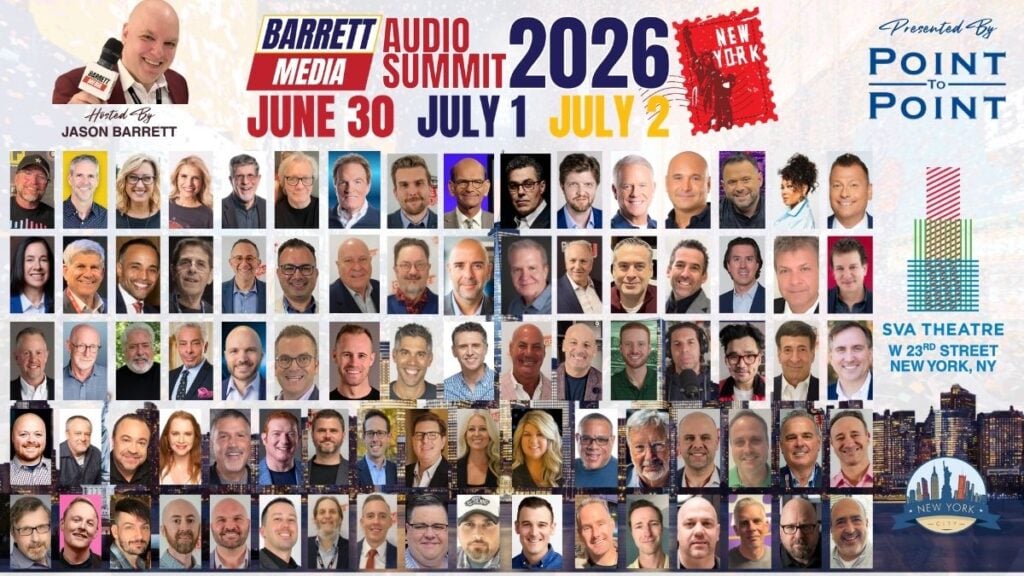
When I announced plans for the 2026 Barrett Media Audio Summit, I said we would recharge the event and make it stronger. Our sports and news shows were restructured to feature the most important people and issues over the course of one-day. We then announced we were taking the plunge into music/radio for the first time ever. In the past few months, we’ve built an incredible lineup that features 80+ highly accomplished broadcasting professionals. The updated list can be found in the Summit section. Additional announcements will be made in the next week or so as we finalize our schedule and prepare to release our final agenda.
Events like this matter because the world of media is more complex than ever. Creators are building independent businesses, radio is becoming television, television is becoming streaming and podcasting, social media is changing algorithms to reach audiences, Search is being disrupted by AI, and gaining advertising support requires excelling across all of it. We’re no longer operating in a world where success is decided by a terrestrial radio or television number. That is both exciting and terrifying.
I believe the industry gets stronger when the sharpest people in it unite to examine critical issues. Between the on-stage conversations, hallway networking, and after party discussions, people gain real insight to help themselves and their brands by being around others who speak the same language and face the same pressures. You can watch YouTube videos, read articles and look at posts on X but there’s a deeper level of learning and a different energy when you share space with others who you know, respect, compete and/or partner with. If you manage a company, program a brand, entertain an audience, represent a talent, sell advertising, buy media, promote events and/or content across digital platforms, this event is for you. There’s no reason to not be in the room if you make your living in the media industry. Tickets are available, just go here to secure your seat.
Exceptional Leaders Join the Mix
Today, I am thrilled to add four speakers who are helping to shape the present and future of sports media. It’s my pleasure to welcome ESPN’s newly promoted Executive Vice President, Executive Editor, Sports News and Entertainment, Mike Foss, President of Yahoo Sports, Ryan Spoon, CEO and founder of Futuri, Daniel Anstandig, and host of Sharp or Square, part of The Volume, and former Action Network Chief Content Officer, Chad Millman.
Ryan Spoon has served as President of Yahoo Sports since June 2023. Before joining the company, Ryan held COO roles for Sorare and BetMGM. He also spent 8+ years at ESPN as Senior Vice President of Digital and Social Content. Under his watch, Yahoo has launched the Yahoo Sports Network, hired notable personalities such as Jason Fitz, Caroline Fenton, and Andrew Siciliano, and expanded Yahoo’s college football coverage with Josh Pate and Andy Staples. Most recently, Yahoo launched a new sports business hub, which Barrett Media is a proud partner of. Ryan will appear on Wednesday, July 1st alongside Mike Foss and Sinclair COO Rob Weisbord for an in-depth discussion on brand building, podcasting, creating digital impact, social and AI disruption, and more.
Mike Foss was recently promoted to Executive Vice President, Executive Editor, Sports News and Entertainment. He has been with the company since 2017, becoming a driving force behind ESPN’s multi-platform evolution. Foss successfully launched ESPN’s official YouTube channels and previously oversaw video production, content creation, and live streaming strategies across all major digital platforms. In addition to collaborating closely with The Pat McAfee Show, he also oversees all editions of SportsCenter, First Take, Get Up, PTI, Fantasy Football Now, ESPN Audio and Podcasts, Digital Production and original studio programming on Disney+. Before joining ESPN, Mike served as a VP at Fox Sports, developing and executing mobile and social content strategies. Foss will appear on Wednesday, July 1st with Ryan Spoon, and Rob Weisbord.
Daniel Anstandig is the CEO and founder of Futuri, which serves more than 7,000 media brands across 22 countries. Daniel and his team have developed more than 20 patents in audio, podcasting, AI, and broadcast technology. Their TopLine, sales intelligence platform delivers 300,000+ sales assets annually to advertising/promotion sales teams. Futuri’s content intelligence system, TopicPulse, is a system that detected 18M+ trending stories in the last year for newsrooms and creators. Daniel is an outstanding speaker who is passionate about AI and innovation. He will join us on Wednesday, July 1st to offer a forward-looking view on how AI is reshaping broadcasting, with a special look at how it relates to sports media operators.
Chad Millman hosts Sharp or Square, which is part of The Volume’s slate of content offerings. Millman previously served as the Chief Content Officer of the Action Network, widely considered the source for betting news and data. Prior to helping launch the company, Millman worked for ESPN as Editorial Director for domestic digital, Editor-in-Chief of ESPN the Magazine and created the gambling beat. He has written seven books, including the bestseller about professional bettors, The Odds. His career started in 1993 as a reporter at Sports Illustrated, where he covered national sports stories for five years. Chad will moderate the conversation between Ryan Spoon, Mike Foss and Rob Weisbord.
Tickets, Hotel Rooms and Sponsorships
25 partners are involved in this year’s conference. We have a few more opportunities still available. To get your company involved, contact Stephanie Eads at Stephanie@BarrettMedia.com. Our deadline to finalize sponsorships is Friday, June 19th. Act now before time runs out.
In addition, Hotel Hayden is our partner for the event. The hotel is nearly sold out. If you plan to travel to NYC for the show and need a place to stay, book your room asap. Once the final room is reserved, we can’t add more. Details are available here.
For those looking to attend, we have one-day, two-day and three-day passes available. We’ve even created a Cluster Pass to help GM’s reduce costs for larger local groups to come. This event is specifically priced lower to encourage industry participation. Help support the industry, your company, your staff, and more importantly, yourself by purchasing a ticket.
And if costs are the issue, there is an alternative to reduce expenses. Contact iMar Entertainment to explore barter packages that include covering your costs for hotel, airfare and your conference ticket.
It’s going to be one of the biggest and best media conferences of the year. I look forward to seeing you there!
Barrett Media produces daily content on the music, news, and sports media industries.Sign up for our newsletters to stay updated and get the latest information right in your inbox.
The strength of syndicated sports radio has been debated for some time now. What once was a destination for strong voices that commanded attention has fizzled in recent years. Sure, Dan Patrick and Colin Cowherd still dominate the airwaves. Yet, the depth of lineup Patrick and Cowherd once belonged to at ESPN Radio is gone and likely will never return.
It’s been two months since ESPN Radio announced that Clinton Yates would no longer be part of the network. Yates spent just over a year in the weekday 10 a.m.-12 p.m. timeslot. Since his departure, ESPN Radio has yet to name a full-time replacement, leaving affiliates and media insiders questioning why.
To be fair, this isn’t 2010. Mike Greenberg and Mike Golic aren’t your wake-up call, and Colin Cowherd isn’t your midday escape. Scott Van Pelt and Ryen Russillo aren’t keeping you busy at work, and Doug Gottlieb isn’t joining you for the ride home.
ESPN Radio used to be the destination for top-tier national sports talk talent after launching in 1992. However, over the last 15 years, the roster has been depleted by direct competition, content evolution, and shifting priorities.
The names listed above are still succeeding elsewhere at ESPN. Also on FOX Sports Radio, in podcasting, or outside the business entirely. Even before the pandemic, the lineup included Keyshawn Johnson, Mike Greenberg, Dan Le Batard, and Max Kellerman. None remain with the network today.
That level of turnover rarely leads to success. Building rapport and connection with a sports radio audience takes time. Over the last five years, constant changes while listeners navigate new ways to discover content have not produced a winning formula for ESPN Radio.
“Well, We’re Waiting…”
So here we are. Two months after Clinton Yates was given only 14 months to build rapport and connection before his exit, ESPN Radio still has no permanent answer for the daypart.
This is ESPN Radio, correct? The radio arm of the “Worldwide Leader in Sports.”
Did the executives overseeing ESPN Radio not have a backup list of talent to pursue? If Yates’ exit was contract-related, surely some planning went into identifying his replacement before his departure.
Since Yates left, ESPN Radio has filled the daypart with a variety of network talent. However, the rotation has lacked consistency. Some days feature solo hosts. Other days feature duos. If ESPN viewed any of them as a long-term investment, wouldn’t a permanent move have happened by now?
Especially with the show serving as the lead-in to The Rich Eisen Show, which joined the network last fall.
Affiliates in Limbo
The other consideration is the affiliates carrying the vacant daypart around the country. I’ve been in the position of programming around a vacant syndicated timeslot. It’s difficult to explain to your audience that the changes are out of your control, that you’re relying on executives across the country to decide who appears on your local airwaves.
There’s danger to this for affiliates currently dealing with this issue. In an era with endless content options, failing to provide affiliates with a timely answer creates opportunities for listeners to look elsewhere. It also puts stations with limited resources at risk of losing audience share at a time when cume continues to decline overall.
By failing to state its intentions directly and in short-order, ESPN Radio gives audiences little reason to remain patient. Those short-attention spans don’t help either.
We can accept that ESPN Radio will never be what it once was. The names listed above, along with many others who once filled the hallways of ESPN Radio, likely aren’t walking back through the door any time soon. However, ESPN Radio — or any syndicated sports radio brand — can’t accept the idea that the format no longer deserves focus and decisive action.
I agree that contracts take time. Discussions require effort. Budgets demand debate. However, obligations to audiences and affiliates deserve more decisiveness than ESPN Radio is currently showing.
ESPN Radio Still Matters
ESPN Radio still matters in an industry that continues to evolve. If ESPN’s motto remains “serve sports fans anytime, anywhere,” then radio still plays a major role in fulfilling that mission. By most estimates, radio still reaches more than 80% of adults in the United States between the ages of 18-49 each week. It also accounts for more than 50% of all in-car listening today.
ESPN Radio can no longer afford to operate in limbo. Not when audience habits are changing daily. Not when affiliates are fighting to maintain relevance in local markets. And certainly not when the brand still carries the expectations that come with the ESPN name.
Every day without a clear direction sends a louder message than any press release ever could: ESPN Radio is no longer a priority for ESPN. Maybe that’s true for some. But if it is, ESPN should say it. Because affiliates, advertisers, and listeners cannot continue accepting silence disguised as strategy.
The reality is simple.
Vacant airtime doesn’t build loyalty. Rotating placeholders don’t help create identity. And waiting months to make a decision in one of the most competitive content environments imaginable represents something other being the ‘worldwide leader.’
ESPN Radio doesn’t need to be what it was in 2010 to matter in 2026. But it does need conviction. It needs urgency. And right now, the biggest issue isn’t who replaces Clinton Yates — it’s that ESPN still appears unsure whether finding that answer matters enough to act.
Barrett Media produces daily content on the music, news, and sports media industries. Sign up for our newsletters to stay updated and get the latest information right in your inbox.
This past week, the New York Knicks advanced to the NBA Finals. Also, The Late Show signed off on CBS after 33 years. The show, originated by David Letterman and carried on for the last 11 years by Stephen Colbert, was a late-night staple. Colbert was excellent at what he did, but no one could ever match the genius of Letterman. A man who shaped comedy as we know it dating back to his Late Night show on NBC.
One of Letterman’s most famous bits was his now-legendary Top 10 List. Given the fact that The Late Show emanated from New York and that the Knicks are in the NBA Finals for the first time in 26 years, let’s pay tribute to the program. In homage to Mr. Letterman, here are the Top 10 reasons why it’s good for the media to have the Knicks back in the Finals.
#10: Celebrities
Sports seem to bring out the humanity in larger-than-life figures.
Did you see actor Timothée Chalamet acting like a happy 10-year-old after the Knicks beat the Cavaliers to win the Eastern Conference title? He did everything but ask Jalen Brunson for an autograph. How about longtime Knicks fans like Tracy Morgan, Ben Stiller, and John McEnroe? Morgan has more Knicks merchandise than Fanatics. Stiller hasn’t been this happy since De Niro put him in the Circle of Trust, and McEnroe didn’t argue with anyone, yell at an umpire, or break a racket.
Pure elation for Timothée Chalamet after seeing his childhood team advance to the NBA Finals 🥺 pic.twitter.com/SQRQ1bsIxB
The Finals will once again prove that New York remains the place to mix sports and entertainment.
#9: MSG
The Knicks’ home court is dubbed “The World’s Most Famous Arena” for a reason.
Some of the greatest sports moments of all time have taken place at MSG, and in basketball. Numerous players have historically elevated their games when they come to play in New York. In 2009, Kobe Bryant set the arena scoring record with an electrifying 61-point performance. Red Auerbach, Tommy Heinsohn, and those legendary Celtics teams beat plenty of opponents, but they took special joy in going to the Garden and drubbing the Knicks. In the mid-1980s, Madison Square Garden hosted the biggest showcase in men’s college basketball history, the Big East Tournament.
In short, nothing matches the hoops mystique of Madison Square Garden.
#8: History
The New York Knicks have two NBA championships to their credit: 1970 and 1973. If you don’t know anything about those teams, check them out through reels, clips, YouTube, or any other media platform you choose.
They might be the most skilled, unselfish, and coolest team ever to lace up a pair of sneakers. With head coach Red Holzman and players like Bill Bradley, Walt Frazier, Dave DeBusschere, Willis Reed, Earl Monroe, Phil Jackson, Dean Meminger, and Jerry Lucas, they truly created basketball art.
They are not the 1960s Celtics or the 1980s Lakers. The early 1970s Knicks remain a vital part of NBA lore.
#7 – New York, New York
When you are the biggest city, and at times the biggest bully on the block, opponents revel in your misery. And make no mistake, New York has endured plenty of misery.
The Yankees haven’t won a championship since 2009, and the Mets haven’t won one since 1986. The Knicks last won a title when Richard Nixon was president and none of his aides had been indicted. The New York Rangers won the Stanley Cup in 1940, waited 54 years to win another, and are now in year 36 without a title.
Want to venture outside the city?
The Islanders have been Cup-less since 1983. The New York Giants last won the Super Bowl in 2011, and do we even need to bring up the Buffalo Bills and New York Jets?
It will make for great television watching the Knicks try to end New York’s championship drought.
#6 – Big Markets = Big Ratings
While it’s often heartwarming to see the likes of Oklahoma City, Cleveland, Milwaukee, and San Antonio compete for a title, big-market teams operate on an entirely different level of interest.
You may hate the Knicks, but the NBA is healthier and more compelling when they are a viable championship contender. The same goes for cities like Boston, Chicago, and Los Angeles. When those teams are successful, the entire league benefits.
The 1980s Lakers and Celtics, the 1990s Bulls, the Lakers again in the early 2000s, and the current Celtics and Knicks prove it. Small markets can have their Cinderella stories, but networks and advertisers are not interested in fairy tales. They want revenue.
#5 – Marquee Franchises
Across the sports landscape this past year, traditionally successful franchises returned to glory.
The New England Patriots were back in the Super Bowl after beating the similarly resurgent Denver Broncos in the AFC Championship Game. In the NFC, the Chicago Bears made the postseason and won a Wild Card game. In the NHL, former Cup winners like the Montreal Canadiens, Philadelphia Flyers, and the LA Kings all reached the playoffs.
In MLB, the Tigers and Reds returned to October baseball. While in pro hoops, the Spurs, Rockets, and Knicks emerged as contenders.
New York cannot boast the banners of Boston, Chicago, or Los Angeles. But as the saying goes, “You cannot write the history of the NBA without mentioning the Knicks.” Marquee franchises have fans all over the world. More importantly, they sell T-shirts and hats.
The bottom line remains the top priority.
#4 – Tell Me A Story
This season especially, the Knicks are loaded with storylines. These have reporters, writers, and producers loaded for bear.
Leading the way is head coach Mike Brown. The Knicks fired Tom Thibodeau after a 51-win season last year, a move that stunned many members of the basketball media. Perhaps even more confounding was the hiring of Brown, a journeyman coach with stops in seven previous NBA locales as a head coach or assistant.
Another terrific story is the college connection. Three current Knicks — Josh Hart, Jalen Brunson, and Mikal Bridges — won national championships together at Villanova. Karl-Anthony Towns, a perennial loser or also-ran with the Timberwolves, has come to New York and flourished.
This is a workmanlike team filled with lunch-pail players like OG Anunoby, Jose Alvarado, and Landry Shamet, all of whom provide great fodder for features, as does the aforementioned 53-year championship drought.
The last time the New York Knicks were in the Finals was 1999. At that time, social media was in its infancy. Websites like Classmates.com and SixDegrees.com were considered cutting edge. Facebook launched in 2004. Instagram started in 2010. Snapchat arrived in 2011, and TikTok followed in 2016.
Social media loves the Knicks.
Hart has 1 million Instagram followers. Brunson has 1.2 million, and Towns has 4.3 million. The team’s Instagram account has 4.8 million followers. In addition, both the New York and national media are all over X praising this year’s team.
It’s a multimedia bonanza having the Knicks in the Finals for the first time in the social media era.
#2 – Love And Basketball
We all know that basketball thrives in the neighborhoods and playgrounds of greater Los Angeles. It’s also played in Indiana with makeshift rims nailed to the sides of countless barns and garages. But gritty, hard-nosed city ball traces its roots to New York.
It starts with the iconic Rucker Park and its legendary streetball tournaments. It includes old-school teams like the Syracuse Nats and the ABA’s New York Nets featuring superstar players like Rick Barry and Julius Erving.
It also includes highlight-generating players like Kenny Anderson, Kareem Abdul-Jabbar, Connie Hawkins, and Stephon Marbury. Not to mention Brooklyn-born high school stars Pearl Washington and Chris Mullin, who stayed in state and starred at Syracuse and St. John’s, respectively.
There is a texture and rugged veneer to East Coast basketball, and the Knicks are a part of it.
#1 – Stephen A. Smith
The most ferocious and loquacious sports media personality today is an unabashed New York Knicks fan.
For years, Smith has openly displayed his passion for the orange and blue, and for years, his hopes have been dashed. Perhaps even more painfully than those of the Dallas Cowboys fans he so gleefully mocks.
Can you imagine Smith doing First Take, as well as guest spots on other ESPN shows, live from Madison Square Garden during the NBA Finals? Watching him comment, debate, laugh, and cry with his Knicks over the next three weeks will make for riveting television.
It is the number one reason why having the Knicks back in the Finals is absolute media gold.
Barrett Media produces daily content on the music, news, and sports media industries. Sign up for our newsletters to stay updated and get the latest information right in your inbox.
Burnout is a factor. Let’s be honest with each other for a second: most media professionals I know are really bad at unplugging. And yes, I am looking square in the mirror when I say that.
We are a breed of people conditioned to treat every text notification like an active air-studio fire. We call it “staying on top of things,” but it’s actually just an addiction to the noise.
But if you are redlining your personal engine 24/7/365, your team is not getting a sharp, strategic leader. They are getting a jittery, short-fused version of you running on pure caffeine and adrenaline. And let’s be totally honest — if your team is not the one getting hit with that short fuse, the people you care about most at home probably are. You cannot pour from an empty cup.
Your Most Critical Asset
Today, we are putting the spreadsheets aside to talk about the most critical asset in your entire operation: your mental battery. And the only way to keep it charged is by finding, and fiercely protecting, your Happy Place.
For me, that reset button is at the lake.
There is something transformative about trading glowing screens for wide-open blue skies, the smell of the outdoors, and a night sky packed with a million stars. It is the absolute antithesis of the media cycle. Just water and trees.
And before you write this off as a touchy-feely speech, it’s actually hard science. Psychologists and neurologists study this under what is known as Attention Restoration Theory (ART). The corporate media grind requires constant “directed attention” — an unnatural, exhausting type of mental focus that literally wears out the prefrontal cortex. Nature, on the other hand, triggers what they call “soft fascination.” Doctors have proven that stepping outside drops cortisol levels almost instantly and resets your capacity for creative problem-solving. You literally think better when you stop thinking for a minute.
You Need Training Wheels
But actually disconnecting is hard for us. We need training wheels. So here is a fun, encouraging challenge for the next time you try to slip away.
Start small: let your phone die. Seriously. Don’t panic-scramble for a charger cord the second the battery bar turns red. Let it slip down to 2%, watch the screen go entirely black, and just let it stay dead. Now, resist the temptation to hurl that $1,000 piece of glass into the water. You need to stop just short of skipping it like a flat stone across the lake — even though we’ve all wanted to. Just lay it down on a table and walk away.
I saw an Instagram meme the other day that perfectly nails the boundary we need to set. It showed a picture of a breathtaking, quiet landscape with the caption:
“This is my happy place. Don’t f it up.”* (There’s a country lyric in there somewhere)
It made me laugh, but it’s a profound rule for survival. The only person who can ruin your happy place is you by inviting the office back into it. If you sit by the water but keep your Apple Watch buzzed with email alerts, you haven’t left the station. You just changed your coordinate location.
If you want to protect your happy place and actually return to your team — and your family — at 100%, here is your playbook for a true disconnect:
The Digital Air-Gap: When your phone dies, leave it dead for a few hours. Set a definitive out-of-office message that empowers your team to handle things without you. If everything collapses because you took 24 hours offline, you don’t have a vacation problem — you have a delegation and alignment problem. Trust your people to keep the ship afloat.
Lean Into the Soft Fascination: Find an activity that forces your brain to stay present. Whether it’s sitting on a dock with a cold drink, fishing, or just looking at the stars, pick something that demands you look up, not down.
Treat Rest Like Prep: We spend hours prepping for morning shows, programming clocks, and client pitches. Start treating your downtime with that same level of respect. Schedule it. Protect it. Make it non-negotiable.
Our industry will happily take every single ounce of energy you are willing to give it until there’s nothing left. Don’t let it.
Find your lake. Let your phone die. Lock down your boundaries and protect your happy place like your career depends on it — because it does. (Though honestly, I am a little curious how many smartphones are currently lying at the bottom of the lake, right next to all those lost pairs of sunglasses).
Barrett Media produces daily content on the music, news, and sports media industries. Sign up for our newsletters to stay updated and get the latest information right in your inbox.ght in your inbox.
I believe today, more than ever, strong personality driven morning radio is key to radio’s future. Live/local shows, community involvement, humor, storytelling, and trusted companionship are what drive it. Listeners form habits around the people, not just the music. When you’re looking for analytics on those shows, Nielsen is the place to go. What’s the percentage of P-1 listeners, length of each listening occasion, time spent listening each week and, maybe my favorite, number of days listened?
If you are on the radio, especially in the morning, you need to see the number in Nielsen’s PD Advantage that shows average days listened per week. They show you the number for the entire audience, as well as the P-1 audience. If you’ve never seen it and expect that your audience is listening every day, you’ll be in for a shocker. Chances are, if you’re the biggest show in the market, you’re getting as much as 1.8 days a week and hitting a home run. If you’re further down the ranker, you could be at 0.7 days a week. How’s that for trashing your ego?
I find that not enough shows take advantage of the multiple-day story arc. Have you watched the HBO show “The Pitt”? Each episode is an hour of the day, and you can’t stop watching because you need to know what happens next. If you’ve done a good job making the audience care about you and others on your show, they will certainly come back tomorrow. They want to hear what develops when you’re in some sort of dilemma. It doesn’t have to be complicated. It’s best when it’s something everyone can relate to.
Start Close to Home
Let’s start with your spouse/partner. Their college roommate is coming over for the weekend. Or they want to sleep in separate rooms due to snoring, talking in your sleep, stealing covers, or temperature disputes — there are hundreds of possibilities. They/you are too messy, never close a half-eaten snack food bag, won’t share a remote, or won’t hang out with your relatives — etc. These are all so easy. You talk about it on the air and listeners weigh in. The next day you talk to your partner on air. Maybe an expert the following day, followed by resolution. Home repairs, furniture shopping, and even painting the kitchen can turn into a multiple-show storyline.
Neighbors are great for this as well. A neighbor can leave you a note about parking in their space, not taking in your garbage can on a timely basis, a messy yard, being too noisy, or having too many or not enough holiday decorations. Again, there are hundreds. Same formula. Ask the listeners, talk to other neighbors, and finally confront the person who left you the note.
Everyone loves a great story. One with drama and conflict that can be part of your show at the same time every day for several days is a home run. Of course, exaggerate it and make it memorable. You must involve your listeners so they feel invested and will come back each day to hear what develops.
Journal Your Life Off the Air
Steve Reynolds has always encouraged his shows to journal their lives — to keep a diary of things that happen while you’re away from work. Sometimes the simplest event on a Saturday can turn into three days of must-tune-in radio. You might even be able to use a station feature to create multiple days of drama.
Here’s one from when I programmed WNEW. I gave the morning show the news that we were going to have to cancel our popular “Can’t Beat Karen” game because the company cut expenses, and one of the casualties was the mug that contestants received for playing. The audience freaked out. After two days of complaints, show bad boy Johnny Mingione gave my office number out on the air so the listeners could complain directly to me. That got Johnny suspended from the show. Fortunately, the sales manager was a fan of Karen Carson and managed to find a sponsor to buy the mugs. Yes, the client saved the day, the feature (and Johnny) returned, and everyone lived happily ever after. Everyone except me — I wasn’t able to answer my office phone for months without a listener yelling at me. We turned a budget cut into a ten-day story arc that caused listeners to love the feature even more, and to bond with Karen, Johnny, and Intern Anthony as they battled the evil boss. Great storylines always have a villain. Batman wouldn’t be Batman without the Joker.
One reminder on the continuing story arc. Always reset and recap the issue each day so those who missed the first parts will be up to speed. Also, these MUST be prepared in advance. It’s usually best to have an ending before you begin. Remember, every great story has twists and turns, something unexpected, and a satisfying ending. And it hopefully doesn’t involve your actual office phone.
Barrett Media produces daily content on the music, news, and sports media industries. Sign up for our newsletters to stay updated and get the latest information right in your inbox.
You can take the girl out of Texas, but you’ll never be able to take Texas out of Kristin Diaz. WTOP’s newest morning anchor joins John Aaron at 5 AM, bright and early, bringing a lot of joy, excitement, and passion to the DC market.
Diaz believes, “God really blessed me with bringing me [to DC] during the springtime. It hasn’t been extremely cold and I’m very grateful for that.” When Diaz left Dallas in March, D-Town was already hitting 90 degrees. “I remember the first week I was here, the first full week I was [in DC], there was a cold front. It brought us back down to the 30s and 40s and I had to reach for my jacket.”
The heat has followed Diaz since the move — and we are not just talking about weather. Her infectious positive attitude and spice for life can brighten any rainy day, and it all started in a Houston radio station.
A Lifelong Lineage
Growing up, Diaz often found herself alongside her mom, who worked in media. “My mother was the general manager of a radio station when I was a little girl in Houston, and it’s funny, some of my earliest memories are of being in a radio station. Before that, she actually worked for Telemundo.”
“I have memories of being in the television station, but I grew up around her always being in the business and going to work with mom and I was always close to it, but it was never really my dream,” Diaz recalled.
It wasn’t until high school that Diaz really started considering becoming a member of the media. “I actually found the idea of researching current events and researching both sides of a story through debate [enjoyable],” she added. “That is what kind of got me interested in current affairs, current events, and local news.”
“And I remember a teacher of mine said, ‘Kristin, have you ever thought about being a news anchor?’ And that teacher kind of steered me into that path.” It’s a conversation Diaz never had with her mom growing up. This allowed the native Texan to forge her own path in the industry.
From TV to Radio
She got her first big break in TV as a production assistant before becoming a weather anchor, reporter, and then news anchor. “All of those positions, you know, were stepping stones to — coincidentally — my radio career,” she affirmed.
Calling the move “serendipitous,” Diaz believes going from TV to radio was “God’s timing and planned for me.” The award-winning journalist also believes being a weather anchor really helped prepare her for radio. “Not having a script and knowing how to ad lib and think on my feet. All those things played a part in helping me with my radio career.”
Her hard work and passion were recognized when she was named one of Barrett Media’s Top 20 Major Market News/Talk Radio Afternoon personalities, along with David Rancken, for their work at NewsRadio 1080 KRLD in Dallas.
“It was truly an honor to be able to work with [news] giants [at KRLD]. And I feel like that respect, that honor, the things that I observed from working there — the team, the incredible newsroom atmosphere — that is the energy that I’m hoping to bring here in DC,” she said. “I’m already walking into an incredible newsroom that I’m blessed to have the opportunity to join. WTOP is such a huge station in its own right, just like KRLD. Another legacy station that’s been here 100 years and has such strong roots in the community.”
Building a Community
When the announcement about Diaz’s arrival was made, she found the WTOP community as warm and welcoming as a Texas pecan pie. “I was so overwhelmed by [people welcoming me to the DC area] on social media, on Instagram, on Facebook over the past couple of weeks. Even before I hit the airwaves. And especially afterwards, so many people have reached out to me.”
Many long-time listeners of WTOP have been reaching out as well. She often tells her new colleagues, “You guys have incredible listeners. The way that people have welcomed me and specifically taken the time to be so kind — to reach out, to want to connect me with other people that they know in the area or want to help guide me as I navigate my way around here and learn the ins and outs — that has been seriously so impressive.”
She’s not just connecting with people on air. She’s also stepping away from the mic and getting involved in the community. “I’ve already gone to church a couple of weekends here nearby in my neighborhood. My neighborhood has a little park in the center of it, where I’ve met a couple of other dog walkers and kind of introduced myself there. And every time I go to the grocery store now, I think all the people know — oh, there she is. That’s a Texas girl.”
Diaz believes “it’s kind of hard to stay quiet when you’re a loud Texas Latina.” But she also recognizes her vivacious and effervescent personality is truly a gift from God.
Working With a Purpose
Outside of her morning show, Diaz finds time to give back and mentor students who are looking to follow in her footsteps. “I talk to students often, and I always try to remind them a couple of things. Number one, do not get into this industry if you think that it’s going to bring you validation as a person. Or if it’s going to bring you likes from social media, going to give you fame, or give you glamour.”
In order to be successful in media, Diaz has a reminder for young aspiring journalists. “It’s not about you, it’s about serving the public. You are a public servant. It’s about sharing other people’s stories. It’s about educating, informing, and building connection, and sharing the spotlight.”
Students have also asked Diaz if she ever gets nervous when interviewing people. In true journalist form, she answered honestly. “I used to get nervous when I would interview people or have a position of being able to share the room with someone, if I thought of them as just their title, if I saw them as just the accolades that they’ve made.”
Then one day, that feeling stopped. Not because she became exceptionally talented at conducting interviews. But because “I realized, I have to look at people as just people, and it’s not just their title. They’re normal people, too. They just have a passion. They have found their passion for what it is that they do. And I always encourage students, find your passion.”
As for Diaz, her passion is telling stories and following God’s plan for her. “I’m just really trying to listen to where he’s calling me and be a good person wherever I show up. And I always come across the nicest people and the most interesting people — people who want to open up and share. I don’t take that for granted.”
She views her role at WTOP as a “privilege” and hopes to “never lose that essence. 17 years in this business now, to do this and to be in a new city and to meet new people — it just really reinvigorates me. But I am truly humbled by what I get to do every day.”
Barrett Media produces daily content on the music, news, and sports media industries. Sign up for our newsletters to stay updated and get the latest information right in your inbox.