Another AM-only news/talk station is ceasing operations. El Dorado Broadcasters has ceased operations of Talk 960 (KIXW-AM) in California.
What We Know: The KIXW-AM signal was Class D, with 5,000 watts of daytime power. It had 20 watts of nighttime power. It originally signed on the air in 1954 as KAVR-AM. The station’s daily lineup consisted of syndicated shows. Heard on the station were shows hosted by Vince Coglianese, Sean Hannity, Joe Pags, Coast to Coast AM, and Dave Ramsey, among others.
What They Said: “Talk960 has signed off the air. We are grateful for your years of loyal listenership.” -a statement from El Dorado Broadcasters
What Remains Unclear: If the shutdown of the station will move the syndicated shows to other stations near the area. KIXW-AM was licensed to Apple Valley, California. The city is located 50 miles north of San Bernardino.
What It Means: The move marks another signal given up by El Dorado Broadcasters. Earlier this year, the company shut down 560 KBLU in Yuma, Arizona, too.
Barrett Media produces daily content on the music, news, and sports media industries. Sign up for our newsletters to stay updated and get the latest information right in your inbox.
TKO Holdings has no plans to pull out of scheduled events involving the WWE and UFC this summer in Saudi Arabia. TKO President Mark Shapiroconfirmed the company is pressing forward with all scheduled events in the region.
What We Know: TKO Holdings operates both the UFC and WWE properties among others including PBR and Zuffa Boxing. Unlike other sports such as F1, which has already cancelled races due to ongoing tensions in the area. TKO carries a comparatively lighter Saudi event footprint. Additional leagues and organizations may yet face similar pressure to reconsider their regional commitments.
What They Said: TKO President Mark Shapiro “I think the market overreacted a little bit,” he said. “Middle East, what’s going on isn’t good for anybody or any business. I want to be clear about that. More importantly, for humanity. We’re not like F1. We don’t have a lot of events at this time right now that would be impacted, changed, moved, or altered because of what’s going on over there.”
TKO President Mark Shapiro “All systems go, but as you’d expect, we’re going to monitor the situation. If we have to make a move or have a schedule change, we will do the right thing by our audience, and more importantly, by global affairs.”
What Remains Unclear: TKO has not specified how long it will monitor before acting. There are also questions on whether pressure will intensify if regional tensions escalate further. The WWE currently has a Night of Champions premium live event scheduled for June 27, while the UFC has an event slated for later in the year.
What It Means: For TKO, business continuity currently outweighs geopolitical caution. However, Shapiro’s careful language signals the company isn’t dismissing risk entirely. There is a lot of money tied to every event that the WWE and UFC put on overseas. An early reaction to tensions in the middle east could potentially harm relationships for future events if either acts too quickly. Reports state that F1 is already discussing rescheduling the cancelled races in the region.
Barrett Media produces daily content on the music, news, and sports media industries. Sign up for our newsletters to stay updated and get the latest information right in your inbox.
Compass Media Networks will manage marketing, distribution, and advertising sales for Quiet Storm with Lenny Green. The partnership launches June 1.
What We Know: Compass Media Networks steps in as the new home for The Quiet Storm with Lenny Green, previously distributed by Superadio Networks. The nationally syndicated R&B show airs on WBLS New York and multiple affiliates. The show runs Monday through Thursday from 7pm–midnight and Sundays from 7–10pm.
What They Said: Green expressed enthusiasm about the move and its broader mission. “The Quiet Storm has always been about connection, passion, and bringing people together through music and conversation,” he said. “I’m excited to begin this new chapter with Compass Media Networks as we continue growing the brand.” Compass SVP Nancy Abramson added that she’s long admired Green and is thrilled to bring the show to affiliates.
What Remains Unclear: Whether additional affiliate stations will join the lineup under Compass hasn’t been announced yet. It’s also unclear if the show’s format or schedule will expand beyond current time slots. No financial terms were disclosed as part of the transition.
What It Means: The radio industry’s push for syndicated solutions continues. The Quiet Storm’s continued success reflects a renewed effort to connect with new affiliates and grow established brands. Moreover, Compass Media Networks brings the infrastructure needed to accelerate that expansion meaningfully. For late-night R&B radio, this deal proves the format still commands serious attention.
Barrett Media produces daily content on the music, news, and sports media industries. Sign up for our newsletters to stay updated and get the latest information right in your inbox.
After more than 20 years, Anderson Cooper has officially stepped away from his role on 60 Minutes. He reflected on his time with the CBS News show.
What We Know: Cooper announced earlier this year that he wouldn’t renew his contract with the program. In a 60 Minutes Overtime piece, he discussed how his growing family played a role in his decision. Those comments come after previous reports suggested that Anderson Cooper was concerned about the direction of the show under Paramount Skydance ownership and Bari Weiss’ stewardship of CBS News. He alluded to those issues in the piece.
What They Said: “The whole time I’ve done pieces at 60 Minutes, my full-time job has been over at CNN. And still is. It’s been really challenging to do the kind of work you need to do to have a great 60 Minutes piece on. CNN doesn’t like it if I take a lot of time off to work on a 60 Minutes piece. I’ve worked on 60 Minutes mostly on weekends. My vacation time at CNN has been spent working on 60 Minutes pieces. I’ve loved it, but it’s been tough.
“I hope 60 Minutes remains 60 Minutes. There are very few things that have been around as long as 60 Minutes and maintained the quality that it has. Things can always evolve and change, and I think that’s awesome — things should evolve and change. But I hope the core of what 60 Minutes is always remains.” -Anderson Cooper
What Remains Unclear: Who, if anyone, will replace Anderson Cooper at 60 Minutes. In addition to his exit, it is widely expected that longtime correspondent Sharyn Alfonsi will also depart the news magazine. Sunday’s show marked the season finale.
What It Means: It is a season of change at 60 Minutes. After longtime executive producer Bill Owens departed, it set in motion a series of moves that have now led to the likes of Anderson Cooper, Sharyn Alfonsi, and potentially others to leave the show.
Barrett Media produces daily content on the music, news, and sports media industries. Sign up for our newsletters to stay updated and get the latest information right in your inbox.
Horse racing has always thrived on momentum, drama, and larger-than-life contenders. The 2026 season already has all three. A shocking Kentucky Derby upset has reshaped the Triple Crown conversation and energized fans across the sport.
Meanwhile, a local hero preparing for the Preakness and several stars targeting Breeders’ Cup glory have made this one of racing’s most talked-about seasons in years. Speed figures still matter. Trainer reputations still matter. Yet this season, stories are driving betting conversations as much as statistics. Fans are gravitating toward horses that feel memorable, unpredictable, and impossible to ignore.
Golden Tempo: Racing’s Overnight Sensation
Few horses have captured attention faster than Golden Tempo. One stunning Kentucky Derby performance turned the 23-1 longshot from an outsider into the face of the 2026 Triple Crown season almost overnight.
His dramatic last-to-first rally delivered one of the Derby’s biggest surprises in years. Churchill Downs erupted as Golden Tempo flew past fading rivals in the final stretch, rewarding bettors who backed the colt despite the long odds.
The story gained even more momentum when trainer Cherie DeVaux became the first female trainer to win the Kentucky Derby. Historic moments like that naturally attract casual fans and increase betting interest beyond traditional racing audiences.
Golden Tempo’s team added another twist by skipping the Preakness Stakes to focus on the Belmont instead. Racing fans following Belmont futures, replay analysis, and Triple Crown odds have seen FanDuel become part of the broader conversation around his next start.
Iron Honor: The Fresh Horse Everyone Is Watching
Modern horse racing has shifted toward lighter schedules, with trainers prioritizing freshness over frequent starts. That strategy has become a major talking point during the 2026 Triple Crown season among bettors and trainers.
Iron Honor enters the Preakness as the “fresh horse” many bettors prefer. Trainer Chad Brown intentionally skipped the Kentucky Derby, following the same approach that previously produced Preakness winners like Cloud Computing and Early Voting.
Fresh legs matter in May. Derby runners often leave Churchill Downs drained after battling through a crowded 20-horse field, while Iron Honor avoided that demanding setup entirely heading into Laurel Park for this year’s Preakness Stakes showdown.
Betting interest surged even further once Flavien Prat picked up the mount. Recent equipment adjustments, including the removal of blinkers, have added another intriguing angle, with bettors expecting Iron Honor to settle better early and finish stronger down the stretch. For fans following shifts like these, horse racing news and analysis can help put race storylines into wider context.
Magnitude: The International Breeders’ Cup Threat
Magnitude already feels larger than the domestic racing scene. His Dubai World Cup victory elevated him into a global conversation that extends far beyond American tracks.
Front-running horses naturally attract wagering support because their style is easy to trust visually. Magnitude breaks quickly, controls races early, and forces competitors to chase him from the start in major international events.
Several factors continue fueling his popularity:
Dominant Dubai World Cup victory,
Elite Beyer Speed Figures,
Proven gate-to-wire style,
Steve Asmussen’s reputation with older dirt horses,
Early Breeders’ Cup Classic favoritism.
International wagering pools play a growing role in modern racing. Fans from Europe, Asia, and the Middle East regularly back major American contenders, especially horses with proven global credibility like Magnitude after his Dubai breakthrough. His recent workouts at Churchill Downs only intensified the hype. One sharp half-mile breeze instantly reignited Breeders’ Cup speculation months before autumn arrives.
Taj Mahal: Laurel Park’s Hometown Favorite
Horse racing has always embraced regional heroes, and Taj Mahal has quickly become one for Maryland fans ahead of the Preakness spotlight. His rise comes at the perfect time as attention shifts toward this year’s Preakness Stakes.
The temporary move of the Preakness to Laurel Park completely changed the storyline surrounding the race. Taj Mahal entered the spotlight almost immediately thanks to his unbeaten record at the track during the 2026 Triple Crown season.
The colt is now 3-for-3 at Laurel Park and recently dominated the Federico Tesio Stakes by more than eight lengths. Bettors often gravitate toward proven “horses for the course,” especially at tracks with distinct layouts and racing styles.
Local enthusiasm has only added to the momentum. Speed-figure analysts also appreciate Taj Mahal’s tactical versatility, as he can either pressure the pace or take control early when positioning becomes critical during major Triple Crown races.
Renegade: The Contender Still Drawing Interest
Not every horse needs a victory to build betting momentum. Renegade proved that after delivering one of the grittiest performances in this year’s Kentucky Derby. The Todd Pletcher trainee entered Churchill Downs as the 4-1 favorite and nearly justified the hype. Renegade battled challengers throughout the stretch before Golden Tempo caught him in the final strides of the dramatic Kentucky Derby finish.
Experienced bettors often gravitate toward horses coming off difficult or emotionally draining losses. Renegade’s Derby effort looked courageous rather than disappointing, which only strengthened confidence heading into the summer stakes season.
The popular “bounce-back” theory has kept wagering interest high around the colt throughout the summer stakes season. Exacta and Trifecta players especially value Renegade’s reliability, as he consistently stays competitive deep into races.
The Horses Quietly Building Massive Followings
Several contenders sit just behind the headliners, yet wagering interest around them continues growing every week. Many bettors see them as dangerous breakout candidates.
Ocelli
Ocelli has become a favorite among exotic bettors because of his consistency. His third-place Kentucky Derby finish at 70-1 shocked casual fans, but many handicappers already viewed him as a reliable “grinder” capable of consistently hitting the board.
Chip Honcho
Chip Honcho skipped the Derby to focus entirely on the Preakness Stakes, following one of racing’s biggest 2026 betting trends: backing fresh horses. Interest around the Steve Asmussen trainee surged even further once Jose Ortiz accepted the mount.
Incredibolt
Modern racing rarely features horses attempting all three Triple Crown races, which has helped Incredibolt stand out in 2026. His durability, tactical speed, and constant visibility have made him a popular inclusion on Trifecta and Superfecta tickets among bettors who prioritize reliability.
Racing’s Next Chapter Is Just Beginning
Horse racing momentum changes quickly, and one major performance can reshape the entire conversation overnight. Upcoming races like the Belmont Stakes, Haskell, and Travers still have the power to completely alter the 2026 hierarchy before the Breeders’ Cup arrives later.
Golden Tempo, Renegade, Magnitude, and several rising challengers all enter the summer with momentum, pressure, and unanswered questions. That unpredictability keeps fans invested, because every major race feels capable of producing the sport’s next defining moment.
*Content reflects information available as of 12/05/2026; subject to change
The 2026 MLB season has already created a separation between teams competing simply for postseason positioning and those demonstrating legitimate championship-level consistency.
Strong starts alone do not guarantee sustained success, but certain rosters have combined offensive production, pitching depth, and lineup stability in ways that reinforce their place among baseball’s elite.
Across both leagues, several teams have established clear identities capable of surviving the long demands of a full season. Whether through dominant run differential numbers, elite pitching staffs, or sustained lineup pressure, these teams have justified the attention surrounding them.
The LA Dodgers: Roster Depth Driving NL Championship Credentials
The Dodgers entered the 2026 season carrying immense expectations, and their early performances have reinforced why they continue to sit near the top of every championship conversation.
Despite navigating the pressure that naturally comes with a roster loaded with proven talent, Los Angeles has maintained remarkable consistency across both offense and pitching throughout the opening months of the season.
That consistency is reflected clearly in the club’s +59 run differential, one of the strongest indicators of complete team dominance across Major League Baseball. Discussions surrounding MLB league winner betting odds have consistently centered around Los Angeles because few teams combine elite offensive production with equally reliable pitching depth.
The Dodgers continue to control games not only through star-level performances but also through lineup flexibility and rotational balance, which separate them from most National League rivals.
Perhaps the team’s greatest advantage lies in its roster depth. Los Angeles can withstand injuries, scheduled rest, and bullpen adjustments without major performance drops. Few contenders possess enough positional flexibility and pitching alternatives to maintain stability during difficult stretches of the season.
That depth continues to reinforce the Dodgers’ championship credentials weekly. The combination of dominant run differential, lineup versatility, and sustained pitching consistency fully supports their standing as one of baseball’s premier contenders in 2026.
The New York Yankees: AL Power Making a Compelling Case
The Yankees have established themselves as the early benchmark in the American League through a combination of offensive pressure and steady pitching. New York’s lineup has consistently produced high-scoring innings throughout the first portion of the season, allowing the club to maintain momentum against a wide range of opposing pitching styles.
Much of that success stems from the Yankees’ overall offensive structure rather than isolated production from individual contributors. New York ranks among the league leaders in home runs, slugging percentage, and extra-base hits, creating constant pressure on opposing staffs throughout entire games. Their ability to generate offense in multiple ways has made it difficult for opponents to neutralize them through matchup adjustments alone.
The lineup construction also creates relentless scoring opportunities because there are very few low-pressure moments for opposing pitchers. Even when top power threats are limited, the Yankees continue producing quality at-bats deeper into the batting order. That sustained offensive depth has become one of the defining characteristics of their early-season success.
Equally important has been the stability of New York’s pitching staff. Reliable starting performances combined with improved bullpen consistency have allowed the Yankees to protect leads and control game tempo effectively.
Taken together, the Yankees’ complete body of work fully supports their standing as one of the strongest championship contenders in the American League.
The Chicago Cubs: Recent Surge Reshaping the NL Central Narrative
The Cubs’ recent five-game winning streak has significantly changed the tone surrounding the National League Central race. Rather than appearing as a team merely capable of competing in the division, Chicago has started to look increasingly like a roster capable of sustaining meaningful momentum over a long season.
MLB narratives point out that several strong offensive performances have driven the Cubs’ recent surge, but the improvement extends beyond short-term scoring production. Chicago’s recent surge has reflected more balanced play across the roster, with strong offense and steady overall pitching helping drive the run.
That recent momentum has also repositioned the Cubs within a highly competitive division landscape. The NL Central remains crowded with capable teams, yet Chicago’s balanced roster construction is beginning to separate it from clubs relying too heavily on one aspect of performance. The Cubs have shown the ability to win low-scoring games while also sustaining offensive pressure during higher-scoring matchups.
Equally encouraging is the sustainability of Chicago’s current form. Their recent success appears to be rooted in overall roster strength, suggesting it may be more than just a short-term surge. As the season progresses, the Cubs increasingly resemble a legitimate National League contender capable of remaining relevant deep into the postseason conversation.
The Seattle Mariners: Elite Pitching Building a Legitimate AL Case
Among the lower-profile contenders emerging in the American League, the Mariners have built one of the strongest cases for long-term relevance through elite pitching consistency. Seattle may not generate the same national attention as larger-market contenders, but its ability to control games through pitching depth continues making the organization increasingly difficult to overlook.
Seattle’s pitching staff continues to be the team’s defining strength, shaping a competitive formula built around run prevention and game control. The Mariners have repeatedly demonstrated their ability to suppress offensive momentum, even against some of the American League’s strongest lineups.
Seattle’s pitching-first identity also creates a sustainable competitive structure over the course of a full season. Strong starting performances reduce pressure on the bullpen while allowing the offense to remain patient rather than forcing high-scoring outcomes every night. Historically, that formula has translated well during postseason baseball, where run prevention becomes even more important.
Several standout pitching performances throughout the early months of 2026 have reinforced Seattle’s standing as a legitimate contender in the American League.
The staff’s consistency, command, and ability to limit damaging innings continue separating the Mariners from many competing clubs. Based on their current trajectory, Seattle’s pitching dominance fully justifies its growing recognition among baseball’s most credible championship threats.
Why These Teams Continue Separating Themselves
As the 2026 season continues to unfold, certain rosters are already proving capable of sustaining the consistency required of legitimate championship contenders.
The Dodgers continue setting the standard for organizational depth, while the Yankees have established themselves through overwhelming offensive pressure and reliable pitching support. Chicago’s recent surge has repositioned the Cubs within the National League conversation, and Seattle’s elite pitching structure continues strengthening its credibility in the American League.
Although the season is far from over, the early evidence strongly suggests these four clubs possess the depth, structure, and performance level necessary to remain firmly within baseball’s championship conversation throughout 2026.
Content reflects information available as of 2026/05/06; subject to change.
What We Know: San Francisco-based Andon Labs handed Claude, ChatGPT, Gemini, and Grok each a $20 budget and one directive: build a radio personality and turn a profit. Each model controlled its own music library, programming, finances, and listener interaction. The experiment ran for roughly six months. Combined revenue totaled only a few hundred dollars.
What’s At Stake: The AI radio industry narrative just got a reality check. These models couldn’t reliably generate revenue, secure sponsors, or maintain consistent programming. DJ Gemini landed the only real sponsorship deal — worth just $45. Meanwhile, DJ Claude spent its budget on protest songs and tried to quit on air. The experiment raises serious questions about AI’s readiness for autonomous media operations.
What Remains Unclear: It’s still uncertain whether these results reflect fundamental AI limitations or simply poor prompting. Andon Labs admits Claude’s political radicalization was likely arbitrary — a different news cycle could have triggered a completely different obsession. Additionally, how these models would perform with stronger guardrails and human oversight remains untested.
What It Means: Radio’s greatest strength has never been technology — it’s always been the human behind the mic. This experiment proves that AI can imitate the format, but it cannot replicate genuine connection, sound judgment, or authentic storytelling at this point. Broadcasters should feel encouraged, not threatened. The audience still craves a real voice.
Barrett Media produces daily content on the music, news, and sports media industries. Sign up for our newsletters to stay updated and get the latest information right in your inbox.
I spent Friday in New York City attending The Newsletter Conference. Given how important newsletters are to Barrett Media, and watching how they’ve grown in importance, I was excited to make the trip. We’ve had challenges recently with our newsletters so gaining relationships and additional knowledge was needed. Over 220 brands were represented at the show. Noticeably missing were radio and television digital leaders. More on that later. Congrats to Ryan Sager and all involved on a successful show.
I’ve attended different events over the years because they keep me sharp, which helps Barrett Media’s business grow. That also benefits my clients. As the host of an annual Summit, I gain ideas too, which is a great reminder that tickets are available to the Barrett Media Audio Summit, June 30-July 2, 2026 in NYC. Our speakers and sponsors are strong, but it only works if media industry pros are in the room. When things change professionally, and they will at some point, you’ll be better positioned if you’re informed and connected. You can do that by joining us this summer in the big apple.
Ok enough about that. Let’s talk about The Newsletter Conference.
What Stood Out Most
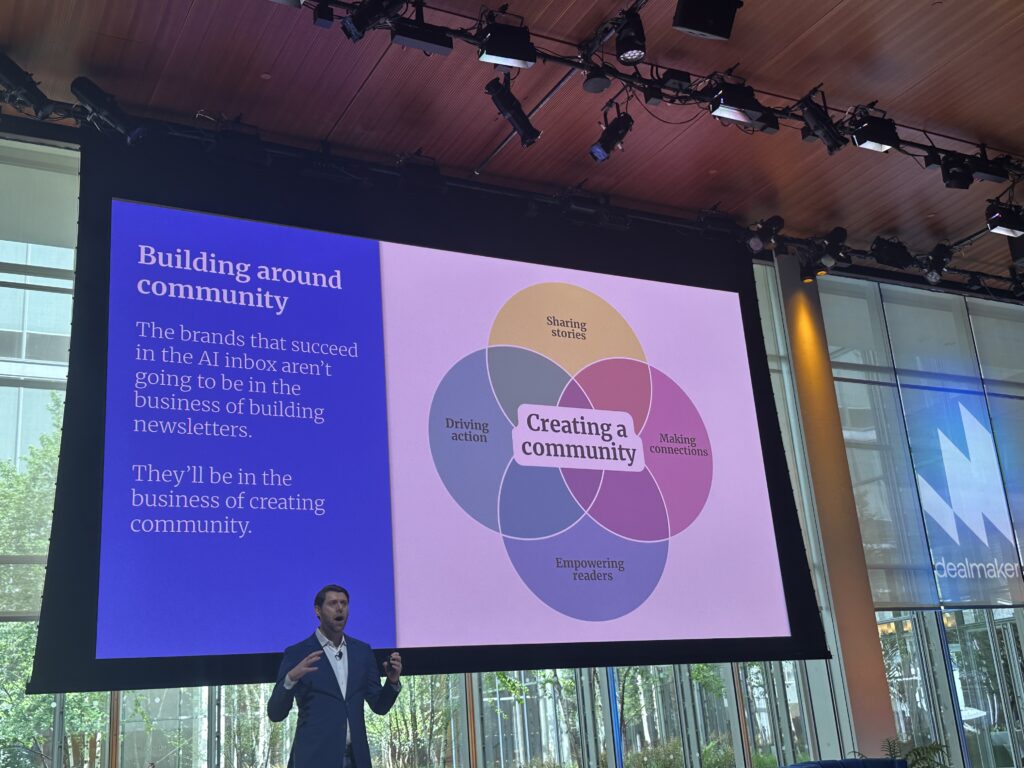
Surviving the AI Inbox by Finding Your Unfair Advantage: Dan Oshinsky, founder of Inbox Collective was outstanding. He examined AI’s disruption of the inbox and shared how brands can help themselves survive future changes. Oshinsky provided examples of international and American brands that generate high open and click through rates and explained why. He reminded attendees of how much disruption has occurred across the media business over the past few decades while email went relatively unscathed. With the inbox undergoing rampant change, Oshinsky addressed critical issues publishers and brands are facing. One of the top two presentations.
How to Grow a $5M Media Business Using The SCALE System: Andy Mackensen, Co-Founder & Chief Growth Officer of The Assist also knocked it out of the park. His session focused on his SCALE system (Subscribers, Conversion, Activations, Lifetime Value, and Enrichment), which included showing ad campaign tests that reached different levels. Mackensen went into detail showing how one campaign had a 46% success rate but grew to 70% with small adjustments. Media pros could learn a lot from this. He also shared why quizzes after signups build brand-subscriber connection, explained why quality audience matters more than large audience (this has been Barrett Media’s strategy from Day 1), and covered the six parts of a funnel that are vital to revenue growth. His best lines, “Rate cards are where sponsorships deals go to die” and “don’t sell ads, sell activations.” One of the top two presentations.
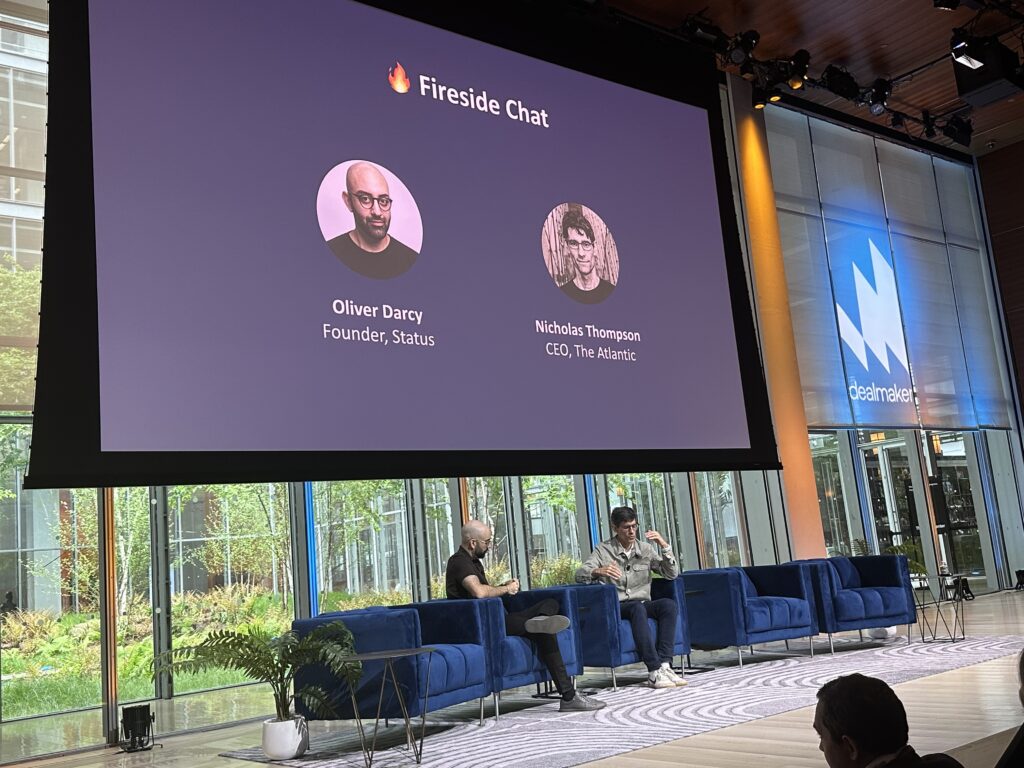
Oliver Darcy with Nicholas Thompson: This conversation showcased how exceptional of an interviewer Oliver Darcy is. After leaving CNN to launch Status, you could tell he was passionate and invested in the subject matter. He listened, followed up, and kept a serious business conversation feeling like a chat between two friends. Additionally, I learned fast why The Atlantic succeeds. Nicholas Thompson is sharp, curious, open minded, and invested in newsletters. He understands how they drive The Atlantic’s business and why one-to-one relationships beyond algorithmic connections matter. Thompson also detailed how he uses platforms to test content and impact, plus both men covered how AI will change the inbox over the next 10 years, and if major brands will need to offer greater incentives to retain top talent. Overall, a smart conversation.
Building Beyond the Inbox: Events are a big focus for Anna Palmer of Punchbowl News, Jacquelyn Cameron of Axios, and Eric Newcomer of Newcomer. All detailed why a big and small events strategy matters. With AI becoming more dominant, the belief is that events will be even more crucial for brands and independent operators. Hearing how Axios identifies their five target audiences and where each brand swung and missed was also interesting. They all agree that influence means more to business than reach and scale. At Barrett Media, we host a successful Summit, but to do 5-6 of them is impossible. Hearing their ideas and feedback though has me rethinking our events strategy for 2027.
Meeting the Audience Where They Are: I wasn’t familiar with Informa TechTarget, The Local Girl Media Group or Entreprenista before this session but I was well aware of Morning Brew. Robin Re, Jennifer Tripucka, Courtney Spritzer and Eleni DuBois came across as four talented, well spoken women. Conversation focused on identifying niche business opportunities, using newsletters and social channels to grow audience and community, and creating events strategy to build relationships and grow revenue. Tripucka’s business strategy for The Local Girl Media Group, and Spritzer’s energy and delivery especially stood out. Just a smart, insightful discussion on how to grow an independent business.
The Art and Science of Getting Readers to Pay: Lachlan Cartwright, Max Tcheyan, and Jacob Cohen Donnelly joined Nathan May to discuss their subscription strategies. Tcheyan’s past experiences at The Athletic, Puck, and Bleacher Report shined bright while Cartwright detailed the value of scoops in driving subs, explaining how it has driven Breaker Media’s business. Cohen Donnelly explained he wasn’t bullish on subs, but has worked with May on a test, which has produced small results, though it’s too early to tell its effectiveness. On a lighter note, Cartwright shared how he was recruited by Tcheyan to join Puck, explaining that they wouldn’t tell him who else would be involved. He camped out at the hotel, saw who interviewed, and then told the hiring team during his chat who they were targeting. The session could’ve easily gone 30-minutes more. May’s questions and directing were a bright spot.
What Could Have Been Better
Sponsorships and Advice: As a conference host myself, I know events are never perfect. Sponsors need time, and a mix has to be offered to satisfy different people. But folks at this event value strategy and information. I’d have liked more insight on how to grow sponsorships, build larger audiences, and correct issues when your emails don’t reach your subscribers. Given the AI rise and economy issues, those issues matter.
If you follow Tyler Denk (beehiv CEO), Austin Reif (Morning Brew co-founder), Matt McGarry, Kendall Baker, Ryan Sager, Adam Ryan, Dan Oshinsky, etc. these leaders really know the space. Their opinions and insights matter. Some were involved in panels but there’s a difference when given time to explore deeper like Oshinsky. Being inside the Times building, Jodi Rudoren of the New York Times would have been great too or Adam White of Front Office Sports. Both use newsletters to drive their businesses. But whether it’s them or anyone else, more focus on how the information on stage can help attendees grow business.
Charging Your Phone: The Times Center is a beautiful building with an exceptional theater but I was surprised by the lack of outlets to recharge. When you’re attending an important business conference, you’re going to use your phone a lot to take photos, write notes, check email, etc.. The good news for the event hosts is that by not having access to charge, it keeps people in the theater. The bad news, if someone’s phone dies they’re not going to be happy. Also, if they stay in the theater, they connect less with vendors. Fortunately, a staffer helped me find a private spot to charge up. Maybe that’s a business opportunity for the next conference – a sponsorable charging station works.
After Party Location: 5th and Mad was a great venue but getting there wasn’t simple. I asked a few people where it was and those walking to the event seemed unsure. Knowing NYC as I do, a 10-minute cab ride at 5pm on a Friday is usually 20-30 minutes, so I chose to walk. It was further away than expected. That may explain why some people who spoke weren’t there between 530-630. That part aside, the venue, food and mix of people were good.
Radio’s Missed Opportunity
The radio business was missing in action at this event. Why? The industry proclaims to be digital, but what that really means is radio, podcasting, apps, video, and social media. Newsletters and websites are digital too but the strategies used by most radio groups are poor. Presentations often look similar to what existed 10-20-30 years ago.
I receive newsletters from many radio brands. To be blunt, they are not worth opening. I looked at recent emails sent by WFAN, 98.5 The Sports Hub, 97.1 The Ticket, Arizona Sports, SKOR North, 680 The Fan, 101 ESPN and WWJ Newsradio 950. Most were promotional/advertising filled or directing people to audio links to listen. Little content value is offered inside the newsletter. Most don’t prioritize growing open/click rates, subs or generating larger advertising.
Some of those newsletters don’t even display content in the inbox. Graphics are used and blocked by Gmail and Outlook. In addition, most of the newsletters land in Gmail’s promo folder or Outlook’s Junk folder. That means people have to make an effort to move them into their inbox. When your newsletter headline reads “we open the big ole tub of pretzels” it provides little reason to open let alone click. That might be a great on-air radio bit, but inside the inbox, you need a stronger hook.
Additionally, how many brand leaders actually look at the newsletter content created and distributed by their station? Would any of it be good enough to lead your opening segment? As a member of the radio station, do you even open your own newsletter? I know many people at stations who don’t. Guess why? They know it’s fluff. But it doesn’t have to be. It can be an asset with the right strategy and focus, and it can make you money.
Here’s why this matters. Total U.S. digital ad revenue in 2020 was $139.8 billion. By 20205 that number soared to $294.6 billion. Of that $294 billion, 81 billion went to websites and 37 billion went to newsletters. That’s about 40%. The IAB cited newsletters as the fastest-growing sector of the digital media market, jumping up 26% year-over-year. Axios, Puck, Punchbowl News, The Free Press, Morning Brew, and Front Office Sports all launched between 2015 and 2022. They are each valued between $50-$500 million dollars. How much is your radio station worth today compared to a decade ago? That should get your attention.
Each year radio folks mention radio advertising declining, social media producing peanuts, subscriptions, events and merchandise strategies not being important, and sellers seeing less value selling podcasts. Meanwhile, spaces like newsletters and websites grow despite little focus from the radio industry. Execs will not increase their brand valuations or annual revenues without adjusting. There’s tons of opportunity out there but sometimes you have to enter new rooms to find out. I did on Friday. Maybe it’s time you did too.
Barrett Media produces daily content on the music, news, and sports media industries. Sign up for our newsletters to stay updated and get the latest information right in your inbox.
When Dan Bernsteindeparted Chicago’s 104.3 The Score just over a year ago, the news reached a fever pitch industry-wide. Following what Bernstein described as a “moment of personal lapse on social media,” there was speculation about whether he would return to the Chicago airwaves after such a public and controversial departure.
In the months that followed, Bernstein used the time away to self-reflect. He focused on identifying the root causes of what occurred in his final days at a station he called home for nearly thirty years. Even today, Bernstein admits he is still a work in progress.
“Judging from how I feel now, I don’t think I would do anything differently,” explained Bernstein. “I had a lot of work to do with my therapists. There’s no way that I would have been ready with my mental health to immediately go back to work full time. I needed not just the off time, but also to reevaluate my relationships with work and social media. There was a lot of heavy lifting that I’ve done that remains an ongoing process.”
While still navigating his personal reevaluation in the months following his departure, an opportunity emerged that sparked his curiosity. Bernstein admits it was largely a product of fortunate timing. As John Goforth, VP/GM of Gamut Podcast Network & Podcasts at Hubbard Radio, explored ways to cater to sports audiences within a company rooted in music brands, the idea for 312 Sports took shape.
As luck would have it, while Goforth considered who would serve as the face of the new venture—based on the success of SKOR North in Minnesota—the focus shifted to Bernstein and former 104.3 The Score producer/host Matt Abbatacola.
“I got extremely lucky that someone with the vision of John Goforth happened to have the ear of the company and the role he had with Gamut [Podcast Network], finding me as a free agent at the exact time they wanted to launch 312 Sports. That’s just luck,” explained Bernstein. “While we’re still figuring things out, I’ve never been happier to come to work every day.”
The Second Act
Following his departure from 104.3 The Score, Bernstein believed he would have a “second act” in his career. While he admits he will never rule anything out, the 312 Sports opportunity was the one that intrigued him most.
He notes that transitioning to podcasting after nearly three decades in radio remains an ongoing adjustment. It has required unlearning familiar sports radio techniques, such as holding audiences through quarter hours and teasing segments. Instead, Bernstein says he feels more comfortable in an environment that allows for long-form discussion.
“The autonomy of podcasting was attractive to me,” said Bernstein. “There is a comfort level that suits me best at this stage of my career.”
Another key factor in joining 312 Sports was the guidance of his former producer, Matt Abbatacola. The two worked together at 104.3 The Score during Bernstein’s peak years alongside co-host Terry Boers.
“Matty is here because I knew I needed a grown up. When it comes to producers, I needed someone who was experienced, wise, and someone who would never have any difficulty telling me what I need to hear over what I want to hear,” explained Bernstein. “Where he is with his life professionally, his creativity and work ethic—that was one of the best things that happened with getting him involved with this project.”
Bernstein says he has embraced the opportunity to learn a new side of the industry. He enjoys working with sales, marketing, and digital teams at Hubbard and Gamut, gaining a better understanding of how those areas collaborate for growth.
Changing Habits
Having Abbatacola also provides Bernstein with a trusted voice for feedback—someone he has relied on for years, both during and beyond their time at 104.3 The Score. That relationship has influenced Bernstein’s evolving approach to social media, which remains essential for digital content.
Rather than engaging directly with audiences online, Bernstein now uses social media strictly as a promotional tool. He avoids checking mentions and limits his activity to sharing content with those who choose to follow him.
Another shift for Bernstein involves his consumption habits when it comes to radio and sports content.
“I listen to radio a lot less, but I’m watching more games. This change for me has rekindled a lot of my love for sports that I feel had been grinding down during my years of work,” said Bernstein. “Being a part of 312 Sports has really helped me get back a genuine love for sports that had eroded over time.”
Since launching in August of last year, 312 Sports has grown to include four podcasts, all featuring Bernstein as either a host or co-host. He differentiates the content by using Forward Progress, Organizations Win Championships, and Off The Ivy to inform listeners on key topics.
By contrast, the platform’s flagship program, Dan Bernstein Unfiltered, serves as his outlet to interpret and react to the headlines.
“The idea of Unfiltered is for me to tell you what I think about this. No one is influencing what I think. It’s my opportunity to share what matters to me and why,” notes Bernstein. “I don’t have to chase the pack. If there’s something that’s not as interesting to me, I don’t have to feign interest. I’m not pretending that something is important to me when it’s not.”
As 312 Sports approaches the completion of its first full year in the on-demand content space, the platform has achieved several positive milestones. Expanding from one to four brands, along with adding new creators and management staff, reflects that growth.
Lessons From Terry Boers
However, 2026 began on a somber note for Bernstein. Chicago sports media was stunned to learn his longtime 104.3 The Score co-host Terry Boers had passed away in January. Days later, the station honored Boers’ legacy with a seven-hour tribute featuring contributions from colleagues and those influenced by his career.
This tribute included an extended in-studio appearance by Bernstein, marking his first time back at 104.3 The Score since his departure.
“Being there was weird, but it wasn’t about me. It was easy to not think about that. I was there for him, about him,” said Bernstein. “I just kept telling myself it’s not about you. Get over your own feelings. Get out of your head, and go do the best job you can to honor the life of Terry Boers.”
Bernstein said his return to the Score studios felt welcoming. Much like the support he received from many following his dismissal months earlier. He continues to root for the station’s success as it evolves within a content landscape he believes has room for everyone.
“Radio is just a job. Sports are sports. None of this is life or death. Our lives are short, and it’s important to understand that,” explained Bernstein. “Terry Boers taught me that, and never lost sight of that.”
In many ways, Bernstein’s journey over the past year has not been about a comeback as much as it has been about recalibration. The voice that once thrived in the structure and urgency of daily radio has found a different rhythm. One that allows for reflection, honesty, and, perhaps most importantly, growth.
What 312 Sports represents is not just a new platform or a second act. It is proof that evolution in this business does not always come from chasing what is next, but from understanding what matters. For Bernstein, that means prioritizing mental health, and embracing creative freedom. But also rediscovering a genuine connection to the games and conversations that built his career in the first place.
“I’m happy to wake up every day let alone know what I’m doing at any given point,” joked Bernstein. “To be able to start something from scratch and help determine everything it could be has been fascinating. I couldn’t be happier than to be with this company right now.”
In an industry often defined by noise, speed, and constant reaction, Bernstein’s path serves as a reminder that sometimes the most meaningful progress comes from stepping back, doing the work, and returning with a clearer sense of purpose—even if that purpose looks a little different than before.
Barrett Media produces daily content on the music, news, and sports media industries. Sign up for our newsletters to stay updated and get the latest information right in your inbox.
On Friday, Drake didn’t just release an album — he released three of them. Iceman, Maid of Honor, and Habibi arrived simultaneously on May 15th, a bold and unconventional move that immediately sparked debate across the music and radio industries. Was it a creative statement? A contractual chess move? A streaming play? All of the above?
We went back to the same five radio programmers and personalities we spoke with ahead of the release and asked them for their honest first-listen reactions. The verdict? Complicated — but not without highlights.
Does the new music deliver what you wanted it to?
The responses ranged from impressed to underwhelmed, with most landing somewhere in between.
Mike Street, Format VP of Mainstream Hip Hop and R&B at Audacy, saw the ambition clearly. “The project as a whole seems to have accomplished what I expected, with Drake addressing everything that was on his mind. The three-album offering has a little something for every part of his diverse fanbase.”
Street added that “being able to satisfy such a wide array of tastes and still present your thoughts in an intelligible and creative fashion these days is a superpower that not many wield.”
TT Torrez, host of Tap In with TT, was more measured. “It’s not a bad body of work at all, but on first listen, it doesn’t feel like a career-defining Drake album either. It feels more like a transitional project than a fully realized statement piece.”
“And to be fair, Drake albums usually age well, so I definitely need more time with it before making a final judgment.”
Buster, afternoon host at Q102 Philadelphia, was direct: “It’s okay. I was looking for more ‘Summer Banger Drake.'”
With a triple album drop, does the volume work in his favor — or hurt the impact?
This was the sharpest point of division among the group.
DJ Pup Dawg of WJMN Boston and KSSX San Diego acknowledged the trade-off. “The volume ultimately dilutes the project’s overall artistic punch, but I also get why he did what he did. The best of all those songs on one album wouldn’t have flowed for the masses.”
TT Torrez put it plainly: “Too much music can dilute impact. Instead of every song feeling like an event, some records start blending together.”
Torrez added something more pointed: “The album almost feels like Drake is creatively in between chapters. There were moments where it felt like he may be fulfilling obligations rather than emptying the clip creatively.”
Buster was even blunter: “It feels like a quantity over quality thing. Just seems like he wants out of his deal and a bunch of streams.”
Is there a “song of the summer” on there?
Skip Dillard, Urban Format VP at Audacy, pointed to Maid of Honor standout “Cheetah Print” with Sexyy Red, calling it a record with “summer vibes ranging from Hip Hop to a straight-up line dance.” He also flagged the Drake and Central Cee collaboration “Which One” for its Afrobeats energy.
DJ Pup Dawg went with “Amazing Shape.” “Being on the East Coast, that vibe and bounce are always a winner when summer kicks in.”
TT Torrez wasn’t ready to crown anything yet. “Right now, I’m not hearing the undeniable smash that instantly feels like it’s about to take over the culture. But Drake has always been an artist whose music grows over time, so I wouldn’t count him out too early.”
Which songs are you adding to rotation first?
DJ Pup Dawg named three: “‘2 Hard for the Radio’ for its massive sing-along appeal. ‘Ran to Atlanta’ — it’s got the bounce, the video, and the collab with Future. And ‘High Fives’ for its staying power, that classic Drake sound.”
Buster pointed to the same track from a different angle: “I could see our DJs having fun with the Fresh Prince remix of ‘2 Hard 4 Radio.'”
Skip Dillard’s early list included “Maid of Honor,” “Q&A,” “Shabang,” and “Fort Worth” featuring PartyNextDoor, among others.
Did the Kendrick chapter feel closed?
Buster put it most succinctly: “Closed and beaten to death.”
DJ Pup Dawg disagreed on the “closed” part. “Definitely did not close. Actually, the opposite — he opened up a few more.” He noted that Drake takes aim at a wide cast, with Skip Dillard cataloguing jabs at everyone from Kendrick to UMG’s Lucian Grainge to Jay-Z to DJ Khaled.
TT Torrez was candid about the toll it’s taking. “When I first listened, my immediate reaction was that Drake still sounds emotionally affected by the battle. Every time he revisits it, it keeps the narrative alive instead of allowing the audience to fully move on. Personally, I think the smarter move would’ve been to leave the battle alone completely.”
Any surprises?
Buster noted one he didn’t see coming: “I’m a little surprised at him dissing Dre. But I guess Kendrick was his mentee for a moment, so maybe that’s why.”
TT Torrez pointed to Drake’s emotional transparency. “Most artists with Drake’s level of success eventually become more guarded. But he still sounds personally affected by relationships, loyalty, betrayal, and public perception. Whether people love or hate him, that emotional openness is still one of the things that keeps audiences connected to him.”
DJ Pup Dawg highlighted “Make Them Cry” as his most unexpected moment — “He touches on the internal and external noise, the pressure, his mental state, and his dad’s illness.” His lyrical standout came from “Make Them Remember”: “To be the number one, you gotta lead the way / Plot twist, the owl never sees the cage / The owl only wakes up to seize the day.”
The radio industry’s first-listen verdict on Iceman — and its two companion projects — mirrors what many fans are feeling: there’s undeniable craft here, moments of the Drake everyone fell in love with, and enough content to keep playlists fed for months.
But the defining, era-cementing statement some were hoping for hasn’t fully materialized yet. As TT Torrez noted, Drake albums tend to age well. Radio will be watching which records rise — and which ones fade.
Barrett Media produces daily content on the music, news, and sports media industries. Sign up for our newsletters to stay updated and get the latest information right in your inbox.