Home Blog Page 210

Scripps Sports Signs Rights Agreement for U.S. 2027 Women’s Volleyball World Cup

0

ION will broadcast every match of the 2027 FIVB Women’s Volleyball World Cup. The Scripps-owned network struck the deal with Volleyball World and the tournament’s organizing committee.

What We Know: Volleyball World, the 2027 FIVB Women’s Volleyball World Cup Organizing Committee and Scripps Sports signed an exclusive U.S. broadcast agreement. In addition, all 64 games will air on ION and Scripps Sports platforms, in English and Spanish. Horizon Sports & Experiences facilitated the deal as the tournament’s exclusive sponsorship and media rights agency. ION reaches more than 126 million households. Moreover, this event adds to a women’s sports portfolio that already includes the WNBA, NWSL, PWHL and PWR.

What They Said: Brian Lawlor, president of Scripps Sports: “The FIVB Women’s Volleyball World Cup is a premier global tournament that showcases the incredible athleticism and competitive intensity of the world’s best volleyball players. We’re thrilled and honored to bring the 2027 event to ION and to the millions of loyal and passionate volleyball fans across the United States.”

Craig Thompson, CEO of the FIVB Women’s Volleyball World Cup 2027: “This agreement represents an unprecedented level of U.S. distribution for the FIVB Women’s Volleyball World Cup. [It’s] a defining moment for the sport in this market. The world’s best athletes, competing in one of the most dynamic and compelling sports on the planet, will have an extraordinary platform to reach millions of fans across the country. It’s a tremendous opportunity to introduce new audiences to the power and excitement of women’s volleyball. Building a new generation of fans.”

David Levy, co-CEO and Founder, Horizon Sports & Experiences: “The FIVB Women’s Volleyball World Cup has all the components that make for great television. Elite competition, a passionate, global fan base, and significant potential for advertisers and sponsors. Securing this rights deal with Scripps and ION elevates the sport to new heights. Also creates new commercial opportunities, and provides the athletes with a significant platform for their matches. We look forward to working closely with FIVB and ION to continue to build upon the momentum for this event.”

What Remains Unclear: Broadcast schedules and game-by-game assignments across ION and Scripps platforms remain unannounced.

What It Means: The agreement adds another property to the growing women’s sports catalog for Scripps Sports. The deal significantly expands volleyball’s U.S. television footprint ahead of the tournament. Moreover, thirty-two national teams will compete in August and September 2027. In conclusion, the top three unqualified finishers earning LA28 Olympic berths.

Barrett Media produces daily content on the music, news, and sports media industries. Sign up for our newsletters to stay updated and get the latest information right in your inbox.

Advertiser Interest in Podcasting Hits 12-Year High Despite Gap in Actual Spend

0

Advertiser interest in podcasting has never been higher. However, new research shows a growing gap between enthusiasm and actual dollars spent.

What We Know: According to new data from Westwood One’s Audio Active Group, advertiser Perceptions surveyed 300 marketers and agencies in June 2026. Results show 93% have discussed podcast advertising as a potential investment. Meanwhile, only 76% currently advertise in podcasts, and 74% plan to in the next six months. That spending-intention figure has grown sevenfold since 2015, when only 10% of brands considered podcasts.

What The Data Shows: (Image via Westwood One)

What Remains Unclear: Despite rising interest, spending remains modest. Magellan’s Q1 2026 Podcast Advertising Benchmark Report found top-500 show advertisers spent just $364,000 monthly on average. New advertisers spent even less, averaging $32,300 in Q1. Researchers say that falls short of what’s needed to build brands or drive measurable sales.

What It Means: Podcasting has clearly won over the ad industry’s attention. However, converting that interest into meaningful budget commitments remains the harder task. As competition for ad dollars intensifies across digital platforms, the industry’s next challenge involves closing the gap between curiosity and real investment. Hesitancy may be linked possibly to how people are consuming podcasts and which podcasts are taking up the majority of the listening versus which are not.

Barrett Media produces daily content on the music, news, and sports media industries. Sign up for our newsletters to stay updated and get the latest information right in your inbox.

James Brown Not Ready To Retire From CBS Sports ‘The NFL Today’

0

CBS Sports’ host James Brown says he’s not done yet with his role on The NFL Today. In a recent profile with Sports Business Journal, he revealed new details behind his 2005 FOX Sports exit, and addressed retirement from his CBS Sports role.

What We Know: Brown left FOX Sports after the 2005 season and returned to CBS Sports. He’s been hosting The NFL Today ever since, nearing two decades in the chair. His comments came via an exclusive Sports Business Journal feature. Brown was an inductee of the 2026 class of the NSMA Hall of Fame. Brown began his national broadcasting career at WUSA-TV in Washington, D.C., after playing basketball at Harvard University, where he was a three-time All-Ivy League selection. He previously spent 12 seasons as host of FOX NFL Sunday and covered multiple professional and collegiate sports for CBS. Brown’s accolades include three Emmy Awards and the Pro Football Hall of Fame’s Pete Rozelle Award in 2016.

What They Said: (All quotes via Sports Business Journal)

James Brown on retirement from his post on The NFL Today at CBS Sports: “I’m not being dismissive of that which I’m doing, because I love what I’m doing. But Marilyn Hickey, before she passed away, people were asking her why she didn’t retire. She said: Retirement is not in the Bible. Whatever gifts and talents I’ve been given, I want to use them to the fullest. When it’s my time to go, I don’t want people looking over, as the proverbial story is, to see all that talent that was unused in the grave. I want to give it all. Whatever that may be.”

James Brown on why he decided to leave FOX Sports following the 2005 NFL season: “I wasn’t asking for anything ridiculous; just wanted it to be fair. I was low man on the totem pole financially, but I understood. I had to prove myself. It’s all about being a good team player. But my colleagues, once or twice during the time of their deals, were always able to bump up. I just waited for mine. We had a great thing going. I will delicately say, I would never have left the show and wasn’t thinking of leaving the show.”

What Remains Unclear: Exact figures from Brown’s talks with FOX Sports in 2005 are unknown. Also, Brown did not share how much longer he’s considering hosting in his role at CBS Sports. Several reports had Brown working on an extension with CBS Sports last summer.

What It Means: James Brown is an NFL gameday institution. He’s been a part of NFL Sundays for nearly three decades on multiple networks. Even at 75, Brown is still performing at the top of his game. This season, he’ll be working with two new faces in Kyle Long and Russell Wilson at the desk. The NFL Today has undergone significant turnover in recent years. However, with Nate Burleson transitioning to CBS Mornings in a hosting capacity, he likely could be Brown’s successor in waiting.

Barrett Media produces daily content on the music, news, and sports media industries. Sign up for our newsletters to stay updated and get the latest information right in your inbox.

Jon Gruden Hints At Desire To Transition Into NFL Play-By-Play Role

0

Jon Gruden wants the play-by-play chair, not just a cameo. The former Tampa Bay Buccaneers coach made his desire explicit on the Ira Kaufman Podcast.

What We Know: Gruden explicitly named play-by-play as his desired role during his podcast appearance. He spent nine years as a broadcaster, serving as ESPN’s Monday Night Football color analyst from 2009 through 2017. Gene Deckerhoff’s radio seat recently opened, sparking speculation around Tampa. However, the organization recently named Tony Castricone to the vacant position. When asked about Deckerhoff and his legacy in Tampa Bay, Gruden, who currently works as a Barstool Sports contributor, hinted he’d like a shot on the call in the booth.

What They Said: Barstool Sports’ Jon Gruden on his desire to be a play-by-play announcer: “I like to have Gene’s [Deckerhoff] old job. That’s the job I want. I was a broadcaster for nine years. Hell’s Bells. I want to be play-by-play. Frank Gifford, he transitioned into the play-by-play role. I would like to transition. I had nine years of watching these guys — [Mike] Tirico. And I’d like to give that a shot, man.”

What Remains Unclear: Whether or not any network would welcome Gruden to a shot at calling a play-by-play event is unknown. The Tampa Bay Buccaneers also have not commented on the matter if Gruden could be included in the coverage of their pre-season slate on local television.

What It Means: Jon Gruden’s renaissance in sports media has been fantastic. Navigating new ways that football fans consume content and engaging through the megaphone that is Barstool Sports. Whether or not any network would consider Gruden is debatable, even in a one-off situation. However, in an era of alt-casts there could be a lane for Gruden to make the attempt. It would be must see TV to see Gruden’s energy for the sport return on full display if any network would take the chance.

Barrett Media produces daily content on the music, news, and sports media industries. Sign up for our newsletters to stay updated and get the latest information right in your inbox.

Carrie Danger Exits 107.3 ALT CLE in Cleveland

0

Carrie Danger Departs Cleveland’s 107.3 ALT CLE. The afternoon air talent has signed off for the last time.

What We Know: Carrie Danger has left 107.3 ALT CLE in Cleveland after the station announced her departure on social media. She joined the independently owned alternative outlet at its 2022 launch. The station confirmed she chose to step away to pursue other opportunities. Her exit leaves the afternoon daypart open.

What They Said: The station didn’t hold back in its farewell. “It is with heavy hearts that we announce that today is Carrie Danger’s last day on the air with us,” the post read. Management credited her with helping shape the station’s identity. “She has made this station what it is today,” they added.

What Remains Unclear: No details have emerged about Carrie’s next move. The station has not announced a replacement or interim host for afternoons. It’s also unknown whether the position will be filled internally or through an outside hire. A timeline for any programming announcement has not been shared.

What It Means: Losing a founding air talent is never a small thing. Carrie built a loyal audience during the station’s early years — and that kind of connection takes time to rebuild. For a live, local, and independently owned station, continuity matters deeply. How 107.3 ALT CLE handles this transition will say a lot about its next chapter.

Barrett Media produces daily content on the music, news, and sports media industries. Sign up for our newsletters to stay updated and get the latest information right in your inbox.


Inside the Crowd React Media Study on AI Voices That Divided The Radio Industry

0

A new study from Crowd React Media suggests radio listeners can’t reliably tell the difference between an AI-generated voice and a professional human voiceover — but the moment they find out which one they heard, their feelings change fast. The research, conducted by the Harker Bos Group’s research division, pits real audio clips against each other in a blind A/B test, and the results paint a nuanced picture for programmers weighing whether to bring AI into their production chain.

Crowd React Media Vice President of Strategy Katie Miller led the project alongside voiceover artist Neil Wilson. She recently sat down with Barrett Media to walk through how the study came together. The idea, she said, started as a casual conversation.

“Funny enough, the genesis of the idea actually came from Barrett Media,” Miller said. “Stephanie (Eads) introduced Neil Wilson and me at CRS, and we started talking about different ways we could collaborate.”

That conversation grew into a formal study built around a simple but pointed question: could listeners actually hear the difference between AI and human voice work? Miller and her team didn’t want to stop there, though. They also wanted to measure how listener sentiment shifted once the source of the voice became known, since raw identification alone wouldn’t capture the full story.

Why the Study Went Beyond a Simple Test

Miller explained that her team deliberately avoided hypothetical survey questions in favor of real audio comparisons. Listeners heard actual clips rather than answering abstract opinion questions about AI, which she said produces more honest data.

“We always try to avoid simple yes-or-no questions and opinions on hot-button topics when there’s a better way to measure real reactions,” Miller said.

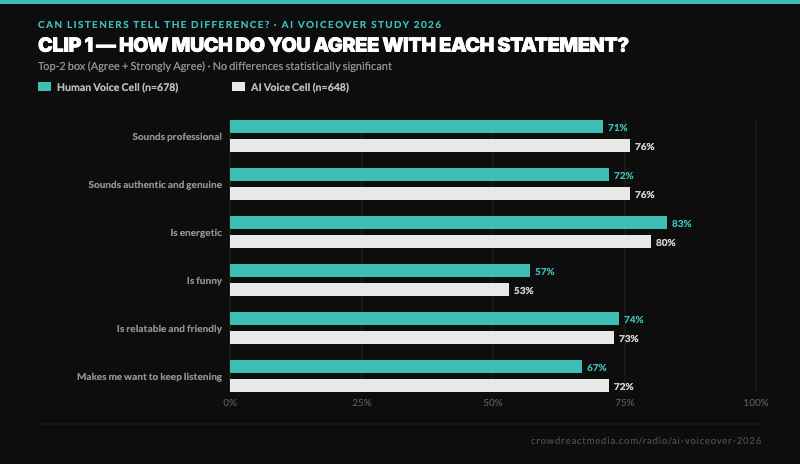
The numbers back up her approach. Across the sample, roughly 57% of listeners believed they’d heard a human voice, while about 32% guessed AI, and the remaining 10% to 11% weren’t sure. When Crowd React Media split respondents by which version they’d actually heard, the identification rates still showed no statistical difference. In short, listeners guessed “human” most of the time regardless of what played in their ears.

The attribute ratings told a similar story. Professionalism, authenticity, energy, relatability, and overall likability all came back statistically identical between the AI and human clips. Only one category separated the two: humor.

“That result makes intuitive sense,” said Miller. “At least today, humans are still better at comedic timing and delivery.”

Crowd React Media Screengrab

The Reveal Changed Everything

Once researchers told participants which voice they’d actually heard, sentiment diverged sharply. Listeners who learned they’d heard a human voice reacted overwhelmingly well, and the numbers reflect that reaction clearly. Forty-eight percent said they felt more positive afterward, while only 4% felt worse.

The AI group responded very differently. About 25% felt more positive after the reveal, but 20% felt more negative, creating a far tighter — and less favorable — margin than the human voice group produced. According to the Harker Bos Group executive, that gap is the real headline of the study.

“There was a 23-point advantage in positive sentiment for the human voice compared to AI,” Miller said. “What that tells us is that performance was essentially the same, but perception changed dramatically once listeners knew the source.”

Open-ended comments reinforced the quantitative split. Listeners who’d heard a human voice praised companies for “still doing things professionally,” and several said they’d keep listening because a real person was behind the mic. Responses tied to the AI reveal clustered around three recurring concerns: deception, job loss, and a belief that radio should preserve genuine human connection.

“Listeners clearly expressed that they expect radio to be built around authentic relationships between broadcasters and audiences,” Miller said.

Wilson, the voice actor behind the study’s human-read clips, echoed that sentiment in comments shared with Barrett Media. His read on the data centers on trust rather than technical quality. He doesn’t mince words about what’s at stake for stations experimenting with synthetic voices.

“Listeners don’t hear the difference — until they do. And when they find out, the word that shows up repeatedly in their responses isn’t ‘disappointed.’ It’s ‘lying,'” Wilson said. “Radio is a trust platform. Always has been. The moment a listener feels deceived, you’ve broken something that’s very hard to rebuild … Radio is a human platform. It was built on the idea that a real person was talking to you. The data says your listeners still believe that — and still expect it.”

The Radio Reaction

Some took the study to mean that listeners overwhelmingly supported AI voices being heard on the air. Reactions poured in on social media, with many DJs, hosts, and voiceover artists arguing that the Crowd React Media study wasn’t true or credible.

However, the idea that listeners supported AI voices only tells part of the story.

Miller’s broader conclusion lands somewhere between reassurance and warning for the industry. AI, she said, has become “technically competitive” in short-form voiceover work, and that trend isn’t likely to reverse. Meanwhile, the emotional fallout from disclosure remains just as real, and stations can’t assume the two forces will cancel each other out.

“The concerns people expressed weren’t about audio quality,” Miller said. “They weren’t saying the voice sounded bad. Instead, they talked about trust, transparency, and feeling like they had been misled.”

Looking ahead, Miller said she’d welcome the chance to repeat the study on a regular basis, since attitudes toward AI are likely to keep shifting as the technology matures. She cautioned, however, against stretching the findings beyond their scope. The study focused strictly on short clips under 30 seconds, such as station imaging and liners, not full AI-hosted programming.

“I wouldn’t apply these findings to something like an AI radio host,” Miller said. “I suspect the results would be very different if listeners spent hours with an AI personality instead of hearing short imaging elements, but that’s outside the scope of this study.”

Barrett Media produces daily content on the music, news, and sports media industries. Sign up for our newsletters to stay updated and get the latest information right in your inbox.

What Taylor Swift’s Wedding Teaches Morning Radio Programmers

0

I can’t help it. I’m surrounded by it. My wife is a massive Swiftie, so there was absolutely no avoiding the fact that behind a velvet rope a wedding was happening — particularly in my household. Before long, I wanted to know what happened inside.

Who was there? What did everybody wear? What did Adam Sandler say? Who gave the best speech? What did the guests get? Apparently, there were designer handbags, expensive watches, and even a car involved.

I wasn’t there. You probably weren’t there, either. That’s precisely why I wanted to know everything.

The Power of Exclusivity

There is something powerful about exclusivity. Put a velvet rope in front of a door, and suddenly everybody wants to know what is happening behind it.

Great morning radio has always understood this. The best shows create a club. More importantly, they make the listener feel like listening every morning is the membership card.

That is the bridge between a celebrity wedding and great air talent. It is not really about famous people, expensive gifts, or what somebody wore. It is about the feeling that something interesting is happening in a room you normally cannot enter.

Build a World Worth Entering

Great morning shows create their own room.

Howard Stern may have done this better than anyone. The show was not simply Howard talking about topics or interviewing celebrities — it was a world. Listeners knew Robin, Fred, and Gary. They knew the grudges, running jokes, and history. They knew who Howard was mad at, who Gary had annoyed, and what happened behind the scenes.

The listener felt like they had access to something outsiders did not understand.

Opie and Anthony created their own club, too. The show built a world around the hosts, comedians, staff members, guests, and recurring characters. The more you listened, the more you understood.

Don and Mike did the same thing. The Woody Show does it today.

There are relationships between the personalities that the audience understands. There is history. There are running jokes and disagreements. Listeners know how Woody, Menace, Greg, and Sebas are likely to react before they even respond.

That is intimacy. However, it is also exclusivity. The audience has earned its way into the club by showing up every day.

Make the Listener Feel Like an Insider

Radio often talks about making the audience part of the show. Usually, that means taking phone calls or reading texts. That is not necessarily the same thing.

A listener answering a topic is participating. A listener who understands the culture of the show belongs. There is a big difference.

Great shows reward frequency. A casual listener can hear a funny conversation and enjoy it. However, the regular listener understands the deeper joke because they remember what happened three weeks ago. That is how you create habit.

The listener wonders what happened after yesterday’s show. They want to know why two cast members are arguing. They heard half of a story on Monday and need to hear the ending on Tuesday. As a result, the show becomes an ongoing story instead of a series of disconnected segments.

Great talent understands that people are naturally curious about what they cannot completely see. So pull back the curtain — but don’t pull it back all the way.

Show the audience what happened in the hallway after the argument. Tell them about the disastrous dinner everybody attended last night. Let a story continue from one day to the next. Give the audience a reason to come back.

Great Morning Shows Have Lore

Great morning shows have stories that longtime listeners remember. They have names that mean something. They have moments that can be mentioned years later and immediately trigger a reaction.

The best part is that new listeners eventually learn the language. In time, they become insiders.

Maybe radio spends too much time trying to make every minute completely understandable to everybody. A great show should be welcoming, but it should also feel special.

There should be a reason to listen frequently. There should be something you know because you were there yesterday. Furthermore, there should be something happening tomorrow that you do not want to miss.

The Taylor Swift wedding fascinated people because almost none of us were invited. Great morning radio should create the opposite feeling.

Everybody else may be outside wondering what is happening behind the velvet rope. But the regular listener? They’re already inside.

Barrett Media produces daily content on the music, news, and sports media industries. Sign up for our newsletters to stay updated and get the latest information right in your inbox.

The Industry According To: Kevin Straley, TuneIn

Thank you for checking out The Industry According To. Every Tuesday we speak with a different expert or leader from somewhere in the vast music industry — label executives, artist managers, programmers, talent, artists, consultants, and beyond. To appear as a future guest, email me at keithblackboxgroup@gmail.com.

Today we sit down with one of streaming’s key content leaders, Kevin Straley. He’s spent 15 years at TuneIn, where he serves as Chief Content Officer, overseeing content acquisition, strategy, and partnerships for the global streaming platform. Before TuneIn, Kevin was SVP of News/Talk/Sports at SiriusXM, PD at WRKO in Boston, and ran his own consultancy, KMS Media Partners.

So, let’s dive in.

*Editor’s Note: Answers have been edited for clarity and length.*

The Gig at TuneIn

Keith: Every day is different at a platform your size. What does a typical day look like for you — what occupies most of your time as Chief Content Officer?

Kevin: Each day begins with reviewing the previous day’s meeting notes and my weekly to-do list, which I keep organized on my reMarkable tablet. When I’m not traveling to meet with partners or attend conferences, I have a relatively short, 30-minute commute that I use to explore the TuneIn app, listen to content, and evaluate the user experience.

Once I arrive at the office, a typical day consists of a mix of partner meetings, internal meetings, and strategic planning. Because I am based on the East Coast, my mornings are focused on connecting with partners in Europe as well as domestic partners in the Eastern Time Zone. Most of the TuneIn content team is based on the West Coast, so around noon I begin checking in with team members on active projects and new opportunities. We’re working with partners every day to drive the most engagement for their content and drive incremental revenue to their stations. There’s a lot of variety, which makes the job a lot of fun.

What Does Success Look Like

Keith: A label VP is judged on sales or roster growth, a radio PD on Nielsen ratings — what does success look like for you? What benchmarks or KPIs define a win at TuneIn?

Kevin: Our core KPIs are increasing the number of unique platform users, growing listening hours, and driving revenue growth. It requires our team to constantly evaluate what’s performing, what isn’t, and where we need to invest next.

The Streaming Challenge

Keith: Radio’s challenges get talked about daily — streaming, attention spans, younger demos, revenue shifts. What about streaming? What’s keeping you up at night, and what are the immediate challenges TuneIn has to overcome?

Kevin: TuneIn offers listeners a wide range of content options with more than 100,000 radio stations, millions of podcasts, and more. Returning listeners typically come to the platform knowing exactly which stations they want to hear. For new users, however, the depth and breadth of our content library can be overwhelming, so our primary goal is to help them find a station as quickly as possible. Guiding new listeners to the content they are searching for — or introducing them to content they are likely to enjoy — continues to be a challenge with such a deep content offering. However, our teams have made significant progress in creating a more intuitive discovery experience that helps new TuneIn listeners find relevant content more quickly. For example, we introduced TuneIn Explorer, an interactive map that helps listeners easily discover content from around the globe.

Your World of Data

Keith: Having a radio background, you know the focus is on Share, Rating, TSL, Cume, etc. Now you have far deeper listener data. Which data points matter most to you — what tells you if something is headed in the right direction or needs a new strategy?

Kevin: I have had the opportunity to hold three platform leadership roles throughout my career: Program Director of WRKO/Boston, a top-format station in a top-10 market; Head of News, Talk, and Sports Content at XM Satellite Radio; and Chief Content Officer at TuneIn. Throughout that journey, the technology used to deliver content has evolved from terrestrial broadcast towers in Boston to satellite distribution with a repeater network across the United States and Canada at XM, and now to the leading global streaming aggregation platform at TuneIn.

The scale of the content offerings has also expanded at each stop — from approximately 40 stations in Boston, to 170 channels at XM, to more than 100,000 stations on TuneIn. Despite these dramatic changes in technology and scale, one thing has remained consistent: success in audio is measured by audience engagement and by comparing your content against the best in its genre.

The most successful audio content builds a loyal, habitual audience that returns regardless of the song, topic, or guest. It creates lasting relationships with listeners through entertainment, companionship, and relevance, while staying closely connected to what its audience is thinking and feeling.

When Lift is Needed

Keith: When you were programming radio, a ratings lift might come from tweaking clocks, adjusting a daypart, or getting some funding for marketing and contests. When TuneIn needs a lift, where do you look — new partnership, product, marketing, content strategy?

Kevin: Typically, when we have seen sizable growth at TuneIn, it comes from new content partners, device partners, or user features. Some of our biggest growth moments have come from expanding where listeners can access TuneIn. Every time we launch with a new automotive partner, like Nissan or BYD, we’re putting TuneIn and our partners’ stations in front of an entirely new audience in one of the most important listening environments.

At the same time, we see growth from recent content partnership launches, like Apple Music Radio, NBC Sports, Stingray Music, and ABC 20/20 True Crime 24/7, along with new product features like TuneIn Explorer and the new broadcaster portal.

Are Stars Just Stars

Keith: You hear podcast stars and radio stars each day — is there actually a difference between a radio star and a streaming star from your vantage point?

Kevin: No. In terms of having the talent and ability to be entertaining and deeply engage an audience, that is a unique skill set that separates the stars from the run-of-the-mill “wind ’em up and let ’em talk” hosts.

I do think the frequency of the content being created, the length of each show, and the demands of delivering live versus on-demand programming require unique skills that don’t always translate across formats. A carefully crafted, highly edited, on-demand show can be exceptional, especially when the format allows for more variety in the audio than simply the host’s polished monologue.

Whether it’s a radio star or a streaming star, there’s something very special about creating 20 to 25 hours of live content each week. Interacting with your audience in real time and allowing the conversation to evolve based on audience feedback is a skill that remains incredibly difficult to replicate in other forms of media.

Is It the Talent or the Pipeline

Keith: Look ahead 10 years — does audio become talent-first or platform-first? Who ultimately has the leverage: the talent needing the pipeline, or the pipeline needing the talent?

Kevin: Content is always king. Without compelling content, an audio streaming platform has nothing for users to engage with. We don’t view this in terms of leverage on one side or the other. Instead, we focus on building cohesive partnerships that create value for both the station or content creator and the platform.

Radio’s Secret Weapon

Keith: You’re in a unique spot: TuneIn partners with thousands of radio stations, but you also compete with them for listening. What’s radio’s secret weapon — the one it should lean on most?

Kevin: Radio’s biggest advantage is live and local. When something important happens in a community, people turn to local radio.

The one-to-one connection that great radio talent has with listeners is unique to our industry. When I travel, listening to outstanding local stations in my market, like WMVY in Martha’s Vineyard, gives me a connection to home that I can’t get from any other form of media.

TuneIn exists to help make audio content available to listeners wherever they are. By making stations accessible across our platform and through our numerous device partnerships, we’re helping broadcasters reach more listeners, not compete for them.

Who Has the Leverage

Keith: It’s like a marriage: TuneIn wants AM/FM streams, AM/FM wants streaming distribution. But if transmitters went away tomorrow — does the leverage shift — and does that trigger a new era of distribution deals?

Kevin: It’s an unlikely scenario. Nothing changes from our perspective. Our role is to make radio more accessible and help our partners reach listeners across every platform.

Why TuneIn?

Keith: TuneIn is strategically aligned with iHeartMedia, so it’s not an adversarial, competitive relationship, but there are countless ways for people to stream content of all types. Why TuneIn? Why should a brand or talent choose TuneIn instead of somewhere else?

Kevin: I don’t see this as an either-or scenario. I think broadcasters that want to be widely distributed should have a strong native streaming strategy and then choose to work with the platforms that best align with their goals.

From a TuneIn perspective, we serve as both a distribution and growth platform for broadcast partners, extending their reach to listeners across more than 250 connected devices, including smart speakers, voice assistants, connected TVs, mobile devices, and automotive dashboard integrations. Beyond expanding audience access, TuneIn creates new revenue opportunities through advertising revenue-sharing across the platform’s ad inventory. Broadcasters also gain access to detailed analytics that provide insight into listener behavior and engagement, helping them better understand and grow their audiences.

To support content promotion, TuneIn works with partners on marketing and in-app prominence opportunities that showcase special programming, live events, and new content launches. Partners also have access to a self-service portal that allows them to manage station URLs, metadata, programming schedules, and logos, ensuring their content is always current and accurately represented across the platform. In addition, TuneIn provides embeddable desktop and mobile players that broadcasters can integrate into their own websites and mobile apps, creating a consistent listening experience for audiences wherever they choose to engage with the station.

What’s Missing

Keith: Over 100,000 streams on TuneIn — what’s missing? Anything? Is it a concept, a brand you don’t have? What’s on your hit list to get up and active on TuneIn that isn’t there already?

Kevin: TuneIn has a diverse and robust content portfolio with more than 100,000 streams. Currently, radio, music, sports, news, podcasts, and audiobooks drive the most engagement and listening on our platform. We are continuously exploring emerging content trends, new formats, and incremental content opportunities that further engage listeners and encourage them to spend more time on TuneIn.

The Big Dogs

Keith: TuneIn offers everything from music to live news, true crime, podcasts, sports, you name it. What are the top three categories that drive the most consistent listening? And can you share what the #1 stream is?

Kevin: At a high level, radio is where we see the highest engagement and listening on TuneIn. While we don’t share data for individual partners, the genres that consistently drive the most listening are music, sports, and news.

What’s Your Version of Airchecking

Keith: As a programmer, you used to be able to just walk into the studio and talk to the talent about something you heard that needs a tweak. As more of a distributor, how do you put your fingerprints on what comes out of the speakers? What’s your version of airchecking?

Kevin: I regularly explore the TuneIn platform from the perspective of our three most important constituents: listeners, broadcasters, and device partners. Feedback from each of these groups plays a critical role in shaping our product roadmap and improving the overall platform experience. My version of “airchecking” is spinning the TuneIn dial, experiencing the platform as our users do, and identifying features, workflows, and content experiences that are working well or could be improved.

With Stingray’s acquisition of TuneIn, announced late last year, we now have the added benefit of one of Canada’s largest radio groups serving not only as a content partner but also as a valuable source of real-time feedback and strategic guidance from the front lines of the radio industry.

Steve Jones and his team at Stingray Radio have become an invaluable sounding board for new ideas and initiatives we want to share with our broadcast partners to drive listening engagement and revenue. They also identify opportunities we may not have otherwise considered, helping TuneIn better serve our broadcast partners. That collaboration has been especially valuable throughout 2026.

The Blank Slate

Keith: Last question, everyone gets a shot. Blank slate — say anything you want to any sector of the audio industry. What do you want them to hear?

Kevin: I have never been more bullish about audio and its future. Across radio, podcasts, streaming audio services, and audiobooks, each category continues to attract a growing audience for best-in-class content while creating new opportunities to become part of listeners’ daily habits across both established and emerging platforms.

With the continued growth of video podcasts, I am excited to see radio have its own moment by embracing visual engagement for leading shows and stations in 2027 and beyond. The opportunity to extend radio’s reach through compelling visual content has never been greater.

Barrett Media produces daily content on the music, news, and sports media industries. Sign up for our newsletters to stay updated and get the latest information right in your inbox.

Why Radio’s AI Disclosure Debate May Already Be Dead Air

0

Radio stations are at a crossroads in their use of artificial intelligence. Every panel at the three-day Barrett Media Audio Summit included some level of discussion about the technology. From the biggest talent to the highest-ranking executives, navigating AI has become one of the industry’s top priorities.

With each passing day, AI becomes less of an outlier and more commonplace. We’ve gone from calling out “AI slop” to seeing nearly every brand use the technology to create graphics and text designed to capture consumers’ attention in an increasingly crowded attention economy. As AI becomes more integrated into everyday life, consumers are becoming less able to distinguish what’s real from what’s artificial. So much so, that a recent survey found that, when tested blindly, the appeal of both was nearly identical.

Harker Bos Group’s Crowd React Media recently conducted a survey of 1,326 people between the ages of 18 and 45 who identified as weekly radio listeners. The focus wasn’t on the content itself, but on the elements that surround the content — specifically, station imaging and promotional spots.

Without knowing which voice was AI and which was human, the results should give anyone in the radio industry pause. When a human voice was played, only 59% of respondents correctly identified it as human. When an AI voice was played, only 55% correctly identified it as synthetic.

The results were remarkably close for a blind test. Not knowing which voice was which, only 4% more respondents correctly identified a human voice than an AI voice. Even more interesting, overall appeal ratings favored the AI voice by 1%.

Does Disclosure Matter If….

Based on those results, here’s the bigger question. As AI continues to evolve and become a larger part of everyday life, will disclosure of use even matter to consumers? Especially if the human consumer can’t tell the difference between the two, and overall satisfaction is better for the AI than a human voice. I’m a big fan of McDonald’s and love Chicken McNuggets, but should the company be required to explain every step of how they’re made? Would I care to know? Is it demanded?

The same question applies to AI across all entertainment. There are AI songs climbing music charts. AI-generated images appear across major media platforms. AI is generating personalized podcasts, creating customized sports reports and producing short-form videos that generate massive digital engagement.

Companies are now in a public relations race over AI disclosure. Google is the latest to announce AI disclosure labels for advertisements across Search, YouTube and Discover. Spotify has added AI labels to songs on its platform. Record labels continue pushing streaming services to follow suit. Meanwhile, iHeartMedia has adopted a “Guaranteed Human” approach to identify human voices, even as on-air talent across the country increasingly use AI as part of their daily workflow.

The bigger question is whether disclosure is already becoming outdated. Will disclosure really influence consumer behavior as AI becomes an accepted part of everyday life?

The findings suggest many weekly radio listeners struggle to distinguish between human and AI voices. If a blind test reveals that human and AI voices deliver a comparable experience, what’s to stop companies from investing more heavily in technology to reduce costs?

People continue to buy Chicken McNuggets. If McDonald’s found a way to produce more of them at a lower cost while delivering the same level of customer satisfaction, do you think the company would worry about disclosing its production process? More importantly, would consumers care?

Defining The Value Of Human

And that’s the root of this discussion about AI. Referencing Funk Flex’s comments from the Barrett Media Audio Summit, he’s right. It all comes down to revenue. Companies bought property, in Flex’s words, at $300 million, and now it’s worth $30 million. To remain profitable, businesses have to operate within the revenue they generate.

Keeping radio human is expensive. More work continues to fall on fewer people, often without additional compensation or greater job security. The realities of today’s media landscape are unforgiving in a content race driven by attention. Radio no longer competes with radio. It competes with everything, everywhere.

If listeners eventually stop caring whether the voice behind the microphone is human or artificial, then the industry’s obsession with AI disclosure may be missing the bigger picture. Disclosure only matters if consumers believe there’s meaningful value in knowing the difference. Based on the latest research, they’re already showing they don’t.

That’s the uncomfortable reality radio has to confront. If an AI voice delivers the same level of satisfaction as a human voice or better with each new day, companies will inevitably ask why they’re paying significantly more for the human option. That’s not an argument for replacing talent. It’s an acknowledgment of the financial pressure the industry already faces.

The challenge for broadcasters, then, isn’t simply proving a voice is human. It’s proving why the human behind the microphone matters. If audiences no longer distinguish between AI and human delivery, stations will have to create value beyond what’s just coming through the speakers. They’ll have to strengthen their brands through personalities, community involvement, digital engagement, live experiences and authentic relationships that artificial intelligence can’t easily duplicate.

AI may eventually make voices interchangeable. It shouldn’t make connections interchangeable. If radio wants to remain relevant in an AI-driven future, that’s where its investment belongs.

Barrett Media produces daily content on the music, news, and sports media industries. Sign up for our newsletters to stay updated and get the latest information right in your inbox.

News/Talk Radio Burnout: When It’s Time to Walk Away

0

Radio was never a career known for job security. You and I went into this career for a variety of reasons, which included a love of music, an interest in news, the need to make people laugh, and/or the desire to share our opinions.

Most of us are socially awkward eccentrics who are chasing the dream. The one thing that we all share is love and a passion for broadcasting. Because of circumstances beyond our control, many of us live in a constant state of fear over our futures.

If you are working for a company that has overwhelming debt, this fear is not an irrational paranoia. This is reality. With all this uncertainty, how can you keep the passion alive?

If you have been in a long-term romantic relationship or have been or are married, keeping that spark lit can be a challenge. Kids, worries, careers, debt, setbacks, household chores, in-laws, and a variety of other things can take the focus away from the romantic partner of your choice.

About a decade ago, there was a pastor in Texas who got into the news for encouraging married couples to set out time each day for a week to make love. Thinking through this, sex is a connection point between couples. It creates an intimate connection and a reassurance for each other that they are still in love and are connected beyond all the outside pressures.

Radio is a career of passion. There is an intimacy that the performer has with his or her audience. If you are having a good show, it feels like an intensely satisfying lovemaking session.

This comes to my questions: Have you lost your spark for radio? How do you reconnect with that first moment of love? If that love has changed, is it time to walk away on your own terms and divorce the industry?

Do You Still Love Radio?

Do you still love radio? This is a highly personal question. I can’t answer this for you. Are you here because it is what you have done with your life and have no idea what is next?

I can only speak for myself. But I am as passionate now as I was when I was hired for my first radio job. I walked into that station with excitement, ideas, opinions, and commitment. Notice, I didn’t say experience. My guess is that you felt the same way.

I was working my way through school with two other jobs. Surprisingly, my grades were pretty good. I don’t know how I did it, but if I had any spare time, I showed up at the radio station. My first program director, Mike Dorwart, kept booting me out of the building. Mike would ask me if I was scheduled to be there, and I wasn’t. I just wanted to be around everyone at the radio station.

It was like that first love where you couldn’t wait to see that amazing love interest. Do you still have that spark?

Reconnecting With That First Spark

If you still love it but that love has grown cold, how do you reconnect?

I think of that pastor who encouraged couples to set aside time for intimacy each day for a week. Obviously, your intellectual and emotional intimacy is tied to your first love.

What is that? In today’s radio environment, can you redirect that passion to reality? I don’t know that answer. news/talk radio people are a little different — our passion points are a little different. We were not dazzled by a hit song or getting backstage at concerts.

Years ago, local radio stations could influence the music charts. A smart program director and/or music director could add a song by an artist and create a hit all over the world. Those days are largely done. There was a period where being a great impressionist was a sought-after skill. Those days have been basically over since the mid-1990s.

In news/talk radio, sometimes the motivation was to create news. Hosts frequently found an injustice and created a community uproar for change.

In news/talk radio, it is about making a difference. When is the last time that you created a flashpoint of passion in your community?

Knowing When It’s Time to Walk Away

If you no longer love the industry, is it time for a divorce before your employer files first? This is scary. We are built for commitment. Walking away from a dysfunctional relationship is difficult. I went through a divorce. It was tough, emotionally crippling, and liberating all at the same time. I walked away on my terms. Most people know that their relationship with a spouse or a career is coming to an end.

Walking away is the most difficult part if it has been determined that it cannot be repaired. If you are mentally drained by the fear of being downsized and cannot enjoy your life, this may be the high sign to get out on your own terms. The fear is what’s next.

What will you do for your career? I would suggest that you weigh this out. Do what is best for you. I don’t know what that is for you, but you cannot live in a world where fear rules your life.

Taking Steps to Reignite the Passion

If you need to reconnect with the passion that made you fall in love with radio, you need to take some steps. It may be to see a therapist. There is nothing wrong with speaking to a professional where you can let out all your concerns, fears, and hopes. This person can be a priest, pastor, cleric, or a guru.

It is not good for your physical or emotional health to be in a place of worry. You are likely to make the people you love the most miserable. You need to address this today.

If you love this career, what steps can you take to make yourself bulletproof? You have unique skills and talents that are indispensable.

Radio needs passion — and if you don’t have it, and that passion cannot be repaired, divorce may be your only option.

Barrett Media produces daily content on the music, news, and sports media industries. Sign up for our newsletters to stay updated and get the latest information right in your inbox.