WWL Radio midday host Scoot Paisant has returned to his show after being off the air for seven weeks.
The longtime host underwent open-heart surgery for a congenital valve defect in March.
When he returned to the show earlier this week, Scoot Paisant said it was a long-overdue return.
“It feels so great to be back on the air, and to be back with you,” Paisant said. “I define my life by this show. This show was missing from my life. I lost a big piece of who I was.”
In a subsequent interview with WWL-TV, Paisant said that his heart is working “perfectly right now, better than it was before the surgery.”
Scoot Paisant has been a near-constant presence in New Orleans radio for more than half a century. After originally joining WWL Radio in 1971, he worked at a variety of stations in the market. He’s also spent time in Portland, Denver, Philadelphia, San Diego, and San Antonio. He landed back in middays at WWL Radio in 2011.
Barrett Media produces daily content on the music, news, and sports media industries. Sign up for our newsletters to stay updated and get the latest information right in your inbox.
Yahoo Media Group is making a significant move in the sports business coverage space. The company has launched a dedicated sports business hub available across both Yahoo Sports and Yahoo Finance. I am proud to share that Barrett Media is a part of it.
The new sports business hub unites some of the most respected names in sports business journalism. The full list of publications can be found below. Reporters and analysts from each partner will appear on Yahoo Sports and Yahoo Finance programming, including Yahoo Sports Daily and Opening Bid Unfiltered.
Yahoo Media Group President Ryan Spoon explained the thinking behind the new venture: “Rapid changes in technology, media rights, and the investment landscape are making the business of sports more important than ever. Fans and investors alike want deeper insight and sharper perspective. We’re excited to deliver that to both Yahoo Sports and Yahoo Finance audiences through smart, in-depth coverage powered by an exceptional group of industry-leading partners.”
The hub will also feature original reporting from Yahoo itself. Dylan Dittrich and Shlomo Sprung join the platform as part of Yahoo’s investment in expanding its sports business coverage.
The timing is deliberate. Sports media rights deals, private equity investment in leagues, and athlete entrepreneurship have pushed sports business coverage into the mainstream conversation. Moreover, the audience for that coverage now spans casual fans and institutional investors simultaneously. Yahoo is building a single destination to serve both.
For Barrett Media, the partnership expands the brand’s reach significantly. The hub positions Barrett’s reporting and commentary alongside the industry’s most established sports business voices. It also exposes the outlet to one of the largest digital audiences in the country.
A leading multiplatform media and news organization covering the business of sports; distributes written news and analysis on major stories at the intersection of sports, business, and culture.
A Penske Media Corporation company and go-to resource for sports industry professionals; provides breaking headlines and expert analysis from an accomplished editorial team.
A leading sports intelligence platform delivering actionable insights and forward-looking analysis; contributes written and video content, including its flagship newsletter and podcasts (Big Business on Campus, JaneWallStreet: At The Table).
The longest-running sports business show (since 2004), hosted by Brian Berger; a weekly podcast featuring interviews with major figures in sports, business, and entertainment.
A key source for sports media news; provides written analysis and video commentary, including content from The Awful Announcing Podcast and The Play By Play.
A next-generation sports business media company followed by owners, investors, and executives; delivers analysis on capital and technology shaping the sports industry.
Furthermore, this allows us to grow our audience, support our partners, and serve more readers of sports media content. We have spent over a decade covering the media business, earning trust and credibility across the industry. Aligning with Ryan Spoon and exceptional brands like Yahoo Sports and Yahoo Finance, is both humbling and exciting. We are honored to showcase our work alongside the best sports media and business publications in the country.
Importantly, all coverage inside the hub is completely free. Currently, the Yahoo Sports Network averages 113 million monthly unique visitors. The Yahoo Finance Network is the #1 Business/Finance News site in America averaging over 100 million visitors each month. Consequently, sports business coverage is gaining mainstream attention overnight.
Barrett Media produces daily content on the music, news, and sports media industries.Sign up for our newsletters to stay updated and get the latest information right in your inbox.
iHeartMedia and Magellan AI have announced a new partnership to bring radio attribution to advertisers.
With Magellan AI’s platform, iHeartMedia’s simulcast data will report the attribution between streaming audio, podcasts, connected TV, and other digital media.
Advertisers utilizing the technology will receive information and insights into how radio campaigns deliver results like web visits, form completions, leads, and purchases.
“Advertisers want clearer insight into how every channel contributes to outcomes,” said Magellan AI CEO and co-founder Cameron Hendrix. “Our expanded partnership with iHeartMedia brings broadcast radio into the same attribution framework as digital audio and other media, giving brands a more complete view of campaign performance.”
“iHeartMedia has always focused on helping advertisers understand the power of audio,” said iHeartMedia Insights President Lainie Fertick. “By combining Magellan AI’s attribution technology with our proprietary in-market simulcast data, we’re providing brands with deeper visibility into how broadcast radio works alongside podcasts, streaming audio, connected TV, and other channels to drive meaningful results.”
Barrett Media produces daily content on the music, news, and sports media industries. Sign up for our newsletters to stay updated and get the latest information right in your inbox.
It came like a LeBron James fast break in the fourth quarter. Audacy announced it would launch an all-sports station in Los Angeles in less than two weeks. 97.1 The Fan was billed as the first-ever FM all-sports audio brand in the history of the ‘City of Angels.’
The release didn’t share details about the lineup, syndication partners, or franchise play-by-play rights. That omission left plenty of speculation about what an FM sports talk destination could mean for the nation’s second-largest market. A market that has never truly been a dominant force in the sports radio landscape nationwide.
There’s speculation not just about the lineup, but also the strategy behind the decision. Taking the 97.1 frequency from a heritage news brand like KNX adds another layer, one Garrett Searight addressed yesterday. Many factors go into a move like this, but is there enough opportunity to justify a third sports station in Los Angeles?
Let’s give credit where it’s due. Audacy, especially under Chris Oliviero’s leadership, values sports radio on the FM dial. There’s a reason why so many of Audacy’s brand managers finish in the top ten of the annual Barrett Media sports radio program director rankings.
For far too long, companies have delayed the inevitable. Sports radio not only should be on FM, but it needs to be on FM. Yes, sports radio is expensive, but it’s also one of the most reliable formats for generating revenue. It needs FM to re-enforce that revenue push.
Between over-the-air reach, talent endorsements, and major opportunities in podcasting and digital, sports radio continues to serve as a lifeboat for many clusters across the country.
With the launch of 97.1 The Fan in Los Angeles, Audacy now has nine of the top ten markets featuring its sports radio brands on crystal-clear FM signals. This year alone, the company added FM to heritage brands like The Score in Chicago and WGR in Buffalo. Based on that pattern, I would expect SportsRadio 610 in Houston to make the shift relatively soon.
However, regarding the station itself, here are three questions about its potential impact and long-term vision.
#1 – Does sports on FM matter in a market like Los Angeles?
Los Angeles is not New York, Chicago, or even Detroit. While the city has a rich sports history, its passion has never matched its market size. It’s filled with transplants, tech, and high costs of living. Although the population remains large, it is also experiencing one of the biggest declines in the country.
ESPN once tried to make Los Angeles a second home for SportsCenter, only to shut it down last year. The city hosts major events like the Super Bowl, World Cup, and Olympics, but those are short-term boosts, not long-term drivers.
The market also sits just hours from Silicon Valley, where big tech dominates. California leads the nation in electric vehicle usage. Companies like Google, Netflix, and Apple all call the state home.
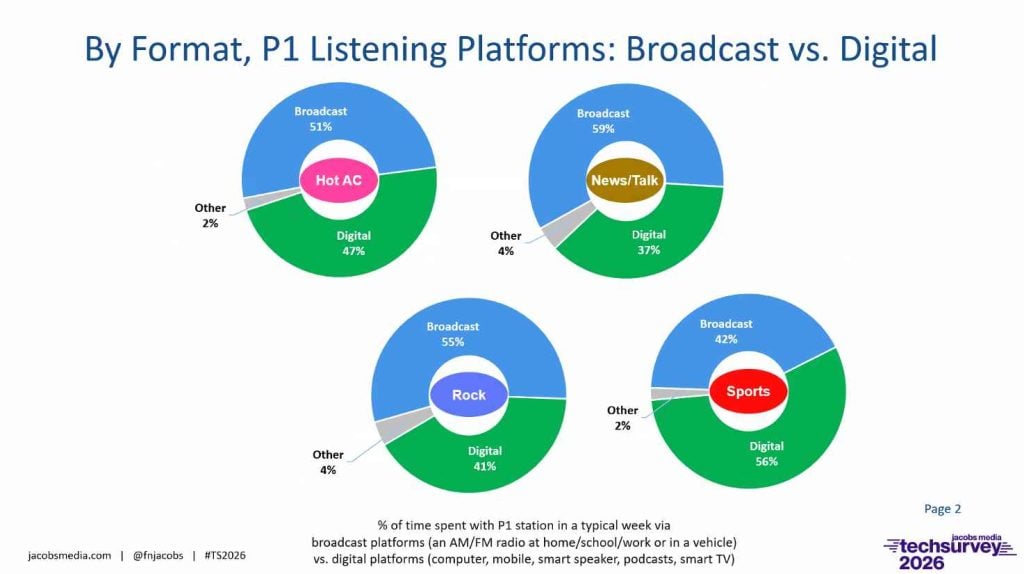
Based on the latest Jacobs Media TechSurvey, sports radio is now consumed more on digital platforms than broadcast. In a state driven by tech, it’s fair to ask whether audiences have already shifted away from FM signals.
#2 – Is there opportunity to cut through?
The market is already controlled by two established brands. ESPN LA (710 AM) has more than two decades of history, strong talent, and multiple franchise partnerships. It has been the home of the Los Angeles Lakers since 2009. The station also partners with the Rams, Angels, Kings, LAFC, and USC Athletics.
It’s also a digital powerhouse, with strong engagement across social and streaming platforms. Operated by Good Karma Brands, the station no longer relies on Nielsen ratings but still presents a compelling story for advertisers.
iHeartMedia’s AM 570, while offering less local programming, has a major advantage. It is co-owned by the Los Angeles Dodgers, the market’s most successful franchise in recent years. The station also holds rights to the Clippers and Chargers, with some Chargers broadcasts airing on sister station KFI. In addition, AM 570 carries Westwood One NFL and college play-by-play.
So where does that leave Audacy?
The most logical move would be securing FM rights to the Los Angeles Rams from sister station 93.1 Jack FM. Launching an FM sports station without premium play-by-play rights would be a major gamble. Those rights drive audience growth and brand identity in ways talent or frequency alone cannot.
Then there’s the lineup, which remains unclear. In Los Angeles, familiarity matters. The market responds to recognizable voices. Several talents with deep ties to the city remain viable options, including Keyshawn Johnson, Max Kellerman, and Marcellus Wiley.
I would also expect Jim Rome to be considered for a return as part of the Westwood One Sports lineup. His absence from the LA market has been noticeable, and his return would make an immediate impact.
As the station launches, it needs a splash talent(s) to get immediate buzz about the brand. FM alone just simply won’t do it.
#3 – How committed is Audacy to FM sports in LA?
In Los Angeles, you can’t afford to miss. Audacy likely weighed the impact of removing KNX from 97.1 FM. KNX performed well on FM and ranked as a top news outlet in recent Nielsen data. It’s also one of the top billing stations in the country.
So the question becomes whether the upside of an all-sports format outweighs the risk of weakening a proven brand. KNX will remain on an HD2 channel, but that platform cannot match the reach or impact of a full FM signal.
This is not true. @knxnews will remain on 1070 AM, streaming 24/7 on the Audacy and iHeart apps, and many other platforms. https://t.co/7V1LXDnx7i
Recent history supports that point. Audacy has already moved several sports brands from HD2 channels to full FM signals to increase impact.
Meanwhile, AM radio continues to decline. Automakers are pushing to remove it from vehicles. Congress continues efforts to preserve it, but usage trends remain low, especially among younger audiences. KNX, a consistent performer, could take a hit if this bet doesn’t pay off.
Overall, I’m curious where things will stand a year from now. Or if Audacy will give it a year in a ecosystem of instant results. Also, is FM is a game changer in LA, could it push competitors like iHeartMedia and Good Karma Brands to follow?
Can 97.1 The Fan break into the digital and social space dominated by ESPN LA and AM 570? Any startup on the digital front has a tall task ahead with giants driving the social engagement online.
Can a live and local format thrive in a city driven by transplants and tech? As much as an FM signal may be sexy in some midwest and northeast locations, out west could be different.
In many ways, this move feels less like a safe rollout and more like a very calculated swing. Audacy isn’t just launching another station. It’s testing whether FM can finally unlock a market that has resisted the format at scale like other large markets.
Los Angeles has always played by different rules. Star power matters. Access matters. And increasingly, convenience matters most. If 97.1 The Fan succeeds, it won’t be because it’s on FM. It will be because it offers something the others don’t. With the management team in place, I fully expect that’s the goal. Be different in a town full of differences.
Because here’s the reality. Being on FM might get you in the game, but it won’t win it for you. If Audacy breaks through in Los Angeles, it validates the company’s aggressive FM strategy nationwide.
If it doesn’t, it raises serious questions about whether signal strength still matters in a market driven by choice and technology.
Either way, 97.1 The Fan isn’t just a new station. It’s a referendum on where sports radio goes next.
Barrett Media produces daily content on the music, news, and sports media industries. Sign up for our newsletters to stay updated and get the latest information right in your inbox.
You never knew what you had till it’s gone. For Evan Roberts, a return to middays on WFAN has been a welcome homecoming. From 2007 till 2020, Roberts called the daypart on the New York City sports talk radio station home. Joined by former WFAN talent Joe Benigno, the duo crafted a style that built a connection that resonated for years following Benigno’s retirement in 2020.
Since then, Roberts has spent the past five years in afternoons, first pairing with Craig Carton and now with former New York Giants running back Tiki Barber. This January, Roberts returned to the midday time slot alongside Barber as WFAN shuffled its lineup again following Carton’s second return to the station.
“I forgot how awesome middays were,” says Roberts. “When I moved to afternoons, from a lifestyle perspective it was a major change. Honestly, I never loved the daypart.”
Roberts admits he is constantly thinking about content for his program. However, the approach differs in afternoons compared to his current role in middays. Instead of spending the entire morning preparing for a show that began at 2pm, the 10am start time provides more flexibility in both content preparation and personal life.
It’s also a different content approach, as audiences are still gathering to begin their day in the city that never sleeps. The show balances reaction with advancing storylines for a rabid New York sports audience. Now, four months into his return, Roberts notes a renewed sense of connection with devoted WFAN listeners.
“I got a lot of welcome back messages,” said Roberts. “There are still a lot of people that are in the car at a certain time. It’s like I’m going back to an audience I haven’t talked to in a while. Most don’t change their listening habits. It’s been a lot of ‘where you been.’”
Navigating WFAN Change
Roberts’ return to middays came at the conclusion of a station lineup shuffle this past January. WFAN decided to move on from Brandon Tierney and Sal Licata after just under three years in the timeslot. Station management allowed both Tierney and Licata to finish out their program, which is a rare occurrence in today’s media landscape.
Even though Tierney and Licata’s departure was handled professionally, Roberts says the audience reaction remained consistent. He notes there was little negative pushback to his return, adding that listeners understood the nature of the decision.
“Management was very open about [Carton’s potential return]. It wasn’t much of a surprise that Carton was coming back,” said Roberts. “It’s not my decision, it’s management’s decision. Luckily, I trust the people I work for. They know what is best. No matter what they decided, I always thought that I’d be cool.”
Roberts also noted he was never overly concerned, given that station management was upfront about the options being considered for Carton’s return. During that time, Roberts says he and Carton stayed in touch, though neither had a clear understanding of what would ultimately happen.
“We spoke, but it wasn’t as if everybody knew it was a secret however many months ago. It was just, ‘yeah, it’s possible,’” said Roberts. “He told me it was on the table. That’s basically what was expressed during that time. Nothing came as a surprise, but also nothing was one hundred percent definitely going to happen. In this business, anything can happen at the last second.”
A Position Of Strength
Since July of 2023, Roberts and Barber have provided WFAN listeners with a balance of the fan perspective and that of a former athlete. It’s a mix Roberts believes plays a significant role in the show’s success. He credits Barber’s unique ability to anticipate what fans want to know and pivot topics accordingly.
“Joe [Beningo] is great, so is Craig [Carton]. They’re both great in their own unique ways. But Tiki is a guy that played at the highest level,” said Roberts. “He’s really on top of it, and not just football. It’s a perspective that guys just don’t have. I find myself every day asking him for that perspective, which not many do, and he’s so amazing with explaining it.”
Those differing perspectives lead Roberts to believe the current WFAN lineup is not only strong, but possibly as strong as it has ever been.
“Much respect to Boomer [Esiason] and Gio [Gregg Giannotti], who have been together for awhile. Boomer has spent more time with WFAN than Don Imus. Then, Craig [Carton] overall has been around for a while through multiple phases,” explained Roberts. “I’m the same way being here since 2007. As many changes there’s been, there’s been stability of the three of us being in different dayparts for a very long time… Those pillars with some new have made the lineup pretty strong if you ask me.”
That consistency holds value, and WFAN’s success continues to rely on it as the station moves further into the digital era. However, with a brand as prominent as WFAN, change often brings detractors who resist it—even some who once called the station home.
Earlier this year, Roberts’ former teammate Joe Beningo made headlines after criticizing the station, saying it will “never be what it once was.” To his credit, Roberts defends his former partner, suggesting the comments were not aimed at the current product but rather reflected nostalgia for a past era.
“I didn’t take his [Beningo] comments as ‘this sucks.’ He’s like everyone else. You long for what you grew up with,” explained Roberts. “Everyone has their perspective, and I talked to him about it. I don’t think he was critical… Keep in mind [Mike] Francesa never talks about the radio station. He’s like the President who leaves office, and I respect that. Anytime you have a former host say anything, it could be perceived as critical.”
A Look To The Future
Roberts says he’s extremely happy to have another opportunity in a timeslot whose benefits he had forgotten. He still arrives at the station by 7am to beat the daily commute, while enjoying evenings with family and watching games. In addition, Roberts continues to expand his content portfolio by hosting the popular New York Mets podcast Rico Brogna.
While WFAN has undergone significant change during Roberts’ tenure, change remains constant. This year, Esiason passed Don Imus as the longest-tenured morning show host in station history. In recent years, Esiason has also scaled back his work with CBS Sports and Westwood One to focus solely on WFAN’s morning show.
Now, at 65 years old, Esiason told Barrett Media he hopes to host mornings until “at least 68 years old.” That naturally raises the question: when that time arrives, would Roberts have interest in moving to mornings?
“I probably shouldn’t say this, because you have to leave all your options open. I trust my bosses. They pay me money, and if they say they want me here, I will listen to them as I’ve done before,” explained Roberts. “There is nothing less appealing to me, personally, than working at 6am… There are plenty of great options once Boomer [Esiason] decides to retire. I certainly hope not to be one of them.”
As unappealing as morning drive may be to him, remaining a guiding voice for the New York sports fan is the dream Evan Roberts continues to live.
For Roberts, middays aren’t just a schedule shift. They’re a reset, a reconnection, and, most importantly, a reaffirmation that authenticity still cuts through. The calls, the habits, the familiar rhythms—they didn’t disappear. They were simply waiting for him to return.
Because you never knew what you had till it’s gone.
Barrett Media produces daily content on the music, news, and sports media industries. Sign up for our newsletters to stay updated and get the latest information right in your inbox.
News/talk radio has a Donald Trump problem — and it’s not the one most programmers think it is.
Across the format, many stations and hosts have narrowed their programming focus to a single subject, riding the national political wave as if it’s a sustainable strategy.
It isn’t.
Here’s the irony that nobody in the industry wants to acknowledge. Many news/talk hosts will tell you, with a straight face, that someone like Jimmy Kimmel is bad for late-night television because his liberal politics alienate half the audience.
They’ll say he’s too one-sided, too partisan, too focused on a narrow worldview that doesn’t speak to a broad audience. Then they’ll turn around and talk for three or four hours about Donald Trump. Without a hint of self-awareness that they’re doing the exact same thing from the other direction.
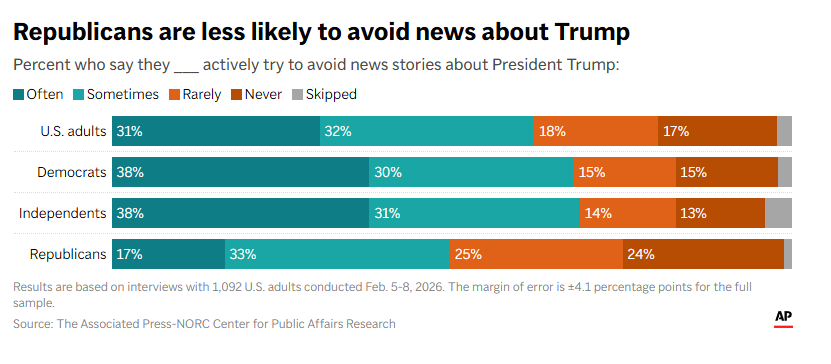
The audience isn’t waiting around for someone to notice. According to a Media Insight Project survey, 63% of U.S. adults say they either often or sometimes actively avoid news stories about Trump. That number climbs to 68% among Democrats. But here’s what should alarm news/talk radio hosts, programmers, and producers most: 69% of independents say they work to avoid Trump stories. Even 40% of self-identified Republicans report the same behavior!
(Photo: Associated Press)
That isn’t subtle data. A significant portion of the country is actively tuning out the content that dominates news/talk radio right now. It doesn’t matter about party lines, either.
There’s another fallacy baked into the format’s current approach, and it’s worth naming directly. The industry tends to operate as if politics is a clean 50/50 split — half conservative, half liberal, always engaged. That’s not the country we actually live in. A more honest breakdown looks something like 30% Republican, 30% Democrat, 20% independent, and roughly 20% who probably should be in the loony bin.
By programming exclusively to conservative politics and building around Donald Trump, stations are voluntarily surrendering half the available audience. Listeners are like money — you can never have enough of them. Giving half away for ideological purity is a strange business model.
And here’s what makes it stranger still: there’s a whole wide world of content sitting untouched. Sports. Business. Crime. Health. Technology. Local government decisions that actually affect what people pay for groceries or how long it takes to get to work. Human interest stories with genuine emotional resonance. Entertainment and culture. The format that built its identity on being indispensable to a community has largely abandoned that mission in favor of chasing the same national outrage cycle that cable news, political podcasts, and social media are already flooding.
News/talk radio still has something those platforms can’t replicate — a local voice, a live presence, and an immediacy that no podcast can match. But that advantage disappears fast when the local station sounds like a syndicated feed from Washington D.C. Hosts who’ve spent years telling audiences they’re different from the coastal media elite have quietly become a mirror image of it. They’re just pointed in a different direction.
Broadening the content horizon isn’t a liberal idea or a conservative one. It’s a business idea. “Republicans buy sneakers, too”, right? Same thing with talk radio. Stations that find ways to serve the Democrat, the Republican, the independent, and the disengaged — without making every segment a political litmus test — are stations that build habitual listeners rather than occasional ones. Habitual listeners become ratings. Ratings become revenue.
The format’s got the talent, the infrastructure, and the trust to do this well. What it needs is the willingness to look up from the Donald Trump news cycle long enough to see how much audience is sitting there, waiting to be served. Broaden the horizons. See what happens. The data already knows the answer.
Barrett Media produces daily content on the music, news, and sports media industries. Sign up for our newsletters to stay updated and get the latest information right in your inbox.
Harlan Howard famously said that country music is simply “three chords and the truth.” It’s the foundational rule of the genre. The audience doesn’t just listen to the music. They love the stories, and that’s what Country Music does best: Storytelling. But what about the people playing the songs on Country Radio?
We have a massive opportunity in front of us. Why? Because the bar for authenticity, storytelling, and audience engagement has been set remarkably low. That bar might be low because talent is overworked, spread too thin, or operating under a culture of fear that prevents them from taking risks.
If we want to be the absolute envy of the media landscape, we just need to tell the truth in three specific areas.
1. The Truth About Being “Local”
Let’s say the quiet part out loud: voice tracking is here to stay, and honestly, it’s a fantastic tool when used correctly. That’s why the “Live” isn’t part of the “Live and Local” mantra we used to hear about. Voice tracking is the absolute next best thing to being live. The problem isn’t the technology. The problem is in execution.
We’ve somehow convinced ourselves that having a sweeper that says, “Your Hometown Country Radio Station,” or reading a generic weather forecast, instead of telling people how that forecast might impact them locally — is the same thing as being local. It’s not.
But here is the fun part: beating that is easy. Even if you are tracking a show, you can still entertain and engage. Do the unglamorous prep. Know why traffic is backed up on Main Street. When we treat a tracked show with the exact same respect and local flavor as a live one, the audience wins. The competition looks like a terrestrial jukebox because the big conglomerates simply won’t do the work.
2. The Truth About “Serving the Community”
Ah, yes. The mandatory public affairs show we bury at 5:00 AM on a Sunday. We check the FCC box and pat ourselves on the back for a job well done.
But real community service? That’s where the magic — and the revenue — actually lives. Years ago, at KSON in San Diego, we discovered that a couple of PPM meters were sitting in a remote zip code. Instead of just shrugging it off, we did some digging and found out that that community hosted an annual “Firehouse Breakfast.” It was one of the biggest fundraisers they had ever held.
We didn’t just read a promo for it. We sent the entire station and showed up with country pride. The entire town came out to eat pancakes with us. Did those two meters make a difference for our ratings? That’s not really the point, but yeah, it did. That is what serving the country radio listener looks like. It’s tactical, it’s fun, and it actually moves the needle. I see it every day. The audience still cares and responds to that.
Will a pancake breakfast change your fate? It’s a damn good place to start.
3. The Truth About “Entertainment”
Entertainment creates an emotional reaction. It makes the listener laugh out loud in traffic. Or even sit in their driveway for an extra three minutes. Because they have to hear how the story ends.
If our talent is just executing mechanics or reading liner cards, we’re creating more reasons to move on to something more compelling.
When we inject actual, unscripted humanity into the mic, we are undefeated.
The Playbook for Winning
You hold the keys to this engine right now. Here is how you put it in drive:
Show Design: Have a fun, honest conversation with your talent — live and tracked. Find one way to make tomorrow’s show 5–10% more compelling than today’s. Find ways to entertain, engage, and be part of their lives. Involving actual listeners in your show, even if it is voice tracked, is a place to start. “But how do I answer the phone, Kevin? I’m not there!” Voicemail, app talkbacks, friends — use the tools.
Find Your Pancakes: Look at your market map. Where is the audience hiding? Find the micro-local events that matter to the fabric of your community and show up. When you go to major events, do something that actually gets noticed. We built a human slot machine for one of our stations — what’s your version?
The “ALL” Factor: Great local execution takes the entire building. Bring everyone into the process early. When programming’s creativity aligns with sales’ relationships to build campaigns that thrill both the client and the listener, it creates the ultimate win-win. When the entire team is invested, everybody scores.
Audit Your Arsenal: You have more resources at your disposal than you think. Hint: social media is one. Stop using it as a billboard and use it to amplify your efforts on the air or on the street.
The War Room: Set time aside to bring a few brains into the room to tackle challenges and create fun ways to engage. I feel I can stick my neck out on this one and say no radio station is doing this enough.
Country radio listeners are craving genuine connection. Make one and you’ll see it too!
Let’s give them three chords and lots of actual truth. Because if we don’t engage, the audience is going to file for the Big D — and trust me, I don’t mean Dallas.
Barrett Media produces daily content on the music, news, and sports media industries. Sign up for our newsletters to stay updated and get the latest information right in your inbox.
NBC’s relaunch of the NBA this season has featured both smooth waters and choppy waves as the network reacclimates to pro basketball with familiar faces and new talent. The regular season gave NBC Sports time to work through kinks. Now, the playoffs have arrived, and just like the players, NBC must elevate its production.
One member of the broadcast team doing just that is play-by-play announcer Noah Eagle.
With a strong on-air presence, a commanding voice, and a keen sense of playoff intensity, Eagle has been a bright spot in first-round coverage.
All NBA playoff games matter, but potential series-clinchers bring added tension. This past Monday, the Minnesota Timberwolves looked to close out the Denver Nuggets in Denver.
Setting the stage, Eagle captured the moment perfectly. Denver won the NBA title just three years ago and now faced another disappointing postseason exit. The Wolves, without Anthony Edwards and Donte DiVincenzo, smelled opportunity in the Mile High City.
Eagle worked alongside color analyst Grant Hill, who brings experience as a player, broadcaster, and executive. Reporter Ashley ShahAhmadi joined them and has emerged this season with smart questions and strong sideline reporting.
The NBA on NBC features the iconic John Tesh-composed theme that defined the 1990s, but the relaunch leans on fresh on-air talent. Eagle embodies that balance. He blends a modern voice with a classic style. His delivery feels authentic, not forced. Eagle emphasized the stakes early. Nikola Jokić and the Nuggets, one of the league’s elite teams, faced elimination against a Minnesota squad missing its best player. That was the story.
Jokić set the tone early, scoring key buckets to give Denver a 10-point first-quarter lead.
Meeting The Moment
The Denver crowd engaged immediately, while players dove for loose balls. NBC’s production team captured the intensity with tight shots of players, coaches, and fans. The broadcast carried a palpable sense of urgency. Eagle thrived in that environment and transitioned seamlessly from NFL and college football play-by-play.
He has made the NBA his space, much like predecessors Brent Musburger, Bob Costas, and Dick Stockton.
This series has resembled UFC and WWE at times, with multiple melees and physical play. It evokes 1990s playoff basketball. When rugged teams like Boston, Philadelphia, Detroit, Indiana, and New York played. NBC aired many of those games, making this matchup a fitting showcase for its NBA return.
NBC’s bottom-screen scoreboard graphic stands out as the best in the business. It shows the score, time, and key individual and team stats. Most importantly, it periodically identifies the broadcast team. Viewers often tune in mid-game and wonder who is calling the action. While fans can search online, these identifiers offer a seamless solution.
The graphics also reduce the need for Eagle to repeat stats, allowing him to focus on the action. NBC enhances coverage further with cutaways narrated by studio host Maria Taylor and a constant top-right scoreboard, similar to NCAA Tournament broadcasts.
This is television, not radio, and NBC maximizes the visual medium.
Hill excelled in breaking down the two-man game between Jokić and Jamal Murray. Both players scored 10 points and dished out multiple assists early. As the first half ended, Jokić hit a deep three. Eagle captured the moment as Denver took a nine-point lead into halftime.
Setting The Stage
The game moved quickly, limiting opportunities for sideline reports. Still, ShahAhmadi delivered a strong interview with Denver’s Spencer Jones at the end of the second quarter. She asked what allowed Denver to set the tone and noted Minnesota’s 14 first-half turnovers. Like Eagle and Hill, she has elevated her performance in the postseason.
These quick interviews challenge any reporter, but ShahAhmadi remains composed and effective.
In the second half, Denver built on its momentum and extended its lead to 15 points midway through the third quarter. The Nuggets controlled the pace. Edwards’ absence clearly impacted Minnesota’s offense.
The physical play continued, with frequent collisions. Eagle, Hill, and ShahAhmadi matched the game’s rising intensity. Hill’s greatest strength appears on replays, where he clearly explains key technical elements in limited time. He highlights both the ball handler and off-ball movement, offering deeper insight into each possession.
Denver closed the third quarter on a 12–3 run, pushing its lead to 25. Rudy Gobert ended the run with his first points of the night, a detail Eagle highlighted effectively. The fourth quarter turned into a blowout, but Eagle and Hill maintained engagement with sharp analysis and relevant stats. Denver secured a 125–113 victory.
NBA playoff basketball operates at a higher level than the regular season. Broadcasts should match that intensity. This game showed how far NBC has come in its NBA return. In one of its biggest broadcasts of the season, the network’s talent and production team elevated their performance and delivered a compelling postseason presentation.
Barrett Media produces daily content on the music, news, and sports media industries. Sign up for our newsletters to stay updated and get the latest information right in your inbox.
The Radio Hall of Fame voting is on. There are a number of long-time radio pros on the ballot. And one person who, when you Google him, says American Football player. No way — Boomer Esiason is a radio guy.
I ask you to read on, as I share my personal experiences as well as give you parts of his resume you may not know.
When I joined CBS Radio in 2010 as VP of AC Programming and day-to-day Program Director of 102.7 in New York, The Daily News did a very nice feature story on me.
When they asked if I had planned any changes at 102.7, my reply was this: “I haven’t really listened, as I spend my time with my favorite show, Boomer and Carton on the FAN.” It was true. I felt the most entertaining radio show in New York in 2010 for a guy was Boomer and Carton, and did really listen whenever I was in the market.
My first morning in the building, Boomer and Carton spent time talking up intros on Elton John songs, as the newspaper article was some sort of signal that was the future. It was hysterically funny. After their show, they insisted on meeting me.
Boomer, who I’d only ever seen on TV or from a bad stadium seat, could not have been nicer — even telling me that if I ever needed anything from CBS, he would talk to (then CEO) Les Moonves for me. I assured him Mr. Moonves would have no idea who I was, but thanked him anyway. Who but a real radio guy would do that?
I worked in that building, on a different floor, for another 15 years. Whenever Karen Carson needed a sports angle on her WNEW morning show, Boomer was there. One year, leading up to the Super Bowl — when a sports station would be busiest — Boomer participated in a cast bet on Karen’s show. The end result would be Intern Anthony as loser getting his head shaved. Boomer was right there for the pictures and every day leading up to the game. Who but a real radio guy would do that?
Boomer’s generosity and help for other shows in the building was always on display. When Karen did her first toy drive on WNEW, she asked to go on with Boomer and Gio in the morning. Not only did Boomer promote the toy drive to his listeners, he personally donated $1,000 worth of toys to the goal. Who but a real radio guy would do that?
Boomer Esiason did night color commentary on national football games for Westwood One for many years — you know, the games where you miss the second half because you need to be at work early the next morning. Boomer not only did those night games but was on his show the next morning at 6 AM. Who but a real radio guy would do that?
It was the same when he did CBS Television Sports. During the NFL playoff season, the man worked on TV on Saturday and Sunday. Did he blow off his radio show on Friday or Monday to do that? No way. I know morning shows that tell me they have a hard time working five days a week. Boomer was working all seven. Who but a real radio guy would do that?
Oh, and how about this — Boomer did color commentary on the radio for 18 Super Bowls on Westwood One. Boomer may have started as a football player, but he has the same passion for radio that you and I have, maybe more.
One more thing. In the latest March PPM, Boomer and Gio are #1 with men 25-54, their target audience, in morning drive in New York. Yes, #1 in the #1 market.
Boomer Esiason never paid his radio dues by doing an overnight show in Akron. He was thrown into the deepest water and told to swim. Not only did he stay afloat, he rose to the top of his profession. Boomer Esiason is a very talented radio guy who belongs in the Radio Hall of Fame.
Barrett Media produces daily content on the music, news, and sports media industries. Sign up for our newsletters to stay updated and get the latest information right in your inbox.
Running a radio station, hosting a nationally syndicated show, and anchoring a nightly television program would overwhelm most media professionals. Todd Starnes isn’t most media professionals.
The Memphis-based broadcaster juggles ownership of The Mighty 990 KWAM, a daily hour on Newsmax, and The Todd Starnes Show — all without losing a step.
The question everyone wants answered is simple: how does he pull it off?
The honest answer starts with learning to let go.
“That’s been a big challenge for me because I like to try to do everything, and I can’t,” said Starnes. “One of the first things I had to address was micromanaging. I had to learn that you hire people because they’re experts, so let them do their jobs and get out of the way. That was difficult, but I’ve reached the point where I can do that. What’s fascinating is that we keep growing.”
Growth has been a constant theme at KWAM since Starnes acquired the station six years ago. He arrived with a vision centered on community — and a digital strategy that turned out to be ahead of its time.
“When I bought KWAM six years ago, it was important to have a radio station focused on the community,” Starnes said. “I think we still do that, especially with our digital platforms, which are among the largest in the city and the Mid-South. When you look at engagement on our Facebook and Twitter pages, that’s where people continue the conversations. We realized that right away.”
That digital instinct has paid off. KWAM now counts more than 42,000 social media followers — a number that didn’t exist when Starnes first took over. He also launched the Stop Memphis Crime group, which has grown to roughly 17,000 members and helped bring real-world attention to public safety concerns in the region. Still, it’s the radio side that remains close to his heart, and KWAM’s local identity sets it apart from corporate competitors.
“One of the great things about us is that we are locally owned,” the KWAM owner stated. “I am the owner, so when a business owner has a question about an advertisement or needs a special deal, they come directly to me. We don’t have to call New York City or Nashville. That’s important for us. We’ve had great success. One of the biggest things we’ve seen is an explosion in advertising.”
That local advantage has proven durable even when larger groups have tried to move in. Starnes didn’t shy away from acknowledging the competition — or his confidence in KWAM’s staying power.
“The big corporate groups have come after us, which surprised me,” he said. “I think they see us as a threat. In one case, a station tried to undercut our advertising sales. But we haven’t lost a single sponsor. That’s because we believe in loyalty and taking care of our local customers.”
Managing all of it — the station, the social platforms, the national syndication, and the television work — eventually forced Starnes to make a tough personal call. He stepped away from hosting the morning show at KWAM, a decision driven not by choice but by necessity.
“It’s a lot to manage. That’s one of the reasons I had to give up the morning show,” The Todd Starnes Show host shared. “I was doing three hours of radio, managing the local station, overseeing a large digital platform, and hosting a one-hour national Newsmax TV show every weekday. There’s a lot going on. But we have an incredible team of about 14 people who work very hard.”
Despite the demanding schedule, Starnes keeps the tone of his work grounded in something he clearly believes matters most — fun. The Todd Starnes Show leans into the unexpected, and he thinks that unpredictability is part of the magic.
“There’s great synergy between the two shows. On the national show, we try to add humor and offbeat content,” commented Starnes. “One minute we’re talking about the White House Correspondents’ Association, the next minute we’re talking about meatball recipes. It sounds like it wouldn’t work, but it does. We had full phone lines with people calling in about the proper way to make a meatball. Someone was listening from the Memphis Italian Festival, and I was made an honorary judge of the gravy contest. That’s what radio should be about — fun, community, and entertainment.”
That spirit of community extends to KWAM’s local programming as well. Starnes takes obvious pride in the touches that make the station feel distinctly Memphis, from the weekend lineup to a signature sound at the top of every hour.
“When you listen to KWAM, at the top of the hour we play a steamboat whistle as an homage to our roots as a Mississippi River town,” said Starnes. “We have a lot of local programming on the weekends. Our garden show is one of the most popular programs aside from the national shows. It has three hosts, and the calls light up at 6 a.m. on Saturdays. Those are the kinds of things we do.”
KWAM has also served as a training ground, launching careers across journalism, politics, and public relations. Starnes stays connected with former team members — and watches their success with something resembling a proud mentor’s satisfaction.
“It’s been incredibly rewarding,” the KWAM owner stated. “One of the great things is staying in touch with everyone. Grace Baker is now a publicist for a book house. Now she’s pitching guests for not only KWAM but the Todd Starnes national show. It’s been fun to see everyone jump out of the nest and become successful in their new careers.”
Six years in, Starnes isn’t slowing down. He’s built something rare in today’s radio landscape — a locally owned station with national reach, a loyal advertiser base, and a growing digital footprint. And somehow, it still doesn’t feel like work.
“We try to convey that KWAM is a big front porch where people can come and be part of the conversation,” Starnes said. “It’s been tough, but I’ve owned the station for six years now, and it doesn’t feel that long.”
Barrett Media produces daily content on the music, news, and sports media industries. Sign up for our newsletters to stay updated and get the latest information right in your inbox.