


Everyone deals with change differently, and many are never truly prepared for it. In sports radio, the only constant is that change will occur at some point during a talent’s career. Last year, that change arrived at Columbus’ 97.1 The Fan, where the station set a new direction focused on the future of its content. Jonathan “T-Bone” Smith was part of that shift—one he ultimately felt was right for the moment.
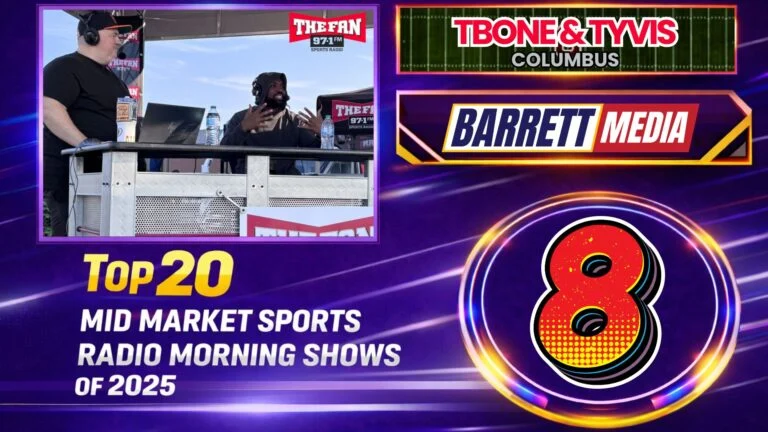
Following a 12-year run co-hosting afternoon drive with Mike “Common Man” Ricordati, Smith embarked on a journey he never planned. He was named the new lead host of T-Bone & Tyvis, taking over morning drive. Less than a year after the transition, the program was recognized as one of the best in Barrett Media’s latest mid-market morning show rankings.
“I was encouraged, because I know that’s something that just doesn’t happen,” said Smith, whose program finished 8th in the latest Barrett Media mid-market morning show rankings. “It’s not a guarantee when you start a new program that people are going to click in and enjoy it.”
National recognition is nothing new for Smith. During his 12 years alongside Ricordati, their show earned multiple nods as one of the top afternoon programs in the country. As both a ratings and revenue driver in Columbus, Smith felt the show had accomplished everything it could for the station.
Change in the Air
Then, in early 2025, the opportunity for change surfaced for a second time. Smith said station management had previously inquired the idea of moving one of the hosts to a different daypart in years prior, but both he and Ricordati declined.
“It had been floated to us before. There was a chance to move one of us to a different daypart, and growing my role with the station,” explained Smith. “I don’t think Mike [Ricordati] had any desire to leave afternoons, and I don’t blame him for that at all. It was well before last year, but we talked about it. Mike always told me he didn’t want to hold me back from opportunity. But who wants to leave the good situation we had going.”
Following the first pass at potential changes to the program, the opportunity came about again in early 2025. Smith approached the concept differently a second time. While he had been content in afternoons, the second opportunity carried more weight.
“The other thought I had was they have already asked once before. I don’t know how many more times they’re going to ask,” said Smith. “At some point, it seemed very privileged to turn down being the one chair. Especially in mornings on a sports radio station I grew up listening to. I didn’t know how many more chances I would get to turn it down before they would move on and say never mind.”
Adapting to All Things New
T-Bone & Tyvis debuted in morning drive in May 2025 and quickly made an impact. The fall 2025 ratings book showed the program leading Adults 18-34 with a 10.2 share and Men 25-54 with a 17.4 share. It also finished first among Adults 25+ and Men 25+, with particularly strong margins.
The show’s success is rooted in its simple motto: football, food, and fun. Co-host Tyvis Powell, a former Ohio State player, kept that former Buckeye player connection to the audience. However, the move to mornings marked his first full-time daily role with the station, which presented some early challenges—ones Smith anticipated.
“There were a lot of things that I expected to be challenging. Obviously, working with a co-host that I hadn’t worked with previously for more than a couple of fill in shifts was one of them,” explained Smith. “I thought I would have to coach Tyvis a little, but it’s been pleasantly surprising. I think a lot of former athletes look at radio as a diversion. Something to do just because it’s there. Tyvis really views this as what he does now.”
Smith credits Powell’s eagerness to learn and adapt, noting that his co-host has pushed him to be sharper in their sports discussions. That shared competitive mindset has helped elevate both hosts and refine their approach to daily content.
Creating Two Morning Lanes
When 97.1 The Fan unveiled its lineup changes, it also introduced a new digital strategy featuring former morning host Bobby Carpenter. The station launched a YouTube-based version of Morning Juice. It was co-hosted by Carpenter and Jeff “Tito” Thitoff, airing simultaneously with T-Bone & Tyvis.
At the time, Carpenter openly questioned the move, framing it as something “they” wanted despite the show’s ratings success. Smith, however, viewed the situation differently. From his perspective, both programs could coexist and grow without conflict.
“There are people who watch on YouTube, but there are also a large number of people who have to drive to work. If I thought Columbus was a small town that only had a certain number of ears to fight for, I’d be more worried about that,” said Smith. “I don’t think we’re necessarily competing for the same audience.”
Smith believes the two shows offer distinct styles, reducing any overlap for listeners who move between them. He also emphasized that there is no tension between the programs.
“We’ll do the show that we do. Bobby and ‘Tito’ have their own way of talking sports that’s different than what we do,” said Smith. “We have a big enough connection to our audience in Columbus. There’s enough audience for both where it’s not taking away from one or the other. Where both can co-exist and grow.”
Content Balance
There is no denying the influence of Ohio State athletics in Columbus. As the flagship station for the Buckeyes, 97.1 The Fan naturally leans into that coverage. However, Smith believes there is a balance to maintain.
“The more someone chases the Ohio State audience, the less they get the general audience,” explained Smith. “People lose sight that Ohio State’s media environment is so saturated in so many different spaces. If you try to compete with all of that by having the same message board level arguments all year, that’s where you fatigue an audience.”
Even with a former Ohio State player as his co-host, Smith avoids building entire shows solely around the Buckeyes.
“We certainly used Ohio State to grab the audience, because who doesn’t like to hear about their favorite team. I think you have to be confident in your own ability to sell your audience on something that is more impactful and interesting,” explained Smith. “We are always looking for things that the vast majority of our audience can relate to at all times.”
The results reflect the approach T-Bone & Tyvis has taken in morning drive. For Smith, however, the success goes beyond ratings and rankings—it serves as validation that embracing change can lead to something even better.
“I view hosting mornings as a big responsibility,” said Smith. “It’s something that I look forward to doing long term… If I’m lucky enough to have another twelve years in a daypart, I’d be more than happy if it were in mornings.”
In a business where nothing stays the same for long, Smith didn’t just adapt to change—he made it work for him.
Barrett Media produces daily content on the music, news, and sports media industries. Sign up for our newsletters to stay updated and get the latest information right in your inbox.


