iHeartMedia has revealed its fourth-quarter financial results, and the company reported a slight overall uptick for the window.
During the quarter, the company saw $1.1 billion in total revenue. That marked a year-over-year increase of 0.8%. When political advertising is excluded, iHeartMedia reported growth of 7.7% compared to 2024’s fourth quarter.
The Digital Audio Group saw its revenue grow by 14%, with podcast revenue increasing 24%. Multiplatform Group revenue was down 3% to $665 million.
For the whole of 2025, iHeartMedia reported revenue of $3.9 billion. That figure is relatively flat compared to 2024, and up 3.6% when political advertising is excluded.
“Our podcast momentum continues, growing 24.5% compared to prior year, above our guidance of ‘up in the mid-teens,’ and we have the number one audience in podcasting as measured by both Podtrac and Triton,” said iHeartMedia Chairman/CEO Bob Pittman. “In 2026, a major goal of ours is to return the Multiplatform Group to segment Adjusted EBITDA growth and we continue to invest in our broadcast programmatic efforts and working with partners like Amazon DSP, Yahoo! DSP and other to include our broadcast radio inventory on their programmatic platforms.
“We also see some of our recent announcements as validation of the power of broadcast radio, with companies like Netflix and TikTok coming to partner with us and our broadcast radio assets,” concluded Pittman.
“We are looking forward to 2026 to be an Adjusted EBITDA and Free Cash Flow growth year for iHeart, driven by our strong podcasting momentum, our growing programmatic revenues and the return of the Multiplatform Group to segment Adjusted EBITDA growth,” added President and COO Rich Bressler.
Barrett Media produces daily content on the music, news, and sports media industries. Sign up for our newsletters to stay updated and get the latest information right in your inbox.
Thank you for checking out ‘The Industry According To’. This series runs each Tuesday, and features radio and record industry executives, managers, programmers, talent, artists, and professionals from all areas of the business world. To be considered as a future guest, email me at keithblackboxgroup@gmail.com.
Today we check in with the hosts of a the very successful syndicated morning show, “TheDave and Mahoney Show.” Alongside Audrey Drake and Producer Chris Jackson, the team has piled up an impressive list of affiliates, mastering the ability to get their content to work across different formats and psychographic groups. In the latest Barrett Media Top 20 of 2025 lists, the show was voted in the Top 5 for both Alternative and Classic Rock. Quite an accomplishment, as voted on by peers.
“The Dave and Mahoney Show” broadcasts live from Phoenix. Their show is heard across the country on Rock, Alternative and Classic Rock brands in Las Vegas, San Diego, Reno, Albuquerque and many more.
So, let’s dive in.
What the Real Secret?
Keith: What’s the real secret to winning in morning radio beyond just talent and smarts?
Dave: Picking the right team and the right content for that team. Being in a room with anyone for 4+ hours a day can be a grind if you’re not creating content with people you like and respect. We are very fortunate to have a talented team of people that genuinely like and care for one another. And then finding the content that will resonate with those key players. It doesn’t have to be the biggest story of the day. It just has to be something that will get a passionate response from one of the cast members.
Mahoney: Us having the combined tallest and pound for pound best pompadour hairstyles out of any radio show in America hasn’t hurt us either.
The Morning Show Model
Keith: The model isn’t broken but it also hasn’t evolved much in decades — 6a-10a, stopsets strategically placed, shows with familiar cast arrangements covering similar topics, benchmarks at specific times, all built around linear listening. If you were hired to reinvent radio’s morning show model, what would you change?
Dave: I think social media has shown us the way. Creating clocks, bits, etc., is still important, but one thing we’ve struggled with as an industry is how we promote it. Not every break is going to be a home run. That’s ok. Are we showcasing the highlights as far and wide as possible?
How many people do we know that say they are fans of Theo Von or Tom Segura’s podcast and have never listened to a single full episode? A lot. Because they see the clips and know they produce funny or relatable content. We need to promote to those listeners that are in the market, to give us that invaluable TSL and occasions, but they need to know where to start their search on the dial by giving them a level of familiarity with the show.
The Belief Radio Still Believes
Keith: What’s the one belief radio — especially morning shows — still believe about itself that isn’t true anymore?
Dave: That having the platform itself is enough. “If I could just get on a winning station or into a major market I would be set” gets said way too much. Radio still has incredible reach, but we don’t win by default of being on anymore. Everyone has a platform, and we have to stick and move with the audience. That’s not just a challenge for morning shows. Seemingly infallible platforms go away or morph overnight – but if we are creating good content and never stop seeking the audience, we will win. Morning shows know how to grind out content nonstop which is what kills off so many potential competitors.
Mahoney: Being a historic winner isn’t good enough. Just because you’ve hit #1 at some point in your career doesn’t mean you can ride that out for another 5 to 10 years. We have to be focused on what comes next and how we can do it again but better.
National vs. Local
Keith: The industry debates local vs. syndication constantly. From your vantage point, what advantages do a syndicated show bring to a station? How do you make content feel local across several markets?
Dave: There is great value in both. Being a syndicated show with a couple of decades of experience means we can offer a product that takes a lot of the guess work out of production. We’ve vetted and tested our content and bits, and know what works with our cast of characters. While highly localized content is great, a lot of daily local news is more doom and gloom than the deeply unserious content that our show thrives off of.
Mahoney: Great chemistry is universal. It doesn’t matter what city you’re in, people just want to laugh and have some fun before the workday starts beating them down.
Audience Trust + Connection
Keith: With more competition than ever for attention, what’s the leader in making a listener repeatedly choose a morning show today — laughter, authenticity, vulnerability, strong opinions, subject matter, or something else?
Dave: We are all complicated human beings that deal with all of the things you listed. All of us on the show come in with an open mind each day about what each member of the show is dealing with. Many days we just dive right into life’s least important issues, which is what listeners expect from us. Other days we are talking about losing a loved one, fertility issues, money problems, or what to do about that little a**hole that is bullying my 7 year old. We have an overall tone for the show of levity, but we are living our lives in real time like everyone else. When those more serious moments call, we lean in.
Mahoney: I walk into the studio every morning trying to make my partners laugh. If we’re genuinely laughing, listeners know it’s real. I think that’s part of what keeps them coming back.
Personality vs. Content
Keith: Both can’t be 10s. Please rate individual personality first, then content subject matter on scales of 1 to 10, with 10 being “very important” and 1 being “not important,” and explain why you gave the ratings.
The personality traits and quirks always lead the way for us. If I told you owning a pet cow was a content choice, you may think that’s pretty dumb…until you hear how passionately Audrey talks about that. Is doing a quarter hour on Arbys a wise choice? Probably not, unless you understand that no living human loves The Meats more than Mahoney.
The dumbest content choices, if they elicit a passionate response from a cast member, can become some of the stickiest.
I’m lucky to work with two of my closest friends who let me be myself. I never feel like I have to hold back how weird I really am. Their trust makes everything easier and it’s why personality will always matter more than subject matter. People connect with people, not topics.
Everything is Political
Keith: Many shows are scared to touch sensitive topics but even having an opinion on the Super Bowl halftime show comes with a perceived political label. How do you handle sensitive topics knowing you broadcast in red and blue states?
Dave: Oh boy do we have some opinions on politics…but we make a conscious decision to avoid overtly political content. It’s because there is so, so, so much of that everywhere else. I would rather be the place that people can come to get a breather from the nonstop barrage of that than think that I need to espouse some wisdom that’s going to change the world. I think there are more and more people that just need a damn break from it all. We want to be that for them.
Mahoney: If I ever decide to get political on our show, it’ll be about the most important issue facing this country… the shocking lack of bidets in both public and private spaces.
Cast Roles
Keith: The “Dick, Dork, Deer” roles model was something countless shows used to be built around and while yours may not precisely follow that model, it’s clear all of you understand the roles within the show. Please explain the importance of role definition and how they relate to your overall success?
Dave: I’m the driver, the instigator, and the “voice of reason” in most cases. Mahoney is the bombastic one that has the hilarious take you never see coming. Audrey will call anyone (especially us) out on their BS in a hot second. But it’s more than that; for example…I’m the one who is supposed to have it all together, but honestly, I’m a hot mess at times too. Mahoney can unexpectedly be the most empathetic and understanding one in the room. Audrey will offer up the most intimate details of her life, despite the tough exterior.
Mahoney: We all take turns being the dick, the dork, and the deer at different times. For us, the show is the real star. We each have our roles but at the end of the day, we’re doing everything we can to make everyone else sound better. When you put the show first that’s when the best moments happen.
Who’s Leading the Huddle?
Keith: Being on multiple stations with several PDs and ownership groups, is anyone coaching the show? Who tells you what’s sticking or not? How do you decide to adjust when something is working in Phoenix but struggling elsewhere?
Dave: We have worked with Mike Stern for many years now. He has been an invaluable resource for the show. Our take on coaching is simple: Even the most experienced players need a good coach and they have to show up to practice. Because every game (or in our case market) needs to have the proper game plan. Our PD at KSLX, David Moore, has been a wonderful sounding board these last few years. So many affiliate PDs know exactly what’s right for their market. It’s our job to put the ball where they want it.
Mahoney: We’ve also been fortunate to work with Steve Renyolds and Mike Peterson over the years. Each of them brought a different perspective and helped us grow as talent and as people. Having coaches who are passionate and honest with you makes a huge difference.
Personal Lives
Keith: Your personal lives are very much woven into the show. How do you decide what’s off limits and what’s interesting enough to spend time with on-air?
Dave: We are all respectful of the other cast members’ choices of what they want to share, but literally nothing is off limits. We’ve talked tragedies, divorce, suicide, foreclosure, miscarriages, and so much more. We also have a motto that “life is content” – meaning that if someone accidentally craps themselves or forgets their sex toy in their luggage before going through TSA, it’s going to have its place on the show.
Mahoney: Nobody likes someone pretending to be perfect. We will always highlight our flaws and failures. The great thing about that is the calls we get letting us know we aren’t alone.
Keith: Has airing personal details ever created unforeseen problems?
Dave: Me talking shit about my mother-in-law coming to crash with us for three weeks at the time hasn’t been a GREAT idea, but I’ll sort that out with Shelly over a bottle of wine.
Mahoney: I’m currently banned from my HOA ZOOM meetings but other than that noreal unforeseen problems.
The Subject That Matters Most
Keith: For young and aspiring shows, if you could waive a magic wand and make one piece of overused subject matter illegal to air, and a second that is a “must master” area, what are they?
Dave: If you don’t have an angle on something, you can probably skip it. Find the things, no matter how trivial, that you really care about. No one is going to care that you are aware the Grammy’s happened last night, everyone is. But if you’re on a GLP-1 or weight loss journey of your own and you have a take on Jelly Roll losing 300 pounds, your listeners are going to remember that.
Mahoney: Nobody likes someone pretending to be perfect. We’re honest about our flaws and failures and the best moments are when listeners call and say, “I thought I was the only one.” That’s when you know the connection is real.
The Best Story Ever
Keith: What’s the one “The Dave and Mahoney Show” story we need to hear? Guest explosion, mayhem, big mistake, wild success?
Dave: One of my personal favorites is the night at our annual holiday concert in Las Vegas many years ago when Mahoney got too drunk, tried to stage drive, accidentally grabbed our bosses ass, got ditched by his girlfriend (who is now his wife), barfed in my car, and had me drop him off at the wrong house…who then called the cops on him and his accomplice (turns out I was “the accomplice in the car”)…and that horsin’ son of a bitch still made it to work at 6a the next day.
Mahoney: About 20 years ago when I was leaving to do my first morning show at 91X, Dave and I got into a faux Muay Thai boxing match on Fremont Street during my going away party. Dave “accidentally” landed a shot that destroyed my gallbladder. He claims those gallstones had always been there and I spent the next five days in the hospital and checked myself out early so I could drive all night to make it on time for my first show there. My bowels have never fully forgiven him.
Dave: I saved him from those deadly gallstones that night. He owes me his life.
To learn more about carrying “Dave and Mahoney”, click here.
Barrett Media produces daily content on the music, news, and sports media industries. Sign up for our newsletters to stay updated and get the latest information right in your inbox.
There’s been plenty of handwringing about what happens if CNN shifts to the political right under new ownership from Paramount Skydance. Some observers have wondered whether Fox News should be worried about a newly aggressive competitor fishing in the same ideological pond.
If you listen to FOX Corp. CEO Lachlan Murdoch, though, that anxiety seems misplaced. Speaking Monday at the Morgan Stanley Technology, Media, and Telecom Conference, he made it clear that Fox News isn’t losing sleep over CNN.
“Under the Ellisons, CNN obviously will be a strong competitor, as we’d expect,” Murdoch said. “But we like competition, and we’ve proven over many years now that we can – running news is hard.”
He’s right. And not just because that’s what a CEO is supposed to say on a conference stage.
For starters, Murdoch isn’t going to publicly belittle CNN. That’s simply not his style. It’s also not how Fox News has positioned itself for three decades. Sure, the hosts may fire rhetorical arrows in primetime. The corporate tone, however, tends to project confidence rather than insecurity.
Taking cheap shots at a rival network during an investor conference would signal fear. Instead, Murdoch projected calm. That’s a message to Wall Street as much as it is to viewers.
Confidence is easier when you’ve got a 30-year head start. Fox News launched in 1996 and essentially created the modern conservative cable news category. CNN was already a legacy brand by then, but it wasn’t built around opinion-driven conservative programming. Fox News entered the arena and then defined it. That foundation matters.
Brand loyalty doesn’t materialize overnight. It’s built over decades of consistent messaging, talent development, and audience cultivation. Fox News has spent a generation refining its voice. Viewers know what they’re getting when they tune in. That consistency creates habit. Habit creates loyalty. Loyalty creates insulation from short-term competitive threats.
Meanwhile, the broader landscape isn’t exactly friendly to cable news. Audiences are leaving traditional television in droves. Cord-cutting continues to chip away at distribution. Just yesterday, DISH Network’s parent company revealed a loss of nearly 170,000 subscribers in just the fourth quarter. In that climate, growth is rare. Yet Fox News has managed to expand both ratings and revenue. That’s not supposed to happen. In many ways, it’s borderline miraculous.
Part of that success comes from focus. Fox News understands its core audience. It programs directly to that base without apology. It’s not chasing every passing trend. It’s not rebranding every election cycle. That steadiness builds trust with viewers who feel underserved elsewhere. Even if CNN were to shift rightward under new leadership, it would still be playing catch-up in that specific lane.
History shows Fox News can withstand turbulence. High-profile departures have rocked the network before. When Tucker Carlson exited in a dramatic split, critics predicted disaster. The same doom-and-gloom surrounded the ousters of Bill O’Reilly and Roger Ailes. Each episode generated headlines, lawsuits, and endless commentary. Each time, the network recalibrated and moved forward. Ratings stabilized. Revenue streams held. The brand endured.
Controversy hasn’t been a stranger to Fox News. Political backlash, advertiser boycotts, and internal upheaval have all tested the operation. Those storms would have capsized a weaker enterprise. Instead, Fox News emerged more streamlined and, in many cases, more focused. That resilience becomes a competitive advantage. It signals to viewers and investors that the institution is bigger than any single personality.
So would a rightward shift at CNN suddenly erode that base? It’s hard to see how. CNN would face its own balancing act. Moving too aggressively risks alienating its existing audience. Moving too cautiously fails to capture new viewers. Repositioning a decades-old global news brand isn’t as simple as flipping a switch. Murdoch’s comment that “running news is hard” wasn’t a throwaway line. It was a reminder that execution matters more than aspiration.
Competition can sharpen even the biggest behemoths. It can force innovation. It can also validate a category’s relevance. If CNN leans right, it arguably affirms the strength of the conservative audience Fox News has cultivated. Rather than panicking, Fox News can lean into what it already does well. That’s a far more comfortable posture than scrambling to reinvent itself.
None of this guarantees perpetual dominance. History is littered with fallen giants (looking at you, Blockbuster, Sears & Roebuck, and Kodak). Complacency is always a risk. Still, Fox News has demonstrated an ability to adapt within its lane. Those moves don’t suggest a company bracing for an existential threat.
Murdoch’s remarks weren’t bluster. Fox News has navigated scandals, talent shakeups, and industry disruption. Running news is hard. It has maintained a fiercely loyal audience through all of it. That’s not easily replicated by a competitor adjusting its ideological dial.
If CNN under the Ellisons becomes more right-leaning, it may well become a stronger competitor. Murdoch acknowledged as much. But I’d doubt it would become a legitimate challenger to Fox News.
Strength in the marketplace isn’t something to fear. It’s something to measure yourself against. And based on the past three decades, Fox News likely believes it measures up just fine.
Barrett Media produces daily content on the music, news, and sports media industries. Sign up for our newsletters to stay updated and get the latest information right in your inbox.
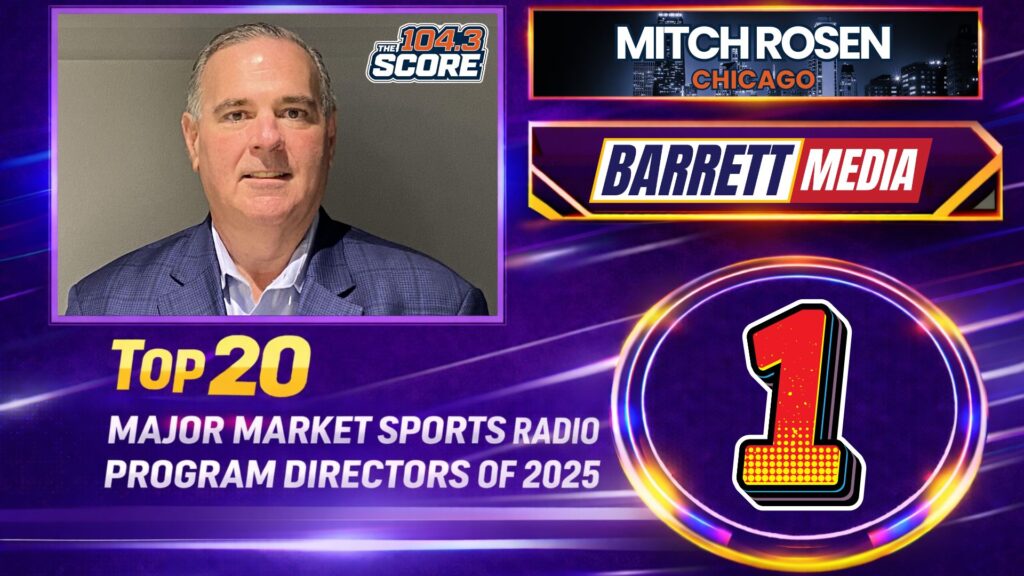
For a decade, Barrett Media has leaned on the industry it covers to help recognize the best among it. It’s a time-honored tradition in which peers submit who they feel best represents what makes sports radio the powerful industry it is. This year was no different, with massive participation in news, sports, and music helping determine the top performers and programmers in each format.
One of those categories is the top 20 program directors in sports radio, divided into major and mid-markets. This year, 104.3 The Score’s Mitch Rosen was recognized as the top sports radio programmer from a major market for the second time in his career. 104.5 The Zone’s Paul Mason earned his first number one ranking among mid-market sports radio programmers.
In speaking with Rosen and Mason, the characteristics that have led to their success mirror one another in many ways. Both oversee successful brands in their respective markets, and both understand that the recognition stems from the collective output of many contributors.
“It’s an honor. But it’s really a team award. This is about everyone I work with in Chicago, and the different brands around the country,” said Rosen. “It sounds very cliche, but it turly is a team. Without the people we work with every day on this iconic brand [104.3 The Score], it doesn’t happen.”
Mason expressed similar sentiments when reflecting on his team’s efforts, though seeing the rankings firsthand came as a surprise.
“I was surprised, but in the best way possible,” said Mason. “It was a really good feeling and reflects not just me. The station also finishing first as well puts a very cool visual on everything that we’ve been working on here for a long time.”
Mason’s brand, 104.5 The Zone, also ranked as the top mid-market sports station in this year’s Barrett Rankings. The Nashville-based brand earned that distinction for the first time after finishing third just a year ago.
Mason began his radio journey at the turn of the century at 1450 WMOH in Hamilton, Ohio, where he planned and executed a Friday night football show along with game broadcasts. His hands-on approach to crafting programming started in those early days and later took him to Cincinnati, West Palm Beach, and now Nashville. He joined 104.5 The Zone in April 2020 during the worldwide COVID-19 pandemic and has since seen the programmer role evolve.
“The growth of the role over the five years [includes] embracing streaming, podcasting, and video. We’re growing on every platform imaginable along with the growth of the FM signal,” said Mason. “The role requires us to be where sports is and consistently doing that day to day.”
As listener consumption habits change, top programmers must remain flexible to ensure content resonates across all platforms. Rosen identified adaptability as a key factor in his development as a brand manager.
“Every year, month, and day things change,” says Rosen. “It’s funny. Five years ago, someone would have said ‘you’re in the radio business.’ Today, it’s content distribution and you have to be flexible. You must go with trying new things with new technology. If you just stay ‘in the radio business’ you’ll get stagnant. I love when someone comes in with an idea. You have to listen, and that’s the most important thing about being a manager.”
Both Rosen and Mason described the humbling experience of being recognized at the top of their industry. That humility reflects a trait many successful executives share within a format built on the creativity of the talent Rosen and Mason hire. Their success is evident in the freedom they give their on-air staff, supported by belief and guidance.
“It’s all about how you treat people. To me, this job is about the people. Caring, teaching, and letting people be creative and do their jobs,” explained Rosen.
Mason echoed Rosen’s sentiments while noting that working with talent requires a tailored approach. It takes time, effort, and an understanding of what works for each individual to get the best results.
“We have a culture where people are trusted to the job they’re hired to do,” said Mason. “Bedside manner is important as well. Getting your staff to know that they can trust you and let them know that you’re going to let them do their job. Being there to listen to them and eliminating obstacles for them is key to help them reach their maximum potential.”
Neither operates alone. Rosen and Mason serve as key representatives not only for their brands but also for their respective companies. Rosen has been a decorated brand manager for Audacy for more than two decades. During his tenure, he has also overseen the BetMGM Network and sports radio operations in the Milwaukee cluster.
Audacy owns and operates several of the country’s largest sports radio brands. That strength appeared in the latest Barrett Media rankings, where seven of the top 10 programmers in major markets represent Audacy.
“It’s no secret. Sports is a big part of Audacy’s business,” noted Rosen. “Live sports and live sports talk is huge. That’s what differentiates us from a lot of other companies… I give our company a lot of credit. They realize that sports is something that will continue to grow that the audience and partners love too. It’s so interactive, and that’s so key to helping Audacy stand out amongst the others.”
For Mason, collaborating with top sports programmers at Cumulus has elevated his approach to brand management. From programming to promotions, digital strategy, sales, and everything in between, Mason believes leadership sets the tone. He points to Bruce Gilbert as a driving force.
“We’re fortunate to have the best in the business in Bruce Gilbert at our company. He’s an incredible resource, supportive, and it starts with him,” said Mason. “It’s nice to lean on our roster of great sports programmers within the company, and vice versa…. It takes the entire village. Everyone has to work together. There can’t be any siloes; it’s one big operation.”
Accolades from peers aside, Rosen and Mason remain focused on setting an example for the next generation of programming leaders. With decades of combined experience, they recognize the challenge of recruiting the next creative mind to advance sports content.
For Rosen, advice for those interested in the role begins with education, market knowledge, and respect for the people within it. Building lasting relationships remains essential.
“If you can combo platter knowledge of the market, getting to know talent, and building relationships, you can be a successful programmer,” explained Rosen. “Our format and the content space we’re in, we’re hungry for ‘the next.’ Who is that next? Everybody’s looking to find out who has those attributes… It seems simple, but those are key.”
Mason emphasizes growth and opportunity. With sports content becoming one of the most valuable properties in media, he encourages a fearless mindset when adapting to new methods of consumption.
“If you’re in the sports radio format, you like sports. Could you imagine growing something that reaches your maximum potential in something you’re passionate about,” questioned Mason. “You can’t be afraid of tech or change. No one will win that battle the way the world is going. How do you live within that, and finding your place there. We have done that very well here, but you need to be open to change while flowing with the current.”
In an industry built on opinion, competition, and constant reinvention, the best programmers understand that success is not built on ego. It is built on trust.
For Rosen and Mason, Barrett Media recognition is appreciated, but it is not the destination. It is a byproduct. A reflection of culture. Of collaboration. Of hiring talented people and giving them the room — and responsibility — to create.
That balance separates good programmers from great ones.
As Rosen and Mason look ahead, neither sounds satisfied. New platforms await, and voices will emerge. New ways to serve audiences who expect content whenever — and wherever — they want it continue to develop.
Barrett Media produces daily content on the music, news, and sports media industries. Sign up for our newsletters to stay updated and get the latest information right in your inbox.
There’s a lot of debate about the accuracy, importance, and methodology of the Nielsen PPM ratings system. I’ve been in too many debates with talent and fellow sports radio programmers about what to judge regarding the output of the data itself. In a day and age when digital metrics are becoming the goal, the traditional system Nielsen provides remains the report card by which sports radio is judged.
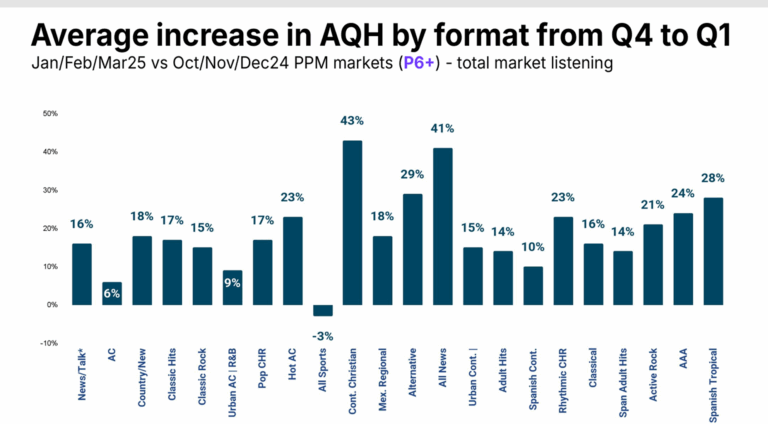
When Nielsen first introduced the shift from a five-minute to a three-minute threshold for credit, many labeled it a boost for radio broadcasters. During a Nielsen webinar in September 2024, the company disclosed that initial research showed average quarter-hour ratings for all stations increasing by an estimated 26%. With the change, the belief was that more stations could see significant gains, benefiting formats that skew younger and appeal to shrinking attention spans.
Now, a year later, sports radio’s share percentage among significant demographics is down. Not just down, but down in every demo measured in a recent Inside Radioanalysis. If the three-minute rule was designed to reflect changing audience habits, sports radio must adjust its content approach as well.
I’m not naive enough to believe that every situation applies to every sports radio station across the country. There are surely examples where the three-minute rule benefited certain stations more than others. However, in conversations with programmers nationwide, very few, if any, coached talent or adjusted clock structure to adapt to the new rule.
A year later, the results are in, and the data shows it’s time for change. First, let’s revisit why Nielsen shifted from five minutes to three.
The decision stemmed from Nielsen recognizing that listener attention spans were shrinking amid a growing variety of content options. According to Jacobs Media, Nielsen reported that half of all radio listening at the time fell short of the five-minute threshold. By reducing the threshold to three minutes, more stations could capture credit for shorter listening occasions, helping companies secure better ad buys and drive revenue.
In May of last year, Nielsen Managing Director Rich Tunkel and VP of Research Jon Miller held an online seminar examining the impact of the change. Their biggest takeaway: audience levels in the first quarter of 2025 were the highest since 2022 and approximately 15% higher than in the fourth quarter of 2024.
Logically, when you lower the threshold for credit, audience metrics should rise. That doesn’t necessarily mean more people are listening; it simply means more quarter-hours are being captured.
Yet when that research was presented, all twenty-two formats represented posted gains except sports radio. Granted, the comparison involved fourth-quarter 2024 results under the five-minute rule during the NFL season versus first-quarter 2025 results under the three-minute rule without NFL football. Anyone in sports radio knows the first quarter is typically the most challenging stretch of the year.
Still, the decline appeared then and persisted throughout the calendar year. According to an Inside Radio analysis released this week, sports radio was one of three formats that saw year-over-year share declines from January 2025 to January 2026. The findings covered persons 6+, persons 18-34, and persons 25-54.
Nationally, sports radio shares were down 11% among persons 6+, down 12% among persons 18-34, and down 6% among persons 25-54. In short, sports radio is losing the format battle under a three-minute qualifier.
So what can be done?
With more listening occasions now counted, sports radio must adapt. If less listening qualifies for the same credit, sports radio talent must adjust. Three keys can help reclaim those quarter-hours.
First, stop wasting the listener’s time. When I survey sports radio across the country, I too often hear talent easing into segments with call letters, phone numbers, text lines, social plugs, YouTube chats, and general small talk instead of getting directly to the topic. The listener chooses to come to you for entertainment and insight. Yet many hosts offer connection options before providing a compelling reason to stay.
It’s an old phrase, but it rings truer than ever: get to the meat and don’t leave them waiting. Why are Instagram Reels and TikTok so popular with these same demos? They’re short, direct, and respectful of the user’s time. Sports radio must operate the same way.
Second, combine strong, engaging content with more commercial breaks. Yes, more breaks. Every hour has its own clock, but more breaks mean shorter breaks. The era of four long breaks per hour must end if sports radio wants to compete in a shortened-attention-span world.
If Nielsen found last July that 23% of PPM listening occasions lasted three or four minutes, spot breaks cannot exceed what the research supports. Two- to three-minute breaks, strategically placed to maximize quarter-hour retention, represent a smarter approach for 2026.
Third, master effective forward promotion. Telling your audience about an interview two hours from now makes little sense in an on-demand world with limited patience. Instead, promote what’s happening next. More importantly, explain why it matters. What makes the upcoming segment, interview, or giveaway something I can’t miss?
Daily routines often dull urgency for sports talk talent. When urgency fades, so does the audience’s desire to stick around. The stage is yours, and listeners expect immediate payoff. A lack of energy is no different than refusing to play the hit record of the day.
Sports radio doesn’t face the same challenges as music radio. Local voices discussing local games offer something audiences can’t find elsewhere. Unfortunately, too many shows settle into routine without enough coaching or feedback to improve. Rather than accepting the three-minute rule’s results, the format should treat them as a challenge to evolve—meaningful change that drives impact.
The three-minute rule isn’t the villain. It’s the mirror.
For years, sports radio leaned on longer listening occasions, habitual quarter-hour patterns, and the gravitational pull of live games to mask inefficiencies in content structure. That luxury no longer exists. If a listener only needs to give you three minutes to count, those three minutes must be compelling, urgent, and impossible to abandon.
This isn’t about blaming Nielsen. It’s about accepting the environment we’re in. Digital platforms didn’t wait for radio to adjust. They trained audiences to expect immediacy. They reward speed, clarity, and payoff. Now traditional measurement reflects those expectations.
Sports radio still holds every competitive advantage: live emotion, local credibility, trusted personalities, and community connection. But advantages only matter when executed with intention. Structure matters. Pacing matters. Coaching matters. Energy matters.
If shares decline across demos even with a shorter threshold, that signals a content problem—not a measurement problem.
The three-minute rule should serve as a wake-up call, not a complaint. Win the first 30 seconds. Deliver substance before housekeeping. Respect the listener’s time. Shorten the breaks. Promote with urgency. Coach with purpose.
The formats that adapt will stabilize. Those that don’t will continue debating methodology while the audience moves on.
The clock has changed. The audience has changed. Now the content must change too.
Barrett Media produces daily content on the music, news, and sports media industries. Sign up for our newsletters to stay updated and get the latest information right in your inbox.
When it comes to new ideas in radio – especially among adult formats – you need a lone genius to champion the idea. It may be someone who believes in a hit, an idea for specialty programming, or discovering talent in unusual places.
The truth about the creative process scares some people. Conquering that fear is empowering.
Especially in the digital platform era. The creative spark for radio doesn’t rest solely with the programmer or production whiz. The spark might come from the board op running high school football. The street teamer setting up tents in a grocery store parking lot. The local sales rep who hears something outside our industry on a client visit, or the afternoon jock who pours creativity into every break. Creativity in radio isn’t hierarchy. It’s hunger. We need to champion it. Our job as leaders is to listen.
Every great moment on the air started with someone’s idea. This includes those mind-blowing promotions and that “wow” morning show goosebump-inducing conversation. Just someone in our radio orbit who raised a hand and said, “What if?”
Our business is built on connection with listeners and each other. The advantage goes to the creative who is willing to listen, experiment, and risk being wrong. The next big thing for your station isn’t waiting for a suit-clad consultant to invent it. That idea is sitting in your building, wearing headphones or prepping promotions while wondering if anyone would take them seriously.
You most likely haven’t heard of the ad agency legend Paul Arden. Most who knew his work called him – without hesitation – a “creative genius.” Arden cut his teeth at Ogilvy & Mather before landing as creative director inside Saatchi & Saatchi in London. There, he helped shape some of Britain’s most celebrated campaigns for brands including British Airways, Fuji, Toyota, and Silk Cut.
It is a compact, highly visual manifesto on ambition, creativity, and success. The book blends bold typography, photography, and short bursts of advice into a fast, provocative read aimed at creatives and entrepreneurs.
Arden’s central thesis is simple – success isn’t determined by your current talent or circumstances. Success is driven by the size of your ambition and your willingness to take risks.
Read that again.
Arden argues that most people limit themselves not by lack of ability. They hit the limit because their creativity lacks audacity. He pushes readers to aim far beyond what feels realistic. Settling for “good enough” guarantees mediocrity. Desire, in his view, is a competitive advantage.
“If you don’t ask, you don’t get,” he wrote. Encourage bold ideas, even at the risk of rejection.
Embracing failure is required. Arden insists that playing it safe leads to invisible work. Taking risks may lead to a mistake, but they also lead to breakthroughs. Instead of avoiding mistakes, make bigger ones.
Thinking differently is also a requirement for invention. Arden preaches breaking conventional rules, presenting ideas in unexpected ways, and approaching problems from an opposing angle.
Question “normal.”
Additionally, he tells us to be clear in our messaging and project confidence, even when we don’t feel it. Arden argues that projecting confidence opens doors. Opportunities go to the person who asks for them. Be courageous without arrogance.
The persistent misconception about creativity in radio and media is that it belongs only to designers and storytellers. Nonsense. That is you and everyone on your staff.
Creativity is applied imagination. Psychiatrist Carl Jung once quipped, “Show me a sane man and I will cure him for you.” The implication? True originality often requires stepping outside conventional definitions of “sane,” “normal,” or “safe.”
Arden would have agreed.
Research supports this broader view of creativity. Scholars such as Teresa Amabile at Harvard Business School have shown that creativity flourishes when people feel motivated to solve problems in novel ways.
In the same vein, psychologist Mihaly Csikszentmihalyi, known for his often-quoted work on “flow,” argued that creativity emerges when skill and challenge intersect.
We all hit mental blocks. The white page stares back at you. The meeting hits a lull and then stalls. The morning show feels “meh.” Creative imaging appears remedial. One of the fastest ways to break creative paralysis is to suspend judgment. Generate before you evaluate. Encourage what sounds absurd at first. You know – brainstorming has no judge, we preach, right?
Inside the design firm IDEO, leadership famously encourages “wild ideas” during early ideation stages. Knowing breakthrough concepts hide inside what seem like ridiculous beginnings. IDEO’s rule is to defer criticism. Quantity precedes quality.
Paul Arden’s career embodied that approach. Many of his campaigns sounded improbable in early discussions. However, as we know, “improbability” is often the birthplace of “memorability.”
Be visually striking, even on radio. The more visually striking an air talent becomes, the more memorable they are.
Visual imagery within the spoken word requires vivid language. We coach talent to create visuals through their content. Specific, bold imagery. Concrete, intimate storytelling.
Going further into visual storytelling, neuroscience research shows that sensory-rich descriptions activate multiple regions of the brain, increasing retention and emotional engagement. When a talent “paints a scene,” listeners construct mental images. Those images anchor memory.
Arden understood visual impact in print and outdoor media. Radio personalities must translate that same principle into sound. Paint pictures with words. Create detailed scenes, not homogenized summaries.
Paul Arden’s most enduring lesson and takeaway from his book is that creative success is about how good you want to become. You are already good – how do you get to “great”?
If you visit a school in your area, watch for the term “growth mindset” in classrooms. Psychologist Carol Dweck popularized the concept of the “growth mindset” at Stanford University. Individuals who believe abilities can be developed outperform those who see talent as fixed.
Paul Arden’s book title anticipated that idea decades earlier. Wanting to be better precedes becoming better.
Creativity is a muscle. It strengthens with use, thrives under challenge, and sharpens through risk. Take an improv class and you’ll understand.
“Creative” is not a department. It is a decision. The decision starts with all of us in the process and all of us wanting more.
In radio, we are constantly selling. We sell ideas on the air and promotions to listeners. We sell campaigns to clients, strategy to station owners. Even programming consultants sell a belief system that change, paired with discipline, can produce results.
Your next big creative spark favors those who embrace change, consistently generate ideas, and refuse to fear failure.
Barrett Media produces daily content on the music, news, and sports media industries. Sign up for our newsletters to stay updated and get the latest information right in your inbox.
The midterm election season is upon us. Must we interview these grifters? I guess so. I know many news/talk hosts love to interview these people and enjoy being around the American Idol for unattractive people… midterm election season.
With this being said, what is your strategy? Do you have an interview blueprint for those seeking to work for your station’s listeners?
Even if you like the bozo who is asking to become your next U.S. Senator, dog catcher, or Congressman (or congresswoman), no one should get a free ride. These people are seeking a job, and the voters are the people making that hire. Always remember, you are in a privileged position. You get to ask questions for the people. Considering the lapdog local TV media, blogs, and what is left of the print industry, you are likely the only person asking real questions.
Since we are here for the people, there are three types of questions that every human who is running for office should receive. I believe that every politician or aspiring office holder should be given a win, a chance to explain why they are running, and a tough question.
Giving the Candidate a Win
You are giving this person seven to 10 minutes of free airtime. There is no reason to give them any more than that. The win is that the interviewee can give their elevator pitch to your massive footprint. This is their opportunity to give the reason they think the people should vote for them.
If they give some happy-crap pitch that says absolutely nothing, your job is to get them to clarify. Some of these people don’t have an understandable reason for running. I think many of these people are running to get a larger government pension. Who am I kidding? Of course, politicians are thinking of themselves first.
You may agree with that human on almost everything. Most of our public servants are not running to serve the people. Remember that.
Always Ask a Tough But Fair Question
If the person has held office before or is currently on the government payroll, there is a record to mine for mistakes. It is the job of the news/talk host to ask about that mistake. This helps the candidate. If they don’t have an answer to a publicized mistake in their life, your question allows them to seriously evaluate how to answer it properly.
In 2016, Megyn Kelly asked Donald Trump about all the vile things he said about women. Trump’s answer was perfect and really helped propel him to victory. Trump said that he only said those negative comments about “Rosie O’Donnell.” Tough question — victory. Sometimes a tough question leads to a candidate falling apart. If you are representing the people, your legitimacy is on the line.
Here are not the people — political activists. This may be a sad reality, but most people are not involved in campaigns in any way, including donations. If you are excited about your local political dinner where the governor is speaking, you are probably not representing the people. If you are invited to be the master of ceremonies or speak at the event, please do so. Take a lot of selfies and work the room.
But if your show is centered on political activists, it is a very limited audience.
Ask a Softball Question
Yes, making this into an aggressive grilling of the candidate is not a winner for anyone. Your people want to hear the candidate speak. Give the candidate a softball. This allows the news/talk host to come across as a nice human. This also allows goodwill in your community. If a person is going to come on the show, they must get something from it.
I can only think of a couple of hosts who are not pleasant to be around. Most of the hosts I have met are very nice people. If that candidate wins, you will want them back on your show at some point. If this were a positive experience, even if the future elected official disagrees with you most of the time, they will come on.
Follow these tips and you will serve the audiences you wish to influence. Some of these candidates have deep pockets and can add a sizeable amount of billing to your show and station. Get that sweet cash money.
If you are too aggressive with some candidates, they may not buy your station at all. Remember, we are in the advertising business — not the elect-my-buddy industry.
Let’s talk about equal time. Some candidates may never come on your show for a variety of reasons. Always invite everyone to be on your show. I believe in equal opportunity. If a candidate does not want to appear, that is fine. The last time I checked, this is America. You can’t force them.
But if you are in the interviewing-candidates game, you must be willing to speak with them all. A big issue for the news/talk format is being too predictable. Interviewing politicians can be so boring.
Barrett Media produces daily content on the music, news, and sports media industries. Sign up for our newsletters to stay updated and get the latest information right in your inbox.
When the United States launches military action overseas, the ripple effects are felt in newsrooms across the country. But in San Diego — one of the nation’s most prominent military cities and home to the largest concentration of active duty military personnel in America — the impact is far more personal. That reality shapes how Lou Penrose approaches his afternoon show on 600 KOGO.
On days when missiles fly or aircraft deploy, Penrose says the stakes are simply different in his market.
“On days like today, this is the top story of the day, but it’s unavoidable to continue talking about it because San Diego is home to the single largest active duty military presence in America,” said Penrose of the recent military strikes in Iran.
“Back in the day, we used to call it saber rattling in the Gulf,” said Penrose. “That was the phrase used in the Reagan administration. The first order of business was check the Dow Jones Industrial Average or gas prices. What’s happening to a barrel of petroleum? Everywhere else, they ask what impact saber-rattling in the Gulf has on the price of gasoline. In San Diego, saber-rattling in the Gulf means our family members will be deployed.”
That distinction — economic inconvenience versus personal consequence — is at the heart of how Penrose frames coverage. In many cities, global conflict is discussed in terms of markets or politics. In San Diego, it is about neighbors, classmates, and co-workers.
“We speak a whole different language in San Diego when there are world events that become potentially belligerent,” Penrose shared. “When there’s a missile strike or a threat of a missile strike, when the rest of Americans watch the TV newscasts and see the night skies in the Middle East lighting up, it almost looks like a fireworks show to everybody else.
“But in San Diego, we know what missiles are being launched,” he continued. “We know what planes are in the sky. We recognize that aircraft because we drive by them every day. Many of us work on it every day. We certainly know somebody that works on it every day because the military community in San Diego is not just here. They’r our neighbors. They live next door. Their kids play with our kids. It’s very personal.”
That proximity demands a different tone. Not softer, Penrose insists — but sharper and more precise.
“It’s sobering when there are international stories like this,” Penrose said. “We treat it with a tremendous level of passion because we want to get the story right. We want to get the facts right. So we’re not interested in hyperbole. This is serious business.”
While some might assume a “delicate” approach is required in a market so closely tied to the armed forces, Penrose rejects that characterization. Accuracy and clarity matter more than tiptoeing.
“Delicate suggests that you have to kid glove a story for the audience,” the 600 KOGO host shared. “And you don’t, because these are American soldiers and sailors. They understand the realities of what they signed up for. They understand that when we have reports of casualties and reports of members wounded, they understand the realities of that. I wouldn’t say that we are delicate. We are straightforward, clear, and accurate.”
That straightforward approach also reflects the mindset of many in his audience. Military families, veterans, and active duty service members are accustomed to direct communication. For Lou Penrose, the show’s role is to provide reliable information without sensationalism.
“In these kinds of conflicts, there’s no good news or bad news. It’s just news,” Penrose shared. “You act on the news. The Marines say you adjust, adapt, and modify. You are always moving forward and you’re always ready. What we can provide for them is accuracy and clear delivery of the conversation.”
The tone of the program can shift quickly depending on the level of engagement overseas. A diplomatic dispute is one thing. Active combat is another.
“When there’s a war of words, we can cover it,” said Penrose. “But when there are planes in the night sky evading missile attack, it’s a much different level. When there’s discussion, when there’s diplomacy, when there’s a breakdown in diplomacy, that’s certainly a news story.
“But when there is active participation and our military community is engaged in action, that’s a significant increase in the level of importance of coverage,” he added. “It’s not just unavoidable. It’s necessary to cover.”
Barrett Media produces daily content on the music, news, and sports media industries. Sign up for our newsletters to stay updated and get the latest information right in your inbox.
The CBS Evening News is going on the road, as Tony Dokoupil will anchor the newscast from the Middle East this week.
During the week of March 2nd, Dokoupil will anchor the program from locations in the Middle East as the U.S. and Israeli military’s action against Iran continues.
On Monday, Tony Dokoupil will helm the show from Amman, Jordan. He’ll then shift to Tel Aviv, Israel, on Tuesday. It remains to be seen if he will move to a different location later in the week or continue to host the nightly newscast from Israel.
Chief correspondent Matt Gutman and national security correspondent Charlie D’Agata will report from Tel Aviv for CBS Evening News.
Meanwhile, senior foreign correspondent Imtiaz Tyvab will report from the Persian Gulf, while chief White House correspondent Nancy Cordes and business correspondent Kelly O’Grady will contribute reports from Washington, D.C. and New York, respectively.
The newscast moving to the Middle East comes as news continues to develop from the region. On Monday, President Donald Trump said he envisioned the situation continuing for four weeks, but will take as much time as needed to complete the military operations successfully in Iran.
Barrett Media produces daily content on the music, news, and sports media industries. Sign up for our newsletters to stay updated and get the latest information right in your inbox.
Former 1110 KFAB afternoon host Chris Baker has returned to the iHeartMedia Omaha news/talk station, stepping back into his old daypart.
Baker helmed afternoons from 2013 until departing the station in April 2021. Baker was fired following an insensitive tweet following the guilty verdict against Derek Chauvin as part of the George Floyd murder trial.
However, with the departure of Emery Songer — who is exiting to focus on his program with 1040 WHO in Des Moines — Chris Baker is back in the daypart on 1110 KFAB from 2-6 PM.
“I am the luckiest, most blessed man on the planet to be able to come back here and do what I love doing with you,” Baker said on his debut program. “I really want to thank iHeartMedia for allowing me to come back and redeem myself. That’s a big part of this. I always felt that I’m not this horrible person. I’m actually stunning, I’m awesome, I’m great, I’m very fast.
“I’ve always said, one of the strongest of the many strengths I have, being humble, is probably right up there,” he said with a laugh. “So I’m just so happy to be back here.”
Barrett Media produces daily content on the music, news, and sports media industries. Sign up for our newsletters to stay updated and get the latest information right in your inbox.