ESPN’s College GameDay drew an average of 2.9 million viewers from Iowa City on Saturday. As a result, it became the most-watched October episode in show history.
What We Know: Additionally, the Iowa City stop delivered GameDay’s most-watched episode so far this season. Through five weeks, the show is pacing 6% ahead of its 2025 season average. Moreover, 2026 now includes three of the top five regular-season episodes all time. Figures come from Nielsen Big Data + Panel. The final hour delivered an average of 3.7M viewers, outpacing the competition (FOX Sports) by 215%. ESPN also notes that ABC won the Saturday noon and primetime windows in Week 5.
What The Data Shows: (College GameDay Viewership 2026):
Week
Location
Average Viewership
Final Hour Viewership
1
Baton Rouge, LA
2.8 million
3.5 million
2
Austin, TX
2.7 million
3.4 million
3
Oxford, MS
2.8 million
3.6 million
4
Knoxville, LA
2.8 million
3.7 million
5
Iowa City, IA
2.9 million
3.7 million
What Remains Unclear: However, ESPN did not disclose the episode’s peak audience. With Caitlin Clarks appearance on the program, it’s unclear if the spike occurred in the final hour to draw a larger average overall.
What It Means: Meanwhile, the momentum stretches beyond the pregame desk. Specifically, ABC and ESPN took three of the top four games across all networks in Week 5. Moreover, GameDay proved it can draw a massive audience outside SEC country. Consequently, ESPN enters the heart of October with its pregame flagship stronger than ever.
What a weekend in Iowa 👋
🏈 @CollegeGameDay delivered its most-watched episode this season & most-watched Oct. episode EVER 📈 4th straight weekly viewership record 👀 3rd most-watched reg. season episode all time pic.twitter.com/wWRZVazzqu
Barrett Media produces daily content on the music, news, and sports media industries. Sign up for our newsletters to stay updated and get the latest information right in your inbox.
The Country Music Association has elevated five staff members across several departments. Michelle Kirk now leads the CMA Foundation as Executive Director.
What We Know: Kirk moves up from Senior Director to run CMA’s philanthropic arm. Additionally, Sydnie Hickey advances from Senior Manager, Email Marketing, to Director, Lifecycle Marketing. Meanwhile, Reuben Schwartz rises from Senior Manager to Director, Business Intelligence. Finally, Ansley Carlson becomes Account Executive, Brand Partnerships, and Katie Karl becomes Senior Manager, Ticketing.
What They Said: Brittany Schaffer, CMA Incoming Chief Executive Officer (regarding Michelle Kirk): “Michelle has spent her career building relationships that move this industry. She brings that same instinct to the CMA Foundation every day. Her work with the music education community and the Country Music industry has strengthened the CMA Foundation’s impact for students, teachers and education partners across the country. Michelle leads with heart and a clear strategic vision, and I’m thrilled to see her step into this role.”
Catherine Frizzell, CMA Vice President, Marketing (regarding Sydnie Hickey): “Sydnie has played an integral role in evolving how CMA connects with our audiences. From expanding our lifecycle marketing efforts across email, SMS, ticketing and fan engagement to helping us make smarter use of audience data to drive meaningful results. She has a unique ability to identify opportunities. While building solutions collaboratively, and connect the work back to our broader business goals. I’m incredibly proud of Sydnie’s growth and excited to see her continue to expand her leadership and impact in this new role.”
Michael Farris, CMA Vice President, Business Strategy and Insights (regarding Reuben Schwartz): “Reuben has become instrumental in how CMA collects, manages, and activates data across the organization. In his first two and a half years at CMA, he’s evolved our entire data tech stack. While championing how every department distills value from our data ecosystem. His ability to build trusted partnerships across every team, manage key vendor relationships, and develop the people around him has made him an indispensable leader.”
What Remains Unclear: However, CMA did not say whether it plans to backfill the vacated positions. Furthermore, the announcement offered no effective dates for the promotions. It also left out reporting lines for the newly elevated directors.
What It Means: Ultimately, CMA is betting on internal talent to steer its biggest priorities. Specifically, Hickey will drive engagement across the CMA Awards, CMA Fest, membership and the Foundation. Meanwhile, Schwartz’s data infrastructure work should support those growth and retention goals. As a result, the organization heads into its marquee events with familiar faces in bigger roles.
Barrett Media produces daily content on the music, news, and sports media industries. Sign up for our newsletters to stay updated and get the latest information right in your inbox.
What We Know: Franchize will continue as music director and midday host at Wild 94.1. Additionally, he remains a fixture in Tampa’s club scene as a DJ and producer. His career began in college radio in Connecticut. Previously, he served as the official DJ for UConn Huskies football and basketball.
What They Said: Joey Franchize (via Instagram): “Happy to keep growing with Wild 94.1 and Beasley Media Group as Music Director and the voice of mid-days! Grateful for the opportunity to keep bringing my passion for music, culture, and our community to the airwaves. Tampa Bay, thank you for rocking with me. Let’s keep building!”
What Remains Unclear: However, neither Franchize nor Beasley disclosed the length of the new deal. Beasley also did not share financial terms or any additional roles that Franchize may be tasked with.
What It Means: Ultimately, the extension keeps a recognizable local voice in a key daypart. Moreover, Franchize brings credibility that extends well beyond the studio. He has worked with and opened for artists such as Wiz Khalifa, Kendrick Lamar, J. Cole and Big Sean. As a result, Wild 94.1 keeps a host who lives by his own motto: “Music is every man’s redemption; I strive to epitomize music.”
Barrett Media produces daily content on the music, news, and sports media industries. Sign up for our newsletters to stay updated and get the latest information right in your inbox.
Barrett Media’s Top 20 of 2026 in Audio Advertising rolls on to day #3. The Top 20 Audio Advertising Agencies (radio and podcast) and Podcast Advertisers of 2026 were announced earlier this week. If you didn’t have a chance to see both lists, click here.
Today, we recognize the Top 20 Local Radio Advertisers of 2026. These results represent the feedback supplied by one hundred and forty four voters across the radio, podcast and advertising industries. Our voting committee includes podcasting and radio industry executives, advertising analysts, and radio market managers. It also includes sales managers, account executives, and independent media owners and operators. The voting sample represents sixty one media groups in total.
Important Details
As you review the results, please remember that our voters live in different cities and work for different companies. They have different marketing goals, challenges, preferences, and relationships. They also enjoy different business successes with clients and weigh certain factors higher than others such as total spend, category dominance, campaign consistency, and digital vs. traditional. We involve a large group of voters in this series from various companies in order to avoid geographical and corporate bias.
This series is analyzed similar to our Top 20 in Radio series, which has been in existence since 2016. Each brand, agency and/or individual earns points for votes based on where our voters rank them. A first-place vote equals 20 points. A 20th place vote receives 1 point. We asked voters to answer up to six questions, sharing which agencies, brands and individuals were most valuable to their business, in exact order. Barrett Media does not vote in this process. We simply collect the feedback, add up the results, and present the information.
Lists are subjective, We recognize that. There is no perfect system for presenting a collective snapshot of an industry. However, recognizing businesses, brands and individuals who invest in the audio industry matters as much as celebrating those who create content and connect with listeners. Our goal is to showcase the best of the audio advertising industry as recognized by media sales, management, and business professionals. We hope you’ll take a moment to reach out and congratulate everyone recognized this week. Thank them, too, for continuing to invest in and support the audio industry.
I want to thank Dylan Barrett for creating the artwork for this series. I also want to thank every voter who took time to share their feedback. Now without further delay, here are Barrett Media’s Top 20 Local Radio Advertisers of 2026.
Additional Notes:
AutoNation finished fifty seven (57) points ahead of Seminole Hard Rock Hotel & Casino to earn the top spot in this category.
Spot #21 belonged to Dunkin’ Regional Co-Ops.
The closest race saw Greater New York Toyota Dealers Association finish six (6) points ahead of Local McDonald’s Owner-Operator Co-Ops.
Fourteen (14) companies received at least one first-place vote from our voting committee.
Meet The Leaders is a special 8-week series created in partnership with Point to Point Marketing. Today’s feature is on the President, iHeartMedia Insights, Lainie Fertick. Follow along with the series and revisit former conversations by checking out the entire category.
Lainie Fertick is the President of iHeartMedia Insights, where she leads the company’s research and consumer intelligence efforts. Her work focuses on understanding how audiences engage with audio across broadcast radio, podcasts and streaming, while examining the behaviors, attitudes and cultural trends that shape today’s media landscape.
Fertick is a frequent voice on the evolving role of audio and its value to advertisers and consumers. She has presented iHeartMedia research on topics ranging from Gen Z and multicultural audiences to advertising effectiveness, consumer behavior and the continued impact of radio. Her work helps translate audience data and research into insights for marketers, media professionals and iHeartMedia’s broader business strategy.
In this edition of “Meet The Leaders,” we dive into her day-to-day duties overseeing every element of research with her six oversight of six departments, the data behind the company’s “guaranteed human” model, her use of artificial intelligence, the growth of iHeart’s partnership with Magellan, and what she’s looking ahead to in 2027.
Fertick spoke with Barrett Media from the road in Las Vegas, NV.
Editor’s Note: Answers have been edited for clarity and length.
John Mamola: Looking back at 2026, what would you say was the defining metric from your perspective that illustrates how iHeartMedia has grown this year compared to previous years?
Lainie Fertick: Lots of interesting tech things, but I want to talk about a not at all tech thing. I want to talk about our work on the human consumer. We started in 2014 naming a word of the year. We’ve taken tens of thousands of pages of open-ended consumer data, fed them into now large language models and precursors for those. Trying to come up with something that says, where’s America? What are people thinking about, talking about, regardless of gender, age, ethnicity, geography?
Last June, I thought it would be fun to run it and see where we landed. The word was so clearly human by such a large margin that it blew our minds. Aliens would have to land for the word of the year not to be human come December when we tend to pull it.
We did that research on where’s that coming from? It was coming from a bunch of places. ICE raids and conversations around that. The concern over whether children and immigrants are fully humanized. The return to work. A lot of people say, and I don’t feel like my boss sees me as a human. But of course, the response to AI.
We went in and made that guaranteed human promise at the end of last year. Not really sure whether the conversation would continue. Boy, did it continue. If you’ve lived in America recently, you have seen what concerns over AI look like. What a gift that we wrangled, wrestled, and freaked out over all that stuff a year before all this was happening here at iHeartMedia.
Our focus on our guaranteed human promise allowed us to make really clear lines around not playing AI artists. We’re going to play real life, human creators. That’s been valuable for our relationship with the record labels and the industry. Our promise is to put on real life human voices in our radio hosts and podcasters. To ensure that there would always be a human, there had all sorts of consequences from listeners being so thankful for that promise. But also for our own employees.
The first people I heard from after that were a lot of our own air talent and programmers. We kind of forgotten we’re all grappling with and wondering with what this stuff means for our lives.
So for me, the word of 2026 really has been human. Rethinking how do we engage with, how do we connect with the humans we serve, and the humans in our own building. By far the biggest thing we’ve done and thought about.
JM: Everyone utilizes AI in some capacity. With the amount of data that you’re seeing on a daily basis, how does someone in your position utilize AI to help your process?
LF: It is a gift to a person who deals in reams of data. No one deals in more reams of data than iHeartMedia. Running 860 stations, we’re doing 10 to 12 million consumer interviews a year. That is too many interviews for me and my people to read. AI has allowed us to collate, summarize, and analyze all of those responses. It’s also allowed us to go back and find the things we need a lot quicker.
To be clear, we use AI at iHeartMedia when it’s a tool that we control. If it’s a productivity tool, we are all using it all the time. My sales researchers are using AI to find the best stats to help advertisers connect the right message on the right stations and measure it appropriately. My programming researchers are using it so that we can keep all these focus blogs. We can keep talking to consumers and get faster insights on what are they saying, and what are they feeling. We actually have a whole process by which the humans check and vet the stuff we see in AI, and it’s super accurate.
AI is an analytical tool. What’s the difference between how young consumers and older consumers are experiencing TikTok radio? What should we promote with Black listeners compared to Hispanic listeners on this hip-hop station? AI is answering the questions that used to take hours of digging in seconds. It’s amazing. The faster we can answer, the faster we can get it out to everyone.
JM: With that being said, what is a typical day-to-day for you?
LF: It’s changed a lot. The last two years now, I’ve moved from running Critical Mass Media where I was general manager and had worked for the 20 years prior to that to running all of iHeart’s research teams. Every day, I’ve got leaders of those teams that I need to engage with to figure out what’s going on in that world.
I’ve got the music research and analytics run by Elizabeth Falke looking at weekly call-out, online music tests, library tests, music maps. All sorts of music strategy, and station strategy.
I’ve got content research run by Kellan Asbach looking at dial tests and focus groups and talent GPS studies. Trying to understand how well our talent are engaging, what features are working.
I’ve got digital listening analytics for the iHeartRadio app run by Joseph Toyoshima. I’ve got UX research, led by Dawn Sakaguchi-Tang, where we’re looking at how actual users are experiencing the app. Campaign insights run by Cara Weiss looking at how we can target our advertising campaigns more appropriately to help advertisers with their goals and KPIs.
Measurement and attribution with guys like Brent Lightfoot looking at who’s visiting the website when they’re exposed to this campaign. Also, corporate research so that we can tell our story to the board and investors.
So, on a typical day I will have interactions and meetings with leaders from across all those groups. Figuring out what are their biggest priorities in any given day. Then where am I needed to jump in. It might be that we have a coaching call with a really big show. But it might be that we have a really big client who has a renewal coming up. So, on this day I’m going to spend a lot of that day looking at four different measurement tools. How many people visited the website, searched for the brand, foot traffic into the store and making sure we’re telling the best story we can with them.
What’s interesting and weird about my job is that because I run all six of those different research groups, my day is different depending on which area needs me the most. That’s not to say I don’t have phenomenal people running each of those areas. They’re all fully capable of running their own space, but there’s always something that kind of needs my attention there. In any given day I’m going to talk to all six of those leaders, but I’m going to dive in deep on whatever the biggest fire or the biggest priority is.
I also run our relationship with Nielsen. On a lot of given days I’ve got to engage with Nielsen on something. I’m trying to sort of centralize a lot of the operations of how we put out surveys and measure analytics. On any given day I’m working with our operations director to make sure that we’re dealing with stuff like fraud and surveys. As great of a gift as AI has been analyzing data, it’s made it easy to be a bot who takes a survey. We’re constantly having to stay out ahead of operational things like that.
JM: Every bit of research that I enjoy reading talks about how radio still matters to younger demographics. I think it’s a misconception that radio is just not for the younger audience because they have their phone. When you look at the data for how radio still appeals to younger groups, what are some characteristics that you see that showcases why radio still matters to younger generations?
LF: Young people use YouTube and Spotify, absolutely true. People do use streaming services to access music collections. I’ve been studying this for 22 years. Everyone has always used their personal music collection. Maybe it was records, eight tracks, or mixtapes. I spent a lot of time illegally downloading music on LimeWire in my college days. Let’s just set up the statute of limitations has expired.
I burned CDs and wrote with sharpies on them. That was such a core formative piece of who I was. Then I put those things on my iPod Nano, which has been sitting dormant in the drawer for 20 years now.
The point is we have all always had personal music collections. You know what people don’t have anymore? iPod Nanos, eight tracks, records, and CDs. The personal music collection absolutely has moved over to places like Spotify, Apple Music, Amazon, or your platform of choice. That behavior isn’t much different, but people go there for a different reason.
What the youngest listeners [Generation Z], nine in ten tell us I use my radio stations and my music collection at different times for different reasons. They can articulate those reasons.
You come to radio because you want to feel like you’re part of something, and feel like you’re part of a community. I don’t just mean a local community, but like hip-hop fans, pop music fanatics, country lifestyle folks.
You want to hear some conversations you can start at the water cooler. You might do it to feel a little less lonely, or do it to feel someone cares. Even if they’re just another person in the studio who you haven’t met in real life. You have that parasocial relationship with them.
We all come to radio to join the world, to feel a sense of connection. In 2020, that was our word of the year. We didn’t recognize that a global pandemic was going to happen, but it was absolutely the right word. We learned that people who kept their routine with their radio show, even if they were no longer commuting, reported better mental health. They felt more connected. It wasn’t just that they stayed connected to the radio, they stayed connected to the other people who listened along with them.
We start the group chat. It gives us something to talk about. We all used to watch TV at night and then come in to talk at work or school about those TV shows. That functionally does not happen anymore. There’s nothing with that cultural power. So, we’re seeing people still coming to the radio for that.
We’re seeing with the youngest listeners, the 13- to 30-year-olds, co-listening is big for a million reasons. Gas is really expensive, if you haven’t heard. So, a lot of them are commuting together to work. Kids are getting their driver’s licenses later than they ever were. More two working parent households. Now, kids have to drive their little siblings around.
We call Gen Z the guarded generation. I don’t blame them, but they’ve grown up in a world where their entire lives were under scrutiny. Their faces were plastered on YouTube, Facebook and Snapchat. Broadcast for the world to see, and they’re a little bit more scared to be themselves. Sharing your personal music collection is a little scary. You might not want people to know you like these songs.
So, they actually tell us I put on the radio because it’s built for everyone. You put it on, it’s communal and feels safe for everyone. Your younger siblings aren’t going to hear anything mom and dad didn’t want them to hear. Your friends and co-workers aren’t going to judge your taste, and your parents aren’t going to be like, he was listening to that. They can tell us that it’s enjoyable. Everyone is welcome, and everyone can enjoy this music and content.
Gen Z’s not dumb. They know that they’ve missed out on the kind of cultural experiences the previous generations had. They miss that, and they want that, and they tell us they feel a little bit of joy.
When you look at the ad-supported time, because I talk to a lot of advertisers, that Gen Z spends with audio. About half of it is broadcast radio, and that’s a huge part of the reason why. They want to come and join the world and hear the same stuff everyone else is seeing.
The non-ad-supported stuff I don’t talk to ad supporters or advertisers about. They can no longer reach someone who’s listening to their paid Spotify subscription with their advertising no more than I could have reached with my Tupac CDs. That was my personal time. Radio is might come join the world time. We’re seeing as much love and enthusiasm for that now as ever.
JM: Attribution has always been a problem for radio. When I was programming, it was a hurdle when talking with advertisers. What’s been the early results of iHeartMedia’s latest arrangement with Magellan AI and their Broadcast Radio Attribution product?
LF: We had web attribution tools like Veritone where you heard the ad, did you go to the website? The difference with Magellan AI is that they use simulcast data. If you are listening to a radio station on the iHeartRadio app on a digital device, we have the same signals for you and who you are. The same identity information as we have for a podcast listener or a streaming listener.
Suddenly you do have that identity data, and we take those listeners to model out based on what those simulcast/digital listeners that we have those digital signals for, are doing. You can use that to model out what the rest of the folks listening on a car radio are doing as well.
The embrace from the advertising community has been incredible, because it’s real data. These are real listeners, real identity, the same way that we would measure behavior from digital. Lo and behold. It turns out that radio ads work.
We’re able to look at hundreds of events. Do they go to the website? Do they fill out a form? We’re also able to see that it might take them a couple times coming to the website to finally buy the product. Because we have that identity and we know who that person is, we’re learning more than ever about the consumer journey. How long it might take from the time you’re exposed to the ad to when you finally buy it.
That’s really important for advertisers because consumer journeys are lengthening. Consumers have some economic concerns. Old methodologies looked at we played the radio ad, how many people visited the website within 15 minutes? Now it’s we pay played “Laney” our radio ad, and we know that she went to the website three times in the following ten days. On that third time she finally pulled the trigger and bought the product. For advertisers to see that is amazing.
What’s even better is they can see performance by creative, performance by daypart. So, they can actually tailor and optimize radio campaigns. Optimize has never appeared in the same sentence as radio campaigns before, but you can actually see [certain elements]. We thought this message was really cute and funny, but this message is performing better with men. So, we’ll go ahead and switch to more of that message.
Being able to measure more like digital, it’s like a little security blanket. I feel like advertisers like that. They’re familiar with that, and it’s opened a lot of other doors.
I think Nielsen finally really sees the critical importance of measuring performance of radio campaigns. So, in addition to the Magellan AI data, simulcast data, and web visitation, we also now have media mix modeling inputs that Nielsen allows us to share. It allows radio to be measured against all other media. So, big companies take these media mix models and they pour in all the different things they’re buying. It all goes into this model, and it gets run by an algorithm that says how much value did each of these media provide. Plus, if you have one more dollar, where would you put your next dollar? What’s the ROI on each dollar and the potential ROI?
What’s been fascinating to watch this year is that radio has started performing significantly better on so many of those models. We have better input data. The more of these signals we have about real people and their exposure, the better the data is.
The data that used to get fed into MMMs was just, here’s your radio plan. Plan data is a mess. The best laid plans are not how things run on radio stations. To be able to put in that real data and see the actual kind of ebbs and flows of the advertising matches how the consumer engages, it’s the thing we already knew.
Now a lot of these folks in investing in these MMMs are learning that broadcast radio works. It’s efficient, and it’s effective. That’s something we never could have seen given the tech even two or three years ago.
JM: Is there too much data, or is there never enough data?
LF: It is the best question, because I love endless rooms and data and I want to look at it all. But we can’t be paralyzed by data. My job is to have all the data in the world. I don’t want my programmers or my air talent to be mired in data. In fact, it’s sort of a running joke at iHeartMedia that I’m the odd researcher who will say don’t get too caught up in the data.
Our programmers are magicians. Our air talent are magicians. They are amazing creators who can connect with people on a level that can’t fully be quantified by data. My job is to give them enough data to do that well enough, and to know when to say that data point is not the most important one or keep pursuing this.
I really view that it’s my job to take all of the data and figure out which of it’s useful. Which of it’s a red herring, and which of it’s going to get you distracted or send you down the wrong path. If you’re letting data distract you from putting on the most compelling, innovative, and interesting programming. You’re not using data correctly.
It is 50% math and 50% magic for sure. Even how we field our research. Everything that we do is based half on what listeners say and half on what they do. They’re not the same thing. It’s important for me to know that you wanted to listen to something that meant something. You wanted to listen to something that seemed a little bit more important.
In 2016-2017, NPR was having a real tear in the ratings. We could see that people were still consuming all of our gossip bits and everything. But we also knew, because we asked them, that they didn’t feel great about it. We want to put out great, sticky, fun-to-listen-to stuff, but we actually want people to feel good about it.
That insight of understanding not just what they were doing, consuming endless gossip. But also what they were thinking. I don’t feel great about this. I want to feel like I’m hearing things that are meaningful and important to the world. It allowed us to rebrand and retool.
We don’t have gossip and sleaze segments anymore. We have Three Things You Need to Know or headlines. They’ll include some entertainment news and some other news.
In terms of data, there’s never too much data for me. But that’s because my job isn’t to create. My job is just to assist creators and be in the background and let them do their thing. There is such thing as throwing too much data at creators or forcing them to adhere to it. It’s not what we do. You could call up anyone with iHeartMedia and ask if Lainie Fertick is forcing you to adhere to too many different disparate data points? They’d say no because the goal is again half math, half magic. That’s how you build great content.
JM: The AM Radio in Vehicle Act passed the House of Representatives. iHeartMedia is a big supporter of this legislation. What data have you seen that showcases to the company that the AM band should not just stay in cars, but also something to continue investing in to remain relevant where people know where to go when AM is needed?
LF: AM radio saves lives, literally. One of my most common catch phrases at iHeartMedia is your bougie friends aren’t normal.
If I were running a high-end subscription service where you paid a bunch of money to get access to something that helped you in a hurricane, great. We reach nine and ten Americans on broadcast radio and at iHeart. We have a duty to every last one of them. Some of those folks can’t subscribe to a million things and work jobs that are not as fun as ours. They’re not telling fart jokes on the radio. When you reach nine and ten Americans and you research what’s going on in the lives of nine and ten Americans, AM radio truly is the lifeline. Especially in weather emergencies, for a substantial portion of them.
The New York Times ran an article on the Hurricane Helene coverage in Ashville, NC. It is a last line of technological defense in some of these major disasters. We’ve got to be there. Someone’s got to be there. Someone who is not selling the subscription service to just who wants to opt into it.
Police and fire. AM radio is in that category of first responders that we all as a society have a duty to support. Because every single citizen in America deserves that life-saving information we can dispense and provide.
JM: 2026 isn’t over yet, but moving into 2027. How would you assess the standpoint of the company moving into 2027? What next step do you feel will be coming to fuel additional growth for iHeartMedia?
LF: The big, exciting thing that we’ve been working so hard on this year that you’ll really start seeing pop in next year is AudioGraph. Our programmatic radio offering that allows us to use real identity data. Same concept as we talked about with Magellan AI, to plan, buy, and measure broadcast radio. That’s what the marketplace demands. This broadcast radio inventory for some buyers, it’s a little more complicated or not as top of mind or as easy to buy as some other audio inventory.
It’s nuts, because broadcast has the largest reach. Lisa Coffey has been brought into iHeartMedia to help work on this. She’s doing a phenomenal job setting up all of the pipes necessary so that you can go buy broadcast radio in programmatic settings. You can buy it as easily, simply, and as quickly as you can buy other media.
That’s such a technical thing. It doesn’t sound like guaranteed human, but it’s so important. When you look at where’s the friction for the industry, a bunch of the friction is in stuff like that. Making it easier and more accessible for all of these on-the-go media buyers. They’re just like everyone else. There are fewer people doing the work of more people; they’re doing harder, longer jobs. Making that inventory available is going to be a huge difference maker for iHeartMedia.
Sometimes it’s just the difference of getting on the plan, making it easier to access. Then, of course, the measurement will all follow suit with that. Now that we have this resource to go in and plan more granularly, targeted, and the way that buyers are looking to buy right now. Broadcast radio inventory, we can also measure in the same way. Like Magellan AI, for every other metric, sales lift, place visitation, foot traffic, and brand lift.
We’re going to have more certainty that we know what the people exposed to this advertising did. Everyone’s being asked to put their money where their mouths are right now in the advertising field. We can say that’s not fair to grade radio that way, or we can go put out solutions that actually do it. We’re choosing to do the latter.
To learn more about Point-To-Point Marketing’s Podcast and Broadcast Audience Development Marketing strategies, contact Tim Bronsil at tim@ptpmarketing.com or 513-702-5072.
Braiden Bell should be allowed to call play-by-play for the Portland Trail Blazers. The 29-year-old broadcaster was fired hours after being hired when a local news station uncovered racist and sexist tweets he posted when he was 15 years old. Yes, an aspiring broadcaster was fired for something he did 14 years ago as a minor.
The conversation has mainly focused on whether the punishment fits the crime, which, by the way, isn’t a crime at all. Anyone can tweet whatever they wish. It’s a free country, and there’s free speech, but people have come to understand the consequences that can come with what they post.
The focus should be more on the Portland Trail Blazers and the double standard in their hiring process. If tracing social media isn’t a priority when you make a hire, why does social media from before you hire become an issue that warrants firing someone afterwards?
That’s the part of this entire formula I don’t understand.
Think Before Hitting Send
The Portland Trail Blazers are not Brick Oven Pizzeria & Ristorante. As much as I love the establishment for its solid pie and ice-cold drinks, it’s not a multibillion-dollar NBA franchise. The standards for a role with an NBA franchise should be slightly higher than those for a line cook at a pizzeria. Therefore, there are added layers of data that every team must investigate prior to making a hire.
The Portland Trail Blazers hired and fired Braiden Bell on the same day!
The TV play-by-play broadcaster (replacing the great Kevin Calabro) was fired for tweets he made when he was 15 years old. pic.twitter.com/rAMKP2e4Pc
Without a doubt, social media presents a problem for employers looking to hire the best people and put them in positions to succeed. It’s free, easy to access and designed to keep people engaged through algorithms that encourage users to continue posting and interacting. In 2012, Twitter had more than 200 million monthly users, with particularly high usage among young adults.
Bell wasn’t the first 15-year-old to say something controversial, racist or sexist on social media. He also won’t be the last. That isn’t an excuse for what he shared. What he posted was wrong and insensitive.
But did those same tweets hold Bell back from roles with Blaze Radio 1330 AM in Phoenix in 2017? What about his short stint as a broadcaster with the Pac-12 Network? Or his five years calling games for California Baptist University. Which led him to earn opportunities with Arizona State, the Valley Suns and the WNBA’s Phoenix Mercury?
It’s obvious that none of those employers took issue with the tweets of a 15-year-old boy. Yet, Bell continued to climb the professional ladder.
Did all those organizations look into his social media background? Likely not.
Did the Portland Trail Blazers look into it? Obviously, they didn’t.
The announcement was made. Social media posts went out, accompanied by a nicely written press release. It was a moment for Bell that had been a long time coming for an aspiring broadcaster. Then, the Trail Blazers played moral police. After someone else did the job they should have done during the hiring process.
A Double Standard
The Portland Trail Blazers can’t have it both ways. No employer should.
You can’t identify, recruit, interview, hire and announce someone as the new voice of your franchise, then fire that person when a hole in your hiring process is exposed. You can’t say something was in clear violation of your team and league policies when you didn’t do the legwork during the hiring process itself.
Yes, the Trail Blazers acknowledged that they failed to meet their own standards during the hiring process. But you can’t simply say you’ll do better when you already had policies in place that were supposed to prevent this PR nightmare in the first place.
That’s why Bell should remain the new voice of the Portland Trail Blazers.
Bell made a mistake when he was 15 years old. He has acknowledged it, apologized for it and spent the past 14 years demonstrating that those tweets do not define the broadcaster he became.
The Trail Blazers, meanwhile, made a mistake at 29. They identified Bell as the right person for the job. They recruited him, interviewed him, hired him and announced him as the new voice of the franchise. Then they discovered something they should have known before making the announcement and decided Bell should pay the price for their failure to do their homework.
That isn’t accountability. That’s passing the buck.
Ring The Bell
If the Trail Blazers truly believe Bell has demonstrated that he is unfit to represent the organization, then they should be prepared to explain why the same evidence wasn’t enough to prevent them from hiring him in the first place.
If the tweets were disqualifying when they were discovered, they should have been disqualifying during the hiring process. Instead, Bell lost the opportunity of a lifetime while the organization gets to move forward after admitting it failed to meet its own standards.
That’s backwards.
The Trail Blazers can still make this right. They can acknowledge their own failure in the hiring process and give Bell the opportunity they already determined he was qualified to receive. If Portland wants to demonstrate that accountability actually means something, it should start by holding itself accountable.
Put Bell back in the chair. Let him call the games. Let his work, his professionalism and the broadcaster he has become determine whether he deserves to be the voice of the Portland Trail Blazers.
Fourteen years ago, Bell made a mistake. Portland has a chance to make sure it doesn’t make another one.
Barrett Media produces daily content on the music, news, and sports media industries. Sign up for our newsletters to stay updated and get the latest information right in your inbox.
Fox News turns 30 on Wednesday, and the milestone says plenty about how this business works. The network launched on Oct. 7, 1996, with plenty of skeptics watching. Today, it’s the most-watched channel on cable, regardless of format or genre.
Critics have a ready explanation for that success. They argue Fox News won because of its partisan lean, and they say the country’s worse off for it. I’m not sure I’m the right person to make declarations on that debate.
Still, I don’t think a conservative position alone built this empire. Plenty of outlets have picked a lane and faded away. Fox News stayed on top because its leaders understood what attracts viewers, and they made the right chess moves at the right time.
The Pivots That Built the Brand
Consider how often the network has reinvented itself. In 1996, Rupert Murdoch and Roger Ailes bet that a huge audience felt existing news outlets ignored them. That bet paid off quickly, and Fox News passed CNN in the ratings by 2002.
Moreover, the network understood something its rivals missed. Viewers don’t just want information. They want a point of view, a familiar voice and a reason to come back tomorrow. Fox News delivered all three, and it did so consistently.
Next, the network built a primetime lineup around strong personalities, from The O’Reilly Factor to Hannity. Similarly, it turned The Five into an afternoon staple and Gutfeld! into a late-night winner. Each move kept the schedule fresh without abandoning the core audience.
Meanwhile, the network read the digital shift early. Fox Nation launched in 2018 as a subscription service, and Fox One followed last year as a full streaming option. Its YouTube presence keeps growing, too.
As a result, Fox News isn’t waiting for cable’s decline to hit its bottom line. It’s building the next home for its audience while the current one still pays the bills.
Bouncing Back From the Hits
Of course, the road hasn’t been smooth. Ailes left in 2016 amid sexual harassment allegations. O’Reilly followed in 2017 amid advertiser pressure. Then the Dominion Voting Systems lawsuit ended in a $787.5 million settlement in 2023.
Meanwhile, lineup changes raised fresh doubts. Many wondered whether Tucker Carlson‘s exit that same year would mark the beginning of the end. Instead, Fox News slotted in Jesse Watters Primetime and kept winning.
Notably, the network didn’t just survive those moments. It adjusted its leadership, its lineup and its messaging, and its audience stayed. That loyalty suggests viewers valued the product as a whole.
Time after time, the network bounced back. In fact, it came back stronger. Today, Fox News holds as dominant a position as it’s ever had in its 30-year history, and no other cable channel can say that.
The Next Chess Move
That track record points to institutional knowledge. Leaders at Fox News know their audience, and they know when to change course. Therefore, this anniversary feels less like a victory lap and more like a checkpoint.
Indeed, the same instincts that built the original channel now drive its investments in streaming, subscriptions and online video. The platforms change. The strategy of meeting the audience where it lives doesn’t.
Still, the next 30 years won’t be easy. Cable’s audience keeps aging, and streaming keeps splintering attention. Nevertheless, betting against Fox News has been a losing proposition for three decades.
For now, Fox News has earned its moment. 30 years in, it’s still the network every competitor is chasing.
Barrett Media produces daily content on the music, news, and sports media industries. Sign up for our newsletters to stay updated and get the latest information right in your inbox.
In the history of sports talk radio, there has never been a show that has survived and thrived like The Dan Le Batard Show. The program combines comedy, celebrity, controversy, and character with sports, creating a unique formula. The show was created in a traditional local market, elevated to national syndication, and eventually transcended to independence in the digital space. Mike Ryan Ruiz has witnessed the show’s evolution while experiencing his own.
“I was selling veterinary pharmaceuticals. That job sucked. But while I was doing that job, I listened to the Le Batard Show. That was the best part of my day,” explained Ruiz, recalling his experience with the program before joining it. “It was a really good show. I enjoyed getting involved as a listener from my desk. It grabbed me because it was more ambitious than your standard radio show.”
Ruiz always envisioned a career in sports, first taking an unpaid internship with the Florida Panthers after college. But with a little money saved and an opportunity to take a chance, he arranged an internship with 790 The Ticket, the station carrying the program he had become a devoted listener of.
Breaking Norms
Now, two decades later, Ruiz is one of the personalities who make up the flagship program under Le Batard’s content company, Meadowlark Media. Twenty years of success in local markets eventually led to ESPN Radio and, ultimately, independence. Ruiz is proud of the program’s history and the role he has played throughout its evolution.
“We were at the forefront of digital audio. So, we knew that the industry was going to evolve. But I’m not sure I foresaw a day where all radio shows would have to be multimedia to grow, especially being good out of the gates when it comes to podcasting,” explained Ruiz. “We knew that the show was special and would really grow as the industry was evolving.”
The journey to independence is unlike any other program in the history of the medium. The success that has followed makes the story even more remarkable. The program continues to grow in sponsorship and distribution, while many of its peers struggle to find opportunities to expand their reach and impact in the digital content space.
However, despite its continued growth and success, Ruiz feels the show still doesn’t receive the respect it deserves from the industry.
“I don’t think there was ever a show like it. Whether people know it or not, a lot has been borrowed from it. The industry went from opinionated talking heads from on high to more personality-driven stuff,” said Ruiz. “Sports always had a starch to it where the gatekeepers didn’t allow a lot of what we provided. We changed the industry in many ways, and I don’t know if we get the proper respect for it.”
Moving Puzzle Pieces
Ruiz also credits the program’s legacy of creating new stars in the industry by giving them a platform on the Le Batard Show. From Pablo Torre to Mina Kimes and many in between, he says the show didn’t necessarily discover those personalities, but it allowed them to showcase their abilities to a larger audience.
The show has always featured a large cast of characters and witnessed many changes over the years. However, the past year proved difficult, with several key members of the Le Batard team moving on from the program.
The biggest departure was Jon “Stugotz” Weiner, who left the program to pursue his own independent platforms before eventually returning to syndicated sports radio with FOX Sports Radio.
“We did hit a rut as the Stugotz stuff came to a head. We also had changes in venue, how we approached the show, and life in general. There was a lot to navigate and difficulty personally and professionally. It took a minute. Probably the most struggle we’ve had doing that stuff,” said Ruiz. “We have some real positive energy on the show now. It took a minute to hone those characters down. But I love where the show is positioned. We’re back to having a ton of fun and being proud of what we’re doing.”
Since Stugotz’s departure, Jonathan Zaslow has stepped into the main co-host role on the program. Ruiz credits Zaslow for how he has embraced the new role and the amount of preparation he brings to the program.
“It’s a whole new energy. He’s got all the eccentricities and things you love from a talent with delivery, voice, and weirdness. As a bonus, he really follows sports and is well informed. That’s a hugely important piece to our show. Especially when the national perception of our show is that it’s a comedy show, not a sports show,” explained Ruiz.
The Dan Le Batard Show has always considered itself a comedy program first. Ruiz takes pride in that label. He believes sports are the entry point into larger conversations, saying the program embraces the challenge of being a character-driven comedy show that can also talk about sports.
Ruiz says he can envision a day when Stugotz reunites with his longtime co-host, Le Batard, even if only for a limited appearance.
“This is the entertainment business. I do think we had a successful partnership. I do hope for a day where we could get the ‘ending’ better than we did before. A lot of the latency in being able to move forward was genuinely the parties trying to work to a place where they could get it right. Sometimes you don’t. We were as transparent as we could be to an audience that we were trying to shield from some stuff as we were fighting to keep some stuff together,” explained Ruiz. “But right now, my focus is on the show that we’re doing right now. It’s genuinely improved by leaps and bounds lately.”
Devoted Audience
Part of the show’s evolution has been its focus on serving the audience. What once reached listeners through traditional radio has now evolved into an on-demand experience. Ruiz understands that the modern consumer no longer wants to devote the same energy they once did to falling in love with a program.
That’s why the story of the Le Batard Show audience is one worth examining. They forged the connection in a traditional setting, strengthened it through syndication and an on-demand audience, and now continue building it within the digital content community.
“For us, even when we broke nationally, the place most people found us was through podcasts. Even as we build out a more robust video operation, that’s where most people are super comfortable making us a part of their day,” said Ruiz. “In terms of daily output from a live show, we’re one of the better ones, if not the best. People have a lot of options, and there’s a lot of really good shows. But we’re still a part of that conversation.”
Ruiz says the program continues to lean into the human connection created through every discussion. It’s something he believes automation and artificial intelligence will never replace. Admittedly, Ruiz says he’s not a fan of AI and insists the program is attempting to move away from using the technology in its day-to-day operation.
An Unknown Future
But with time comes speculation. Two decades is a long time in any form of sports media, and Ruiz admits he’s begun thinking about life following the conclusion of The Dan Le Batard Show.
“It’s natural. I’m 40 and have been blessed to make a decent career with this one show. I’m at a different age than Dan [Le Batard]. It became apparent to me a few years ago there’s going to have to be a life post-Dan,” noted Ruiz.
Because of this, Ruiz has begun spreading his own wings. He’s become a part owner of a Miami Hurricanes content company, as well as a music venue based in Miami. While also elevating his role within Meadowlark Media by working directly with its DraftKings partnership, Ruiz has hosted a podcast in partnership with Chelsea FC and plans to build other creative projects outside The Dan Le Batard Show.
Ruiz says it’s natural to begin having conversations about an unknown future, but he isn’t sure what it holds just yet.
“I don’t know if we’ll have a certified end date. It might get to a point where Dan [Le Batard] is on the show less. But we’re putting in that work right now, whether it is a conscious or subconscious effort,” said Ruiz. “I’m really proud of our show’s track record of putting a spotlight on talented people. So, let’s lean on that and cultivate some stars while building out a great show. Ultimately, who knows? Maybe the show sticks around if Dan’s not a part of it.”
For now, Ruiz continues to hold onto the same ambition he had when he first began with the program so many years ago. He’s thrilled with the continued improvement of the video’s role within the program while continuing to lean on the unique elements that have always made the show special: making stars, challenging norms, and enjoying the energy that comes from having a laugh with the audience along the way.
For Ruiz, that may be the most fitting way to view the next chapter of The Dan Le Batard Show. The program has never been defined by staying in one place, following a traditional path, or allowing the expectations of the industry to dictate what comes next.
Two decades after he first listened from behind a desk at a job he couldn’t wait to leave, Ruiz continues shaping the very show that once provided him an escape. The names around him may change, the platforms may evolve, and eventually, the role of Dan Le Batard himself may look different.
But the philosophy that made the show different from the beginning remains intact.
Make people laugh. Give talented personalities a platform. Challenge the conventions of sports media. And, above all, make the audience feel like they’re part of something.
For Ruiz, that’s what made the show special when he was a listener. It’s what kept him around for two decades. And as The Dan Le Batard Show enters its next chapter, it’s what he believes can keep it relevant for whatever comes next.
Barrett Media produces daily content on the music, news, and sports media industries. Sign up for our newsletters to stay updated and get the latest information right in your inbox.
Thank you for checking outThe Industry According To. EveryWednesdaywe speak with a different expert or leader from somewhere in the vast music industry — label executives, artist managers, programmers, talent, artists, consultants, and beyond. To be considered as a future guest, email me atkeithblackboxgroup@gmail.com.
Today we sit down with Sam Milkman, Executive Vice President and Senior Consultant at Coleman Insights, whose career has given him an unusually complete view of radio, music, branding and consumer research.
Before becoming one of the industry’s leading researchers and strategists, Sam held programming and operational roles at some of America’s most influential radio stations, including WXRK and WHTZ in New York and WMMR in Philadelphia. He also began his professional career as a litigation, intellectual property and entertainment attorney.
Sam later founded mediaEKG, whose innovative content-testing work led to its acquisition by Coleman Insights in 2009. Today, he helps radio stations, podcasts, streaming platforms, music companies and other media brands understand what consumers use, what they believe and expect, and what they may choose next.
Few people have spent as much time sitting on both sides of the research, so let’s dive in.
*Editor’s Note: Answers have been edited for clarity and length.*
Is Ignorance Bliss?
Keith: What’s the single most important finding you repeatedly see clients rationalize away or choose to ignore — and what will continuing to ignore it eventually cost them?
Sam: A continued downward trend in station Awareness and Cume. We know that most of us don’t market our brands. Some not at all, many at a small fraction of what we did years ago. A framed sign in Abbey Konowitch’s office at Hollywood Records read: “Without promotion, a terrible thing happens… Nothing!” (P.T. Barnum gave us that wisdom originally, but I’m a bigger fan of Abbey’s). I understand the economics of 2026, but it’s unfair to expect audiences to grow organically.
Community
Keith: Radio has long claimed companionship and community as two of its defining strengths. Yet a recent Coleman study found podcast listening is more strongly linked to both than most other media. How much ground has radio lost on one of its greatest advantages — and what will it take for brands to win it back?
Sam: The Power of Community podcasting study is a great read. You can find it here.
And I understand that there is a strong correlation between podcast listening and a sense of companionship and community. But that’s obviously not an exclusive quality of podcasting. I believe the same holds true for great radio and always did. My takeaway is that we need to continue to build and nurture these connections in radio. Celebrate radio’s place in this ecosystem rather than look over our shoulders at podcasting.
Radio’s Purpose
Keith: You’ve argued that sounding somewhat better than the other stations in town may no longer be enough to save the day. Based on the consumer behavior you see, what key purpose can radio still serve that Spotify, podcasts, TikTok and other media can’t?
Sam: Connection and community as you mentioned above. More, radio should focus on being culturally relevant — in the center of the story — as it always has been historically. When Madonna does whatever she did in the bathroom set at the VMAs, we should be hosting dance parties in bathrooms the next morning. Okay, that idea may need some refinement, but you get my point. Radio needs to be in the middle of the story, not just reporting on it the next day. Steve Kingston used to say: “I want Z100 to be the story — not just another station talking about it.” Aren’t you sick of hearing that somebody on TikTok did this or that outrageous thing — stuff that we used to do all the time?
Radio can tell stories in its own short-form way. Listening to podcasts requires a time commitment. Spotify is a utility. Radio can add so much more to content in a quick, snackable fashion. I’m not talking about spending money here, I’m talking about getting creative.
The Image Pyramid
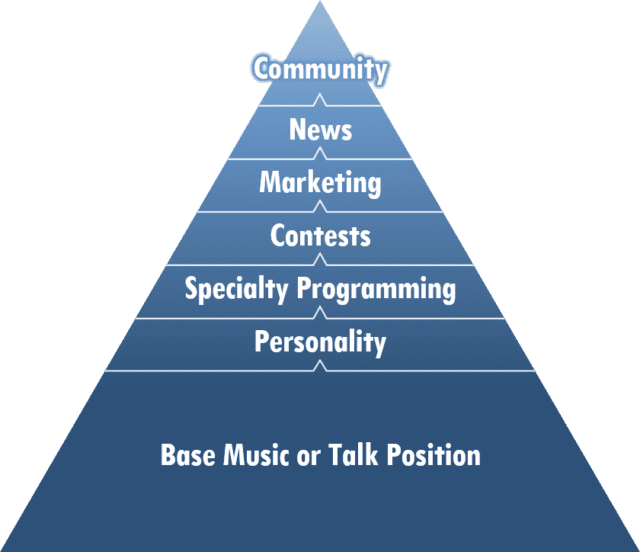
Keith: Coleman is famous for its Image Pyramid, putting Base Music or Talk Position at the foundation, with personality, promotions and other images built above it. If you were launching a station for 2027, would its layers and order remain exactly the same, or do digital access, distribution and discovery now deserve a place of their own in the pyramid?
Sam: I wouldn’t change the Image Pyramid at all. The pyramid is meant to express the basic concept of how brands are built. Any brand from Apple to Jeep. More than anything, a brand must stand for one thing and own it. Whether that’s your music position or a talk position. Everything else is designed to support that idea — the upper bricks of the pyramid add complementary, memorable elements that elevate the big idea.
Digital and distribution are tools, just the delivery system. We didn’t promote the tower in the 90s. No harm in explaining how to hear your station, but that’s not the purpose of the pyramid. It’s all about brand building. Discovery could be used to build the brand, and I think that’s covered in the Image Pyramid as it stands today.
A Hit Song or a Career Maker
Keith: Consumption data can show that a song is working, but it doesn’t necessarily tell you whether listeners care about the artist behind it. How can research help a label determine whether it has just a hit record or an artist capable of building a lasting career?
Sam: By deploying the same brand research we do for radio stations, podcasts, and other products. And we have done a lot of this work for labels. A song may just be a good song, but mate that to a compelling brand and you have an artist with career. An artist has an Image Pyramid just like a radio station. A consumer can describe what Ella Langley stands for, what her persona means, what attributes they perceive she has. Couple that image with songs that match, and you have bottled lightning.
Needles in the Haystack
Keith: A Coleman Plan Developer perceptual study may ultimately produce 200 slides. Which finding or data point makes your stomach drop because it signals a brand has a real problem — and which tells you there may be enormous upside the client hasn’t recognized?
Sam: Please don’t exaggerate the length of our studies, 199 slides at most! Perceptual studies do not uncover a tiny needle in a haystack. They reveal big structural elements with potential for enormous upside. You have morning show with tremendous potential — but not enough people know about it. You aren’t owning your position. You don’t have enough Cume. Music tastes are evolving and you need to adjust. That’s what a perceptual study will tell you.
Music Testing
Keith: Many cite “mood” as a key driver in their music selection. Traditional music research asks how much someone likes a song but rarely asks when, where, or in what mood they want to hear it. A ballad may be perfect at one time of day and poison at 8 a.m. Is music testing too context-free — and should mood and listening occasion become part of the measurement?
Sam: Music testing has its limitations. When we understand a brand from all of our studies, particularly the music that a station has an image and expectation for, we get closer to understanding the when, where, and mood. Some of that requires a programmer who really knows their brand.
We sometimes ask how often the listener wants to hear a sound, even if they love it. Now could we add these additional dimensions to our studies? Sure, let’s try it with one of the stations you work with!
Listeners & AI
Keith: AI continues to be a hot-button issue, but what does the consumer research you’ve seen tell us about how listeners feel about two things: radio personalities powered by AI and music created entirely by AI? Do consumers care — and does knowing something is AI change their reaction?
Sam: Knowing something is AI definitely changes listeners’ perceptions. You don’t really want to interact with something you think is AI-generated. But more and more, the audience doesn’t realize the content is AI. And in that case, great content is great content. Unless the curtain comes down when AI pronounces Conshohocken like an out of towner.
He Said, She Said
Keith: A client’s Nielsen performance says the brand is healthy, but your research shows serious weakness, or vice versa. How do you handle that, and how do you prevent a client from simply believing whichever data flatters them most?
Sam: We have really smart clients. They understand that a station could have good ratings but the brand is in trouble as our study might reveal. The competitive environment might allow success despite brand weakness. A foreboding report would prompt them to shore up their brand despite Nielsen success. Going the other way, our work might tell them their brand is strong and the ratings haven’t captured that just yet. Because we work with much larger sample sizes of the station’s Cume, we are more likely to see performance in a more consistent manner. As one of our biggest clients always says: I’d trust Coleman!
Research on a Budget
Keith: Radio companies are cutting research budgets while describing themselves as more data-driven than ever. Is the industry actually better informed — or is it just surrounded by more available data? And what gets lost when custom research is reduced or eliminated?
Sam: Stations have a lot more behavioral data available, but not perceptual information. Here’s what people are doing online, for example, but we don’t know why. What’s lost is what people in your local market are thinking and feeling. And that’s the key to generating more listening on a consistent basis.
Are Demos Outdated?
Keith: Radio still builds and sells brands around demos such as Adults 25–54 — a 30-year age span whose members may have very little else in common. In a media world where consumers can choose from an endless menu of niches, are broad age-and-gender demos now too blurry to guide product strategy? Should stations target a mindset first and let the ages fall where they may — or would that collide with radio’s advertising model?
Sam: You have to deliver what the sales department can sell. But no format falls neatly into “Adults 25-54” and so we wouldn’t advise programmers to focus broadly on that demo. Still, there is a correlation between age and mindset and format and mindset. So, find a way to grab a big piece of a sellable demo. But start with the proposition that a large number of people within that target must love this idea.
Which Risk Is Riskier?
Keith: Research is great at identifying things listeners don’t like, but many of the biggest brands and personalities became successful by making people either love them or hate them. Can following research too closely make radio so safe that nobody has a reason to tune in? And how do you tell the difference between a real warning sign and a strong reaction that means you’re onto something?
Sam: I would agree that following research too literally could cause someone to shave off all the edges and stick to a plan that is too safe. Often, research can tell you whether it is worth the risk. Add this style of music and you will bring in a lot of people, but you will lose some too. And that’s okay if it is done intentionally and responsibly.
Reading the Wrong Room
Keith: Research is only as valuable as the way it’s interpreted. The same pie chart can lead two people to different conclusions, but only one may actually be supported by the data. Without naming names, what’s the funniest or most painful example you’ve seen of someone completely misreading research — and what happened then?
Sam: The examples that come to mind are from our song-testing for labels, specifically, pre-testing songs before release. When a song is a cover or contains samples of a popular song it may test very well, but you can’t be sure that listeners are excited about the original or what you are putting in front of them. Or, the song may be great but the artist has no image or worse the wrong image. It’s easy to get confused in both cases, but experience and an understanding of these sorts of issues can steer you in the right direction.
The Blank Slate
Keith: Last question — blank slate. Say anything you want to any sector of the industry. What do you want them to hear?
Sam: As an industry we have a blank slate. We don’t have to stick to any pre-existing formats or designs. We can try things and put them on the air tomorrow. Somebody is going to try something crazy and build a new audience. Let’s do that together!
Barrett Media produces daily content on the music, news, and sports media industries.Sign upfor our newsletters to stay updated and get the latest information right in your inbox.
I spent most of my career as a programmer. I worked in sales for about a year and 15 minutes. That qualifies me to say, with some authority, that I am not a sales expert.
But it was long enough to see the business from the other side of the hallway — and it changed how I think about what we’re selling.
Programmers think about what we create. The brand. The personalities. The music, the promotions and the connection to the community. Advertisers are thinking about something much simpler: Did it work?
That gap made me wonder whether radio communicates its value in the way advertisers actually need to hear it.
The Three Pots
From where I sat, advertisers fell into three pots.
The first pot is the believers. They understand radio, and they’ve probably seen it work. Serve them well — and don’t take their budgets for granted.
The second pot is the nonbelievers. Some had a bad experience. Some don’t personally listen to the radio, so they assume nobody does. And some have simply decided the medium is obsolete. You can spend a lot of time trying to convert someone who has already made up their mind. I’m not sure it’s the best use of anyone’s afternoon.
The third pot is the persuadable middle. They aren’t anti-radio. They just aren’t convinced. And they may believe radio builds awareness but question whether it drives action. And they’re open to it if we can make the investment feel less risky.
That third pot may be radio’s biggest growth opportunity.
The persuadable middle doesn’t need another argument about why radio matters. They need us to remove some of the reasons they’re afraid to buy it.
Making Yes Feel Safer
So what’s holding them back? Cost and commitment, for starters. Then come the questions. How much frequency is enough? How long does it need to run? Are we reaching the right people? How does this compare with digital? Is the creative any good? Did the last campaign fail because radio didn’t work — or because it was never built to work?
And the big one: How will I know it worked?
That isn’t a no. It’s a request to make yes feel safer.
The good news is that radio’s attribution story is changing. Ratings, reach and frequency still matter. But we can now point to trackable calls, landing pages, promo codes, search lift, streaming data, foot traffic, retargeting and brand-lift studies. Attribution isn’t perfect. Still, we’re well beyond handing someone a ratings book and wishing them luck.
The key is having the measurement conversation before the campaign starts — not after the client calls asking where the results are.
Radio is no longer limited to telling advertisers how many people might have heard their message. Increasingly, it can show what some of those people did next.
The Programmer Comes Back In
This is where the programmer in me wants back into the conversation.
Radio should be great at storytelling. Yet too often the commercial becomes the free thing thrown in with the schedule. A bad spot can make a good media buy look ineffective. One idea. One message. One clear action. The creative and the schedule have to work together.
We also need to stop overselling what radio can do. Radio usually works through repetition, familiarity and trust. It isn’t always an instant-response medium. A campaign needs enough weight and enough time to get a fair shot. Selling too little might get an advertiser on the air today — and create another radio skeptic tomorrow.
Testing radio is reasonable. But it has to be a fair test.
Maybe we also need to stop thinking about radio by itself. The advertiser isn’t really trying to buy radio. They’re trying to acquire customers. Or, to borrow the buzzword their marketing team uses, they want marketing qualified leads — MQLs — not just impressions. Put broadcast, streaming, personalities, social, events, email and retargeting together the right way, and the conversation shifts from selling spots to accomplishing an objective.
And here’s the part I actually know. Programming creates much of what sales has available to sell: the personalities, the music, the brand, the events and the trust listeners place in a station. But those things don’t automatically matter to an advertiser just because we believe in them. We have to connect them to what the advertiser is trying to accomplish.
Fred Jacobs has written about the bond listeners build with personalities and how that relationship can move people to act. That’s the story programming and sales should be telling together.
Win the Winnable
Take care of the believers. Don’t exhaust yourself arguing with the committed nonbelievers. Spend more time with the people in between.
What’s keeping them from saying yes? Can we reduce that risk? Can we make better creative? Or, can we give the campaign enough weight? Can we show them what happened?
Radio has a great story to tell. I’ve watched it work for more than 30 years. But the persuadable middle isn’t waiting for us to believe in radio harder.
So stop just asking advertisers to believe in radio. Give them a campaign they can believe in — and a way to see what it accomplished.
Barrett Media produces daily content on the music, news, and sports media industries.Sign upfor our newsletters to stay updated and get the latest information right in your inbox.