Emily Boldon left her Brand Manager job at Audacy’s WSTR (Star 94) in Atlanta. Corporate restructuring drove her exit.
What We Know: Boldon departed Cumulus Media in March 2022 after two decades. She joined Cox in San Antonio as Operations Manager in April 2022. There, she oversaw Hot AC and AC formats while fulfilling her non-compete agreement. Overall, she spent 20 months across Cox San Antonio and Cox Atlanta locations through December 2024. Then, Audacy hired her as WSTR Brand Manager in April 2025.
What’s at Stake: Regional programmers now oversee Star 94. This move reflects Audacy’s push for operational efficiency. Importantly, it signals a shift toward centralized decision-making over local autonomy. Consequently, the change could affect on-air consistency and market responsiveness.
What Remains Unclear: Audacy hasn’t named the regional programmer taking over Star. Meanwhile, the full restructuring scope affecting other stations remains unknown. Additionally, details about further WSTR staffing changes haven’t surfaced.
What It Means: This decision reflects broader industry consolidation trends. Major broadcasters continue cutting management layers to reduce costs. Similarly, talented executives like Boldon may increasingly pursue consulting or independent opportunities.
Barrett Media produces daily content on the music, news, and sports media industries. Sign up for our newsletters to stay updated and get the latest information right in your inbox.
The hometown call. We all love it. There is nothing better than reliving the biggest moments in your favorite franchise’s history through the voices that were there to describe them. For generations, fans had a choice. They could watch the television broadcast or tune into a dedicated radio crew whose job was to paint every detail of the action. That choice is slowly disappearing in the NHL.
The real issue isn’t whether fans notice the difference between a television and radio broadcast. It’s whether teams still believe radio is valuable enough to deserve its own product. Earlier this week, the Columbus Blue Jackets became the latest NHL franchise to answer that question.
The club announced that Steve Mears and Jody Shelley will continue handling television duties, but after 17 seasons, Bob McElligott’s run as the team’s dedicated radio play-by-play voice has come to an end. Beginning this season, the television broadcast will also serve as the radio broadcast.
From a business standpoint, the move is easy to understand. One broadcast team. One production. Lower costs.
The Blue Jackets aren’t breaking new ground, either. They’ll become the fifth NHL franchise to adopt the model, joining the Buffalo Sabres, Dallas Stars, Carolina Hurricanes and St. Louis Blues.
Whether it’s the right move for listeners is another conversation. There was plenty of social media reaction to showcase the disgust of the Blue Jackets decision this week.
One Is Not The Same
Television and radio are different mediums that demand different skills. Television allows the pictures to tell much of the story. Radio requires the broadcaster to become the viewer’s eyes. You need description of puck movement, player positioning and the atmosphere inside the arena with far greater detail. Both broadcasts can feature the same personality approach, but they shouldn’t sound the same.
NHL takes over production of broadcast, immediately does the dumbest thing you can do in broadcasting. WTF??? https://t.co/16mkkU907O
Apparently, that distinction no longer carries enough value for some organizations. It’s a shame, but also a risky proposition.
Entering the 2026-27 season, 15 percent of the NHL will rely on a television simulcast instead of producing a dedicated radio broadcast. For teams, it’s another opportunity to reduce expenses while continuing to distribute their games across multiple platforms. That’s understandable.
Professional sports franchises, like every other business, constantly look for ways to operate more efficiently. As media revenues evolve and expenses continue climbing, every department is scrutinized. But every cost-cutting decision creates consequences somewhere else.
This one changes the value of the relationship between teams and their radio partners.
For decades, carrying a professional sports franchise wasn’t simply about filling three hours of programming. Radio stations built entire marketing campaigns around their teams. They created imaging, promotions and sponsor integrations. They sent personalities to games, broadcasts and community events. Being the flagship station became part of a station’s identity.
That investment made sense because listeners couldn’t get that experience anywhere else. The hometown call on radio was special, unique, and only found in one place.
A television simulcast changes the equation.
A Two-Way Street
If the exact same audio is available on television, streaming platforms and terrestrial radio, the station is no longer offering an exclusive listening experience. It’s simply another distribution outlet. That distinction matters.
Sports radio operators have traditionally pursued play-by-play rights because the games strengthened their brands, created appointment listening and gave advertisers unique access to passionate audiences. The hometown radio voice became intertwined with both the franchise and the station carrying the games.
As teams continue reducing their investment in dedicated radio broadcasts, they also weaken one of the biggest reasons stations aggressively pursue those rights. Providing a product that you can’t get anywhere else. That’s beginning to be no longer the case, and yet somehow just accepted. That can’t happen.
If I’m running a sports radio station, why should I continue paying significant rights fees, dedicating valuable programming inventory and investing promotional resources into a product the team itself no longer believes it deserves its own presentation?
That’s not an emotional reaction. It’s a business question.
Teams are absolutely entitled to control expenses. No one should fault them for searching for operational efficiencies. But partnerships work both ways. If one side continues reducing its investment, the other side eventually reevaluates its own. That’s just smart business.
If more NHL franchises continue down this path, sports radio operators may eventually decide the return on investment no longer justifies the cost. Rather than compete to become the flagship station, they may choose to invest those dollars and inventory into local personalities, original programming, podcasts or digital content they completely control. Why be tied to a franchise that doesn’t want to invest into your medium?
Ironically, the money teams save by eliminating dedicated radio broadcasts could eventually cost them something much more valuable: radio partners eager to promote their brand 365 days a year. That’s not music team executives in the NHL want to hear as they compete for attention with other teams, leagues, and sports.
For decades, sports radio has helped NHL teams deepen their connection with local fans. But if franchises continue treating radio as little more than another speaker for the television broadcast, they shouldn’t be surprised if radio stations eventually stop treating NHL play-by-play like premium programming.
Because once one side decides the partnership is transactional, it’s only a matter of time before the other side reaches the same conclusion.
Barrett Media produces daily content on the music, news, and sports media industries. Sign up for our newsletters to stay updated and get the latest information right in your inbox.
Dan Mason spent decades shaping some of radio’s most storied brands, leading major companies such as CBS Radio. But it took a stranger on a cable news program to convince him his own story deserved the same treatment.
The longtime programmer and executive has put his story to paper in Fearless: The Life and Times of a Media Maverick, a memoir that traces his path from a mischievous contest-winning teenager to one of the industry’s most respected leaders. The idea didn’t arrive as a grand plan. It arrived while Mason was flipping channels.
“I saw on television, one of the cable channels — I don’t remember where — but they were interviewing someone, and that person said the reason they wanted to write a book was to have a written account of their life,” Mason said. “I thought, yeah, that really makes sense.”
That small spark grew into a two-year commitment. Mason quickly learned the project would demand far more than he expected.
A Longer Road Than Expected
Mason initially assumed the process would move at a reasonable pace. Instead, he found himself navigating chapter-by-chapter interviews, transcription reviews, cover photography, typesetting and a publisher search — all before the book ever reached shelves.
“I thought it would be a moderate process. I didn’t think it would be easy, but it was harder than I thought, because there are a lot of things involved,” Mason said. He credited co-writer John St. Augustine with helping shape the manuscript, explaining that each chapter began with an hour-long interview before returning as a transcript for revision.
Because the finished product spans ten chapters, Mason wanted the book to reflect the full range of a career built across formats and decades. Consequently, he pushed the writing process well past any quick turnaround.
“In my book, it’s ten chapters, and it covers just about everything; there’s every emotion that could possibly be in it,” Mason said. “So you don’t do that in sixty days.”
Once the writing wrapped, the real production work began. Mason then had to select cover art, track down a photographer and send the manuscript to a typesetter for review. After receiving what’s known as an artist’s proof, he had to approve the layout before shopping the finished product to publishers — a process that, as he put it, simply couldn’t be rushed.
Reliving the Emotional Moments
Writing an honest memoir meant revisiting memories Mason hadn’t touched in years, and he didn’t shy away from the emotional weight that came with it. The longtime radio executive shared that authenticity required a level of vulnerability he hadn’t initially anticipated.
“I think anybody who does it fairly to the audience and to themselves has to expose certain parts of their feelings — otherwise it’s not authentic,” Mason said. “Things came out that I hadn’t really thought of in a long time.”
Some of those memories brought humor along with them, while others carried more weight. Because Mason’s career spanned radio, sports broadcasting and acting, the book pulls from a wide array of professional chapters rather than focusing narrowly on any single medium.
“Some funny things came out that I’d forgotten,” Mason said. “Some of it is personal, some of it involves radio, some of it involves sports broadcasting, which I did, and some of it involves acting, which I did.”
That range, he noted, forced him to confront the industry’s evolution as much as his own personal history. Radio’s transformation over the past two decades weighed heavily on Mason as he wrote, particularly the shift away from the staffing models he came up under.
“That’s another interesting question. The first quarter of next year, I’d like to come out with a fifty-page book,” Mason said, describing a planned follow-up focused specifically on programming philosophy. “This book was 200 pages, but this one, fifty pages, about the pure art of radio programming. I think I’m perfectly capable of writing it, because that’s all I’ve done — programming and product.”
An Ever-Changing Media World
Mason was careful to note that radio isn’t alone in facing disruption. Industries far removed from broadcasting have undergone similar upheaval, he argued, and radio’s struggles shouldn’t be viewed in isolation.
“It’s not only radio — every industry has changed,” Mason said. “Look at banking. My wife is a dentist in Northern Virginia, and even her industry has turned upside down somewhat.”
The First of Several?
Despite the planned follow-up, Mason was quick to distance himself from authors who churn out books at a rapid clip. He drew a clear line between his approach and those who lend their name to a project without doing the actual writing.
“There’s no series,” Mason said. “You see a lot of people say, ‘This is my tenth book,’ and I don’t believe they wrote it. I believe somebody else did, and they just put their stamp of approval on it.”
The finished project didn’t stop at print, either. Mason also recorded an audio version, adding another layer of work to an already lengthy process.
“We haven’t even addressed Audible. After you write the book and it comes out, you then have to read the book back for the audio version, which I did,” stated the Fearless author. The book is currently available on Lulu and Amazon, with the audiobook expected shortly. It can also be found by clicking here.
For readers curious about surprises inside the memoir, Mason pointed to his teenage years as a likely highlight. Long before his executive career began, he built a reputation as a relentless radio contest winner throughout his neighborhood.
“They’d probably laugh at all the things I did when I was about fourteen years old with radio,” said Mason. “I never did that — I just terrorized radio stations all during my teens. They called me a ‘contest pig,’ because I won so many things they couldn’t handle it.”
Even after being banned from entering contests on his street for thirty days, Mason simply found a new one. That same persistence, carried him through four decades in the industry, now through the writing of his own story.
Barrett Media produces daily content on the music, news, and sports media industries.Sign up for our newsletters to stay updated and get the latest information right in your inbox.
The Kyle Shanahan reporting controversy became a much bigger sports story than the accident itself. Not because of the crash, but because it wasn’t reported for nearly two weeks. The conversation quickly shifted from what happened to who knew, when they knew and why nobody said anything.
If the head coach of one of the NFL’s flagship franchises is involved in an accident, should the public know? Should it have been reported sooner? If 49ers quarterback Brock Purdy had been behind the wheel instead of Kyle Shanahan, does anyone believe that story would have stayed quiet for days? I don’t.
The standard must be the standard, whether you’re the franchise quarterback, the head coach or the last player on the roster.
While everyone else debated the Shanahan story, I found myself thinking about something entirely different.
Delicate Balance
After more than 30 years in sports media, I’ve learned the hardest part of this business isn’t getting information. It’s deciding what to do with it. Every reporter knows things the audience doesn’t. That’s the easy part. The difficult part isn’t deciding whether people want to know. It’s deciding whether they need to know.
Those aren’t always the same thing.
The 49ers mishandled the Kyle Shanahan situation from the get-go. They could have announced right away that the accident happened, that he sustained non-life-threatening injuries, and that more information will be provided at the appropriate time. pic.twitter.com/gXL4AxZHsv
I’ve been fortunate enough to spend my career where most fans never get to go. I’ve flown on team charters, stayed in team hotels, covered Super Bowls and spent enough nights around professional sports teams that, eventually, the curtain gets pulled back. Athletes stop being superheroes. Coaches stop being larger than life. Executives stop sounding polished.
You simply see people, and people are messy. That’s also when you learn things the audience never will.
Over the years, I’ve seen players miss curfew, coaches blow off steam after ugly losses and executives behave in ways they’d never want repeated on the air. I’ve seen players with women who weren’t their wives on road trips, then watched those same players hug their families as they stepped off the charter flight the next afternoon.
Making A Choice
Every one of those moments would have made compelling talk radio. Today, every one becomes a viral post before lunch. None of them ever made one of my shows, not because I was protecting anyone, but because I never believed they were my stories to tell.
One experience has stayed with me because it reminded me how dangerous assumptions can be. During one Super Bowl week, I noticed several players outside the team hotel well after midnight the night before the game. My first reaction was probably the same as yours.
What are they doing? The next day after the game, I asked one of the players about it, and he laughed.
“We couldn’t sleep. The adrenaline was overwhelming. The coaches knew exactly where we were. We just went outside to walk.”
Imagine if I’d snapped a picture and posted it online with the caption: “Several players spotted outside the team hotel after midnight before the Super Bowl.”
Within an hour, television would’ve questioned their commitment. Sports talk radio would’ve debated their leadership. Social media would’ve convicted them before kickoff. Every one of those conclusions would’ve been wrong. The story wasn’t that they were outside. The story was why they were outside.
Context changed everything. That’s also why relationships still matter.
A Changing Expectation
Somewhere along the way, we’ve convinced ourselves that having relationships with players, coaches and executives means you’re compromised. I disagree.
Relationships aren’t about protecting people. They’re about protecting the truth and mean making one more phone call before you hit publish. They also mean asking one more question instead of assuming you already know the answer. The player outside that Super Bowl hotel changed the entire story because I asked instead of assumed.
Today’s media world doesn’t always reward that. Every platform rewards speed. Every algorithm rewards engagement and every viral post creates pressure to be first, louder and more provocative than the next person. We’ve become conditioned to fire from the hip. Report everything. Rip a player after every bad game. Question every coaching decision. Turn every disagreement into a controversy. Convict people in the court of public opinion before all the facts are in.
This isn’t A Few Good Men. Athletes, coaches and executives aren’t on trial. That’s why the Shanahan story resonated with me.
"It felt like everybody was sitting on a story that had to do with an NFL head coach who was involved in a car accident. This is a big deal!"
Yes, I believe it should have been reported much sooner. But it also reminded me how many stories never become public because someone decided they shouldn’t. Fans judge reporters by the stories they publish. They never see the ones that stay in a notebook because they don’t affect the game, the team or the public.
Those decisions don’t trend. They don’t generate clicks. Most of the time, nobody even knows they were made.
The Shanahan story should have been reported. I don’t think that’s much of a debate. Long after everyone forgets the details of Kyle Shanahan’s accident, another reporter will know something the public doesn’t. Another editor will have to decide. Another host will debate whether to go with it, and another insider will hover over the “send” button.
Every day, someone in this business faces the same choice.
To report or not report? That is the question.
Barrett Media produces daily content on the music, news, and sports media industries. Sign up for our newsletters to stay updated and get the latest information right in your inbox.
According to research recently released by Crowd React media, afternoon drive is on its way to becoming the most important daypart in radio. That’s great news for Alan Cox who has been hosting a personality-driven all-talk afternoon show at iHeartRadio Rock station WMMS/Cleveland for more than fifteen years. Indeed, if afternoon drive is taking over from mornings, Cox is more than ready for the spotlight.
Cox took over the slot from The Maxwell Show in 2009 when contract negotiations broke down. Moreover, what made the transition interesting was the difference in the two shows.
“My predecessor was really popular,” Cox says. “So, I stepped into a situation where many listeners were understandably upset.” His message to the audience was simple: his show would be different, “but I think you’re going to like it and have fun. And I guess they did, considering it’s been sixteen years.”
The Secret of His Success
Cox says the ratings took off fairly quickly, which he attributes partially to being a good fit for the market. “I’ve been on the air in a lot of places, but I still have that Midwestern sensibility. I’m a literate guy and I like to be a little more cerebral but not to the exclusion of people who like farts.”
Another key to his success is his approach to the show, which includes a great deal of preparation each day. “You’re never going to hear me say, ‘so what was I talking about.’ Whenever you punch into me there’s going to be something going on.”
In fact, he tries to be overprepared. “If the phones were down and the internet were down and everything was down, I would still be able to do a show, and it wouldn’t be fumbling for four hours. That’s what I want. That way everything else, like phone calls and voice memos, is just gravy.”
He says the show includes daily audio to make it sticky and short pieces he writes that the station’s production team assembles. “People figured out real fast that I was doing a show that moves pretty quick. Thus, I think that continues to serve me as attention spans have gotten shorter.”
In fact, the show is so well prepared there is a running joke with listeners that it’s completely scripted. Occasionally when Cox trips over his words, his co-host – and WMMS Program Director – Rob Anthony will ask “what page” meaning what page of the script is Cox on. “I’ll make up a number and then hit the music bed. Rob will say, ‘three, two, one’ and I’ll start over with the exact same thing I was saying as if we are picking up the script from that point.”
Learning From the Best
The urge to be overly prepared comes from studying at the knee of a Chicago radio legend, Jonathan Brandmeier. “Gary Shandling once said he never wanted another man’s approval more than Johnny Carson. That’s what Brandmeier was to me. His show just moved so fast and that’s not easy to do.”
Like many personalities from that era of radio, Brandmeier was notoriously tough to work for. He was famous for screaming at his staff and throwing carts at people. Nevertheless, none of that bothered Cox. “I worked at a hotel when I was barely old enough to see over the counter and they made me the manager because people would scream at me and I would just say ‘that’s fine, we’ll figure it out.’ Things like that never fazed me.”
What did catch Cox’s attention was how hard Brandmeier worked on his show every day. “I looked at the level he was at in his career and thought this must be what it takes. Now I’m never going to yell at people or throw things, but I did learn the value of the creativity and the very intentionally prepared content.”
Pulling Back from Politics
That ability to let criticism and conflict roll off his back has served him well during his career. “It’s not like I grew up in that environment. My parents were as nice and quiet as people could be. It’s probably from being heckled doing stand up.”
Regardless of why Cox isn’t bothered by criticism, it’s especially helpful when talking on his show about politics, which he used to do a lot more than he does today.
“I had to make a conscious effort to pull back because there were a couple years during the first Trump term when my soapbox was worn out,” Cox recalls. “I’ve never been quiet about being very progressive and there are plenty of people here who agree with me. But if you go off on that stuff, the people who agree with you already agree with you and that’s no fun. And the people who don’t agree with you won’t agree with you and that’s no fun either.”
Talking politics didn’t negatively impact the ratings, but Cox says he was uncomfortable with the direction of the show. “It felt weird to me. I knew I needed to recalibrate.”
The change in focus also helped him move away from what he felt everyone else in all forms of media was doing: arguing. “We were always told people love conflict, and that is true. However, when everyone in every format is arguing I would like people to come here and find that we’re just goofing around.”
It also helped to have Anthony join the show as his co-host. “I love bantering with him. He’s an easy laugher. And I also like to joke that I’ve always been kind of curmudgeonly, but he makes me sound downright delightful.”
The current iteration of the show also includes Jess Hutchinson who serves as phone screener and participates in the show. “Jess is a direct contrast to the females I’ve had in the past,” Cox says. “She’s probably the least stereotypically female person I’ve had in that role, and her brain goes in really weird ways that we can’t figure out.”
More Attitude, Less Family
While he’s not afraid to take on controversial topics like politics, one area Cox does temper is how much of his family and life experiences come to the show. “We’ll talk about our lives, but I don’t lean super heavily on that. Our spouses didn’t get into this business. And I’m not talking about how ‘my kid did the funniest thing today’ because nobody cares. They are my family, not fodder.”
Instead, he relies on having a unique attitude that sets the show apart. “I normally have a different view of things than a lot of other people do because I’m not particularly sentimental or especially nostalgic. In fact, if I’m anything I’m pragmatic to a fault.”
But to be clear, Cox says he’s not trying to shock the audience with his viewpoint. For example, a caller complained recently that he was talking too much about diarrhea. “I thought wow any other week you could probably knock me for that but right now it’s a national outbreak. Even CNN is saying diarrhea with some frequency.”
Dealing with Complaints
Other times when he does get complaints, Cox says he prefers not to argue. Instead, he likes to use people’s own words against them. For instance, he still occasionally gets callers who prefer his former co-hosts Bill Squire and Mary Santora. “People will say the show’s just not the same without them, and I’ll say you are correct; it is literally not the same.”
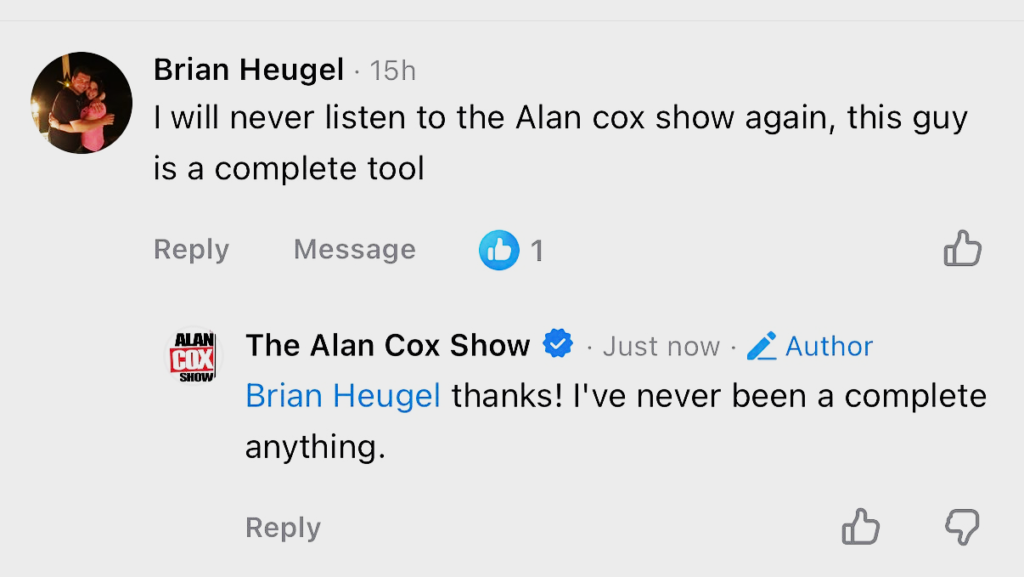
Cox also chooses not to argue with people on social media because he sees it as a waste of energy. “Instead, I’ll screenshot people’s nasty comments and respond with a pithy joke. Then I’ll post that and let the audience have fun with it.”
That wasn’t always his approach, though. “Earlier in my career, when I was a lot more insecure, I had a much more adversarial relationship with the audience because they were being critical and I was worried they were right. But I’ve put enough time in that they can’t say anything that’s going to bother me.”
Instead, he just wants people to enjoy his approach to doing a show. “This is my show; it has my name on it. I want to be silly, but also to convey that this is my job not my hobby,” Cox says. “I want people to have a good time but also hopefully know a lot of work goes into it. They don’t have to know how the sausage is made but hopefully they hear the effort when they tune in.”
Barrett Media produces daily content on the music, news, and sports media industries. Sign up for our newsletters to stay updated and get the latest information right in your inbox.
The Wall Street Journal just made a move that should catch the attention of every outlet chasing eyeballs and eardrums in the digital media race. The publication has tapped Samantha Henig to lead its expansion into podcasting and video, and the hire says a lot about how seriously the outlet is taking this next chapter of its business.
Henig isn’t a name plucked out of nowhere. She was on the ground floor of The New York Times’ audio team, serving as the outlet’s first hire in a division that has grown into one of the strongest podcast publishers in the game. That’s not hyperbole, either. The Daily is routinely one of the top shows in the country, regardless of genre, and it didn’t get there by accident.
Meanwhile, other New York Times alums have carried that momentum forward. Ezra Klein and Ross Douthat, before leaving to join 60 Minutes earlier this week, saw their profiles grow substantially in the audio space. Both built loyal followings through thoughtful, well-produced conversations, and both proved that opinion journalism translates well to a microphone. So the question now becomes obvious: can The Wall Street Journal replicate that same kind of success?
Why This Race Matters
It’ll be fascinating to watch this play out, and the stakes are higher than they might first appear. Consumption habits have shifted dramatically toward short-form video and podcasts, and that shift shows no signs of slowing down. Study after study and survey after survey confirm that these numbers are only increasing. Consequently, any publication hoping to stay relevant needs a real strategy here, not just a token presence.
The Wall Street Journal already has some solid footing in both spaces, which makes this hire feel less like an experiment and more like an escalation. Gunjan Banerji produces a spectacular series for the publication with The Money Interview, and it’s become appointment listening for people who follow markets closely. Additionally, The Journal podcast is one of the best in the medium, consistently delivering sharp storytelling on complex financial and political topics.
Specifically, the Camp Swamp Road series from The Journal that was released late last year was especially outstanding. It combined narrative depth with the kind of reporting rigor readers expect from the brand, and it proved the team could stretch beyond daily news hits into something more ambitious. Honig now inherits that foundation, along with the challenge of scaling it further.
Game On
I say all of that to say, it seems clear that The Wall Street Journal is especially serious about competing in this space. Hiring someone who helped build The New York Times’ audio operation from scratch isn’t a passive move. It’s a direct signal that leadership wants results, and it’s a signal that leadership understands what’s at stake.
Therefore, the real test will come in execution. Building a hit show requires more than talent behind the scenes; it requires patience, resources, and a willingness to experiment before finding a format that clicks. The Daily didn’t become a juggernaut overnight, and The Wall Street Journal’s next big audio bet likely won’t either. Still, the ingredients are there, and the ambition is obvious.
Game on. More content like this is better for everyone, whether you’re a listener, a viewer, or someone who simply cares about strong journalism finding new ways to reach people. Competition tends to raise the bar across an entire industry, and if The Wall Street Journal pushes The New York Times to keep innovating, audiences win either way. It’ll be worth watching closely in the months ahead.
Barrett Media produces daily content on the music, news, and sports media industries. Sign up for our newsletters to stay updated and get the latest information right in your inbox.
Welcome to RockTernative Summer Camp — the only camp with no curfew, free earplugs, and kick ass music at the lake each night.
You remember Summer Camp. It’s the perfect metaphor for what most brands should be doing between now and Labor Day.
Parents shipped off kids to camp. A few weeks later, they came home knowing how to make fire, tie knots, and canoe. Additionally, they returned with a lifelong crush on a counselor way too old for them. All in the name of gaining skills and building confidence for next year.
Radio knows what “next year” means. It means “Fall” — about 30 days away. So perhaps RockTernative needs a Summer Camp of its own. It would probably go something like this.
Lesson #1: Making Fire
If you’re stranded on an island, fire keeps you alive. It cooks food, purifies water, signals planes, and keeps wild animals away. However, fire doesn’t just happen. It must be built and managed with care.
In radio, fire equals the product and people.
Wood = leadership + team
Spark = on-air talent + music
Oxygen = strategy
Care = Camp Counselor PDs stoking the fire
There’s no fire without each element. What kind of fire is your brand running? A towering inferno or a sad pile of twigs?
If leaders aren’t leading with clarity, then the music isn’t right. If talent isn’t perfectly cast and sellers don’t have meaningful avails — the fire isn’t ready. It’ll fizzle by Halloween. So you need to self-reflect and adjust now. You’ve got 30 days.
Lesson #2: Build Shelter
Fire is great, but it won’t protect you from Fall. You need shelter. Not a flimsy promo tent, but a command center where real product and strategy work gets done before the season hits.
The cabin represents home base. It’s a safe structure with specific focus rooms where critical development work happens before Fall.
Morning Room: new storylines + benchmarks are built
Social Room: new digital extensions shaped
Garage: experimentation + strategy collide
Backyard: community + appearances take form
Kitchen: programming + revenue cooked into a strategy
A strong cabin where important work can be done is your competitive advantage.
Lesson #3: Survival & Safety
Campers are given a map. Survival requires knowing the terrain. Moreover, you need to know where to hunt, which areas to avoid, and what weapons you’ll need.
At camp, survival and safety equal research. So you’ll know:
What’s happening across the island
Where the audience is hiding
Which competitors are circling
What tools or weapons you need to stay alive
Which paths are dangerous
Even simple listener groups or web polls reveal what’s connecting. They show what listeners want more or less of, when they listen most and least, and why they choose or skip your brand.
Wandering blindly into Fall is dangerous. Just ask the kid who came back with poison ivy.
Lesson #4: Skills & Drills
Every camp has skill-building activities. Think archery, knot-tying, and three-legged races that bust ankles.
Even the best brands should put in practical work heading into Fall:
Audit everything
Recruit and audition potential new talent
Binge core artists for lost hits
Deep dive the audience
Study competitor movements
Summer Camp is a timely visual. Furthermore, this is legit to-do stuff starting Monday.
Lesson #5: Community
Kids at camp never stay indoors. They’re out meeting, bonding, singing cheesy songs, and developing a new crush every night over roasted marshmallows.
That same energy can make the difference at RockTernative. Especially since seeing external radio marketing is about as common as spotting Bigfoot. Community presence may be the only marketing a brand gets this year — but it’s still how new listeners can discover your brand.
Park takeovers
Backyard parties
Lake days
Lemonade stands (yes, I said it)
Club appearances
Sidewalk sessions
Tailgates
Get out and start growing your tribe before Fall.
Lesson #6: Cleanup
No one likes camp chores. However, they build discipline — cleaning cabins, clearing trails, fixing gear, and scraping gum off dining hall tables.
Radio needs the same discipline:
Tighten databases
Groom categories, audit rotations
Freshen clocks
Refresh imaging
Update street team assets
Sharpen one sheets
Clean the studio (yes, for real)
Fall will reward stations that feel new, clean, and alive.
Lesson #7: The Take Home Bag
Summer Camp ends and kids head home. They’ve gained new skills, confidence, and stories. Additionally, some return with a busted ankle.
But when RockTernative Summer Camp ends, brands head into Fall with:
A blazing fire
A stronger cabin
A fresh playbook
A mapped strategy
A bigger community
An alive vibe
Fall is coming fast. Waiting until Labor Day is too late.
Follow the RockTernative Summer Camp curriculum. You’ll avoid poison ivy and be ready to rock.
Barrett Media produces daily content on the music, news, and sports media industries. Sign up for our newsletters to stay updated and get the latest information right in your inbox.
Sometimes you have to let things die, and from death new life will come forth. This is eminently true for the happenings at CBS, including the Paramount deal and the death of CBS News Radio. As the famous refrain from Frozen puts it, sometimes you just have to let go and stop holding it back.
But first, a brief history lesson: RKO was one of the “Big Five” studios in the golden age of Hollywood.
It produced some of the greatest movies, like Citizen Kane, King Kong, and my personal favorite film, It’s a Wonderful Life. They signed the biggest artists, whom we still talk about well after their passing, including Fred Astaire, Cary Grant, and Katharine Hepburn (the latter of whom we all need to thank for the Bluetooth technology we use today).
RKO folded in 1958. In January of that year, 83% of American households had a TV — a huge industry shift that RKO did not keep up with. The company also faced financial strain; it carried an insurmountable amount of debt and was bought and sold multiple times between 1955 and its closure in 1958.
United Artists, founded by Charlie Chaplin, went through similar problems in the 1980s until it was dissolved in 2011 and folded into MGM.
These changing conditions are similar to what we are all facing and often talk about now. The way we connect with audiences is changing. Many outlets are financially strained and are attempting to find a path forward. CBS’s path forward is most clearly the same as RKO’s: to be dissolved into memory for its great moments while shying away from the embarrassing ones.
CBS’s Ratings Freefall
Turn away and slam the door on the way out, CBS — your numbers are in the toilet. During the week of July 13, CBS was the only national network to lose viewers, and it also failed to hit 500,000 viewers in the 25-54 age range for its flagship evening news program, the only national network to fall short there.
This is a downward trend that extends far beyond the introduction of Bari Weiss to the network. We’re just not that into you, CBS. It’s time to go.
The Paramount-WBD Merger Math
This Paramount/CBS merger with Warner Bros. Discovery (WBD) would bring both CNN and CBS under the same parent company. Two news networks are facing floundering ratings and blatant bias, and both are in desperate need of a complete makeover or closure.
Ignoring the fact that this merger would give Paramount and WBD an entertainment market share greater than Disney’s, and speaking strictly about the underperforming news outlets, you have to wonder if they could keep both CNN and CBS afloat. Is it too expensive?
It is also clear neither company wants to be the one to shutter the doors of a once-great media giant. However, the industry is too saturated, and there is not enough market share to go around. So, you could argue, one of them has to go. You are voted off the island. The tribe has spoken.
I don’t like this deal for a whole host of reasons and think it should be kicked to the curb. But again, speaking strictly about the news organizations being affected, if the merger happens, one (likely CNN) would probably be folded into the other (CBS). If this lawsuit succeeds and the merger doesn’t happen, at least one, if not both, of these outlets will not be around in the next five to ten years, in my view. And honestly, I’m not sure which option is better for the news industry. But I do know that with the technology we have, something good will come from the impending failures of CBS or CNN.
Let It Go — And Let Something Better Emerge
Either way, jobs are going to be lost. So the worker bees of the news industry need to let it go and find a new path forward — one that can and will likely be better than working at CBS or CNN.
Now let me be clear: I never like hearing that people are losing their jobs, that news outlets are closing, and/or that news deserts are becoming more prevalent. However, it is an unfortunate part of publicly traded companies — shareholders need to see returns, and those returns often come at our expense (aka our jobs).
Something Better Is Already Filling the Void
As I said in my May column, the death of CBS News Radio opens up new doors for the industry as a whole. There is a vacuum to fill, and ABC News Radio, Fox News Radio, and now the Worldwide News Network, among others, are all trying to fill it.
In fact, I’d find it hard to believe the powers that be at WNN would have started a 24-hour news radio network if CBS News Radio hadn’t closed. The same could be said if CBS News dies off — something bigger, better, and more beautiful could be ahead. You just have to let it happen. You just have to keep looking forward. Don’t become a pillar of salt by looking back at what was.
Independent journalism is on the rise. Consumers no longer need the CBS gatekeepers to tell us what is news and what is not. So if you are working at CBS or CNN, getting those awkward pro-merger emails that have been going around (I’ve seen them), and feeling skeptical that your job will survive if the deal happens, don’t panic. Don’t stress. Don’t worry. Be happy. Because we are watching in real time how this industry is changing, and what’s on the other side will be better than what CBS or CNN could ever offer you.
Barrett Media produces daily content on the music, news, and sports media industries. Sign up for our newsletters to stay updated and get the latest information right in your inbox.
Trevor Marden didn’t plan on becoming a morning show co-host. He planned on being a great producer. Then COVID hit, and everything sped up. Marden joined the “Jim Kerr Rock & Roll Morning Show” on Q104.3 as executive producer about a week before the pandemic shut everything down. What should have been a slow, years-long process of building trust with Jim Kerr instead happened almost overnight.
“The trust that normally takes years for a host and producer to build had to happen almost immediately,” Marden said. Suddenly Kerr needed him to run the board remotely and feed him information over an iPad, live, with no room for error. Marden and Kerr had to talk constantly on-air just to keep the show running. That forced closeness pushed Marden’s personality into the show years before anyone expected it to happen.
Six years later, that same trust helped carry the show into its next chapter. This March, iHeartMedia promoted Marden and Christin Marks to co-host alongside Kerr, adding fresh voices to New York’s longest-running morning show. Marden now heads to Cleveland this week for TalentMasters’ 38th Annual MSBC, where he’ll join Woody, Anna Zap and Karson Tager on a panel about building shows that last, moderated by Angela Perelli.
A Front-Row Seat to How Trust Gets Built
Marden’s path to the mic ran almost entirely through the studio, not around it. He spent his career as an in-studio producer, watching every call get made in real time rather than listening from another room.
“That gave me a front-row seat to how a great morning show operates,” he said, “but more importantly, how it earns and keeps the audience’s trust day after day.”
That education started even earlier, working alongside Scott Shannon. Marden calls him one of the best talent developers he’s ever been around, someone who can spot potential in people before they see it in themselves. Shannon kept a sign in the studio that stuck with Marden: “Preparation. Concentration. Moderation.”
Marden takes preparation seriously. He said he does enough prep for one show to fill eight, because he never knows where the next great bit will come from. Concentration means the outside world disappears once the mics go on. Moderation is the one he admits he’s still chasing — the instinct to push a joke too far or chase a laugh a little too hard.
“Scott tried to teach me that sometimes less is more,” Marden said. “I am the first one to admit this is a lesson I am still working on.”
Filling a Chair, Not a Legacy
Jim Kerr spent 49 years on-air with Shelli Sonstein before her retirement earlier this year. Marden never treated his new seat as a replacement for hers.
“That’s simply impossible,” he said. Sonstein could deliver music news, headlines, sports, weather and traffic in three minutes flat without ever overwhelming the listener, and her work with the FDNY, NYPD and the 9/11 community speaks for itself on its own.
So Marden approached the show differently. Jim and Shelli knew each other so well they could finish each other’s sentences. Marden’s job became asking the question nobody had asked yet, or steering a conversation somewhere new. He’s worked with Kerr for six years and still learns something about him almost daily.
The same philosophy applies to how he and Marks are introducing themselves to the audience — families, wins, disasters, all of it. “Listeners don’t just want to hear us,” Marden said. “They want to know us.” Kerr has always framed the audience as a friend, and Marden said that idea drives everything the show does.
Before Q104.3, Marden worked under a different name entirely: Kermit the Wonderfrog. When he arrived at the station, Kerr told him to just be Trevor.
“I don’t play a role here,” Marden said. “You usually get genuine Trevor.” He’ll occasionally play devil’s advocate to surface another side of an argument, but he said 99 percent of what listeners hear is real. He’s happy to wear the “heavy-metal-loving suburban New Jersey dad” label Q104.3 program director Eric Wellman gave him, because it fits — and he hopes it resonates with listeners who see themselves the same way.
Marden’s answer to what keeps a morning show alive for decades comes down to one idea: treat the listener like a friend.
“There may only be three people in the studio, but we always act like there are four,” he said. “The fourth chair belongs to the listener.” He said the goal is a backyard-hangout feeling, where the audience laughs along, disagrees, and shares its own stories rather than just listening in.
He also doesn’t think every show needs to chase everyone. “We’re not trying to make every single person love our show,” Marden said. “We’re focused on earning the trust of the people who choose to spend their mornings with us every day.”
Ahead of his MSBC panel, Marden said a “reply all” email thread among the panelists made clear just how many different philosophies exist on what makes a show last. Some responses he agreed with completely, others less so, and he said that’s the nature of the business. There’s no single formula, or every station in America would be number one. He’s looking forward to comparing notes with Woody, Anna Zap and Karson Tager, even knowing their approaches will differ from his own.
His advice for shows chasing longevity mirrors Shannon’s old sign: put in the work, and never act like you’re above the audience. “You should be punching up to them,” he said.
Who Else Deserves Credit
As has become tradition for my features, I asked Marden to turn the spotlight elsewhere for a moment and talk about talent he admires. He said, “radio has allowed me to travel the country, meet amazing people, and build friendships with talent I genuinely admire. I steal ideas from all of them.” His list included on-air talent like The Woody Show, Dave & Mahoney, The Joe Show in Tampa, The Daily Migs, Kira Kathleen on Y107, Cane at the Jersey Shore, Tamo in D.C., Battle in Nashville, and The Roula Show with Eric.
Behind the scenes, he singled out Kristen Accardi, executive producer of “Cubby & Christine” on 106.7 LITE FM. Accardi inherited an already-successful show and elevated it further, Marden said, calling her ideas creative, thoughtful and flawlessly executed. “She won’t be behind the scenes long.”
Radio’s Staying Power
Asked what gives him confidence in morning radio’s future, Marden kept it simple, borrowing a line plenty of artists have said before him: rock and roll will never die.
For anyone hoping to follow his path from behind the board to behind the mic, his advice is equally direct. Put in the work. Don’t be afraid. Learn from your mistakes, because there will be plenty of them. Marden said, “Be yourself and never second guess it.”
Barrett Media produces daily content on the music, news, and sports media industries. Sign up for our newsletters to stay updated and get the latest information right in your inbox.
The Columbus Blue Jackets will unify their television and radio game coverage next season. Moreover, fans will hear the same broadcast on both platforms beginning in 2026-27. Following the release of the news, sports media shares their reactions to the decision.
What We Know: The Columbus Blue Jackets announced that every game broadcast will be simulcast across television and radio starting with the 2026-27 NHL season. As a result, the television audio feed will air throughout the club’s radio network, including flagship station 97.1 The Fan in Columbus. Steve Mears will continue handling play-by-play, while former Blue Jacket Jody Shelley remains the color analyst. Additionally, radio listeners will now hear Shelley’s analysis, which has also appeared on TNT and Amazon Prime NHL broadcasts. Meanwhile, the club confirmed it didn’t renew the contract of longtime radio play-by-play announcer Bob McElligott after 17 seasons. In addition, Dylan Tyrer will remain part of the radio coverage as host.
What They Said: “Bob McElligott has made significant contributions to the Blue Jackets organization on the air and in the community over the past 17 years. Bob’s voice was at the heart of many of our club’s unforgettable moments. He helped shape memories that will live on for years to come. We sincerely thank him and wish him nothing but success moving forward.” -Columbus Blue Jackets Vice President of Business Intelligence & Broadcasting Marc Gregory
What Remains Unclear: The organization hasn’t finalized its television distribution plans for the upcoming season. Consequently, it’s unknown whether any additional broadcast changes could accompany the new simulcast model.
What It Means: The move aligns the Blue Jackets with a growing industry trend of using a single broadcast team across multiple platforms. It also gives radio listeners access to the same analysis and presentation television viewers receive while reducing the need for separate game broadcasts. At the same time, the departure of McElligott closes a lengthy chapter for the franchise after nearly two decades behind the microphone.
Embarrassing look for a league that claims to have made around $8 billion this season, for a franchise that's probably worth north of $2 billion, and for an owner whose company is valued at around $3 billion. https://t.co/EeVhtO12fm
for the 1,456,764th time…TV/Radio simulcasts are disrespectful to fans, a tremendously wasted opportunity for hometown messaging and team identity & a dereliction of content creation https://t.co/Wtk0VtGWQv
Shameful. And not just because I’ve known @BobbyMacSports for 20 years and he does first-rate work and is a first-class person.
Teams thinking simulcasts are good for listeners are just being cheap. This is terrible. #Sabres doing it 30 years shouldn’t be some endorsement. https://t.co/atbxfEKXnE
Absolutely dogshit decision by the @BlueJacketsNHL. Shouting from the rooftops that the radio audience does not matter. #CBJ fans were lucky to have an announcer like @BobbyMacSports. Dumb. Short-sighted. Cheap. Nothing good to say about this, so I'll stop now. https://t.co/G1bSpHk3dt
TV is an art, and radio is an art. Like how Nolan films demand 70mm screens, both the creator and consumer of these art forms suffer when they become one size fits all. https://t.co/9XP5p90IZg
This has not been a good off-season for the #CBJ and it just got worse. 1 @BobbyMacSports is one of the best humans there is. I've never seen another Broadcaster more willing to help the younger generation. A true pro. You never get better losing quality humans like him. https://t.co/1NtrYqFGzf
As a PxP broadcaster this is disheartening to see. @BobbyMacSports does an excellent job calling hockey. I feel awful for him. Not deserved at all based on the quality of his work.
Generally speaking, I’m not a fan of simulcasts. It’s not fair to the fanbase. Credit instead… https://t.co/Vpmlsx8Rs5
Barrett Media produces daily content on the music, news, and sports media industries. Sign up for our newsletters to stay updated and get the latest information right in your inbox.