FIFA has reportedly not released formal bidding guidelines for the upcoming 2030 and 2034 men’s World Cups. According to Puck Media, media giants like Fox, Netflix, Disney and YouTube are already weighing their options.
What We Know: FOX Sports paid roughly $485 million for English-language U.S. rights to this year’s tournament, while Telemundo committed $600 million back in 2011 for Spanish-language rights. Those figures are roughly a discount for FOX Sports following litigation with FIFA. Audiences are watching this year. England’s win over Mexico drew 44.8 million U.S. viewers, and the USMNT’s loss to Belgium pulled in roughly 46 million. Given that surge, rights fees could nearly double for 2030 and 2034 according to Puck Media.
What They Said: According to Puck Media, FIFA has yet to release any details of the packages for the 2030 and 2034 World Cups. This also includes if hydration breaks will continue.
Anonymous executives via Puck Media: “Everybody’s thinking about it. We’re thinking about it. But nobody’s focused on it. And certainly nobody has any idea on how much this is all going to cost.”
What Remains Unclear: Plenty remains up in the air. FIFA hasn’t confirmed whether hydration breaks will return, a detail worth an estimated $200 million in ad sales this year for FOX Sports. It’s also unclear if the 2034 Saudi tournament will run in summer or shift to November and December, as Qatar did in 2022.
What It Means: Even without clarity, expectations are forming. According to Puck Media, executives believe FIFA will offer four bid types, similar to the IOC model: English-only, Spanish-only, combined, or a contingent Spanish bid tied to winning English rights. Networks will likely submit initial bids before FIFA returns to top contenders for a second round. Until FIFA speaks publicly, though, everyone is negotiating in the dark. The price tag will likely rise, but it remains to be seen who could afford the bill.
With the overperforming World Cup headed into its final (and probably thrilling) stretch, FIFA is seemingly in the catbird seat in negotiating rights deals for 2030 and 2034. And while there is no shortage of suitors, there are surprisingly few details, and a time-zone penalty…
Barrett Media produces daily content on the music, news, and sports media industries. Sign up for our newsletters to stay updated and get the latest information right in your inbox.
Bonneville believes radio still has room to grow. Scott Sutherland says the industry’s biggest challenge is turning audience growth into revenue.
What We Know:Bonneville International Executive Vice President of Regional Media Scott Sutherland believes broadcasters should focus on adapting instead of dwelling on industry disruption. He argued that audience growth remains a positive sign, even as companies balance traditional broadcasting with digital distribution. Sutherland also said radio companies have untapped revenue opportunities because many existing products still aren’t fully monetized. Rather than trying to sell every new offering, he suggested broadcasters should build a more focused strategy around the products that deliver results. Those comments came during an appearance on the Radio on Main Street podcast from the RAB and its CEO, Mike Hulvey.
What They Said: “For us, it’s what are we willing to do differently, and how do we get growth. I think that’s the holy grail. With all the turbulence that we’re having, there is a great path for us. It’s complicated. It’s difficult right now. But I still go back to, if our audiences weren’t growing, there is a problem right now. But they are. So how do we figure that out with all the distribution channels that are coming at the same time?
“On the sales side, it’s complicated because we have to monetize these new revenue streams. But we have a ton of products, and we’re not selling 100% of our products. So to me, that’s where there’s enormous opportunity on the revenue side. A challenge to figure it out. You can’t be where we want to sell everything. I think we all got kind of bit in the rear for a while, where all these new products are coming out and we want to sell everything. That’s a problem. But I think when we figure this out, there is a growth plan, and I’m excited about it. Doesn’t mean it’s not difficult, but that excites me.” – Scott Sutherland
What Remains Unclear: Sutherland didn’t identify which products Bonneville believes offer the strongest growth potential. He also didn’t outline a timeline for implementing any broader revenue strategy across the company’s markets.
What It Means: Sutherland’s comments reflect a growing belief that radio’s future depends less on building larger audiences and more on monetizing them across multiple platforms. His remarks also suggest broadcasters should prioritize execution over chasing every emerging product, even as the industry’s distribution options continue to expand.
Barrett Media produces daily content on the music, news, and sports media industries. Sign up for our newsletters to stay updated and get the latest information right in your inbox.
Fubo has a new chief executive. Alisa Bowen is leaving her post as Disney+ president to take the job, effective immediately.
What We Know: Fubo’s board tapped Bowen to succeed David Gandler. He served as the company’s co-founder and CEO for more than a decade. The move follows last fall’s merger of Hulu + Live TV into Fubo, which handed Disney a 70% stake. Bowen spent nearly 10 years at Disney, most recently as Disney+ president. She helped build Disney+, Hulu and ESPN+ from Disney’s founding streaming team. Before Disney, she held leadership posts at News Corp, Dow Jones and Thomson Reuters.
What They Said: Andy Bird, chairman of the Board, Fubo: “Following the combination with Hulu + Live TV last year, Fubo has reached a pivotal moment in its strategic evolution, with a compelling Pay TV platform, strong content portfolio and unique integration in the Disney ecosystem. Alisa’s appointment is the culmination of a thoughtful process led by the independent directors of the Board to find the next leader to advance Fubo’s strategy and performance. Alisa is a proven operator who brings nearly 30 years of product, digital and operational experience, including leadership across Disney+, Hulu and ESPN+. She has an established track record of driving global subscriber growth and profitability, and we look forward to benefiting from her experience and expertise as Fubo enters its next chapter.”
Alisa Bowen, CEO Fubo: “I am excited to lead Fubo in its next phase as we sharpen its strategy across sports, news and entertainment. Also accelerate growth and drive profitability, while delivering even greater value to Fubo and Hulu + Live subscribers, our advertisers and our content partners. I look forward to working closely alongside this talented leadership team to strengthen Fubo as an industry leader. Creating significant value for all of our shareholders.”
What Remains Unclear: Disney hasn’t named a direct successor to Bowen at Disney+. Instead, co-presidents Joe Earley and Adam Smith now share that streaming portfolio alongside other Disney titles, according to Variety.
What It Means: Bowen inherits a larger, more complex platform than the one she’s leaving. Her mandate will be to sharpen Fubo’s sports, news and entertainment strategy while driving profitability. Ultimately, the switch closes one chapter of Fubo’s decade-long history and opens another closely tied to Disney’s streaming ambitions.
Barrett Media produces daily content on the music, news, and sports media industries. Sign up for our newsletters to stay updated and get the latest information right in your inbox.
Radio still reaches more Americans weekly than any other platform. New Nielsen data confirm that dominance is holding steady even as media habits diversify.
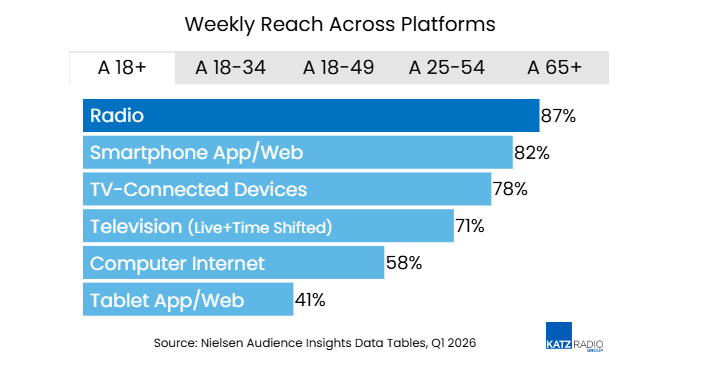
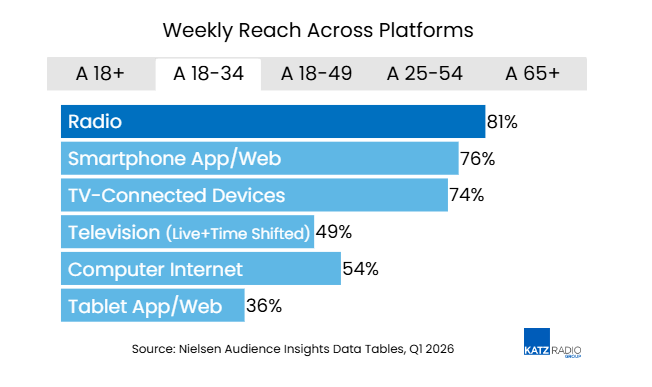
What We Know: According to the latest Sound Answers series, AM/FM radio reaches 87% of U.S. adults each week, according to Nielsen Audience Insights. That’s the broadest weekly reach of any measured platform. Radio’s edge is even sharper among younger listeners, reaching 81% of Adults 18-34, more than any other platform tracked. Reach also stays strong among Black and Hispanic adults, with listening holding steady year over year. While media consumption is expanding, it’s not shifting away from radio. Television saw a seasonal rebound in Q1 2026, boosted by the Super Bowl and Winter Olympics. Meanwhile, daily smartphone usage grew by nearly 90 seconds, led by Black Adults 18-34 and 18-49.
What Remains Unclear: There’s no data in the release that points to radio losing ground to any single competitor specifically. Whether that be television, smart phones, or other.
What It Means: For advertisers, radio remains a dependable way to reach mass, diverse audiences at scale. Despite misperceptions about younger generations and their usage, radio’s advantage holds among younger consumers. Weekly reach among A18-34 hit 81%, ahead of smartphone app and web use at 76%. Radio also held the top spot in every age breakdown presented in the report, including adults 65 and older. That demographic’s weekly reach hit 90%, just ahead of television’s 87%. As television and smartphone engagement rise and fall seasonally, radio still holds its position. That stability makes it a strong complement to digital and mobile campaigns rather than a competitor to them.
Barrett Media produces daily content on the music, news, and sports media industries. Sign up for our newsletters to stay updated and get the latest information right in your inbox.
Washington State Football and Men’s Basketball are heading back to the airwaves in Seattle. Bonneville’s Seattle Sports 710 is once again the Cougars’ flagship station.
What We Know: Washington State Athletics and Bonneville Seattle Media Group announced a new multi-year partnership. Moreover, Seattle Sports (710-AM) returns as the Seattle flagship for Cougar Football and Men’s Basketball broadcasts. This, in addition to, pregame and postgame coverage. When conflicts arise with Seattle Mariners or Seahawks programming, WSU games will shift to 770 KTTH-AM. The Cougar Sports Network, managed by Playfly Sports, remains the official broadcasting network for Washington State Athletics.
What They Said: WSU Vice President and Director of Athletics Jon Haarlow: “Seattle Sports gives us an incredible opportunity to connect with Cougs across Washington and throughout the Pacific Northwest. As the region’s premier sports media brand, Seattle Sports provides a tremendous platform to share the stories of our programs, student-athletes and coaches. Reaching all Cougs wherever they are is critical to our outreach, and we’re excited about what this partnership means for the future of Washington State Athletics.”
Seattle Sports Program Director Kyle Brown: “We’re thrilled to partner with Washington State University Athletics at such an exciting time, as the new Pac-12 takes shape and the Kirby Moore era begins. At Seattle Sports, our goal is to be more than just a radio station. This renewed and expanded partnership allows us to deliver even more coverage for Cougar fans through enhanced on-air programming, original video content, and the Seattle Sports app – connecting fans across Western Washington and around the world.”
What Remains Unclear: Financial terms of the multi-year agreement were not disclosed.
What It Means: The agreement continues to build on a partnership between the university and the radio station. In addition, this deal strengthens Washington State’s regional footprint as the Pac-12 rebuilds under new membership. Meanwhile, expanded streaming across baseball, women’s basketball, and multiple apps signals a broader push toward year-round digital access.
More ways to follow the Cougs ‼️
WSU Athletics and Seattle Sports 710-AM have announced a new multi-year partnership, expanding Cougar Football and Men’s Basketball broadcasts across the Puget Sound region.
— Washington State Cougars (@WSUCougars) July 9, 2026
Barrett Media produces daily content on the music, news, and sports media industries. Sign up for our newsletters to stay updated and get the latest information right in your inbox.
Philadelphia’s 92.5 WXTU has found its new midday voice. Beasley Media Group officially named Jen Scordo as the station’s full-time midday host, effective immediately.
What We Know: Scordo is no stranger to WXTU or Philadelphia radio. She previously served as the station’s fill-in midday host and brings deep market roots — including stops at WMMR, WMGK, Cat Country 107.3, and 97.5 The Fanatic. Her new role was announced live on the Andie Summers Show Friday morning.
What They Said: “Philadelphia has been my home for the past 25 years, and WXTU has always represented everything I love about country radio,” Scordo said. Program Director Chuck Damico praised her natural ability to connect with listeners, calling her “a true talent” with a great sense of humor and tremendous work ethic. VP and Market Manager Paul Blake echoed that sentiment, noting her professionalism and authentic listener relationships.
What Remains Unclear: No details have been shared about who will handle fill-in duties during Scordo’s absence or whether the midday daypart will see any format adjustments. It’s also unknown what her long-term contract terms look like.
What It Means: This is a smart, low-risk hire for Beasley. Scordo already knows the brand, the market, and the audience. Promoting a proven fill-in removes uncertainty and signals stability in a daypart that can be tough to anchor consistently. For WXTU, continuity matters.
Barrett Media produces daily content on the music, news, and sports media industries. Sign up for our newsletters to stay updated and get the latest information right in your inbox.
On Thursday, Barrett Media announced that all panels from last week’s Barrett Media Audio Summit will be posted on YouTube. If you weren’t able to make the event in New York City, you’d be well served to watch as many of the panels as you can.
ake time after your shift, before your shift, on the weekends, or whenever you can to focus, take notes, and try to learn something (or multiple things) from each of these panels. Even as someone who was there, I plan to watch them back because I know I’ll find something that I didn’t pick up on in the moment. And while there’s nothing like being in the room, meeting new people, seeing old faces, and having the in-person experience, this is the second-best option.
With that, the three biggest takeaways that are relatable to hosts and programmers, while also being time-sensitive, are the following:
Playing The Trump Card
This panel with Sid Rosenberg of 77 WABC, Mark Simone of 710 WOR, and Larry O’Connor of Salem Radio Network, with Erick Erickson of Compass Media Networks as the moderator, was excellent.
Every host is trying to figure out how to navigate Trump World. It’s been 10 years of Donald Trump dominating the news cycle, and the current state of the world and country has divided Republicans and conservatives in a way we haven’t seen since the tumultuous but wildly entertaining primaries of 2015-16.
However, if you were looking for A-list stars to give you the green light to criticize the President when you disagree, you got it here. This doesn’t mean anyone on the panel regrets their vote or would prefer President Harris, but admitting you disagree with the administration should not be off-limits. Your listeners are regular people. Even if they voted for the President and are like-minded, it doesn’t mean they approve of every move the President makes.
So why do you feel like you have to? Because you host a news/talk radio show in 2026? Just open the mic, say what’s on your mind and heart, be honest with your audience, and welcome their reaction. That’s talk radio at its best.
Dollars on the Dashboard
Everyone is trying to figure out how to get, and then retain, a younger audience. One of the most obvious things to do is to use your dashboard effectively. Fred Jacobs’ presentation was excellent.
And when it comes to the things people want on their radio dashboard, three of the Top 5 are relatable for news/talk radio: Number Two was emergency weather (58%), Number Three was breaking news alerts (50%), and Number Four was breaking traffic alerts.
How can you efficiently and effectively utilize your dashboard, beyond the obvious of showing name/host/phone number, to keep the audience engaged?
They are telling us what they want, so now it’s our job to deliver.
Getting Serious withStephen A. Smith
Stephen A. was excellent in his sit-down with Jason Barrett. He’s a sponge who wants to get better every day and wants to keep learning. And just like in sports, that’s what the best do. They never think they have it figured out.
Stephen A. shared that he expects an e-mail after each of his SiriusXM shows from Dave Gorab, VP and GM of talk programming at SiriusXM Radio, critiquing that day’s show. And guess what? Dave delivers the said e-mail. And Stephen A. wants the good, the bad, and the ugly. He’s not looking for all the accolades.
I tracked Dave down after the show and told him how impressed I was with this part of the conversation and the work he does with Stephen A. He shared a personal anecdote: one day he forgot to e-mail Stephen A., and Gorab received a note from Stephen A. that evening asking if everything was OK and why he didn’t receive critiques for that day’s show.
That’s amazing. How many people do you know, or work with, who think they have it all figured out?
And then, one of the biggest stars in media is looking for and expecting constant feedback to continue to grow, get better, and stay ahead.
I could write another 10 takeaways, but hopefully this gives you the incentive to start diving in and watching on YouTube. Enjoy!
Barrett Media produces daily content on the music, news, and sports media industries. Sign up for our newsletters to stay updated and get the latest information right in your inbox.
Josh Martinez spent more than 12 years at iHeartMedia. Five of those years were spent on Z100 New York’s night show, one of Top 40 radio’s most visible seats. Now, after exiting amid the company’s ongoing consolidation, Martinez is a free agent. He’s treating the moment less like a setback and more like a strategic reset.
“I’m trying to reconnect with the same hunger I had in my early 20s,” Martinez said. “I’ve been in radio for 18 years. One thing I’ve learned is that talent opens doors, but relationships and work ethic keep them open.”
A Free Agent With a Plan
Martinez has never made a career move without thinking several steps ahead. He’s long described his rise through radio as a chess match. That mindset hasn’t changed now that he’s off the board at Z100.
This chapter has already pushed him outside the iHeart ecosystem he knew for over a decade. He’s meeting new people across companies and platforms he hadn’t worked with before. His plan isn’t to rush. It’s to build.
“My goal is to keep building on those relationships, stay prepared, and be ready when the right opportunity presents itself, whenever that may be,” he said.
That patience extends to how he views the industry. Martinez was exploring opportunities beyond traditional broadcasting even while he still held a full-time radio job. He sees versatility as the new currency in media.
“Whether it’s radio, digital content, podcasting, video, hosting or live events, I think it’s important to be versatile,” Martinez said. “The people who continue to grow are the ones who are willing to evolve.”
From La Mega Doubts to Z100 Pride
Martinez’s Z100 tenure carried weight beyond ratings. He became the first full-time Puerto Rican host on the station this millennium. Representation shapes how he thinks about whatever comes next.
Growing up, he assumed his only path in radio ran through Spanish-language stations like La Mega. He wasn’t fluent in Spanish, and that made him question whether mainstream radio had room for him at all.
One moment changed how he saw his own impact. A listener once asked where he was from, then told him he sounded just like the guys he grew up with. The listener added he never expected Z100 to hire “one of us.”
“That stuck with me because I never tried to sound like anyone else,” Martinez said. “I just sounded like any other kid who grew up in New York or New Jersey.”
He carries that responsibility forward, whatever platform he lands on next. “I’ve always believed people deserve to see themselves represented authentically in media,” he said, whether that’s radio, television, or his long-standing dream of WWE.
Before Z100, Martinez logged serious time in Des Moines, Cedar Rapids, Dayton and Cincinnati. Those stops rarely make the headline of his career. He credits them for nearly everything he knows.
His first full-time job in Des Moines had him working as music director, imaging director and night host at once, for a $26,500 salary. Cedar Rapids piled on even more. He programmed the station, produced Elvis Duran’s show locally, ran promotions, hosted afternoons and built imaging.
“Looking back, I’m incredibly thankful for those opportunities because it forced me to become a well-rounded programmer and host,” he said. “You learn every part of the business and you learn to solve problems creatively because there usually isn’t a huge budget behind you.”
That scrappy, do-everything foundation still guides him today. It’s part of what he wants programmers to know about him as a free agent.
Wrestling Dreams and Open Doors
Radio isn’t the only ring Martinez wants to step into. His podcast, “The Superstar Crossover,” has landed conversations with CM Punk, Seth Rollins, Paul Heyman, Becky Lynch and Tony Khan. He’s had ideas land on AEW television and recently made a brief on-camera appearance with TNA Wrestling.
“Professional wrestling has been my passion for as long as I can remember, so I’d absolutely welcome the opportunity to work with a major wrestling company in an on-camera role,” Martinez said.
Still, he’s not narrowing his focus. Sports media, digital content and live hosting are all on the table.
For any PD or executive reading this, Martinez wants one thing understood clearly. He competes to win, and he checks his ego doing it.
“Authenticity matters more than ever,” he said. “Audiences know when you’re full of shit and forcing something, so I’ve always tried to be myself and create genuine connections with listeners on-air and at events.”
Martinez isn’t shy about what layoffs feel like from the inside. He leaned on an unlikely source for perspective: Knicks star Jalen Brunson. During New York’s championship run, Brunson said you’re allowed to think about the worst-case scenario, but you still have to do something about it.
“Everyone processes uncertainty differently,” Martinez said. “For me, acknowledging the difficult emotions isn’t the problem, staying there is.”
His advice to peers navigating their own exits is blunt and practical. Feel what you need to feel. Then move. Update the resume. Take the meeting. Learn a new skill. Rebuild.
Paying It Forward
I asked Martinez if there are any personalities in radio right now that he felt are worth spotlighting. He didn’t come back with one or two names; instead, he sent me thoughtful notes about eight members of our industry. I’m including his thoughts below in his exact words because while my goal in doing this feature on Martinez was to highlight a talent who should not be “on the beach”, I think it’s important that we all keep lifting each other up as much as possible.
Shelley Rome — I’ve said for years she’s one of the most underutilized personalities in any form of media. She has the talent, versatility and professionalism to excel in virtually any role, including a major-market morning show.
Brady (KISS FM Chicago) — One of the hardest-working people in the business. His off-air hustle is just as impressive as what he does on the air. That dude busts his ass on a level rarely seen.
Eric White (Charlotte) — He understands content and knows how to immerse himself in a community, making everything he creates feel local and authentic.
Vont Leak (KDWB Minneapolis) — Exceptionally creative and always pushing himself to try something new on-air on social media.
Sol Tsonis (Columbus) — Tremendous talent with the drive and personality to succeed at a very high level in any form of media.
Cat Sodano (WBLI) — She has an incredibly natural connection with her audience. Her content feels authentic, relatable and perfectly matched to her station and who she is.
Amanda Gaudiosi (Poconos) — One of the brightest young talents I’ve seen. She’s early in her career but already understands what it takes to build a successful brand.
Israel Nunnely (Seattle) — I’ve worked with him on airchecks, and he’s someone I’d bet on. He has the work ethic, talent and mindset to become one of the next great personalities in our industry.
Martinez’s instinct to lift so many others up, paired with nearly two decades of range across markets, formats and now podcasting, is exactly why his free agency shouldn’t last long.
Barrett Media produces daily content on the music, news, and sports media industries. Sign up for our newsletters to stay updated and get the latest information right in your inbox.
There is an art to doing great interviews, and if anyone has come close to mastering that art, it’s Julia Cunningham. Host of The Julia Cunningham Show on SiriusXM’s Radio Andy channel — which is focused on Andy Cohen’s expansive pop culture universe — she regularly interviews all kinds of celebrities. That experience is how she’s learned to manage the variety of curveballs guests can throw at her.
For Cunningham, a great interview starts with balance. She weighs her personal curiosity against the audience’s interests — even when her curiosity leans toward more obscure projects. “I think to myself, what does the audience want to know and what do I want to know, because I’m often more curious about a project that is not necessarily something everyone else brings up,” she says. “I like asking unexpected questions.”
She also wants to take care of her guests. “I want that person to walk away feeling like not only were they completely understood, but they can also be proud of whatever project they were working on.”
Preparation Is Everything
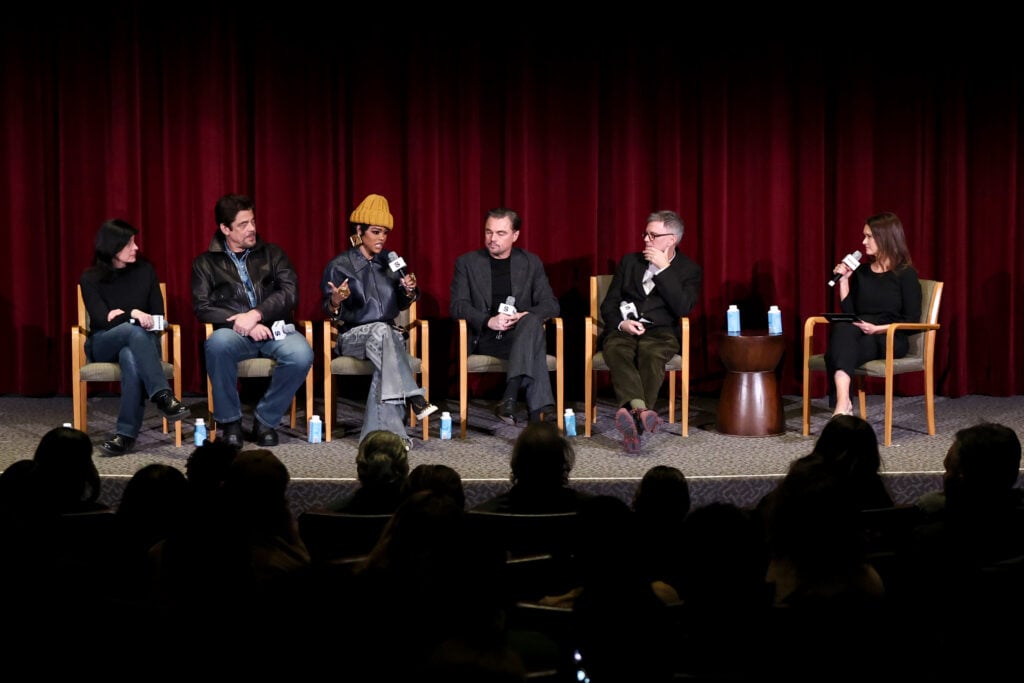
Her biggest tool for successful interviewing is preparation, which Cunningham admits she can sometimes take too far. For example, she recently conducted an interview with the director and cast of One Battle After Another. “I went back and watched the movie another five times. I wasn’t letting anything slide by.”
NEW YORK, NEW YORK – JANUARY 14: (L-R) Cassandra Kulukundis, Benicio del Toro, Teyana Taylor, Leonardo DiCaprio, Paul Thomas Anderson and Julia Cunningham speak during SiriusXM’s Front Row Series With The Cast And Creatives Of Warner Bros. Pictures’ “One Battle After Another”at DGA Theater on January 14, 2026 in New York City. (Photo by Jamie McCarthy/Getty Images for SiriusXM)
While that might seem excessive, there is a method to the madness. “I was way overprepared, but I slept well knowing that I wasn’t going to crash and burn.” She adds that she has always liked homework, so all the studying doesn’t bother her. “I always like to feel that I’m overprepared, never underprepared.”
It Takes All Kinds of People
No matter how much preparation she does, Cunningham also has to adapt to each guest. “Some people can be nervous or just aren’t great storytellers, and that’s when I have to think, ‘how do we get there? How do I make them feel more comfortable?'”
But her years of experience have also taught her that patience really is a virtue. “I’m less scared of the silence now. When I ask a question and the answer is just yes or no, sometimes I just wait. Then they fill that silence because they’re uncomfortable.”
Other times it’s the exact opposite. Some guests bring so much energy they nearly take over the interview — Cunningham calls them Tasmanian Devils. Balancing control with entertainment value becomes critical in those moments, like when she moderated a Q&A that included Chris Robinson of The Black Crowes. He quickly stole the spotlight.
“I realized Chris is this majestic Tasmanian devil. I threw my cards in the air and thought I just had to let him be himself, because the crowd was devouring everything he was saying and doing. He was having the time of his life and people were responding to it.” So she let him go — for a while. “But then you have to find a balance. It takes a lot of resetting, asking specific questions that have limited answers and making sure the person that isn’t talking a lot gets pulled in too.”
Through all of that, she’s also juggling time constraints. “I have an amazing producer named Sarah, who is always in my eyeline and giving me time cues. Then I have to think about what the most important things are that I can fit in during the remaining time. I’m listening, but also doing my own mental gymnastics.”
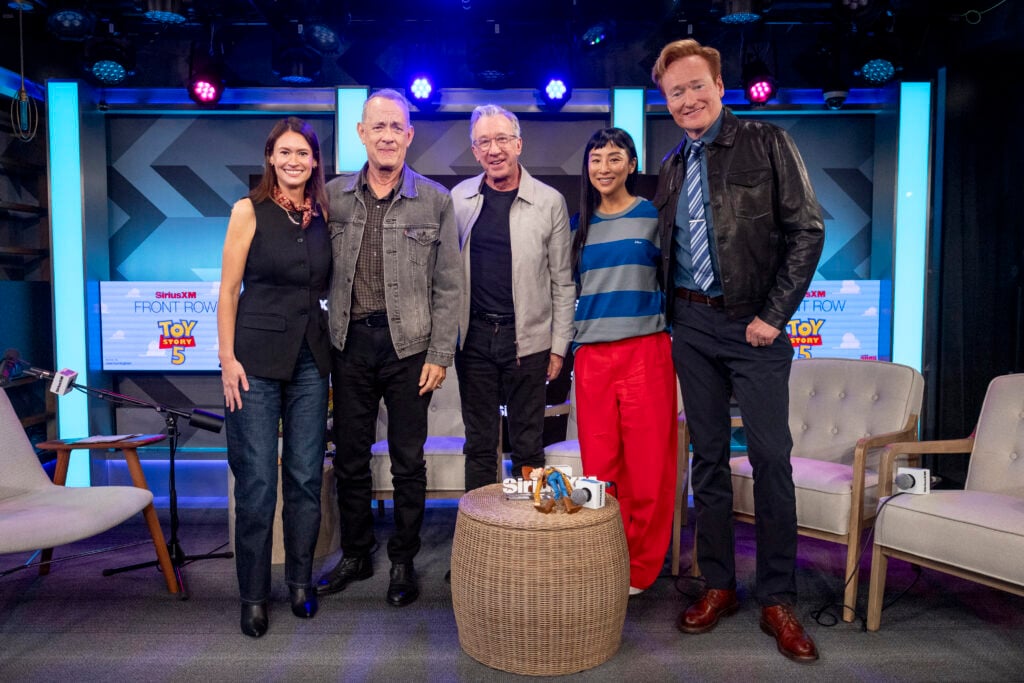
LOS ANGELES, CALIFORNIA – JUNE 10:(L-R) Julia Cunningham, Tom Hanks, Tim Allen, Greta Lee and Conan O’Brien attend SiriusXM’s Front Row with the cast of “Toy Story 5” at SiriusXM Studios on June 10, 2026 in Los Angeles, California. (Photo by Emma McIntyre/Getty Images for SiriusXM)
Learning From the Best
Cunningham’s skill as an interviewer comes not only from experience but also from studying several talented journalists. One of the most influential is Jess Cagle, former Editor-in-Chief of both People and Entertainment Weekly.
When Entertainment Weekly partnered with SiriusXM for the EW Radio channel, Cagle launched his own show and asked Cunningham to co-host. “Getting to sit next to him every day was a master class in how to up my own game,” she says.
Cagle’s biggest strength was the ability to ask tough questions. “Jess did a beautiful job of setting the scene and leading up to it in a way that gave context for the listener and gave the guest a heads up that the tough question is coming,” Cunningham says. “He acknowledged that this is a thing everyone is wondering about, you need to answer it, and here it is, plain as day.”
Sometimes, even though it’s uncomfortable, Cunningham says difficult stories need to be told. “Especially when it comes to addiction or having gone through something incredibly serious like a mental health break. It can remind the guest that telling their story allows people to understand it better and lets light shine on that type of scenario. When that happens, I always thank them for being vulnerable.”
Working With Andy Cohen
Today, working on Radio Andy, Cunningham works closely with Andy Cohen, whom she sees as a modern-day version of another cultural icon with a similar name — Andy Warhol. “He looks at pop culture in a way that no one else really does or has. I think what he has built is an incredible legacy. It’s an honor to represent his ideas and feelings.”
She says what sets Cohen apart as a host is the way he carries himself. “He does amazing interviews. He knows how to ask the questions that everyone is dying to know, but he does it in such a casual, nonchalant way. I’m still learning how to do it with that sort of chutzpah.”
Navigating a Complicated World
Much like Warhol did in his time, Cunningham now finds herself walking a tightrope as politics becomes a bigger and bigger part of the pop culture landscape. “I think art is political no matter what. And I know people can argue whether or not The Real Housewives is art, but it is.”
She would prefer to watch shows without wondering where the performers stand on the political spectrum, but it’s difficult. “It bums me out, especially if it differs from my point of view. I try and take some things at entertainment value, but there are issues that are also deeply important to me.”
Cunningham believes highlighting women’s voices and advocating for people in below-the-line jobs is important, but so is delivering what the audience wants. “I think the listeners know that I’m going to use my voice to lift up things I believe in without just sitting there and complaining,” she says. “But I also know that they’re tuning in to hear about The Real Housewives and Summer House. I realize I have a platform to use my voice, but I use it strategically, and I’m mindful that when I make a point it’s done with purpose.”
In the end, politics aside, Cunningham believes the best interviews reveal something about the subject. “I think it’s important to tap into the person, what their point of view is, and what they’re trying to get across through their music or their book or their movie.”
Barrett Media produces daily content on the music, news, and sports media industries. Sign up for our newsletters to stay updated and get the latest information right in your inbox.
There are a lot of theories on what defines a successful sports program in the modern era. It’s a period defined by short attention spans, playing the hits, and distributing content across every traditional, streaming, and social platform available. Few programs buck those trends and remain successful as generations of consumers continue to change how they consume content. One of those programs is ESPN’s Pardon the Interruption.
It’s no secret that PTI remains as familiar as the four letters of the network it calls home. For a quarter century, Tony Kornheiser and Michael Wilbon have hosted a show that perfectly blends sports, insight, and entertainment for audiences with both lean-in viewing habits and increasingly shorter attention spans. It’s rarely changed its formula, if ever. The personalities have room to breathe. It’s built for clip culture but refuses to embrace it, remaining the lone piece of appointment television on a network designed to serve sports fans anytime, anywhere.
In an era of inflated viewership, where nearly every sport and studio show is posting impressive gains, PTI remains a constant. It continues to lead every ESPN studio program in viewership. Just last month, PTI averaged 665,000 viewers per episode. That’s a 21% increase year over year and the program’s highest June audience since 2021.
Among ESPN’s studio programs, PTI still sits atop the rankings, averaging more than 200,000 more viewers than Get Up and 150,000 more than First Take in June. Looking at the past six months of released ESPN data, the trend remains impressive. PTI posted its best first-quarter average audience this year, drawing 777,000 viewers. That’s 16% higher than the show’s performance during the same period last year.
Keeping The Main Thing
Mind you, this is a program built around two stars. Kornheiser and Wilbon are showcased from 5:30-6 p.m. ET as the main attraction. It’s appointment programming by design, never moving from its daypart. Both personalities also rarely appear elsewhere across ESPN’s lineup. By resisting the temptation to spread their star power across the network, ESPN preserves the value of the feature presentation each afternoon.
Longevity breeds familiarity and connection. Kornheiser and Wilbon are throwbacks to a time when newspaper columnists were ESPN’s premier opinion-makers. They’re not hot-take artists. They’re seasoned communicators whose experience, reporting, and perspective drive the conversation.
The set has barely changed. Two chairs, never three or four. A desk where both hosts face off with little separating them. Faces of the biggest names in sports surround them like royalty watching combatants inside a coliseum. The theme music, graphics, opening, and closing all remain the same. A welcome to the boys and girls and a goodnight to Canada.
While nearly everything else in sports media has evolved, PTI hasn’t chased the changing digital consumer. The show and its stars don’t fit what many networks now expect from their top-tier talent.
Socially active? Hardly. Kornheiser and Wilbon have largely stayed away from social media, especially compared to many of ESPN’s biggest personalities. You’ll find an occasional post or comment, but very little engagement.
Clip culture? PTI shares its opening segment on X. That’s it. Instagram, Facebook, TikTok be damned. If you want to hear what Kornheiser and Wilbon think about the biggest topic of the day, you still have to tune in at 5:30 p.m.
On demand? Sure, you can catch the show later via podcast or the ESPN app. But you won’t find full episodes on YouTube or every major video platform.
Not Broke, Don’t Fix
PTI is different. It always has been. It doesn’t need to change simply because the industry says it should. PTI doesn’t chase a different audience because it has never abandoned the one it already built. It’s the rare nostalgia play that never became outdated, delivering a familiar format anchored by personalities audiences still trust.
In a media landscape obsessed with reinvention, Pardon the Interruption has quietly proven that consistency can be just as powerful as innovation.
ESPN hasn’t chased every trend with PTI because it hasn’t needed to. The network hasn’t flooded social media with endless clips, asked its stars to become full-time content creators, or reinvented the show to accommodate every new viewing habit.
Instead, it continues to trust the formula that made PTI successful in the first place: two respected voices, intelligent conversation, authentic chemistry, and a half-hour audiences still make time to watch.
Sometimes the smartest programming decision isn’t finding the next big thing. It’s recognizing when you’ve already built something people refuse to abandon.
If it isn’t broken, don’t fix it. After 25 years, Pardon the Interruption remains one of the strongest arguments in sports media that success doesn’t always come from chasing every trend. Sometimes, it comes from knowing exactly who you are and having the discipline to stay that way.
Barrett Media produces daily content on the music, news, and sports media industries. Sign up for our newsletters to stay updated and get the latest information right in your inbox.