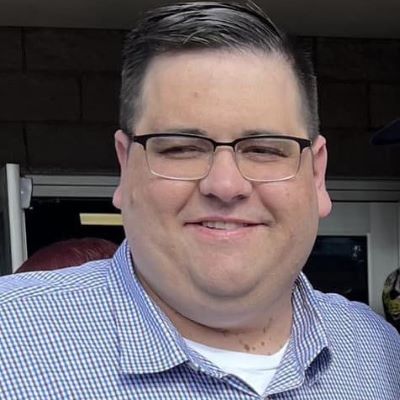
Today, like most days, the eyes of the news/talk radio world are on Washington, D.C. as the government shutdown continues. But for 105.9 WMAL morning host Larry O’Connor, it’s just another day inside the nation’s capital.
While many news/talk radio hosts will aim the focus of their shows on Washington, D.C., Larry O’Connor does a show in Washington, D.C., and he believes there’s a distinct difference between the two.
“When we talk about our community, we’re not just talking about that one-mile stretch down Pennsylvania Avenue, between Capitol Hill and the White House,” O’Connor said. “But what’s funny about it is that when we go hyper-local and find really good stories that are happening in our community, they often end up being national stories.”
O’Connor pointed to stories about local school boards during the COVID-19 pandemic as evidence of this fact, adding that the high-profile nature of being near the capital adds fuel to the news cycle fire.
“We’d have the school board members on the air. We’d challenge those school board members with really fiery interviews. The next thing you know, those stories are prime time at Fox News, because those producers are listening to us on the way in as well,” O’Connor shared. “So, suddenly, what started as a local story on the local radio station ended up being a national, even international story.”
As the government shutdown becomes the second-longest in U.S. history, it continues to be a hot-button topic in news/talk radio circles.
And while others in far-flung locales are able to opine on the subject with reckless abandon for those affected by the shutdown, Larry O’Connor doesn’t have that luxury.
He noted that it’s “very popular and very easy” to get on the air and say “to hell with those federal workers.”
But that isn’t the case when those same workers are your P1s.
“I get it, trust me, I get it,” he said. “But if you did that doing Seattle radio, and you start screaming about Starbucks and Microsoft, your listeners are going to be pretty pissed off. If you got on a (Los Angeles) radio station, (and said) ‘Yeah, screw everybody who works in the film and television industry. Let them get fired, I don’t care,’ yeah, that’s not going to be good for your bottom line.
“Ultimately, these are Americans who have jobs, and it’s not their fault if the federal government is bloated,” he continued. “They’ve got the jobs. And when you’ve got a government shutdown and they’re having trouble making their next rent payment, it’s cold comfort to them that once it’s over, they’ll get their back pay.”
O’Connor added that it goes beyond the scope of those who only work for the federal government.
“There are also a lot of people who work for contractors, who interact with the federal government,” he shared. “They don’t get their back pay. They’re out of work right now, and they’re not going to get these paychecks made up. They’re my listeners, too.
“And I think on a human level, we should just recognize that when any employee for any business, they’re being used as political pawns, and they’re the ones who are suffering because politicians are flexing their political egos and trying to build up their own political capital,” he continued. “Those are human beings who have families. They’re getting stuck in it. We try to be as compassionate as possible for those people.”
O’Connor did note, with a chuckle, that oftentimes “the people who are hardest on federal workers are other federal workers,” joking that much of the response from the audience of those affected by the shutdown is that the government actually is bloated with too many employees.
In addition to his work with 105.9 WMAL, Larry O’Connor is involved in several digital products. Most recently, he announced that he is now co-hosting a new weekly podcast with Heritage Foundation President Kevin Roberts, which will relaunch this week.
He also hosts a show for Town Hall, which features much more extended commentary than what the fast-paced news/talk morning show allows.
And he says that stretches some muscles that the radio show doesn’t always allow to be exercised.
“Doing a morning show means that we have a pretty strict clock: shorter segments, lots of topics, traffic and weather every 10 minutes, news breaks at the top and bottom. It’s your typical clock. Which means the longest I get on a topic without taking a break is about eight minutes,” O’Connor said. “When I start my live stream at noon for my Town Hall show, I usually go for about an hour. It averages about an hour and 15 minutes without a break.
“I can take as long as I want. I aim for about 20 minutes per topic of just me monologuing or interacting with videos and audio on a topic. Sometimes I’ll do an interview, but usually it’s just me. So it definitely exercises a muscle to be able to talk about a topic for as long as I want without a break, building the story arc and the narrative. It’s been good for me.”
He added that having that ability to enter more long-form discussions on a topic has also helped him on his radio content, as well.
“It’s allowed me to sort of open up the way a story is presented,” he admitted. “And it’s also helped discover new revenue streams for our industry. And I think radio needs to do that. They need to figure out new ways to bring in drive revenue, and bring in revenue to our to our industry, if we’re going to survive.”
Larry O’Connor added that he appreciates the instant metrics digital media can provide versus the analysis and data that terrestrial radio has relied upon for decades.
“We know very well if we’re performing well, because within 24 hours, we know what our download numbers are,” he said. “We know what our views on YouTube are, we know exactly how we performed, we know exactly when we started to lose the audience, because we can track the views during the show. When people leave, when more people come, what segment of the show got recommended digitally, on social media, and things like that.
“And because of that, there’s no guesswork involved. There’s no averaging, there’s no sampling, there’s no meters, there’s no waiting for the ratings book to come out. It’s the real measure of success when you’re looking at views on YouTube and downloads and podcasts, and there’s no fudging it and there’s no faking it.”
Barrett Media produces daily content on the music, news, and sports media industries. To stay updated, sign up for our newsletters and get the latest information delivered straight to your inbox.