

A federal judge handed public media a victory Tuesday. But not everyone in the media industry is celebrating.
U.S. District Judge Randolph Moss ruled that President Trump’s executive order ending federal funding for NPR and PBS violated the First Amendment. The White House had accused both networks of being “biased” and fueling “left-wing propaganda with taxpayer dollars.” Judge Moss disagreed — strongly. In a 62-page opinion, he said Trump exceeded his authority and issued a permanent injunction blocking the administration from implementing the order.
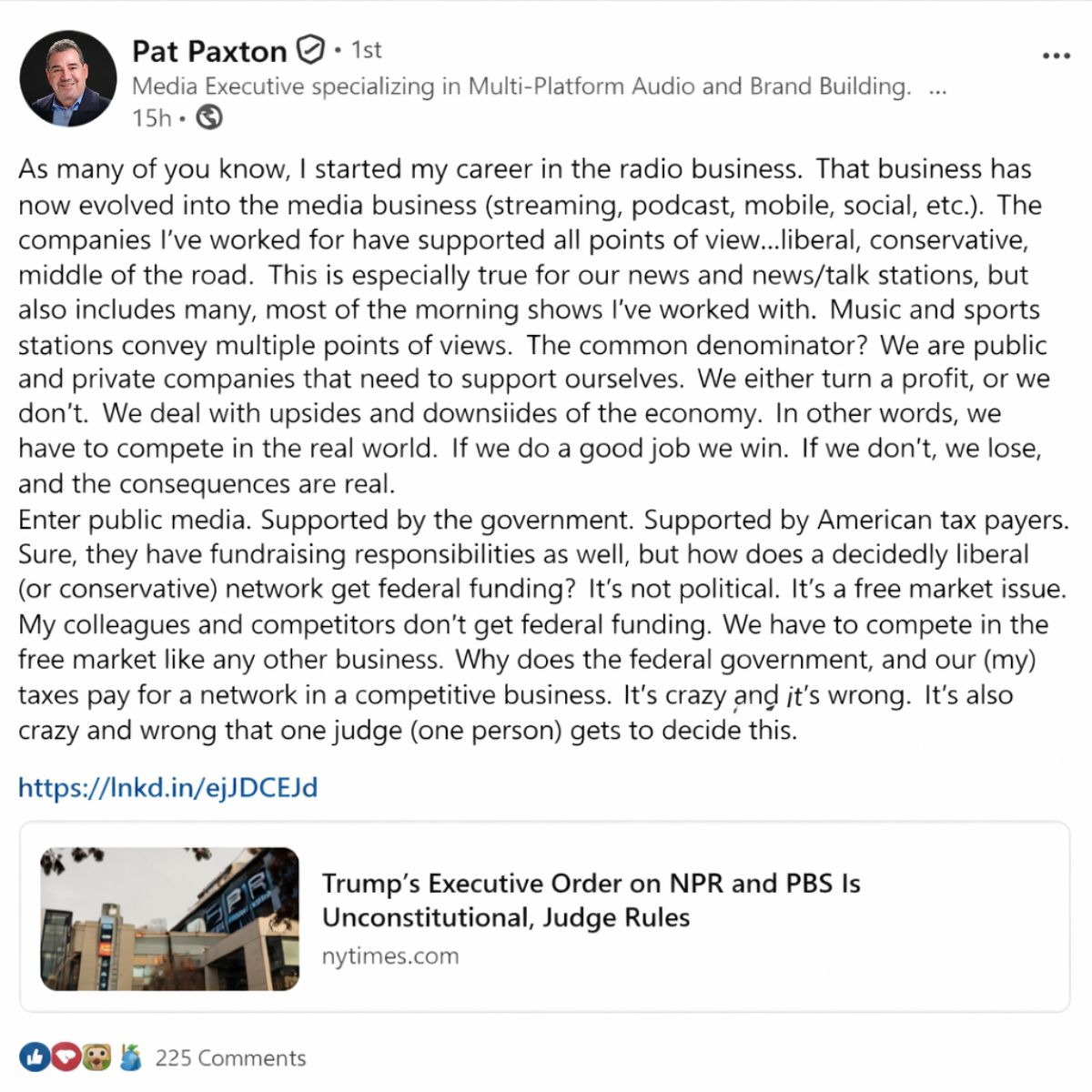
The ruling ignited reaction across the media industry. One of the most pointed responses came from Pat Paxton, Senior Vice President of Content at Saga Communications.
Paxton didn’t debate the First Amendment. He focused on the free market.
“The companies I’ve worked for have supported all points of view — liberal, conservative, middle of the road,” Paxton wrote. “We are public and private companies that need to support ourselves. We either turn a profit, or we don’t.”
Commercial broadcasters live and die by ratings and revenue. There’s no safety net. No government backstop. Paxton has spent his career in that world, and knows what it means to compete.
“We deal with the upsides and downslides of the economy,” he added. “In other words, we have to compete in the real world. If we do a good job, we win. If we don’t, we lose, and the consequences are real.”
Paxton isn’t alone in that thinking. His frustration reflected something many in commercial media feel but rarely say out loud. Why does a network — with an identifiable editorial lean in either direction — receive taxpayer subsidies? His colleagues don’t get that luxury.
“My colleagues and competitors don’t get federal funding,” Paxton wrote plainly. “We have to compete in the free market like any other business.”
Many share similar feelings about the competitive imbalance. Trump’s executive order immediately cut millions from the Education Department to PBS for children’s programming, forcing one-third of PBS Kids staff to be laid off. Yet even amid those cuts, both networks have remained on the air, sustained through listener donations and corporate support. Commercial operators don’t have that luxury.
Paxton also raised a separate concern — one about judicial power.
“It’s also crazy and wrong that one judge — one person — gets to decide this,” he said.
The ruling’s practical impact remains limited. Congress already rescinded public media funding last summer, and the Corporation for Public Broadcasting has dissolved. One judge’s opinion doesn’t restore a single dollar.
The broader debate isn’t really about NPR or PBS. It’s about whether the government should fund any media operation competing in today’s crowded landscape. Trump’s own executive order made that argument directly, noting that “the media landscape is filled with abundant, diverse, and innovative news options” and that government funding of news media is “not only outdated and unnecessary but corrosive to the appearance of journalistic independence.”
Paxton’s take lands somewhere similar — just from the perspective of someone who’s competed against publicly subsidized media his entire career. That perspective deserves to be part of the conversation.
Barrett Media produces daily content on the music, news, and sports media industries. Sign up for our newsletters to stay updated and get the latest information right in your inbox.
