

Thank you for checking out ‘The Industry According To’. This series runs each Tuesday, and features radio and record industry executives, managers, programmers, talent, artists, and professionals from all areas of the business world. For future guest considerations, email me at keithblackboxgroup@gmail.com.
Today we check in at the executive level with a veteran programming leader who understands how to build content at scale across large markets and also in smaller communities. For decades, he served as Chief Programming Officer at Entercom and Audacy — Pat Paxton.
Currently, Pat is the SVP of Content at Saga Communications, overseeing content teams across more than 100 brands in nearly 30 markets. I’m especially glad that he joined this series. So much industry attention focuses on PPM markets but there are far more non-PPM markets in the U.S. doing great radio and producing some of the industry’s biggest success stories.
So, let’s dive in.
What Has Really Evolved?
Keith: Your programming career spans decades. Since the ‘90s, what’s the most important programming evolution radio has made?
Pat: I think that’s a moving target as there have been several “most important” breakthroughs since the 90’s. Let’s go back 42 years to 1984 when the 12-12-12 ownership rule was implemented. No company could own more than 12 AM stations, 12 FM stations, and 12 TV stations. This was up from 7-7-7. In 1990 the FCC upped the radio limits to 36 nationwide, 18 AM’s and 18 FM’s. Then in 1996 the business changed dramatically with “Telecommunications Act of 1996” which still stands today allowing one company to own up to 8 stations in a market evenly split between AM and FM. This Act was one of the greatest disruptions our industry has ever seen and is now 30 years old and being challenged by many ownership groups. There may be more deregulation on the way.
Let’s look at technology. The advances we’ve witnessed have been astounding. While the internet was officially invented in 1983, it wasn’t widely available until the early to mid 1990’s. Think about how that changed our world. I’ll skip forward to today as we’re witnessing another life changing technological advancement with AI. You can love it or hate it, but there is no question that it has or will change how we all think and do our jobs.
The last advancement I’ll mention here happened in 2007, the year PPM was introduced by Arbitron. This one changed everything we thought we knew. Everyone from CEO’s to part-time announcers to sales assistants to engineers had to think about our industry differently.
What’s next? Who knows. There’s no question that we’re not finished evolving. I hope we never are.
Coaching Without Data
Keith: Many stations can no longer afford research, and some markets don’t even receive ratings. How do you coach programmers to know if they’re heading in the right direction when traditional data isn’t there as a guide?
Pat: Between Audacy and Saga, I’ve had the incredible pleasure of working in America’s largest and smallest markets. The one constant shared by successful programmers (we call them Directors of Content, some call them Brand Managers) is their passion for what they do. It’s the love of what they do. Their dedication and belief in what they do help them deal with both the best times and the worst times. They network with other successful programmers. They use what tools are still available such as Mediabase. Most importantly they get to know their audiences and communities better than anyone so they instinctively know what works and what doesn’t.
One of the things that I’ve learned since joining Saga is that there is some amazing radio being done in smaller markets. Incredibly talented people who could be working in major markets but choose not to. They choose to stay home and stay near family. They make a lifestyle decision. I think they are underappreciated and underestimated in our industry.
Are We Overthinking?
Keith: The industry spends a lot of time debating radio’s future. But listeners just want something good to hear when they turn it on. Is the industry overthinking and spending too much time on the future instead of simply focusing on how a brand or show can sound better tomorrow — or is the balance about right?
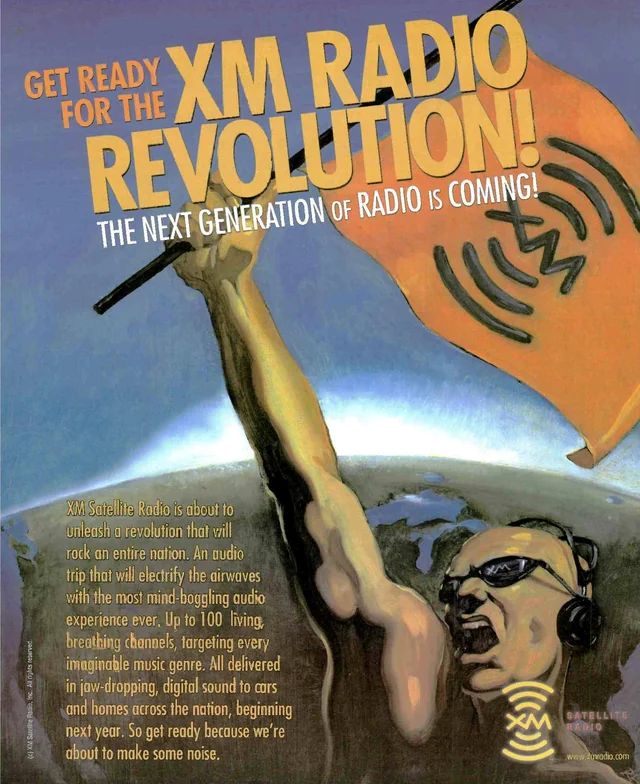
Pat: Two issues relating to your question come to mind. First is we, as an industry, have an inferiority complex. This all started in 2001 when XM Radio was born, followed quickly in 2002 by Sirius. XM Radio debuted with a $100,000,000 marketing budget, primarily focused on the “Radio to the Power of X” campaign largely featuring talking points about why they were better than traditional radio. Our response? Zero. Zilch. We were getting beat up, repeatedly punched in the face. Many started to believe the hype.
Since then we’ve seen the rise of streaming media. You Tube, Spotify, Apple, and too many others to mention have also, in part, aimed their guns at us. They want our listeners, but just as important is that they want our revenue. They want our dollars. The question I often ask myself is that if we’re so irrelevant and standing on the footsteps of extinction, why does everyone keep coming after us? If I want to make nickels, I’m not going to try to squeeze nickels out of a rock. I’m going to go where the nickels are to do my nickel hunting.
Which leads to issue #2. Perception. Some of you buy this, some of you don’t. But my position is (and it’s backed up by facts and numbers) is that we have hundreds of millions of people who engage with us every single week. Remember, we live in an “impressions” based eco-system today. No longer is our radio cume good enough. If you look at, collectively, the number of people we touch and engage with every day (radio, mobile, social, podcast, video, etc.), you realize what an amazing story we have.
The problem is that those who control a lot of dollars simply don’t believe this. Many marketers are entranced by whatever the newest, shiniest thing is, and the money follows that thinking. I wish I had a game-changing idea on how to fix this. I don’t. All we can do for now is to continue to be a megaphone for the industry and continue to chip away at this false narrative.
How Important is Local?
Keith: You’ve long believed in “live and local.” It’s a key cornerstone of Saga’s philosophy. In an industry where downsizing is the norm and voicetracking is now decades old, how important is local really? Is it more important in some markets than others? What is the real cost of losing that local connection?
Pat: It’s really important to note that I would take great national content over bad local content every time. It’s not good enough to just be local. All content needs to be great, compelling, engaging, etc. Add to that a local spin that relates to your listeners and community and you’ve won.
This is especially true with Saga and many smaller markets where interacting with your listeners is so important. Some of the larger companies have adopted a national approach because they have the scale to do so. I get it and totally understand their position. However, that leaves an opportunity for us (Saga) to pivot away from national and be as local as humanly possible in everything we do. That doesn’t mean we don’t voice track. We do, but we insist that our voice trackers create shows for each specific station and market. We also aren’t afraid to use talented syndicated hosts in certain situations.
Again, I’d take great national over bad local any day. There have been situations where hiring someone to do great local wasn’t a feasible option. In these few instances, we’ll go with a national show with great content.
Content Strategy
Keith: Every company talks about “content strategy,” but what does that actually mean in your office on a Tuesday afternoon at Saga? What strategies are you developing and directing across all those stations and markets?
Pat: Probably our most important strategic initiative today is our approach to content distribution and production. I think everyone realizes that we need to be available everywhere our listeners are. But not everyone knows how to do that. We are seeing some pretty positive results so far with video creation, mostly for social media. We have more than a few examples of talent making videos that create millions of views. Add to that the engagement these posts generate and you wind up with some pretty impressive numbers that can then be monetized. Our industry happens to employ some of the best local influencers available. Why wouldn’t we want to take advantage of their local “star” status and generate even more likes and followers than what we could generate using radio only?
The More Difficult Revenue Puzzle
Keith: You’ve been responsible for helping guide revenue in highly ratings-driven markets. Now you also oversee many markets that aren’t rated but still have revenue expectations. Which situation is more challenging, and why?
Pat: Honestly, neither is easy. Both have challenges, but the challenges are different. When I was at Audacy, it wasn’t so much about any individual market, but all about scale. How could we in programming help drive revenue across the board? Events are a good example. We could do one big show in New York, Detroit, or LA, and create millions of dollars in sponsorship revenue because we could scale similarly formatted brands to the event. It was a national, scaled play.
Saga, for the most part, is not as reliant on national dollars. We have a handful of PPM markets where ratings still drive significant revenue, but in many of our markets it’s more about the team. The GM, the sellers, the announcers, all use the relationships they’ve spent years developing to earn the trust of the local business community. Then we deliver. If we don’t do what we said we’d do, we lose that trust. Under promise and over deliver is always a good premise to work and live by.
The one area we all have to succeed in, no matter the market size, is digital. And the good news is that no other industry has the megaphone that we do to create digital demand. Our brands deliver unprecedented reach for our customers, one of which happens to be us! Creating awareness of our digital products and including our digital assets in every sales presentation are critically important. This isn’t to say digital is more important than radio. It’s not. But it has certainly become as important.
Los Angeles vs. Bucyrus, OH.
Keith: You’ve seen success in markets like New York and Los Angeles — “KRTH is #1 again.” What does programming success look like in a market like Bucyrus, Ohio? What makes the champagne bottles pop in a market like that?
Pat: It’s the recognition and satisfaction you get when you help your community. When you are thanked and appreciated by countless local residents for the fund drive you just did, for the community event you just put on, for keeping the community informed, for knowing you make a difference in countless lives. I’ve been fortunate enough to be part of many ratings “highs”…that adrenaline rush you get when you first download a book (assuming it’s good). I can honestly say that smaller markets experience the same kind of rush when doing something special for their communities. They feel the love. It’s very real.
Recruiting in 2026
Keith: When you need to fill an on-air position in a smaller market today, where are you looking? How are you finding and developing the next generation of talent for Saga?
Pat: Great question. It’s hard. We’ve had positions open for months before we found the right person. The traditional training grounds (overnights/weekends) are long gone. But, young people are still creating content. In fact they are doing it in record numbers. Social media and podcasting have created entirely new funnels with their ease of entry into content creation. The really good ones are not easy to find. But once you do, the value proposition we can offer them (massive exposure to their brand) is something that no one else can offer. Start by looking locally or regionally. You’re unlikely to convince influencers with millions of followers to come join your local morning show. But the ones with talent who are trying to build a following might just jump at the opportunity.
There are still plenty of young people interested in radio. Not as many as previous years, but they’re there. Many just need an opportunity…someone to take a chance on them like someone did for all of us years ago.
AI
Keith: AI clearly has the potential to help broadcast companies in several ways, but what’s one area you believe AI should just stay far away from radio?
Pat: AI personalities. I’m afraid of everything we put at risk, everything we lose, if we start replacing real personalities with AI. Listeners want engagement, companionship, and authenticity. It’s part of the relationship and commitment we’ve made to consumers, who in turn have chosen us to spend time with.
That said, I’m a big fan of AI. I use it all the time in both my personal and professional lives. I think it can be immensely useful in so many ways. But replacing personalities, to me, is a step too far.
Best Practices
Keith: Programmers often talk about Nielsen “Best Practices,” which some would argue hurt the listening experience. But you’re in a fascinating position: some Saga markets are Nielsen rated, some aren’t ratings-driven at all. Which Nielsen practices still matter in non-rated markets, and are there principles smaller markets follow that bigger markets may be overlooking?
Pat: Many PPM principles remain the same no matter the size the market. Reasons that cause tune out are mostly universal. When announcers talk about something no one cares about, people tune out. When a song is played that people don’t want to hear, consumers tune out. All the rules of music scheduling are the same in all markets. The art of programming applies in all markets. I used to use Media Monitors to find patterns driving tune out. We used this data to coach PD’s and talent.
For example, many personality driven rock morning shows felt they must have a sports person, or at least a detailed sports report because they are, after all, male focused brands. But the data shows that many male rock listeners don’t go to their favorite morning shows to hear about sports. There was consistent tune out when sports reports came on multiple rock morning shows. Another example was traffic reports on many music stations. Research might say that listeners want traffic reports, but tracking their behavior told a very different story. And, don’t even get me started on tune out that comes with morning shows interviewing comedians who went to bed an hour and a half ago.
I still use a lot of what I learned in markets where more tools were available, to coach PD’s and talent today.
Free Markets
Keith: You recently posted on LinkedIn about the difference between commercial media companies that compete in the free market and public media organizations that receive government funding. Your post wasn’t political, although some commenters tried to steer it into a left vs. right debate. From your perspective, what’s the core issue here? What do you think people outside (or even inside) the industry misunderstand about that dynamic?
Pat: Yea. I kind of hopped into a hornet nest with that one. It’s a moot point as Congress has already defunded public media. I had one point to make, and only one. It was totally apolitical. Federal funding for public media began in 1967. The “1967 Public Broadcasting Act” mandate was and is “to provide educational, non-commercial programming and serve underserved audiences.” There are many great arguments for and against federal funding of public media but I’m not sure anyone would argue that public media is “non commercial”. Just because they say “underwritten by” before a toned down ad does not make them non commercial. That premise was abandoned years ago.
Regarding “educational” programming, the original argument was made because there were limited news outlets and children’s programming available. Today I couldn’t even count the number of news outlets available. Between radio and TV there are left leaning outlets, centrist outlets, and right leaning outlets, and everything in between. There is quite literally something for everybody in todays free market. The same goes for children’s programming. PBS gave us Sesame Street, Mr. Rogers and other great shows for kids. But today there are a plethora of media outlets serving children 24/7. And if you prefer the public media productions, no problem because they are still available on PBS. Or go to You Tube. It’s all right there.
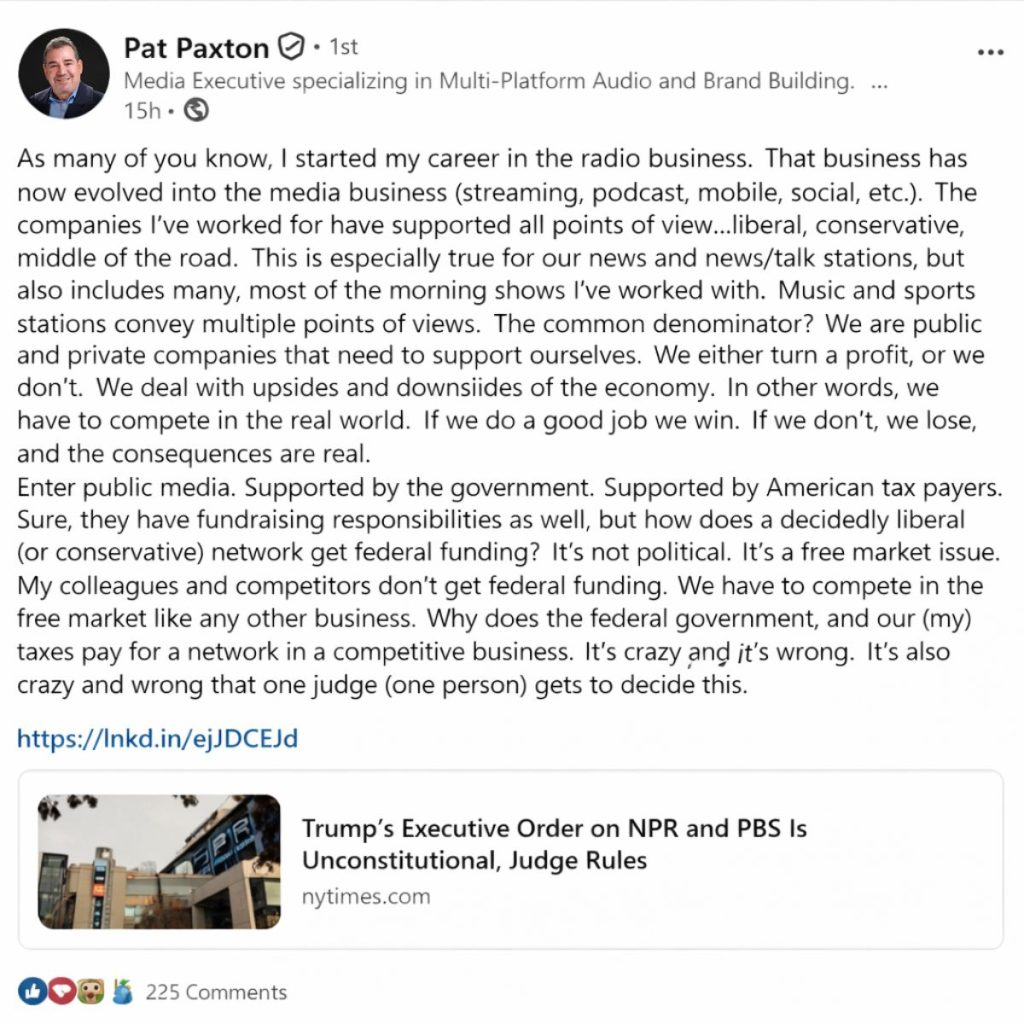
An argument often used by those to support federal funding for public media is that it represents only a small fraction of the total NPR/PBS budget. That brings up two points. First, if the money is so inconsequential, why is it such a big deal? Most of us have been asked to cut a far larger percentage of our budgets over the years. Second is that the number that public media receives from taxpayers is $550,000,000. A year. I bet I could find a lot of non-public media CEO’s who would have no problem taking their share of that windfall.
Those of us in commercial media don’t get handouts. We have to survive on our own. If we don’t there are very real consequences as many of our colleagues have unfortunately experienced.
Finally, I have been swayed to the argument that there are communities that without public media would have no free media at all. For that I would carve out an exception. Public media goes after the same listeners and marketing dollars that commercial media does. To say that they are not competitors is simply not based in reality in 2026.
To be clear, I am NOT anti-public broadcasting. I think they do a great job in many ways. They have a place in todays world. I just don’t think tax payers should be funding them, creating an uneven playing field for the rest of us.
Barrett Media produces daily content on the music, news, and sports media industries. Sign up for our newsletters to stay updated and get the latest information right in your inbox.

Not only was our industry’s response to XM’s 100m marketing campaign “zilch,” we all had to clear XM spots the various networks sold them.
Talk about letting the wolf in the hen house.