

There’s a moment in every conversation with Aaron Axelsen where you forget you’re talking to someone with three decades of influence in Bay Area alternative radio. He’ll be mid-sentence about booking Arctic Monkeys at his club in 2005, or running a dance party in Oakland in the early ’90s, and it hits you — this guy is simply doing what he has always done. He’s turning people on to music.
That’s not a PR line. It’s the throughline of everything Axelsen has built.
A Career Rooted in Passion
His run at Live 105 in San Francisco spans from intern in 1994 to music director in 1997 to afternoon drive host — a full-time career from 1996 to 2020 — and now a weekly specialty show called Soundcheck. He launched Soundcheck back in 1999. He believes it may be one of the longest-running specialty programs in commercial alternative radio history. That’s not a small claim, and it’s hard to argue with it.
“I’ve always had this insatiable appetite to discover new music since I was in high school,” Axelsen said. “Whether it was going to Berkeley and buying records and making mixtapes, or working in record stores and college radio, I’ve just always had this penchant for discovering new music and introducing it to friends and people. That has been the impetus, the foundation of my entire career.”
That foundation produced results. Axelsen broke Coldplay, Arcade Fire, Billie Eilish, The Killers, and Imagine Dragons — among many others — long before the rest of the country caught up. He’s quick to say there’s no trade secret to it. Passion plus competition, blended together. “If you ever see me on the softball field, you know I’m competitive,” he said with a laugh. “I like to find the biggest new artists first and book them for Popscene or play them on Soundcheck.”
Thirty Years of Popscene
Pop Scene is the other pillar of Axelsen’s career, and it turned 30 this year. What started as a monthly dance party in San Francisco — a group of friends from a Berkeley record store who were self-described “hopeless Anglophiles” spinning Britpop, The Smiths, New Order, and Joy Division — grew into something no one planned on.
“We didn’t go into starting Popscene as, hey, we’re going to be doing this for 30 years,” Axelsen said. “It just kind of happened by our passion and a relentless commitment to creating a scene.”
The list of artists who played their Bay Area debut at Popscene reads like a music fan’s greatest hits. Amy Winehouse, Billie Eilish, Charlie XCX, The Killers, Glass Animals, Imagine Dragons, Sam Smith, 1975, Sam Smith, Calvin Harris, Maggie Rogers — and Muse, in 1999, in front of 132 people. That night mattered. It still does.
The formula Axelsen built was deceptively simple. A built-in crowd of 300 to 400 people already dancing, then a band takes the stage. The audience came for the experience. The artist got the audience. Booking agents noticed. Eventually, Marty Diamond called when he wanted Arctic Monkeys to play. That’s how you know you’ve built something real.
“Popscene is kind of a microcosm of my passions,” Axelsen said. “Radio is an audio form of introducing new music. But the club world is something tangible where people actually come and see live music. With everything that’s changed in this industry — with AI and all the crazy things going on — that has never been replicated. The experience of going to a venue, being around people with the same passions, seeing live music. That can’t be copied.”
Building Flood FM From the Ground Up
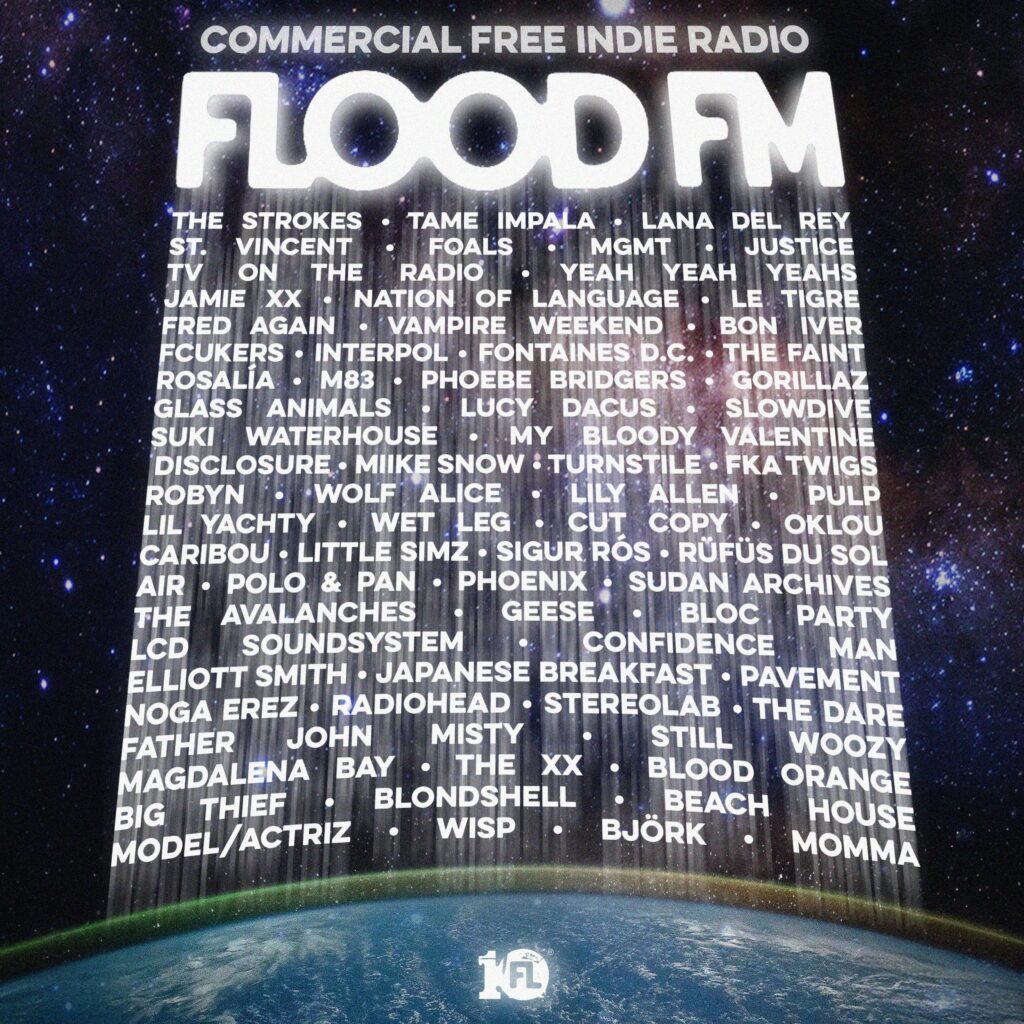
When Live 105 was shut down during COVID, Axelsen used the downtime to build another platform. Flood FM — a 24/7 indie streaming radio station built in partnership with the Flood music brand — is now in its fifth year. It’s available on Live 365, TuneIn, Apple Radio, iHeart, and the Odyssey app, reaching a global audience. The station runs 70% current music, with a strong catalog of Y2K indie titles underneath. He describes it as what would happen if someone handed him $10 million to start his own radio station. He just doesn’t have a terrestrial stick.
When Live 105 came back post-COVID, Axelsen came with it. He hosts Soundcheck once a week now, operating remotely from Salt Lake City — where he relocated five years ago when his wife took a lead graphic designer role with a western wear company. He returns to the Bay once a month, runs Popscene from there, and records Soundcheck from there as well.
The virtual era suits him fine. However, it also sharpens his concern about what’s being lost every time a station cuts a live, local personality in favor of automation or syndication.
Case for the On-Air Personality
“The average person, the average commercial radio listener — they don’t have time to sit there and listen to a thousand new records a week,” he said. “They listen to radio stations. They trust that you are going to do the heavy lifting. They expect you to bring the best 20 to them.”
Axelsen still finds music everywhere — KEXP, Spotify, Pitchfork, Stereogum, NME, music blogs, and trusted booking agents. But his strongest conviction cuts deeper. A skilled on-air personality — one who bridges the gap between an emerging artist and a mainstream listener without getting too heady or too obscure — beats any algorithm every time.
“If you can play someone Phoebe Bridgers and say, ‘Dave Grohl is a huge fan of this,’ you’ve connected the dots,” Axelsen said. “That’s the art of a good on-air personality. And that’s what always breaks my heart when I see personalities getting blown out, because I think that is our strongest asset.”
Thirty years of working from the inside shaped that conviction — from intern to music director to afternoon drive to the weekly specialty show he still hosts today, alongside a club in its fourth decade and a streaming station he built because he simply couldn’t stop.
“Everything I’ve done throughout my career has always just been for the pure, unadulterated love of music,” Axelsen said. “Period. Nothing else. That’s always been what’s driven me.”
For Aaron Axelsen, that’s not a philosophy. It’s just who he is.
Barrett Media produces daily content on the music, news, and sports media industries. Sign up for our newsletters to stay updated and get the latest information right in your inbox.
