Nielsen is reportedly getting set to roll out another significant change to its media measurement. This time, the focus is co-viewing, and it could reshape sports audience figures once again.
What We Know: According to Front Office Sports, co-viewing measurement could be in used as early as September. This marks Nielsen’s third major measurement shift in under two years, following last year’s out-of-home expansion and September 2025’s Big Data + Panel rollout. The new system targets co-viewing, or group viewing in the same room. Earlier this year, Nielsen piloted the methodology across seven major events: Super Bowl LX, the Olympic Opening and Closing Ceremonies, the NBA All-Star Game, the Daytona 500, the Olympic Gold Medal Hockey Game, and the State of the Union. Across those events, co-viewing added 4.19% to total viewership, according to Nielsen.
What They Said: Nielsen head of global sports Seth Ladetsky (via Front Office Sports): “This is obviously complex stuff, but our goal is still very simple. We want to be as accurate as possible, and this is the next iteration of Big Data.”
What Remains Unclear: Nielsen hasn’t confirmed an exact date of the rollout.
What It Means: If history is any guide, co-viewing’s addition will push live sports audiences higher still. As a result, comparing today’s numbers to pre-pandemic figures grows increasingly difficult with each new add on with measurement. Networks and advertisers will need to recalibrate expectations yet again. Ultimately, Nielsen’s continued pursuit of undercounted viewers keeps redefining what “big” audiences actually look like.
Barrett Media produces daily content on the music, news, and sports media industries. Sign up for our newsletters to stay updated and get the latest information right in your inbox.
Versant continues to add to its expansive golf portfolio. The media company, which owns Golf Channel, will acquire golf technology firm Full Swing for $530 million in cash.
What We Know: Versant is buying Full Swing from Bruin Capital and a group of minority investors. All will be subject to customary purchase price adjustments. The deal strengthens Versant’s Golf vertical, which includes Golf Channel, GolfPass and GolfNow. In May, Versant reported platforms business revenue, which includes GolfNow, rose 9.5% to $192 million. Full Swing brings advanced golf simulators, tracking software and analytics into that portfolio.
What They Said: Versant CEO Mark Lazarus: “Full Swing is exactly the kind of strategic platform that reflects how we are building Versant: investing in our core markets, extending the reach of our iconic brands and creating new ways to serve passionate audiences.”
Full Swing CEO Ryan Dotters: “Joining Versant gives us the scale and distribution to bring our technology to even more golfers, athletes and fans.”
What Remains Unclear: Versant hasn’t detailed how Full Swing’s simulator entertainment business will fit alongside its existing golf software offerings like GolfNow. It’s also unclear whether more golf-adjacent acquisitions could follow.
What It Means: The acquisition reinforces Golf as Versant’s blueprint vertical, one CEO Mark Lazarus has called a model for the rest of the company. It also continues a broader strategy of tucking acquisitions into existing verticals. Ultimately, the deal pushes Versant closer to its goal of rebalancing revenue toward digital and subscription businesses.
Versant has entered into a definitive agreement to acquire @FullSwingGolf, adding an interactive sports technology platform across golf, baseball and multi-sport experiences.
Barrett Media produces daily content on the music, news, and sports media industries. Sign up for our newsletters to stay updated and get the latest information right in your inbox.
Michael Cohen, Donald Trump’s former attorney, is adding a new media endeavor to his plate. He’s joining 77 WABC in New York.
What We Know: Michael Cohen joins 77 WABC after his past podcast with The MeidasTouch Network ended earlier this year. That relationship ended after comments he made about feeling pressured to testify against Trump. Beginning on Sunday, July 12th, Cohen will host When You Know… You Know at 5 PM ET. Cohen will also host a weekly podcast using similar branding. Those new episodes will be released on Tuesdays.
What They Said: “Several radio and television stations approached me about doing a show. I chose WABC Radio because I wanted a media partner that isn’t afraid to let me be me. A media partner that welcomes different viewpoints and isn’t afraid of tough conversations. John has created that kind of environment at WABC Radio, and it’s the only place where I have the freedom to tell people what I know… and what they don’t know.” -Michael Cohen
“Michael has lived through events most people only read about. I’m interested to see what listeners think as the layers beneath the headlines unfold, and reality is exposed.” -Red Apple Media owner John Catsimatidis
What Remains Unclear: If Cohen’s show will feature any guests or interview segments, or if he’ll continually helm the program solo. It is also unclear if there will be any encore presentations of his program throughout the 77 WABC weekend lineup.
What It Means: 77 WABC has been unafraid to partner with figures from each side of the political aisle. It has also never worried about how controversial the figures are. Michael Cohen certainly fits the controversial billing from his time working for and against President Trump. His appointment is likely to draw attention to the station’s weekend lineup.
Barrett Media produces daily content on the music, news, and sports media industries. Sign up for our newsletters to stay updated and get the latest information right in your inbox.
Beasley has rebranded Top 40 WHHD as Party 98.3 in Augusta, GA. The station officially launched Friday, July 3 at 5pm under the new identity “The #1 Hit Music Station.”
What We Know: The rebrand followed two days of stunting with non-stop Taylor Swift hits, timed to her Friday wedding. Beasley launched the new brand with a Commercial-Free Launch Weekend. The promotion gave listeners uninterrupted access to the biggest hits. Party 98.3’s first major promotion, “Free Gas Friday,” arrives this Friday, July 10, offering listeners a chance to win free fuel.
What They Said: Beasley Chief Content Officer Justin Chase called the move a deliberate effort to build energy beyond the radio dial. “Party 98.3 is all about creating an exciting, energetic brand that connects with today’s listeners both on-air and beyond the radio dial,” Chase said. PD Adam Star added that great stations earn their place in the community. “Party 98.3 was built to reflect the energy and spirit of the Central Savannah River Area,” Star said.
What Remains Unclear: The station has not announced specific programming changes beyond the rebrand. It is also unclear whether additional format shifts will follow the launch. No details about new on-air talent moves have been released.
What It Means: Beasley is clearly pushing to energize a summer audience in a competitive market. The strategic timing around a holiday weekend maximized launch visibility. Furthermore, the “Free Gas Friday” promotion signals an intent to build ongoing listener engagement. This rebrand positions Party 98.3 as a community-first brand with promotional momentum already in motion.
Barrett Media produces daily content on the music, news, and sports media industries. Sign up for our newsletters to stay updated and get the latest information right in your inbox.
Radio One is reshaping its Dallas/Fort Worth cluster starting Monday. The company closes on a $22 million purchase of KKDA-FM and KRNB while divesting KZMJ for $6 million.
What We Know: Radio One acquires Hip Hop “K104” 104.5 KKDA-FM Dallas and Adult R&B “105.7 Smooth R&B” KRNB Decatur from Service Broadcasting. Simultaneously, it sells Adult R&B “Majic 94.5” KZMJ Gainesville to Fuzion Dallas LLC, an Encouragement Media Group entity. The Rickey Smiley Morning Show moves from KZMJ to Hip Hop “97.9 The Beat” KBFB Dallas effective today. Smiley originally launched on KBFB in 2004 before departing in 2017.
What They Said: KZMJ Program Director and middays host Queen Indy Beeaddressed listeners directly ahead of the format’s final day. “This is not goodbye, it’s see ya later,” she wrote on Instagram. “To every loyal listener across DFW, thank you for making us part of your days, your drives, and your lives.” She added, “Majic 94.5 — the magic isn’t gone… it’s just getting ready for its next chapter.”
What Remains Unclear: KZMJ’s transition timeline to Spanish Christian “Fuzion” has not been formally announced. It’s also unknown whether any KZMJ air talent will move to other Radio One properties. Additionally, programming details for the newly acquired KKDA-FM and KRNB remain unconfirmed.
What It Means: Radio One is strategically consolidating its DFW presence around Hip Hop and R&B formats. Meanwhile, the return of Smiley to KBFB closes a full circle — he first built his Dallas audience there. The cluster restructuring signals a deliberate push to maximize reach across the market’s Black audience. DFW radio is about to look noticeably different.
Barrett Media produces daily content on the music, news, and sports media industries. Sign up for our newsletters to stay updated and get the latest information right in your inbox.
We did something special in New York City last week. Our Super Bowl, WrestleMania or Catalina Wine Mixer attracted over 500 media professionals over the span of three days. Many had influence across the world of management, programming, hosting, representation, tech, advertising, measurement, syndication, digital, TV and podcasting. I want to thank every speaker, sponsor and attendee who joined us for a memorable 2026 Barrett Media Audio Summit. Video from all sessions will be added to the Barrett Media YouTube channel this week. Subscribe to the channel so you’re notified once the sessions are uploaded.
If you’ve ever seen the movie Moneyball, I’m Billy Beane after he’s been offered the largest contract to an executive in professional sports. Peter Brand has to remind me that we’ve hit a homerun and didn’t even realize it. I’ll spend days thinking about the mic flags being left at home, a screwup in the program or a rushed question on a panel that it’s difficult to absorb the moment and appreciate it. That said, I was very happy with this year’s show. After our Barrett Bash last year, I knew that we had to reimagine our approach to live events. This year’s strategy was much better. Seeing the mixture of accomplished people in the room made it unique and one of our best events yet. 36 partners were involved in the show too — a record. There is not another event out there like this one.
I say this often, we want to celebrate, educate and challenge the media business. To do that, honest conversations with business leaders must take place. I will never go on stage looking to attack or embarrass anyone but I’m also not going to avoid real issues. As I tell many in advance, I control the questions, you control the answers. If everyone is open, honest, and willing to share insight, the room gets smarter. That helps professionals gain a deeper understanding of what they must do to be more valuable and successful.
What Stood Out
The SVA Theatre provided an intimate feel and good tech team which helped us deliver a good show. Stephanie Eads knocked it out of the park with this year’s setup and sponsor activations. The show was also in a private building, which was important, especially following last year’s tragedy with Charlie Kirk. The green room setting was also great. Dylan Barrett was on point managing our backstage interview process.
Point to Point Marketing stepped up as our presenting sponsor. Their creative posters and social images around the event to promote a 20K Audience Development Campaign giveaway were a hit. Announced today on PTPMarketing.com, Hank Fuerst of Ramsey Solutions won the 20K campaign. Speaking of winners, Matt Fishman won Collette‘s trip giveaway to either Italy, Ireland or Iceland.
Kelli Turner did a nice job in her industry debut. She was open, honest, and didn’t sidestep any question. I don’t go into interviews letting guests know every single thing I have planned. There needs to be natural reaction along with a few prepared topics. She was comfortable, engaging, and understood the challenges facing Audacy and the audio industry. Her honesty about the St. Louis sale and needing to be open to all possibilities as a CEO was smart. People can agree or disagree with her outlook but I appreciated it. She even interacted with folks in the hallway prior to the session. Audacy leadership has avoided these conversations in prior years. This was a great sign.
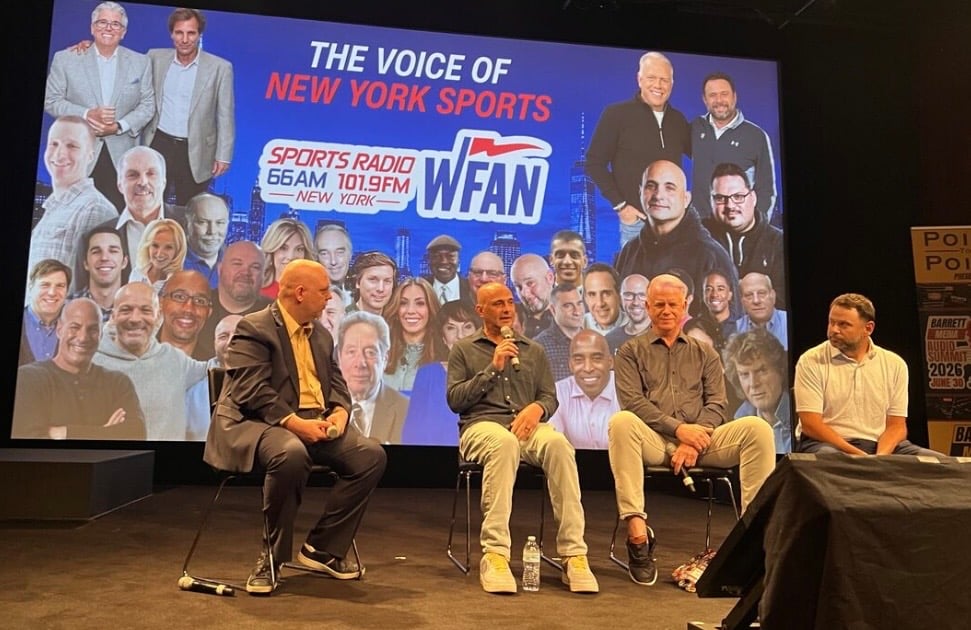
If individual stocks were available, I’d buy tons of Josh Pate. He’s already successful but his business acumen is outstanding. He even took time to talk with aspiring broadcasters and share his number. Josh is going to do even bigger things moving forward. Attendees also saw why Boomer, Gio and Carton, Paul Finebaum,Funk Flex and Angela Yee, Jim Kerr, Scott Shannon, and Broadway Bill Lee, Sid, Larry, Erick and Simone, Joon, D.A., Jake and BT, and Murphy, Sam and Jodi are not only exceptional performers, but also well versed in business. Funk Flex‘s truth bomb on the real issues with the radio industry had everyone’s undivided attention. Boomer Esiason‘s advice on attaching yourself to revenue struck a chord. Frank Kramer‘s “Don’t put music into your morning show, put your morning show into your music” stood out. So did Buck Sexton‘s point on Rush Limbaugh’s shoes being so big they needed Clay and Buck to fill both. As usual, Stephen A. Smith captured the room, creating 3-4 headlines during our 40-minute conversation.
Jason Barrett chats with Craig Carton, Boomer Esiason and Gregg Giannotti at the 2026 Barrett Media Audio Summit
A special shout out Andre Yancey of 94.7 The Block. I said it on stage, luck is what happens when preparation meets opportunity. I wasn’t aware that Damizza was more comfortable reacting than hosting so when he shared that on stage, I knew we had to call an audible. The last thing I wanted was for him and everyone involved to have a bad experience. Andre stepped in to lead the group and absolutely crushed it. That entire session was spectacular. His knowledge of the format, the people involved, and his command of the session allowed it to shine. It was a great reminder of the importance of staying ready. Every participant in that session was awesome.
The Premiere Networks Awards ceremonies for all three days were special. A big thank you to Julie Talbott, Peter Tripi, and Hosea Belcher for seeing the vision and continuing to support it. Chad Lopez, Phil Boyce and Mark Simone represented an outstanding class at our news show. Paul Finebaum, Chris Oliviero and Eric Spitz were exceptional at our sports shows. And the introduction of the Mike McVay and Scott Shannon Awards and acceptance of both honors from Yonni Rude and Kevin Rolston made for a perfect ending.
I especially want to thank Mike Gallagher for flying in to surprise Phil Boyce. Oliviero’s WFAN letter, Finebaum’s remarks about his family’s New York ties, and Spitz’s words about his family were memorable. So were Yonni’s words about Mike McVay. Kevin’s impression of Scott Shannon was hilarious, and Scott’s final word on Rolston delivering the worst acceptance speech he’d ever heard was a perfect final touch.
Shane Profitt sounded great at the Magellan AI After Party. He even spent time with attendees afterwards too. A big thank you to Raffaella Braun and the Triple Tigers team for bringing Shane to NYC.
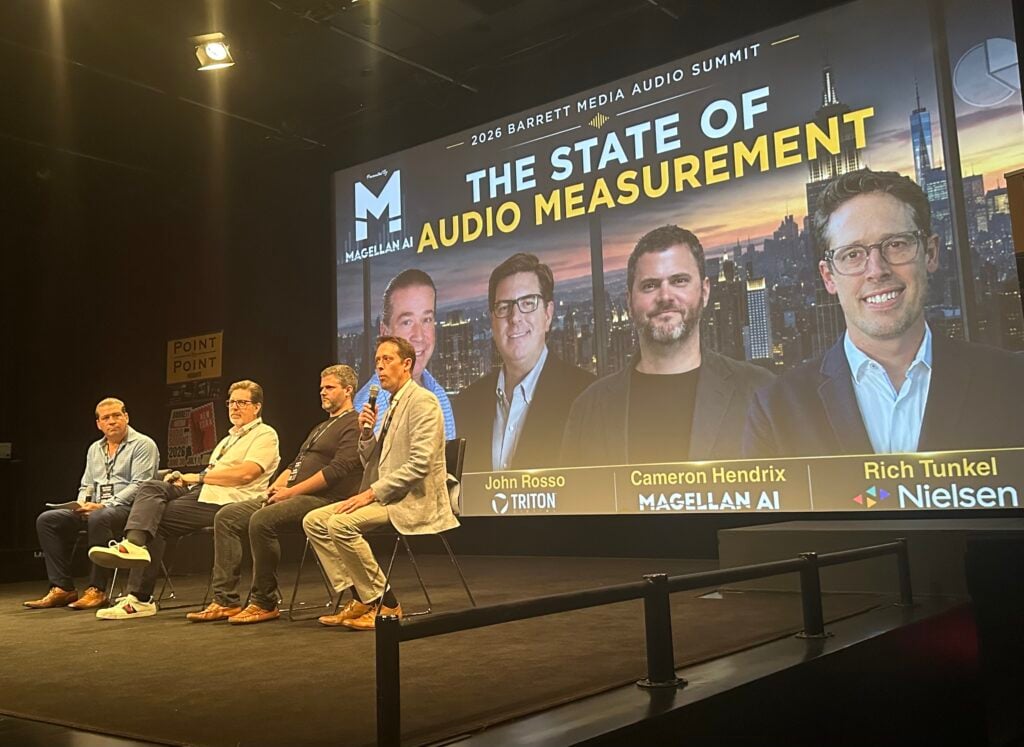
It was great seeing Rich Tunkel of Nielsen in the room for all three days. Having Xperi’s Juan Galdamez and Joe D’Angelo present was also excellent. Rich and Juan were both on stage too and each provided valuable takeaways. Rob Miller did an outstanding job guiding the State of Audio Measurement panel which included John Rosso and Cameron Hendrix. Media folks love data, and want to trust and support the groups they’re in business with. When both sides know each other and spend time together, it makes a difference.
If we gave out an award for best passion it’d go to Keith Dakin with Anna Zap and Sid Rosenberg battling to pull it away. All had great energy on stage. I also thought Christine Travglini, Hank Fuerst, John Sylvester, Ryan Spoon, James Kurdziel, Mark Adams, Jon Zellner, Jeff Sottolano, and Greg Strassell dropped pearls of wisdom on stage. The laughs from Jimmy Failla and Adam Carolla were incredible. The panel conversation between Buzz Knight, Fred Jacobs and Mike McVay was both candid and thought provoking.
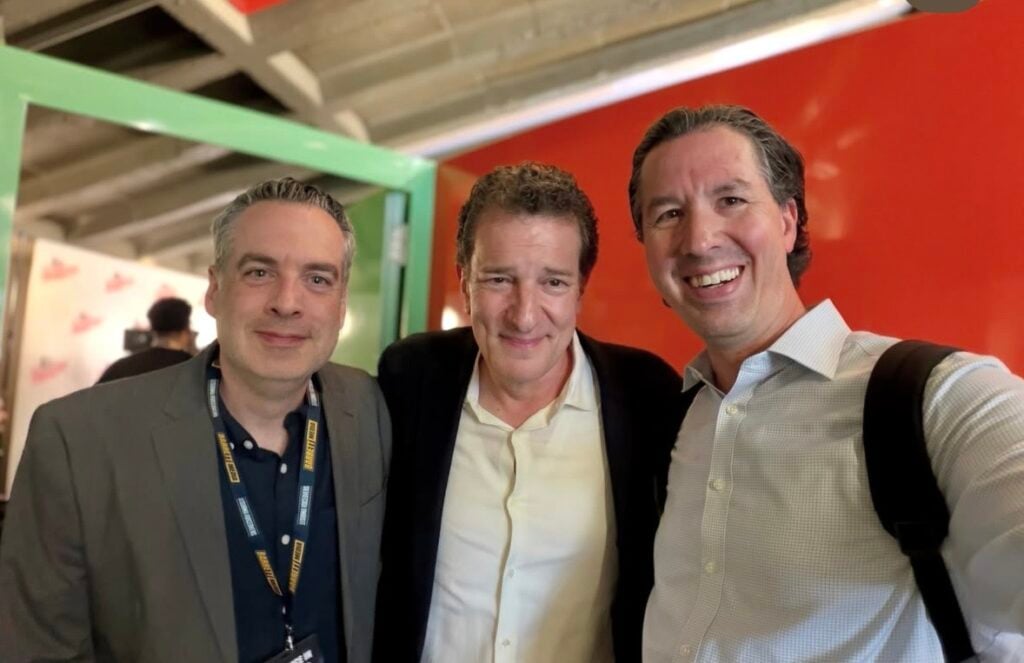
Keith Dakin, Jon Zellner and Jeff Sottolano caught up outside the green room at the 2026 Barrett Media Audio Summit
It was cool to see Susan Larkin and her teams at RCS, MediaMonitors, and MediaBase in the room learning and networking. Special thanks to Alissa Pollack for delaying a vacation to support the show.
A big shout out to agent to the stars Heather Cohen. Not only does she consistently support the Summit, but she encourages her clients to attend too. We love you Heather!
Needs Improvement
The toughest thing about the show is that I am so busy running it that I don’t get time to interact with many folks. There are literally instances where my only interaction is an on-stage handshake. That’s the one part of the event I wish was different for yours truly.
My energy for day three did not meet my standard. I nearly lost my voice the night before, which became concerning, but no excuses, I need to be better. My opening monologue was solid and the Final 40 was good but my ins and outs were not crisp.
I contemplated adding an all-female panel prior to the show. Looking back, I should’ve done it. We had some outstanding ladies involved but should have featured more. That will be a focus for the next one.
Focusing on specific formats was a good idea. The creative that supported the sessions kicked ass. But with only one day of content it was hard to go deeper into each format. Unfortunately, we can’t do a 10-day Summit. Providing more depth for key formats is something we have to figure out moving forward.
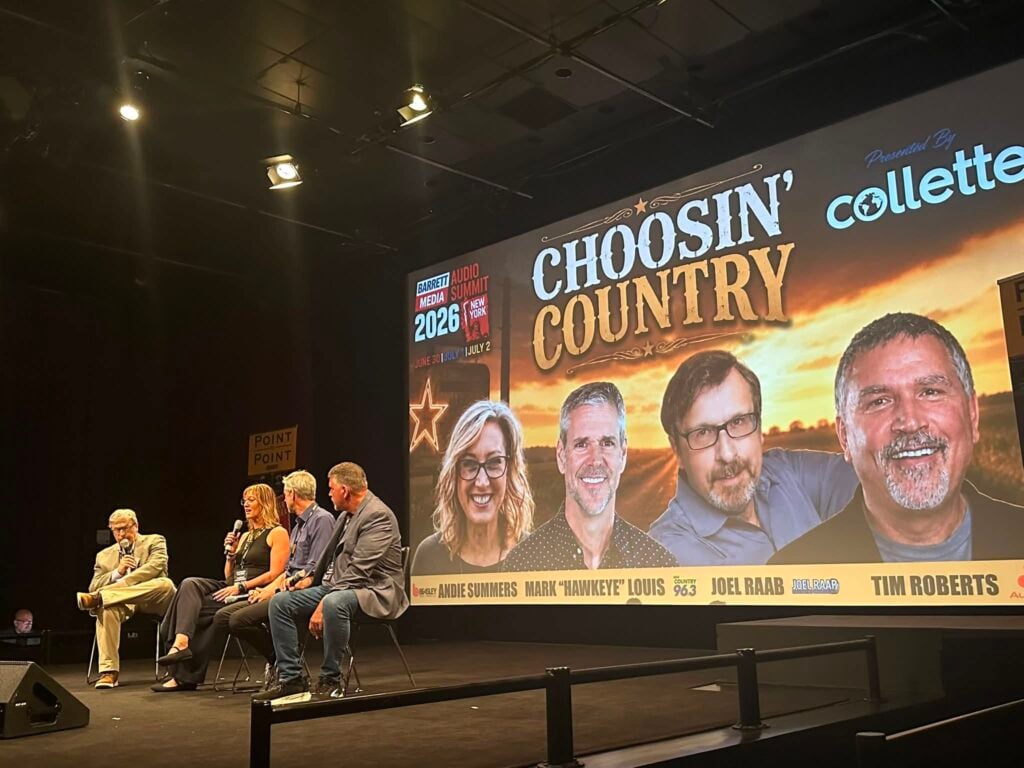
Getting people to the venue for the start of the show is always tough. Keeping them in the room for all panels can also be a challenge. Many want to network and see friends not just learn. I just wish more folks saw Joel Raab, Tim Roberts, Andie Summers and Hawkeye. That was a damn good session. The room got busier halfway through but they missed some great insights early on. Tim’s story of how an early bond with Garth Brooks paid off thirty years later was especially great. Make sure to re-watch it later. All involved offered smart insights.
Joel Raab leads the Choosin Country panel featuring Andie Summers, Mark ‘Hawkeye’ Louis, and Tim Roberts.
We had a few staff communication issues cause confusion. I serve as both host and executive producer, which is hard. Once a show starts, I am counting on our core team of 6 to execute and direct our supporting staff. Some took initiative and wore multiple hats, others did not.
What You Missed
We promoted 96 speakers in advance. Lee Abrams had a last minute conflict but Lee Harris, Mike Gallagher and Andre Yancey joined the mix to boost the total to 98. The collection of star power across various roles was impressive. Here’s a snapshot below.
Talent: Stephen A. Smith, Adam Carolla, Buck Sexton, Jimmy Failla, Mike Gallagher, Lee Harris, Erick Erickson, Sid Rosenberg, Mark Simone, Larry O’Connor, Ryan Gorman, Pete Mundo, Chris Krok, Boomer Esiason, Craig Carton, Gregg Giannotti, Paul Finebaum, Josh Pate, Kevin Clark, Brandon Tierney, Damon Amendolara, Joon Lee, Jake Asman, Chad Millman, Murphy, Sam and Jodi, Frank Kramer, Jim Kerr, Scott Shannon, Broadway Bill Lee, Sean Copeland, Anna Zap, Andie Summers, Mark ‘Hawkeye’ Louis, Angela Yee, Funk Flex, and Kevin Rolston.
Executives: Kelli Turner, Jeff Smulyan, Mike Foss, Ryan Spoon, Pete Gianesini, Jon Zellner, Jeff Sottolano, Chris Oliviero, Chad Lopez, Keith Dakin, Greg Strassell, Phil Boyce, Chris Berry, John Sylvester, Hank Fuerst, Chris Berry, and Christine Travglini.
Programming: Drew Anderssen, Ken Charles, Ben Mevorach, Dave Tepper, Ann Thomas, Mitch Rosen, Justin Craig, Armen Williams, Justin Craig, Scott Shapiro, Matt Moscona, Kraig Riley, Rod Lakin, Paul Mason, Eric Spitz, Mark Chernoff, Rob Miller, Tim Roberts, Skip Dillard, Devin Steel, Damion ‘Damizza’ Young, Chris Lloyd, James Kurdziel, Justin Johnson, Mark Adams, Andre Yancey, and Steve Salhany.
Management: Mary Sandberg Boyle, Dan Seeman, Natalie Marsh, Michael Spacciapolli, and Lee Davis.
Consultants/Tech/Measurement: Mike McVay, Fred Jacobs, Buzz Knight, Joel Raab, Jim Ryan, Sharon Dastur, Daniel Anstandig, Rich Tunkel, John Rosso, Cameron Hendrix, and Juan Galdamez.
Rob Miller guides the State of Audio Measurement session featuring John Rosso, Cameron Hendrix and Rich Tunkel.
In addition, our attendees list was strong too. If you were at the SVA Theatre for all three days, you’d have seen the following people.
Premiere Networks President Julie Talbott, Skyview Networks CEO and Owner Steve Jones, RCS CEO Susan Larkin, BFOA Chairman Scott Herman, SiriusXM SVP of Sports Jared Fox, SiriusXM VP/GM of Talk Dave Gorab, Cumulus Media SVP of Sports Bruce Gilbert, Radio One VP of Programming Colby Colb, Gamut VP of Podcasting John Goforth, VSiN EVP of Programming Steve Cohen, MediaBase/iHeartMedia Executive Vice President Global Music Marketing Alissa Pollack, Director of Corporate Operations at Zimmer Communications, Trevor Morgan, Superadio President Eric Faison, RadioCraft VP of Entertainment Scott Meyers, and Talk Media Network CEO Josh Leng. Programmers Eric Wellman, Cynthia Smith, Ryan Hurley, Robby Bridges, Jason Dixon, Matt Fishman, Blake Taylor, Allan Lamberti, and Cat Thomas, and Market Managers Andrea Kahrer, Marsha Landess were also there.
On the talent side, Ian Eagle and Kenny Albert were in the room. So were Curtis Sliwa, Andrew Wilkow, Shelly Wade, Greg Beharrell, Race Taylor, Corinna Delgado, Carol Miller, Jusnik, Maggie Gray, Chris Carlin, Freddie Coleman, Jeremy Conn, McGraw Milhaven, Rich Valdes, Mary Walters, Jonathan ‘T-Bone’ Smith, Virginia Sinicki, Jared Stillman, Jared Smith, Skywalker, Trevor Marden and TJ Taormina. Agents Heather Cohen, Josh Levy, Kraig Kitchin, John McConnell and Stephanie Cassidy were also in attendance. So were label pros and promoters Raffaella Braun, Erik Olesen, Jerry Lembo, Ray Mariner, and members of Universal Music and NC Management.
Final Thoughts
Many praised our content, production, posters, marquee display and event programs. That meant a lot. We try to tackle key issues and make a strong impression visually. I want those who didn’t attend to see what they missed and regret not coming. Shows like this should be a must for anyone working in the media industry.
To those who didn’t come, you are missing out. This business is rapidly changing. Jobs that exist today won’t in the near future. The more you know and the deeper your connections are, the better your chances of success. You can’t talk about a lack of education, income, and limited chances to build relationships and then not make time to attend. Benjamin Franklin once said, an investment in knowledge pays the best interest. If you value your career, you have to invest in it. Companies will not do it for you.
Moving forward, I want to bring more Advertising professionals, Record Label pros and Market Managers/Presidents into the room. The information and connections formed at this show are worth it. Hopefully next year folks in those roles are more involved.
I have no idea where or when next year’s show will take place but whenever that is, I want Bob Pittman, Dan Patrick, Megyn Kelly and/or Charlamagne tha God to join us. All are gifted speakers with exceptional business knowledge and success. Their insights would be valued. If Joe Rogan and Dave Portnoy want to join in too, I’m happy to make room 🙂
The amount of feedback I received to return to New York was surprising. I’m not sure if we will do that but there are positives to doing so. I just don’t want the show to become predictable or repetitive. It’s why I don’t ask some folks to speak each year. Changing it up is needed. Suggestions on where to host it can be emailed to Jason@BarrettMedia.com.
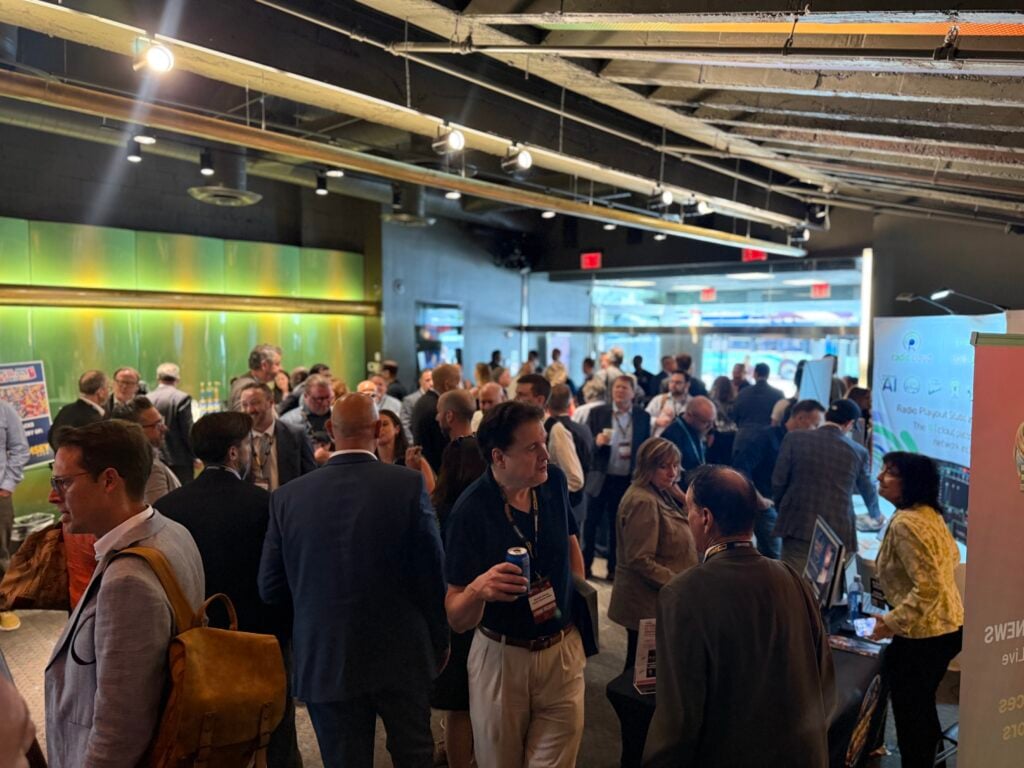
Attendees gather inside the SVA Theatre hallway during a break in the action
Our biggest decision for 2027 is deciding if we stick with a 3-day, 3-areas of the industry approach or splitting up to two 2-day shows featuring sports/news and two days of music. We could also build a 4-day super show with sports/news and two-days of music. If we split them up, we’d operate in two cities. If not, we’d be in one spot. I’d likely add a special guest host for the music show if we went that route. Regardless of where, when and how we do it, I’d like to avoid being close to a holiday.
Thanks again to all who attended, supported, and spoke at the 2026 Barrett Media Audio Summit. We couldn’t have pulled this off without every single one of them. It was a blast uniting and educating the industry, and God willing, we’ll run it back in 2027.
Barrett Media produces daily content on the music, news, and sports media industries. Sign up for our newsletters to stay updated and get the latest information right in your inbox.
Barstool Sports founder Dave Portnoy has a new book out that you should definitely read. Especially if you’re interested in the unique story of the digital sports content behemoth. The book is entitled Cancel Me If You Can, which is spot on for a person who built his content business by taking chances, being unique, and never settling for what everyone around him felt Barstool Sports should be. The rise of Barstool Sports has been transparent. Nearly everything is on film, and no questions go unanswered.
The results are a massive following and a reach that many media companies around the world envy. A combination of colorful personalities who tell stories, interviews that shape narratives, and partnerships that continue to expand the brand with FOX Sports and Netflix, for example. Barstool Sports has risen to a level where many would consider the brand part of the mainstream media ecosystem. However, Portnoy denies that assertion. Why?
If you look up any definition of mainstream media, the key words are simple to isolate and examine: large, established, mass communications, and broad audience. Doesn’t Barstool Sports fit each and every one of those descriptions based on its own metrics?
Scale Matters
Large? Barstool Sports has offices in both New York City and Chicago. Both locations produce daily written content, record successful podcasts, and create long-form and short-form video for every major distribution platform. The company gained investment from both The Chernin Group and Penn National Gaming. Those investments allowed the brand to grow to a valuation of more than half a billion dollars.
Established? Barstool Sports began as a weekly print publication in the Boston area in 2003. Within a decade, it had expanded into five cities and operated a blog that drew more than four million unique users each month by 2013. By 2016, Barstool claimed to generate 250 million views per month. Pardon My Take, Barstool Sports’ most successful podcast, is now 10 years old. In the creator economy, many consider Barstool Sports ahead of its time, setting the standard well ahead of many companies in the digital content space.
Mass communications? On TikTok, only ESPN has a larger following among sports media brands. Regarding YouTube, Barstool has nearly two million subscribers on its primary account alone and 12 additional channels under its umbrella. On X, formerly Twitter, the main account has nearly seven million followers. However, each personality is a brand unto itself, further expanding Barstool Sports’ reach.
Dave Portnoy (@stoolpresidente) says Barstool Sports does not carry "the same weight" as the established, mainstream media.
"The main Barstool stuff is still, generally, 98% of the time, meant to make you laugh," he told PBS News' @RealAmnaNawaz. "It is sort of a comedy brand."… pic.twitter.com/Fy3bLnBV2p
All of those factors lead to a broad and diverse audience: male, female, young, and old. Barstool’s personalities have become established pop culture celebrities. When they host events, they sell out. Who needs Super Bowl Radio Row when the celebrities of the Super Bowl come to them? The outlet has interviewed everyone from the president of the United States to the sixth man who went viral for hitting a last-second basket at a local high school.
The question is why Portnoy doesn’t consider his own brand mainstream media, especially since it appears to meet the definition.
“If you say Barstool says something versus CNN, NPR, New York Times, Washington Post, that doesn’t, like, hit. We’re different,” says Portnoy during an interview with PBS. “When you say mainstream media, seeing a quote from Barstool still does not carry for most people the same weight, I don’t think, as like established blue blood-type news organizations. Nor should it, really.”
The Culture Shift
Does Barstool Sports break news like CNN, NPR, The New York Times, or even TMZ? Not necessarily. The brand has had its share of breaking news throughout its rise, but it has hardly operated as a traditional news organization. However, people are getting their news from more places than ever before, and that’s where Barstool plays best with its audience.
According to a recent Pew Research Center study, 19% of Americans make social media their first destination for breaking news. That’s up 10 percentage points since 2018. Among Americans ages 18-29, 31% turn to social media first. A recent YouGov survey found that 60% of U.S. adults consume their news on social media first, including 73% of those ages 18-44.
That shift is why the debate over whether Barstool Sports is mainstream media feels outdated. Portnoy is comparing Barstool to the legacy institutions that defined mainstream media for generations. Newspapers, cable news networks, and national broadcast outlets earned that label because they were where the largest audiences gathered. Today’s audiences gather elsewhere.
Mainstream is no longer determined by a printing press, a television affiliate, or a cable channel. It’s determined by where people spend their time, where conversations begin, and where news, opinions, and culture spread. Increasingly, those places are YouTube, TikTok, X, Instagram, podcasts, and creator-driven platforms.
That’s the world Barstool Sports helped build.
Whether someone likes Barstool’s style is beside the point. Millions of people consume its content every day. Its personalities influence conversations, interview major newsmakers, partner with companies like FOX Sports and Netflix, and command an audience that rivals or exceeds many legacy media brands. Those are the very characteristics that have always defined mainstream media.
Portnoy may never embrace that label because Barstool was built as an alternative to the establishment. Ironically, that’s exactly what makes the company’s evolution so remarkable. The establishment has changed. When one of the largest and most influential voices in sports reaches millions where modern audiences actually consume content, it isn’t operating outside the mainstream anymore. It is the mainstream.
Barrett Media produces daily content on the music, news, and sports media industries. Sign up for our newsletters to stay updated and get the latest information right in your inbox.
CNN and Independence Day go together well, at least when the network leans into live event coverage. Saturday’s The Fourth in America: Celebrating 250 special reminded viewers why CNN still owns this particular lane, even as its primetime and total day ratings continue drawing scrutiny.
The network has faced plenty of criticism this year for its programming choices and its struggles against competitors. None of that criticism applies to how CNN handles a national holiday.
Brianna Keilar and Laura Coates opened the coverage from Washington, D.C. at noon, anchoring from the National Mall as the White House’s Freedom 250 celebration unfolded behind them. Their segment set a steady tone for the day. Coates brought her legal and political sharpness to the moment, while Keilar’s field experience kept the broadcast moving briskly between correspondents and set pieces. Together, they gave the network’s marathon coverage a strong foundation.
As the day progressed, Dana Bash and Boris Sanchez took over primetime duties from the same Mall location, carrying the broadcast through the evening’s festivities. Their chemistry translated well on a day built for spectacle rather than hard news.
Meanwhile, Anderson Cooper anchored from Boston alongside Pamela Brown, where CNN served as the exclusive broadcast partner for the Boston Pops Fireworks Spectacular at the Hatch Shell. Cooper has become something of a holiday fixture for CNN, and his presence in Boston added weight to an already stacked lineup.
A Coast-to-Coast Showcase
What made Saturday’s broadcast work wasn’t any single anchor pairing. It was the breadth of the coverage. CNN didn’t just plant a flag in Washington and call it a day. It sent teams from coast to coast, giving viewers a genuine sense of scale for a milestone occasion. Elex Michaelson and Cari Champion closed out the night from San Diego, extending the broadcast well past prime hours and ensuring West Coast viewers got their own dedicated segment instead of a tacked-on mention.
That kind of commitment takes real resources and real planning. Networks don’t stumble into ten-plus hours of live, multi-city programming. They build it deliberately, and CNN clearly treated this broadcast as a priority. The production value showed in the transitions between cities, the pacing of musical performances, and the way anchors handled live handoffs without stepping on each other. It’s the kind of execution that often goes unnoticed until something goes wrong. Nothing did.
Where CNN Still Leads
This isn’t the first time CNN has pulled off this kind of feat recently. Its New Year’s Eve coverage with Anderson Cooper and Andy Cohen remains appointment viewing for millions. Its reimagined approach to Thanksgiving last year also drew praise for breaking from a stale format. Add Saturday’s Independence Day broadcast to that list, and a pattern starts to emerge. CNN struggles to hold viewers during ordinary news cycles, but it consistently delivers when the calendar hands it a reason to celebrate.
There’s a lesson buried in there for the network’s executives. Ratings pressure in primetime isn’t going away soon, and critics will keep pointing to total day numbers as evidence of deeper problems. Those criticisms aren’t unfounded. But live event programming is a different animal, and CNN has quietly become one of the best in the business at it. Few networks can coordinate this many moving pieces across this many cities without something falling apart on air.
CNN has real issues to address. Its programming lineup draws fair scrutiny, and its ratings trends give competitors plenty of ammunition. Still, holiday and live event coverage isn’t part of that conversation. It’s a strength, not a weakness, and Saturday’s broadcast proved it once again. If CNN wants a blueprint for engaging viewers again, it doesn’t need to look far. It already has one, and it airs every time the calendar gives it a reason to celebrate.
Barrett Media produces daily content on the music, news, and sports media industries. Sign up for our newsletters to stay updated and get the latest information right in your inbox.
For many who work in sports media, reaching ESPN is the pinnacle of a career. The “Worldwide Leader in Sports” has had many faces come and go over the network’s 46-year history. Joon Lee was one of those faces.
The New York City-based sports writer, who was born in Seoul, South Korea and raised in Boston, was considered part of the network’s new generation of sports journalists. After stops at Bleacher Report and several other outlets, Lee achieved his dream job, working for the network he grew up loving while covering the sports he had been passionate about since childhood.
Then, in June 2023, after four years with the network, that dream was shattered. Lee found himself part of a round of layoffs at ESPN. At 28 years old, he didn’t sulk. Instead, he pivoted, as many in sports media do following an unfortunate and unexpected end to a chapter of their careers. Ultimately, Lee returned to another passion from his youth, one he had always envisioned becoming his long-term career.
“For me, YouTube has always been my end game. It’s been what I’ve always wanted to do since the beginning of my career,” says Lee, who just celebrated three years since his departure from ESPN. “When I got to college, I realized that if I wanted to do something well, I would have to devote all the time and focus to it. So, I cared more about sports than I did about YouTube. Though, I figured YouTube would come back around at some point.”
That opportunity arrived in the moments following his departure from ESPN.
The Pivot To YouTube
With two years remaining on his contract, Lee was unable to work because of a non-compete clause in his agreement. Instead, he used the time to re-invest in understanding sports fans’ perspective of the industry today. He also immersed himself in learning the latest about YouTube. Studying the metrics, strategy, and approach creators use to build sustainable independent businesses.
Lee says he received offers to do work similar to what he was doing at ESPN. While he considered some of those opportunities, he ultimately decided not to pursue them. Instead, his desire to return to YouTube outweighed the other options available to him.
“After having conversations about YouTube, my heart was in a place of wanting to try to make the independent space work,” explains Lee. “I’m engaged and don’t have kids. I had built up my savings with the thought of trying to go independent. For me, this was a time in my life to try and take a big swing and might as well go for it. Because I don’t have any kids that are dependent on me. It felt like the right time to take a risk.”
Lee then got to work. He officially relaunched his channel in early April 2025 with a single video explaining his decision to go independent. Since then, he has posted at least one video each week. The aim is building a relationship with his audience while steadily growing his subscriber base. Today, Lee has more than 62,000 subscribers and is aiming to eclipse 100,000 by the end of 2026.
He credits his success over the past year to hard work, investigative curiosity, and a little luck. With less bureaucracy dictating topic selection, Lee relishes the freedom to turn virtually any idea into content for his audience. That freedom also gives him complete editorial control. Lee scripts, writes, shoots, edits, and publishes all of his own content, outsourcing only the occasional complex animation.
The product lives by a simple mantra: make sports fun again. That means tackling topics that deserve deeper investigation and discussion while replacing the algorithm with the audience.
“I’m always trying to find the line of what I’m interested in and what the audience is interested in. That’s the stuff that’s going to make the business sustain over the long run,” said Lee. “I’m always giving myself room to experiment. Because I don’t want to pigeonhole myself in just doing one thing and doing the same thing over and over again.”
Creator Credibility Over All
Lee’s content focuses on sports topics that extend beyond the action on the field. It’s an eclectic mix of experiential content. Ranging from taking batting practice against a major league pitcher to driving a stock car with NASCAR legend Jimmie Johnson. He also explores topics including illegal streaming, sourcing in sports journalism, dad shoes, and how sportsbook and prediction market advertising dollars are changing sports media.
Lee believes sports media is facing a credibility crisis because of the business relationships among leagues, networks, and media outlets. He says fans increasingly perceive those outlets as compromised. Particularly when gambling advertising plays such a significant role in their revenue.
“It’s really important for me to have hardline stances on gambling because it does affect the way audiences receive the credibility of the outlet,” notes Lee. “The reason I’m going about the business the way I am is because the business and the editorial are tied together. The business decisions you make do affect your editorial standing. Sports fans are smarter and more savvy than ever before. They see how sports journalism has changed.”
With that in mind, Lee does not accept advertising revenue from sportsbooks or prediction markets, a category that floods digital sports content, from podcasts to short-form video. In turn, that decision has created collaboration opportunities with companies that prefer not to align with brands that accept gambling clients.
“The feedback from the sales team at GoodStory has been advertisers like the fact I don’t take sports gambling money. It improves our negotiating stance with advertisers because I’m going for a family-friendly audience,” said Lee. “There’s brands that want to advertise with sports. But because of the amount of money tied up in sports media, some brands don’t feel comfortable making that jump. My hope is to attract those brands through the stances we make to reach sports fans on an outlet they can trust.”
Lee’s approach on YouTube is to present each conversation as if he were talking with one of his friends. While most of his content consists of feature pieces centered on a single topic, he is also exploring expansion opportunities, including the possibility of launching a podcast.
Earning The Audience Trust
However, Lee is no different from any other creator when it comes to the continued rise of artificial intelligence. While he admits using AI to help research projects before verifying the information himself, he also has concerns, especially because his content lives on YouTube, which is owned by Google.
“I have concerns about how my videos are being used to train AI and misinformation being spread through AI,” says Lee. “I’m working for Google in some capacity. There’s a lot of conversation about how Google is using YouTube for its own AI training… But I worry most about the way it affects the future of written journalism overall.”
With trust in traditional journalism declining, Lee has seen trust between creators and their audiences continue to grow. In many ways, that relationship has become more important than ever, given the endless options for news, opinion, and entertainment.
“That level of intimacy and trust you have with the audience boils down to everything you do. From the scripts you write to the camera lens I use,” said Lee. “That kind of trust is important to build in a day where many people don’t trust major media outlets.”
In an industry where so many careers are measured by the logos on a business card, Lee has found success by removing one altogether.
The layoff that once felt like the end of a dream instead became the catalyst for building something entirely his own. He no longer answers to network executives or programming mandates. He answers only to his audience and to the standards he has set for himself.
Along the way, that independence has attracted interest from venture capital investors eager to be part of what he’s building, further validating the risk he chose to take.
For a generation of sports journalists who grew up believing ESPN was the ultimate destination, Lee’s story offers a different perspective. Sometimes the biggest career break isn’t getting hired by the industry’s biggest brand. It’s finding the confidence to build one of your own.
It happened. Taylor Swift and Travis Kelce are married. Madison Square Garden — transformed into a fairytale garden draped in peach and white — hosted what may be the most talked-about event of 2026. The Royal wedding… err I mean… Taylor Swift wedding was officiated by Adam Sandler who even reportedly sang an original song.
The Empire State Building lit up blue for “something blue.” And the moment the vows were exchanged, digital billboards outside MSG flashed “JUST&T MARRIED” to thousands of Swifties standing in the rain. Someone online said that was like the smoke turning white when a new Pope is chosen.
Maybe you read my initial column from last month for prep. If your station engaged last week, congratulations. You were ahead of the moment. If you didn’t — the story isn’t over. Not even close.
Here’s how radio keeps the momentum going all week long.
The Details Are Still Dropping. Stay On It.
The wedding was airtight. And yet the details are leaking anyway — because they always do.
A since-deleted post from AMC CEO Adam Aron described the interior of MSG as transformed into what felt like “a lush countryside retreat,” with peach-and-white draping, real flowers, and large photos of Swift and Kelce at every age lining the walls.
Country superstar Maren Morris posted a pic of handkerchiefs embroidered with the “Blank Space” lyric “So it’s gonna be forever” on social.
TMZ reported that Jason Kelce’s kids were the flower girls.
Taylor walked down the aisle to one of her own songs played on strings.
Every one of those details is morning show content this week. Run a daily “What We Know Now” segment through Friday. Each new leak becomes a new conversation. This story has a long tail — use it. If you’re looking for a few central places for the latest Swiftie content, here are some people on social I’d suggest following:
Olivia Levin – she runs SwiftiesForEternity one of the biggest fan accounts, and she recently wrote a book about the fandom.
Bryan West – he’s an actual Taylor Swift reporter for USA Today.
Liz P Woods – she’s a longtime Swiftie who will have the latest info, but is also a great pop culture follow in general.
You could even reach out to any of the above and see if they would be willing to be a guest on your station.
The Charity Angle Is Underplayed
In the days before the wedding, Swift and Kelce donated $26 million to at least 20 charities, including Food Bank for NYC, Feeding America, Children’s Mercy Hospital, and Dolly Parton’s Imagination Library.
Most stations haven’t fully told this story yet. More importantly, it’s a community angle. Did any of those organizations serve your market? Find out this week. Connect it locally. Invite someone from that organization on-air to talk about what they do and how your listeners can get involved. This is where radio does something streaming can’t — make a national story feel personal to your city.
The Guest List Is a Week of Programming
Among the 1,000-plus guests spotted at MSG were Ed Sheeran, Bradley Cooper, Gigi Hadid, Selena Gomez, Tom Brady, Steven Spielberg, Jimmy Fallon, Benson Boone, Glennon Doyle, JLo, and Andy Reid. That’s not just a celebrity roster. That’s a programming menu. You can find a reported initial list here. I even spy some record label execs on there.
Nicole from 92.5 WXTU in Philly is already all over it. Not surprised. She’s great at her job.
Run a daily “Wedding Guest Spotlight” this week. Play their music. Tell the story of their connection to Taylor. Talk about the standouts. Have fun with it, get silly. My group chats have been discussing the most random celebrity guests as they’ve leaked. So far, for me, it’s MGK. But another fun take is to talk about random seating charts. Was MGK sat with Coach Andy Reid? What were those conversations like?
There are angles everywhere. Pick one per day and build around it.
The Dior Story Could Be Its Own Segment
Swift and Kelce’s wedding looks were custom Christian Dior Haute Couture, designed by Jonathan Anderson. For fashionistas, that’s a cultural moment beyond the wedding itself. Anderson’s tenure at Dior has been one of fashion’s biggest stories this year, and Swift just put him at the center of the biggest wedding in a generation.
Find your local fashion voice this week — a stylist, a boutique owner, a blogger with an audience — and get them on-air to break it down. Give listeners context behind the look. It’s a conversation your competition probably isn’t having.
Tease What Comes Next
The honeymoon speculation starts now. The first post-wedding photo drop — whenever it comes — will break the internet. Then comes the first interview, and eventually, new music.
Swift’s most recent album was described as heavily influenced by her relationship with Kelce. Wedding-inspired music isn’t a stretch — it’s an expectation. Start teasing that story with listeners this week. Give them a reason to keep coming back.
Radio had the chance to be part of how people experienced this wedding. That opportunity doesn’t expire today. The audience is still locked in. Keep going.
Barrett Media produces daily content on the music, news, and sports media industries. Sign up for our newsletters to stay updated and get the latest information right in your inbox.