For many who work in sports media, reaching ESPN is the pinnacle of a career. The “Worldwide Leader in Sports” has had many faces come and go over the network’s 46-year history. Joon Lee was one of those faces.
The New York City-based sports writer, who was born in Seoul, South Korea and raised in Boston, was considered part of the network’s new generation of sports journalists. After stops at Bleacher Report and several other outlets, Lee achieved his dream job, working for the network he grew up loving while covering the sports he had been passionate about since childhood.
Then, in June 2023, after four years with the network, that dream was shattered. Lee found himself part of a round of layoffs at ESPN. At 28 years old, he didn’t sulk. Instead, he pivoted, as many in sports media do following an unfortunate and unexpected end to a chapter of their careers. Ultimately, Lee returned to another passion from his youth, one he had always envisioned becoming his long-term career.
“For me, YouTube has always been my end game. It’s been what I’ve always wanted to do since the beginning of my career,” says Lee, who just celebrated three years since his departure from ESPN. “When I got to college, I realized that if I wanted to do something well, I would have to devote all the time and focus to it. So, I cared more about sports than I did about YouTube. Though, I figured YouTube would come back around at some point.”
That opportunity arrived in the moments following his departure from ESPN.
The Pivot To YouTube
With two years remaining on his contract, Lee was unable to work because of a non-compete clause in his agreement. Instead, he used the time to re-invest in understanding sports fans’ perspective of the industry today. He also immersed himself in learning the latest about YouTube. Studying the metrics, strategy, and approach creators use to build sustainable independent businesses.
Lee says he received offers to do work similar to what he was doing at ESPN. While he considered some of those opportunities, he ultimately decided not to pursue them. Instead, his desire to return to YouTube outweighed the other options available to him.
“After having conversations about YouTube, my heart was in a place of wanting to try to make the independent space work,” explains Lee. “I’m engaged and don’t have kids. I had built up my savings with the thought of trying to go independent. For me, this was a time in my life to try and take a big swing and might as well go for it. Because I don’t have any kids that are dependent on me. It felt like the right time to take a risk.”
Lee then got to work. He officially relaunched his channel in early April 2025 with a single video explaining his decision to go independent. Since then, he has posted at least one video each week. The aim is building a relationship with his audience while steadily growing his subscriber base. Today, Lee has more than 62,000 subscribers and is aiming to eclipse 100,000 by the end of 2026.
He credits his success over the past year to hard work, investigative curiosity, and a little luck. With less bureaucracy dictating topic selection, Lee relishes the freedom to turn virtually any idea into content for his audience. That freedom also gives him complete editorial control. Lee scripts, writes, shoots, edits, and publishes all of his own content, outsourcing only the occasional complex animation.
The product lives by a simple mantra: make sports fun again. That means tackling topics that deserve deeper investigation and discussion while replacing the algorithm with the audience.
“I’m always trying to find the line of what I’m interested in and what the audience is interested in. That’s the stuff that’s going to make the business sustain over the long run,” said Lee. “I’m always giving myself room to experiment. Because I don’t want to pigeonhole myself in just doing one thing and doing the same thing over and over again.”
Creator Credibility Over All
Lee’s content focuses on sports topics that extend beyond the action on the field. It’s an eclectic mix of experiential content. Ranging from taking batting practice against a major league pitcher to driving a stock car with NASCAR legend Jimmie Johnson. He also explores topics including illegal streaming, sourcing in sports journalism, dad shoes, and how sportsbook and prediction market advertising dollars are changing sports media.
Lee believes sports media is facing a credibility crisis because of the business relationships among leagues, networks, and media outlets. He says fans increasingly perceive those outlets as compromised. Particularly when gambling advertising plays such a significant role in their revenue.
“It’s really important for me to have hardline stances on gambling because it does affect the way audiences receive the credibility of the outlet,” notes Lee. “The reason I’m going about the business the way I am is because the business and the editorial are tied together. The business decisions you make do affect your editorial standing. Sports fans are smarter and more savvy than ever before. They see how sports journalism has changed.”
With that in mind, Lee does not accept advertising revenue from sportsbooks or prediction markets, a category that floods digital sports content, from podcasts to short-form video. In turn, that decision has created collaboration opportunities with companies that prefer not to align with brands that accept gambling clients.
“The feedback from the sales team at GoodStory has been advertisers like the fact I don’t take sports gambling money. It improves our negotiating stance with advertisers because I’m going for a family-friendly audience,” said Lee. “There’s brands that want to advertise with sports. But because of the amount of money tied up in sports media, some brands don’t feel comfortable making that jump. My hope is to attract those brands through the stances we make to reach sports fans on an outlet they can trust.”
Lee’s approach on YouTube is to present each conversation as if he were talking with one of his friends. While most of his content consists of feature pieces centered on a single topic, he is also exploring expansion opportunities, including the possibility of launching a podcast.
Earning The Audience Trust
However, Lee is no different from any other creator when it comes to the continued rise of artificial intelligence. While he admits using AI to help research projects before verifying the information himself, he also has concerns, especially because his content lives on YouTube, which is owned by Google.
“I have concerns about how my videos are being used to train AI and misinformation being spread through AI,” says Lee. “I’m working for Google in some capacity. There’s a lot of conversation about how Google is using YouTube for its own AI training… But I worry most about the way it affects the future of written journalism overall.”
With trust in traditional journalism declining, Lee has seen trust between creators and their audiences continue to grow. In many ways, that relationship has become more important than ever, given the endless options for news, opinion, and entertainment.
“That level of intimacy and trust you have with the audience boils down to everything you do. From the scripts you write to the camera lens I use,” said Lee. “That kind of trust is important to build in a day where many people don’t trust major media outlets.”
In an industry where so many careers are measured by the logos on a business card, Lee has found success by removing one altogether.
The layoff that once felt like the end of a dream instead became the catalyst for building something entirely his own. He no longer answers to network executives or programming mandates. He answers only to his audience and to the standards he has set for himself.
Along the way, that independence has attracted interest from venture capital investors eager to be part of what he’s building, further validating the risk he chose to take.
For a generation of sports journalists who grew up believing ESPN was the ultimate destination, Lee’s story offers a different perspective. Sometimes the biggest career break isn’t getting hired by the industry’s biggest brand. It’s finding the confidence to build one of your own.
It happened. Taylor Swift and Travis Kelce are married. Madison Square Garden — transformed into a fairytale garden draped in peach and white — hosted what may be the most talked-about event of 2026. The Royal wedding… err I mean… Taylor Swift wedding was officiated by Adam Sandler who even reportedly sang an original song.
The Empire State Building lit up blue for “something blue.” And the moment the vows were exchanged, digital billboards outside MSG flashed “JUST&T MARRIED” to thousands of Swifties standing in the rain. Someone online said that was like the smoke turning white when a new Pope is chosen.
Maybe you read my initial column from last month for prep. If your station engaged last week, congratulations. You were ahead of the moment. If you didn’t — the story isn’t over. Not even close.
Here’s how radio keeps the momentum going all week long.
The Details Are Still Dropping. Stay On It.
The wedding was airtight. And yet the details are leaking anyway — because they always do.
A since-deleted post from AMC CEO Adam Aron described the interior of MSG as transformed into what felt like “a lush countryside retreat,” with peach-and-white draping, real flowers, and large photos of Swift and Kelce at every age lining the walls.
Country superstar Maren Morris posted a pic of handkerchiefs embroidered with the “Blank Space” lyric “So it’s gonna be forever” on social.
TMZ reported that Jason Kelce’s kids were the flower girls.
Taylor walked down the aisle to one of her own songs played on strings.
Every one of those details is morning show content this week. Run a daily “What We Know Now” segment through Friday. Each new leak becomes a new conversation. This story has a long tail — use it. If you’re looking for a few central places for the latest Swiftie content, here are some people on social I’d suggest following:
Olivia Levin – she runs SwiftiesForEternity one of the biggest fan accounts, and she recently wrote a book about the fandom.
Bryan West – he’s an actual Taylor Swift reporter for USA Today.
Liz P Woods – she’s a longtime Swiftie who will have the latest info, but is also a great pop culture follow in general.
You could even reach out to any of the above and see if they would be willing to be a guest on your station.
The Charity Angle Is Underplayed
In the days before the wedding, Swift and Kelce donated $26 million to at least 20 charities, including Food Bank for NYC, Feeding America, Children’s Mercy Hospital, and Dolly Parton’s Imagination Library.
Most stations haven’t fully told this story yet. More importantly, it’s a community angle. Did any of those organizations serve your market? Find out this week. Connect it locally. Invite someone from that organization on-air to talk about what they do and how your listeners can get involved. This is where radio does something streaming can’t — make a national story feel personal to your city.
The Guest List Is a Week of Programming
Among the 1,000-plus guests spotted at MSG were Ed Sheeran, Bradley Cooper, Gigi Hadid, Selena Gomez, Tom Brady, Steven Spielberg, Jimmy Fallon, Benson Boone, Glennon Doyle, JLo, and Andy Reid. That’s not just a celebrity roster. That’s a programming menu. You can find a reported initial list here. I even spy some record label execs on there.
Nicole from 92.5 WXTU in Philly is already all over it. Not surprised. She’s great at her job.
Run a daily “Wedding Guest Spotlight” this week. Play their music. Tell the story of their connection to Taylor. Talk about the standouts. Have fun with it, get silly. My group chats have been discussing the most random celebrity guests as they’ve leaked. So far, for me, it’s MGK. But another fun take is to talk about random seating charts. Was MGK sat with Coach Andy Reid? What were those conversations like?
There are angles everywhere. Pick one per day and build around it.
The Dior Story Could Be Its Own Segment
Swift and Kelce’s wedding looks were custom Christian Dior Haute Couture, designed by Jonathan Anderson. For fashionistas, that’s a cultural moment beyond the wedding itself. Anderson’s tenure at Dior has been one of fashion’s biggest stories this year, and Swift just put him at the center of the biggest wedding in a generation.
Find your local fashion voice this week — a stylist, a boutique owner, a blogger with an audience — and get them on-air to break it down. Give listeners context behind the look. It’s a conversation your competition probably isn’t having.
Tease What Comes Next
The honeymoon speculation starts now. The first post-wedding photo drop — whenever it comes — will break the internet. Then comes the first interview, and eventually, new music.
Swift’s most recent album was described as heavily influenced by her relationship with Kelce. Wedding-inspired music isn’t a stretch — it’s an expectation. Start teasing that story with listeners this week. Give them a reason to keep coming back.
Radio had the chance to be part of how people experienced this wedding. That opportunity doesn’t expire today. The audience is still locked in. Keep going.
Barrett Media produces daily content on the music, news, and sports media industries. Sign up for our newsletters to stay updated and get the latest information right in your inbox.
Last month, Crowd React Media released its 2026 State of the Media report. It’s 50+ slides of data, research, and information that can be incredibly valuable for anyone in the media space. And buried on Slide 28 of this 56-slide study is an unbelievable tidbit for local radio: Who wants local radio content? Younger people! Yes, that’s right.
When those polled were asked why they listen to radio, 30% of listeners overall cited local content and events.
However, among those 18-34, that number jumps to 40%. And for those 55+, the number falls to 20%.
The Local Content Opportunity
This is the opposite of what most people polled would expect. They would assume that older folks would like the local flair, while those younger could not care less about what’s happening in their backyard. The conclusion: the audience the industry most wants to grow is also the audience most motivated by exactly what local radio does best — provide local content, information, analysis, and opinion.
Now, does that mean leaning into “cat stuck in tree” for top stories is the play, in favor of a story or topic on the Iran War or an update from the Trump White House? No. However, what it does mean is that you might be able to structure topic importance differently and make sure you’re finding local angles to the national stories of the day. And while you’re doing this, you aren’t alienating the younger end of the demo; in fact, you might be giving them exactly what they want.
Also, since this study was done exclusively for radio and applies to all formats, it likely means that these younger listeners may be less in tune with the politics of the day, but may like getting their local sports analysis and local concert information from local radio. What’s the news/talk radio play of all of this? Talk about those things when appropriate.
No one needs you to break down a mid-summer baseball game or go into hyperdrive about a Sabrina Carpenter concert in your town. But if there are ways to blend the top local news stories that might seem “out of your news/talk radio lane” into your content, what do you have to lose? Maybe you tick off a 55+ listener for a segment or two, but my guess is they’ll be loyal to you over the long run. If it gives you the opportunity to get the younger demographic to sample or stick around your station and local shows, it’s well worth the trade-off.
Digital Access and Radio’s Enduring Consistency
Now, when it comes to other conclusions from this study, does this mean you can go back to doing radio like it’s 1996 instead of 2026? Of course not. The data also made it clear that, among the 18-34 demographic, combined digital access (mobile + desktop + smart speaker) exceeds traditional AM/FM listening.
So by making sure your younger audience can find you where they are or where they want to be — via an app, smart speaker, desktop, or any other streaming device — along with giving them the local content they want, this can be a winning formula.
Lastly, consistency remains radio’s great advantage. Cume sits at 76% usage in 2026, up from 75% in 2025, and down slightly from 80% in 2024. Frequent usage (30-60 minutes per day) has remained steady at 30% for the last couple of years. So when every other platform is trying to explain why its numbers moved, radio gets to explain why its numbers didn’t. There’s a huge benefit to telling that story, which remains under-told across the advertising space.
Now the question is: can radio sell its story and make the necessary tweaks to give listeners and advertisers what they want and need from the platform going forward? That is TBD.
Barrett Media produces daily content on the music, news, and sports media industries. Sign up for our newsletters to stay updated and get the latest information right in your inbox.
What impressed me most at the Barrett Media Summit wasn’t just the star power in the room. There were plenty of recognizable names, familiar voices, and people who have built significant careers in this business. That part was great.
But what stuck with me most was the youth.
I talked to a handful of bright students who came looking to get a foot in the door. They wanted to learn, ask questions, meet people, and be part of whatever radio and audio become next. They were not sitting around waiting for an invitation. They showed up. They listened. They talked to people. They put themselves in the room.
Simply put, we need more of that.
More Than Data and Demographics
We need corporate execs and data analytics — of course we do. But we also need more college kids who understand what it means to connect. They are not doing it because it is a business. They are doing it because it is a passion. That matters. In some ways, that passion may be the very thing radio needs to find again.
Then, as the summit went on, college radio kept popping up in different panels and conversations. Not always as the main topic, but enough to make me realize something. Maybe college radio is not something from the past that we recall with a smile and a story about our first bad overnight shift. Maybe college radio is starting to move back toward the center of the conversation.
During one summit conversation about talent and the future of content, the point was made that “there still is college radio being done with incredibly creative people who want to be in this industry.” That line stuck with me because it runs counter to so much of the doom and gloom we hear about the next generation. They are out there. They are creating. They are experimenting. They are trying to find their way in.
Where It All Started
For me, that hits home.
My years at WRAS Atlanta were the pathway to 99X in the 90s. Without that pivotal point in my career — and without walking through the doors at WRAS — I would not have had the career that I have had. It is that simple. College radio gave me a place to learn, to make mistakes, to figure out what worked, to understand music, and to begin becoming who I was going to become in this business.
I owe a lot to college radio. And I intend to repay it.
Because I believe in the medium. I believe in radio. And I believe in college radio.
A Loss Bigger Than We Realized
Somewhere along the way, college radio fell off to the side. The industry got bigger, more consolidated, more measured, more researched, and more cautious. There were fewer training grounds, fewer places to experiment, and fewer places to be wrong before you got good.
That may have been a bigger loss than we realized.
At some point — and maybe this is it — big media has to recognize that the youth of America may be the primer that helps us figure out where to go next. Not just analytics. Not just past history. Not just another look at what worked before. Young people are the ones venturing into new territory, trying to redefine an age-old medium in real time.
That does not mean we throw away research. It does not mean we ignore experience. But it does mean we should stop pretending the next answer will only come from the same places we have always looked.
The New Language of Connection
Because now, as radio tries to figure out what comes next, it may be time to look back at the place where so many of us started. Not out of nostalgia, but out of necessity.
The next generation understands things many of us are still trying to figure out. They understand what resonates on TikTok, YouTube, Instagram, Discord, podcasts, short-form video, group chats, and all the places where culture actually moves. They do not separate audio, video, social, and community the way the traditional broadcast industry often does.
To them, a show is not just a show. It is a clip. It is a moment. It is a comment. It is an inside joke. It is a shared experience. It is something that lives beyond the studio and beyond the signal.
Teachers and Students at the Same Time
That does not mean college students know everything. They do not. They still need guidance, coaching, and the fundamentals of structure, storytelling, discipline, responsibility, and how to respect an audience.
But we should stop pretending we know everything, too.
We are not all-knowing. We are not sitting on top of some mountain, handing wisdom down to the next generation. At our best, we should be teachers and students at the same time.
That is where college radio becomes so important again. These young broadcasters may not be trying to change the world — or maybe they are. Either way, they are much closer to the way younger audiences actually think, listen, share, laugh, discover, and connect.
That matters.
Let Them In
The tastemakers and gatekeepers in the broadcast industry should not be shy about looking to college students for direction. That does not make the industry weaker. In fact, it makes it smarter.
Radio needs ideas. It needs energy. It needs people who are not afraid to try something before a committee has a chance to water it down. It needs young people who understand the secret sauce of what connects now.
College radio may not have all the answers. But it may be closer to the answers than we are willing to admit.
So let’s lean into that. Let’s listen to them. Let’s invite them in. Let’s give them a real seat at the table.
Because the future of radio may not be waiting for us to teach it.
It may already be trying to teach us.
Barrett Media produces daily content on the music, news, and sports media industries. Sign up for our newsletters to stay updated and get the latest information right in your inbox.
It’s easy to forget the power of the music we play on Classic Rock and Hits stations. When you live with these artists and songs day after day, year after year, it can start to feel like wallpaper. So, when something comes along that’s a stark reminder of how powerful other people think our music is, I try to note it in this column.
One example would be the promos FX is running for the final season of their hit show The Bear. Considering the demographic that watches the show, I was surprised when they chose The Who’s “Love, Reign o’er Me” as the focal point of those promos.
But the real standout example of Classic Rock’s enduring power is in the major partnership announcements that have popped up around the Rolling Stones’ new album Foreign Tongues, which drops on July 10. Here are three examples that caught my attention.
NASCAR
When I think about NASCAR, I can’t say a band of 80-year-olds like the Rolling Stones is exactly who comes to mind. But earlier this week, the two announced a “first-of-its-kind collaboration celebrating two cultural icons built on performance and life on the road.”
The centerpiece of the partnership is a NASCAR vehicle transformed into a listening lounge where fans will hear music from the album. The vehicle is said to “blend racing culture and the band’s legendary aesthetic.” Additionally, there’s a NASCAR x Rolling Stones merchandise collection, headlined by a signature racing jacket and two limited-edition NASCAR-themed vinyl editions of the new album.
The press release also mentions original content “highlighting the parallels between professional drivers and touring musicians.” That begins with a film featuring several drivers set to music from the album. It will reimagine the drivers as a touring rock band by blending racing imagery with “rock ‘n’ roll storytelling.” Furthermore, it’s the centerpiece of a campaign designed to “bring fans inside the worlds of both NASCAR and The Rolling Stones.”
Marvel Comics
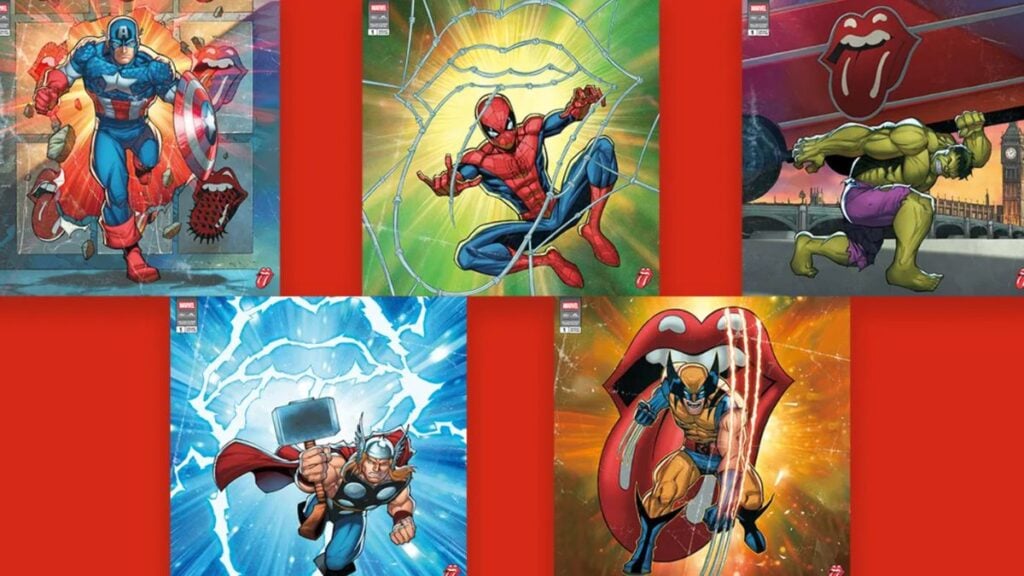
Another unexpected partner — and one much closer to my personal wheelhouse — is Marvel Comics, which teamed with the Stones for a series of special collector’s edition vinyl variants. The series features some of Marvel’s best-known characters: The Hulk, Captain America, Spider-Man, Thor, and Wolverine.
Each hero has their own edition of the album with corresponding artwork. For example, Spider-Man is using his web to form the iconic Stones lips and tongue logo, Thor has the logo rendered in lightning around his hammer, and The Hulk is in the process of throwing an iconic British double-decker bus bearing the band’s logo on the side. The special pressings also come with a comic book, though it’s unclear whether the story is Rolling Stones-related.
FIFA
While I only have a mild case of World Cup fever, the Rolling Stones — not surprisingly, given their English roots — are fully on board. This partnership starts with three special vinyl editions for the World Cup host nations of the United States, Canada, and Mexico, with artwork focused on the colors and cultural themes of each country.
There is also a FIFA World Cup edition of the album featuring the lips and tongue logo with a soccer ball pattern. Additionally, the band is contributing a remix of “In the Stars,” one of the songs from the album that’s already been released, to the official FIFA World Cup 2026 album. And, literally as I was writing this, I came across the announcement of an extensive Rolling Stones/World Cup merchandise line.
What It All Means for Classic Rock
Here’s the moral to this week’s story. NASCAR, Marvel, and FIFA represent some of the biggest fan communities around, none of which exactly match who you might picture as a typical Rolling Stones lover. Yet all three were willing to lend their cachet to the band.
Meanwhile, at Classic Rock — where the band is still a top 10 artist — we reach the community that likely loves this band the most. Yet I wonder how many stations are going to create special programming around the release.
As you read this on July 6, there is still time to join the likes of NASCAR, Marvel, and FIFA in celebrating a new Rolling Stones album release. You don’t have to focus on playing the new music, but you should be finding ways to celebrate the fact that one of the format’s biggest acts is still relevant and still creating buzz.
Barrett Media produces daily content on the music, news, and sports media industries. Sign up for our newsletters to stay updated and get the latest information right in your inbox.
It’s somehow appropriate that my first column following the 250th birthday of the United States should involve the laws of our land. No, not the dumb ones, like the law here in Kentucky that requires you to take a shower or bathe at least once a year.
Specifically, there are laws requiring the FCC to issue reports covering important things, like how many radio or TV stations an entity can own. When Congress passed the Telecommunications Act in 1996, Section 202(h) required the FCC to “review … all of its ownership rules biennially as part of its regulatory reform review …” In a massive bill passed in 2004 (the “Consolidated Appropriations Act, 2004”), Congress inserted Section 629, which changed the television ownership cap to 39 percent national audience reach (up from 35 percent) and dropped the word “biennial” from the Telecom Act, inserting “quadrennial” instead.
If that rule didn’t keep the FCC folks busy enough, Congress passed the RAYBAUM Act in 2018. Congress and the President like catchy names for bills, and the RAYBAUM acronym stands for Repack Airwaves Yielding Better Access for Users of Modern Services Act. Yes, that’s RAYBAUMSA, but RAYBAUM rolls off the tongue more easily. RAYBAUM required the FCC to publish a biennial report (so far, not changed to quadrennial) on the state of the communications marketplace and to submit the report to both the House and Senate committees, as well as publish it on the FCC website.
You’re probably thinking, “Ed, why should I care about all that, especially after a holiday weekend?” Both the Quadrennial Report and the Communications Marketplace Report are due this year. It matters because these reports become the basis for changing the media ownership rules.
Where the Industry Stands on Ownership Rules
If you follow the trades, you know there are those in the industry who advocate for looser ownership restrictions, especially for radio. Some comments filed with the FCC suggested that the local ownership rules for radio be scrapped entirely, while others believe the current rules, established in the Telecom Act of 1996, should stay in place.
As usual, the arguments on both sides make sense, but there are nuances. The FCC received over 2,200 comments on the docket (link at the end of this column), though the vast majority came from individuals submitting the same pre-written comment supported by the MusicFIRST Coalition and the Future of Music Coalition, opposing any local ownership changes. These individuals weren’t original, perhaps, but the fact that 2,000 people took the time to support a cause in an FCC proceeding counts for something.
On the broadcast side, joint comments from a group of smaller owners (Connoisseur, Midwest, Mid-West Family, Townsquare, Bonneville, Legend, and Frandsen) pointed out the loss of audience and ad revenue for local radio in recent years, driven by the rise of digital competitors that don’t face the restrictions and obligations placed on broadcast licensees. They supported eliminating the local ownership rules. A quick look at other comments from smaller ownership groups suggests they agree.
Meanwhile, iHeart took a different approach in its submission, supporting unlimited ownership in the AM band while retaining ownership caps for the FM band. With AM’s continuing decline, this argument has merit.
The Conundrum of Consolidation
Here’s why this is such a conundrum: we know the local radio business is hurting. The joke about “flat is the new up” is real when it comes to revenue. No matter how many studies show the value of local radio to advertisers, many still prefer digital, despite its shaky statistics. If an ownership group could own an even larger number of stations in a market, especially the stronger signals, it could spread costs across more stations and offer a stronger option for advertisers, ideally bringing in more business.
However, small operators might get squeezed out. Any owner left with one or two stations, especially in a niche format, would need a solid core of local advertisers who genuinely support what the station is doing, or else risk losing them.
The wild card here is money — not just revenue, but financing. We’ve seen the bankruptcies, including a couple that are ongoing as I write this piece. Lots of debt is fine if the marketplace is improving, but if ownership restrictions are removed and we see another debt-fueled buying spree like the one that followed passage of the Telecom Act in the late ’90s, the industry will be heading for another fall: more good people out of work, more syndication and automation, and very little local presence, fulfilling the prophecies of those who oppose any change to the local ownership rules.
Looking back, the Telecom Act was a watershed moment for commercial radio. We went from small groups (the 20/20 rule) to huge radio conglomerates owning hundreds of stations across dozens of markets. The track record hasn’t been good, but then again, who could have foreseen the competition local radio faces today?
What a Fair Trade-Off Might Look Like
Much as foreign entities aren’t allowed to own more than a small percentage of a U.S. broadcast station, could there be a requirement limiting how much debt an operator can carry? Can the FCC ensure that an operator, whether a small group or one of the majors, has enough cash invested to maintain the local presence needed?
I doubt we want to return to the days of studio location rules or add requirements for certain amounts of local presence, like the old news/public affairs percentages that existed prior to 1981. Still, if we’re going to allow a near-monopoly in local broadcast radio to exist, shouldn’t there be a quid pro quo? That’s why it matters.
If you want to read the comments on the quadrennial review, here’s the link.
For the comments on the competitive market report, go here.
Let’s meet again next week.
Barrett Media produces daily content on the music, news, and sports media industries. Sign up for our newsletters to stay updated and get the latest information right in your inbox.
Marcellus Wiley’s Fourth of July didn’t go as planned. The former NFL star and longtime sports broadcaster spent the holiday in a Florida jail cell instead.
What We Know: Jail records confirm Marcellus Wiley was booked into the Orange County Jail on July 4. Authorities charged him with domestic battery, and he’s currently being held without bond. Following retirement from his NFL career spent with four teams, Wiley moved into broadcasting and became a recognizable presence at both ESPN and Fox Sports, where he co-hosted several debate shows.
What’s At Stake: This latest arrest lands during an already difficult stretch for Wiley. Four accusers came forward in April with sexual assault allegations against him. On his podcast in May, Wiley denied the claims outright, saying, “They are attempting to leverage lies for personal gain. As they say, assassination by accusation, that’s their goal. They trying by lying.” A domestic battery charge now adds another layer of scrutiny to a reputation already under fire.
What Remains Unclear: Details about the alleged incident haven’t surfaced yet, and it’s not clear who else was involved. TMZ Sports reached out to Wiley and his representatives for comment, but neither has responded so far. Whether this case connects in any way to the earlier sexual assault allegations also remains unknown.
What It Means: For Wiley, this arrest marks the second major controversy of 2026. And it’s likely to renew questions about his broadcasting future. Networks tend to distance themselves from talent facing legal trouble, especially when multiple allegations stack up within the same year. Since Wiley’s already denied one set of accusations publicly, observers will be watching closely to see if he addresses this arrest with a similar approach. For now, the story remains developing, and additional details will likely emerge as the case moves through the legal system.
Barrett Media produces daily content on the music, news, and sports media industries. Sign up for our newsletters to stay updated and get the latest information right in your inbox.
The latest round of radio layoffs doubled down on the longstanding feeling of uneasiness for everyone in the radio industry. On Monday, I wrote about surviving a radio layoff. Right now, for a lot of our colleagues, the future feels uncertain. For many, the question of what comes next is still unanswered.
Today, I’m choosing to highlight someone who made a choice to step away from radio. Megan Ryte made an intentional career pivot that may surprise you. My hope is that it will also inspire you to think outside the box for your own future.
Ryte built two decades of equity in radio. She rose through markets including Norfolk, Miami, Houston, and eventually landed at the legendary HOT 97 in New York City. She has DJ’d stadium stages, toured with artists, and even released an album. Ryte gradually moved into television as a correspondent Extra TV and contributing correspondent for ABC News, Nightline, and Good Morning America.
Now she’s making a hard pivot — this time into anesthesiology, after earning her chemistry degree and securing a role as an Anesthesia Tech at a level one trauma center “with the goal of going to med school”. Her story is about more than career reinvention. It’s a roadmap for anyone feeling at a crossroads.
Ryte doesn’t point to a single turning point. The shift was gradual. “I woke up feeling like I no longer enjoyed what I did,” she says. “And then it was important to me to figure out why that was.” That kind of honesty isn’t common in an industry built on performance and presence. Sitting with discomfort long enough to understand it takes real courage.
For Ryte, the harder part was accepting what she found. “Coming to terms with the reality that it was time to move on from something I spent almost two thirds of my life doing was incredibly difficult,” she says. “Even though it felt like the right thing, it felt like weirdly a part of my identity.”
Identity is the word that keeps surfacing when radio professionals talk about leaving. The industry doesn’t just give you a career. It gives you a name, a voice, and a sense of self. Walking away from that is more personal than professional.
Why Medicine?
The jump from HOT 97 to an operating room is jarring to imagine. But for Ryte, it wasn’t a leap into the unknown. It was a return. “I grew up wanting to be a doctor, and then life took me in a different direction and I became a DJ instead,” she says. “But that dream never left.” Before committing to the pivot, she did her homework. She reached out to a hospital and shadowed anesthesiologists and CRNAs in an operating room for a full day. “It was a polar opposite from the studios and stages I was used to,” she recalls. “But after being present for my first surgery, I knew I was right where I was supposed to be.”
She’s now on the floor full-time, assisting anesthesia providers. And she draws a direct line between her media career and her medical one. “Spending my career in high pressure environments helped prepare me to work quickly and efficiently in stressful situations,” she says. “The pressure is a completely different type — but the muscle is the same.”
Ryte isn’t bitter about the industry. She’s reflective. She started in radio in 2007 at WOWI 103 Jamz in Norfolk — then a Clear Channel property. The industry was already churning. Ratings moved from diary to PPM. Jobs were disappearing. The anxiety felt familiar then, even if the scale is different now. “Radio has been through a lot, like many other industries,” she says. “Being there through the transition from CDs into streaming, the consolidations, the loss of jobs — it has been tough.”
Still, she believes in radio’s staying power. “Radio is and will continue to be important, it just may look a little different,” she says. “I hope that as many local voices as possible can continue to represent their communities.”
Advice for the Next Generation
Ryte has clear advice for people early in their careers. Stop thinking in formats. Start thinking in range. “When I first got into the game, I wanted to be a VJ,” she says. “That job doesn’t even exist anymore.” She’s not being dismissive. She’s being practical. TRL is gone. 106 & Park is gone.
The landscape shifts, and the people who survive shift with it. “Instead of looking at it like ‘I want to be a radio host,’ look at it as ‘I want to work in media as a whole,'” she says. “Whether you are in front of the mic or camera, or behind the scenes — be an asset.”
She also reframes what radio still offers right now. Big salaries may be fading, but the platform builds something durable. “Radio can be a great platform to market yourself and then move on or evolve when the time is right,” she says.
The Multi-Track Mindset
Ryte’s career reads like a highlight reel across industries. DJ. Radio personality. TV correspondent. Recording artist. Now, anesthesia tech. Was it all planned? Not exactly. “I would not say every path I took was completely intentional,” she admits. “But having a multi-track approach is very necessary now more than ever before.” She chased what she wanted and figured out the path as she moved.
That willingness to act — even without a full blueprint — is what set her apart. “If I had a dream, I went for it,” she says. “A few small wins can lead to your next great opportunity.”
The DJ Never Left
Despite the pivot, Ryte is clear on one thing. She’s not walking away from who she is. “I am a DJ first and foremost,” she says. “My goal is to get to a point where I can DJ and take on gigs or projects because I want to — and not because my life depends on it.” She’s not retiring the name. She’s giving it more freedom.
For radio people feeling the weight of the industry’s uncertainty right now, Ryte offers a challenge more than comfort. “You made one dream come true,” she says. “Who says you can’t make another?”
The mic doesn’t have to be the last thing you ever love. It can be the thing that taught you how to love what comes next.
Barrett Media produces daily content on the music, news, and sports media industries. Sign up for our newsletters to stay updated and get the latest information right in your inbox.
Roku unveiled a new special spotlighting top female athletes Thursday. The project marks Omaha Productions’ latest and boldest push into women’s sports programming.
What We Know: The special, Gamechangers: America’s Top 25 Female Athletes is executive produced by Sue Bird, Alex Morgan, and Peyton Manning. Commentary comes from Olympic medalists Adam Rippon and Alysia Montaño, comedians Fortune Feimster and Jared Freid, and broadcasters including Cari Champion and Hannah Storm. Omaha Productions, best known for ESPN’s ManningCast, has released four women’s sports projects in 2026 alone, including live coverage of League One Volleyball. The company also produced The Final Third and Celebrating Pat Summitt earlier this year.
What They Said: Colin Campbell, head of development for Omaha Productions (via Variety): “The great thing about women’s sports is there are still a lot of stories that haven’t been told. There’s a lot of opportunity to go deep on different individuals. And I think that that’s where we’re going to spend our time.”
What Remains Unclear: Omaha hasn’t detailed whether Gamechangers will return as an annual franchise. Similarly, the release doesn’t specify additional live-sports rights deals beyond League One Volleyball.
What It Means: Omaha’s expansion signals growing industry confidence in women’s sports content. Meanwhile, ESPN launched Women’s Sports Sundays earlier this summer, replacing Sunday Night Baseball entirely. Together, these moves suggest media companies are betting heavily on women’s sports drawing sustained audience interest.
Barrett Media produces daily content on the music, news, and sports media industries. Sign up for our newsletters to stay updated and get the latest information right in your inbox.
Fred Jaobs(Jacobs Media) Mike McVay(McVay Media) Moderatir: Buss Knight (Taking a walk)
The Consultants Conversation at the first Barrett Media Music Radio Conference focused on the current state of radio, the pressure facing the business, and what operators, programmers, talent, and CEOs need to do differently as the industry continues to evolve.
The discussion opened with the acknowledgment that radio, like every business, is changing. New jobs are being created while other jobs are disappearing, and nobody wants to see talented people lose work. A major force behind that disruption is AI. The panel recognized that AI is already affecting content creation, social media, imaging, music discovery, and audience behavior. At the same time, the speakers made a distinction between using AI as a tool and using it as a replacement for talent. The smart approach, they argued, is to use AI to make shows better, improve preparation, gather information faster, and help smaller stations compete with larger operators. The dangerous approach is using AI to copy voices and eliminate human talent.
A central theme was that the world does not need more content. It needs more community. Radio now competes in an environment filled with podcasts, streaming, YouTube, social video, Reels, and endless short-form content. That makes standing out harder than ever. The panel stressed that success can no longer be defined only by Nielsen ratings. Video views, downloads, social engagement, community interaction, live events, and relationships with advertisers all matter. As AI grows, authentic human connection becomes even more valuable.
Fred Jacobs described the industry as being at a precarious point. He argued that many of the rules that guided radio for decades are breaking down. It is not just the organizational chart that needs to be rethought; almost everything about the business needs to be reconsidered. He pointed to years of short-term, quarter-by-quarter thinking as one reason the industry is now struggling to invest properly in research, talent, and innovation. He also said radio is paying the price for decades of ignoring younger demographics, especially in the years following the Telecommunications Act of 1996.
Mike McVay offered a more optimistic but still realistic view. He said the radio business still has the potential to be profitable, especially when stations are not buried under debt. He used examples of stations and companies that generate strong cash flow when they are locally engaged and financially healthy. However, he also acknowledged that the industry may have to go through more pain before it gets better. That pain includes layoffs and the “human carnage” already being seen across the business.
Both Jacobs and McVay agreed that the future is multiplatform. Radio can no longer think of itself as only over-the-air broadcasting. It must be present on apps, social media, streaming, video, podcasts, newsletters, live events, and wherever audiences spend time. McVay said radio is a delivery system, but the real business is talent, content, and connection. A successful show today has to be heard, seen, shared, clipped, streamed, and experienced in person.
The panel also discussed what they would build if they were handed the keys to a new station or audio brand. Jacobs said he might not start with a radio station at all. He might start with YouTube or another platform where an audience can be built and monetized directly. He emphasized the importance of building a brand that lasts, not a short-term “Roman candle” format that burns bright and disappears. He also questioned whether music alone is enough anymore, given how commoditized music has become through streaming platforms.
McVay pointed to a successful sports station in a top-10 market as an example of what strong local engagement can still look like. The station has salespeople, promotions staff, social media leadership, digital sales, remotes, live personalities, and a strong app audience. Its owner is deeply connected to the business community. The point was that radio can still thrive when it is everywhere and when it is deeply involved in the community.
The speakers also contrasted large-scale operators with independent or local owners. Large companies such as iHeart, Audacy, and Cumulus need scale, and that often leads to nationalization, syndication, and hubbing. That model may make business sense, but it creates job losses and can weaken local connection. Independent owners, especially outside the top 20 markets, may have an advantage because they can be more visible, more local, and more connected. McVay used the example of mobile radio studios in Ireland that traveled from community to community, arguing that American broadcasters could build stronger brands by committing to that kind of street-level presence.
Another major point was the need for “strategic rule-breaking.” Jacobs said the old programming model of conducting a music test, drawing a line at 250 titles, and loading songs into a scheduling system is not enough anymore. He argued that PPM itself is not the problem, but the way radio interpreted PPM caused damage. In the early PPM era, some stations stopped identifying themselves clearly, assuming listeners would just find them. That thinking weakened branding and connection.
McVay agreed that music still matters, but said programmers must understand how people actually listen today. With some research showing very limited weekly listening time, it is unrealistic to assume listeners hear every song in the way programmers imagine. Stations need the big hits, but they also need “chocolate chips” — special songs, surprises, or moments that give the brand texture and personality.
Talent was repeatedly identified as the most important differentiator. McVay said he could copy a station’s music, marketing, and contests, but he cannot copy air talent that has a real relationship with the audience. The panel argued that personality is what protects a brand. That personality can be local, national, or even voice-tracked if the prep and connection are strong. The key is whether the talent creates something distinctive and meaningful.
The conversation also addressed the talent pipeline. Jacobs said radio has no real bench anymore. In the past, stations could find rising talent in smaller markets, but many of those stations now run syndicated programming. He sees college radio as one of the best remaining places to find young, radio-oriented people with fresh perspectives. McVay added that young people are still creating; they are just doing it through podcasts, TikTok, fake online radio stations, and social platforms. The bigger problem is compensation. He argued that radio has eliminated much of its middle class, with some people making wages comparable to retail or food-service jobs but with weaker benefits.
Finally, the panel discussed what CEOs need to understand. Jacobs said CEOs must understand every platform they expect their companies to use. It is not enough to order a podcast division, newsletter strategy, or digital product without understanding how that content is made, how long it takes to develop, and how it should be sold. McVay praised leaders who understand programming, content, technology, and local execution. The best CEOs surround themselves with people who know the work and give them room to evolve, while still holding ideas accountable financially.
The panel closed on a sober but hopeful note. The industry is clearly facing painful change, layoffs, debt, technological disruption, and audience fragmentation. But the speakers also believe radio is capable of better work. The path forward is not more sameness. It is stronger talent, smarter use of AI, better community connection, multiplatform distribution, strategic risk-taking, and leadership that understands how content is actually created.
The State of Audio Measurement
Moderator: Rob Miller (WNEW-FM) Rich Tunkel: (Nielsen) John Rosso: (Triton Digital) Cameron Hendrix: (Magellan AI)
he discussion centered on how audio measurement is evolving across radio, streaming, and podcasting, and whether the industry is moving fast enough to satisfy advertisers who increasingly want proof of business outcomes, not just audience estimates.
The panelists generally gave the current state of audio measurement a B or B-minus. The reason was not that measurement is broken, but that audio is fragmented. Broadcast radio, podcasting, streaming audio, and video all operate with different measurement systems, different standards, and different expectations from advertisers. Digital audio has more native delivery and attribution data, while broadcast is still working to become more measurable in the same way digital channels are.
A major theme was that advertisers are no longer satisfied with reach, frequency, impressions, or rankers alone. They want to know whether campaigns drove sales, foot traffic, web searches, leads, or other outcomes. The panel repeatedly came back to the idea that outcome measurement is becoming the real report card for audio.
Rich Tunkel addressed Nielsen’s diary-market measurement and explained why Nielsen requested a pause in MRC accreditation for diary markets. His point was that the audit process is backward-looking and resource-intensive, while Nielsen needs room to innovate faster. Nielsen is testing a new, less burdensome way to collect diary-market listening data, alongside traditional paper diaries and the newer mobile M-Survey. The goal is to make it easier for people to participate and to better capture listening from harder-to-reach demographics.
There was also a discussion about Nielsen’s shift from the five-minute rule to the three-minute rule in PPM markets. Rich said the change helped capture more listening occasions, especially shorter listening sessions that reflect today’s media habits. He said it brought in more listening and was fairly equitable across formats, with Spanish-language formats seeing some of the larger gains. However, he also said he had hoped radio programmers would experiment more with the added flexibility, especially around stopset placement. Instead, many stations still cluster commercial breaks around the old quarter-hour habits.
One of the most important programmer-facing points was about ratings compression. Rich explained that in an average quarter hour, only about 40 to 50 people out of every 1,000 may be listening to radio at that exact moment. When that listening is divided across a large number of stations, especially in a market like New York, it creates a crowded ranker with a lot of stations bunched closely together. That also explains why one panelist can seem to have such a large impact, especially in younger demos.
The panel addressed whether younger-skewing formats are being undercounted. Rich pushed back on the idea that younger listeners are simply missing from the data, saying Nielsen uses weighting to prevent older listeners from being overrepresented and younger listeners from being underrepresented. But he acknowledged the real frustration: younger demos are harder to recruit, and because fewer 18-34s are listening in any given quarter hour, each active panelist can carry more influence. So the issue may not be undercounting as much as volatility and stability.
AI came up as another major topic. The panelists were careful to distinguish between using AI to improve analysis and using AI to create audience estimates. Nielsen said it does not use AI to inform its audience estimates. Instead, AI is used internally to improve processes and analyze data more efficiently. Magellan AI said its technology is used to identify ads in podcasts and audio streams, but the measurement still has to be grounded in real advertiser data, such as purchases, order IDs, or conversions.
A strong point from the conversation was that AI should not invent better-looking numbers. Its value is in helping humans make sense of the firehose of data. One example was using AI to turn complicated campaign performance data into a short, understandable narrative for a seller to share with a client. A campaign may not show a dramatic “hockey stick” increase, but a 3% lift in sales, foot traffic, or search activity can still be meaningful. AI can help explain that.
The panel also discussed the need to bring podcasting further upstream in the media planning process. Nielsen is working to integrate first-party podcast data into Nielsen Media Impact, the planning tool used by advertisers and agencies. The argument was that podcasting cannot grow simply by fighting for a small piece of the existing audio budget. To grow meaningfully, it has to appear in the planning systems where agencies make allocation decisions and where media channels compete for budget.
There was also a pushback against treating “audio” as one single bucket. Podcasting, streaming, and broadcast radio can each reach different audiences and play different roles in a media plan. Cameron noted that advertisers sometimes think they have checked the audio box if they buy one form of audio, but the overlap between podcast and streaming audiences may be smaller than expected. The takeaway was that buying one part of audio does not mean an advertiser has bought all of audio.
The final portion focused on the long-running debate over advertiser demos, especially whether radio should move from 25-54 to 25-64. Rich said the demos are available in the tools, but advertisers are usually the ones setting the age target. The panel agreed that radio has a strong case to make for older, affluent consumers with disposable income. John made the point that radio has been having this same argument for more than 30 years.
The strongest argument for expanding the demo was tied to outcomes. If a 55-year-old buys a Jeep, the car dealer does not discount that sale because the buyer is outside 25-54. A buyer is a buyer. That may be where radio has its best opportunity: instead of only fighting over age cells, the industry can prove that its audience actually buys things.
Overall, the panel painted audio measurement as a system in transition. Radio, podcasting, and streaming are all being pushed toward the same reality: advertisers want proof. Reach still matters, demos still matter, and audience estimates still matter, but the future of audio measurement will be about connecting listening and ad exposure to actual business results.
Act Like a Talent, Think Like An Owner
Murphy Sam & Jodi (Premier Networks)
The Murphy, Sam & Jody session was less a traditional programming panel and more a business lesson for radio talent. The central idea was that their success did not come only from chemistry, likability, and relatable content, although all of that clearly matters. Their growth came from learning to treat the show as a company, not simply a daily performance.
Jason Barrett introduced them by saying he wanted them involved because of their chemistry, energy, relatability, and likability. But he also made the point that their story goes beyond being a successful radio show. They built a business, learned how to distribute it, and grew it into syndication in a way that other talent in the room should study.
Murphy, Sam, and Jody opened by saying the session would not be a deep dive into programming best practices. Instead, they wanted to talk about what they learned the hard way over 25 years of syndication. Their four main lessons were: be your own CEO, understand that you serve more than one audience, check your ego, and “keep the wow.”
The first major theme was the need for a mindset change. Jody said that when she started, she mostly wanted to focus on the audience and the content. That was her natural lane. Murphy, however, pushed the group to think like business owners. He helped them understand that they could not just show up, do the show, and wait for the industry to take care of everything else. They had to operate like a business.
Murphy explained that being a CEO means focusing on the outcome and owning all the responsibilities around the show, even the boring ones. That includes affiliate communication, technical delivery, sales support, brand consistency, market research, contracts, and making sure the show fulfills every promise it makes. He said talent can’t always do everything themselves, especially as they grow, but they do have to own the responsibility.
They also talked about serving three different audiences. The first audience is, of course, the listener. Jody said she does not think of listeners only as a target demo or profile. She thinks of them as people she is in a relationship with. She talked about how listeners interact with them online, invite them into their lives, and feel personally connected to the show. That relationship, she argued, is still the most powerful thing radio talent can create.
But the second audience is advertisers. Murphy and Jody made the point that sales can no longer be treated as someone else’s problem. When they launch in a new market, they do not only meet with the PD or OM. They also meet with the general sales manager, sales team, and sometimes clients. They tell affiliates to treat them as if they are “down the hall.” They give sales managers, advertisers, and affiliates their cell phone numbers. Jody said she once worried that clients might abuse that access, but they generally do not. Instead, it helps build trust.
A key moment came when someone told Jody that she needed sales managers walking into the GM or market president’s office and fighting for the show, saying, “I can sell this.” That changed how she viewed the role of talent. If the sales team believes in the show and knows the talent is responsive, they become internal advocates. That is critical for syndicated talent.
The third audience is the affiliate itself. Murphy, Sam, and Jody emphasized that every affiliate is, in some way, a boss. As they joked, when you are on nearly 90 stations, you have about 90 bosses. That means being available, flexible, and responsive. They told a story about being ready to leave for Christmas vacation when an AE from an affiliate asked them to cut a spot for a client. The client wanted all three of them on the spot, the copy was long, and the timing was terrible. But they did it anyway because the affiliate had sold the client on them. Their attitude was that the job is not just to be talent, but to deliver when someone in a local market has put their credibility on the line.
The “check your ego” section focused on rejection, flexibility, and not taking business decisions personally. Sam talked about the reality that stations will drop the show, deals will fall apart, and markets will change. Sometimes there is something to learn from the loss. Other times, the decision may be about money, format changes, or local strategy. Murphy said the challenge is to separate the facts from the feelings. Talent naturally takes rejection personally because the product is their personality, voice, and life. But if every loss becomes emotional, it becomes harder to grow.
They also talked about flexibility. If a station cannot carry them in mornings anymore, maybe there is an afternoon solution, a weekend version, or some other content offering. Murphy said the answer should not automatically be “no.” It should be, “How can we approach this?” That mindset keeps doors open.
One of the strongest business stories came from 2009, when the economy tanked. They had been self-syndicating for several years when several affiliates suddenly said they could no longer pay cash and needed to switch to barter. The problem was that Murphy, Sam, and Jody did not have a barter option. At first, they had to figure it out without letting the stations see the panic behind the scenes. They essentially said yes, then worked to solve it. They eventually built a barter model and later partnered with companies like Skyview Networks and Premiere Networks. Murphy said the important part was that the client-facing side remained steady. The affiliates did not need to see the pain and confusion behind the curtain. The show had promised to be a solution, and they had to keep acting like one.
They also talked about the importance of intellectual property. During the old Clear Channel days, after being turned down for another salary increase, they asked if they could own the intellectual property of the show. Mark Chase and Brad Harden agreed, and that decision changed everything. It allowed them to syndicate beyond iHeart. Murphy said that moment gave them freedom, but also responsibility. They had to manage the privilege carefully and avoid abusing the company that had allowed them to own the show.
Murphy said that move is the reason they are on 87 stations today. It was not because anyone simply handed them a platform. At the time, they were too small and boutique for major networks to sell nationally. But owning the IP gave them the ability to start building. They later had to operate like “Switzerland,” meaning they could not give iHeart automatic preference, even though that was where the opportunity began. They had to treat all partners and affiliates fairly.
The session also touched on protecting what you build. Jody’s phrase “Keep the Wow” began as a personal motto about holding onto good moments and letting losses go. Murphy, thinking like a businessman, protected it with a service mark. They now use it as part of the brand and even sell merchandise connected to it. That illustrated the larger point: if talent creates something valuable, they should protect it.
The emotional heart of the session was “Keep the Wow.” Jody said talent and programmers are being asked to do more than ever. They may have to be the CEO, HR department, marketing department, sales department, engineer, IT person, billing department, and contract writer. But amid all that, she reminded the room that talent is still the “wow” of the business. Talent is the heartbeat, the touchstone, and the reason listeners form an emotional bond.
In the Q&A, someone asked what sitcom best represented their show. They said “Friends” because of the ensemble dynamic. Murphy is the straight man and the steady center. Jody is the heart. Sam is the smartass, cynic, and color. They stressed that these are not fake characters. They are real versions of who they are. Their marriages, divorces, kids, sobriety, family lives, flaws, and personal stories all become part of the show.
The final message was that if they could do it, others can too. But the key is running the show like a business while never losing the human connection that made the show worth building in the first place. Murphy, Sam, and Jody’s story is not just about syndication. It is about ownership, humility, service, adaptability, and knowing that talent still matters — but talent has to think bigger than the studio.
Appetite For Disruption
James Kurdziel (Cumulus Media)
Frank Kramer (95.5 KLOS)
Justin Johnson (98 Rock)
Chris Lloyd (102.5 WBAB)
Moderator: David Hill (Barrett Media)
David Hill opened up the line of questioning talking about AI and how it’s beginning to take over the world of rock radio. James Kurdziel says he considers AI a tool much like technology when he first began in radio. Johnson built on those comments by saying it’s used more for the day to day of consolidating the busy work of the role. Lloyd believes the AI is more about how humans choose to use it. There’s plenty of ways to continue.
Kramer however said the technology is scary for him. Instead of the technology being so open, it needs some more dedication and oversight by human beings. There’s little oversight which leads to concerns about how the technology could actually be beneficial over intrusive to the business of the industry.
When asked about the backlash from the consumer in their individual markets, Kurdziel believes that the audience already believes that radio is already run by AI. It’s the job of the station and the talent to now prove their not artificially enhanced. Kramer mentioned the rise in AI artists in both listening and popularity.
Hill then shifted to the challenge for any brand. Reaching new listeners. Kurdziel says there’s plenty of mistakes being made by many stations. He says the goal of Q101 isn’t to attach themselves to 24 year old’s, but more 40 year old’s. It’s more about reaching listeners who loved the format, left it with time, and now want to re-live the fun times of what those younger experiences brought.
Lloyd then referenced the different type of audiences, all earned one by one. It comes down to working within your own communities, and connecting with people on a more personal level. Johnson says that success all comes down to talent. Getting your talent in front of as many different people and platforms as possible. However, Kramer says being available on every platform is not exactly a good strategy. For him, it’s all about driving people back to the radio show. Therefore, he doesn’t give away everything on every platform. He wants to ensure that people understand the radio show is paramount, and the bigger party can be found there.
When it comes to corporate influence in how playlists are curated, Kurdziel admits that hits in every format are undeniable. However, where the nuance comes is in market to market. Local bands and sounds matter most with local audiences. He credited Cumulus Media of allowing station management to have more control over their playlists than ever before. it’s about winning, that’s it. While not denying that corporate control still somewhat exists, it’s not as prevalent as you may think.
Lloyd echoed those statements. Hits are hits, and other songs are not just hits. It’s all about getting the audience involved and as much research as possible to make the decisions for your individual markets. Johnson revealed that every active rock station’s playlists are about 80% the same, the rest is just more gut decisions based on the research you have. He cherishes the freedom in his role with 98 Rock, but he does miss the discussions with fellow programmers about strategy on playlists.
Kramer however doesn’t play any music to his show on 95.5 KLOS, and wouldn’t have it any other way. Have the morning show mixed in with the music, not the other way around.
When it comes to morning shows around the country and the balance of music in morning shows, it’s a heated debate. Johnson said it’s all about content. As long as the content is there, allow the talent in the morning show talent to determine if they need the music to add to the content of the show. If it’s a personality driven show, let the personality drive it. Lloyd says there’s not a one size fits all with every morning show on every station.
When it comes to what makes their individual brand special, Kurdziel says in Chicago, Q101 is cool. It’s had that cool factor for years before he arrived, and the branding is undeniable around the city. Lloyd spoke about WBAB and it’s heritage brand in Long Island, NY. It comes down to the people of the station that continue to build upon the standard set many years ago. Johnson echoed the same about 98 Rock in Baltimore. However, he says that the music isn’t the only thing driving the success of the brand today. It has play by play among other items on the brand to reenforce that heritage in the Baltimore market. Kramer talked about the “Rainbow Racetrack” of 95.5 KLOS and the talent that have been legendary in that market for many years. However, it also comes down to rewarding the listener too by providing them access to experiences that they will never forget.
However, re-invention is key to remaining relevant for success. Kurdziel says it comes down to try, fail and then find success. But it’s all about continuing to try. Also, people who understand what works and what doesn’t as time moves on is vital to remaining ahead of the game. Lloyd agreed saying that the goal always has to be about stepping on the gas no matter how often you fail. Johnson said taking chances is the only way to find success. There shouldn’t be a fear of being fired every time you have a decision to make.
To wrap up, David Hill asked everyone on the panel about what was their biggest failure in radio. Kurdziel says he’s currently living in his own personal failure. Working with different playlists, jocks talking in different parts every single day. It’s more about finding out what works, and then building off that. That leads to a lot of excitement about where the future could lead. For Lloyd, it’s about building his team during his first term as a program director and a giveaway for a Harley Davidson where he lost all the entry forms for everyone who submitted. What he learned is be more humble and work with your people on many things.
Johnson referenced his time working for iHeartMedia at WEBN where there was a lot of cooks in the kitchen. He took every word from those cooks as gospel, and never used his own gut instinct on things. Kramer said it came down for him where he didn’t know who the clients were on the radio station he represented. So, when doing a segment on his program, not knowing that the topic of the conversation was an advertiser on the radio station.
Barrett Media produces daily content on the music, news, and sports media industries. Sign up for our newsletters to stay updated and get the latest information right in your inbox.
The Eras of Radio
Mark Adams (iHeart Media)
Sean Copland (B101)
Steve Salhany (Mix 104.1)
Anna Zap (Anna & Raven. Connoisser Media)
Moderator: Sharon Dastur (Dastur Venture)
The panel, moderated by Sharon Dastur, focused on where music radio stands today, how station brands are being built, where future talent will come from, and why personality, local connection, and trust may matter more now than music alone.
Sharon opened by asking each panelist to describe the personality of their station or show without using format labels or positioning statements. Mark Adams described Z100 as a reflection of New York and the Tri-State area. Even though Z100 is a massive brand, he said it has to feel small and personal to the listener. The station’s job is to reflect the mood of the market, amplify what people are already talking about, and provide entertainment, companionship, and connection.
John described the stations he programs, and himself included, as unpolished and authentic. He said real conversations with friends are usually not polished, and that authenticity is part of what makes radio work. Anna described her show as “mom radio,” but not in the safe, Radio Disney sense. She said the show is funny and edgy while still being able to connect with moms, kids, and men. That early exchange set the tone for the larger conversation: successful radio brands need a human personality, not just a music position.
When Sharon asked what makes their brands different from competitors, the answer came down to execution. Steve Salhany said plenty of stations talk about being local and connected, but the key is actually doing it. He said personalities and promotions people need to be in stores, out at events, and visible in the community. That localness is what gives a station its vibe and makes listeners feel connected to the people behind the brand.
Anna added that being live still matters. She said she gets up at 3:30 every morning, and because her show is live, she can talk about what is happening that day. She contrasted that with shows that pre-record bits days in advance. She also said she still believes in putting listeners on the air, including kids, because it allows the audience to participate. Sean Copeland added that his company still has people in the building, which allows them to do meaningful things for both the audience and clients. He acknowledged that a well-staffed building is becoming increasingly rare.
Mark said Z100 tries to execute ideas that are “bigger than big,” things that make people ask how the station pulled them off. But even with large-scale ideas and syndicated talent, he said the local connection still matters. Elvis Duran may be syndicated nationally, but he is still a New Yorker, and that identity helps anchor the brand.
Sharon then asked what old-school behaviors or radio ideas might be coming back. Steve said he believes radio itself is coming back. He argued that the medium has been declared dead many times, from MTV to streaming, but it has survived because it still offers one-on-one connection. He also said radio has done a poor job of growing the next generation of young talent, which must change if the industry wants to remain healthy.
Mark connected radio’s opportunity to the current distrust of artificial intelligence and misinformation. He said people are overwhelmed by digital platforms and unsure what to believe. That gives radio personalities an opening because they can provide trusted companionship, curation, and endorsement. In his view, the trust dynamic between listener and personality may become even more valuable.
John talked about nostalgia and the desire for older, simpler cultural experiences. He mentioned the idea of a village frozen in the 1990s, with old Pizza Huts and AOL Messenger, and said people seem to want pieces of that world back. His station has leaned into that with The Tape, a live, local, all-request Saturday night show. On paper, a six-hour call-in request show may sound outdated, but listeners still call because they want to participate.
The panel then shifted to where radio will find its next generation of talent. Sean shared the example of someone on the promotions team who also board-opped for a talk station. The employee loved country music and wanted to be on the air, so Sean gave him a chance to voice track overnights on the country station. It was an old-school development opportunity: get some reps, make airchecks, and learn by doing.
Mark pushed back against the idea that the talent pipeline is completely broken. He said dynamic people are still out there, but radio has to look beyond the old small-market ladder. He gave the example of a current Z100 afternoon personality who had been a waitress in San Jose only a few years earlier. Someone noticed her personality, introduced her to radio, and she eventually landed one of the biggest afternoon jobs in the country. Mark’s point was that radio needs to find talent in the real world.
Anna added a practical warning: young people still need to pay bills. She said she was able to chase radio partly because her husband helped support the household while she took pay cuts. Not every young talent has that option. If radio wants to keep younger people, it may need to find ways for them to supplement income, especially when they can often make money as influencers or content creators.
When asked what matters now when evaluating personalities, the panelists said experience is less important than the ability to connect. Steve said he looks for someone dynamic who wants to be a personality. Mark said he pays attention to social media because entertainment is platform-agnostic. If someone can be interesting and engaging in one space, he can teach them radio. John told a story about hiring a country co-host whose resume and demo were not impressive, but after having a beer with him, he realized the person could tell stories, carry a conversation, and be relatable.
The conversation then moved into music and data. Steve said programming has changed because there is so much information now: streaming, research, Shazam, Spotify, and even iTunes. But he made a larger point: for many music brands, music is not as important as it used to be. Listeners can get any song they want, whenever they want, without commercials. That means radio’s real difference-maker is local content and personality.
Mark said Top 40 radio has moved away from being a pure gatekeeper. In the past, programmers often looked for reasons not to play songs. Now, he said, radio needs to think more strategically about artists who can matter over multiple songs and multiple years. Not every song needs to be a smash. Sometimes a good song helps build familiarity and supports the larger brand. Because audiences are fragmented, songs also take longer to become familiar, so radio has to be more patient and strategic.
Sean added that his company benefits from sharing information market to market. Mobile data helps show how different cities respond to music differently.
Sharon then asked about the difference between someone listening to a station and following the brand. Mark said every point of contact matters. If someone discovers a personality on social media before knowing they are on the radio, that is an opportunity to pull them back to the station. Steve compared it to politics and said talent needs a ground game. They have to meet people, shake hands, introduce themselves, and ask for the order: “Would you be willing to check me out?” Anna echoed advice from an old promotions director: shake as many hands as possible.
A major takeaway was that people follow people more than brands. When Sharon asked what does the heavy lifting outside of music, Mark said Z100’s foundation is the morning show. Steve said stations need strong morning shows but also more depth in other dayparts, especially afternoons. John put it bluntly: with 15 minutes of commercials an hour and music people did not personally choose, meaningful personalities are the reason anyone would choose radio.
Mark gave Alex Warren as an example of the long game. Z100 supported him early, including at a Summer Bash event where only a small crowd showed up. But after sustained support across platforms, events, and songs, the investment became meaningful. His point was that wins are rarely instant anymore.
The panel closed by challenging the assumption that radio is dying. Mark said radio is alive, healthy, vibrant, and growing in many places. People are overwhelmed by choice and still need trusted curation. He compared it to walking into a comic book store and needing someone knowledgeable to guide you. Radio can do that for music. Steve said he is tired of hearing that radio is over and said the industry needs to believe in itself again. Sean pointed to listener comments after recent layoffs as proof that people still care when familiar voices disappear.
Overall, the panel argued that radio’s future is not about becoming more like streaming. Its opportunity is to lean harder into what streaming, algorithms, and AI cannot easily provide: trusted personalities, local presence, human connection, community participation, and people who make listeners feel like they belong.
Learning From Legends
Jim Kerr (Q104.3)
‘Broadway’ Bill Lee (WCBS-FM)
Scott Shannon (True Oldies Channel)
Moderator: Jim Ryan (Barrett Media)
The Radio Hall of Fame panel moderated by Jim Ryan brought together Scott Shannon, Jim Kerr, Broadway Bill Lee, Tim Kelly, and others for a warm, funny, and deeply revealing conversation about what built their careers, what radio used to demand of its best personalities, and what the business has to remember if it wants to keep mattering.
The discussion opened with Ryan recognizing the weight of the moment. He was sitting with multiple Radio Hall of Famers, including people he had competed against and others he had the privilege of working with. That set the tone for the panel: admiration, humor, honesty, and a clear understanding that these were not just famous radio voices, but people who helped shape the sound and personality of the medium.
When asked what allowed them to build Hall of Fame careers, Jim Kerr gave the simplest and maybe most important answer. He said the key was showing up every day, being consistent, being positive, being upbeat, and appreciating that the audience was there. Kerr said his job each morning was to make sure listeners could feel his affection for them through the speakers. His goal was not to prove how clever he was or dominate the room. It was to give people something that made their day a little better.
Scott Shannon said he never set out to be a star. He just wanted to be on the radio. As a kid, he saw a picture in Billboard magazine of a man alone in a small room with a microphone, talking to people he could not see. That looked perfect to him. He joked that it meant he did not have to talk to anyone face to face; he could just talk into the microphone. Like so many great radio people, he had a childhood fascination with the medium and later realized that almost every other great DJ had some version of the same story — a pretend radio station in the bedroom, basement, or another room in the house.
Broadway Bill Lee said his passion came first from the music. He had been in garage bands and loved records before he ever became a radio personality. His early career was not about being famous as much as it was about being close to the songs. He talked about advice he received from Jerry Cagle, who told him to “try to be as good as the music.” That became central to the Broadway Bill Lee sound. He approached song intros as if he were introducing a band on stage. If Journey was about to play, he wanted to bring the same energy and excitement through the radio. Eventually, especially through social media, people could see how much he genuinely loved the music, and that love became part of his brand.
A major theme of the panel was failure. Ryan asked when each person felt they had “made it,” but the answers quickly turned into stories about getting fired, rejected, and starting over. Broadway Bill talked about being fired from WTIC-FM in Hartford after going too far during a live on-air conversation involving condoms and marijuana. That could have been a career disaster, but it led to one of his biggest breaks: KFRC in San Francisco, part of the legendary RKO General group. Bill described those stations as majestic, loud, tight, edgy, and nationally respected. For him, landing at KFRC was a moment when he knew he had reached a different level.
Scott Shannon asked Jim Kerr whether he had ever been fired, and Kerr said yes, several times. The panel treated it as a shared truth: everybody in radio gets fired eventually. Scott said being dismissed, replaced, retired, or “separated from your duties” is part of the gig. The people who make it are the ones who keep going.
Scott told one of the best stories of the panel about buying a plastic briefcase from Kmart early in his career because he wanted to look official. Inside the briefcase, he taped a page from Broadcasting Magazine that listed the top media markets. He circled Mobile, Alabama, where he was working, and planned to circle each bigger market as he moved up. He wanted Los Angeles. He also repeatedly sent airchecks to WABC in New York, only to be told he was not the kind of disc jockey they wanted and that he did not sound like New York. Years later, of course, Shannon would become one of the defining voices of New York radio.
Jim Kerr’s New York story was just as revealing. He had been working in Chicago, first on ABC’s FM station WDAI, where he took over mornings at just 19 years old. He was working six days a week for $273. Then ABC moved him to WLS for one Saturday night shift from 10 p.m. to 4 a.m., and the pay jumped to $434 a week. That showed how different radio economics were at the time, and how much more powerful the AM brands were.
When changes came to WLS, Kerr thought he might be out. Instead, ABC told him they would keep him until they found another place for him inside the company. That place turned out to be mornings at WPLJ in New York. The raise was only sixteen dollars a week, from $434 to $450, but the opportunity was enormous. Kerr admitted it was terrifying. New York was full of huge radio names, including Don Imus and John Gambling. But his new program director, Tim Powell, took him to dinner and told him not to try to compete with them. Just be yourself. Kerr said that worked.
Kerr also reflected on the difference between New York radio in 1974 and New York radio today. Back then, he was right in the middle of the 18-24 demo stations wanted. Now, he joked, he is out of demo, along with many of the listeners who have been with him from the beginning. But he did not frame that as a complaint. Instead, he said the key is surrounding himself with younger people who have different cultural references. They help the show connect with younger listeners, while he can mentor them in return.
The conversation then turned to Scott Shannon as a program director. Shannon said he never really wanted to be a PD. He wanted to be the best DJ. But he became a programmer because he did not want to work for people who loved radio and music less than he did. His programming style was based on simplicity. He did not believe in long aircheck sessions where every break was dissected. He preferred hallway coaching. If someone talked too much, he told them they “yakked” too much. Simple, direct, and clear.
That led into the classic “Beat It” story. Shannon recalled Magic Matt Alan talking over the long intro of Michael Jackson’s “Beat It.” Scott walked into the studio and explained that the cart machine showed the intro time. When the numbers matched, that was the signal to stop talking. His message was blunt: shut up. It was funny, but it captured his larger philosophy. Do not get in the way of the record unless you are adding something better.
The panel also dug into the craft of old-school Top 40 radio. Scott joked that no listener ever called to praise a jock for hitting the post, but Jim Kerr and Broadway Bill Lee made clear that the skill mattered. On stations like KHJ, CKLW, WRKO, WOR-FM, WLS, and KFRC, the energy came from the way the music, jingles, pacing, and personalities moved together. Great jocks became one with the music. They did not just talk over song intros; they rode them.
Bill Drake’s influence also came up. Shannon said Drake changed radio by creating tighter, more disciplined stations. The station always sounded consistent, even though personalities could be different. The greats, like Robert W. Morgan, The Real Don Steele, and Dr. Don Rose, were so talented they could bend the format. Jim noted that Z100 worked the same way. Scott could do almost anything on the Z Morning Zoo, while the rest of the station stayed within the structure.
The final part of the conversation looked at radio’s future. Broadway Bill talked about poetic license and whether local personalities today are still allowed to take chances. The feeling was that many are not. Talent is often more restricted, more careful, and less free to experiment with content or language.
Jim Kerr delivered the strongest argument for why radio still matters. He said the industry has done a poor job promoting itself to the larger media and advertising world. Too many people talk as if radio is dead, even though hundreds of millions still listen every week. Technology has changed everything, but human nature has not changed. People still crave companionship and connection. Kerr said radio provides that better than almost any other medium.
Scott Shannon added that local still works when it is great. He pointed to the KVJ Show in Florida as an example of a local show that plays very little music, talks heavily about its community, and wins big. But he also made a realistic point: a great national show can be better than a weak local show. The issue is not local versus syndicated. The issue is whether the content is compelling.
The best closing thought was that a good song is better than mediocre content, but great content is better than any song on the playlist. That summed up the careers on stage. These Hall of Famers gave listeners more than records. They gave them rhythm, personality, humor, companionship, and a reason to keep coming back.
Choosin’ Country
Tim Roberts (Audacy)
Andie Summers (Beasley Media)
Mark ‘Hawkeye” Louis (New Country 96.3)
Moderator: Joel Raab (Joel Raab Consulting)
Country radio has always carried a little bit of an outsider complex inside the broader radio business. It is massive, loyal, highly commercial, and often culturally powerful, yet it can still be treated as if it sits apart from every other format. That dynamic was on display during the Country Radio panel led by Joel Rabb, with Tim Roberts, Andie Summers, and Mark “Hawkeye” Louis offering a candid look at what still makes the format special, what is threatening it, and why the best country stations still have a very real opportunity to win.
Raab opened by asking what makes country different from other formats. The answer came back quickly: intimacy. Country is personal. The songs are personal. The artists are personal. The connection between the audience and the performers feels different. Fans do not just believe they are watching a star on stage; they often believe they know that artist. In country, the relationship between listener and artist can feel like friendship. That gives country radio a powerful role as the bridge between the two.
Hawkeye made the point that country artists are simply more accessible than many artists in other formats. He mentioned Chris Young calling his show after Dallas Cowboys games to talk football, something that would be difficult to imagine from a major pop star on a regular basis. That accessibility is one of country radio’s great advantages. Artists understand what radio has meant to their careers, and many of them still treat the medium as a partner rather than just another promotional stop.
Tim Roberts leaned into the loyalty factor. Country radio listeners tend to stay with their stations. They care about the air talent. They show up for events. They respond to community involvement. Roberts pointed out that country stations have historically been deeply involved in radiothons, fundraisers, veterans’ causes, children’s charities, and local events. That presence in the community has helped country stations become more than music outlets. At their best, they are community institutions.
But the panel did not pretend the format is without problems. When Rabb asked what keeps them up at night, Hawkeye went straight to the financial realities of radio ownership. Debt, corporate pressure, and cost-cutting have led to reduced staffs and, in some cases, stations that appear to have stopped trying. He mentioned seeing stations in major markets with barely any identifiable local presence, even on their own websites. His fear is that more companies will choose that path, cutting personnel to save money while weakening the very product that gives the station value.
Roberts said one of his concerns is radio’s larger inability to tell its own story to advertisers and media buyers. He argued that radio is still delivering audience and results, but the industry has not been loud enough or coordinated enough in making that case. Rabb added that the industry could use a broader campaign promoting the value of radio itself. He pointed out that consumers can hardly find a radio department in a store like Best Buy anymore. That creates a visibility problem for the medium, even as millions of people continue to use it.
The panel also dealt with the human side of staff reductions. Andie Summers said she tells her team to keep doing the work. People are not being eliminated because they are doing a bad job. They are often victims of business realities beyond their control. That is easy to say when you are not the one losing a job, but it matters that managers and teammates make clear that talent is still valued. Roberts said managers need to be good listeners and understand where each person is in life, including their family and financial situations. Leadership during hard times requires empathy, not just strategy.
At the same time, the group acknowledged that country radio can still be a strong revenue generator when it uses its brand properly. Roberts talked about the Hoedown, an event that has helped launch careers, create memories, and generate real money for the station. Fans still talk about seeing future stars early in their careers at those events. The most powerful example was Garth Brooks, who had played the event early on and promised to return 30 years later. Roberts held him to it. Everyone signed NDAs, the appearance was kept quiet, and Garth returned for a surprise 30-minute set. Roberts described it as one of the most electric musical moments he had ever witnessed. The panel agreed: that is country music. It is loyalty. It is memory. It is the artist-radio relationship at its best.
That relationship still matters to Nashville. Roberts said artists sign with labels because they want No. 1 records, and country radio still plays a major role in creating that mark of success. A No. 1 country record is not just a chart achievement. It can help build a touring career. The panel noted that artists with multiple No. 1 hits can draw concert crowds for years. That is healthier for the entire ecosystem than a format filled with disposable one-hit wonders.
The conversation turned to syndication and how talent can sound local when they are not physically in the market. Roberts said it requires work: meeting with local sales managers, understanding the local events, supporting radiothons and fundraisers, and feeding local content to local markets. Summers, whose show is heard in multiple markets, was honest about the challenge. She said doing the homework matters, but it is hard to be truly local when there is no budget to visit the market. Hawkeye said that is where local shows still have an advantage. If he were competing against a syndicated show, he would be everywhere locally — at events, charities, and community functions — making sure listeners knew he lived there and cared about the market.
Coaching air talent was another major topic. Summers said coaching is essential. Without it, how does talent get better? She does not love traditional aircheck sessions, but she values feedback, ideas, and encouragement. She remembered an early program director who gave her tapes of successful women in radio and told her to find someone she liked, then do her own version. The lesson was not to copy, but to discover what felt authentic. Hawkeye agreed, saying good coaches point out what talent does well and encourage them to do more of it. He also said coaching can help program directors, especially when a PD does not understand how to properly manage a morning show.
Roberts connected coaching to strengths. His view is that talent should be treated almost like actors in a show. Find out what they do best, feed that strength, and help them grow. That kind of coaching is creative, collaborative, and fun — the reason many people got into radio in the first place.
The panel also tackled whether country audiences are more patriotic. Roberts said country stations often naturally lean into patriotism through red, white, and blue branding, veterans’ causes, Fourth of July programming, and patriotic songs. Hawkeye added an important caution: he does not want to judge anyone’s patriotism based on politics. Still, he acknowledged that patriotism is easy for country radio to embrace because it fits the format naturally.
Regional differences in country remain very real. Roberts said the Southwest, East Coast, Midwest, Texas, and other regions all have different musical nuances. Texas has its own country ecosystem, while Americana influences from artists like Zach Bryan are changing the texture of the format. Some artists may be huge in one region and nearly invisible in another.
AI came up as a tool, but not a replacement for personality. Summers said her show may use ChatGPT for brainstorming contest names or ideas. Hawkeye said his show uses AI more on the back end for research and blog posts, helping them quickly support on-air content with website material. But he pushed back against chasing meaningless web traffic with cat videos and recipes. Digital content should serve the show, not distract from it.
The final message was realistic but not defeated. Hawkeye compared radio’s current moment to New York newspapers in the 1960s. Too many outlets fought for a shrinking ad pie, and eventually only the strongest survived. He believes radio may be heading toward a similar correction. Some stations will die. Some may go dark. But stations with strong personalities, community connection, smart operators, and real relevance can thrive.
Country radio’s advantage remains clear. It has loyal fans, accessible artists, sellable events, emotional music, community roots, and talent that can matter locally. But none of that works automatically. The stations that survive will be the ones that keep showing up, keep coaching talent, keep helping sales, keep serving listeners, and keep proving that radio is more than a signal.
It is a business. It is also a relationship. Country radio still wins when it remembers both.
Straight Outta Hip Hop
Damizza (SynerG Marketing)
Funk Flex (Hot 97)
Angela Yee (Premiere Networks)
Skip Dillard (Audacy)
Devin Steel (Hot 107.9)
Moderator: Andre Yancey (Audacy)
The hip-hop panel at the Barrett Media Audio Summit turned into something more than a discussion about radio programming. It became a candid conversation about culture, talent, technology, ownership, artist development, and whether hip-hop radio can still do what it once did better than anyone else: break records, build stars, and make listeners feel connected to the moment.
Andre Yancey stepped in as a last-minute moderator and helped guide a conversation that had plenty of honesty, emotion, humor, and history. The panel included Funkmaster Flex, Angela Yee, Damizza, Skip Dillard, and Devin Steel, each bringing a different perspective on what radio has been, what it has lost, and what it still has the power to become.
The conversation began with a larger question about radio’s identity. Too many people still think of radio as an old analog button in the car. But the panel made clear that radio’s real power was never just the signal. It was programming, promotion, personality, community, discovery, and trust. Hip-hop radio was never just about playing songs. It was about neighborhoods, slang, clubs, artists, rumors, taste, and real voices telling the audience what mattered.
The panel acknowledged that pieces of radio’s role have been taken away over time. TMZ took part of the celebrity-news lane. Spotify and streaming platforms took part of music discovery. Social media took some of the immediacy. Podcasts gave audiences another way to consume personalities. Syndication, voice tracking, regionalization, and cost-cutting also removed some of the live energy that made radio feel urgent and local.
Funkmaster Flex brought history and emotion to the room. He talked about growing up in the Bronx and finding his way into DJing through the influence of Frankie Crocker, Mr. Magic, Marley Marl, Chuck Chillout, and Kool DJ Red Alert. Flex remembered how important language was to him. When Mr. Magic used phrases like “Boogie Down Bronx” and street slang on the air, it made listeners feel like radio was speaking from inside the culture, not outside of it.
Flex also talked about the old apprenticeship system that helped build radio and DJ talent. Carrying records was not just carrying crates. It meant buying food, parking cars, watching, listening, and doing whatever needed to be done to earn a place in the room. That kind of training ground has become harder to find today. There are fewer overnight shifts, fewer board-op jobs, and fewer places for young talent to learn by making mistakes before they are expected to perform on a major platform.
Angela Yee’s story showed a different but equally valuable path. Before becoming a major radio personality, she worked in marketing and entertainment, including with Nile Rodgers and later around Eminem’s world. She eventually made her way to Sirius and Shade 45. An interview with Jay-Z helped prove she had something, and from there she became part of The Breakfast Club, one of the most influential hip-hop radio shows of its era.
Yee’s story was also about reinvention. Leaving The Breakfast Club to launch Way Up with Angela Yee meant betting on herself at a time when listening habits had changed. Audiences no longer consume radio only in real time. They hear clips, watch video, listen to podcasts, and follow talent across platforms. For Yee, the opportunity was not just to do another radio show, but to build a brand that could live on-air, online, and on demand.
She also raised one of the panel’s most important points about AI and misinformation. In a world where content can feel fake, automated, or non-human, trusted personalities matter more. Yee noted that even experienced media people can be fooled by social posts that look real. That gives radio a new responsibility: not only to entertain, but to help sort through the noise.
Skip Dillard brought a broader programming and leadership view. He reminded the room that radio has been declared dead many times before. Television was supposed to kill it. CDs were supposed to kill it. MP3s, streaming, and now AI were all supposed to finish the job. Yet radio remains because it has always learned how to evolve. But Dillard also made clear that evolving cannot mean abandoning the basics. Radio still needs to be a cheerleader for its format, its artists, and its community.
Dillard said if labels are not developing artists the way they once did, radio may have to help fill that void. He also pointed to college radio, community programs, local scenes, and overlooked places as sources for the next wave of talent. The industry cannot complain about the lack of new artists and personalities if it is not willing to invest in the places where those people are formed.
Devin Steel spoke from the perspective of a programmer who came up through Memphis, college radio, DJing, production, Clear Channel, iHeart, and Radio One. He talked about having thousands of pieces of vinyl and still thinking like a DJ, but also understanding what it takes to run a modern radio brand. His biggest concern is that too many people today want the platform without doing the work.
Steel said social media fame does not automatically make someone a radio talent. A person can have followers, host a podcast, or make money online and still not know how to execute a radio show. Radio requires pacing, storytelling, format discipline, market connection, and the ability to create inside a structure. He said jocks also have to make themselves more valuable. The days of only reading liners and sending production down the hallway are disappearing. Talent needs to understand production, sales, content, client needs, and the full operation of the building.
Damizza gave the panel some of its sharpest industry commentary. He challenged radio to ask what happened to artist development and whether the business is simply going to let Spotify win. He said what he is doing now on Instagram is not much different from what he always did on the radio: short, direct, passionate breaks aimed at his core audience, which is the music business.
Damizza said radio and music have changed, but great talent has not. The challenge is finding new ways to display that talent. He also talked about the importance of passion and risk. He remembered hearing Eminem early, being told not to play the record, and playing it anyway because he believed there was something there. He said he was willing to risk his job for the record. That kind of belief, he argued, is what radio needs again.
One of the strongest moments came when Flex publicly praised Damizza. Flex said Damizza was not just someone offering opinions from the sidelines. He had done the work. He remembered Damizza’s passion at Power 106 and said his commitment to the station, the artists, the brand, and the music should not be overlooked. Damizza responded by calling Flex a beacon, saying if a record did not get past Flex, it was not really that record yet. It was a moment of respect between two people who understood the fight to push hip-hop forward.
The panel also dealt with radio’s harsh business reality. Flex put it bluntly: one of radio’s biggest problems is that companies paid too much for assets that are no longer worth the same amount. That pressure has led to layoffs, cuts, and reduced investment. But Flex also reminded the room that most people in radio did not get into the business for the money. They chose it because they loved the music, the microphone, the content, the marketing, the culture, or the connection to listeners.
The social media discussion showed how much the job has changed. Yee talked about being early to video and social content, even when companies did not always understand why giving away clips could help a paid platform. Her instinct was that clips would make people want more. Today, some of her strongest content comes from listener-driven segments, including people calling in with secrets and personal stories. That works because the audience feels involved.
Yee also said part of her connection comes from still being present in her community. She lives in Brooklyn, walks around, goes to her coffee shop, and sometimes takes the train. People see her and feel like they know her. That kind of connection cannot be manufactured by an algorithm.
As the panel closed, the message became clear. Hip-hop radio was built by people and stations that took chances: Power 105.1, Kiss, WBLS, Stretch and Bobbito, Hot 97, Power 106, Funk Flex, Damizza, and many others. It was also built by mentors and innovators who showed that radio personalities and shows could become brands.
The final advice was simple but powerful: be passionate, evolve, take chances, and mentor the next generation. Dillard said radio has to keep finding talent and artists in places it may have stopped looking. Steel said jocks and programmers need to get creative again and learn every part of the business. Yee emphasized mentorship and using new platforms to extend conversations beyond the air. Damizza called for passion. Flex reminded everyone that love for the medium is still what separates real radio people from everyone else.
The panel did not argue that radio should go backward. It argued that radio needs to carry its original spirit forward. AI, streaming, social media, podcasts, and national syndication are not going away. But none of them can replace authenticity, trust, live connection, artist relationships, mentorship, or a real human being speaking to a real community.
Hip-hop radio’s next chapter will not be saved by nostalgia alone. It will be saved by talent, courage, discovery, smart programming, and people willing to fight for the culture the way the previous generation did.
The Final 40
Keith Dakin (Connosseur Media)
Jeff Sottolano (Audacy)
Greg Strassell (Hubbard)
Jon Zellner (iHerat Media)
Moderator: Jason Barrett (Barrett Media)
Jason Barrett led a wide-ranging executive panel focused on the state of radio, the pressures facing brands and talent, and what the industry must do to remain relevant. The panel featured Hubbard’s Greg Strassell, Audacy’s Jeff Sottolano, Connoisseur Media’s Keith Dakin, and iHeartMedia’s Jon Zellner. The discussion moved across several major themes: how success is defined today, the role of talent in revenue, music discovery, the balance between gut and data, the changing job of the program director, how people can protect their careers, and where AI fits into radio’s future.
The conversation began with the basic but complicated question of what success looks like now. Zellner said radio can no longer define success by ratings alone. Ratings still matter, but the best brands are building habits, changing minds, educating listeners, and making emotional connections. He said talent should ask themselves every day what they learned about their target listener that can be brought into the next show. If talent does not know the answer, they may need to rethink how they are preparing.
Sottolano was direct in saying that from an executive standpoint, revenue and cash flow are still the most important measurements. He said that may sound cold, but it is the reality of the conversations happening in rooms where decisions are made. However, he added that value can be created in several ways. Talent and programmers may contribute through ratings, social influence, off-platform revenue, collaboration with sales, and the culture they build inside the company. His job, he said, is to identify each person’s “superpower,” help amplify it, and support them in areas where they need help.
Dakin focused heavily on the need to connect talent with clients. He said that was one of the strongest takeaways from Funk Flex’s earlier appearance. In smaller markets especially, a talent’s relationship with a key local advertiser can be incredibly important. A morning show host who can text an auto dealer or build trust with a local business owner brings value beyond the rating book. Dakin also said he does not want talent to be “wallpaper.” He wants people who are disruptive, memorable, and capable of creating moments that listeners talk about in the grocery store.
Strassell said he wished more music radio stations had the kind of energy WFAN showed at the sports summit. Sports radio often has a sense of momentum, multiple voices, and a winning atmosphere that is easier to feel. He said music radio needs more of that “it factor.” Strassell also talked about Hubbard’s company identity around the word “connect.” When the company looked for an umbrella idea that could include radio, digital, and podcasting, “connect” quickly became the answer. He said that is not just a slogan but a North Star.
The connection theme also applied to clients. Strassell said advertiser attrition can be high in many forms of media, but endorsement spots tied to talent have much lower attrition because they are built on personal relationships. A client may cut billboards, TV, social, or general radio spending, but if they have a trusted relationship with a talent, that endorsement is harder to eliminate. He said when a jock is on a sales call, the entire conversation changes and often becomes a brainstorming session.
The panel then moved into music discovery and whether radio can still break new artists. Strassell pushed back against the idea that radio should concede that space to social media or DSPs. He said public radio and non-commercial music stations often do a better job because there is real curation happening. The talent sounds connected to the music. They tell stories about songs. They make the audience feel like there is a human being behind the choices.
Strassell said telling stories about songs is one of the oldest tricks in the book, and radio needs to bring it back. He gave the example of a rock station doing a midday show before the Indy 500 where the host played songs about racing and cars, took listener requests, and created a show that sounded spontaneous and alive. It likely went off the playlist, but it felt curated and connected to the moment. He said radio needs more of that.
Dakin said he refuses to believe radio can no longer break music. He pointed to WXRT in Chicago as an example of a station that still feels cool because it is curated and trusted. He said rock and alternative radio still have an opportunity to break the next major band, but stations have to remember they can do it and work together to support new artists.
Sottolano agreed, but said the industry has to work in a more coordinated way on artist development. The media ecosystem is fragmented, and some artists have built careers without much radio support. He said radio should support the artists who value it, but it also has to prove its value to those who may not understand what radio can still do. He said it is not an artist’s job to chase radio airplay; it is radio’s job to demonstrate why airplay matters.
Zellner said radio has to own the things DSPs cannot do. Playlists can play a song, but they cannot create theater around it. They do not have jocks, imaging, local context, artist takeovers, or a relationship with the audience. He pointed to moments involving artists like Bruno Mars and Taylor Swift as examples of how radio can still create scale and excitement around music. His point was that radio should not act like a playlist. It should do the things only radio can do.
The conversation then turned to the balance between data and gut instinct. Barrett raised the example of Damizza playing Eminem despite being told he could be fired for it. Strassell said the answer is to use both. “Research is a compass. Gut is the art.” He recalled Scott Shannon’s “desktop only” trick, where a programmer would walk into the studio, hand a talent a song, and tell them to play it right then and talk about it. That was not research-driven. It was about creating a moment.
Sottolano said there has to be room for both data-informed and intuition-informed decisions. However, he noted that programmers now have far more information about audience reaction to music than they had 10, 15, or 20 years ago. He said it would be foolish to ignore that. If he were advising programmers where to take more creative chances, he might point them toward content, promotions, community events, and off-platform ideas rather than simply blowing up the playlist.
Zellner said gut may help decide what gets into the system, but research helps determine the path a song takes once it is there. He said iHeartMedia has internal systems with thousands of data points that help determine whether a song moves up, slows down, or gets dropped. Labels, radio, and audiences all operate on different timelines, so programmers need both instinct and discipline.
The panel also discussed how the role of program director has changed. Sottolano said today’s PD has to understand multiple platforms, not just linear radio. They need to coach talent, create content for radio, and build ideas that work on digital, social, video, and podcast platforms. They also need to motivate people, because great work usually comes from people who are inspired by their leaders.
Dakin described the modern PD, especially in smaller markets, as a unicorn. Companies need someone who can keep the trains running on time while also being a creative mad genius. That person may need to manage logs, imaging, promotions, talent coaching, digital expectations, and local strategy all at once. For Dakin, the key quality is being a committed doer.
Strassell said the first thing he looks for in a PD is vision. Program directors make important decisions every week and need a clear sense of where the brand is going. He also said the future requires “community program directors” who know their markets, build relationships, and understand what is happening locally.
Zellner said the job is no longer just art versus science. Today’s PD has to be a steward of the brand, a sales partner, a motivator, and a trusted messenger inside the building. They cannot be a speed bump to senior leadership. They need to understand company strategy and explain it in a way that makes sense locally.
When the discussion turned to layoffs and career security, the message was clear: become more valuable. Strassell said content teams need to think more about revenue. Dakin said talent should become stars in their communities. Sottolano said the best talent are CEOs of their own personal brands, and work ethic is undefeated. Zellner said talent who have deep client relationships and local endorsement revenue are harder to replace because there is real revenue at risk if they walk out the door.
The panel closed with AI. Sottolano called AI an augmentation tool, useful for show prep, video clipping, and removing lower-level tasks from programmers’ plates. Zellner explained iHeartMedia’s “guaranteed human” approach, saying every voice on the company’s stations is real because trust is one of radio’s great advantages. Dakin said AI can be helpful for imaging, promotion names, and thought starters, especially for overworked programmers, but fake AI testimonials or artificial voices damage authenticity. Strassell said AI can also help teams understand platform best practices and improve social execution.
The overall takeaway was that radio’s future depends on becoming more human, not less. The industry has to use data, technology, and AI wisely, but its strongest advantages remain talent, trust, community, curation, client relationships, and the ability to create moments that playlists and algorithms cannot. The people who survive and grow will be the ones who expand their jobs before someone else does it for them.
The Mike McVay Award: Yonni Rude
Honoring a rising music programmer who elevates talent, champions innovation, and is collaborative and consistent.
The inaugural Mike McVay Award was presented to Yanni Rude, recognizing a rising programming executive who has already made a major impact across music radio. Rude’s career has taken him from Fayetteville, North Carolina, through Charleston, Richmond, Detroit, Cleveland, Atlanta, and now Houston, where he leads Magic 102.1 and 97.9 The Box. The award, named for one of the industry’s most influential programmers and strategists, was created to honor content leaders who have shown the ability to grow, adapt, and elevate both brands and people. Rude was praised for keeping both Houston stations among the format leaders while expanding their digital footprint and influencing everyone around him, from talent to sales to management.
In accepting the award, Rude thanked Barrett Media, Jason Barrett, Mike McVay, his SVP Colby Colb, and his Radio One Houston team. He also shared a powerful story about being a third-generation broadcaster and telling his grandfather that he had become number one across all demos in Charleston. His grandfather’s response — “Now you have their attention. What are you going to teach them?” — shaped the way Rude sees radio. For him, the business is not only about ratings or entertainment, but about teaching, connecting, uniting, and creating moments. Rude said radio’s biggest competitor is the phone, and that the industry must keep collaborating and creating solutions that serve listeners, clients, and stations. He closed by promising to keep pouring back into the business and helping prepare the next generation.
The Scott Shannon Award: Kevin Rolston
Recognizing elite music radio talent who innovate, connect, create impact, and make the industry better.
The inaugural Scott Shannon Excellence in Broadcasting Award was presented to Kevin Rolston, the longtime host of The KVJ Show in South Florida. Rolston launched the show in 1999 on Wild 95.5, and 27 years later, he remains a major presence in the market, now calling 97.9 WRMF home. Scott Shannon introduced Rolston by recognizing not only his longevity, but the fact that he is still deeply involved in the work: production, prep, bits, listener connection, and setting the tone for the show every day. Shannon pointed to the kind of audience loyalty Rolston has built, including live events that sell out in minutes and fans willing to show up at 6 a.m., as proof that The KVJ Show has created a real bond with its listeners.
In his acceptance speech, Rolston used the moment to honor Shannon’s influence on his own career and on the radio industry. He recalled interning at Z100 in New York, where Shannon’s “Worst to First” legacy still filled the building, and later learning the mindset of morning radio through Shannon’s former producer. Rolston credited Shannon with teaching generations of broadcasters to think bigger, create shared local moments, and make radio part of the community conversation. He also thanked the people who helped him along the way, including John Zeller, his KVJ co-hosts Virginia and Jason, Elizabeth Hamma, Hubbard Media, and his family. Rolston closed by thanking Shannon for inspiring broadcasters like him and for reminding the industry that great live and local radio can still matter deeply.
Barrett Media produces daily content on the music, news, and sports media industries. Sign up for our newsletters to stay updated and get the latest information right in your inbox.