It’s the end of an era for 830 WCCO. Steve Simpson is departing the Audacy Minneapolis news/talk station.
What We Know: Longtime morning news anchor Steve Simpson’s final day was Thursday. He originally joined 830 WCCO in 2014. Previously, he spent more than two decades at 93 WIBC in Indianapolis. Gov. Tim Walz (D-MN) proclaimed Thursday as Steve Simpson Day in the state to honor the outgoing anchor.
What They Said: “I knew these call letters before I could drive, even in Philadelphia. That’s how big this station was … I’m just worn out and want to do something else.” -Steve Simpson
What Remains Unclear: What Simpson plans to do after his departure. He largely stayed away from using the term “retirement” in his exit. He did note that he will not miss waking up at 2:30 AM to be ready and on the air at 5 AM.
What It Means: Simpson’s impact on the station is on display by the comments made by Walz and his colleagues. Several 830 WCCO staffers took to social media or the radio station to share their admiration for their colleague.
Barrett Media produces daily content on the music, news, and sports media industries. Sign up for our newsletters to stay updated and get the latest information right in your inbox.
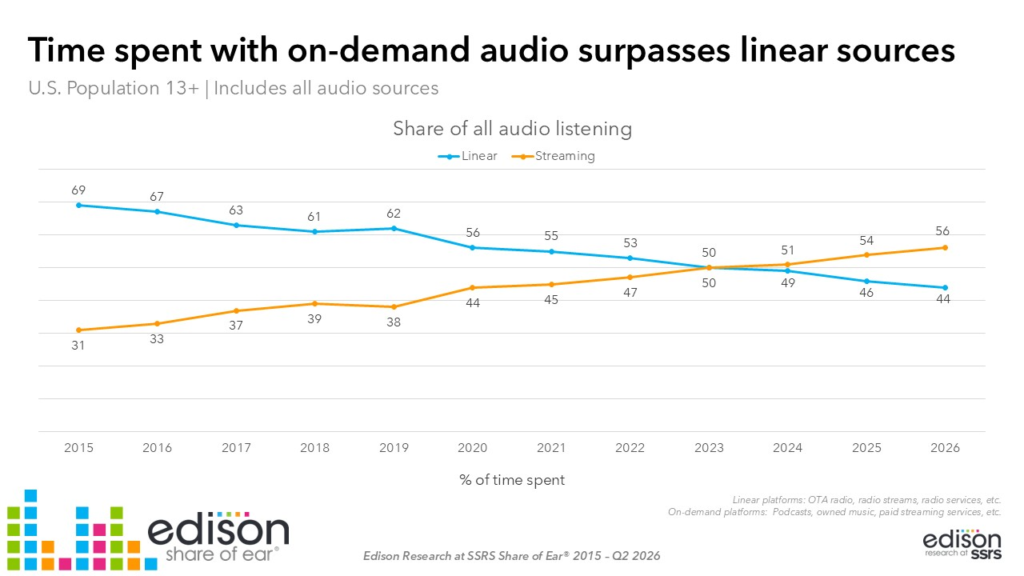
On-demand audio now claims a majority of all listening time in America. Edison Research’s latest Share of Ear data shows the format’s lead over linear radio keeps growing.
What We Know: On-demand platforms, including streaming music and podcasts, now account for 56% of all audio time in 2026, according to Edison Research’s Share of Ear. That figure marks a steady march forward since the categories first tied in 2023. Meanwhile, linear formats like AM/FM and satellite radio continue shedding share, a reversal of their historic dominance. Consequently, on-demand’s current 12-point advantage mirrors the exact margin linear held back in 2020.
What Remains Unclear: Edison hasn’t detailed whether the pace of on-demand growth will accelerate or plateau from here. Additionally, it’s unclear how much of linear’s decline stems from in-car listening, historically radio’s strongest environment. The report also doesn’t specify how younger versus older demographics are driving the shift.
What It Means: For programmers and advertisers, the message is unmistakable. This is no longer a trend, it’s becoming the standard. Therefore, traditional radio operators must keep investing in streaming and podcast extensions to chase listeners. Meanwhile, linear’s staying power suggests total abandonment remains unlikely anytime soon. Ultimately, the industry’s future increasingly hinges on winning listeners outside the dashboard.
Barrett Media produces daily content on the music, news, and sports media industries. Sign up for our newsletters to stay updated and get the latest information right in your inbox.
NBC is reportedly starting the process of inquiring about the FIFA World Cup 2030. According to a report by Sports Business Journal, the network is now exploring an English-language and Spanish-language package.
What We Know: Telemundo and NBCUniversal have reportedly already opened talks with FIFA about the rights to the 2030 World Cup in Spain, Portugal, and Morocco. Telemundo executive Joaquin Duro told SBJ said the plan could merge English and Spanish coverage under one roof. FOX Sports currently holds the English-language U.S. World Cup rights, and like Telemundo, is entering the final year of its deal.
What They Said: Telemundo’s EVP/Sports & Head of Streaming Joaquin Duro (via Sports Business Journal): “Definitely something that we are beyond exploring.”
What Remains Unclear: No timeline has emerged for finalizing any deal with FIFA and NBC/Telemundo. It’s also unclear whether FOX Sports intends to fight for renewal of its English-language rights.
What It Means: With FOX Sports seeing massive gains in audience this year with an expanded tournament, any network would look to capitalize on the event. However, the price of the media rights will be something any network has to reckon with. FOX Sports earned this year’s tournament as a discounted rate according to many experts. That fee will surely rise, especially with the amount of viewership that this year’s tournament has gained.
Barrett Media produces daily content on the music, news, and sports media industries. Sign up for our newsletters to stay updated and get the latest information right in your inbox.
FOX Sports CEO Eric Shanks isn’t wavering on Alexi Lalas. The FOX Sports CEO says the veteran soccer analyst remains central to the network’s plans.
What We Know: Lalas has served as FOX Sports’ lead soccer analyst since January of 2015, following several years with ESPN. He’s drawn heavy criticism during FOX’s 2026 FIFA World Cup coverage. Despite that backlash, Shanks addressed the situation directly in an interview with Puck’s John Ourand.
What They Said: FOX Sports CEO Eric Shanks (via The Varsity Podcast): “Alexi has been the cornerstone of our soccer coverage for as long as I can remember. He’s the straw that stirs the drink, and he’ll be the cornerstone for many years to come.”
What Remains Unclear: FOX’s broader soccer future still carries some uncertainty, even as Lalas’s role seems secure. The network’s FIFA contract expires after this year’s tournament, and rights negotiations for 2030 haven’t begun.
What It Means: For now, Lalas isn’t going anywhere, regardless of the noise surrounding him. FOX Sports and Concacaf announced last month a new multi-year media rights agreement that makes the network the U.S. English-language home of the Concacaf Gold Cup and Concacaf Nations League through 2029. Lalas will likely be a huge part of that coverage. Shanks’ comments suggest the network views controversy as engagement rather than liability.
Barrett Media produces daily content on the music, news, and sports media industries. Sign up for our newsletters to stay updated and get the latest information right in your inbox.
June was a relatively slow month on the news front. However, that didn’t stop MS NOW from seeing a jump in the primetime ratings.
What We Know: Fox News continued its lead in the total viewership race in primetime. It averaged 2.3 million viewers during the window. The Five also stayed as the most-viewed show in the space, averaging 3.5 million viewers. Fox News earned the top six spots in the overall shows category. The first show from MS NOW in the cable news rankings was The Rachel Maddow Show. That show averaged 2.1 million viewers for the month. The next highest-rated show from MS NOW was The Last Word with Lawrence O’Donnell. It featured an average of 1.3 million overall viewers.
What the Numbers Show:
Primetime Total Viewership: June 2026 vs. May 2026
Network
June 2026
May 2026
Change
Fox News
2.3M
2.4M
🔻 -5.8%
MS NOW
1.0M
942K
🟢 +7.7%
CNN
628K
633K
🔻 -0.8%
Newsmax
198K
194K
🟢 +2.1%
NewsNation
156K
146K
🟢 +6.8%
Total Day Total Viewership: June 2026 vs. May 2026
Network
June 2026
May 2026
Change
Fox News
1.6M
1.5M
🟢 +3.0%
MS NOW
655K
595K
🟢 +10.1%
CNN
500K
460K
🟢 +8.7%
Newsmax
198K
191K
🟢 +3.7%
NewsNation
80K
75K
🟢 +6.7%
What Remains Unclear: What led to the uptick for MS NOW. It is also unknown what led to the total day viewership increases during the month for everyone included in the space. MS NOW underwent a lineup change mid-month, across both the dayside and primetime windows.
What It Means: The news in the total day viewership window is slightly surprising due to the lack of major news events taking place during the month. While it’s unsurprising that Fox News remained on top of the cable news ratings, MS NOW has to be encouraged by its performance during the month.
Barrett Media produces daily content on the music, news, and sports media industries. Sign up for our newsletters to stay updated and get the latest information right in your inbox.
101.1 The Bounce (KZCE) in Cordes Lakes/Phoenix has a new morning voice. Justin Credible’s Liftoff Show debuts weekdays from 6-10am.
What We Know Justin Credible joins the Sierra H Multimedia rhythmic throwbacks outlet while continuing his afternoon role at Power 106 (KPWR) in Los Angeles. He is also heard on SiriusXM’s Shade 45. Meanwhile, former morning host APZ shifts to nights at the station.
What They Said: Credible expressed enthusiasm about the new opportunity. “I’m beyond excited to join the 101.1 The Bounce family and connect with the amazing listeners in Phoenix every morning,” he said. He credited Director of Programming and Content Eric Rosado and Ken Brentlinger for their belief in him. Rosado added that Credible’s track record across radio and entertainment makes him a perfect fit for the station and format.
What Remains Unclear The show’s full lineup of features and contributors has not yet been announced. It is also unclear whether Credible’s dual-market commitments will affect the show’s structure or content approach going forward.
What It Means Phoenix mornings just got a nationally recognized voice with significant multimedia reach. Rosado’s emphasis on human connection signals the station’s belief that personality-driven content remains essential. This move reflects a broader industry push to blend entertainment credibility with local engagement. The Bounce is clearly betting on star power to build morning momentum.
Barrett Media produces daily content on the music, news, and sports media industries. Sign up for our newsletters to stay updated and get the latest information right in your inbox.
Last year in this space over the 4th, we celebrated American explosions that changed rock forever. Hendrix at Monterey, the MTV Moonman landing, the Grunge takeover, and Metallica’s loud arrival all made the list.
This year we celebrate some self-inflicted explosions that almost killed rock from the inside. These moments were so chaotic and unhinged that they felt spectacularly American, and we all wondered whether rock might finally collapse under the weight of its own dumbassery.
Because nothing is more American than blowing it publicly, posting bail, lighting a Marlboro, and still making it to the gig on time. So… let’s light the fuse.
Woodstock ’99
When: 1999 Where: Rome, NY What: An attempt at replicating original Woodstock love that went terribly wrong. The festival was held on a massive cement landscape, an old Air Force base, in 100-degree heat with no shade and $12 water. Overflowing porta-potties, arson, sexual assault, and mosh-pit assaults plagued the weekend, and then a Sunday night riot broke out that looked like a third-world coup. It’s a miracle the Clinton administration didn’t outlaw rock Monday morning.
Axl Being Axl: Chapter 1,243
When: 1991 Where: St. Louis What: Axl spotted a guy with a camera, then did his best Greg Louganis and dove into the crowd. He punched the guy, stormed off, and left thousands of concertgoers with nothing to do but riot, trashing the place and causing millions in damage. The city banned Guns N’ Roses for life, so the band then wrote “F**k You, St. Louis!” in the Use Your Illusion liner notes. The ban was eventually lifted, and the band now goes there all the time just for the ribs.
Billie Joe — “One Minute” of Epic Punk Rockness
When: 2012 Where: iHeartRadio Festival What: Billie Joe stopped mid-song and unleashed an epic, profanity-laced, guitar-smashing, punk rock tirade about Green Day’s set being given only “one more minute.” He name-checked Bieber, though no one knows why, and flipped off the industry. In doing so, he cemented himself as a true RockTernative legend living in a corporate festival world.
Nikki Sixx & the Bullet Train
When: December 1987 Where: Japan What: A very drunk Nikki Sixx thought hurling donuts at Mick Mars on the bullet train sounded like a fun way to pass the time. When that got boring, he fired a Jack Daniels bottle that hit a Japanese businessman in the head. Nikki was arrested by riot police and thrown in jail until the promoter got him out. Motley Crue: the only band that turns train rides into international incidents.
The Night Scott Stapp Forgot But Will Never Forget
When: 2002 Where: Chicago What: Creed’s Scott Stapp reportedly showed up highly intoxicated, or medicated, and fell off the stage a few times. He forgot lyrics, then lay down and mumbled through the rest of the set while the band tried to keep the show alive. Fans even sued the band for “paying to see Creed,” claiming the band didn’t actually perform “Creed.” When your own fans sue you… you know it’s game over.
Ozzy & The Alamo — When Ya Gotta Go, Ya Gotta Go
When: 1982 Where: San Antonio What: Ozzy could have his own series of columns here: snorting ants, the bat, the dove. But nothing tops the night the Prince of Darkness had clearly had a few too many, was wearing one of Sharon’s dresses, and, since it was late, had to go. So, on The Alamo he went. The Ozzman was arrested and bailed out for 40 bucks. He apologized several times, including in a History Channel special from the historic site.
Marilyn Manson Joins the Church of Satan (Sort of)
When: 1994 Where: Salt Lake City What: While on tour with Nine Inch Nails, Marilyn Manson was named honorary “Reverend” by the Church of Satan’s founder Anton LaVey. The two were friends, and both later clarified that the title was a gesture from a friend rather than an official spiritual calling within the church. So titling an album Antichrist Superstar doesn’t actually mean he’s Satan?
Billy Idol Gets Kicked Out of Thailand
When: 1989 Where: Bangkok What: Billy Idol went on a wild bender in Thailand. Three weeks and one destroyed hotel room later, he refused to leave. Enter the Thai army who forcibly sedated him and sent him back to the States. If you get kicked out of Bangkok, you’ve reached elite rockstar status.
The Morning After — Seeing KISS With No Makeup
When: 1983 Where: MTV What: KISS finally removed the makeup… not realizing the KISS Army cared about more than just the music. A letdown so big they almost became Nickelback before Nickelback. And quite possibly the only time in rock history when putting makeup back on was the comeback strategy. And Gene wanted to remind you that KISS merch is still available [here].
Nirvana Gets Knocked Out — Literally
When: 1992 Where: MTV VMAs What: Bassist Krist Novoselic knocked himself out on live TV. Near the end of performing “Lithium,” he launched his bass high in the air, then proved he’d never played baseball by misjudging the catch as the bass slammed down on his head. He stumbled off stage and collapsed. Thankfully, members of Queen were backstage and allegedly gave him alcohol for the pain — because of course they did.
Jim Morrison Hangs Out in Miami
When: 1969 Where: Miami What: People thought Tommy Lee and Pam Anderson’s sex tape was shock rock. 30 years before that — in the ’60s — Jim Morrison exposed himself on stage, full monty. He then ranted… sweating and swearing, and the crowd went wild. Morrison was arrested, convicted, landed his own personal FBI file, and The Doors were instant hall of famers.
The Encores That Never End
When: 1980s-Present Where: Every arena and stadium What: KISS, Ozzy, The Eagles, Motley, Scorpions, and Sabbath all had “Final Tours” that weren’t actually final. In fact, that list is longer than the Declaration of Independence we’re celebrating this weekend. But hey… nothing is more American than retiring for profit, then un-retiring for even more profit.
Fire up some RockTernative this weekend and give a salute to all who deserve it, including our rock heroes who sometimes forget to pack their judgment in their tour cases. And have a great 4th.
Barrett Media produces daily content on the music, news, and sports media industries. Sign up for our newsletters to stay updated and get the latest information right in your inbox.
As I listen to radio, I’m hearing a lot of USA pride on country and conservative talk radio. But that’s pretty much where it ends. A programmer told me he was staying away from that because it was “political.” Huh? If you’re worried about offending the radical 1% of flag burners in your audience, you should stop reading this immediately.
I would call myself a casual social media user. I use it mostly to see what the radio shows and stations I work with are posting, and to buy dumb stuff that doesn’t work. Over the past couple of weeks, however, I have seen countless stories of foreigners posting how great America is. Most are stunned. They have watched the news in their countries and only see the bad stories about America. As a result, they came here expecting us to be rude and the USA to really be an awful place.
The Little Things We Take for Granted
Let’s start with the joy of air conditioning on a hot day. AC is a minority feature in Europe. Paris, for example, is just enduring an unbelievable heat wave with temperatures well above 100 degrees, yet just 20% of the buildings in that city are air conditioned. Meanwhile, our foreign visitors post about Walmart, Target, free refills on soft drinks, and that amazing American-invented Ranch dressing. One of my favorites was from a British couple driving across Florida and seeing alligators wild on the side of the road.
It’s the People, Not Just the Perks
But the most important posts are about how friendly and helpful Americans have been. Say what you want about New York — I worked in that city for decades — locals will go out of their way to give you directions and advice. It seems like our country is enjoying the visitors, from the Scots drinking all the beer in Boston to the Norwegians rowing in stadiums and subways. More importantly, they are enjoying and loving us and our country.
A Perfectly Timed Celebration
The timing of FIFA visitors coming to the USA as we celebrate our 250th birthday is perfect. Our country is unquestionably and seriously politically divided. But that division exists because our citizens believe there are different paths to pursue for our future. Perhaps we needed people from other countries to tell us we’re pretty freaking awesome right now, because we are, despite the flaws.
Sometimes it takes a guest in your home to tell you how great it is, because you dwell on the imperfections. So don’t be afraid of celebrating America with some 4th of July imaging on your station this weekend, no matter the format.
As we head into the holiday weekend, families are getting together. So, I thought I would share a family story about my Uncle “Big Tom Callahan” and my cousin “Little Tommy.” If you’ve ever spent time around the Callahan side of my family tree, you know we are a loud, passionate bunch. Who built a legacy on making quality auto parts in Ohio and treating our workforce like family. My uncle “Big Tom” was a force of nature who led with his heart. Tommy, despite his habit of setting model airplanes on fire or driving a Plymouth Satellite into a ditch, ultimately understood that a brand is absolutely nothing without the actual people who keep the lights on.
But every great heritage brand eventually runs into a Ray Zalinski.
You know the character Dan Aykroyd played so perfectly. The self-proclaimed “Auto Parts King” who stands in front of an American flag and look-at-me graphics, smooth-talking the audience by saying he makes parts for the American worker “because that’s what I am.” He positions himself as the ultimate champion of the consumer, yet he doesn’t care about the actual components, the craftsmanship, or the people sweating on the factory floor. He just cares about the logo on the box. He’s perfectly fine selling a guarantee with no substance as long as the marketing looks clean. Okay, by now you may have figured out the Toms aren’t really family, but hear me out.
The Corporate “Thud”
That exact Zalinski gymnastics routine was on full display recently. When the internal memos floated through the industry detailing the latest round of iHeartRadio layoffs, the corporate-speak attempted the ultimate pivot. The messaging was wrapped in a bow of “evolution” and “future-proofing,” explicitly claiming that these difficult organizational shifts would ultimately benefit the larger ecosystem, the product, and the consumers.
It fell with an absolute thud. It wasn’t buyable.
When you tell an air-staff, a cluster, or an industry that you are stripping away local, human capital to “benefit” the brand, you are putting a shiny guarantee on an empty box. The audience isn’t stupid. They can tell the difference between a station anchored by a living, breathing companion who lives in their zip code and a voice-tracked utility line piped in from three time zones away. In short, you cannot spin a loss of local connection as an upgrade for the listener.
The Data Disconnect
What makes this corporate playbook so baffling is that it flies directly in the face of every single piece of industry research we possess. Well, not that baffling I suppose. It’s about money.
Pick up any recent Techsurvey, Edison report, or dashboard study. The data is entirely unanimous: human talent is radio’s ultimate moat. Listeners tune into local radio for the companionship, the local context, the personalities, and the shared community experience.
So, how does this math work? How do we look at mountains of data proving that talent is the single most critical asset for securing our place in modern listening, and still conclude that the best way to move forward is to cut them?
When you strip out the quality inside the box just to save on production costs, you might save a buck this quarter. But eventually, the consumer buys the part, the car breaks down, and they never trust the logo again. Likewise, when we strip the human element out of our radio stations, we don’t optimize the brand — we just give the driver another reason to plug their phone in and leave us behind.
A Call for Compassion
Now we need to talk about the human cost.
This week, a lot of incredibly talented, dedicated, and hard-working broadcasters found out their livelihoods were eliminated via a cold notification, a few while on vacation. These are people who woke up early, stayed late, emceed the local charity events, and poured their souls into those call letters. They didn’t do anything wrong. They just caught the bad end of a corporate weather shift.
To everyone impacted by these cuts: please know that this is a reflection of a broken system, not your worth or your talent. Our industry needs your voices, your creativity, and your passion now more than ever, even if the current corporate structures don’t know how to properly value them.
As we head into this holiday weekend to spend time with the people who matter, let’s make sure we are reaching out to our peers who are navigating these tough waters right now. Let’s look out for our own.
My Uncle “Big Tom” and Little Tommy knew that a business is only as strong as the people who build it. It’s time the rest of the industry remembered the same thing.
Lastly, I am sorry if you hate the movie analogy. However, I almost wrote this one about an episode of the Twilight Zone (a show released many years before I was born) called “To Serve Man.” Ultimately, that one was about aliens that appeared to solve all of humanity’s problems. It turns out that their manual “To Serve Man” was ultimately a cookbook with humans on the menu.
If you were (to use their word) “impacted” by these moves and I can help, please use the contact info below.
Barrett Media produces daily content on the music, news, and sports media industries. Sign up for our newsletters to stay updated and get the latest information right in your inbox.
Day two of the Barrett Media Audio Summit was a smashing success. As someone who has attended the sports summits over the years, I thought the retooled approach to this year’s event was a smart pivot. Instead of two days full of content, discussion, and networking, organizers embraced a less-is-more approach. However, one element of this year’s annual gathering of the best in sports media stood out more than anything else. It should have been predictable, but unfortunately, I forgot to ask my AI agent about it.
Woven throughout every conversation was the role AI plays in the industry’s evolving workflow. From sales and marketing to programming, video editing, prep sheets, and even the occasional email, AI surfaced in every panel throughout the day. That’s a far cry from where we were just a couple of years ago, when AI seemed like something off in the distance.
How did we get here so quickly? What happened over the past few years that caused the sports media business to move AI from the back burner to the forefront of nearly every conversation at the Barrett Media Audio Summit?
The answer is actually pretty simple. AI stopped being a futuristic concept and became a practical one because the sports media industry isn’t unlike any other business today.
More Than Just A Tool
Sports radio has always embraced tools that create efficiency. We moved from carts to digital automation, from fax machines to email, from tape editing to Adobe Audition, and from physical media kits to digital marketing campaigns. Every technological shift initially produced skepticism before eventually becoming standard operating procedure.
AI is simply the next evolution. The difference is the speed at which it has happened.
It feels like only yesterday that conversations about AI centered on whether it would ever be reliable enough to use. Now the discussion isn’t whether you should use it. It’s how you’re using it and whether you’re getting more value from it than the station across town.
That distinction matters.
The best programmers I know aren’t looking for AI to replace creativity. They’re looking for it to remove friction. If AI can summarize a ratings book, generate multiple promotional concepts, organize research, build a social media calendar, create video captions, or produce a first draft of a presentation in minutes instead of hours, it frees leaders to spend more time coaching talent, building relationships with clients, developing content, and solving bigger strategic problems.
Talent should view it through the same lens.
Listeners don’t tune in because ChatGPT can write a monologue. They tune in because personalities have opinions, experiences, chemistry, and credibility that no software can replicate. But if AI helps organize prep, identify trends, transcribe interviews, clip social videos, brainstorm interview questions, or uncover story angles that otherwise might have been missed, it becomes another producer in the room helping make the show better.
No More Denying Facts
The misconception is believing AI is trying to replace personalities. In reality, it’s far more likely to replace the people who refuse to learn how to use it. That’s the message that emerged from day two of the Barrett Media Audio Summit.
The days of treating AI as just another tool are officially over. We’re now entering an era in which the industry will separate those who embrace AI from those who refuse to adapt.
That may sound harsh, but every major advancement in our business has rewarded those willing to evolve. The people who learned digital editing gained an advantage over those who insisted on razor blades and tape. The stations that embraced podcasting early built stronger brands before everyone else joined the party. Those who understood social media first created audiences that extended well beyond the radio signal.
AI feels remarkably similar, doesn’t it?
It doesn’t eliminate the need for creativity, judgment, or authenticity. If anything, it places an even greater premium on those qualities because the technology is available to everyone. Having access to AI isn’t the competitive advantage. Knowing how to ask better questions, refine better prompts, fact-check the results, and transform those outputs into compelling content is where the separation begins.
That’s a skill, and one that’s now potentially more valuable than any other in your programming arsenal.
Whether you’re a program director managing multiple brands, an account executive chasing new business, a digital producer wearing five different hats, or an on-air personality trying to maximize your reach across every platform, AI has become part of the daily workflow.
Ignoring it won’t make it disappear. It simply means someone else will become more efficient, more productive, and ultimately more valuable.
The Future Of The Industry
Walking out of the sports day at the Barrett Media Audio Summit, I found myself thinking less about AI itself and more about what it represents. Every panel reinforced the same message without intentionally trying to.
AI is no longer a niche discussion reserved for tech enthusiasts. It’s become part of the language of modern sports media.
Five years from now, I don’t think employers will ask whether applicants know how to use AI. They’ll simply assume they do, just as they assume candidates know how to send an email, edit audio, or post to social media. The differentiator won’t be whether you use AI. It’ll be how effectively you use it.
That’s why, more than any other takeaway from this year’s summit, AI wasn’t just another topic on the agenda. It was the underlying theme connecting every conversation. If that’s any indication of where our business is headed, learning how to work alongside AI may prove to be the most important investment anyone in sports media can make.
Barrett Media produces daily content on the music, news, and sports media industries. Sign up for our newsletters to stay updated and get the latest information right in your inbox.