Kelly Nash is stepping into mornings on iHeartMedia’s News/Talk outlets in South Carolina. He takes over “South Carolina’s Morning News” on 560 WVOC Columbia and 94.3 WSC in the Charleston market.
What We Know Nash will host mornings while continuing to co-host “The Morning Rush” on Country 97.5 WCOS Columbia alongside Jonathan Rush. He succeeds Gary David Barboza, who exited last week in iHeartMedia’s latest round of layoffs. Sports Director Christopher Thompson stays on as co-host. Nash had been hosting nights on WVOC and WSCC for the past month.
What’s at Stake Barboza spent multiple decades as PD and morning host at WVOC. His show expanded to WSCC as recently as last December. Replacing a decades-long morning voice carries real risk. Nash brings familiarity, though — he has been a Columbia market fixture since 2005.
What Remains Unclear Nash’s PD status at either station has not been addressed publicly. Whether iHeartMedia intends to fill Barboza’s programming director role separately remains an open question. It is also unclear how Nash managing two morning shows across formats will affect long-term workload.
What It Means Nash is a known commodity in this market — that matters. He originally built his reputation at CHR 104.7 WNOK before rejoining Rush at WCOS in 2011. He also brings outside experience, including a PD stint at WKCI New Haven and a role at Universal Records. For iHeartMedia, consolidating talent across two formats is a cost-efficient move. For Nash, it is a significant career elevation.
Barrett Media produces daily content on the music, news, and sports media industries. Sign up for our newsletters to stay updated and get the latest information right in your inbox.
If you’re attending the Barrett Media Audio Summit this week, here’s another reason to keep your eyes open. Point-To-Point Marketing is awarding a $20,000 Audience Development Campaign to one lucky attendee — and entering couldn’t be simpler.
Throughout the SVA Theatre, you will find Point-To-Point movie posters on display. They are funny, creative and will immediately get your attention. Scan the QR code on any poster, complete the entry form, and you’re in. The winner will be drawn after the Summit is over on Monday, July 6th. Point to Point will announce the winner on the company’s website and social media accounts.
Our friends at Locked On won this contest at last year’s sports summit. They can attest to the great work PTP does. For those who haven’t had the pleasure of partnering with them, here’s what one lucky organization is going to win.
What to Expect
The campaign delivers more than 2,000,000 paid social impressions through a customized audience development strategy built around your brand’s specific goals. Whether you’re trying to grow a radio station’s ratings, increase podcast downloads, build a streaming audience, drive video views or sell tickets to a live event, PTP has the experience and the infrastructure to move the needle.
There’s also a revenue component worth paying attention to. The campaign can be structured around a sponsor. That means the winner has the ability to monetize the promotion and keep 100% of the sponsorship revenue. That’s not a giveaway — that’s a fully funded marketing campaign with a built-in business opportunity attached to it.
Winners also receive weekly reporting and direct collaboration with the PTP team throughout the campaign, so this isn’t something that gets handed off and forgotten. It’s a working partnership with people who have spent nearly three decades helping media brands grow audiences across radio, podcasting, streaming, YouTube and digital media.
Point-To-Point has been a valued partner of Barrett Media and are our presenting sponsor of the 2026 Audio Summit. This giveaway reflects exactly the kind of tangible value they bring to the table for media brands at every level.
The Summit runs Tuesday, June 30th through Thursday, July 2nd at the SVA Theatre in New York City. Keep an eye out for the posters, scan the code and get your entry in.
Good luck.
Barrett Media produces daily content on the music, news, and sports media industries.Sign up for our newsletters to stay updated and get the latest information right in your inbox.
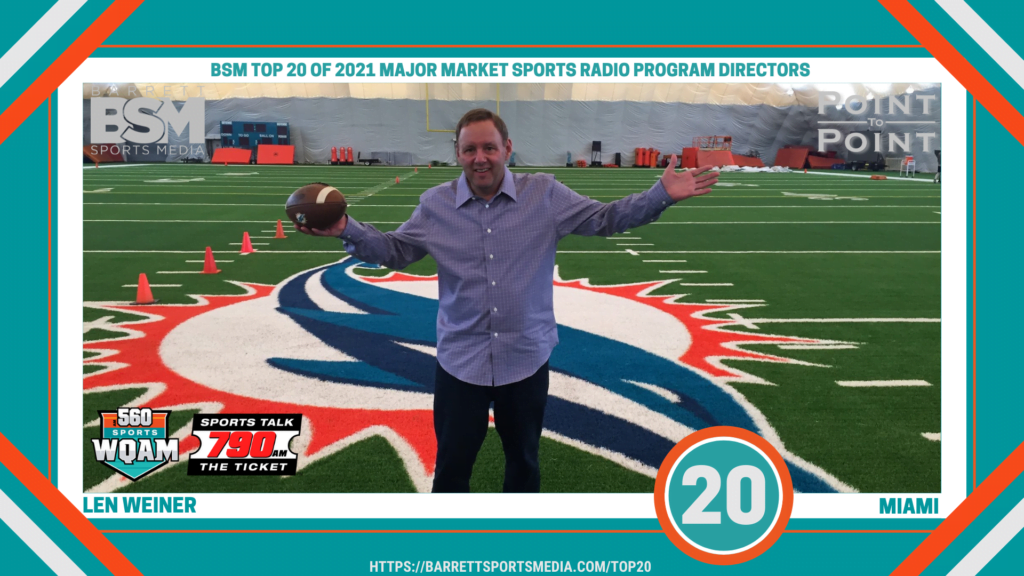
After 44 years, longtime sports radio programmer Len Weiner is retiring. The journeyman programmer, who began his sports radio career as an original member of WFAN in 1986 after spending several years in news beforehand, has decided it’s time for his next chapter in life. For the last 12 years, Weiner has called Miami home, where he programmed both 790 The Ticket and 104.3 WQAM. At one point, he programmed both stations under the Entercom/Audacy umbrella.
For the last eight years, Weiner has guided WQAM from a heritage brand featuring legacy talent on the AM band to a 100,000-watt flamethrower on FM. Now in his mid-60s, he felt the time was right to step away.
“I’ve done this a long time, and have been lucky to have been a part of some good things. I just felt at this point in time, there’s other things that I want to do. It’s time,” said Weiner reflecting on the weight of the decision.
When navigating the path to ultimately deciding to step away, it wasn’t an overnight decision. Over the past couple of years, Weiner watched friends begin that path and make the same decision he has now made. As the days and months went on, thoughts of retirement slowly entered his mind, with every conversation leading him closer to finalizing how he envisioned retirement would come.
“I’ve been thinking about this for maybe a year and a half. Probably longer to be honest,” notes Weiner. “I got a lot of advice from friends and family. I like to plan, and I was trying to think about what I’m going to do. I’ve been planning what retirement could look like for about that amount of time.”
A Miami Connection
On August 31, Weiner will officially retire from his current brand manager position at Miami’s 104.3 WQAM. It’s a station that he says he has grown to love working for because of the people who encompass it. A passionate, hard-working, and creative group from top to bottom.
When Weiner broke the news of his retirement to WQAM staff earlier this month, the reaction was an overwhelming sense of congratulations and happiness. Because of the bond he had built with the team at WQAM, Weiner says he wanted to ensure they were the first to know, and that they heard it directly from him.
“I wanted to make sure they understood it was my decision, which it absolutely was. They were happy for me. Many of them were shocked. They didn’t see it coming. But, they were all very happy for me,” said Weiner. “I loved working in Miami because it’s been more of a challenge to do things here sports-wise. The passion and creativity of the people I work with I will surely miss.”
As each day passes closer to August 31, Weiner says he is keeping his day-to-day approach the same. He continues to focus on growing the brand, coaching talent, and serving in the role as normally as possible.
While August 31 may be the official end date of his tenure as WQAM’s brand manager, he remains open to staying connected to the station if Audacy needs him in any capacity.
“They’ve asked me to stay on as an advisor if needed. If it’s needed, I will,” noted Weiner. “I don’t just want to leave and leave them stranded because they [Audacy] have been really good to me. They may keep me on. We’ll decide on that sometime in August. I’m proud of everyone for everything they’ve done here. I don’t want to leave them stranded. I want to continue the success we’ve had here and not flounder.”
Navigating What’s Next
When it comes to his eventual successor, Weiner says he is happy to participate in any way Audacy management sees fit. As for the role, Weiner hopes the person who follows in his footsteps understands both the market and the talent they will oversee.
“You have to be smart. Be able to figure out solutions and be strategic. It helps to understand what’s going on in your field and format. More than anything, a strong work ethic and being sports savvy is key,” said Weiner on the characteristics that encompass being a brand manager at WQAM. “There were times when I started in a new market where I was completely overwhelmed. A lot of knowledge is gained through trial and error. You need to lean on the longtime people who have been there to gain a better understanding of what works.”
As for retirement, Weiner hopes to continue working in some aspects of the business while remaining independent. He plans to continue scratching the creative itch through imaging and working with other teams in a different capacity. He also plans to spend more time with family, travel the world, and sell his expansive baseball card collection to the highest bidder.
Frankly, Weiner is leaving an industry that he helped build from its earliest days. Over his 44 years, he played a role in launching WFAN, helping ESPN Radio transition to a 24/7 format, pairing Mike & Mike together in mornings, and guiding WQAM’s shift from AM to FM.
Over his career, he has witnessed the evolution of radio from the primary audio content source to one piece of a much larger content ecosystem. With that evolution comes added challenges, ones that Weiner feels sports radio can navigate and still win.
“The plethora of ways to get sports talk is bigger than it’s ever been. Sports radio really has to figure out how to get its piece of the pie,” said Weiner. “It’s about the right personalities that cut through. The content has to be better than anything else. Substance and angles are what will win and elevate personalities. Every segment counts.”
Weiner also says a lost art that sports radio once dominated was becoming more involved in local communities.
“Stations need to be more involved with their communities. Some are, some aren’t. The more you can get out with people and show that you are part of your market’s fabric, you win and influence some people to tie themselves to the brand,” said Weiner. “If sports radio can continue to work on that, it will be fine.”
Believe in the Future of Radio
The future of the radio industry remains a giant unknown. Every broadcast company continues to battle for every dollar, click, listener, and advertiser against competition rooted in both traditional and non-traditional platforms. Even so, Weiner believes radio will never go away. Despite the challenges the industry faces today and tomorrow, he feels the value radio provides will always remain.
“What annoys me is when I see a lot of negative things either said or written about radio. I don’t think radio ever will go away. It’s a valuable commodity that offers things that people need. I don’t see anything down the road right now that’s going to take away those needs,” said Weiner. “However, with all the other mediums the competition is ramped up. That’s where you need to figure out how to be better and market what you bring to the table.”
For 44 years, Len Weiner has helped shape sports radio from behind the scenes. From helping launch WFAN and building ESPN Radio into a national force to guiding WQAM through one of the most significant transformations in its history, his fingerprints are on some of the industry’s most important chapters.
Now, as he prepares to step away from the daily grind, Weiner leaves with no regrets, a long list of accomplishments, and an unwavering belief in the medium that has defined his career.
The technology may change, the platforms may evolve, and the competition may continue to grow, but the fundamentals that drove his success remain the same.
Great talent. Great content. Strong community connections. Every segment counts.
For the next generation of programmers, that’s not just advice. It’s the blueprint left behind by one of sports radio’s most respected architects.
Barrett Media produces daily content on the music, news, and sports media industries. Sign up for our newsletters to stay updated and get the latest information right in your inbox.
Welcome to Summit Week. If you’ve been following the site over the past few weeks, you’ve seen we’ve been talking with members of the industry about what they expect from this week in New York City. We discussed everything from memories of past Summits to the conversations those interviewed hope will take place on stage at the SVA Theatre.
Over my career, I’ve attended the Barrett Media Audio Summit all but once. For many years, including the very first Summit held at the soundstage studio of Prudential Plaza 2 in Chicago, I’ve attended both as a participant and now as a member of the Barrett Media team. While my approach to the Summit has evolved over the years, a few things have always remained the same. This year, however, there are some subtle differences.
Another evolution will take place with the annual event this week. For the first time in Barrett Media history, the Summit will span three days, with each day dedicated to a different segment of the industry we cover.
Sports media was the foundation on which the Barrett Media Audio Summit was created. News media became the first expansion of the business. Music is the latest add and will be present for the first time at the Summit this week in New York City.
We even have a musical act closing out the after-party on night three as we welcome Triple Tigers artist Shane Profitt to the Summit. That’s pretty cool. I remember when the after-party consisted of a few beers and the World Baseball Classic on TV. Then and now, there have been plenty of memories made, with many more still to come later this week.
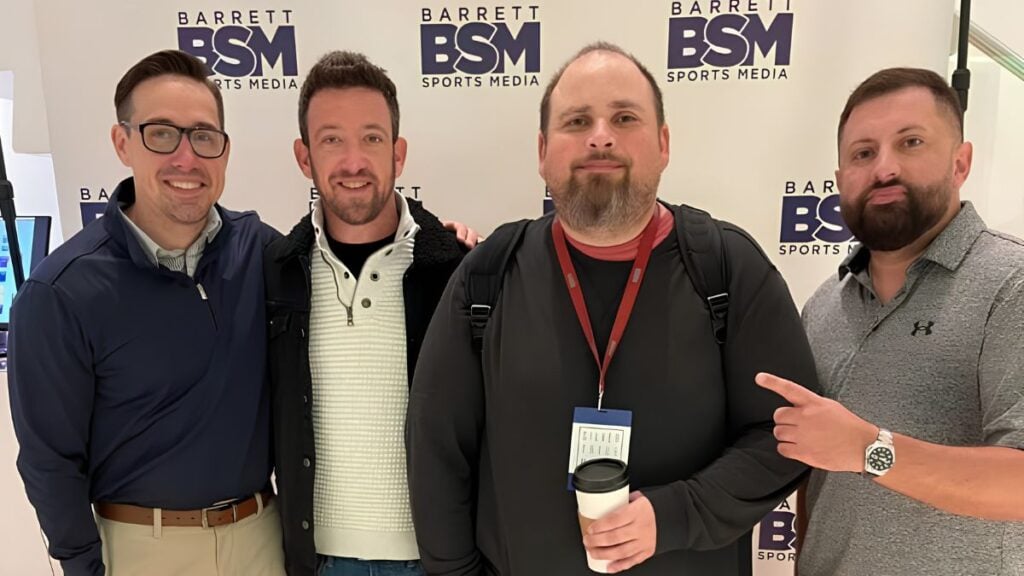
John Mamola, Jay Recher, Zac Blobner, Aaron Jacobson (Credit: John Mamola)
What remains the same, however, is the impact these few days can have on a career in sports, news, or music media. The speaker lineup this year is as impressive as ever. You’ll hear from some of the brightest minds, influential decision-makers, innovative digital leaders, and high-profile talent from around the country. It’s a combination of seminar and social gathering, where people come to learn, network, educate, challenge one another, and leave with a treasure trove of ideas to bring back to their markets.
Not everyone attends, and that’s their loss. Not every company supports employees by covering the cost of attending, and that’s unfortunate. Every Summit I attended over the years was paid for out of my own pocket. Flights, hotels, admission, and yes, even a few after-party cocktails. Not a cent ever came by my employer. Yet the value I received year after year proved invaluable to the future of my career.
So when I caught up with old friends and connected with new faces, they all asked what I expected to see this week in New York City.
Supporting Sports Radio
First, the Summit couldn’t come at a better time. The challenges of remaining employed in sports radio are greater than at any point I can remember. More is being demanded of fewer people than ever before. They’re expected to accomplish more with less support, fewer resources, and less attention from their employers.
Sports radio also continues to navigate how it competes in today’s content landscape. Stations no longer compete solely with other radio stations. They compete with everything because everything is just as accessible, if not more accessible, than sports radio has ever been. As companies continue reducing their workforce, they also lose talented, well-connected people who serve the local communities they call home.
My hope is that during this Summit, we discuss ways to ensure local talent continues to provide value to broadcast radio companies across the country. Today’s talent can accomplish more than ever before. They simply need support to get started and proper guidance on how to grow. That approach benefits not only the individual but also the company that employs them.
If there’s a content race to be won, companies must educate their own people on how to compete so they can win bigger down the road.
Video Needs The Radio Star
Second, sports radio needs to evolve its video distribution strategy. YouTube is dominating the podcast space. Netflix is spending enormous sums to join the conversation. If The Breakfast Club is streaming live on Netflix, why aren’t more brands around the country being given the same opportunities and resources that larger shows receive? It’s not just the technology. It’s also the staffing and education needed to succeed.
Simply installing webcams in studios and expecting radio staffs to know how to use them is a tremendous waste of money, time, and strategy.
But it’s about more than simply appearing on YouTube, X, or another platform where algorithms determine who sees your content. It’s about understanding short-form and long-form video, on-demand content, and podcasting. It’s about knowing how to edit, write, and produce radio content specifically for podcast audiences. They’re not the same. Thumbnails, titles, descriptions, timestamps, and effective marketing are all essential to success.
Video is becoming the new standard for podcast consumers. Every piece of research points in that direction. Ask yourself whether there’s a local sports radio station offering its podcasts in video form on Apple, Spotify, or another major distribution platform. If there is, how can the rest of the industry learn from that model?
By this time next year, both the audience and the industry will have shifted even further toward video. Sports radio must be ready to meet consumers wherever they choose to connect.
AI Adaption
Finally, AI is not your enemy. I criticized iHeartMedia for its mixed messaging about guaranteeing a human experience while buildings across the country lost human employees last week. The broadcast companies that succeed will be the ones that adapt to technology the best. That much is undeniable. But AI is unlikely to replace the human voice anytime soon. That’s why more sports radio talent should embrace AI for what it truly is: a tool to guide, assist, and elevate content across every platform.
Just as you might look up statistics on Baseball-Reference, you can ask AI for 20 questions surrounding a player’s performance over the past five years. Need a social media image? Guide AI toward what you’re trying to create while understanding that not everything it generates is appropriate or usable. Need a clever jingle, liner, or promo? You’re still the artist. Tell the tool what you’re trying to accomplish and see where it leads.
AI is the greatest therapist the creative mind has ever had. It listens, thinks, searches, takes direction, and provides guidance. Not just in theory, but through practical tools at your disposal. Every prompt, however, still begins with a human mind. The talent behind the microphone or the executive looking for a second opinion.
Like any other therapist, the result isn’t perfect. And yes, you should always ensure the final product meets your company’s standards. But AI is there to help, not replace. My hope is to leave the Summit energized by new and innovative ways AI can benefit every format in the years ahead.
And that’s the entire point of the Barrett Media Audio Summit. It’s a rare opportunity for the sports, news, and music audio industries to come together, collaborate, share ideas, and exchange strategies so everyone leaves better prepared for tomorrow. That’s how I’m approaching the Summit this week, and I can’t wait to see everyone in New York City.
John Mamola, Jason Barrett, Stephanie Eads (Courtesy; Barrett Media)
Barrett Media produces daily content on the music, news, and sports media industries. Sign up for our newsletters to stay updated and get the latest information right in your inbox.
With iHeartRadio’s latest wave of layoffs rippling through the industry, it feels like the right moment to have an honest conversation about what comes next. I was laid off from my position as National Director of Music Initiatives at Audacy in August 2025. I wasn’t shocked that my team was shrinking again, but being next on the list was still a gut punch. Day one, I cried. Day two, I went to the beach. I highly recommend the latter. After about a week of FUNemployment, reality set in. Here’s my advice from someone who is now ten months post-RIF.
Let Yourself Grieve
Forbes describes what many of us experience as “career grief — a profound sense of loss tied not just to a job role, but to identity, purpose, and self-worth.” That grief hits differently in radio.
None of us got into this business for the money. For most of us, it’s a genuine love. I started as an intern at 18, and now in my early 40s, I look back at my first years in Providence radio the way most people look back at growing up. Radio bleeds into your social life. My fiancé works in IT and initially found it odd how many of my closest friends came from my career. He has approximately zero co-workers on our wedding invite list. I have a small army of radio people.
It’s also worth saying plainly: most of us who were laid off were good at our jobs. That part remains a hard pill to swallow.
Get Clear On What You Actually Want
Think hard about what matters most to you at this specific point in your life. In my younger years, I moved for radio without hesitation. When I was laid off this time, my answer was immediate — I didn’t want to move. I was recently engaged and happy in Rhode Island. I wasn’t willing to uproot my life for a position that, in today’s climate, could disappear just as quickly.
Reflect on what you genuinely enjoy most from your skillset and chase that direction. For me, it was brand development, marketing, and event production. Let that clarity guide you.
Invest In Your Next Chapter
Hire a career coach and get your resume professionally redone. I used a portion of my severance on both, and it was worth every dollar. Having someone outside our industry helped me reframe my experience in language that travels beyond radio. Our skills are more transferable than we sometimes give ourselves credit for.
That brings me to something important: radio people are generalists. We write, we market, we produce, we manage talent, we host, we build relationships, we execute under pressure. That versatility is an asset, but it can also make it hard to position yourself on paper. A good career coach helps you solve that problem.
Get Out And Network
Something I didn’t prioritize early enough was local networking. I now work for a chamber of commerce doing marketing and producing events in Rhode Island, and I see firsthand how much value these events create. People genuinely want to connect and help each other. Seek those opportunities out in industries where your skills apply.
Don’t be shy about reaching out to former colleagues on LinkedIn or via email either. Most people are good. Most people want to help if they can.
Say Yes To Everything
Lean into freelance, contract work, and side hustles. Saying yes to everything that came my way is what carried me financially through unemployment. Through contacts, I landed event production roles for Microsoft, PayPal, and the global broadcast of the New Year’s Eve ball drop in Times Square. I showed up, even when things felt unfamiliar, and realized quickly just how much our radio skills translate.
I also discovered a new passion when I became obsessed with vintage and antiques and launched Anchor & Hope — named as a nod to the Rhode Island flag — a vintage décor business with an online presence and two booth spaces at a local antique mall. It has been genuinely successful and brought me real joy.
Advice From The Radio Peeps
I asked members of the Radio Peeps group on Facebook for any advice they would give to those who have been let go recently based on their own experiences. Below are some highlights:
Shelley Wade commented “Radio tends to be all-consuming on our lives, so I think it’s important to our process to give ourselves time to rest once we’re out of work. Yes, go through the grieving process, it’s a healthy part of life. Then, if you’re financially able to, take some time to just be… I mean live life like you’re a retiree, so you know how it feels to not make work your life. It’s also important to remember that radio is what we do, not who we are.”
Julian Nieh chimed in “as someone who’s been let go multiple times, here’s what I’d say. Everyone will tell you to “keep going,” “keep creating content,” and “stay positive.” That’s all true. But my advice is this: don’t let radio determine your worth. I love this business and the art of communication, but I also learned that so much of this industry is out of your control. For years, I let other people’s opinions define my value. I don’t anymore. I know what I bring to the table and I know I can compete with anyone in this business. If someone else doesn’t see it, that’s their decision — not my identity. And one more thing: when you get let go, you quickly find out who your real friends are. Pay attention to actions, not words. Love the business. Just don’t let the business control you.”
The Peeps On Action Steps
Phil Newmark, who has now been working for RCS for 11 years, after nearly 25 years in radio said “take what you have built and look for ways to use it in other fields, the community interaction and social media experience is huge right now and translates to so many other fields that you are pigeonholing yourself by trying to stick to just broadcasting.”
And Tucker Young added “Take EVERY MEETING YOU CAN. Make time for coffees, lunches, pickleball dates…anything with anyone. Meet with no expectations with friends, former clients, listeners. Stay open for opportunities because they will present themselves in the places you least expect.”
Stay Connected To The Industry
Writing for Barrett Media has given me a creative outlet and a way to pass on what I’ve learned while spotlighting the people still doing great work inside radio. There are ways to stay tethered to this industry even when you’re no longer inside it.
Grieve when you need to. Be gentle with yourself. Lean on the people who love you. You were good at your job. You are worthy of what comes next. Keep going.
Barrett Media produces daily content on the music, news, and sports media industries. Sign up for our newsletters to stay updated and get the latest information right in your inbox.
I used to joke that WZBA was the retirement home for old 98 Rock staff members. That sounds meaner than I ever intended it to be. The truth is, if you worked at WIYY long enough, you knew the path. Some people retired. Some left town. Some moved into management, sales, consulting, or something else entirely. And some, sooner or later, found their way to 100.7 The Bay. That was not an insult.
A lot of talented people walked through the doors at WZBA. Some had already done great work at 98 Rock. Others had worked elsewhere. But many were simply good radio people who knew Baltimore, knew rock music, and understood what a local station was supposed to feel like.
That is why the end of The Bay deserves more than a passing mention.
The Easy Narrative Misses the Point
It is easy to reduce radio stories to formats and call letters. Classic rock station gets sold. K-LOVE moves in. Another local brand goes away. The business changes again. All true. But that does not really tell the story.
To me, WZBA was always a reminder that sometimes the issue is not the talent in the room. It is not always the music, the imaging, the morning show, the promotion, the programming instincts, or whether the staff understood the market. Sometimes, the issue is the stick.
From across the street at 98 Rock, I admired The Bay for more than a decade. That may sound strange because we were competitors, but good competitors make you better. WZBA made people pay attention. It was a nuisance in the best possible way.
It Was Not Supposed to Do What It Did
It was not supposed to be able to do everything it did. The Bay had a signal issue. Everyone in Baltimore radio knew it. WZBA could sound strong in one place and disappear in another. It could be perfectly usable in parts of the market and frustrating in others. That is a hard way to fight a heritage monster like 98 Rock.
And yet, The Bay fought. There were times when 98 Rock dominated. There were times when The Bay popped up and took a bite. Every now and then, it would show up in a way that made people at 98 Rock look across the street and say, “Okay, what are they doing over there?” That is not nothing.
A struggling signal that can make noise in a market like Baltimore is doing something right. A station that can be outgunned and still be talked about is doing something right. A station that can live in the shadow of one of America’s great rock brands and still build its own identity is doing something right.
Its Own Lane
The Bay was never 98 Rock. It did not have to be. 98 Rock had the history, the firepower, the attitude, and the kind of market position most rock stations would love to have for even five years. WIYY was, and still is, part of the fabric of Baltimore. But WZBA had its own lane. It was familiar. It was local. It was classic rock without feeling like it was trying to win a bar fight every hour. It had a different temperature. In a market with as much personality as Baltimore, that mattered.
And maybe that is why this one feels different. Formats come and go. Call letters change. Radio people learn not to get too sentimental because the business will beat that out of you if you let it. But certain stations become part of the market conversation even when they are not the biggest station in the room. The Bay did that.
What Made WZBA Admirable
It was not the station with every advantage. It was not always the station with the cleanest path to victory. It had to work around limitations that were baked into its existence. The signal was never just a technical detail — it was part of the story. But it was also part of what made WZBA admirable.
Anybody can compete with a flamethrower. It takes something else to compete when your coverage map has weak spots. It takes creativity. It takes persistence. It takes people who are willing to keep showing up, even when the marketplace reminds them daily what they do not have. That is the calling card for the people who worked there. They made The Bay bigger than its signal.
That does not mean it beat 98 Rock in the larger historical sense. It did not. I do not think anybody who lived through that era would argue otherwise. But it did something almost as important. It mattered. It mattered to listeners who found it and stayed with it. It mattered to advertisers who believed in it. It mattered to Baltimore radio people because it was part of the competitive ecosystem. It mattered because it was local, because it had names and faces attached to it, and because it carried a piece of the market’s rock identity.
What Comes Next
Now that signal issue belongs to K-LOVE. Although, let’s be honest, it may not be much of an issue for them. K-LOVE has become very good at what it does. It continues to collect signals across the country and turn them into pieces of a much larger national platform. That is the world we are in now. Local stations with personality and history become assets in a network strategy.
That is not a shot at K-LOVE. It is just the reality of modern radio. But for those of us who spent years in Baltimore radio, WZBA was not just an asset. It was The Bay. It was the place where familiar voices landed. It was the station that kept poking at 98 Rock even when the odds were not even. It was the station that proved a signal problem does not automatically mean a relevance problem.
I will remember it that way. Not as the station that could not quite overcome its limitations. As the station that kept overcoming them just enough to matter.
Barrett Media produces daily content on the music, news, and sports media industries. Sign up for our newsletters to stay updated and get the latest information right in your inbox.
It’s finally summertime! The kids are out of school, people are going on vacation, and the big summer Hollywood blockbusters are rolling out. Seems like a perfect time to talk about focus and making sure your product doesn’t wander off course. Fun, right?! Stick with me and I’ll try to make this lesson enjoyable by (poorly) adapting some movie quotes to fit the theme.
I was inspired to write this column by an article on the SmartBrief website by Katy Myers Allis titled Why Leaders Abandon What Works. Her premise is that as businesses change — and radio surely is — it takes discipline for leaders to keep whatever the main thing their organization does front and center as the main thing.
She points out that when progress — or in our case, ratings — stalls, the instinct is to change and do something different. But leaders often mistake movement for improvement. Too often, that leads a business away from the main thing that really drives its success.
The Classic Rock/Hits Trap
In radio, I find this to be especially true in gold-based formats like Classic Rock/Hits. It’s hard to keep grinding the same library of gold records. Moreover, the allure of adding new music, playing deeper cuts from core artists, or widening the sounds heard on the station — especially when ratings slip — is hard to resist.
But as Myers Allis notes, there has been tons of research showing that the problem companies run into usually isn’t their strategy — it’s execution. Furthermore, considering we know that well-executed Classic Rock/Hits stations can get ratings, if a station has an issue, it likely has more to do with execution than with the format itself.
So, following her blueprint, here are five suggestions from the article that I’ve adapted to focus on what it takes to maintain and improve Classic Rock/Hits stations. If it comes to it, try these before making radical changes that could derail the format.
Don’t Get (Too) Distracted
Throughout the industry, there is a lot of pressure to embrace new initiatives. New digital products, content for social media, video strategies, and podcasting efforts are all important to our future. However, it’s crucial to prioritize these efforts so the main product isn’t allowed to suffer or be diluted by shiny new objects.
Stay Firm Through Discomfort
I know I promised movie quotes, but here’s one first from the article: “friction is not failure, it’s feedback.” Every station goes through bumpy times. Don’t let that change your core identity. Instead, let the challenges guide you toward improving your core product.
Keep Refining Your Approach
Now to the movies. Specifically, the original Top Gun, when Commander Mike “Viper” Metcalf is counseling Maverick. He says, “a good pilot is compelled to always evaluate what’s happened so he can apply what he learned.” The same goes for the Program Director. Always try to learn more about what’s happening with your product and use that information to refine your daily execution.
Eliminate the Extraneous
As noted earlier, Program Directors will consistently be tasked with launching new initiatives in today’s radio industry. Additionally, let’s not forget there are probably leftover bits and pieces of older initiatives that didn’t work out. Those should be cleaned out to help maintain focus on your main format.
Remind Everyone What Matters
This time I’m going to steal from the Marvel movie Black Panther. During the scene when T’Challa is losing a fight for the throne, his mother yells, “show them who you are!” That’s a great reminder that collective belief in the goals of the station will lead to success. Making sure everyone who touches the station — programming, sales, and management — knows the focus and how you plan to achieve your goals can have a huge impact.
Consistency Is the Winning Formula
History shows us that the most successful stations in every market are generally the ones that have been consistent — always focusing on what they do and how to do it better.
Consider the wisdom shared by the ultimate galactic consultant, Yoda, who told Luke he wouldn’t be a Jedi because he lacked focus. “All his life has he looked away… to the future, to the horizon. Never his mind on where he was.” If Yoda worked in radio, he would have finished his speech by saying, “A Program Director must have the deepest commitment, the most serious mind. Deeper libraries. Heh! Format changes. Heh! A Program Director craves not these things.”
And if that’s a little much, maybe just take the advice of Rebel pilot Gold Five from the first Star Wars movie. During his attempt to blow up the Death Star, as he faced impossible odds, he kept repeating the most important mantra of all: “stay on target!”
Barrett Media produces daily content on the music, news, and sports media industries. Sign up for our newsletters to stay updated and get the latest information right in your inbox.
The Barrett Media Summit starts tomorrow in NYC, and the timing is auspicious. While I typically talk about research issues, let’s think — as some background for the conference — about what we’re seeing in this revolutionary period for electronic media.
Some recent actions highlight the continuing revolution. After over 70 years on TV, CBC’s Hockey Night in Canada is no more. Counting radio, HNIC lasted 95 years, nearly as long as CBS News Radio, but not as long as Mel Brooks, who turned 100 yesterday. And the BBC turned off its longwave radio service last weekend after 92 years, with some talk about whether the BBC should operate over-the-air radio and TV services in the UK in the age of streaming.
Two recent columns on this revolution caught my eye. First, The Economist‘s Schumpeter column — a weekly commentary in the business section (The Economist doesn’t use bylines) — had a piece about the World Cup entitled “Tournament of Losers,” with a subhead of “The World Cup is a festival for corporate has-beens,” in the June 20 issue.
The World Cup’s Fading Corporate Champions
Isn’t the World Cup the biggest sporting event on the planet, or at least even with the Olympics? From FIFA’s standpoint, yes, and they have the revenue to prove it. However, Schumpeter pointed out the following:
Of the sports brands that make the kit for the teams, the three biggest — Adidas, Nike, and Puma — are all worth less than they were when France won in 2018.
The beer companies are hurting. Depending on which country makes it to the finals, brewers expect the World Cup alone to increase beer consumption by 0.2% to 0.3% for the entire year. But Schumpeter noted that the English team, followed by some heavier drinkers, includes players wearing Whoop tracking devices, and the team captain endorses Oura rings. Not what you want to wear when drinking multiple beers, as you’ll be told the alcohol isn’t good for you.
Betting is big, but the stocks of DraftKings and Flutter — owner of FanDuel and other betting sites — are down substantially this year. If you haven’t noticed, the stock market overall is doing quite well, thank you.
The big brands are trending down, just as in media. As an aside, did you notice that a deodorant brand, Rexona, has its logo on the underarms of World Cup officials? Makes me wonder if a company that makes athletic cups approached a league.
Streaming’s Promise and Its Problems
The Financial Times ran a column last Thursday by Robert Armstrong, “The Future of TV: Lots of Choices, Lots of Hassle.” Armstrong traced the move from cable — which he felt was bad for consumers because you had to buy everything to view what you wanted (how many channels were in your package that you never watched?) — to streaming. Remember Bruce Springsteen’s “57 Channels (and Nothin’ On)”?
But streaming is only a partial answer. Yes, you can choose what you want when you want on either a pay basis for the good stuff or free with FAST channels. However, being “big” isn’t enough. Netflix is doing fine, but Paramount Skydance felt the need to go after Warner Bros. Discovery — merger still pending — because Paramount+ alone didn’t have scale. Add HBO Max and Discovery+ along with the still-viable cable networks like Turner (TBS, TNT, CNN, etc.) and the company becomes a player.
Meanwhile, Fox is buying Roku to access the millions of sets with Roku boxes or Roku built in — we have four. Lots of FAST channels to add to Fox One, Fox Nation, and the cable operations of Fox News, Fox Weather, Fox Business, and Fox Sports, and it might work. That made the $22 billion price tag for Roku worthwhile, even if Fox overpaid.
Armstrong noted that despite all that financial maneuvering, the younger demo heads to YouTube and TikTok. The idea of very short “microdramas” — two minutes or so per episode — an idea imported from China, fits with constantly shrinking attention spans. Armstrong suggested the production quality of these bite-size videos will improve as well, thanks to AI.
Then there is sports. How many platforms do you need if you’re a big fan of any of the major sports leagues? And the cost? Armstrong’s conclusion? Lower profits — if any — and an even more annoying experience for consumers.
Which brings us to US radio. I’m sure some of the discussions at the Summit will be about the latest round of enforced departures at iHeart, as well as cuts at other companies. The corporate folks can spin it any way they wish to make the RIFs look like a step forward, but more good people are on the beach, and our industry is worse off for it.
Each year, I donate to the Broadcasters Foundation of America, and I’ve made larger donations over the last couple of years. Last week was the BFOA’s Giving Day, but if you missed it and you still have a good job, send them some money. My guess is that BFOA will be receiving more requests for aid this year.
We are living through a media revolution, and if anyone claims to know where things are going, be sure to check back in a few years and see how far their projections were from reality. I could offer some thoughts, but I’ve been wrong so often that it’s not worth trying.
Let’s meet again next week, and if you’re attending the Barrett Media Summit, let’s catch up or meet for the first time. I’ll be there all three days — and even in my semi-retired state, learning, picking up new ideas, and seeing lots of good people.
Barrett Media produces daily content on the music, news, and sports media industries. Sign up for our newsletters to stay updated and get the latest information right in your inbox.
MS NOW is rewriting the weekend cable news playbook, and honestly, it’s hard to argue with the logic. The rebranded network recently added video podcast editions from Nicolle Wallace and Chris Hayes to its weekend lineup — a roster that already included Pod Save America. That’s a deliberate strategy taking shape, not a happy accident. And the more you think about it, the more sense it makes.
Cable news has always been expensive. Live shot crews, graphics packages, control room staff, segment producers — it adds up fast. Podcast programming flips that equation entirely. A video podcast might need a camera operator, a decent backdrop, and two people who know how to talk. The production overhead is microscopic compared to a traditional cable hour, and the content can still be sharp, topical, and relevant to the audience already tuning in. Cheap and compelling rarely share the same sentence in the television business. But here, they do.
So naturally, the question becomes: is MS NOW just ahead of the curve, or is everyone else about to follow?
The Cost Argument Is Hard to Ignore
Let’s be honest about what’s driving this. Cable news networks aren’t flush with cash the way they once were. Skinny bundles, cord-cutting, and shrinking advertising revenue have forced every network to get creative about how they fill hours — especially on weekends, when A-list anchors aren’t typically working.
Podcast programming solves that problem elegantly. It’s familiar talent, engaging conversation, and low overhead. That combination is essentially a gift to a cable programmer trying to stretch a budget.
MS NOW recognized that first. Wallace and Hayes already have audiences who follow their work closely. Putting their podcasts on a cable window doesn’t dilute the brand — it extends it. Viewers who might not have discovered the podcast version get exposed to it. Podcast listeners who are already fans might tune in on the television side. It’s a cross-platform play dressed up as weekend programming, and it works.
Could CNN and Others Be Next?
That’s where things get interesting. CNN has long used its weekend hours to step outside the relentless breaking news cycle — long-form documentaries, investigative franchises, personality-driven programming. A podcast simulcast wouldn’t be a massive departure from that approach. In fact, it’d fit right in.
Consider Pivot with Kara Swisher and Scott Galloway. Swisher has been publicly vocal about her desire to exit her CNN contract early, given her concerns about the direction of the network under the Ellison ownership. But even setting that aside, the show is exactly the kind of smart, argumentative, high-profile programming that would play well in a cable window. The same logic applies to Don Lemon’s podcast, which has found a real audience since his CNN departure. Piers Morgan and Megyn Kelly — two personalities who generate strong reactions on both sides — could each command a weekend slot on a cable network willing to take the deal.
Fox News is the obvious outlier here. The network doesn’t need to experiment with podcast programming because its existing model simply works. Ratings, revenue, engagement — Fox operates in a different tier than its competitors. It’s an anomaly in the cable news landscape, and it gets to think about fewer of the problems other networks have to solve. But for everyone else, the math on podcast programming is getting harder to dismiss.
This trend should also register as a genuine positive for the podcast industry itself. When cable networks compete with streaming platforms for podcast content and talent, it drives up the value of that content. Creators benefit. Audiences get more access points. And the format — which has always thrived on conversation rather than production spectacle — gets validated on one of the biggest stages in news media.
More options, lower costs, broader reach. That’s not a warning sign. That’s just smart programming.
Barrett Media produces daily content on the music, news, and sports media industries. Sign up for our newsletters to stay updated and get the latest information right in your inbox.
KiddChris is off the air in Cincinnati. June 24, 2026, was his last day at WEBN after nearly 14 years.
What We Know:Chris Foley, known on-air as KiddChris, was let go from iHeartMedia’s WEBN in Cincinnati as part of a round of cutbacks. He had been with the station for almost 14 years — well beyond what he expected. Foley made clear he holds no bitterness toward the company, crediting iHeartMedia with hiring him after two years of unemployment and supporting him through personal hardships.
What They Said: “They took a chance on me, and because of that chance, they gave me and my family an incredible life,” Foley wrote. He also acknowledged the reality of the business, noting that cutbacks are simply part of radio.
What Remains Unclear: Foley has not announced a new role or landing spot. He mentioned the possibility of something new but offered no specifics. Starting August 1st, he plans to post archival talk shows at KiddChris.com, suggesting a digital pivot may be in motion.
What It Means: Foley is another casualty of iHeartMedia’s ongoing cost-cutting wave. However, he signaled he isn’t done. His priority is staying in Cincinnati for his daughters, which could limit his options — but also keep him in the local market. Radio hasn’t heard the last of KiddChris.
Barrett Media produces daily content on the music, news, and sports media industries. Sign up for our newsletters to stay updated and get the latest information right in your inbox.