Home Blog Page 224

Why The Wall Street Journal’s Gunjan Banerji is Betting on The Money Interview

There’s a new show on the street from The Wall Street Journal, as Gunjan Banerji leads The WSJ Money Interview.

“We are inviting some of the most compelling tycoons of our time to have a candid conversation about how they cemented their place in business, how they built their wealth, [and] how they think about money,” Banerji, who serves as a Lead Writer in the Live Markets sector and podcast host for The Wall Street Journal, said.

Banerji is more than just a writer. She’s the tenacious journalist asking your pressing questions to the wealthiest people in the world on The Wall Street Journal‘s new video series, The WSJ Money Interview.

“I really fell in love with viewing stories through the lens of money,” the journalist recalled. “My first job was covering a really niche area of financial markets, the municipal bond markets and the distressed debt markets.”

It’s been a long nine months working on the video series, which Banerji and the team officially launch on Monday.

“It’s actually really, really exciting. The strategy behind it is really distinctive, and I’m really proud of how we are approaching launching a new show,” Banerji said. “WSJ subscribers get access to these full-length conversations with business tycoons, investors, and people who have made it from all walks of life.”

There is also a rollout plan for non-WSJ subscribers. And of course, there will be lots of clips across all socials. Banerji noted the pilot episode had a few clips go viral.

“Kenn Ricci took us behind these family money meetings that he has with his kids and his wife. All the way down to the agenda of what they talk about and how he talks about passing down money and his estate plan,” she remarked.

It was a conversation that resonated with WSJ readers and across social media. “The clips that I have shared on estate planning, on real estate investments, on people’s money philosophy have done quite well,” Banerji said.

The social media interaction is one Banerji loves. “One of my favorite things to do is talk to our subscribers, investors, and readers who land in my inbox. I think it’s just so fun to engage with them.”

It’s an interaction that is now a pillar of the show. “It’s like an Ask Me Anything segment, where we are posing WSJ subscribers’ questions to our incredible guests.” Banerji added, “They are weighing in on everything from questions about entrepreneurship to investing, money philosophies, and estate questions. We’ve just gotten such a wide range of questions from WSJ subscribers. And it’s an opportunity for us to deepen that relationship with them.”

Another pillar of the show is a game — luck versus skill. The guests place a rock on a scale as they answer the most essential business questions: is having a successful business luck or skill?

“We use it as a closer. And I have to say, every single interview that I’ve done so far, that’s been the segment that people are the most animated about,” Banerji said. “I’ve got to give credit to the incredible WSJ team that helped bring this to life, where we wanted to experiment with creative formats, and this game was one of those things.”

It’s more than just a show about money. There’s a lifestyle element too, including one executive who spends $800,000 on vacations. “Our goal here is to give a window into how the ultra-successful think about their money. My goal is for this interview to provide insights for anyone. Whether they are in the C-suite already, or if they’re building a startup that they hope really blows up.”

One thing Banerji has learned over the years of covering business news is, “People manage conversations around money in so many different ways. So we want to represent a really broad swath of philosophies around how to build, grow, and spend your wealth.”

For the show, however, she believes, “The number one thing is we always want to keep it candid. It’s important for me that we bring our viewers and readers a conversation that they cannot find anywhere else.”

Banerji added, “People are letting us into their homes. They’re letting us into their lives. And they’re sharing details about how they think about money that you can’t find anywhere else.”

“I truly believe everything is a money story,” Banerji said. “I don’t think there are any exceptions at all to that. Every single thing on the planet is a money story. I love looking at everything through the lens of money.”

As for those looking to follow in The Wall Street Journal host’s footsteps? She says, “Journalists of the future need to be really flexible with how they tell their stories. And be really adaptable across mediums.”

Many view The Wall Street Journal as a print and digital outlet. Banerji’s hard work is proving WSJ is way more. “I think it’s important to think of yourself as a cross-platform journalist and meet the audience wherever they are.”

It’s a skill Banerji is continuously honing. “Once I write a piece for the Journal, I’m often thinking about how I can take this reporting and repackage it. How do I tell the story once, twice, maybe three times, maybe four times through different mediums?”

“I really think it’s important to take that exclusive bit of reporting that you’ve done and tell it in as many different ways as possible,” Banerji added. “I think it’s a lot of experimentation, because you just never know what’s going to land, especially on social.”

Barrett Media produces daily content on the music, news, and sports media industries. Sign up for our newsletters to stay updated and get the latest information right in your inbox.

Why Radio Stations Need Mascots More Than Ever in 2026

0

Somewhere along the way, radio stations decided mascots were corny.

Budget cuts. Fewer street teams. Less local marketing. More promotions that could be copied, pasted, in 40 markets.

The mascot got stuffed into a closet next to the faded remote tent, the broken prize wheel, and 400 leftover keychains.

And we lost more than a costume.

We lost one of the few brand assets that could walk into a school, wave at a kid, hug a listener, show up to a client event, survive a down music cycle, and still belong completely to the station.

Why a Mascot?

Each company deck now has a slide about artificial intelligence. Every memo finds a way to include the buzzwords of 2026: “efficiency,” “scale,” and “content first.”

But a mascot can always protect the brand because it can’t age out of the demo, hold you hostage during a contract negotiation, get poached by a competitor, or go on Facebook and rant about the President.

The company owns it.

The company can build social accounts around it. And the company can put it at schools, charity events, client appearances, concerts, parades, sponsor activations, and anywhere else the morning show does not want to go unless there is a talent fee.

And here is the part radio should understand better than anyone: mascots matter to the consumer.

Planters famously “killed” Mr. Peanut in 2020, held a Big Game funeral, brought him back as Baby Nut (also my AOL screen name), then aged him back into the beloved character.

Mr. Clean recently “retired” only to return two weeks later with a glow-up — a reminder that the bald man in the white shirt is a star (line doubles as a Phil Becker plug).

And if anyone thinks mascots are only for legacy brands, go watch the Savannah Bananas. Their mascot, Split, is not some small-market, local-ballpark afterthought. He is part of their entertainment machine that understands fans want characters, rituals, and shareable moments. Split stands seven feet tall and was named by the audience, not by the research team.

At the time I was leaving my role as EVP of Alpha Media, I created the return of WGTZ Z-93 in Dayton. And of course, you cannot relaunch Z-93 without the historic Zebra. That tells the listener everything they need to know about the brand before a song ever played.

The CashSquatch

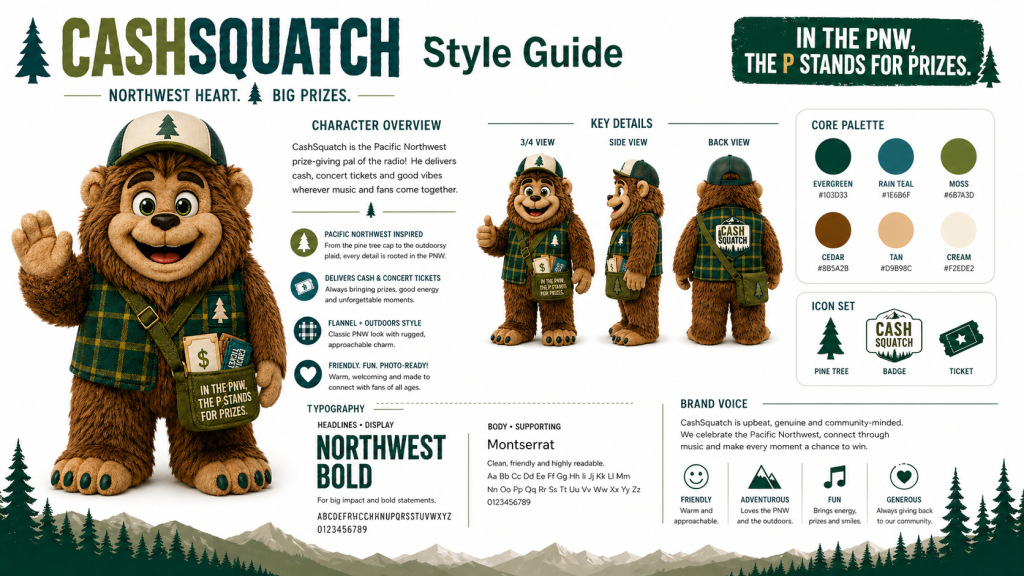
A Portland station, for example, could build a character called the CashSquatch. It plays off the lore of Sasquatch, Bigfoot, whatever name you prefer for the world’s most famous blurry local celebrity.

The CashSquatch would be the deliverer of cash, concert tickets, and all things prize-related. He could hold coloring contests, with pages handed out to kids and hung in Safeway grocery windows. He could voice promos, star in a cartoon series on social, help stuff buses, show up at client events, and be onsite for photos people would actually want.

Because I assure you, no listener has ever said, “You know what would crush on Instagram? A picture of me next to a car salesman on an empty lot with a koozie and a tablecloth.”

A market-specific mascot can do something “Spring Into Cash” never will. It can be local, it can be entertaining, it can be funny, it can give promotions a starting place, and it can give programming something that is more interesting than another keyword contest. This hour’s keyword is “forgettable.”

And yes, it is also “guaranteed human.” Somebody has to wear the Jammin’ Salmon costume.

In an industry wanting to prove it still has human connection, we need to bring back the most physical, entertaining, touchable, IRL tool we ever had.

Real-Life Examples

Here are a few big-brand mascot starters I would build tomorrow:

KIIS-FM Los Angeles: The Kiss Cam Cupid — onsite at Staples Center, standing next to artist photos and not saying “I’m the one on the left.” Romance pics, couple photos.

KROQ Los Angeles: The Roq Rat — a scrappy, underground, nocturnal mascot. More Shredder, less Mickey, slight resemblance to Stephen Pearcy.

Power 106 Los Angeles: The Power Plug — The Plug delivers tickets, backstage passes, and merch drops.

B96 Chicago: The Bee — Dude, how is there not a B96 mascot?

Ready to build your station mascot? To start, ask yourself:

  • What local legend, food, animal, landmark, or attitude could only belong here?
  • Can a listener explain the character in one sentence?
  • Can a kid color it?
  • Would you buy the stuffy?
  • Can a sponsor support it?
  • Can social animate it?
  • Can it survive a format tweak or a talent exit?

Sometimes the person sweating inside the costume becomes the night guy, the next promotions director, the MD, APD, PD, OM, GM, station owner, EVP, or the author of this article.

They are guaranteed human — and how some of us became radio people in the first place.

Barrett Media produces daily content on the music, news, and sports media industries. Sign up for our newsletters to stay updated and get the latest information right in your inbox.
Audacy Moving KNX News Off 97.1 FM for FM All-Sports Station

1

Los Angeles is finally getting its first FM all-sports radio station. Audacy announced the launch of 97.1 The Fan, debuting May 11 at 6:00 a.m. PT. The station promises an all-live, local weekday sports lineup — the only one in the market.

“Los Angeles is the epicenter of the sports world, and 97.1 The Fan is its new voice,” said Jeff Federman, Regional President, Audacy West. With the FIFA World Cup and 2028 Summer Olympics approaching, LA’s sports footprint is only growing. Audacy wants to own that conversation.

97.1 The Fan becomes Audacy’s 22nd FM sports station. The company now claims FM sports presence across all top 10 U.S. markets.

Its portfolio includes over 40 owned-and-operated sports stations and 160 digital sports channels.

Chris Oliviero, Chief Business Officer at Audacy, didn’t shy away from the big picture.

“This launch further strengthens Audacy as the unrivaled leader in sports audio, reaching more sports listeners than our eight closest competitors combined,” said Oliviero. “Adding Los Angeles—one of the most passionate and influential sports markets in the country—completes our presence across the top 10 markets and meaningfully expands our reach and scale. It allows us to deliver even greater impact for listeners and partners through premium content, unmatched distribution, and deeper fan engagement.”

Adding LA is the final piece of a major strategic puzzle.

Andrew Williams takes the helm as Brand Manager. He previously built the BetMGM Network’s national video and podcast distribution strategy. His resume includes senior roles at SiriusXM and Chicago Fire FC.

The programming lineup drops in the coming weeks.

KNX News 1070 will lose their 97.1FM signal as part of the announcement. However, KNX will continue its all-news format on its AM frequency 1070 and also be heard on 97.1 HD2.

Barrett Media produces daily content on the music, news, and sports media industries. Sign up for our newsletters to stay updated and get the latest information right in your inbox.

CNN Adds Rachel Siegel as Business Reporter

0

CNN has announced the addition of Rachel Siegel as a business reporter, focusing on economic policy.

Siegel joins the network after most recently working at The Washington Post.

During her near decade with the company, she covered the U.S. housing market. She also covered the Federal Reserve.

After the COVID-19 pandemic, she worked as a lead reporter on The Post’s economics team.

In a post on social media, Siegel shared her excitement for the move.

“So, so excited to join CNN next month for this dream job,” Siegel wrote. “And with enormous gratitude for almost nine years at The Washington Post.”

Prior to joining The Washington Post, Rachel Siegel worked for The Marshall Project and The Dallas Morning News.

In her new role with CNN, she’ll be based at the network’s Washington, D.C. bureau.

Barrett Media produces daily content on the music, news, and sports media industries. Sign up for our newsletters to stay updated and get the latest information right in your inbox.

FCC Commissioner Anna Gomez: Review of Disney Licenses a ‘Political Stunt’

0

The FCC has launched an early review of the broadcast TV licenses owned by Disney after recent comments made by Jimmy Kimmel drew the ire of President Donald Trump and First Lady Melania Trump.

The commission has called for an early renewal of the eight licenses owned by Disney. That comes after the FCC has previously opened two investigations into Disney. One for its DEI practices that was opened last year. The other was for an appearance by James Talarico, which raised questions about whether The View broke equal time rules in its interview with the Texas Senate candidate.

In a letter to Disney, the commission states that the company must file its license renewals for its owned-and-operated TV stations by May 28th, 2026.

Those licenses were not up for renewal until 2028.

Following the revelation of the action, FCC Commissioner Anna Gomez shared her displeasure with the situation.

“This is unprecedented, unlawful, and going nowhere,” Gomez said in a statement. “It is a political stunt and it won’t stick. Companies should challenge it head-on. The First Amendment is on their side.”

The move follows recent comments by Jimmy Kimmel Live! host Jimmy Kimmel, who has drawn sharp criticism from the White House.

During a mock White House Correspondents’ Dinner roast last week, Kimmel said First Lady Melania Trump had the “glow of an expectant widow.” The joke drew widespread backlash after Saturday’s shooting at the actual White House Correspondents’ Dinner, which took place two days later. The Trump family has called for Kimmel’s firing following the comments.

Currently, there are eight ABC-owned stations. They include:

  • KABC-TV (Los Angeles)
  • KFSN-TV (Fresno)
  • KGO-TV (San Francisco)
  • KTRK-TV (Houston)
  • WABC-TV (New York)
  • WLS-TV (Chicago)
  • WPVI-TV (Philadelphia)
  • WTVD-TV (Raleigh)

Barrett Media produces daily content on the music, news, and sports media industries. Sign up for our newsletters to stay updated and get the latest information right in your inbox.

Gabe Mercer Joins Country 107.9 In Mornings Following Cheyenne Davis Exit

0

Audacy has made a move for Country 107.9 KMLE in Phoenix. Gabe Mercer is back, joining Niko Petrou for mornings following Cheyenne Davis’s exit last week.

Most recently, Mercer was doing mornings in Seattle at Audacy owned 100.7 The Wolf KKWF alongside Matt MacAllister. The duo was also tracking afternoons for KMLE in Phoenix.

“I’m excited for this next chapter with Niko,” wrote Mercer to Barrett Media.

After McAllister was laid off earlier this month, it was unknown where Mercer would land. She knows the Phoenix market well and has held a myriad of roles within the cluster.

These include promotions coordinator, sales assistant, plus hosting evenings and middays at KMLE.

Petrou has served in mornings at KMLE since January of last year.

“I got my start in radio with KMLE and it feels right to be coming back,” notes Mercer. “I’m grateful for Drew Bland for believing in me and supporting us through this next era.”

Barrett Media produces daily content on the music, news, and sports media industries. Sign up for our newsletters to stay updated and get the latest information right in your inbox.

FCC Preparing Challenge to Disney’s O&O TV Licenses

0

Here’s the rewritten story:

The FCC is reportedly planning to file paperwork to challenge the broadcast licenses of eight Disney-owned television stations. The move follows recent comments by Jimmy Kimmel Live! host Jimmy Kimmel that have drawn sharp criticism from the White House.

During a mock White House Correspondents’ Dinner roast last week, Kimmel said First Lady Melania Trump had the “glow of an expectant widow.” The joke drew widespread backlash — especially after Saturday’s shooting at the actual White House Correspondents’ Dinner, which took place two days later.

In response, FCC Chair Brendan Carr appeared on The Katie Miller Podcast. Host Katie Miller — wife of White House advisor Stephen Miller — asked Carr what license revocation could look like in practice.

“There’s lots of options,” Carr said. “You have a license. The licenses come due every so often. You can accelerate when a license comes due and say, ‘Hey, we have significant concerns with the value of conducting your operations. We want to review your license now. And decide if you’re in the public interest.'”

He continued: “If we find that a broadcaster hasn’t been doing that, then the statute requires us to issue a hearing designation order.”

That process now appears to be moving forward. Semafor’s Liz Hoffman and Rohan Goswami report that the FCC is working to file paperwork reviewing Disney’s broadcast licenses for eight local TV stations the company owns and operates.

The potential review follows calls from both President Donald Trump and the First Lady for Kimmel’s firing over the monologue.

Semafor notes the FCC could still choose not to initiate the process. However, CNN’s Brian Stelter reported the paperwork could be filed as early as this afternoon.

Barrett Media produces daily content on the music, news, and sports media industries. Sign up for our newsletters to stay updated and get the latest information right in your inbox.

Spotify Revenue Increases 14% During 2026’s 1st Quarter

0

Spotify has announced its 2026 first-quarter financial results, and the company reported a revenue uptick.

During the quarter, the company reported $5.2 billion in total revenue. That marks a 14% year-over-year increase.

Additionally, Spotify now features 760 million monthly active users. That marks a 12% year-over-year improvement. Its gross margin is now 33%, while its operating income is more than $835 million.

Of those active users, 293 million are premium subscribers. That’s an increase of 9% compared to the same quarter in 2025.

“We surpassed 760 million MAU, delivered on the subscriber growth we aimed to achieve, and saw healthy engagement from existing users, reactivations and new users alike,” said Co-CEO Alex Norström. “Since the global rollout of our more personalized free experience, users in key markets like the US are listening and watching more days per month. All that reinforces our confidence in sustained user and subscriber growth, low churn, and continued progress on revenue and margin.”

“We’re well positioned because of our large, engaged user base, deep creator relationships, and years of investment in personalization and infrastructure at scale,” added Co-CEO Gustav Söderström. “Together, these create a platform that can take advantage of this moment and unlock entirely new growth vectors that will enable us to climb new mountains previously unimaginable. We see significant room to grow across users, formats and engagement and to expand what Spotify is and can become over time.”

Barrett Media produces daily content on the music, news, and sports media industries. Sign up for our newsletters to stay updated and get the latest information right in your inbox.

iHeartMedia, Omnicom Study Shows Audio Ads Drive Major Lift Across Every Key Brand Metric

0

A new study from iHeartMedia and Omnicom Media Group delivers a clear message to advertisers. Audio isn’t background noise — it’s a performance engine.

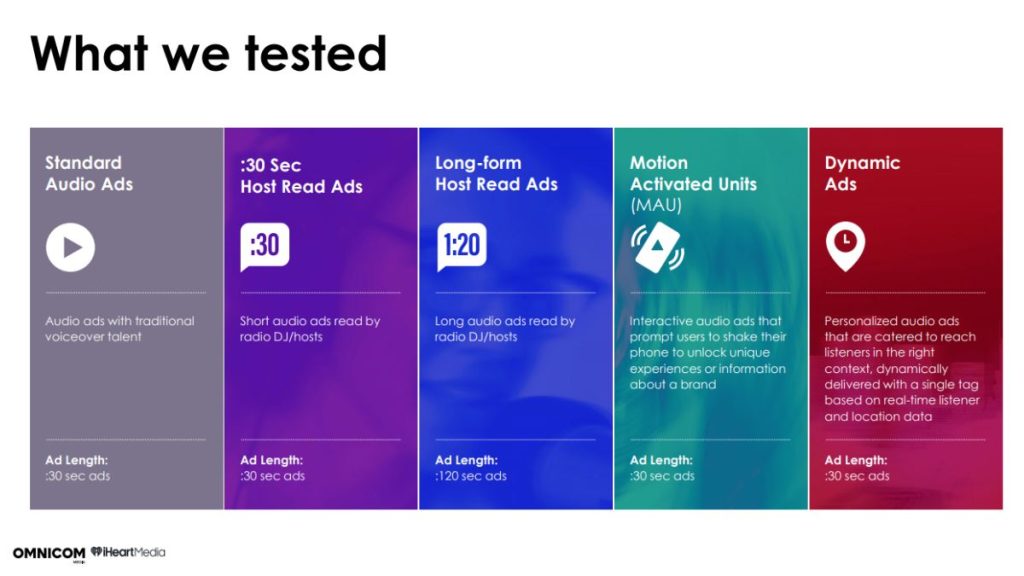
The study, titled Turning Volume into Value, tested five ad formats across 3,521 U.S. listeners aged 18 and older. Researchers used controlled experimental design to measure brand lift across CPG, beauty, and insurance verticals. The results give audio sales teams some of their strongest ammunition in years.

Standard audio ads drove significant gains among listeners likely to purchase soon. Unaided ad recall jumped 22 points. Brand favorability, search intent, and purchase intent each climbed five to six points. Furthermore, audio’s reach doesn’t stop at the headphones.

The study documented what it calls an “audio multiplier effect.” When consumers hear a brand message first through audio, social performance improves by 83%. Digital and social engagement rises 109%. Branded search activity increases 47%. Consequently, audio amplifies every other channel in the media mix — not just its own.

The Host-Read Advantage

Trusted voices change the equation entirely. Host-read ads outperformed standard audio ads across every brand metric tested. Specifically, listeners familiar with the host were 76% more likely to say the narrator made the brand’s message feel personal — compared to 61% for standard ads. Emotional connection jumped from 33% to 44%.

The trust variable matters most at the bottom of the funnel. Among listeners likely to purchase within a week, trusted host-read ads drove a 20-point lift in immediate purchase intent. Standard ads produced just a two-point lift in the same window. Additionally, the study found that 80% of listeners consider audio hosts a trusted friend — making them genuine influencers at scale.

Motion-activated units — interactive ads that prompt listeners to shake their phone — delivered a 16-point lift in search intent among in-market audiences, compared to nine points for standard ads. Purchase intent rose 11 points versus five. Gen Z and Millennials engaged at the highest rates, with 42% and 36% shaking when prompted respectively. Meanwhile, 88% of likely purchasers called the format “an easy way to get more information.”

Photo Credit: iHeartMedia.com

Dynamic ads personalized by time-of-day also outperformed standard formats. Eighty percent of listeners found dynamic ads felt relevant to them. Search intent lifted 11 points — nearly four times the standard ad result.

Key Takeaways

This study hands audio sellers a data-driven argument against budget cuts and media mix skeptics. The combination of recall strength, social amplification, and host credibility makes audio one of the most efficient buys available. For broadcast and digital audio professionals, the directive is direct: push for adequate weight in the media mix, lead with trusted voices, and layer interactive formats for audiences already close to purchase. The volume is there. Now the industry has proof that it converts.

Barrett Media produces daily content on the music, news, and sports media industries. Sign up for our newsletters to stay updated and get the latest information right in your inbox.

CW Network Acquires Broadcast Rights for All WWE ‘NXT’ Premium Live Events

0

The CW Network just made a major power move in the sports entertainment world. The network announced it will air all WWE NXT Premium Live Events exclusively on its broadcast platform. The deal expands The CW’s existing partnership with WWE, part of TKO Group Holdings.

NXT programming now lives entirely under one roof.

The Great American Bash kicks things off later this summer. From there, The CW will broadcast 20 ‘PLEs’ live on both coasts over several years. Stand and Deliver, Deadline, and Vengeance Day are among the marquee events on deck.

WWE retains full production control of all events.

CW President Brad Schwartz made his enthusiasm clear.

“WWE NXT has energized our Tuesday nights by consistently delivering a loyal and passionate fanbase to The CW every week,” he said. “Adding WWE NXT Premium Live Events to our schedule is a natural fit, providing one broadcast destination for audiences to watch all their favorite Superstars, storylines and championship matches.”

The CW inked its original five-year NXT deal in October 2024. That debut broadcast drew the program’s largest audience since October 2023. It ranked as The CW’s top telecast of the year among adults 18-49 and 25-54.

WWE’s Shawn Michaels, Senior Vice President of Talent Development Creative, praised the partnership.

“The CW has played an integral role in raising the profile of our up-and-coming Superstars,” he said, adding excitement about bringing PLEs to broadcast television for the first time.

Barrett Media produces daily content on the music, news, and sports media industries. Sign up for our newsletters to stay updated and get the latest information right in your inbox.