Round one of the 2026 NFL Draftaveraged 13.2 million viewers across all linear and digital platforms on Thursday, April 23. That ranks as the third most-watched opening round since the current format launched in 2010.
The number trails only 2020’s pandemic-era peak and last year’s record-setting Day 1 in Green Bay. Still, it beats the 2024 Draft by 8%.
However, the figure does mean a 3% dip from the previous year in comparison.
The highlight of the evening was Pat McAfee’s show and how it continues to pull serious weight. The seventh edition of The Pat McAfee Show Draft Spectacular drove more than 54 million total minutes consumed across YouTube, TikTok, X, and the ESPN App on Day 1.
It also generated 2.2 million total views. McAfee’s footprint in the Draft ecosystem keeps growing.
Pittsburgh’s attendance numbers were equally impressive. The 2026 NFL Draft drew a record 805,000 fans across three days. Thursday alone brought in a record 320,000 for Round 1.
Merchandise sales also broke records. In its first year as the NFL’s retail Draft partner, Fanatics and the NFL surpassed the previous sales record set last year in Green Bay.
Thank you fans for tuning in to Round 1 of the 2026 @NFLDraft 🏈
Barrett Media produces daily content on the music, news, and sports media industries. Sign up for our newsletters to stay updated and get the latest information right in your inbox.
Every day, businesses across the country are finding new avenues to utilize artificial intelligence (AI) in their day-to-day operations. Some have been open about using these platforms and showcasing their results, while others stay in the wilderness, hiding their use from public view. I’ve been a very vocal supporter of utilizing AI as a tool in sports radio. Not as a replacement, but as a vessel for a different spin or approach to a regular task.
The NFL hasn’t been shy this offseason about its use of AI. Just this past Super Bowl, the league celebrated its partnership with Microsoft. Using premium ad time, the league showcased the Tampa Bay Buccaneers utilizing AI to narrow down linebacker prospects. Last week, San Francisco 49ers general manager John Lynch admitted his staff is using AI, stating that if teams aren’t leveraging it, they’re already behind.
There are nearly endless possibilities for how AI can be used in sports media, but Lynch’s comments and the Super Bowl advertisement sparked a new idea. While NFL teams are using the technology to determine which prospects best fit their winning formula, should sports media do the same?
As a former program director, I’ve made some great hires during my tenure. I’ve also made some terrible personnel decisions that still get a chuckle from former teammates. Still, I’ll stand behind my “batting average” when it comes to finding the right people to join my programming teams.
Now that AI is becoming part of everyday life, should hiring managers use the technology to determine who would be the best fit for their openings?
It depends on what matters most to you.
Metrics That Matter
In sports media, there is no 40-time, long jump, or measurable metric based on routes run over a college career. Instead, we evaluate service time, accolades, skill sets, and reference points. Most resumes today are likely generated with some level of AI, designed to hit specific keywords tied to job postings.
Most companies already use AI to filter candidates, identifying the strongest and weakest prospects based on the job criteria.
So, if AI is being used on the front end for resume creation and on the back end for resume filtration, why aren’t more managers using it to identify prospects?
What if the middle of the process is where AI actually delivers the most value?
Instead of simply scanning resumes or flagging keyword matches, hiring managers could use AI to evaluate the work—the part that actually matters in sports media. Airchecks, podcast clips, writing samples, and social posts are the modern equivalent of game film.
Just like a front office breaking down tape, AI can help identify patterns that are easy to miss when reviewing a large pool of candidates. This is especially valuable in the age of short-form video, where many managers still hire based on traditional formats and techniques.
AI can analyze engagement, reach, and overall digital impact across platforms. It can tell the story of a candidate beyond a traditional resume or attached .mp3 file or sizzle reel.
Working Smarter
Think about how often hiring decisions come down to time.
You may have a dozen candidates—or more—and only a few hours to evaluate them while balancing everything else in your day. AI can quickly surface trends: who consistently delivers strong segment openings, who builds compelling arguments, and who relies too heavily on clichés.
It’s not making the decision for you, but it provides a sharper lens before you begin narrowing the field.
It also creates a level of consistency that hiring in our business has rarely had. One hiring manager may value energy over structure, while another prioritizes storytelling over pace. AI can help standardize part of that evaluation, giving leadership teams a shared baseline before subjective debates begin.
Then there’s the part nobody likes to admit—bias. Whether it’s a familiar name, a big-market logo on a resume, or a recommendation from a trusted colleague, those factors influence decisions.
When used correctly, AI can remove some of that bias and force a focus on output—who sounds good and truly connects.
Those are the 40-times, long jumps, and metrics that matter most when making a successful hire in sports media. At the end of the day, hiring has always been a mix of instinct and information. AI doesn’t replace instinct—it sharpens the information, leading to more informed decisions.
Aid Not Decide
The question is whether an industry built on human connection is willing to embrace the tools shaping its future today.
The answer should be yes—because we’re already watching the blueprint play out in real time.
If NFL front offices can rely on AI to sort through hundreds of prospects, identify hidden value, and ultimately make smarter draft decisions, there’s no reason sports media can’t apply that same thinking to its own version of scouting.
The stakes may look different, but the goal is identical: find talent, project growth, and build a winning roster.
The next great host, reporter, or content creator isn’t always the loudest voice or the most polished resume. Sometimes it’s the one whose clips reveal a natural instinct for storytelling, whose social content quietly gains traction, or whose perspective cuts through in a crowded space.
Those are the intangibles that used to take hours—or days—to fully uncover. Now, they’re patterns that can be identified faster and with greater clarity.
That doesn’t mean handing over the decision-making process. It means approaching it better prepared.
Because just like in the NFL, the teams that win aren’t simply the ones with the best instincts—they’re the ones that pair those instincts with every available advantage.
In a business where the right voice can define a station, a network, or an entire era, passing on that kind of edge isn’t staying traditional—it’s falling behind.
Barrett Media produces daily content on the music, news, and sports media industries. Sign up for our newsletters to stay updated and get the latest information right in your inbox.
Timing is everything in sports and in business. Last year, what began as a normal October week in Milwaukee turned dark without warning as iHeartMedia began another round of layoffs that hit 97.3 The Game extremely hard. For Steve Czaban, a two-decade veteran of the sports radio industry, it was a morning he won’t forget.
Czaban, along with many others on the staff of Milwaukee’s 97.3 The Game, fell victim to a reduction in force as the station began to flip away from sports to adult contemporary.
“Disappointing for sure, and I miss the station and the team badly,” said Czaban, recalling the events of that week in Milwaukee. “That remains a hole in my radio heart. But the industry is the industry.”
Czaban’s morning program led the station’s ratings success and which led to 97.3 The Game securing the broadcast rights of the Green Bay Packers just a few years earlier. Despite that success, Czaban says a change in upper management marked the beginning of the end for the station. Following the retirement of market president Jeff Tyler, he says a management restructure led to The Game’s demise just three months later.
“It’s unprecedented what happened. I can’t imagine another situation like it. A sports station and the flagship station of an NFL franchise, while also doing so well in the target demos. Plus, in the middle of a football season with a pedigree team like the Green Bay Packers just suddenly saying never mind,” explained Czaban.
What made the timing even more unprecedented was that Czaban was negotiating a new multi-year extension with iHeartMedia. He said talks were well underway after the company extended program director Tim Scott and other members of The Game team.
Czaban says he saw no warning signs that business would turn for the worse so quickly.
“We had agreed to the scope of let’s keep doing this. Then it kept getting held up, and then by fall it was never mind. We’re going to shut the whole station down,” notes Czaban. “It’s all about who wants to run that kind of format. Are they equipped to do it and do it in a way that makes economic sense to them.”
Absolutely jaw dropping. In the middle of the Brewers historic feel good World Series run, and a possible Super Bowl season for the Packers. Wow. My heart hearts for everyone. Thank you to all of our listeners. We’re sorry.
A week after the cuts at 97.3 The Game, iHeartMedia Milwaukee management flipped the station to B97.3. The pivot to adult contemporary also moved Packers Radio Network broadcasts to classic hits 95.7 Big FM.
“If somebody really believes that a station that plays the hits of the 80’s till today will kill, you’re not going to talk them out of it. Sometimes some people in radio think iTunes and Spotify don’t exist,” explained Czaban. “Sports radio is an expensive format. To me, when done right, it’s a durable, dependable, money-making format. Even more so now, with fewer things that get the collective eyeballs and ears at one time.”
Keep The Train Rolling
Despite what happened in Milwaukee, Czaban didn’t hit the brakes on creating content. Since 2018, he has been ahead of the curve for prime sports radio talent with the creation of the CzabeCast. A podcast venture born from his desire to control what he talked about on his own terms.
Nearly a decade later, the CzabeCast has generated a unique and devoted following that has supported Czaban through several stops on his sports radio journey.
“It’s always smart to dig your well before you’re thirsty,” says Czaban. “At numerous occasions along the way when it came to contract time, radio entities asked if they could host my podcast on their platform. I told all of them over my f***ing dead body.”
Czaban’s reasoning for that decision is simple. If situations like the one in Milwaukee were to happen, the radio company would own the rights to the content he built over many years.
“The CzabeCast is my one thing I’m holding back as a big middle finger. Just in case things go sideways with any of these companies,” explained Czaban.
In the immediate aftermath of the events in Milwaukee, Czaban says he received multiple offers about his interest. Since then, he has focused on producing the CzabeCast and taking fill-in opportunities with 106.7 The Fan in Washington, D.C., one of his previous markets.
He says filling in on The Fan has been a fun experience, allowing him to co-host with different programs and personalities. Czaban compared it to a freelance guitarist playing with different bands on the road, where each experience offers something new.
Czaban continues to receive interest from around the country about a return to sports radio. As he weighs his next move, he is considering several options.
“There’s a couple right now that I’m evaluating, now that I’m out of my non-compete with iHeartMedia. It’s going to be about making sure I choose the right opportunity to pursue,” says Czaban, adding that he feels no hesitation in taking his time after the events in Milwaukee. “I don’t want to do anything half-assed or one to two years and done.”
A Return To Radio
The interest from other outlets comes as no surprise. Czaban brings a wealth of experience, spanning digital platforms, local radio, and nationally syndicated sports talk. Over his career, he has hosted on multiple national networks, including Fox Sports Radio, Sporting News Radio/Yahoo Sports Radio/SB Nation Radio, and ESPN Radio.
As he surveys the current landscape of national sports talk radio, the veteran voice admits he doesn’t see much that resonates like it once did.
“It’s very weak right now. ESPN seems to have given up on having a premiere national lineup in terms of radio. Who’s their big name? But ESPN never really embraced radio anyway,” said Czaban. “National programming now that’s radio only is like a bucket of grout that is only used by affiliates to spackle holes in a lineup.”
To his credit, Czaban says hosting a national sports radio show is never boring. In fact, he prefers the opportunity to be conversational and perform across a broad spectrum—something he hopes to return to one day, though he understands nothing is guaranteed.
“I left my crystal ball in my golf bag back home,” jokes Czaban when asked if he’ll be hosting local sports talk radio a year from now. “I would love to do that, but I can’t predict or say how or where.”
If the events in Milwaukee six months ago proved anything, it’s that even the most stable situations in sports radio can vanish without warning. However, they also reinforced why Czaban bet on himself years ago.
The microphone may change, and the signal may move, but the voice—and the audience that trusts it—remains. For Czaban, that’s the part no corporate decision can ever take off the air.
Barrett Media produces daily content on the music, news, and sports media industries. Sign up for our newsletters to stay updated and get the latest information right in your inbox.
Where do you place your guest? You have a 3-hour show — what is the best time or worst time to book that guest? Fox News, CNN, and Newsmax have great strategies here. Do you?
Also, what is the purpose of the guest? What makes that person so important, and why does that individual appear at the time that you booked them? Have you ever heard the term “Don’t Leave Cash on the Table?” Your cluster has a client that is spending one million dollars in the market on radio, TV, digital, and billboard. Sadly, that client is only spending $100,000 with your company. The account executive should always be asking for 50k more. Is your show leaving cash on the table?
Guest placement is essential for your show. Great guests at the right segment and for the appropriate amount of time. Following the USA military action in Iran — what time did you have the expert on that story? It should be booked into the most important time of the show. What hour of your show has the highest cume? Best guests or subjects for the time where the station has the most listeners. You don’t want to bury the biggest story and guest in the least important time of the show. You also don’t want a guest who is not timely or amazing for the listeners.
Take a cue from Fox News, Newsmax, MS NOW, News Nation, and CNN — always lead with the biggest guests and topics at the best time for the show to grow audience. Here is an interesting aside: I have been a guest on CNN, but never the rest. I am sure that is a slight oversight, or perhaps I am better looking and more charismatic than their hosts.
Moving guests is a tough thing for most talk show hosts or producers to accomplish. Remember, you are doing a favor by having a guest on your show. How long is your average guest hit? Eight minutes? How much is an endorsement spot on your show? Let’s say that it is $100 a minute for that style of live spot. Your guest is receiving your voice, giving an indirect or direct endorsement for the privilege of being on your show. Your guests are getting free marketing for their website, book, products, and/or their ideas. You hold the power here.
In fact, guests should be sending you a thank-you card, email, or text every time they have the honor of being on your show. If someone is a jerk about being rescheduled for a breaking news item, that is their problem. I suggest to my producers that they have that caveat when a guest is booked — that breaking news is the priority and sometimes we reschedule guests.
Another note: the most important person on a news/talk show is the host. Obviously, you are not moving the President of the United States or a hugely important get. Most of the guests that you are booking are not that great — unless it is me. I am a really good talk show guest. Ask Kevin Miller and Walter Sterling, but this is not about me. It’s about your shows.
Let’s talk about the role of the guest. That expert should be there for a specific reason. You are there to accomplish something with the discussion. If that person is there because you like them, or because they are a regular who occasionally delivers a great segment — reevaluate that person.
Now, here is a little more on guest placement. The biggest guests at the times of the largest audience. Just because you need a guest, you don’t automatically book them to the best time on the radio station. If you are desperate for guests, you are not a host — you are an interviewer. Your audience will not grow attached to you but to a cluster of largely mediocre guests. Your listeners are tuning you in because they connect with you.
You are the most important ingredient of your show. If you want to book the think-tank expert on the wonders of agricultural weedkiller, book them for the least important time on your show. 6:05 is perfect. Place the guests at the most important time for your show, not around their schedule. You are giving these people the favor.
Interview length is key. Jimmy Kimmel gives the greatest guests available two segments — that is, approximately, eight minutes of programming. I can’t tell you how many times I have heard a host hold over a lousy guest.
Remember, if your talk segment is eight minutes, get the guest to opine and inform on the subject. You don’t need to keep them for the full eight minutes. Why was the guest booked on your show? What are you trying to accomplish? Once those criteria are met, move along. Tell your producer that the guest will be on for up to eight minutes. Remember, you are giving the guest a huge favor.
I understand it. Hosting and/or producing a three-hour-a-day talk show can be incredibly challenging. It is a living and breathing thing when you book a guest. Sometimes these guests can go sideways — other times, the guest just stinks. You don’t need to keep them on the air. Think of your audience. With millions of options, listeners aren’t waiting around. Treat every moment on your station or show as a precious commodity.
Barrett Media produces daily content on the music, news, and sports media industries. Sign up for our newsletters to stay updated and get the latest information right in your inbox.
Those who have visited this space over the past two years know you’ll find a tip or two about how to improve your brand, cluster, or company. You’ll also find a deep dive into what makes our business great—people like Mark McGill on Sunny 101.5 in South Bend, IN.
In the past few seasons, you’ve learned what makes Melissa Forman tick. Also, we’ve discussed the passion of Jack Diamond, and the format crossover of Kevin & Taylor. Without dynamic personalities, music radio is simply a free jukebox.
You would be hard-pressed to find someone more enthusiastic and accomplished as a long-term radio personality than Mark McGill. His radio career has carved a lasting imprint across northern Indiana and southern Michigan. His voice still connects with listeners after decades on the air in the region. McGill’s drive reflects a deep passion for broadcasting, paired with a natural and approachable style.
The industry has shifted through ongoing waves of technological change, eliminating positions while navigating evolving audience habits. McGill has remained relevant and resonant with listeners, no matter the market or format.
His ability to communicate with energy relates both on and off the air to the audience. McGill’s ability to entertain within the community has allowed him to grow alongside the medium rather than be left behind.
Last week, I connected with Mark to discuss his journey and how his fervent view of the business might energize you.
*Editor’s Note: Answers have been edited for clarity and length.*
Kevin Robinson – Let’s talk about your radio path from the beginning to where you are today. Plus, all the extra voice work off air.
Mark McGill – Growing up in Chicago, I always wanted to be Harry Caray or Ron Santo. However, I couldn’t hit a curve ball. So, I decided to go into broadcasting. Listening to the old WLS back in the day, I enjoyed Larry Lujack, John ‘Records’ Landecker, Tommy Edwards and Fred Winston. That’s when I decided at an early age that radio was going to be for me.
While still in college, I got my first job in commercial radio doing weekends at WJTW. My first full time job was doing overnights, then nights at 99.9 The Bus in Kankakee, IL.
From there, I went to Lansing, Michigan, and spent some time at Ape 92 and 95 WVIC. Then I spent twelve years in Grand Rapids, Michigan, at WSNX and WGRD.
I moved across the state to 100.5 The Fox in Saginaw, Michigan, before finding my way to South Bend. I’ve spent the last 25 years on the air—22 at Federated Media, and now into my fourth year at Mid-West Family Marketing and Media. Now, I’m the morning guy on Sunny 101.5.
Thanks to the magic of radio today, I also do mornings at 103.3 The Beat in Maui, Hawaii. Plus, I host afternoons at WHIN and weekends at Hippie Radio in Nashville. Also I work for B-105.3 in Dothan, Alabama, Q103 in Maui, Hawaii, and fill in at WRSW in Warsaw, Indiana. All of these roles I work from my home studio.
A Quarter Century Of Service
Kevin Robinson – How long have you been in Michiana and what’s special about for you about the area?
Mark McGill – I have been in Michiana for the better part of 25 years. We love it here. Besides having the University of Notre Dame, I am from Chicago. My wife, Julie, is from Michigan. So, we are right between both of our families.
We are 45 minutes from the beautiful Lake Michigan shoreline. There’s some amazing beaches, and we can get to downtown Chicago in about 90 minutes.
Kevin Robinson – What’s your best day in radio – and why?
Mark McGill – I was doing mornings for 95.3 WTRC, a News/Talk station here in South Bend. John “Records” Landecker had a new book out, and we interviewed him on the air. The on-air interview lasted two segments, about 20 minutes.
However, it was the last two segments of the show. So, we spent another 90 minutes chatting off the air after we signed off. Hearing all of the stories about WLS, the station and jocks I grew up listening to was amazing.
Kevin Robinson – With all the audio choices and social media platforms developing around you, how do you stay relevant and connected?
Mark McGill – Staying relevant and connected is tough. Especially for an old guy. I could do a much better job of it. Luckily, my main gig at Sunny is for an AC station, so I am in the demo. My audience probably struggles with staying up on the latest trends like I do.
I am lucky to have two daughters in their late 20s and early 30s who feed me things that I might have missed.
Kevin Robinson – Give us something that makes you successful. This could be prep, longevity or behind-the-scenes of your show.
Mark McGill – The secret to my success is more about what I do off the air. I love to prep, and I am proud of what we do on the air. Honestly, I am especially proud of the relationships that I have built here with key community leaders, not to mention many local nonprofit organizations.
I have the honor of hosting close to thirty nonprofit annual galas and fundraisers every year. That is what I am most proud of.
Kevin Robinson – What would you say or advise emerging talent or your role with getting into radio today?
Mark McGill – I quite often have lunch with young broadcasters, as well as speak at several career fairs for both high schools and colleges in the area. Giving young people advice is tough these days.
You want to be honest about the state of the industry, which is challenging on its best days. However, I don’t want to dash their hopes and dreams either. Especially since they just spent four years studying the business in college.
I’m as honest as I can be with them. It’s a very hard business to break into these days and that it is always changing. The days of getting your foot in the door to run Casey Kasem’s Countdown, or pulling a shift on Christmas morning because the full-timer was off, are gone.
It still is a “who” you know more than “what” you know. However, with how amazing technology has become, it’s definitely a tougher road these days.
Kevin Robinson – What are your thoughts on AI as a tool? What challenges do you see with AI in the future?
Mark McGill – I have embraced AI and use it every day as a tool. It does make prepping for the morning show easier. I often wonder how I used to do a morning show without the internet, but we did.
AI, if used correctly, can be a real asset and make your show better.
Kevin Robinson – If you could host a show with any guest, living or dead, who would it be—and what would you talk about?
Mark McGill – I would love to do a show with Kevin Matthews. Back when he was on WLUP, he mastered the art of old-time radio and the theater of the mind. With all his different voices and bits, it would have been fascinating to just watch him.
It was magical to listen to him and how he crafted his show. I am in the business and was still amazed every day listening to him masterfully execute his show and how he seamlessly pulled it off.
McGill’s story reflects what many of us have experienced and continue to navigate. Formats, platforms, and technology continue to shift, while the core of radio remains—people.
McGill chose to stay regional and make his mark, and many refer to him as the “Radio Mayor” of South Bend.
Barrett Media produces daily content on the music, news, and sports media industries. Sign up for our newsletters to stay updated and get the latest information right in your inbox.
Thank you for checking out ‘The Industry According To’. This series runs each Tuesday, and features radio and record industry executives, managers, programmers, talent, artists, and professionals from all areas of the business world. To be considered as a future guest, email me at keithblackboxgroup@gmail.com.
Today we visit with one of the industry’s most thoughtful contributors. Sean Ross is a multi-format veteran and journalist who is equal parts music expert and data ninja. Over the past decade, he has been the editor of his Ross On Radio Newsletter. He recently joined Advantage Music Research as an additional resource for music testing clients after spending two decades as Edison Research’s VP of Music and Research. In addition, Sean consults and schedules music logs for numerous stations in the US and Canada.
So, let’s dive in.
Data vs. Gut
Keith: You’re one of the rare people who understands both music instinct and audience data. There are cases of winning stations not doing research and some researched brands losing, but when those two things disagree — the data says one thing, your ears say another. Which one should win?
Sean: There is not only a place for gut, but there are also different types of research that you can draw on now. I look at callout, streaming, and requests, which I still believe in, especially for songs in the weeks before callout kicks in. Part of what gut is for now is deciding what to do when different types of research contradict each other, or which unlikely songs from streaming are also potential radio records.
There are songs now that look healthy in every other indicator that may not test until they get to No. 1 like Bruno Mars’ “I Just Might” or might not test power for everybody like Raye’s “Where Is My Husband!” If I were a programmer, I would want to see callout. I’m not sure though it’s the every-time arbiter of whether a song should be a power.
As somebody who both loves music and conducts music research for a living, I’ve always believed that research helps you find songs to play, not just eliminate them. When I work on a music test for a station, I usually find at least a few songs which they weren’t planning to test that come back in the top 100 and sometimes even in the top 5. I think callout could give programmers a faster answer on new songs, but only if we’re willing to rotate them aggressively while they’re fresh.
The Streaming Reality Check
Keith: Streaming data is giving labels and programmers more information than ever about listening behavior and music consumption. What’s the most important thing radio and labels still misunderstand about how people actually consume music?
Sean: The biggest myth about streaming is the belief that their audience is inherently faster and more interested in new music than the radio audience. For two years now, there’s been a study at Country Radio Seminar showing that Country music’s streaming-only audience is choosing streaming to hear more oldies, not the edgy new artists that Country radio won’t play. If you look at Spotify’s Today’s Top Hits, there are plenty of recurrents and year-old songs or 18-month-old songs, and if you look at pure Spotify numbers, you still have Fleetwood Mac and the Killers in the Top 20. One of the reasons so much old music is gurgling up is because streaming isn’t creating as many new hits as people think. Radio has been discouraged from their own enterprise.
The Discovery Myth
Keith: Radio spent decades owning music discovery. Today, discovery mostly happens elsewhere. In your view, what role should “new music” realistically play for a radio brand in 2026?
Sean: I firmly believe that “new music” is part of the promise for most contemporary formats. Triple-A stations are posting some surprisingly good numbers now by not giving up on the music discovery franchise. In some cases, they’re beating the commercial Alternative stations in their market that have largely become Alternative Gold. Country is our most successful new music format and most stations there are doing a good job of balancing currents, recurrents, and gold, as well as active and passive records. For the new music pipeline to begin flowing again, there would need to be people at the station level listening to new music, not just looking at streams, and healthy promotion departments willing to pursue those songs.
Don’t Go Below the Mean
Keith: Traditionally, when music research comes back, the first step is cutting everything below the Mean. But sometimes the difference between survival and death is razor thin — say 3.8 to 3.75. Is radio becoming too rigid with research, or is that discipline still the right approach?
Sean: I have never believed in just playing the ranker. If you look at Top 40 ratings now, just following callout and keeping “Ordinary” or “Golden” in power indefinitely isn’t working for people. In a library test, there are a lot of factors that determine the mean score—how many songs you tested, whether you held back some of the songs that you thought would test anyway, whether you included currents and recurrents. When you get to the middle of the test, you have an opportunity to play any song in that region, but not an imperative. And if you can only test music once a year, like most people now, the song that squeaks through with a 3.8 could easily lose some of its shine after six months, and it might not beat the song with a 3.75 next time.
Repetition Reality
Keith: Radio has always leaned on familiarity, and “repetition” has always been a listener complaint. But today listeners have infinite choice. Are audiences becoming less tolerant of repetition? Does the complaint carry more weight now, or should the industry continue to largely ignore it?
Sean: Repetition has become a problem, especially in current-based formats. We trained ourselves as an industry to view listener complaints about repetition as validation that we were playing the hits. I think somewhere around 100x a week on powers, that changed, and judging from ratings, there was a point of diminishing returns. For gold-based formats, I can’t argue with anything KRTH (K-Earth 101) Los Angeles does. However, not every Classic Hits station that plays its powers 3-4 times a day is winning like K-Earth and the highest-rated Classic Hits station in America, at least until Cumulus pulled out of the Nielsen ratings, KCMO-FM Kansas City, which is at the more traditional 12x a week on powers.
If Sean Owned a Radio Station
Keith: A song may be “new” to one listener, but three months old and tired to another. If you programmed Sean FM, when does a song stop being new? When do you stop calling it new?
Sean: On Sean FM, there would be a lot of things done differently, besides deciding when to call a song “new.” In general, if radio was advocating more for all the songs it plays as currents throughout their lifespan, and not just with “discover new music” stagers playing before “End of Beginning” on its second or third time around, we would defang this issue.
The “Good Enough” Question
Keith: You listen to more stations than most. There’s a growing sense that “just good enough” is okay. Budgets are tighter, and expectations are lowering. From a programming and music standpoint, would you agree with that growing concern that the industry has quietly lowered its product standards?
Sean: Broadcasters are doing what they can logistically manage to do with the resources they have. To some extent, they’re too blinkered and pressured to even decide what “better” would be now. Is it “more local” or “more personality”? Is it marketing again or addressing spotloads or the streaming experience? It’s hard to imagine how we could make any of those things happen, but they definitely won’t happen if we get defensive and decide that today’s radio is just fine, or if we’re determined to prove that yesterday’s radio wasn’t really so great.
Who’s Standing Out to You
Keith: I loved your article on KYGO/Denver and how you see them doing some things differently. In that spirit, which brands do you see taking risks or doing things that may be from the conventional playbook but it’s working?
Sean: Any list I might provide here is vulnerable to sins of omission. I write a weekly column, and I still don’t get to spotlight everybody I like, which is, at least, good news for the state of radio. In terms of ratings stories, besides the non-comm Triple-As that have surprised everybody, I was happy to see Country WKDF Nashville’s music enterprise pay off in the ratings, again before Cumulus withdrew. I’m glad that Top 40 KMVQ (99.7 Now) San Francisco is usually among our healthiest CHRs. I was also a big fan of 2Day Sydney, which went more aggressive with their music a year ago. A month ago, they scored their first decent ratings books since the change. They recently evolved back to Hot AC nonetheless.
Will Tight Be Right 10 Years from Now?
Keith: Most radio playlists are very tight. Ten years from now, do you still see radio as a tightly programmed experience or something broader?
Sean: Being tight vs. playing what I call “hits plus,” really does come down to the individual station. There will continue to be room for both. Programming for variety is a lot more challenging, especially when there are fewer people at the controls. Each of them is under pressure to let AI crank out a log in a few minutes. But I don’t believe that tight is always right. I also think “you don’t get hurt by what you don’t play” is no longer the mic drop that it used to be.
Over the last 20 years, the lessons of Bob- and Jack-FM, then Pandora, then streaming, have been some people do want “hits plus.” I believe that programming your station for an eight-minute listening span becomes a self-fulfilling prophesy. We want to double-down on in-car listening because it’s where radio is still most dominant. Is that an invitation though for listeners to not give us half of their workday afterwards?
Overall, I would hope that strategic “surprise and delight” remains part of radio, whether that’s with new or old songs.
Barrett Media produces daily content on the music, news, and sports media industries. Sign up for our newsletters to stay updated and get the latest information right in your inbox.
It was an interesting start to the afternoon on Audacy’s 93.7 The Fan in Pittsburgh. As listeners tuned in to hear reactions from a busy weekend in the “Steel City,” the first segment of the highly rated PM Team with Andrew Fillipponi and Chris Mueller took an unexpected sports radio turn.
Just minutes prior to air, Fillipponi tweeted that he would be quitting his position at the Audacy Pittsburgh brand. The reason stemmed from a tweet he sent last August, in which he said that if the Pittsburgh Steelers were to draft Drew Aller, he would “think” about quitting his job. This weekend, the Steelers drafted Aller, leading Fillipponi to follow through on his social media promise with an opening segment announcing he would be leaving.
While the on-air and digital bit lasted just an hour, the program opened without its top talent after he walked out on his audience. With listener expectations centered on NFL Draft reactions, along with whether the Pittsburgh Penguins would stave off elimination against the Philadelphia Flyers, I asked multiple program directors around the country if they would sign off on a bit like this. Especially when considering timing, placement, and the importance of meeting audience expectations during such a high-cume opportunity.
Several programmers I spoke with praised the creativity of the moment, despite concerns about timing and execution.
“I love drawing attention to a bit and not being too serious. Choosing a day where you have more ears on you than a normal Monday might draw more attention to it,” said one major market sports radio programmer. “You just need to know your station and your audience. The day after the NFL Draft is typically more sports-heavy than most in the spring. That doesn’t mean you can’t have fun and be entertaining though.”
The same programmer noted that for a bit like this to work, it must be an all-in approach. On social media, 93.7 The Fan leaned into the moment with creative posts and short-form video of Fillipponi’s announcement.
However, the station’s website never changed its lineup, making the bit feel less like a full commitment.
Another anonymous programmer pointed to poor timing. Instead of serving the audience what it expected on a Monday following the NFL Draft, Fillipponi and the station pivoted away from that expectation.
“That’s pretty weak,” said another mid-market sports radio programmer. “This is a great thing to do in the months down the road, when fewer major sports events are happening. For any baseball market, there’s plenty of time to play into so-called drama—but not the day after the NFL Draft.”
Even though the mid-market programmer said he would have avoided the bit entirely, he added that the execution of Fillipponi’s one-hour exit should have been extended for greater impact.
“Go all in, or don’t go in at all. If you’re going to quit, make it more effective by quitting the whole day. The turnaround was too quick for the bit and its effectiveness for the audience,” said the mid-market anonymous programmer.
I'm making a $1500 donation to the Greater Pittsburgh Community Food Bank. In light of the Drew Allar fiasco. I want to help people not working. Who don't have a job. Who are struggling and need some help. Allar truthers. Poni lovers/haters. I'd love for you join me.
While the bit may have resonated with Fillipponi’s social media audience, it also originated there. That stood out to another program director I spoke with, who noted that not every listener follows everything happening on social platforms.
“For a major daypart like that to assume every listener is clued into the bit is laughable,” said another major market sports radio programmer. “Roughly twenty percent of your audience at best is following you on social media. Your listening audience isn’t made up of your following—it’s much bigger than that.”
Still, the social media impact was undeniable. Across platforms, video of Fillipponi’s “exit” outperformed every other post from the station that day, which another major market programmer viewed as a significant win.
“We play in an attention economy, and this won the day for the station,” said another major market sports radio anonymous programmer. “It proves that you don’t always need a hot take to get reach in a digital world. The more creative, the better. This was very creative.”
Ultimately, this comes down to a question every programmer—and every personality—must answer: who are you serving first?
“If you’re going to take it as far as NFL Draft weekend, you have to follow through on it,” said another major market sports radio programmer. “I like this kind of stuff. It generates buzz with your audience where is curious if you’re going to follow through with it or not. Every programmer has their own style of programming they aim for, but this is one I would support.”
If the goal is to win the moment on social media, then this worked. It generated attention, drove engagement, and cut through a crowded content landscape on one of the busiest sports days of the year. In that respect, it’s hard to argue the bit didn’t accomplish exactly what it set out to do.
However, if the goal is to serve the audience that tuned in expecting insight, reaction, and immediacy following the NFL Draft, the return becomes far more debatable.
Radio has always been at its best when it meets listeners where they are—especially in moments of peak interest—not when it asks them to be in on the joke.
The real takeaway isn’t whether the bit was “good” or “bad.” It’s that execution and context matter more than ever. Creativity remains essential for talent and programmers, but it cannot come at the expense of clarity or audience expectation—particularly in a format built on habit and trust.
Barrett Media produces daily content on the music, news, and sports media industries. Sign up for our newsletters to stay updated and get the latest information right in your inbox.
Larry Elder has earned plenty of accolades over a long career in talk radio. Now, some of his colleagues want to add Radio Hall of Fame inductee to that list.
The Radio Hall of Fame announced its 2026 nominees last week, and Elder’s name appears among a wide-ranging class of 24 candidates.
Salem Media Vice President of Content Phil Boyce and The Mike Gallagher Show host Mike Gallagher are both making the case that Elder belongs in the class.
Boyce didn’t hold back in his endorsement.
“Larry Elder is a true American patriot,” said Boyce. “He has deep understanding of the news events facing our country right now and fights on a daily basis to make sure the right side wins. We are in a culture war in America, and we need voices like Larry to help make sense of it all.”
Elder built his reputation over decades as a firebrand conservative voice in Los Angeles. He launched The Larry Elder Show on KABC in 1994, quickly becoming one of the most recognized names in talk radio. His sharp delivery, legal background, and libertarian-leaning commentary earned him the nickname “The Sage from South Central.”
From local Los Angeles airwaves, he grew into a nationally syndicated force.
His influence extends well beyond radio. Elder holds a star on the Hollywood Walk of Fame — a distinction that Gallagher says only strengthens the argument for Hall of Fame inclusion.
“I’ll try to conceal my bitterness at never having been nominated and say a few nice things about my friend Larry Elder,” Gallagher said with characteristic wit. “Seriously, he’s iconic. He had a delightfully unexpected entry into the business and has mastered the craft.”
Gallagher added: “Besides, anyone with a star on the Hollywood Walk of Fame should be in the radio hall as well. I’m proud — and envious — that he’s nominated. He deserves it.”
Boyce also pointed to Elder’s 2021 run in California’s gubernatorial recall election as evidence of his audience’s trust in him. Fifty candidates sought to replace Governor Gavin Newsom. Elder finished first among all of them.
“It just shows the confidence his audience has in him to be the right voice at the right time,” Boyce said. “I think it’s time we put him into the Radio Hall of Fame.”
Alex Marlow, who joined the Salem Radio Network lineup earlier this year, echoed similar sentiments.
“Larry Elder is a singular voice in talk radio,” The Alex Marlow Show host said. “I’m not sure exactly who gave him the nickname The Sage, but there’s a reason why it stuck. What’s well-known is that he has been a juggernaut on the AM dial because he has a unique gift of being an educator, a philosopher, and an entertainer all at once, but what people might not understand is how vast his influence has spread.”
Marlow noted that he owes his show to Elder’s influence on the industry.
“I’m a perfect illustration (of Elder’s influence): I became a religious listener to Larry’s show in high school and went on to intern for him for a brief time,” Marlow shared. “That résumé item alone persuaded Andrew Breitbart to hire me as the first employee of Breitbart News, which I’m proud to say has had a hand in shaping modern history. Now we’re colleagues at Salem, but that doesn’t begin to describe the importance he’s had in my life, and I’m just one of countless examples.”
The full 2026 class won’t be revealed until Wednesday, May 20th. Honorees will be celebrated on October 8 at a ceremony at the Fairmont Hotel Chicago.
The complete list of nominees is below:
Andie Summers
Big D & Bubba
Bob Stroud
Boomer Esiason
Charlie Van Dyke
Enrique Santos
Fred Winston
Funkmaster Flex
Helen Little
Joey Reynolds
John & Ken
Johnny Magic
Kevin Matthews
Kid Leo
Larry Elder
Lee Arnold
Monica May
Pat Hughes
Raul Brindis
Rickey Smiley
Ryan Cameron
Shotgun Tom Kelly
The Electrifying Mojo
Wait Wait… Don’t Tell Me!
Barrett Media produces daily content on the music, news, and sports media industries. Sign up for our newsletters to stay updated and get the latest information right in your inbox.
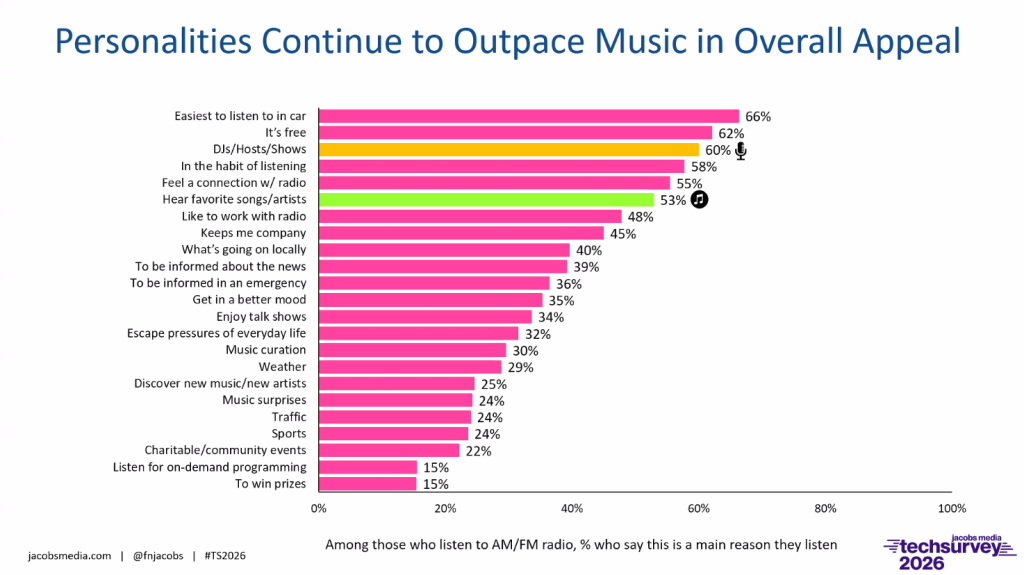
The Jacobs Media Techsurvey 2026 dropped some revealing data about the radio business recently, and I can’t stop thinking about one particular finding.
When asked why they listen to radio, 66% of respondents cited ease of listening in the car, 62% pointed to the fact that it’s free, and 60% said they tune in for the DJs, hosts, and shows.
That last number should be a wake-up call for radio executives — but I’m not convinced they want to hear it.
Think about what that data is actually saying. Personalities rank just behind “it’s free” as a reason people actively choose radio.
They beat out “plays my favorite music and artists” at 53%. They outrank local information at 40%. It even tops “it’s a habit” at 58%.
Listeners aren’t just tolerating the people on their radio. They’re showing up specifically because of them. That’s not some trivial detail. It’s the whole ballgame.
And yet, the industry keeps treating talent like a line item to eliminate. Wherever major companies like iHeartMedia, Cumulus, and Audacy have found an opportunity to cut DJs, shows, and hosts, they’ve taken it without hesitation. The most expendable item in virtually every major company’s budget isn’t technology, music rights, or real estate. It’s people. That’s a stunning disconnect from what the data tells us listeners actually value. Worse, every cut nudges another listener toward a competing medium that’s happy to fill the void.
At some point, “How do we create more profit?” can’t keep getting answered with another round of layoffs. Whether radio leaders want this to be true or not, the data is unambiguous: in radio, people are the commodity. Listeners want entertainment. They want connection. They want it for free. Someone is going to fill that need — and if radio keeps gutting its talent base, another platform will gladly step in and do it.
Can AI fill that void? Probably not in any meaningful way. Can a piped-in, nationally syndicated show do the job? Maybe, to a degree. But neither truly replaces the local voice that makes a station feel like it belongs to a community. The sad irony is that radio still has the infrastructure, the reach, and the audience to win this fight. It just keeps making decisions that undermine its own greatest strengths.
Now look at the top three reasons people listen to radio, and consider that two of them face constant external pressure. Audio competition in the car grows every single year. That in-car advantage isn’t vanishing overnight, but it’s eroding steadily. Being free is a durable advantage. That’s exteremly unlikely to change. However, talent is the factor radio controls entirely, and it’s the very thing the industry keeps dismantling with each new budget cycle.
Suppose a study found that one of the top three reasons people choose a grocery store is the variety of products available. No one in that industry would respond by drastically cutting their inventory. That would be, plainly, business suicide. You wouldn’t want to invest in the grocery industry. You’d think it was run by morons. Obviously, the people leading major grocery brands would be viewed as buffoons.
So why does radio keep eliminating the commodity that draws listeners in? The answer is short-sighted thinking, driven by the pressure to produce short-term gains. Meanwhile, the long-term cost keeps quietly compounding in the background.
The talent pool shrinks day after day, week after week, year after year. Each individual cut feels manageable in isolation. But cumulatively, they’re carving out the soul of the medium. Radio is a relationship business. On the air, in the office, and on the streets. With listeners and advertisers alike. Listeners know when that relationship has been hollowed out and replaced with automation and recycled content. And don’t think for one second advertisers don’t notice, either.
It’s past time to wake up and reckon with what the research is plainly telling us. Radio is never going to cut its way to prosperity. The industry has enough advantages to remain relevant and profitable for years to come — but only if it stops treating its most valuable asset as a budget problem to solve. The quicker major company leaders genuinely internalize that reality, the better the odds that local radio stations will still have someone worth tuning in for.
The data is pointing the way forward. The only question is whether anyone in power is willing to follow it.
Barrett Media produces daily content on the music, news, and sports media industries. Sign up for our newsletters to stay updated and get the latest information right in your inbox.
Triton Digital and Nielsen have announced that the two companies have collaborated on an enhanced podcast measurement tool.
Triton Digital’s Podcast Metrics Demots+ data will be integrated with Nielsen Media Impact.
With the collaboration, it will provide visibility, accessibility, and podcast data utility to creators and advertisers.
“Our collaboration with Triton Digital makes it easier for advertisers to evaluate and plan podcasts alongside, and with the same level of precision, comparability and confidence as other media channels, delivering a critical need,” said Nielsen Audio Managing Director Rich Tunkel.
“Podcasting delivers a unique combination of scale, intimacy, and attention that few other channels can match,” said Triton Digital CEO John Rosso. “Triton has built the industry’s most complete podcast measurement offerings, with the scale, granularity, and utility the market increasingly demands. Together with Nielsen, we’re unlocking the value and capabilities podcasts deliver in a modern media plan.”
Barrett Media produces daily content on the music, news, and sports media industries. Sign up for our newsletters to stay updated and get the latest information right in your inbox.