Yahoo Sports has a new leader. The company named Jarrod Schwarz as General Manager of Yahoo Sports. He will oversee product, design, technology, revenue, operations, partnerships, business development, and content.
Schwarz brings more than 20 years of experience building digital sports products. He most recently served as Chief Operating Officer at BetMGM. Before that, he held a VP of Product and Design role at Disney and ESPN, where he helped launch ESPN+.
Earlier stops include eBay and Bloomspot, which JPMorgan Chase later acquired.
Ryan Spoon, President of Yahoo Media Group, made clear why the hire matters.
“Jarrod has a unique and exceptional track record of building winning digital sports products and businesses, especially in areas fundamental to Yahoo Sports like core platforms, streaming, editorial, and fantasy,” Spoon said. “We’re thrilled to have him join the team and lead our growing Yahoo Sports operation to new heights.”
Schwarz sees Yahoo Sports as a rare platform. Few digital brands operate at this scale across sports, media, and technology simultaneously.
“I’ve spent my career at the intersection of sports, media, and technology, and Yahoo Sports is one of the few places that brings all three together at real scale,” Schwarz said. “From fantasy to editorial to community, it fuels fandom at every moment that matters. I’m looking forward to working with this talented team to deliver experiences that make us an indispensable part of every fan’s daily routine.”
Schwarz reports directly to Spoon. He starts this summer.
Barrett Media produces daily content on the music, news, and sports media industries. Sign up for our newsletters to stay updated and get the latest information right in your inbox.
Mallory Kay at Mix 93.3 is moving to afternoons. Kansas City’s Steel City Media promoted Kay to drive time, where she joins Dave O weekdays from 4–6 p.m.
The station broke the news on social media. The post read, “Dave O has something he wants to share with you… and it’s gonna be PURRty great…” It continued, “Mallory Kay has earned a promotion to afternoons with Dave O!”
Kay previously hosted nights. Her “After Hours” show ran weekdays from 7–10 p.m. That slot now belongs to Marissa, a Kansas City native hired to fill evenings Monday through Thursday from 7–11 p.m.
Marissa grew up in Kansas City. She’ll count down the Top 7 at 7 and keep listeners current on pop culture. Her bio captures her connection to the market: “This city has shaped me into the person I am today.”
Kay built her brand around lifestyle content and community engagement. Moving her to afternoon drive alongside Dave O continues that trajectory. Afternoon drive remains one of radio’s most important dayparts.
No other lineup changes came with the announcements.
Barrett Media produces daily content on the music, news, and sports media industries.Sign up for our newsletters to stay updated and get the latest information right in your inbox.
Cumulus Media has unveiled its 2026 first-quarter financial results. The company reports an overall revenue decline.
During the quarter, Cumulus reported $164 million in net revenue. That figure represents a 12.2% decrease compared to the same quarter in 2025.
Of that $164 million in net revenue, broadcast radio revenue accounted for $101 million. That marks a year-over-year decrease of 19%. The company’s network radio revenue fell just under 25% during the first quarter.
Digital revenue dropped 8.3% to $33.5 million.
“We are pleased to report first quarter earnings,” said President/CEO Mary Berner. “The Court’s recent approval of our reorganization plan marks a pivotal milestone in strengthening our financial foundation and positioning the Company to compete in the evolving media landscape. While we await FCC approval of the plan, we remain focused on leveraging our core strengths to drive long-term value creation.”
Cumulus‘ Adjusted EBITDA for the first quarter was $2.7 million, down 23.6%. It’s net loss for the quarter, however, was mitigated sharply. It lost $16.9 million, down from $32 million the prior year.
Barrett Media produces daily content on the music, news, and sports media industries. Sign up for our newsletters to stay updated and get the latest information right in your inbox.
The CW Network and ESPN have a new deal. Starting Summer 2026, the ESPN App becomes the exclusive streaming home for all CW Sports live events.
Fans with an ESPN Unlimited subscription will access CW Sports on any device. That includes ACC, Pac-12, and Mountain West college football and basketball, NASCAR, WWE NXT, PBA Bowling, PBR Bull Riding, AVP volleyball, and the 2026 Arizona Bowl.
CW Sports continues to build real momentum. The network now delivers over 800 hours of live sports annually. NASCAR viewership grew 10% in 2025, with the first 13 races each topping one million viewers — a first in nearly a decade.
In 2026, the first 10 races have all cleared one million viewers, with viewership up 22% over last year.
“Joining forces with ESPN is a monumental next step in the evolution of CW Sports,” said Brad Schwartz, President of The CW Network. “This new partnership will allow us to connect seamlessly with our audiences everywhere.”
ESPN’s Rosalyn Durant, EVP of Programming & Acquisitions, framed it from her side: “This agreement gives fans even more live sports to watch year-round within the ESPN Unlimited plan, while extending the reach of CW Sports to new audiences.”
The partnership makes strategic sense for both parties. The CW gets streaming distribution and digital reach. ESPN deepens the value of its Unlimited plan. Fans get more sports in one place.
CW Sports recently earned a finalist nod for the Sports Business Awards 2026 Breakthrough of the Year.
Barrett Media produces daily content on the music, news, and sports media industries. Sign up for our newsletters to stay updated and get the latest information right in your inbox.
The addition connects two brands with a shared sense of purpose. Veterans Classic Rock targets the nation’s 13 million veterans as well as people with disabilities. NEWHD Radio also champions employment for individuals with autism, disabilities, and veterans across its formats.
Zach Martin, founder of NEWHD Radio, explained what drew him to the show. “Miller and Moulton relate to people in a one-on-one manner, they don’t talk down to their listeners,” he said. “They have real energy and are both entertaining and informative. We’re excited to bring our audience Miller and Moulton in the morning and great classic rock all day long.”
Gentry Thomas, founder and CEO of Radio Customs, emphasized the broader significance of the partnership. “Being part of Veterans Classic Rock means more than just adding another affiliate for us; it means being part of something that truly matters,” he said. “What Zach and his team have built is special. It’s a platform that honors those who have served, supports veterans and individuals with disabilities, and uses the power of radio to bring people together.”
Miller and Moulton also weighed in. “At its core, Miller & Moulton has always been about connection, conversation, and community, and that aligns perfectly with what Veterans Classic Rock represents,” they said. “We’re proud to be part of a network that not only entertains but also uplifts and serves a greater purpose.”
Veterans Classic Rock additionally features Charlie Kendall’s Metalshop, Beatle Break, and Denny Somach’s Rock and Roll for Grown Ups.
Barrett Media produces daily content on the music, news, and sports media industries.Sign up for our newsletters to stay updated and get the latest information right in your inbox.
One of the great parts of each Barrett Media Audio Summit is the Premiere Networks awards ceremony. In partnership with our friends at Premiere, we’ve celebrated many of the true heavyweights in our industry. From talent to programmers to executives and legends, the best of the best are recognized for their various contributions to the business.
Today, we kick off announcement season for our awards ceremony with the reveal of the 2026 Jeff Smulyan Award recipient. Additional award winners will be announced in the weeks and months ahead. The Premiere Networks Awards ceremony will close out all three days of our upcoming Summit. The event takes place on Tuesday June 30th, Wednesday July 1st, and Thursday, July 2nd at the SVA Theatre. For tickets, click here.
Our first award, The Jeff Smulyan Award, was introduced in 2019 at our first live Sports Summit in Los Angeles. It is named after the inventor of the sports format, Emmis Communications CEO and Chairman, Jeff Smulyan. The award goes annually to an executive who takes risks, produces results, and champions sports radio’s growth. Jeff Smulyan joins us each year to present the award. Past winners include Kraig Kitchin, Dan Mason, Traug Keller, Julie Talbott, Steve Cohen, and Bruce Gilbert.
It is my pleasure to announce our 2026 recipient of the Jeff Smulyan Award, Audacy Chief Business Officer, Chris Oliviero.
An Accomplished and Respected Executive
Chris Oliviero currently leads operations across Audacy’s entire portfolio. He has served as New York Market President since 2022. Before that, he held the title of Senior Vice President and Market Manager starting in 2020.
Previously, Oliviero served as Executive Vice President of Programming at Entercom. There, he led content strategy for the company’s news, sports, and talk brands. He also played a key role in Entercom’s 2017 merger with CBS Radio.
Prior to the merger, Oliviero spent 22 years at CBS Radio. As Executive Vice President of Programming, he oversaw 117 stations across 26 markets. Those stations spanned both music and talk formats.
Beyond his professional roles, Oliviero remains active in the broader industry. He currently serves as Vice Chairman of Radio for the New York State Broadcasters Association. He is also an original member of the Brooklyn Sports and Entertainment Advisory Board at Barclays Center. Additionally, he serves on the nominating committee of the Radio Hall of Fame in Chicago.
His accomplishments speak for themselves. But his passion for sports talk radio sets him apart from the rest. Chris has played a pivotal role at CBS Radio, Entercom, and Audacy. Each group has enjoyed consistent success in the sports format, earning industry recognition as best-in-class operators. Under his leadership, WFAN has remained one of radio’s most important and successful brands. Furthermore, Audacy’s sports radio presence in Philadelphia, Chicago, Detroit, and Atlanta tells its own story. Oliviero is widely regarded as one of sports radio’s most committed and influential advocates.
In Their Own Words
“I am thrilled that Chris has been selected as the 2026 recipient of the Jeff Smulyan Award,” shared Jeff Smulyan. “Chris is not only a great leader of Audacy’s industry leading sports programming, but he is also a skilled operator with a first-class leadership style that carries over to all of the operations he oversees. I look forward to shaking his hand on stage in New York this summer.”
“To be in the sports media business and honored with an award bearing Jeff Smulyan’s name is truly a meaningful moment,” added Chris Oliviero. “Our industry owes a debt of gratitude to Jeff’s vision as I and many others have reaped its benefits for decades now. My appreciation to Barrett Media and Jeff for this recognition. I can’t wait to share the room with so many friends and colleagues on July 1st in New York City.”
The Premiere Networks Awards ceremony will feature three individual awards at each day’s show. The Gold Standard in Programming, Business, and Content is featured at the News Summit on 6/30. Our Sports Summit on 7/1 features the Jeff Smulyan Award, the Mark Chernoff Award, and the Lifetime Achievement Award. And our Music conference will have three new honors revealed in the near future.
We hope to see you in the big apple this summer!
Barrett Media produces daily content on the music, news, and sports media industries.Sign up for our newsletters to stay updated and get the latest information right in your inbox.
On Tuesday, a surprise announcement came down: Audacy is moving KNX News off the 97.1 FM signal to make way for a new sports talk brand, 97.1 The Fan.
On May 11th, the new brand will hit the airwaves, with KNX News moving back to solely being heard on the 1070 AM signal.
It isn’t as if KNX has a long, illustrious history on the FM dial. The Audacy all-news brand first hit the 97.1 FM signal in December 2021.
So it isn’t the end of a longstanding brand like other moves the company has made in recent years. But it was surprising nonetheless. KNX is a heritage brand in Los Angeles and has been performing relatively well in the ratings. During March, the station featured a 4.1 share in the 6+ ratings, making it 6th in the market.
Generally, a sixth-place station isn’t ripe for a format change. Especially in a market like Los Angeles. But, Audacy is making a bold move. Which I ultimately commend them for. I’ll almost always champion taking big swings and missing rather than sitting on your hands and hoping that something good happens.
But it does bring up three questions in my mind that need asking.
1) Is this a shift in overall strategy by Audacy or just a one-off?
Audacy has put a lot of work into bringing strong AM radio brands to the FM dial. Whether it be sports, news/talk, or all-news, it has made it an emphasis in recent years to get those brands on FM.
There’s been a long line of stations that have moved from AM to FM in recent years. And I’ve championed them all. Because, as I’ve written many times, I think that AM radio is largely DOA. Outside of super large markets — and Los Angeles absolutely fits in that category — I just don’t think there’s a ton of value in having an AM-only signal or brand these days.
So why the change now? Is this a one-off, market/format-specific move, or is it a broader shift by the company? Do station personnel at WWJ 950 in Detroit or KYW in Philadelphia need to give up on hopes of getting a full-market FM signal?
Is there a newfound importance on the AM band at Audacy? I don’t ask that faceitiously. I think you could probably argue that with its heritage at 1070, KNX News makes a bunch of sense on the AM band. Couple that with a new format on the 97.1 FM signal, with another opportunity to generate revenue, and I can understand the move. But I’d be interested in knowing if this is a very specific case or if “We need to use our assets — namely, AM radio — to generate revenue in any way we can” is a new edict.
2) What does this say about the state of All-News at Audacy?
When you think about the news surrounding Audacy’s all-news brands over the past couple of years, it hasn’t been overly positive. 1080 KRLD went away from the all-news format in June 2024. WCBS 880 went away completely in August 2024.
It isn’t an Audacy brand as much as Audacy was tasked with selling and distributing it, but CBS News Radio is set to go away next month.
Sure, 1010 WINS got an FM simulcast on 92.3 FM. And by all accounts, it has gone spectacularly for the brand and the New York cluster. But was that just an outlier? A specific case where a brand with such an undeniable heritage and selling power works?
In the press release about the move, Chief Business Officer Chris Oliviero said that the launch of 97.1 The Fan “further strengthens Audacy as the unrivaled leader in sports audio.” He’s absolutely right. Audacy dominates the space.
But is that the only space Audacy wants to dominate? Because you could easily argue that the company also dominates the all-news space. Outside of some outliers like WTOP, WBZ, or NPR stations, Audacy owns the lion’s share of the big-time stations in the format.
Is diminishing KNX — and I don’t think that’s an unfair word to use — cementing Audacy as the leader in sports audio or hurting itself in the all-news world?
I don’t view this as a “sky is falling” type move, really. But I can’t help but wonder about the state of all-news radio at the company following this development.
3) Will a sports radio station ultimately cost more money to run than an all-news station?
All-News radio is expensive. Make no mistake about it. But sports isn’t much cheaper, either, is it? Sure, maybe a little bit in personnel costs. But all-news stations, generally, aren’t ponying up for rights fees, either.
If anyone in the business knows the answer to this question, it’s Chris Oliviero. He oversaw a cluster that had 880 WCBS, 1010 WINS, and WFAN for a long time to know the answer. Logic would say that the answer is, yes, an all-news brand is going to cost more.
But logic would also say that an all-news brand generates more revenue, too. When BIA Advisory Services lists out its top ten radio stations by revenue, do you know which format has the most stations? All-news. In 2023, WTOP, 1010 WINS, WBBM, and WCBS all made the top 10. There were two sports stations. Of those four all-news brands, they had the rights to exactly one pro sports franchise. WCBS was the home of MLB’s New York Mets.
Those two sports stations, which included 98.5 The Sports Hub in Boston and WFAN in New York? Well, The Hub has the New England Patriots, Boston Celtics, and Boston Bruins. WFAN has the New York Yankees, New York Giants, and the Brooklyn Nets.
I’d have to imagine that paying for the rights to three pro sports franchises costs more per year than a few writers, producers, and reporters. But I’ve been wrong before.
97.1 The Fan might not immediately compete for rights. I’d assume the station will announce it is the new FM home the Los Angeles Rams for the 2026 NFL season. I’d also imagine it has interest in becoming the home of the UCLA Bruins. But the company isn’t launching an FM sports station of the blue to not have or compete for the rights of the likes of the Rams, Lakers or Dodgers in the future.
It’s something that had never really been an option on KNX News. I have to think that it’s a hefty price tag that either equals or exceeds expenses on the current station.
Barrett Media produces daily content on the music, news, and sports media industries. Sign up for our newsletters to stay updated and get the latest information right in your inbox.
Mike Francesa still has it. After a near two-week departure from his BetRivers podcast, the legendary New York City sports talker proved he can still command the attention of his audience.
Not with a new twist on a hot take or a featured interview that drew headlines. Instead, by proving that absence makes the heart and mind grow fonder. Over the last two weeks, Francesa stepped away from his podcast to undergo knee surgery—an operation he didn’t hint at publicly, keeping it within the walls of his friends, family, and staff.
What followed was rabid speculation. Rumors flooded timelines and message boards, with people guessing what had happened to Francesa. There was no word from him, BetRivers, or anyone connected to the show regarding his whereabouts or status. Without even trying, Francesa showcased a prime example of what many radio companies are forgetting about the connection between their brands and the consumer.
The content world is dominated by personalities. Social media has influencers. Television networks have talent and commentators. Sports radio has personalities who shape opinions and drive influence around local teams.
Francesa has done it all during his Hall of Fame career. He became a sports radio host viewed on a television simulcast and, since retirement, has built a strong digital and social following.
Fortunately for Francesa, he has never fallen victim to the red pen of death that radio companies use for layoffs and cost-cutting. Many of his peers, however, have encountered that red pen once, twice, or even more.
Francesa disappeared without explanation. No reasoning was provided by his sponsored podcast, leaving his audience to speculate. That sounds a lot like how radio companies often refuse to let talent say goodbye to their listeners on air.
Instead, they remove them and move on to the next step.
Power In Personality
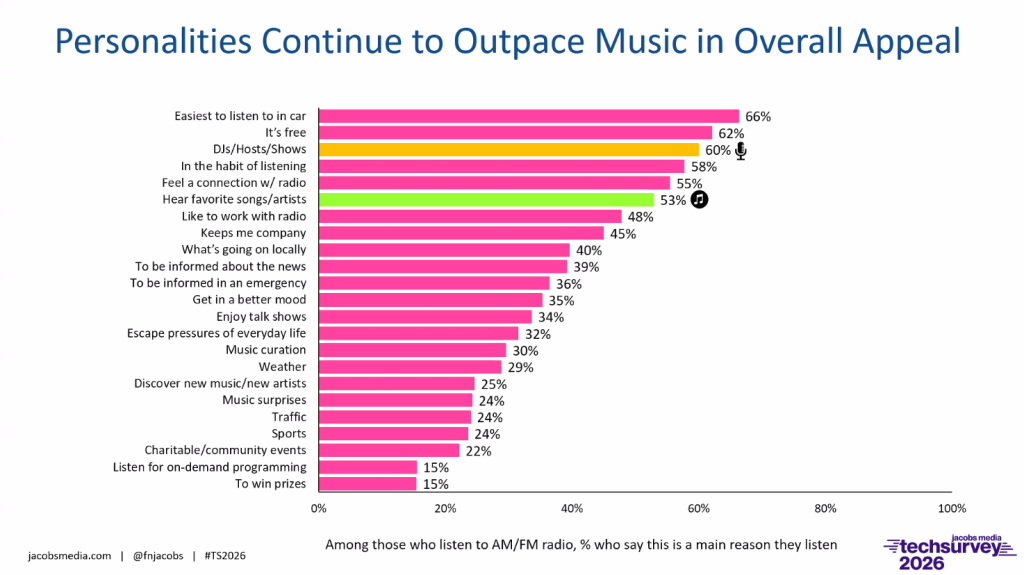
Time and again, radio broadcasters forget that one of the top reasons people listen is… people. Jacobs Media’s latest TechSurvey shows that, outside of convenience in the car and being free, personalities rank as the third-largest reason listeners continue to choose radio.
Yet year after year, we see companies cut ties with the very personalities who make the medium unique compared to streaming apps or syndicated filler programming.
So, is there a fix?
Does radio want to maintain the reach it still has despite shifts in consumption habits, as audiences move from traditional platforms to digital ones?
Radio’s strongest remaining advantage is in the car. However, automakers are already exploring more advanced dashboards that prioritize new and innovative content options. It’s not hard to imagine a future where streaming video begins to invade that space.
Don’t believe me? Hit me back in five years.
For example, I worked for iHeartMedia for 13 years. Every year, employees would hear the same messaging from the top. iHeartMedia CEO Bob Pittman always emphasized that radio is about companionship.
“Everyone thought radio would decline like TV and newspapers, but the idea was, Let’s take on this platform. It turns out radio is companionship. People crave companionship, they develop a real relationship with our talent,” said Pittman in 2017.
“Our niche is companionship,” stated Pittman in 2019.
“Our radio stations are all about companionship, and our job is just to keep people company,” said Pittman in 2024.
Yet, when you talk to those who serve as those companions on a local level there’s a sense of the end always in sight. I’ve been in those hallways, and in those one-on-ones. It almost seemed an annual tradition when the company went through another round of cuts that impacted the same talent responsible for building those relationships.
No goodbye. No closure. Just remove, rinse, and replace. Also, no thought on how this would affect the station’s most important customer. The listener.
To be fair, it’s not just iHeartMedia. It seemingly affects every format at nearly every radio broadcaster in America. That’s not a winning formula if radio still hopes to hold onto its reach.
Francesa proved in two weeks that listeners want what they want—and who they want.
Mike Francesa returns after internet rumors of death: ‘My demise was greatly exaggerated’ https://t.co/1GvGevHuBv
That’s also why the creator economy is becoming more lucrative than radio’s future, not only for today’s talent but for the next generation of aspiring broadcasters.
Francesa didn’t need a marketing campaign, a press release, or a carefully scripted return. His absence created demand. His return satisfied it. That only happens when there’s real equity in the person behind the microphone.
Listen To Your Audience
Radio can keep chasing efficiency. It can keep trimming budgets, syndicating hours, and convincing itself that content is interchangeable. But it isn’t.
The audience just proved that. They weren’t refreshing their feeds looking for “sports talk.” They were looking for Mike Francesa.
That’s the difference.
If radio wants to compete in a world where creators build loyal followings overnight and take them anywhere, it must stop treating talent like replaceable parts and start investing in them as irreplaceable assets.
Because once that connection is gone, it doesn’t return with a format tweak or a new voice. It comes back with someone people genuinely care about.
And as Francesa just reminded everyone—those voices still matter. He still has it.
Barrett Media produces daily content on the music, news, and sports media industries. Sign up for our newsletters to stay updated and get the latest information right in your inbox.
Kevin Clark is regarded as one of the best interviewers in the sport of football. His skill set was shaped from birth, as the son of two journalists, and refined while flipping through the sports section of his local newspaper. Following his graduation from the University of Miami, his approach has centered on combining his love for sports with a deeply rooted sense of journalism.
“Instead of saying I have a five-year plan, you just try to be good at everything and hone a million different skills,” explained Clark on his approach to his career. “All you can do is work hard and study where the audience is going. It’s been the same formula for the entire existence of media.”
It’s been nearly three years since Clark made a decision that changed his outlook. After seven years at The Ringer, where he wrote and hosted his popular Slow News Day podcast, his work earned him an opportunity to join ESPN and its partnership with Omaha Productions.
In 2023, Clark launched a new podcast, This Is Football, centered on having “the best conversations in football.” Each episode leans into his journalistic background and curiosity, creating compelling conversations with the biggest names in the game.
That approach is what separates This Is Football as one of the more successful football podcasts in a crowded sports media ecosystem.
“There’s so much you can do today, and it’s made our industry better because there’s more competition,” explains Clark. “Being on television is no longer the only voice in the room. Now, we have a culture of competition that back then simply did not exist.”
That culture fueled Clark’s transition from covering the NFL at The Wall Street Journal to joining The Ringer in 2016.
Brand Value & Clip Culture
Electric story from Ryan Day: He retired from basketball when an eighth grader dunked on him. The brother of an older recruit. It was Sonny Styles.
While at Bill Simmons’ media company, Clark expanded his skill set from reporter to featured writer and podcast host. With an eye on emerging trends in sports media, he worked to develop new skills and stay ahead in an evolving landscape.
With This Is Football, Clark takes the most pride in how the brand has established itself—not just with a growing online audience, but with NFL franchises as well.
“The most important thing for us is establishing a brand that people know what they’re getting when they come on our show,” said Clark. “That’s what I’m most proud of. When we have something, it cuts through, which is something you can’t take for granted.”
To “cut through,” Clark focuses on ensuring the right clips from his interviews help market the program on social media. His goal in every interview is to generate moments that “stop the scroll.”
Using extensive research, he pieces together insights from prior interviews and identifies topics that deserve deeper exploration.
“You’re going to stop scrolling on the timeline if you see an impassioned take or a deep dive from a famous person,” notes Clark. “There’s no other secret ingredient. It’s not rocket science. It’s all about compelling information from compelling people… [This Is Football] evolved so much to meet people where they are on social media and shows on ESPN.”
Each show produces these clips with the Omaha Productions digital team, distributing them across every major social media platform. Clark notes a deliberate focus on reaching different audience segments that may connect with the content in unique ways. While he doesn’t obsess over every metric, his goal is simple: consistent growth and meaningful impact in a competitive sports content landscape.
Simmons vs Manning
His motivation has always come from working with people who deeply care about their product. Clark has had the rare opportunity to work with both Bill Simmons and Omaha Productions founder Peyton Manning. He notes that both share a similar approach to building their brands.
“I cannot believe I’ve had the opportunity to know, let alone work, for both of them. They both care so deeply about the product and get fired up when you’re as fired up as they are,” said Clark. “They both have had incredible second pivots in their careers. Their curiosity led to that, and a desire to roll up their sleeves and get it done no matter what.”
Clark also revealed that he turned down several offers from legacy media brands in 2016 to join The Ringer, which he described at the time as a “podcast startup.” His belief in Simmons drove that decision, as he trusted Simmons would not allow The Ringer to fail.
That same drive is what Clark sought when ESPN and Omaha Productions approached him in 2023.
“I love both Peyton and Bill. They’re absolute media geniuses. How could you not want to work for either of those guys,” said Clark. “Most people would feel extremely lucky to just work for one. To work for both is beyond comprehension.”
Sports Media Evolution
The evolution of sports media has played out throughout Clark’s career. He recalled a conversation with former NFL Chief Media and Business executive Brian Rolapp in 2016, while weighing his decision to leave The Wall Street Journal for The Ringer.
“He had a front row seat to sports media and told me in 2016, any job could be the best job in the world. However, at that time you needed space at legacy media brands to grow. Now, anyone can start up a YouTube page and be the highest paid person in sports media in eighteen months,” said Clark.
That conversation reshaped Clark’s perspective—not only on where sports media was headed, but on what it takes to succeed.
“In media, you’re six bad months from losing your voice in the industry. Far more important than contracts or role is your credibility and your name. Your name has to be more important than any show you’ll ever be on,” notes Clark. “It’s about what my name means when I talk about football. You always have to study where the audience is and cultivate different things on different platforms to grow.”
That understanding of what content succeeds has helped establish Clark as one of the emerging voices in the sport. Even as the industry faces disruption from artificial intelligence, he sees opportunity rather than threat.
“It’s been the same formula for the entire existence of media. It’s just the medium that’s changing,” said Clark. “If you were a sports columnist in 1980, you’d have a monopoly in your market. Now, you can dominate five different platforms with a worldwide audience. If you’re not excited about this era, then I don’t know what you’d be excited about.”
ESPN Super Bowl
Clark is especially energized by the upcoming NFL season, with ESPN set to broadcast its first Super Bowl in company history. While he hinted at additional projects tied to the event, he insists he feels no added pressure tied to the moment.
Instead, he’s embracing the opportunity one day at a time.
“Do good work with people you like. I’m so blessed to like all these people I’m doing television with. I’ve never had a negative interaction with any of them, and some of them are my heroes,” said Clark. “The Super Bowl is a cool milestone for ESPN. That broadcast is going to be unbelievable because I know and respect the people who are doing it.”
Clark’s outlook—shaped by years in an industry that never stands still—ultimately comes back to something simpler than algorithms, platforms, or access. It comes down to trust.
The trust he has built with audiences. The trust placed in him by leaders like Bill Simmons and Peyton Manning. And the trust he continues to earn with every conversation he produces.
In a space where anyone can grab a microphone and chase relevance, Clark has built something more sustainable: credibility that travels with him, no matter the medium. That’s why This Is Football resonates.
Not because it’s louder or flashier, but because it’s intentional.
As the next wave of sports media continues to blur the lines between traditional and digital, Clark isn’t chasing where the industry is going. He’s already there—doing what he has always done: asking better questions, finding sharper angles, and delivering content that cuts through.
Because Clark remains curious, credible, and, above all, worth listening to.
Barrett Media produces daily content on the music, news, and sports media industries. Sign up for our newsletters to stay updated and get the latest information right in your inbox.
For those watching at home, the shooting at the White House Correspondents’ Dinner was a sterling example of journalists springing into action, despite their fear about becoming targets of the gunman who wanted to assassinate President Trump.
But the hidden story from inside the room is the toll that the frightening episode took on the 2,000 assembled journalists and politicians.
The morning after the gunfire at the Washington Hilton, former NBC correspondent Dasha Burns made a pained — more than eight-minute — confession on Instagram. She was in the ballroom and scrambled to hide under a table.
“I don’t think a lot of us are mentally and emotionally ok. I’ll be honest. I’m not.” She spoke haltingly, saying, “This is the second time in the last two years of covering Trump that I’ve been at an active shooting scenario.”
Burns, who now works at Politico, said that the assassination attempt — seen on live TV — of President Trump during a 2024 campaign stop in Butler, Pennsylvania, “did a number” on her and her colleagues. And that those same colleagues were in the room with her during Saturday night’s attack. She added, having been through this more than once, it’s “devastating to think about.”
“Last night, boy, does something like that make you feel human and vulnerable.” She admitted she had a panic attack on the way to the dinner, thinking about the possibility of a terror attack. And “that thought is always in the back of my mind now.”
She wrapped up the video with a ten-second pause that ended with tears in her eyes. “I can’t help thinking that it could have been a lot worse.”
Now, skeptics will say journalists shouldn’t complain about having to do their jobs. Obviously, they haven’t had the traumatizing experience of hiding from a would-be assassin. And they did their jobs extremely well — mostly — fueled by adrenaline, broadcasting and posting through the middle of the night. But that takes a toll. It is now “the cost of doing business,” New York Times White House correspondent Peter Baker said on MS NOW.
One glaring mistake was made by CNN’s Kaitlan Collins. She said on air that the shooter was “confirmed dead.” She later corrected this, noting that Trump confirmed the suspect had been apprehended alive. It’s the kind of mistake made too often by less seasoned reporters that, sadly, happens in fast-moving, chaotic breaking news situations. She should have known better than to simply cite, as a source, security for Education Secretary Linda McMahon.
Others, like Wolf Blitzer — who was on his way to the bathroom and feet away from the shooter — said he thought he may have been in the line of fire. “All of a sudden I heard these loud… very scary gunshots right near me… next thing I knew… I was thrown to the ground and protected.”
He was so close to the action that he said, “I had no idea… who this shooter was aiming at.” And he said, “The first thing that went through my mind: is he trying to shoot me?” A reporter asked him how he could anchor after this. He simply said, “I’m a broadcast professional.”
Fox’s Peter Doocy said “it was really scary in there.” And he asked Trump, “Why does this keep happening to you?” The president, who remained calm at a briefing after the shooting, said those who do important things become a target.
Another Fox White House reporter, Jacqui Heinrich, remarked that Trump “held it together for all of us” during the emergency.
Fox anchor Bret Baier shared a firsthand account describing the “chaos” that unfolded in the ballroom. “I heard shots and everybody dove down… within seconds the entire place was filled with Secret Service guns drawn.” “As we were in the basement of the Washington Hilton as they’re clearing room to room, it was urgent… and they were telling us to run out of the building.”
Trey Yingst, Fox News Chief Foreign Correspondent, who returned from a war zone in Gaza only to encounter gunfire in Washington, told viewers: “It was a very tense moment. Some people were laying flat on the ground, others hiding under tables, shaking and crying.”
MS NOW host Stephanie Ruhle worked to debunk emerging conspiracy theories that the shooting was “staged” or a “false flag,” declaring that “what happened… was real.”
The claim, on both sides, that the Trump assassination attempt was “fake” isn’t just wrong — it undermines reality and the seriousness of political violence. What proof do they have? When people come forward with conspiracy theories, they dismiss a documented event with real victims and extensive evidence. They’re not being skeptical; they’re spreading misinformation that erodes trust in everything from journalism to public safety.
Disagreement about politics is one thing, but denying events outright crosses into something far more damaging, where facts no longer matter and accountability becomes impossible. People can speculate all they want, but it comes at a cost.
Former CNN anchor Brooke Baldwin posted an angry video. “What is so deeply disturbing to me this morning isn’t just what happened last night in Washington,” she said. Although she said it troubled her to watch friends and former colleagues ducking for cover in “tuxes and ballgowns.”
“People are saying this was staged. That they wanted this to happen… this is political violence. This is real. Whether you support this president or you can’t stand him, we cannot normalize assassination attempts on any American leader.”
I can relate to that fear and sense of panic. And the unbelievable spread of conspiracy theories surrounding the loss of almost 3,000 lives. On 9/11, I was broadcasting from one of the top floors of the USA Today high-rise in Rosslyn, Virginia. It was directly in the flight path of airplanes headed down the river to Washington Reagan Airport. There were reports that a hijacked plane was headed our way. We were terrified that it might slam into our building. In fact, the plane did fly by us and crashed into the Pentagon. We continued to broadcast for the next 12 hours. Our fear became part of the story.
It’s a rare case when press people become subject, storyteller, and potential victims at once. But it shouldn’t be the case.
Journalists are meant to bear witness to events, not be thrust into them — because when the line blurs, the reporting can sometimes blur with it.
Barrett Media produces daily content on the music, news, and sports media industries. Sign up for our newsletters to stay updated and get the latest information right in your inbox.