

Home Blog Page 237

The Industry According To: Gene ‘Bean’ Baxter, SiriusXM Lithium

Thank you for checking out ‘The Industry According To’. This series runs each Tuesday, and features radio and record industry executives, managers, programmers, talent, artists, and professionals from all areas of the business world. To be considered as a future guest, email me at keithblackboxgroup@gmail.com.

Today we visit with a Radio Hall of Fame talent everyone has heard of. He’s won ratings and revenue battles at the highest levels and helped reshape how morning shows sound in many markets. His resume includes creating an international incident, embarrassing the President of France, and triggering investigations from law enforcement. His name is Gene Baxter, but you can call him “Bean.”

After a long career at KROQ, being one-half of the legendary “Kevin & Bean Show,” he now currently hosts on SiriusXM’s Lithium. In addition, he also co-hosts the podcast, “A Cup of Tea and a Chat with Allie and Bean.”

Bean is a radio lifer. He’s one of the smartest in the room, and if you’ve ever heard him on the radio, he’s not afraid to speak his mind.

So, let’s dive in.


Where’s Radio At?

Keith: You’ve been out of the day-to-day grind for a few years, but I know you still follow the industry closely. From your perspective, where is radio today? What’s it doing right, and where might it be going wrong?

Bean: I’ve been in radio for 49 years this year and still love it as much as ever but there is no doubt these are challenging times. I don’t listen to much anymore that is not on demand. Content is still king but other platforms are far more convenient than linear programming. And the commercial load on US radio is well beyond my comfort level. The billion dollar question is how to get people to tune back in and that solution is more for smart guys like you, Keith, than worker bees like me.

The UK and the U.S.

Keith: Having lived in the UK for years and even doing some radio there, what are the key differences in commercial radio between the U.S. and UK? Do they sound similar? Are ratings as important? Are the programming and revenue models analogous?

Bean: We are years behind America here in one way. Massive consolidation has only hit much more recently here leading to hundreds of layoffs and contraction of programming. But we are years ahead of moving nearly everyone to digital platforms. There is almost no AM radio anymore here and FM stations are minor players compared to DAB and DAB+ stations. Less than 25% of radio listening in the UK is on terrestrial radio. Yes, ratings still matter and even the commercial-free BBC needs to justify their license fees by satisfying as many people as possible. The major radio group apps (Bauer, Global, BBC) are well- integrated into people’s lives here.

Being Dangerous

Keith: “The Kevin & Bean Show” is famous for having dangerous and rebellious traits and content — The Miss Double December Pageant, legendary pranks like Blink-182 playing in a parking lot that didn’t exist, the Thom Yorke “altercation,” and the Jerry Lewis/Jacques Chirac bit that caused an international stir. That kind of material is rare on radio now. Has the industry lost some of its edge — and should more of that spirit return (within FCC guidelines), or is it better left in the history books? 

Bean: Most radio stations have always been controversy-free but the few that we’re willing to let talent push the envelope have now retreated from that position, it seems to me. Maybe the thinking is sales dollars are too hard to come by now so why risk ticking people off? Keith, you hear much more US radio than I do. What was the last surprising morning show bit, stunt, whatever you want to call it, that you heard? How long ago was it? I can’t think of any. Please let me add that I am very embarrassed by many of the things we did on the radio in the ‘90s and ‘00s and I am grateful society has evolved into a kinder, gentler, more inclusive place. In our later years we definitely changed with the times, thankfully.

Building a Winner

Keith: Kevin & Bean didn’t start on top; it was a long build. Today’s younger talent often wants success immediately. What advice would you give an aspiring talent on what it actually takes to build a winning show with real longevity?

Bean: We were incredibly lucky to have champions in our corner at KROQ. GM Trip Reeb, PDs Andy Schuon and Kevin Weatherly gave us the time we needed to learn the job. We were so bad when we started, having never done a morning show before, but they nurtured us and supported us. Radio doesn’t really mint household names anymore but there are many, many internet content creators who found a niche, worked hard, and are incredibly successful. The rules of engagement are the same no matter the job though. Serve your audience. Be authentic. Be interesting. Be consistent.

Audience Connection

Keith: Kevin & Bean had an incredibly loyal audience, and that can’t be bought. What’s the key to building that kind of listener relationship, and is it harder to do today than it was twenty years ago?

Bean: It’s harder to get those pre-podcast, pre-Covid numbers now, but you can still build a strong relationship with the listeners you can get. My former colleague Allie Mac Kay and I started a podcast together in October of 2020. It’s called “A Cup Of Tea And A Chat.” We only have a few thousand paid subscribers on Patreon, a tiny fraction of the old KROQ numbers, but they are the most loyal and interactive audience I have ever experienced. The community they have built would you make you cry. The friendships they’ve forged with each other, and the way they help each other out, it’s beautiful. We are 800 episodes in and I still can’t believe how many of them are still proud “Teabaggers.” Allie and I are both extremely accessible to them and try to super serve their interests. We are grateful for their feedback.

Is Alternative Still… Alternative

Keith: You lived in Alternative radio when it truly felt counterculture. On a scale of 1 to 10 — where 1 is basically CHR and 10 is legit Alternative, where does terrestrial Alternative radio sit today, and why?

Bean: I don’t want to sound like a homer here but the shining example of a 10 out of 10 alternative radio station is KROQ in the mid to late 80s. They were brilliant, wacky, adventurous, and really reflective of their left-of-center audience.  Most what-we-call alternative stations today are actually so diluted and bland as to be really mainstream alternative, an oxymoron, I know. I hate that they are 85 percent gold now and the “oh wow!” records are just another different Red Hot Chilli Peppers song. I know it’s a 25 – 54 numbers game and those stations are giving the available audience what they think they want but I wish stations would try a little harder to surprise and delight, both with talent and tunes. Current grade: 6. Come at me, bro.

Why Repetition Works

Keith: Many probably don’t know this but “The Kevin & Bean Show” would repeat content often. It wouldn’t be reckless to say you did one show daily but aired much of it twice each morning. That comes from an understanding of audience turnover, their habits, available windows, etc. What’s your philosophy on morning shows repeating content?

Bean: It went against everything I thought I believed for the first few years but the diaries didn’t lie. There was not one person listening at 8:30 who had been listening at 6:30. So we leaned in and built a wheel. If we didn’t have a couple of things to replay later in the show then we weren’t doing a very good show that day. And we almost never got a complaint for repeating except from the superfans and they were going to listen anyway.

Transparency and Self-Deprecation

Keith: A big part of your career has been your willingness to be transparent and your ability to find humor in almost anything, especially yourself. You were often put on display by co-hosts and listeners for your obsessions with 7-Eleven, the post office, or “The Wreck of the Edmund Fitzgerald.” How important are transparency and self-deprecation for on-air talent.

Bean: I mentioned authenticity earlier and that is maybe the key ingredient to success. In many fields. The things we ribbed each other about were all real things that we found funny. and the oddball traits that each person had were usually the things the audience would most remember about them. I still get former Kevin and Bean listeners sending me everything they ever come across about the Fitz. Kevin loved monkeys. Ralph was the Batman guy, etc.  Self-deprecation is an appealing trait but it also wasn’t phony. We did not take ourselves too seriously and it was also fun to laugh at everyone else.

The Art of an Interview

Keith: You’re top tier when it comes to interviewing people on-air. What’s the real trick to pulling off a great interview — and who’s been your toughest guest?

Bean: Research, yes, Watch the movies, read the books, track down everything you can online. That’s all “Interview 101”. Where you shine is when you put that out of your mind and actually listen to the guest. Pick up on what he or she is saying and look for unexpected places to take the conversation. Ask the follow-up question. Then another if warranted. Don’t be in a rush to get back to the pre-planned run sheet of how you thought it was going to go. And your real secret weapon is curiosity. In my opinion, that is the absolute most important trait an air talent can have, not just for interviews, but for taking phone calls, talking about news stories, everything.

Talent Bean Likes

Keith: You’ve always had a sharp ear for talent. What shows or personalities do you listen to these days and think, “this is really great”? Give us some listening homework — and maybe a reason or two why you are such a fan.

Bean: You know who is an incredible air talent? A real natural. Smart, funny, with incredible musical knowledge, and a fantastic interviewer? John Mayer. Born to do it, if he weren’t also born to be a phenomenal guitarist and singer-songwriter. He has his own channel (4) on SiriusXM.

I have about ten podcasts I listen to every week including one about radio that anyone interested in the talent side of the business should check out. It’s called Game Changers Radio, out of Australia. I think the Louis Theroux podcast is my absolute favorite interview show right now. My old friends Luke Burbank and Andrew Walsh have been hosting “Too Beautiful To Live” for the past 15 years and were really my inspiration when starting my own podcast. They taught me the value of minutia. The most interesting things in the world are rarely the most important. And they have, again, authenticity, in spades.

The World According to Bean

Keith: I know how much you love radio and have thoughts on everything, both positive and constructive. The last question is just a blank slate: what haven’t you said that you want the industry to hear?

Bean: I know I have been a Debbie Downer about the state of radio today. But I am sure there are many great programmers and air personalities doing amazing and inspiring work right now that I just don’t know about. I want to say thank you. Keep doing it. I want you to succeed. Thanks to everyone trying to make it better. And thank you to Keith Cunningham for this series and his thoughtful coverage of our industry every week here on Barrett Media. And for anyone who wants to reach out and say hi, I’m at Bean9@mac.com.

Barrett Media produces daily content on the music, news, and sports media industries. Sign up for our newsletters to stay updated and get the latest information right in your inbox.

Sports Radio Continues To Play the Wrong Social Media Game

0

There are both positives and negatives for sports radio brands when it comes to properly using social media. With each passing day, there’s a high probability that what worked yesterday won’t work today—and may never work again tomorrow. However, the real challenge lies in the strategy. If you focus only on limited platforms, you risk missing potential audience. Conversely, if you try to be everywhere, you risk diluting your overall impact.

However, what most sports radio brands miss is how to adapt to platform-specific trends. What works on one platform doesn’t necessarily work on another. With limited staff, resources, and time, it’s nearly impossible for many brands to keep their social strategy performing at peak levels every day of the week.

That’s why sports radio needs to work smarter, not harder, when it comes to social media. Relying on platforms that place your content into a bucket for an algorithm to determine reach later isn’t a winning approach. Instead, sports radio needs to shift its strategy from the written word to real-time engagement—the kind that YouTube provides.

Since COVID, sports radio has appeared on YouTube more than ever before. The pandemic showed that when you remove the car, you must find ways to penetrate the home. Ask yourself: when was the last time you saw an AM/FM radio in a home? Most have been replaced by smart speakers or smart TVs with streaming apps serving as the primary distribution model.

Additionally, COVID accelerated video consumption across platforms like YouTube and Twitch. YouTube’s global traffic increased by 15% during lockdowns, making it one of the most visited sites worldwide. In 2020, 64% of social media users reported using YouTube more frequently while confined at home.

Video First Content Economy

Over the past five years, podcasts have evolved from audio-first to video-first products. Netflix is now investing millions of dollars in top podcasts, securing exclusive access to video audiences originally built on YouTube.

Sports radio needed to adapt—and it did. Many stations now distribute video through YouTube, thanks to forward-thinking executives who recognize that traditional radio may no longer be the primary destination for sports content. However, many stations still miss the point of being on YouTube. As a result, they lose potential reach, engagement, and key metrics that matter to advertisers seeking digital opportunities.

So, does sports radio actually use YouTube as social media? Or does the format still view it primarily as a consumption platform? Consider your own local sports radio station and how it approaches social media.

Most strategies still begin with X, where many brands have long established their presence. It’s where Adam Schefter breaks news and where Pat McAfee streams his show.

However, despite continued investment in the platform, returns are far from guaranteed—and are less reliable than ever. There is little growth potential on a platform that deprioritizes links to external sites or live streams. Furthermore, expanding reach without significant sharing provides minimal value.

Meanwhile, Facebook has largely been neglected by many sports radio brands. Instead, stations lean on centrally generated content to stay “up-to-date” or use it as a secondary dumping ground for Instagram Reels. However, the same principle applies: without a clear strategy, there’s no reason to expect growth or engagement.

Then there’s Instagram, TikTok, and LinkedIn. Nearly every sports radio brand lacks a meaningful presence on LinkedIn, while many use Instagram primarily for clips that are later repurposed for TikTok in hopes of generating engagement.

YouTube Is Social Media

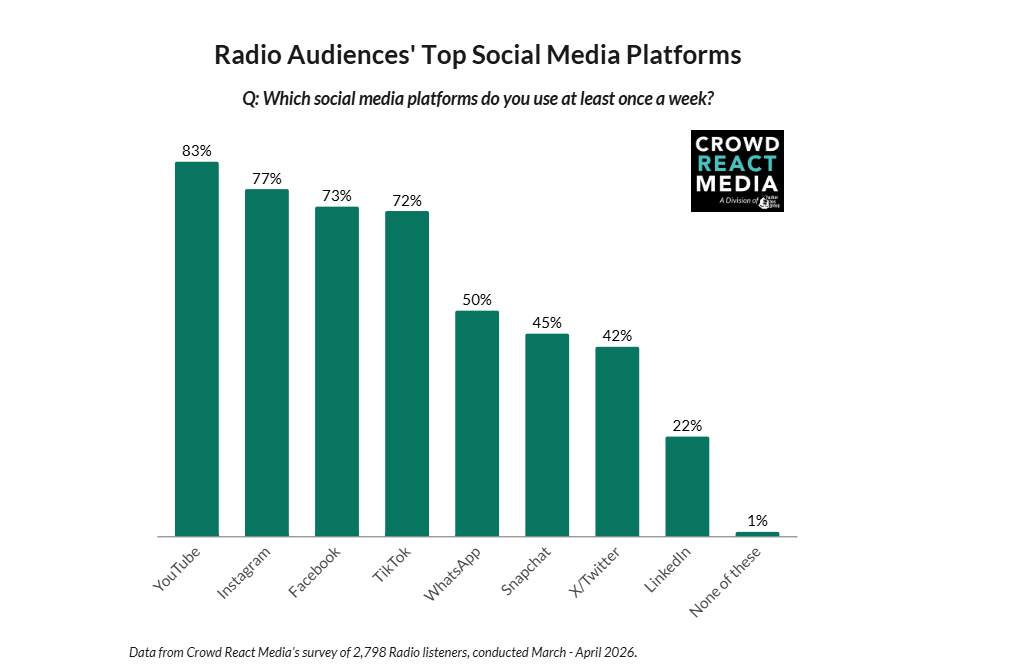
However, what all of these platforms lack—compared to YouTube—is consistent user behavior. According to a recent survey by Crowd React Media, 83% of surveyed radio listeners say they use YouTube as a social media platform at least once a week. That’s higher than Instagram, Facebook, TikTok, and even X.

Shouldn’t that data send a clear message? If radio listeners are using YouTube as a social platform, they’re looking for engagement from the sports radio brands they love. Sports radio brands have become more accessible over the past six years, especially through live video in real time. So instead of posting another GIF on X with a “listen live” link, why not actively engage your audience on YouTube instead?

The tools are already in place, and the opportunities are significant. Rather than hoping for clicks from platforms that deprioritize your links, create a unique user experience where audiences are actively seeking interaction.

The days of equal investment across every social platform are over. Social platforms—and how they treat publishers (and yes, you are a publisher)—are not equal. Therefore, you must focus on where your audience actually spends time and build the skills necessary to maximize that opportunity.

That doesn’t mean abandoning other platforms. Instead, it’s time to reset priorities and focus on what drives digital growth. YouTube offers longer content windows, stronger discoverability, and audience behavior that aligns with how people consume sports radio. In other words, YouTube has the potential to become the new home for sports radio.

Or will that ground be ceded to podcasters once again?

Own Your Territory

The real risk isn’t that sports radio disappears—it’s that it gets outperformed in its own space.

Make no mistake: the next generation of sports fans isn’t choosing between AM, FM, or even streams. They’re choosing between personalities, access, and interaction. Increasingly, that decision is happening on YouTube—not on your frequency or your app.

Sports radio has always thrived on immediacy, reaction, and human connection. Those same qualities drive success on YouTube: live chats, real-time interaction, community building, and content that engages audiences rather than talks at them.

That’s not a new skill set for sports radio. It’s the original one. This isn’t about chasing trends—it’s about recognizing that the platform has finally caught up to what the format has always done best. It’s time for sports radio to cease leaning on what worked five years ago, and start building for tomorrow.

The question isn’t whether you should be on YouTube. It’s whether you’re willing to treat it like your home field—or continue playing road games while someone else builds the crowd.

Barrett Media produces daily content on the music, news, and sports media industries. Sign up for our newsletters to stay updated and get the latest information right in your inbox.
How ‘First Things First’ Discovered a Winning Formula To Land a Sports Emmy Nomination

0

First Things First: every day presents a new opportunity for another first. The show’s title borrows from an idiom suggesting certain items should be addressed before others. While the program has been part of the FS1 lineup since 2017, last month brought another “first” for the show: a Sports Emmy nomination in the Outstanding Daily Sports Show category.

“It was very gratifying to receive the news,” said host Nick Wright about the nomination. “I was probably way more thrilled than I should have been. I started to feel the show was really good with Kevin Wildes, Chris Broussard and myself. Every year the Sports Emmys nominees would come out, and every year I’m in a bad mood for three days afterwards because I’m angry we didn’t get nominated.”

For the last five years, First Things First has served as the network’s flagship sports debate program. Despite several roster changes and time slot shifts throughout its history, the show has achieved its greatest success since the formation of the trio of Wright, Broussard, and Wildes.

Since shifting from mornings to afternoons in September 2022, First Things First has doubled its viewership. The network says the program has grown 102% compared to its weekday morning audience.

“The show has been one of the best sports shows on television,” said Chris Broussard, who joined the program full time in September 2021. “I felt like we were in that league. So, to get the Sports Emmy nomination was gratifying. We’d love to win it, but even being nominated is a reward as well.”

Building A Winning Roster

Kevin Wildes, who has served as the moderator since joining in early 2020, said the Sports Emmy nomination reflects a team effort. The longtime producer built a strong reputation at ESPN before joining FOX Sports. Following the nomination, he added that the credit belongs to the show’s entire staff.

“There’s so many people that you don’t see that make this show work,” said Wildes. “There are so many little things that go into making the show what it is, and so many people involved with that. It’s a team effort and a team award.”

Success didn’t come easily to First Things First. The program has evolved since its 2017 debut, when Cris Carter and Wright debated the latest sports topics each morning with Jenna Wolfe as moderator. Over time, the show featured contributions from Carter, Wolfe, and Brandon Marshall across a five-year span.

However, the combination of Wright, Broussard, and Wildes has proven to be the winning formula.

“The three of us bring different things to the table. That’s what makes the show work,” explains Broussard. “Nick [Wright] always brings intelligent takes with substance. But when [Kevin] Wildes got on the show, I always enjoyed the show, but the show became more fun to do. I know they [FOX] was going for more levity when they brought Wildes in, but the show is more fun now.”

Broussard, who worked with Wildes during his time at ESPN, said that built-in relationship helped create instant chemistry.

“The biggest difference in the show was adding Kevin Wildes because of his natural instincts for what works and what doesn’t,” said Wright. “Also, with no disrespect to anyone else. Chris Broussard is the best partner I’ve ever had. I’m a tough guy at times to work with… but [Chris] Broussard is the hardest working partner I’ve ever worked with.”

First Things First also marked a new beginning for Wildes. His role on the program was his first on camera rather than behind the scenes. However, he viewed the transition as a natural progression.

“People think it was a bigger transition than I thought it was,” noted Wildes. “I viewed the opportunity as less of a left turn, and more a continuation of evolving in this field I’ve been working in for twenty years. I didn’t feel that strange. Honestly, wearing a suit and make up in the lights was a little intimidating at first.”

Being Different Matters

Another factor helping First Things First stand out in a crowded sports media landscape is its digital and social media strategy. Each show is available as a podcast and distributed across multiple platforms, while the program’s social media team continues finding new ways to present content that drives engagement.

Over the past year, First Things First has generated more than 640 million social views across its platforms—an 11% increase from the previous 12-month period. On YouTube alone, the show has grown 24%, surpassing one billion total views in February.

What makes these figures more notable is that the program has achieved them as an afternoon show, unlike many competitors that air in the morning or midday and benefit from a full afternoon of online engagement.

“The meat of our show is real opinion with real factual basis. Our show has to lead the league in both absurdity and most data conveyed per minute,” said Wright. “That’s what special about our show and the relationship between the three of us.”

Wildes said airing in the afternoon also provides an advantage by allowing the show to react to established narratives.

“There’s also an advantage to being live when breaking news happens in the afternoon,” explained Wildes. “In the morning, very few things break in sports where we could respond in real time. The afternoons also provide that opportunity more often than in mornings.”

Navigating Change

As the show approaches its tenth year on FS1, the network’s approach has remained steady. First Things First has settled into its core trio while continuing to grow in the afternoon slot. Last summer, FS1 expanded the program to three hours, adding Danny Parkins, Eric Mangini, and Greg Jennings for the additional hour.

The expansion was part of broader changes to the network’s daily studio lineup. FS1 canceled Breakfast Ball, Speak, and The Facility, removing several high-profile talents from its roster.

Despite those shifts—and the ongoing challenges networks face in producing in-house studio programming—First Things First remains focused on what it can control.

“On the top of my script I have for the show, I have a picture of Secretariat with blinders on. It’s a constant reminder that the only thing I need to be focused on is trying to be best for the show at 3 o’clock,” said Wildes. “What’s happening in the industry is not part of my focus. Obviously, I know it’s there, but it doesn’t affect me. Because I keep my focus on the show exclusively.”

For Nick Wright, who just celebrated ten years with FOX Sports on Monday, the opportunity to continue building First Things First stands as his proudest accomplishment with the network.

“If you do anything long enough, you know whether or not the show as a whole is a good show or a bad show,” explained Wright. “My proudest moment is a continual moment of creating what is the best sports show on television. It is incredibly gratifying, and I’m incredibly proud that I get to be a part of that everyday.”

For a show built on the idea of prioritizing what matters most, First Things First has spent nearly a decade doing exactly that—refining its voice, sharpening its chemistry, and earning its place in an increasingly crowded space.

The Emmy nomination may be the latest milestone, but it also signals something deeper: after all this time, the show isn’t chasing relevance. It’s continuing to define it.

Barrett Media produces daily content on the music, news, and sports media industries. Sign up for our newsletters to stay updated and get the latest information right in your inbox.

The Data Doesn’t Lie: Liberal Media Has an Influence Problem

0

The liberal media has a voice problem — and new research makes that impossible to ignore.

A study from the University of Mississippi examined the most influential non-politician news figures in the 2024 election. Researchers used a weighted survey to determine who Americans trusted most for information. The results should be a wake-up call for anyone on the left side of the media dial.

Joe Rogan topped the list. With 11.4% of respondents naming him as their favorite news influencer, he wasn’t just first — he was dominant. Sean Hannity came in second at 9.6%. Greg Gutfeld followed at 7.3%. Elon Musk and Mark Levin tied at 6.8% to round out the top five.

Lack of Liberals?

Notice anything? None of those five figures could reasonably be called a liberal voice. So where does the left show up?

Jimmy Kimmel cracked the top 10, but let’s be honest — he’s a late-night comedian, not a news influencer. That’s a different lane entirely. Stephen Colbert also made the top 10, sitting at ninth. He fits the same category.

Bill Maher is perhaps the strongest argument for a liberal presence near the top, but even he blends punditry and comedy in a way that muddies the waters.

Rachel Maddow is the first figure on the list you’d call a genuine liberal news influencer — without the comedian asterisk. She landed at 16th.

16th.

For a media environment constantly described as dominated by the left, that ranking demands an explanation. Either A) the “liberal media” label is more mythology than reality, or B) liberal media members are doing a poor job of converting audiences into engaged, loyal followers. Neither answer is flattering.

Think about what that means in practical terms. Conservative media built an ecosystem — from talk radio to podcasts to cable news — that turns casual listeners into passionate advocates. Fox News, independent creators, and podcasters like Rogan didn’t accidentally dominate this list. They built communities, they created habits, and they gave audiences a reason to come back every single day.

Liberal media, by and large, hasn’t done that — at least not at the same scale.

The Fix?

That’s not a political statement. It’s a business and strategy observation. Influence isn’t measured by op-ed column inches or Sunday morning roundtables anymore. It’s measured by who people actually turn to when they want to make sense of the world. This data says conservatives have figured that out. Liberals haven’t.

There’s also a distribution problem worth acknowledging. Conservative voices found homes on platforms — talk radio, podcasting, YouTube — where audiences were already forming habits. Liberal voices often relied on legacy media infrastructure that’s been shedding trust and audience share for years. That bet hasn’t paid off.

The danger for liberal media members is dismissing this data rather than learning from it. It’s easy to question the methodology, challenge the sample, or argue that “influence” is a flawed metric. But that kind of defensive posturing is exactly why the gap keeps widening.

Conservative media built its audience by speaking directly to people, in formats they preferred, on platforms they already used. The data shows that approach worked — and it worked decisively. Until liberal media figures are willing to honestly reckon with that reality, don’t expect the rankings to change.

The scoreboard is up. It doesn’t lie.

Barrett Media produces daily content on the music, news, and sports media industries. Sign up for our newsletters to stay updated and get the latest information right in your inbox.

How to Refresh Your Morning Show Before Management Does It for You

0

When did you last add a new wrinkle to your show? If you have been hosting a show on the same station for several years and have not changed anything substantial, learn from a successful morning show.

I have heard many a long-running show that sounds pretty much the same except for some of the topics expressed on the air. New wrinkles are essential for the long-term survival of your show. I hate to hit you with this truth bomb: we are all replaceable. It is show business.

Clinton Yates was recently iced by ESPN Radio and ESPN. Clinton gave the perfect response: “That’s showbiz, kiddos!” Yes, we are in the business of show. It is about the addition of audience and advertisers. If you are not doing both, get ready for that pink slip. So, here are some strategies for you to extend the run of your radio show.

Ask yourself what part or parts of your show have run their course? What about your show’s open? How long has that been running? Is it too long? I got a demo from a host once, and the open was at least three minutes long. I personally think that 20 to 30 seconds works fine. Does the open speak to your target demo? Is your open contemporary? Your show’s open should be streamlined.

The morning show on my stations has a quick open that updates at least once a week with quick sound bites from people in the news. Quick, informative, with a theme that speaks to men in their 40s.

Rotating Regular Guests

Let’s talk about regular guests. Some of these are amazing and benefit your show greatly. Many of these guests are time killers that are not helping your show grow. When is the last time that you evaluated the guests on your show? Do yourself a favor — aircheck a segment with regular guests. What are your guests bringing to the table? You may have some guests that you need to cut, some that you may need to make an as-needed booking. You may have an occasional guest that you need to make into a weekly one.

There is a long-running syndicated music morning show that has not really changed a cast member in years. When I hear the show, I find it to have zero drama or personality. Your cast members should never grow stale.

Tom Barnard, who retired from KQRS in Minneapolis a few years ago, was always tinkering with his cast. For the most part, Tom was the only consistent member of the KQ Morning Crew for his over 30-year run. Tom and his station managers were always trying to keep things fresh. I know Tom a little bit — he worked across town from me and had an epic run dominating in ratings and revenue.

I don’t know all of the inner dynamics on how decisions were made, but most of these changes worked very well and kept the show vital, fresh, and contemporary.

Cast Member Conundrum

Speaking of the cast members of your show… Are their roles defined? Who is the person who is the instigator? Who brings the drama? Which one of you is funny? Hey hosts — do you take yourself too seriously? Can your news person, producer, or guests make fun of you? Speaking on the subject of defined roles… Play into each cast member’s strengths and weaknesses.

Personally, I prefer the producer to be more of a sniper. Quick hits that either create laughter or drama. The funny person on your staff may be the news anchor or the station’s engineer. Realize this — if your cast just parrots what and how it is said on your show, it’s not good. Some hosts may need to give permission for their teammates to go on the offense. Someone on the show needs to put their neck out for criticism. If it is authentic and relatable, these moments will create a bunch of glue for the audience to love the show even more.

Revaluating vs Refresh

Every brand manager and host should evaluate each guest on the regular. I had a host once who had a regular guest that was an every-once-in-a-while type of topic. I quizzed him and agreed that the subject of Islamic terrorism is sometimes a good one, but only when it is in the news.

Then the host confessed that the regular guest was his brother’s college roommate and he felt like he should support his mission. That may be a fine and good reason for helping your brother’s college friend, but it is meaningless to your audience. Make it meaningful and relevant.

Consider every moment on the air as vital and important… I hear too many hosts phoning it in for meaningless segments. You may be doing a Big 3 stories of the day, an open-line hour, and a complaint segment. I am not saying that these are necessarily bad to do. I want you to evaluate whether these things are good for the show, treasured by the audience, or just time killers. And I know that you may be bored with a feature. That may be a good reason to get rid of it.

Perhaps the feature needs to be rescheduled to a different time and/or day. Part of a listener-focused experience is to delight and surprise your fans. If these benchmarks hinder your show, it’s time to either cut them back, eliminate them, or reschedule them.

Barrett Media produces daily content on the music, news, and sports media industries. Sign up for our newsletters to stay updated and get the latest information right in your inbox.

Why the Masters Tournament Is the Ultimate Branding Masterclass for Radio

0

Nowhere else in sports does an organization operate with the same level of precision, tradition, and intentional discipline as the Masters Tournament. The annual gala of golf every April at Augusta National Golf Club in Georgia. No other venue shuns commercial clutter or bans cell phone use as a matter of standard operating procedure.

The Masters Tournament officials purposefully execute their showcase week with a tight agenda and a vocabulary all their own.

Other areas of precise detail are just as important. Those in attendance are “Patrons,” not fans. No running, loud, or rowdy behavior on the course. That will get you pulled off the grounds. Chairs can be set early and left alone for the reminder of the day. Tickets are extremely difficult to obtain, but are also surprisingly affordable. Don’t think about a secondary resale, it’s forbidden. The practice is closely monitored, and will get you banned for life.

The course conditions are immaculate, with each hole named after a flower. Television coverage deliberately avoids certain off-course areas to preserve The Masters mystique. Augusta National tightly controls the broadcast with limited commercial interruption. The club also dictates camera angles and commentary verbiage.

Concession offerings are limited to pimento cheese and egg salad sandwiches. Prices have changed only marginally in decades. All concessions are wrapped in Masters-green, logoed packaging.

The Masters Tournament is an invitational. Players can qualify, but Augusta National ultimately controls the field. Tournament winners receive the same green jacket. Their jacket remains on the grounds, with the exception of the current champion, who can travel with it for one year.

The Masters also has a strict dress code. Patrons cannot wear hats backward, go barefoot, or, in the case of women, wear pointed heels. On the course, Masters caddies wear jet-white coveralls marked only with a number—no names.

Additionally, there are dozens of other Masters-specific traditions, including a manual—not electric—scoreboard. There’s also little if any visible corporate signage on the course, and a strict no-music policy.

This piece, however, is not about The Masters Golf Tournament or golf in general. Instead, we’re asking whether you and your brand(s) operate with the same set of standards that Augusta National brings to The Masters.

The Masters’ disciplined mindset translates powerfully into the business—and radio—world. Companies that thrive over time are often the ones that resist shortcuts, protect their standards, and obsess over consistency in execution. Like Augusta National Golf Club, they understand that excellence comes from disciplined choices repeated every day.

In the business world, unique sets of rules power the dominant brands in their respective categories.

Apple

Apple is famous for its intense focus on simplicity, secrecy, and product perfection. Its core principles include extreme design discipline plus simplicity over complexity. An end-to-end control of hardware and software, and an “Only the best products make it out” mindset backed by ruthless quality control.

Patagonia

Patagonia stands at the top of values-driven companies, especially in environmental responsibility. Leadership believes, “We’re in business to save our home planet.” The company champions environmental activism, builds durable, repairable products, donates significant profits to environmental causes, and encourages employees to engage in sustainability efforts

Costco

Costco is known for its disciplined, old-school retail philosophy. For years, it has maintained limited markups (Costco makes the bulk of its revenue from memberships), treated employees well with above-average wages and benefits, kept operations simple, and prioritized member trust over short-term profit.

Last July, we asked What Happened To The Playbook? A step-by-step planning guide with unified standards so every team member could stay aligned. Inside, the organization built systems to develop a unified strategic plan and support the brand with clear tactical approaches.

That covered an array of items mission statement, talent and imaging specifics, and the music matrix. Also what composed of your target demographic, promotional outline, and on-site specifics. Let’s also not forget the all important Christmas music philosophy for the winter book.

Our hope is that you developed your own playbook from those insights. This included a mission statement and consistent naming conventions for all programming elements. Everyone on the same page.

Two weeks ago on this platform, we applied similar thinking to your customer service department. We began with, “What can we do that Spotify can’t?” Local radio excels at community connection. That discussion covered the station lobby experience, on-site presence, and listener communication. All helping build stronger best practices around audience engagement.

Using a framework inspired by how The Masters operates, let’s examine a few standards and how your team can apply them to improve your clusters or brands.

Patrons are the attendees at The Masters. What would you call your listener? Choose a sharp, memorable name. We work with a morning show that calls its audience “Secret Agents.” Once you choose a name, commit to it. Don’t call them listeners again.

Course conditions at Augusta National are intentionally immaculate. What does your studio say about your brand? Is it presentable for a listener drop-in? If your company president walked through, would you be proud? What about your remote setup? Do you have a plan and defined standards for on-site presentation? Develop a structured approach for both.

A tight broadcast with Augusta National controls every shot and word that reaches the air. Do you have standards for out-of-studio broadcasts? Are sponsors allowed to exceed agreed-upon time limits? Do you allow weak listener interaction on-air? Establish clear protocols for every live broadcast.

The dress code at Augusta National is strict for patrons, golfers, and caddies. Does your talent understand expectations for appearance? Too often, teams show up to remotes without a single logo visible. Establish clear standards for how your brand presents itself in the field.

Augusta National Golf Club and the Masters have never published an official mission or vision statement. However, their expectations are unmistakable.

The Masters Tournament preserves the traditions and integrity of golf while delivering an unmatched standard of excellence in presentation. It maintains strict control over the spectator experience and environment, emphasizing respect, discipline, and consistency in every detail.

Does this sound like your brand?

Barrett Media produces daily content on the music, news, and sports media industries. Sign up for our newsletters to stay updated and get the latest information right in your inbox.

Fox News, Red Seat Venture Podcasts Added to FOX One Streaming Platform

0

As Fox continues to invest in the FOX One streaming app, it is adding podcasts from Fox News and Red Seat Ventures to the platform.

Beginning on Monday, episodes of select shows were added to the platform for full consumption.

Included in the programs are episodes of Hang Out with Sean Hannity, Ruthless, The Riley Gaines Show, Planet Tyrus, Will Cain Country, The Brett Cooper Show, The President’s Daily Brief with Mike Baker and Keeping It Real: Conversations with Jillian Michaels.

“This podcast expansion is a great example of how we’re working across Fox to bring together best-in-class content from our businesses in new and exciting ways,” said FOX One Senior Vice President of Content Strategy and Planning Reagan Feeney. “By leveraging the strength of our partners at Fox News Media and Red Seat Ventures, we’re able to offer subscribers even more compelling voices and perspectives, all in one place, while continuing to build a platform that delivers real value to our audience.”

Previously, Crime Stories with Nancy Grace was available on the platform. Sports shows like Speed with Harvick and Buxton, and The Joel Klatt Show were similarly on the app.

The addition of the shows come as platforms like Netflix and Spotify have each invested heavily in the video podcast space to compete with the likes of YouTube.

Barrett Media produces daily content on the music, news, and sports media industries. Sign up for our newsletters to stay updated and get the latest information right in your inbox.

NBC Sports’ Jon Miller: NBC Wouldn’t Have the NBA and Premier League Without Peacock

0

Jon Miller, President of acquisitions and partnerships for NBC Sports is bullish on using a hybrid approach to retain sports rights. Speaking at NAB during a panel moderated by Puck’s John Ourand, Miller pointed to Peacock as a key piece of the company’s long-term strategy.

He described the platform as a complement to broadcast, not a replacement.

“It’s enabled us to make investments in properties that we wouldn’t have been able to make otherwise,” Miller said. “We would not have been able to acquire NBA [rights] if we didn’t have Peacock as a platform. We would not be able to acquire the exclusive [U.S.] rights to the Premier League.”

Peacock now reaches roughly 44 million homes, but when added with NBC Sports Network carriage on YouTube TV and Xfinity, that figure reaches roughly 65 million homes. A figure Miller said puts it in line with competitors such as ESPN, FOX and TNT Sports. However, he emphasized that its role centers on expanding opportunities rather than shifting core distribution.

Despite the rise of deep-pocketed streaming competitors for sports rights, Miller believes traditional networks still hold meaningful advantages.

“I think the streamers have a different set of priorities and strategic objectives than we do,” Miller said. “They have very deep pockets, but they can’t offer a lot of what broadcast can offer. They can’t offer the marketing and the promotion. Certainly, they can’t offer the production expertise that NBC Sports, CBS, Fox and Disney [ABC/ESPN] can offer to partners.”

Miller also highlighted decades of investment by NBCUniversal in infrastructure and technology. Those resources, he said, allow NBC to deliver high-level production quality and broad distribution at scale.

He added that partners continue to value that reach, especially when compared to newer platforms. In Miller’s view, companies like CBS and Disney remain well positioned as the sports rights marketplace evolves.

Barrett Media produces daily content on the music, news, and sports media industries. Sign up for our newsletters to stay updated and get the latest information right in your inbox.

NAB Show Panel: ‘The Creator Economy is a People Business’, Can’t Be Replaced by AI

1

The NAB Show in Las Vegas is underway, and one of the many hot-button topics is the use of AI in media.

During Sunday morning’s “State of the Creator Economy”, some of the panelists shared their thoughts on the use of AI.

“Brands are all-in on everything these days,” said Pierre-Loic Assayag, CEO and co-founder of Traackr. “The good, the bad, and the ugly.”

He said the good includes the data that can be compiled and analyzed by AI.

Others on the panel, such as Ankler Media’s Like & Subscribe editor Natalie Jarvey, believe generative AI was once viewed as a threat but is now considered a useful technology tool.

Alesandro Bogliari, however, isn’t convinced AI can replicate what humans do on platforms like YouTube. The co-founder and CEO of The Influencer Marketing Factory believes the advantages are with humans, not AI.

“The creator economy is a people business,” Bogliari said. “It’s a friend I’ve never met. And I follow them because I can see part of myself in them. AI simply cannot replace that.”

Barrett Media produces daily content on the music, news, and sports media industries. Sign up for our newsletters to stay updated and get the latest information right in your inbox.

Barack & Michelle Obama’s Higher Ground Production Company Leaving Netflix

0

Higher Ground — the production company owned by former President Barack Obama and his wife, Michelle — is set to leave Netflix later this year.

For the past eight years, Higher Ground has partnered with Netflix for its first-look deal. However, that deal is set to expire later this year. The former President said the company is evolving in the process.

While speaking at History Channel’s HistoryTalks special on Philadelphia, Obama shared that the deal with Netflix is coming to a close.

“We were in partnership with Netflix,” Obama said. “We’re in a process now of transitioning to a more independent [future] where we can work with a bunch of different studios.”

Barack and Michelle Obama launched Higher Ground in 2018. It had an exclusive deal with the streaming platform until 2024. It then transitioned to a first-look arrangement. The company has produced a wide array of programming, including podcasts and documentaries.

Barrett Media produces daily content on the music, news, and sports media industries. Sign up for our newsletters to stay updated and get the latest information right in your inbox.