Home Blog Page 31

Why the FCC Killing the TV Ownership Cap Is Closing the Barn Door

0

Regular readers know that media history is a regular part of this column. Today, let’s start in 1970, regardless of whether you were around or not. I was a teenager navigating high school but had already decided that I wanted a career in media. And it worked out!

The reason for choosing 1970 was a law passed by Congress and signed by the President that year called the Newspaper Preservation Act (Public Law 91-353). It’s a short read, but if you think concern about newspapers going out of business is an issue today, it was also an issue 50+ years ago.

The Newspaper Preservation Act declared that antitrust law didn’t apply to joint operating agreements (JOA) among newspapers in the same market, assuming one paper was doing well financially and the other was “failing.” Prior deals were now exempt from antitrust, and new ones could be entered into with the approval of the Attorney General. Why the NPA? The thought was to preserve multiple print editorial “voices” in local journalism. The law did not exempt things like predatory pricing, something I doubt any newspaper could pull off today.

History Repeats Itself: From Newspapers to Local TV

Yogi Berra once said, “It’s tough to make predictions, especially about the future.”

In 1970, newspapers were doing OK, still making money from subscriptions, display advertising, and want ads (remember those?). Many big markets had two papers, and perhaps one was “failing.” Who could have accurately predicted where the newspaper business would be in 2026?

Now fast forward to a different medium having problems in 2026: local television. The FCC’s Report and Order about what is known as the National Television Multiple Ownership Rule was approved last week, effectively eliminating the ownership cap for local TV.

Prior to this change, the national cap was 39% national aggregate reach, so DMAs like New York and Los Angeles counted far more toward the cap than Bowling Green, Kentucky.

Ownership Caps, the UHF Discount, and the 1970 Parallel

When I started in the broadcast business, one entity could own up to 7 AM, 7 FM, and 7 TV stations; however, to own seven TV stations, two had to be UHF. Analog UHF signals were considered inferior to analog VHF (channels 2-13), which was generally true.

When the cap was changed to a percentage, a “UHF discount” was included, counting UHF stations at 50%. In other words, the 39% national cap could be as high as 78% (!) if every station owned by a group was UHF. This was despite the change to digital TV, which made the UHF handicap meaningless.

The parallels to the 1970 Newspaper Preservation Act jump out, except that the FCC has the power to act unilaterally without the need for Congressional action (the way the FCC reads it). If you want proof of local TV’s current situation, read the comments submitted in January from a combination of the four major network affiliate organizations.

The affiliates talked about the dwindling revenue sources combined with both the obligation and need to serve local communities with quality news, weather, and involvement. It’s the 1970 newspaper business all over again.

From Network Compensation to Retransmission Fees

More history: from the early days of radio, local stations were paid “compensation” — in other words, they would run the network’s shows and, in return, get paid. This was the initial model for working with TV affiliates, giving local stations a second and consistent source of revenue. Later, the networks moved to no payment and eventually to “reverse compensation,” in which affiliates pay the networks. However, a new source of affiliate funds arrived in the form of negotiations with MVPDs, known to the public as cable TV.

If you still have cable service, you probably see a line on your bill for broadcast TV, which covers what the cable companies pay to local stations for retransmission consent.

The little guys (TV stations with limited audience appeal) can opt for “must carry,” in which case they appear on cable systems without any compensation, but if you’re a Big Four affiliate, your mantra is “pay me.” It was all part of the Cable Act of 1992, although the must-carry rules date back to the ’60s.

Streaming Disruption and What’s Left for Local TV

It was a good system for affiliates until streaming came along with vMVPDs, or virtual cable systems, such as YouTube TV and Hulu with Live TV. The laws and regulations didn’t anticipate these entities, so the networks negotiate directly with them, and the local stations get nothing or next to nothing.

Meanwhile, cable penetration is around 50% and dropping, so the fees from cable to local stations are declining. And ad revenue hasn’t kept up.

Of course, the affiliates had those great network shows all to themselves — that is, until they didn’t. “Catch the next episode of American Idol on ABC or stream it tomorrow on Hulu.” “Enjoy the NFL on CBS and streaming on Paramount Plus.” And with the vMVPDs, the networks may offer “white feeds” or “national feeds” with just their shows. You don’t get the local news or all those ads for personal injury lawyers.

All that’s left of unique content for local TV stations is localism, typically local news. And according to the FCC’s press release, this will still matter in most transactions. The Commission will use a “case-by-case” approach, analyzing localism, viewpoint diversity, and competition for specific transactions.

What Scale Means for Local TV’s Future

While it’s not clear to me that eliminating the ownership cap will make local TV any better, competing with behemoths like Netflix, Amazon, Apple, and the national networks — all of which have their own streaming services as well as owned-and-operated local TV stations — requires scale.

The average consumer may not like massive companies controlling lots of local TV stations, but closing the barn door after the horse has escaped won’t work. And new voices? Just check YouTube, Facebook, TikTok, or any podcast aggregator — you’ll find plenty.

It’s a new media world.

Let’s meet again next week.

Barrett Media produces daily content on the music, news, and sports media industries. Sign up for our newsletters to stay updated and get the latest information right in your inbox.

20 Brands In 20 Days: Brady Marks, 107.3 Alternative Cleveland

The morning show grind isn’t for everyone. Yet Brady Marks has built a career around it — first as a street team member, then weekends, and now as Program Director of 107.3 Alternative Cleveland. The trajectory from college radio at Oberlin to leading a flagship Rubber City Radio Group station happened fast. That hustle, though? It never stopped.

When I caught up with Brady in the late afternoon, she was already running on fumes from another early start. Still, her energy about the station and its future remained unmistakable. Clearly, this is someone who genuinely believes in what alternative radio can do — especially in a market like Cleveland.

Rising Fast, Learning Faster

Brady’s path to the PD chair is unconventional. “This is my only commercial radio job,” she says. Everything else — the foundation — came from college radio at Oberlin. “I did a college radio at Oberlin College. I had a few shows there. I was there. I was involved in the radio all four years.” She pauses, trying to frame it. “You know, Oberlin is very hippy dippy, and there was it was a lot. It it prepared me in unique ways for this job, but I just think of it as you know a totally different thing.”

Specifically, she started with 107.3 Alternative at its launch in January 2022, just under five years ago. “I started on weekends, and I was a street team member before that.” The learning curve moved fast — partly because she was hungry, but also because she surrounded herself with mentors. Ray Horner, the operations manager and morning host at sister station WAKR, became one of them.

That mentor relationship isn’t always smooth. However, there’s a clear logic to it. “You know, like you both want to win. You have the same goal, so it’s never in bad blood.”

The Anti-Nine-to-Five

Here’s where Brady plants a flag. She’s technically Gen Z. She knows the stereotype about her generation wanting work-life separation, remote work, and phones off at five. Ultimately, she rejects it entirely.

“I’m technically Gen Z, and I get told a lot that like Gen Z, you guys want to work from home, and you know you want to be turn your phones off when you go home and nine to five. And I am a firm believer against that. I don’t think it works for this job. I think you got to be collaborative, you got to be flexible, and you got to want to win.”

It’s a refreshing stance in an era where burnout gets romanticized and boundaries are supposedly sacred. For Brady, the work environment at 107.3 Alternative isn’t transactional. Instead, it’s communal. “We’re tethered. We’re all tethered to the same goal,” she says, resisting the “family” label that gets thrown around too loosely. “A community” feels far more honest.

That culture permeates decisions — from talent development to sales strategy. There’s a midday opening at the station, and Brady’s approach is to develop from within. “We have a big belief in that we can teach radio at Rubber City Radio Group. Like I was taught a lot at the station, so I’m a big believer in it. I’m a product of it.”

Local Music, Local People

The music research matters most. Brady is clear about that priority. Yes, talent is important. But in her framing, the hosts are holding up the music, not the other way around. “The music is what the average person is is appealing to the station with. So as the more we can commit to local research and playing music that not just people like, but the people of Cleveland like, and our listeners like.”

This local-first approach shows up in the events strategy too. Additionally, it showed up in a partnership idea that came from sales, which would’ve been easy for programming to dismiss. Instead, Brady leaned in. “We have to be the the first salespeople,” she explains. “I try to keep the creativity with the programming staff,” but the collaboration matters more than defending turf. When a local business owner loved the station’s locally-owned positioning, the team created a local business feature he could sponsor. “Okay, well, I guess we’ll put in the morning. We need one in the morning anyway. So it’s it’s collaborative in that sense.”

Digital as an Extension, Not a Separate Thing

The social media operation runs through Justina Seraldo, who coordinates across the whole cluster. However, Brady has a specific vision for how digital storytelling should work. It’s not about posting for posting’s sake.

“I want in the same way that every break should have meaning and should have a purpose. I think it should be similar social media approach.” That means artist interviews get a visual component — short-form clips, YouTube versions, social tiles — rather than just pointing people to a radio stream. “I’m making sure I get a visual element and making short form content as well as the YouTube and the radio aspect.”

There’s a cadence to it. “We have biweekly trending meetings at our station at our company that Justina Ciraldo leads, and we all get in a room and we talk about what’s going on, what’s trending, what’s on your algorithm, like what could we hit on, what’s what are people talking about that we could do on air and online.”

The Grunge Moment

Brady believes alternative radio is at an inflection point. She points to a New York Times piece about the resurgence — the Dexter and the Moonrocks moment that signaled something bigger. “I think we’re in an alt grunge era. I think the there was like a an article or a New York Times article or that one of their pop life their music podcast. They talked about the song Dexter and the Moonrocks freaking out, freaking out, and how it kind of its huge moment kind of signified this moment for grunge and for alt, and how it’s it’s in the mainstream now, and we’re kind of seeing this resurgence like we did in the ’90s.”

That’s the macro opportunity. Meanwhile, the micro one is simpler: “I believe alt is having a moment. I believe radio is going to have another moment.”

The Hardest Part of Getting Here

Early in her career, Brady felt compelled to prove herself constantly. “I think because I’m young and because I lack a lot of the experience than the people around me, like I get the most advice out of anyone I that I think in the building. Like everyone’s like, I’ve been doing this for you know, and I’m and I love the advice. I wouldn’t be here without the advice. But I think it’s caused me to feel like I need to prove myself even more.”

That feeling drove her forward. “The hardest thing has been believing that I’ve done the work, and so in in that case I just keep doing more work, and then I you know that’s probably what led me to to move up because I never felt like I was doing enough.”

Looking ahead five years, Brady sees expansion. “I see myself with the station, and I see us having like a web throughout the community that is completely brand new for a station in the modern day. I would really love to be just yeah bigger and better, and and to also give people faith back in radio because I believe alt is having a moment. I believe radio is going to have another moment.”

The station’s biggest opportunity? “In our talent and in our music research, really, the music is the main thing.”

But it’s more than that. Brady is betting on something the industry has chased for years — a return to genuine community radio, powered by people who actually care about the market they’re in. At 107.3 Alternative, that’s not just a tagline. Ultimately, it’s the whole operation.

Barrett Media produces daily content on the music, news, and sports media industries. Sign up for our newsletters to stay updated and get the latest information right in your inbox

How Bill Reiter’s Road To 97.1 The Fan Was Anything But A Straight Line

0

It’s been a fascinating last 18 months for 97.1 The Fan afternoon drive host Bill Reiter. A year and a half filled with highs, lows, difficult decisions, and unexpected departures. The peaks and valleys of the journey are what made his debut on Audacy’s Los Angeles all-FM sports outlet worth the ride. For someone who dedicated so much of himself to the craft, the experience proved well worth it.

“Humbling. Instructive, and weirdly sort of rejuvenating,” Reiter says, encapsulating the experience of the past 18 months. “This is a say yes business. I’ve been lucky to have two or three jobs over the last fifteen years. But I guess also unlucky to have a stretch over the past year or so without a job.”

Reiter is a writer at heart, a storyteller who has always valued the strength of great editorial work. Over his career, he turned an award-winning journalism career into a multi-platform media career in radio and television. For more than a decade, he provided fans with a vehicle that brought them as close as possible to the biggest games, stories and personalities in sports.

Then, in June of last year, Reiter decided it was time for a change. While balancing his written work for CBS Sports with hosting a daily radio show, he chose to step away from CBS and devote his full attention to the medium he had grown to love: radio.

“In full disclosure, CBS Sports and I mutually agreed that they no longer wanted me to work there. Stepping down is a really nice way to put it, but they didn’t want me to be a part of that operation anymore,” explained Reiter. “I didn’t love the job with CBS Sports. I loved my radio job with Infinity Sports Network that filled me up professionally and loved the people I worked for.”

While Reiter acknowledged that leaving CBS Sports probably wasn’t the best move professionally, he believed there was greater opportunity in continuing his work with Audacy and the Infinity Sports Network.

An Unexpected Change….

Then, months later, another unexpected change arrived. One that Reiter wasn’t prepared for. As Audacy and Cumulus Media partnered to launch the Westwood One Sports Network in December, Reiter’s daily national radio program also came to an end.

“Going from having a lot of work to no work was a gut punch. It was really hard professionally having both of those roles goes away for vastly different reasons,” said Reiter. “When the radio role went away, that was the bigger blow professionally.”

For the first time, Reiter found himself without an outlet to discuss his passion for sports. Following the announcement of Westwood One Sports’ formation, he says the new network never considered retaining his show, nor did he receive an interview for another position.

However, Reiter didn’t waste time searching for his next opportunity, but this job search was different. After Audacy executive Jeff Sottolano allowed him to retain the IP and imaging for his Reiter Than You RSS feed, he continued producing podcast episodes of the program through Substack. That kept Reiter in touch with his devoted listening audience during his search.

Questions did remain. Throughout his career, Reiter had always moved wherever the work took him. This time, remaining in Los Angeles became a priority. Based on his resume and experience, he received numerous opportunities to return to the industry. Some in radio and others outside of it.

An Unexpected Call…..

Reiter says he turned down several because they required another move for himself and his family. He was beginning to lose some hope. Then, a message from someone he had never heard from before changed everything.

“I had gone from a very hopeful person in this business to not. But then I got a random text message in January or February from Andrew Williams [97.1 The Fan brand manager], who I had never met before,” said Reiter. “That was the moment when I tried to control myself and be optimistic and the first reach sign that things could be happening.”

For some time, Reiter had heard rumors that Audacy wanted to launch an FM sports talk station in Los Angeles. However, those discussions always seemed to land on the back burner despite his optimism that the rumors would eventually become reality.

Following the text from Williams and several conversations, Reiter participated in a series of test shows with different co-hosts over the next month. He didn’t know whether the auditions would lead anywhere or, if they did, who would be his partner. After each callback, Reiter became more confident he could find a home on Audacy’s sports station in his preferred city.

“I knew that I didn’t totally suck in the tryouts. Andrew’s there. Jeff Sottolano’s there. You have a feeling things are good when those people are showing up for your auditions,” said Reiter. “I told my wife with it being a rough year, if I don’t get this job, I’m going to be a hot mess.”

In May, Reiter was announced as the afternoon drive host for 97.1 The Fan alongside co-host Doug McKain, a digital reporter with a massive following covering the Los Angeles sports scene.

“Love you Doug [McKain], but I’m not sure I would have picked Doug. Which is why I’m probably not a programmer. I’ve worked with co-hosts who didn’t like me, or I didn’t like them. It’s a forced marriage,” said Reiter. “Doug is amazing to work with. He’s the most plugged-in Dodgers guy I know… Having the right co-host personally, professionally, and chemistry wise has made this the easiest transition professionally I’ve ever had.”

Afternoon Drive In LA….

Reiter relishes the opportunity to anchor afternoon drive on Los Angeles’ lone FM sports station. The daypart features some of the market’s biggest personalities and legacy brands. But Reiter says he doesn’t feel pressure from the assignment. Instead, he appreciates the trust Audacy has placed in him to lead the station during the market’s most competitive daypart.

“I’ll do whatever you want, whenever you want. I was just hopeful to not get mornings, because I’m not a morning person. But beggars can’t be choosers,” joked Reiter. “When I got offered the job and told me I’d be paired with Doug, we didn’t know what daypart. I assumed it would be middays because I’m not famous and Doug’s not a former athlete. But it was really cool when they told us it was afternoon drive. Yes, we have local competition but LA radio isn’t supposed to be easy.”

Reiter has lived in Los Angeles for years and believes he understands the local sports radio landscape. In his view, sports fans in the city have never been fully served by local sports radio. Because so much syndicated programming dominates competing stations, he believes many local shows have grown complacent by not spending enough time discussing the teams their audience cares about most.

That’s exactly what Reiter and McKain hope to change. Reiter sees an opportunity to build a show that carries the flag for Los Angeles sports fans while serving as a bridge that connects listeners more closely to the teams, athletes and stories they care about.

“I want to win and my station to win. I say what I think and mean what I say. We provide candor, reporting and information. When I’m on the radio, it’s my personality. That’s why honesty, edginess and criticism are important. We don’t have rights on the station, which liberates us to say what we want,” said Reiter.

Being Comfy In The Uncomfortable

Reiter understands the risks that come with sharing opinions in a public forum. The live, reactionary nature of sports radio is unlike any other medium. Sometimes, criticism comes from within your own building. But avoiding those conversations instead of embracing them has never been his approach.

Following Reiter calling LeBron James a “mercenary” for the way he handled his departure and eventual arrival in Philadelphia, fellow Fan host Derek Fisher challenged him. Reiter accepted an invitation to join the morning show and explain his opinion to Fisher and co-host Cody Decker. What followed was 20 minutes of engaging and, at times, uncomfortable discussion between teammates.

“I come from a journalism background. I’m accustomed to that sort of discomfort. In live radio, the target shoots back whether it’s your co-host or a listener. That’s part of the deal,” said Reiter. “I really enjoyed our talk and showed up because I respect the audience. It’s a learned thing in radio to get comfortable with the discomfort, but every radio host has a different vibe. It was gracious for Derek and Cody to invite me in.”

Three months after the launch of 97.1 The Fan in Los Angeles, Reiter believes both the show and station are only beginning to make an impact on local sports fans.

“I want to do a great radio show. Now that I know how good of a team we have with The Fan, I’ve never been happier with a job in my entire professional life,” said Reiter. “My parents told me, the only people that are going to get in me and Doug’s way are me and Doug… I want to do everything in my power with this opportunity and not f**k it up.”

For Reiter, the past 18 months served as a reminder that careers in sports media rarely follow a straight line. Jobs disappear. Companies change direction. Opportunities emerge from unexpected places. Through it all, the one constant has been his belief in the power of live radio and honest conversation.

After enduring one of the toughest stretches of his professional life, he has found himself exactly where he wanted to be all along—talking sports in the city he calls home. Whether 97.1 The Fan ultimately becomes a major player in Los Angeles remains to be seen.

But for Bill Reiter, that question can wait.

Over the past year and a half, he experienced the uncertainty that so many in sports media know all too well. Jobs disappeared. Plans changed. Doors closed. Yet the opportunity he wanted most arrived when he least expected it. Now, back behind the microphone in the city he calls home, Reiter has rediscovered the passion that first drew him to the business. And if the enthusiasm he brings to 97.1 The Fan is any indication, the most rewarding chapter of his career may just be getting started.

Barrett Media produces daily content on the music, news, and sports media industries. Sign up for our newsletters to stay updated and get the latest information right in your inbox.

KOLA vs KCAL Classic Rock Format Comparison

0

The biggest story in Classic Rock right now is undoubtedly the shift of KCAL/Riverside. The station has been some flavor of Rock for the last sixty years, but the change to Classic Rock represents a major departure. KCAL had been a Mainstream Rock station for a quarter of a century.

The most shocking part of this story isn’t the music itself; it’s the decision to cut the entire airstaff. The station has shifted to a jock-less presentation. Anyone who knows me knows that I am one of the biggest fans of talent on the radio. Frankly, I do not want to downplay how distressing this is.

However, it’s also safe to say that between coverage and commentary in the trades and on social media — which created an avalanche of comments — that topic has been covered. To summarize: it sucks. It’s unfortunate. It’s not a great harbinger for radio. Moreover, no one outside of management knows for sure what financial pressure the station is under.

But that doesn’t make a whole column. So, much like I encourage air talent to do when they evaluate content, I decided to take a different angle. I wanted to examine the musical shift. Essentially, there are three questions worth addressing:

  • How different is the new KCAL music mix from the old? • How close is the new mix to its Classic Hits sister station KOLA? • How close is it to KLOS, which has always been a factor in the market.

The New Mix

Comparing a day’s music log from a month ago to the new Classic Rock log reveals stark differences. The station’s music had been nearly half nineties with another 35% coming from the ’00s. Only a small amount (2%) consisted of new music.

The new mix is centered in the eighties with that decade accounting for 40% of the mix. The rest splits almost evenly between the seventies and nineties. That’s a big shift for Rock fans in the market.

The Sister Station

While KCAL’s new mix is 40% eighties, KOLA is even heavier on that decade. Over 60% of songs played come from that same era. Additionally, another 25% of KOLA’s music comes from the nineties and the 2000s. This leaves the seventies mostly to KCAL.

However, the real difference between the two is less about era and more about the types of songs being played. KCAL’s top sounds are Harder Rock and Hair Metal from the eighties. Also included are seventies Rock and 90’s Rock Alternative. In contrast, KOLA is centered on pure pop titles from the eighties and nineties. Their selection includes Flashback Alternative sounds — early MTV-type titles — from the eighties. While they share decades, the two stations’ sonic profiles are very different. This gives them plenty of room to co-exist.

And Then There’s KLOS

KLOS/Los Angeles has traditionally garnered strong ratings in the market. I don’t know enough about Riverside to know if KLOS’ owners monetize those numbers. Still, having a heritage station like that in play certainly impacts the competitive situation. For perspective, in the June PPM, KCAL was a 2.9 6+ and KLOS was a 3.1. That was a high-water mark for KCAL — of course — and a relatively low point for KLOS.

Musically, with KCAL’s new direction, KLOS is actually the more contemporary radio station. Nearly 40% of their music comes from the nineties and another 10% from the ’00s. As mentioned above, KCAL’s center is 40% eighties music and 20% seventies. The two overlap quite a bit but KCAL is slightly older.

Sonically, the two stations are close. The only sounds that have a notable presence on KCAL that don’t have a big foothold on KLOS are eighties hair metal. Also notable are straight-ahead rock from the eighties and nineties — like the Black Crowes, Billy Squier, and later career Aerosmith. Otherwise, there is a lot of overlap.

It will be interesting to see how this move plays out for KCAL’s ratings. Equally interesting would be knowing how this impacts the station’s balance sheet. Unfortunately, that’s information we’re never likely to see.

Barrett Media produces daily content on the music, news, and sports media industries. Sign up for our newsletters to stay updated and get the latest information right in your inbox.

Why Cumulus Media’s Statement on Greg Papa’s Departure Was a Needless Mistake

0

Layoffs are never easy, and I don’t envy anyone in the position of delivering that news to an employee. There’s no manual for it, and there’s no training that can properly prepare you for it. But when a decision is made, I’ve grown to understand that the less you say, the better. Cumulus Media is no different from any executive or company in any other line of business. Layoffs are unfortunately a regular part of business, and the less you say, the easier it is to get back to business.

Late Friday, Cumulus Media released a statement on the departure of Greg Papa from KNBR. The 63-year-old legacy broadcaster was released by the company while he continues his battle with leukemia and the effects of his treatment. If the less you say is better, the statement by Cumulus Media should be the single best example of what not to do following layoffs.

With hundreds of people losing their opportunities in radio last week, Papa’s departure stood out for good reason. It’s been no secret that he continues to fight a health battle, even making a return to KNBR for a period last year.

In a business built on connection, Papa maintained his with the listening audience in San Francisco throughout his fight. The support he’s received following the news of his departure from the station serves as proof of that connection.

Lacking Impact

In an obvious Friday news dump, Cumulus released a two-paragraph statement on Papa’s departure from KNBR through the station’s social media accounts. It read like any corporate statement on an employee departure would: crediting the resume of the person leaving, showing appreciation for the legacy Papa helped build, and essentially stating that the company could not comment on the reason behind the decision but hoped to have Papa back another day.

The memo itself was rare. Almost never does a company release anything like this to the public following layoffs. Yes, there was outrage from listeners both on air and online, as well as from talent. That outrage should have been expected before the news about Papa became public.

I’ve been in the meetings where we prepare for how to handle bad press surrounding layoffs. It’s a common occurrence with any company about to enact layoffs. This statement makes me wonder: Did those meetings not happen?

Remember, the less you say, the better.

What happened following the release of the statement should also have been expected. Did Cumulus Media expect a pat on the back with this one? Was there an expectation of praise for sharing the company’s gratitude for Papa’s tenure?

Also, unsigned? Just a statement from Cumulus Media signed “Cumulus Media.” With the amount of responsibility and salary that comes with making these types of decisions, wasn’t there one executive willing to go on the record for creating such a statement? Guess not.

The People Are The Voice

In the days following the news of Papa’s departure, KNBR and its listeners shared a balance of disgust and remembrance in their reaction. The number of ties Papa’s legacy has to KNBR and San Francisco sports radio spans generations. Every talent on that station shared not only a deep appreciation for the legacy he built but also the heartache his departure caused.

In nearly every case surrounding layoffs, that’s the only statement any company should make. Layoffs are not intended or designed to generate positive press. That’s why every company doesn’t make statements following layoffs. That’s where Cumulus’ latest example was a misstep.

Cumulus Media didn’t need to say anything about Greg Papa’s departure. The company didn’t owe the audience an explanation, and it certainly wasn’t going to provide one that would satisfy those who were angry about the decision. What it did owe Papa was the opportunity to have his departure handled with dignity and respect.

Instead, Cumulus chose to issue a statement that accomplished very little and created an entirely new conversation about the decision. The company turned what could have been a difficult personnel decision into a public relations issue.

That was the mistake.

In the aftermath of layoffs, silence isn’t always comfortable, but it is often the most responsible approach. Allow the people who worked alongside the person who departed speak to their contributions. Let the audience remember what they meant to the station. Let the former employee decide how much they want to say about what comes next.

Cumulus didn’t need to defend itself. It didn’t need to explain Greg Papa’s departure. And it certainly didn’t need to put out a corporate statement that invited more questions than it answered. Sometimes leadership means knowing when to speak. Just as importantly, it means knowing when not to.

In this case, Cumulus Media would have been better served saying nothing at all.

Barrett Media produces daily content on the music, news, and sports media industries. Sign up for our newsletters to stay updated and get the latest information right in your inbox.

Cumulus Media Releases Statement On Greg Papa Departure From KNBR

0

Greg Papa is still off the air at KNBR. Cumulus Media released a statement late Friday that the company is exploring ways for a potential return.

What We Know: Cumulus cut Papa and midday co-host Greg Silver from KNBR earlier this week. In turn, John Lund takes over middays Monday, rejoining the station less than two years after his own layoff there. Greg Papa has battled leukemia over the past year. The situation forced Papa to be away from the show. He has not been on the air in months following a return in September of last year. The Bay Area legend recently told the San Francisco Chronicle that he hoped to make a return to his daily KNBR program. Sources tell Barrett Media that if Papa’s health improves KNBR would have interest in a reunion. Cumulus Media released a statement specifically on Papa’s departure Friday.

What They Said: (via Cumulus Media)

“For decades, Greg Papa has been one of the defining voices of Bay Area sports radio. His knowledge, passion, and connection with his listeners helped shape KNBR into what it is today, and his contributions to the station will not be forgotten.

We’re not able to comment on the specifics of his departure, but we want to be clear about this: our respect and gratitude for everything Greg has given to KNBR, its listeners, and its team runs deep. We are continuing to explore ways we can bring his voice back to the station, and we wish Greg strength, healing, and a full recovery.”

What Remains Unclear: Cumulus didn’t say what form a Papa return might take or when it could happen. Or if it happens at all. Meanwhile, Greg Silver’s next move remains unknown, whether inside the company or elsewhere.

What It Means: Cumulus’s statement breaks from the company’s usual silence following layoffs, and that shift is notable. Public backlash over Papa’s timing, amid his cancer recovery, likely drove the response. Still, “exploring” a return commits Cumulus to nothing concrete just yet. For now, Lund fills the midday chair while Papa’s KNBR future stays open.

Barrett Media produces daily content on the music, news, and sports media industries. Sign up for our newsletters to stay updated and get the latest information right in your inbox.

Cumulus Radio Layoffs Hit Multiple Markets This Week

0

Cumulus Media enacted a round of layoffs this week. On-air and management staff across multiple markets received notice.

What We Know Several Cumulus Media talent and staff have revealed they’ve been part of a company wide reduction in force. These cuts come as the company’s reorganization following approval from a court extend key Chapter 11 deadlines. The broadcaster continues to await FCC approval to complete its restructuring. The FCC’s approval remains the final major step before Cumulus can complete its financial restructuring. Once finalized, the transaction would eliminate roughly $592 million in debt, reduce annual cash interest expenses by approximately $49 million, and transfer ownership to the company’s lenders.

What’s at Stake Programming continuity at affected stations faces immediate pressure across multiple markets. Markets lose experienced management and on-air talent simultaneously. Cumulus must rapidly fill multiple leadership vacancies. Consequently, morning show transitions create real listener engagement risks.

What Remains Unclear The total number of layoffs remains unknown across all Cumulus markets. Additional departures may emerge as details surface in coming days. The company has not announced strategic plans for affected markets. Reach out to our Barrett Media team of David Hill (david@barrettmedia.com), Garrett Searight (Garrett@barrettmedia.com), or John Mamola (John@barrettmedia.com) if you have information from affected employees.

What It Means These cuts reflect broader consolidation pressures gripping the radio industry. Experienced talent departures typically precede format or operational changes ahead. Ultimately, the industry continues navigating economic realities.

(UPDATE 8-6-2026): Following unconfirmed reports that Cumulus Media eliminated their entire Cumulus Podcast Network from outlets, the company provided the following statement to Barrett Media:

Cumulus Media Spokesperson: “Reports that Cumulus Media eliminated the entire Cumulus Podcast Network staff are entirely inaccurate. While we made the difficult decision to eliminate certain roles as part of a broader organizational realignment, the Cumulus Podcast Network is operating in full force, with dozens of team members continuing to support the network across production, content acquisition, operations, and monetization. Cumulus Media remains committed to the Cumulus Podcast Network and to the podcasters, partners, and advertisers who rely on it.”

Who’s Affected:

Albuquerque, NM: Stephanie Duran departs Magic 99.5 after twelve years. She joined the stations as midday host in 2014, moved to mornings, and then back to middays in January 2021. He career also includes several stops in Albuquerque, and Santa Barbara, Phoenix, and St. Louis.

Doug Durocher departs his PD/midday role at 94.5 The Pit and afternoons at Magic 99.5 and 103.3 KRUZ Santa Barbara, CA. He served nearly a decade with Cumulus.

Amarillo, TX: Cumulus has released these longtime veterans from its Amarillo, TX cluster: Shortie departs middays at 93.1 The Beat after 15 years with the company.

Chase Elder also departs Cumulus after 28 years on the air, most recently in middays on Rock 108.

Atlanta, GA: Kristin Klingshirn departs afternoons at Q99.7. She moved to afternoons in January after previously spending fifteen years in mornings as part of The Bert Show.

Atlanta, GA: Steve Barnes departs as morning host at 99X after returning to the station in late 2022 for its resurrection. Barnes was a key personality during 99X’s iconic 1990s run, hosting the “Morning X” show during the station’s heyday as an alternative music destination. Christopher “Crash” Clark, co-host of the morning show, also exits. Producer Leslie “LT” Tillery departs as well. Evening host Jill Nelson also let go. Status unclear for midday host Steve Craig, weekend host Matt Jones, and afternoon host Will Pendarvis.

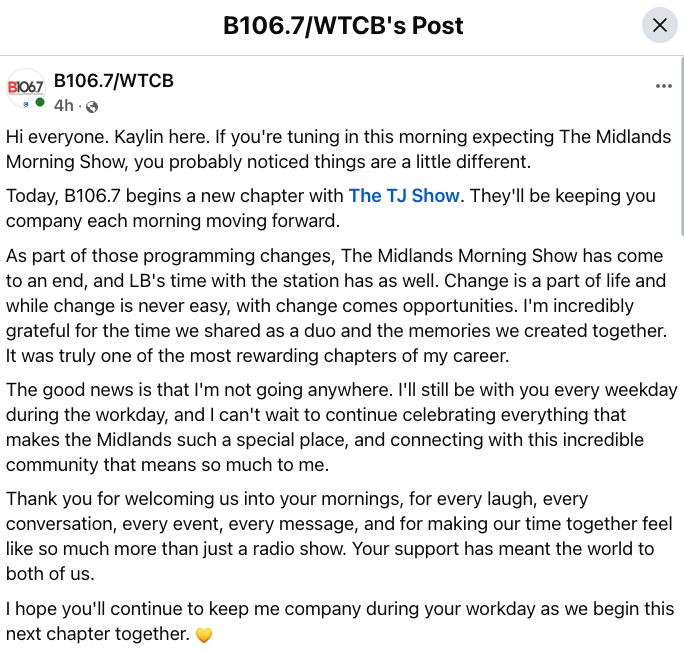
Columbia, SC: Leo ‘LB’ Baldwin is out as program director of 98.5 OMG and B106.7. Baldwin was also a key part of The Midlands Morning Show on B106.7. A Facebook post by the station confirmed Baldwin’s exit. Baldwin joined the cluster as Program Director in June 2023 from Audacy St. Louis where he spent nearly three years as OM/PD for Y98 and 102.5 KEZK. He previously held roles in West Palm Beach, Indianapolis, Philadelphia, and Honolulu.

Detroit, MI: 96.3 WDVD Detroit afternoon host Dave Fuller is out after nearly eight years at the station. Fuller joined the station in January 2019 after previously hosting afternoons on 93.1 Nash-FM. Fuller has also spent time in the market since the early 1990s.

“It was a great run; I had a blast every day and got to do the job I’d wanted to do since growing up listening to the radio in Detroit! Best of luck to my mentor, Cumulus/Detroit OM Mike Wheeler, and everyone at Cumulus Detroit,” said Fuller to Radio Insight.

Fayetteville, AR: Levi Peckenpaugh departs as producer and programming assistant at 92.1 The Ticket in northwest Arkansas. He joined the company in June of 2024 after nearly nine years in Stillwater, OK working for several brands.

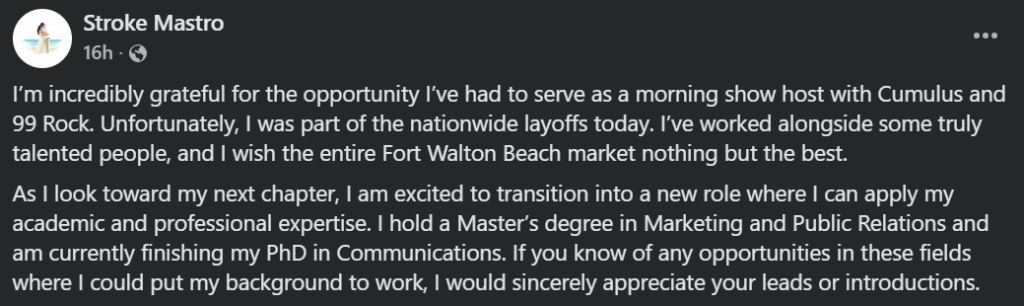
Fort Walton Beach, FL: Stroke Mastro is out as morning host at 99 Rock after two years. He joined the station following a five year run in Sacramento with 98 Rock.

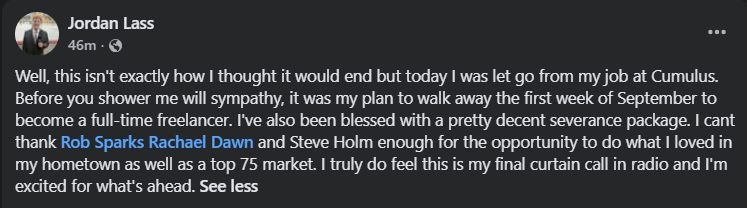
Grand Rapids, MI: Jordan Lass departs as assitant program director of WHTS 105.3 Hot FM and WKLQ as well as hosting afternoon drive on WLAV. He joined in September of 2024 after serving as Brand Manager and PM Driver at Midwest Communications Hot AC WZOX (Hits 96.5)/Kalamazoo until October 2023. He served as PD and afternoon host at iHeartMedia’s Top 40 KOSY (Hot 95.7)/Cedar Rapids and PM Drive at then Alternative KSXA (Alt 106.3)/Des Moines

Lexington: WVLK midday host Larry Glover has exited the news/talk station. He originally joined the station in 2008 before moving to middays in 2017. He also hosted a call-in show following University of Kentucky football and men’s basketball broadcasts. “Regarding Larry Glover, he is no longer with WVLK,” the station published on social media. “Out of respect for Larry and his wishes, we have not made any public announcements regarding his departure. We are sad to see him go, and we know many listeners will miss him as well. Thanks for tuning in.”

Little Rock, AK: McConnell Adams departs his PD role at B98.5 and Alice 107.7 in Little Rock. Adams joined Cumulus Little Rock in September 2024.

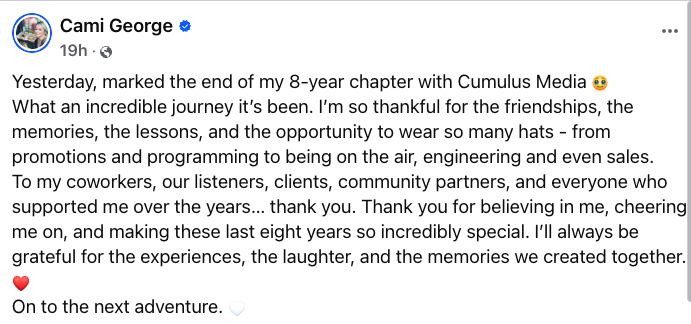
Mobile, AL: Cami George is out as program director / afternoons at 97.5 WABD. She also served as the regional promotions director. George was with Cumulus for 8 years after three years with WYOY in Jackson, Mississippi. She also has experience in West Virginia, North Carolina, Ohio, and New Zealand.

Modesto, CA: Jaimee Lee is out again after her third stint at Cumulus where she served as APD/MD/morning co-host/midday host at Kat Country 103 since 2015.

Nashville, TN: Amy Paige departs midday host duties at WSM-FM (95.5 Country) after four years with Cumulus. Paige previously held the same shift at sister station WKDF (103-3 Country) for three and a half years. Before joining Cumulus Media in 2020, she hosted middays at iHeartMedia’s crosstown country outlet WSIX-FM (The Big 98) for nine years, resigning in October 2020.

Paige’s career also includes six years at SiriusXM, hosting both “Prime Country” and “The Highway,” as well as previous stops at WRQX (Mix 107.3) Washington, D.C.

“I am so grateful for the four years I spent with Cumulus,” Paige said in a Facebook post. “I was given a compassionate and gentle sendoff yesterday. It’s a new year and a new era for me.”

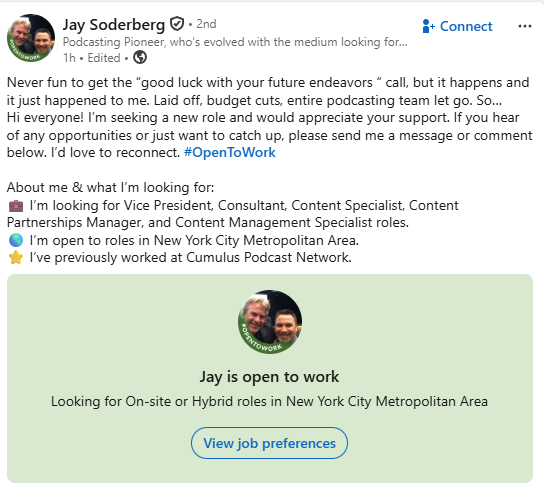
New York City: Jay Soderberg departs his role as vice president of digital programming operations, podcast and digital operations after almost six years with the company.

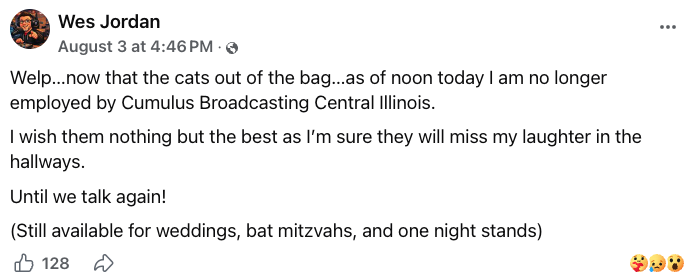
Peoria/Central Illinois: Wes Jordan departs after seven years as Production Director for the Bloomington and Peoria IL markets. He also hosted afternoons on Z92.3..

https://www.facebook.com/share/v/1EnwNSojJ6/

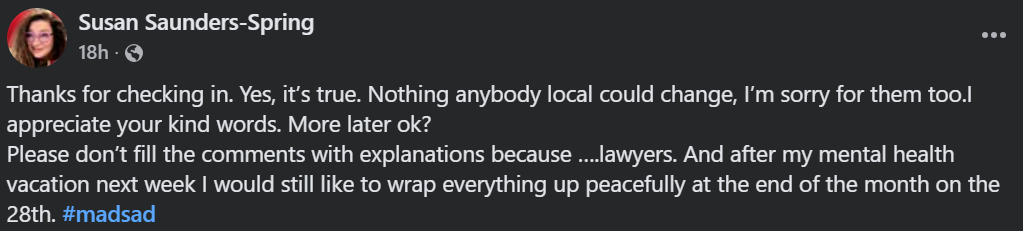
Susan Saunders also departs mornings at WBNQ Bloomington IL after almost three decades.

Blake Haas also departs the market as afternoons/APD and News Director at News/Talk 1230 WJBC.

Shreveport, LA: Anthony Simmons has departed as PD/PMD host at 99.7 KMJJ and PD/middays at 101.1 KRMD. He had been with KMJJ since 2014 and added the roles at KRMD-FM in July 2023.

Barrett Media can also confirm that Senior Vice President of Marketing and Podcasts Carolyn Chauncey has also exited in this round of layoffs.

Barrett Media produces daily content on the music, news, and sports media industries. Sign up for our newsletters to stay updated and get the latest information right in your inbox.

WLS-AM 890 Morning Host Ray Stevens Inks Multi-Year Contract Extension

0

WLS has secured its morning host for the foreseeable future. Ray Stevens has signed a multi-year contract extension with WLS.

What We Know: Stevens has led mornings on WLS-AM 890 since June 2024, when he succeeded Steve Cochran following Cochran’s exit from the station. Now, the Chicago news/talk outlet has committed to keeping Stevens in place with a new multi-year contract extension. Since taking over the morning drive slot, Stevens has worked to establish his own identity while emphasizing local coverage, community involvement, and personality-driven conversations. As a result, the extension provides stability for one of the station’s most important dayparts.

What They Said: “This is the little morning show that can. We work hard to be out in the community, and our content is both focused and fun. I’d like to thank my ride or die, Nick Gale, for making every day an adventure. I’d like to thank Tom Hush for being the best producer in the universe, and Michael Garay for his crazy knowledge of Chicago and his amazing radio skills. Last but not least at the top of the list is Marv Nyren, GM of our Chicago and Minneapolis cluster. I know as a host I can be a handful, but he’s always there to support my crazy ideas. I love Chicago radio and I love WLS.” -Ray Stevens

What Remains Unclear: The station hasn’t disclosed the length of the new agreement beyond confirming it’s a multi-year extension. Additionally, WLS hasn’t shared whether the deal includes expanded responsibilities for Stevens outside of his weekday morning program.

What It Means: Morning drive remains the cornerstone of spoken-word radio, so retaining an established host carries significant value. Furthermore, the extension gives WLS continuity in a competitive Chicago market while allowing Stevens and his team to continue building on the foundation established over the past two years.

Barrett Media produces daily content on the music, news, and sports media industries. Sign up for our newsletters to stay updated and get the latest information right in your inbox.

PGA Tour CEO Brian Rolapp Adds Former NFL Executive Will Deng as SVP Media Strategy

0

PGA Tour CEO Brian Rolapp has added to his ranks with a familiar face from his days in the NFL. According to the Sports Business Journal, Will Deng will shift from his role at the NFL to a SVP or media strategy role with the Tour.

What We Know: The PGA Tour keeps raiding the NFL’s front office. Will Deng, the league’s former head of corporate strategy, is joining as SVP/Media Strategy. Deng spent more than 11 years at the NFL, most recently leading corporate strategy. The hire continues Brian Rolapp’s overhaul of senior leadership, following moves like Dhruv Prasad and Paul Hicks. He’ll report to EVP/Media Norb Gambuzza, and additional senior hires from across sports are expected soon.

What’s At Stake: With the PGA Tour’s media rights running through 2030, the Tour reportedly plans to go to market beginning next year. With Deng in place with the PGA Tour, that adds another weapon to the arsenal for Rolapp who hasn’t been shy about of the upcoming NFL media rights agreements could play with who the Tour approaches.

What Remains Unclear: It’s unknown if the PGA Tour will add more to their roster following some departures due to February’s 4% staff reduction.

What It Means: Deng arrives as the PGA Tour approaches a critical media crossroads. The Tour’s timeline collides with major structural changes starting in 2028 and a possible NFL rights renegotiation along with MLB’s media rights also coming up in 2029. According to reporting, Deng’s tri-cast experience, built with Twitter/X and Amazon, could prove directly relevant as the tour maps its next deal.

Barrett Media produces daily content on the music, news, and sports media industries. Sign up for our newsletters to stay updated and get the latest information right in your inbox.
Kennedy Elsey Wins 2026 MIW Airblazer Award

0

Kennedy Elsey accepted broadcasting’s most prestigious women’s honor yesterday. The MIX 104.1 Boston co-host now joins an elite group of industry leaders.

What We Know Kennedy, co-host of the Karson & Kennedy morning show, received the MIW Airblazer Award during the Talentmasters MSBC Luncheon in Cleveland. The honor recognizes women driving meaningful impact in radio and their communities. Previous award winner Karen Carson selected Kennedy for the distinction. The award has recognized female radio excellence since 2015.

What’s at Stake This award highlights radio’s commitment to advancing female leadership. Female radio personalities continue shaping broadcast media’s future. Industry recognition elevates women’s contributions to mainstream conversations. Awards like the Airblazer inspire the next generation of female broadcasters.

What Remains Unclear We don’t yet know who will nominate next year’s recipient. The MIW hasn’t announced plans to expand the award’s reach. Future initiatives to support female radio talent remain undisclosed. Additional partnerships beyond Talentmasters MSBC could emerge.

What It Means Kennedy joins an impressive lineage of honorees spanning a decade. The recognition underscores Boston radio’s continued prominence in national conversations. This signals MIW’s expanded focus on major market personalities. Her selection reinforces that women’s voices matter in broadcast media.

The Airblazer Award’s recipient list includes Delilah (2024), Dana Cortez (2023), Patty Steele (2022), and others. Each honoree championed radio while making tangible community differences. Kennedy’s selection reflects her years building Boston’s media landscape. The award validates her influence beyond traditional ratings measurements.

Barrett Media produces daily content on the music, news, and sports media industries. Sign up for our newsletters to stay updated and get the latest information right in your inbox.