VICE TV will bring back one of its sports debate-driven programs later this month when The Verdict, hosted by Christopher ‘Mad Dog’ Russo, returns for a five-episode second season beginning Tuesday, March 24 at 9 p.m. ET/PT.
The series, which blends documentary storytelling with spirited debate, places Russo alongside a panel of sports insiders, reporters and analysts who examine some of the most polarizing arguments in sports history. Each installment explores the competing perspectives behind well-known debates, combining statistical evidence, historical context and firsthand reporting before Russo ultimately renders his final judgment.
While the inaugural season focused primarily on football-related questions, the upcoming slate broadens the conversation across several major sports. Producers say the second season aims to present a wider variety of legendary matchups that have fueled arguments among fans for decades.
“Sports fans have argued about these topics for decades — in bars, on radio, at family dinners,” Russo said. “These debates define eras. We’re breaking it down — history, numbers, context, all of it — and at the end of the hour, I’m giving you a verdict.”
The season premiere will feature a comparison between baseball icons Babe Ruth and Shohei Ohtani. Subsequent episodes will examine heavyweight boxing legends Muhammad Ali and Mike Tyson, golf greats Jack Nicklaus and Tiger Woods, and the athletic versatility debate between Bo Jackson and Deion Sanders.
The season finale will shift to tennis, evaluating the legacy battle among Roger Federer, Rafael Nadal and Novak Djokovic.
“We’re thrilled to bring back The Verdict with a broader lens on the most polarizing debates in sports,” said VICE TV President Pete Gaffney. “Mad Dog doesn’t sit on the fence – he forces the conversation forward – and this season the arguments are bigger, the stakes are higher, and the debates are fierce.”
Russo’s involvement also brings decades of sports media credibility to the series. The longtime radio personality earned a place in the Radio Hall of Fame after helping popularize the sports talk radio format during a career that now spans more than four decades.
In addition to hosting The Verdict, Russo currently serves as a recurring contributor on the First Take on ESPN, where segments such as “What Are You Mad About?” and “Mad Dog’s A-List” frequently generate significant social media engagement. He also hosts Mad Dog Unleashed each weekday afternoon on SiriusXM’s Mad Dog Sports Radio channel.
The program debuted in January 2025 on VICE TV with an episode examining the impact of Tom Brady and Bill Belichick during the New England Patriots dynasty.
Barrett Media produces daily content on the music, news, and sports media industries. Sign up for our newsletters to stay updated and get the latest information right in your inbox.
710 WOR has announced it is pairing Curtis Sliwa with Larry Mendte in morning drive on the iHeartMedia New York news/talk station.
The duo will begin hosting Curtis Sliwa and Larry Mendte in the Morning beginning on Monday, March 9th. The show will be heard from 6-10 AM. Natalie Vacca will serve as the Executive Producer of the new program.
Curtis Sliwa joins 710 WOR after a lengthy career in New York news/talk radio. Most recently, he helmed a variety of roles at rival 77 WABC before departing the station in an effort to seek the office of Mayor in New York. He has vowed to never return to his longtime home after the way he was treated by hosts and owner John Catsimatidis in the run up to the 2025 mayoral election.
“It’s been four months since the end of the New York City Mayoral election and most places I go people have asked me to come back to talk radio, so that’s what I’m going to do,” said Curtis Sliwa. “I’m going to the best radio station in New York City, joining my friends of 30 years, Mark Simone and Sean Hannity. It’s a full circle moment for me as my first radio station appearance for me was in 1971 when WOR’s Arlene Francis interviewed me as a kid, and I’ve been talking on the radio since.”
Larry Mendte has been with 710 WOR since 2023.
“I couldn’t be more excited,” said Mendte. “Curtis is not only a legendary talk radio host, but an iconic New Yorker. What an honor to get to team up with him to get New Yorkers started every weekday.”
“Curtis is a true New York original. His passion and knowledge of the city, combined with Larry’s incredible journalistic background, make them the ideal team to wake up New York,” said 710 WOR Program Director Tom Cuddy. “We are thrilled to have this powerhouse duo leading the morning charge for WOR.”
Barrett Media produces daily content on the music, news, and sports media industries. Sign up for our newsletters to stay updated and get the latest information right in your inbox.
On Wednesday morning, 77 WABC morning host Sid Rosenberg issued an apology for recent social media posts he made attacking New York City Mayor Zohran Mamdani.
Earlier this week, in a post on X, Rosenberg called Mamdani a “Radical Islam cockroach” and a “Jihadist America hating Mayor” while urging President Donald Trump to stop meeting with and speaking positively about the newly elected New York mayor.
Many took issue with Sid Rosenberg’s comments. The New York chapter of the Council on American-Islamic Relations called for Rosenberg’s show to be cancelled. Gov. Kathy Hochul (D-NY) labeled the comments as “hateful, racist, and disgusting” and said that it was “dehumanizing language.” Sen. Chuck Schumer (D-NY) called the comments “a disgusting display of bigotry and Islamophobia that should receive universal condemnation.”
While responding to a reporter’s question about Rosenberg’s statements, Mamdani said he wasn’t surprised.
“This language is both painfully familiar to me as a Muslim New Yorker, but also as someone who was born in east Africa,” Mamdani said. “It is difficult to hear.”
On Wednesday morning, Rosenberg issued an apology for his remarks.
“To the mayor, and anyone else that I offended with my tweet on Saturday, I send out a heartfelt apology,” Rosenberg said in the statement.
The comments from Sid Rosenberg came after he returned to the X platform following a lengthy suspension for unspecified reasons. He subsequently deleted his post with the disparaging remarks to Mamdani.
Barrett Media produces daily content on the music, news, and sports media industries. Sign up for our newsletters to stay updated and get the latest information right in your inbox.
NBC Sports has selected one of the most respected voices in modern sports broadcasting to guide its return to Major League Baseball coverage. Veteran play-by-play announcer Jason Benetti has been tabbed to serve as the network’s lead voice when it re-enters the national MLB television landscape this spring.
Front Office Sports was first to report that Benetti will handle play-by-play for NBC’s revived baseball coverage. His debut is scheduled for March 26. The defending champion Los Angeles Dodgers will host the Arizona Diamondbacks in a nationally streamed matchup.
The game will air on Peacock as part of the company’s renewed push into Major League Baseball, marking the first step in what NBC hopes will become a consistent Sunday night destination for the sport.
“After Jason finished the 2022 baseball season with us, we told him that if we ever got MLB back, he’d be our first call,” said Sam Flood, NBC Sports Executive Producer. “Jason is one of the best play-by-play announcers in the business and we’re thrilled to have him back on a full-time basis with NBC Sports, beginning with Sunday Night Baseball.”
The assignment represents another significant milestone for Benetti, whose broadcasting career has expanded steadily across multiple networks and sports properties. Over the past several years, he has built a reputation as one of television’s most versatile and energetic play-by-play announcers. He developed that reputation through roles with FOX Sports, ESPN, and regional baseball broadcasts.
“I am thrilled to be rejoining the NBC Sports family,” Benetti said. “Rick Cordella, Sam Flood and the whole team at NBC all have a deep appreciation for live sports. It’s a true honor to be part of the dawn of Sunday Night Baseball at NBC Sports. Each week is going to be a new, unique experience with analysts who all have different viewpoints on the game of baseball.”
Benetti currently serves as the television voice of the Detroit Tigers and previously held the same role with the Chicago White Sox, gaining widespread praise for blending storytelling, analytics and personality into modern baseball broadcasts.
Benetti had been rumored for months as a top contender to join the network’s roster for MLB play by play. When FOX Sports recently announced their World Baseball Classic announcer pairings, Benetti’s name was a glaring omission. According to sources, the regular season MLB schedule for FOX’s coverage had yet to be finalized but Benetti had been working for the network calling college basketball.
NBC plans to build its coverage around Benetti. The network will pair him with a rotating group of analysts from local team broadcasts. Benetti remained under contract with FOX Sports. However, Front Office Sports reports that FOX allowed him to exit early to accept the NBC opportunity.
His departure does not affect his ongoing role with the Tigers, where he continues to handle play-by-play duties on regional television.
The move also reunites Benetti with NBC programming. He previously contributed to the company’s baseball coverage during the sport’s streaming era. In 2022, he called games for Peacock’s MLB Sunday Leadoff package. The broadcasts were an early attempt to experiment with exclusive streaming coverage. One year earlier, Benetti also served as a play-by-play announcer during coverage of the 2020 Summer Olympics in Tokyo.
Barrett Media produces daily content on the music, news, and sports media industries. Sign up for our newsletters to stay updated and get the latest information right in your inbox.
Radio loves two words more than any others: live and local. It’s on the website. It’s in the sales deck. And it’s the crutch of CEOs in press releases and on banker calls.
But the second the live and local community actually talks back about something they disagree with, many stations disappear (granted, they disappear live and locally).
Listener outrage used to live in phone calls, emails, and faxes. Now the listener talks back publicly on social media. And with too many C-suite seat fillers who don’t even have a profile photo, or follow their own stations, there’s a dangerous illusion that very little negative feedback exists.
Meanwhile, they are missing the love letters the airstaff sees every time a station posts, “excited to bring you something new.”
Common comments look like this:
“You ruined this station.”
“Bring back the old format.”
“This new show sucks.”
“I’ve listened for 20 years. I’m done.”
“I’m listening to your competitor from now on.”
“I’ve removed you from my presets.”
“Thank God I have Apple Music and Spotify.”
Every complaint now lives in public. Every non-response also lives in public. And every defensive reply lives in public. Every station says it exists to serve the public. But do they?
Program directors were trained to schedule clocks, come up with promotions that rhyme, and plaster their logos everywhere, a strategy I have never fully agreed with. They were not trained to manage conflict in front of an audience.
Market managers were trained to protect revenue, negotiate vehicle trades for the DOS, and hope the DJs do not find out. They were not trained in public diplomacy.
So the local market freezes and hopes corporate will handle it. Corporate stays quiet because they do not understand the nuance of the change. Now, both the local station and the company look indifferent.
You cannot celebrate the community in the studio and then ignore them on social media. Listeners see it instantly. And part of what makes radio uncomfortable is this: the audience now has its own media. But that is a Barrett column for another day.
Silence Is a Bad Strategy. Let Me Help.
The first day after a major change is announced is not the time to hide. It’s the time to monitor, assess tone, and make a statement. Something simple works:
“We hear you. Change is never easy. We appreciate everyone who has been part of this station’s story, and we are excited about what’s ahead.”
Handled correctly, negative feedback can deepen loyalty. When listeners see thoughtful responses, even critics soften. Most negative comments are not asking for blood. They’re asking for acknowledgment.
When someone writes, “I hate this format change,” they’re not filing a lawsuit. That’s more of a Cumulus or Nielsen situation. They’re grieving familiarity. And when someone says, “you don’t listen to your audience,” what they really mean is, “I don’t feel heard.”
Having made changes at hundreds of stations, across dozens of formats, in multiple countries, I have found one approach that works almost every time.
Use the acronym L.A.S.T.
Listen.
Ask.
Solve.
Thank.
It is simple, human, and easy to remember. Kind of like “Free Ticket Friday.”
What Gets a Response and What Does Not
Not everything deserves your attention. Personal attacks, profanity, and obvious trolling can sit untouched.
But high-visibility posts should be managed in the first 24 hours. That does not mean replying to every comment.
If five or more comments raise the same concern, respond publicly once. Not individually. One visible acknowledgment shows enough awareness without turning into a debate.
Training Day. No Denzel.
Most radio managers were trained to protect ratings and revenue. They were not trained for public conflict in front of an audience.
Yet every format flip, personality exit, or controversial segment now triggers a public trial in the comments section. And the station shows up unarmed. No guidelines. No tone strategy.
You would never put a new morning show on air without coaching. You would never launch a sales rep without training. But we routinely allow managers to represent the brand publicly with zero preparation.
Training should include:
How to acknowledge frustration without admitting fault.
How to separate trolls from longtime listeners, although depending on how long they have been listening, they may look like trolls.
And how to escalate real issues internally before they become external narratives.
Remember once a defensive reply is posted, it lives forever. Once a sarcastic tone slips through, it becomes a screenshot, it becomes a story.
Every station should appoint someone responsible for digital community management. Not an intern. Not the promotions assistant juggling remotes. Someone trained in tone, someone who writes well, and someone who knows what to acknowledge, what to ignore, and what to never type.
If You Cannot Handle the Comments, You Cannot Handle the Job
Ignoring comments does not make them disappear. It turns them into Reddit threads. It turns them into revenue risks.
Always remember: clients also read the comments.
A local advertiser sees, “you ruined this station,” followed by, “why won’t anyone respond?”; then that client calls the sales rep, “what’s going on over there?” The rep has no script. The manager has no statement. The station has no plan. All of a sudden, both ratings and revenue are at risk.
If you are going to say live and local, you have to be live in the local conversation at every touchpoint. The lobby. The front desk. The comments.
Community does not only exist when the mic is on. It continues when you hit reply.
Say something.
If that fails, go with shrugging emoji.
Barrett Media produces daily content on the music, news, and sports media industries. Sign up for our newsletters to stay updated and get the latest information right in your inbox.
For every headline claiming sports radio is in decline as more content players invade the space, there are always studies that provide stability for the industry as a whole. Each year, the research team at Cumulus Media and Westwood One, led by Chief Insights Officer Pierre Bouvard, offers a glimpse into the continued power sports radio still holds.
Last month, Bouvard and his team released another study finding that sports radio on the AM/FM dial remains a dominant force. The study showcased the format across every metric, from increases in streaming audience and revenue shares to the number of stations nationwide. Much of the growth in sports radio has occurred as more stations move from the AM band to FM simulcasts.
“Ten percent of all American radio listening is going to AM. Ninety percent goes to FM,” Bouvard pointed out. “Let’s say you had a small store in a small mall. Then there’s this other mall that’s nine times bigger than your mall. Wouldn’t you want to have a store in the bigger mall with nine times the amount of people in it?”
For Bouvard, the argument is simple. If sports radio stations continue operating where engagement is limited on the AM band, the path to growth becomes more challenging.
“Music formats come and go. A strong sports brand lives forever,” noted Bouvard. “There is so much new breaking news every day in the world of sports. It’s not playing ‘Stairway to Heaven’ again. Literally, every time you tune in there is something new going on.”
According to Bouvard’s latest project, sports-formatted AM/FM radio stations have grown 14% over the past decade. With more opportunities to capitalize on local talent and expanded inventory, associated revenue has grown in line with the increase in stations. The findings show that revenue shares for sports-formatted stations have also risen — by an astounding 38%.
Another reason companies continue to believe in the power of sports lies in the consumption habits of the sports audio audience. Bouvard’s latest findings state that sports AM/FM radio ranks as the top streaming format among Persons 18–34 and Persons 25–54. Those figures represent nearly four times the total share when over-the-air AM/FM listening is included.
As sports podcasts have risen during the same period, Bouvard acknowledged that podcasting may have taken some share from total time spent listening to sports audio. However, he credits sports radio for adapting to platforms where podcast audiences live.
“Think of podcasts not as something new, it’s just on-demand. It’s giving me the thing I love and when I want it,” explained Bouvard. “That’s a gift to sports radio because we have talent and content people love and want. Making that available is just making what they want and placing it in places when they want it.”
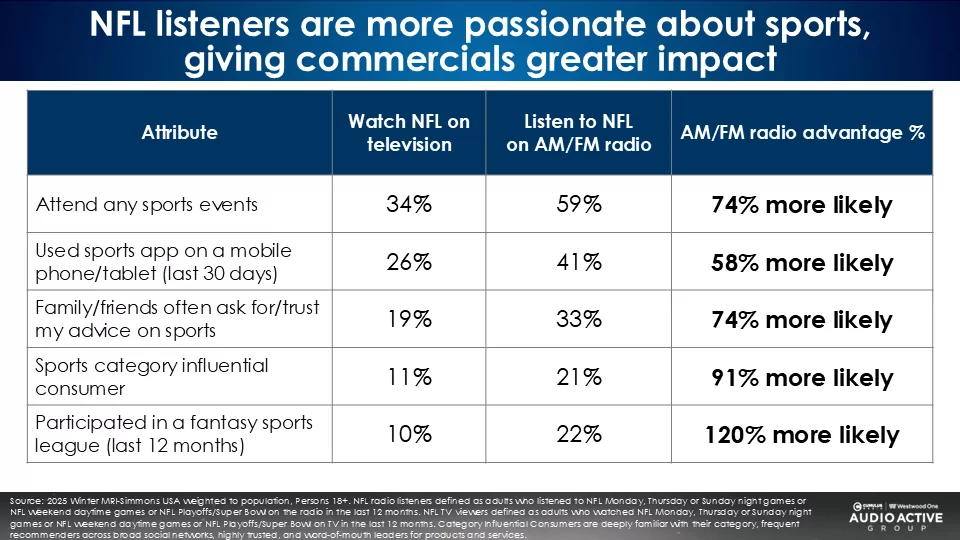
From an advertiser’s standpoint, engagement is where sports radio outshines its competition. Bouvard’s latest research indicates that sports AM/FM listeners engage more actively with advertising. By contrast, sports television viewers tend to consume content more passively. The findings suggest radio audiences lean in. That behavior can translate into deeper interaction with brand messages.
“The rule of thumb is when your ad is playing on television, 25% of the time that ad is playing to an empty room. About 25% is playing to a room with eyes not on the screen. The other 50% when your ad is playing is there someone in the room looking at the TV,” explained Bouvard. “TV is about sight, sound, and motion. You’re only getting that half the time with TV. With sports radio, it’s ears on. With the Nielsen meter, you need to be ears on all the time at an audible level. That’s why advertisers who use sports radio find it works really well for them.”
A significant reason for this advantage is the human-to-human connection sports radio provides — something television viewing often cannot replicate.
“People crave people. Hearing someone’s entertaining voice, we crave that as people. I think sports radio attracts people, and people pay more attention to people,” noted Bouvard. “90% of people commute by car in America alone. That’s a little lonely. But you turn on a sports station and immediately you’re with this fun family of people in the car with you. That’s why advertising works so much better on sports radio.”
That connection, along with the relatively low barrier to entry in the format, helps explain why Bouvard remains confident in its stability despite continued advancements in artificial intelligence. As AI evolves into an everyday tool for media consumers, some question sports radio’s long-term viability. However, Bouvard pointed to similar concerns raised in the past when new technology emerged.
“Remember all the hype in 2017 around ‘Alexa?’ Someone made the prediction that two-thirds of all search will be made through Alexa by 2020. People rarely ask Alexa anything anymore,” said Bouvard.
FOX Sports recently announced its ‘Sports AI with Colin Cowherd,’ a tool that offers users a real-time, on-demand experience with a personalized approach from one of sports radio’s biggest talents. The platform allows immediate engagement, which could reduce the desire to hear the same take repeated if AI can deliver it instantly.
Still, Bouvard believes the technology serves as a complement rather than a replacement.
“Sometimes we see these interactive things as something that people will spend a ton of time with. The reality is we, as people, don’t want to work that hard to be entertained,” said Bouvard. “I can turn on a sports radio station and they entertain me. Day in and day out to use an AI tool to talk to ‘Colin Cowherd, that’s a lot of work. That was the issue with Alexa. We all way overthought what its impact would be. I have no anxieties about Colin Cowherd AI eating all of sports radio.”
The research also provides insight into the sports AM/FM radio audience — one that advertisers actively seek. Findings show a more engaged listener with rising average annual income and stronger interest in major purchasing categories such as automotive, travel, and investments.
With more disposable income and a willingness to spend, the research further indicates that engaged sports AM/FM listeners also enjoy betting on the games they follow. In 2025, the sports betting industry reached a record $16.96 billion in revenue, according to the American Gaming Association.
Bouvard offered caution to programmers and sales teams when interpreting this data. While the figures show above-average interest in sports gambling, stations should avoid adopting an all-in betting strategy without first understanding their specific audiences.
“You want to do a little listener research on your station first. What percent of your audience bets on sports weekly, occasionally, and so on. Every station will be different. People are listening for any number of reasons,” said Bouvard. “The top reason why people listen is to be entertained. We’re not bookies and a tip machine on sports radio. We’re in show business. We need to be careful that we’re here to put a smile on people’s faces and not get obsessed about super serving the frequent sports bettor.”
The future of sports AM/FM radio remains unclear, but its present state shows promise. As station counts, revenue shares, and streaming audiences continue to grow, Bouvard’s latest research suggests sports radio is one of the few formats expanding within the industry today. His roadmap demonstrates that audiences are growing, engaging more deeply than television viewers, and earning higher incomes — positioning them as consumers ready to spend.
That combination makes sports radio a destination advertisers should consider investing in, driven by the power and passion of the sports fan.
“Sports radio’s core mission is to entertain and put on a show,” noted Bouvard. “Sports is the great equalizer. We share our passions no matter our work or backgrounds. That’s the cool thing about sports. It’s not a class thing, it’s just something that’s very entertaining to all people. We need to be where the people are. If it’s FM, podcasts, YouTube, we need to be there. The good news is sports radio content works well in all those different platforms.”
The numbers from Pierre Bouvard and the Cumulus Media research team do not reflect a format in decline. Instead, they depict a format that understands its audience — one that knows where listeners are heading and meets them there, whether on FM, on-demand, YouTube, or during a solo commute home.
Sports radio’s power has never been about the signal. It has always been about the connection. As long as sports fans crave trusted voices, authentic conversations, and personal entertainment, sports radio will continue to earn its seat at the table.
If the latest research offers any indication, that seat is not shrinking. It is expanding.
Barrett Media produces daily content on the music, news, and sports media industries.Sign up for our newsletters to stay updated and get the latest information right in your inbox.
You can’t question the appeal of nostalgia. People love remembering “the good ol’ times” as they continue to age with every passing day. The memories made in high school. That awesome track heard on the radio before they became your favorite band and made it big time. Watching Michael Jordan push (yes, push) Bryon Russell in Game 6 of the 1998 NBA Finals to bury “the shot,” sending Chicago to its sixth NBA championship on NBC Sports.
The moments where you remember where you were, what you were doing, and who you were with while sharing that experience that has lived in your memory forever. NBC Sports has done a masterful job this season with its broadcast re-entry into the NBA, piecing together what the next generation will look and sound like while dipping into the nostalgia of the past.
Last night, NBC Sports celebrated that past with an all-in approach to a classic NBA on NBC broadcast. A throwback with Bob Costas returning to the NBA call for the first time in over two decades. The nod was executed perfectly, albeit as a throwback to an imperfect past with little to no graphics value or high definition. It made me wonder why more networks don’t do the same. Would a nod to the past with these broadcast teams pull in viewers like this NBC Sports one-night journey back to the future?
The sports broadcast landscape today has changed significantly since the days when I grew up watching my heroes on a bubble screen. I remember watching my first World Series on a black-and-white television. My children have no concept of that, and they can’t imagine a television presented without color or high definition.
Games are no longer found solely on traditional networks as rights shift to streaming platforms. Still, the memories of the past remain strong. That is why NBC Sports chose not only to educate viewers but also to remind them of its history. The network celebrated its role during one of the sport’s greatest eras.
Every aspect of NBC’s throwback broadcast worked, with commentators who had no ties to competing networks. Costas was the only member of the talent pool still signed to NBC Sports. That works in many respects, especially because networks don’t have to coordinate approvals for cross-network talent sharing.
That’s why a throwback broadcast is as much a rarity as a flawless one.
However, the reality is people pay attention. If done correctly, the opportunity could benefit everyone. Networks that share their talent. The leagues, with added viewership. And the broadcasts themselves, which become more of a shared experience at a time when some sports are losing that value each season.
I hoped to see a throwback of sorts this past month when NBC hosted the Winter Olympic Games. Kenny Albert deserves his moment in the spotlight for the effort he put in. Would it have been too much to include a Doc Emrick appearance during a Team USA game in the prelims with his broadcast partner, Eddie Olczyk?
No pairing since Gary Thorne and Bill Clement has meant more to hockey than “Eddie and Doc” on NBC Sports. The majesty of hockey puns and lighthearted jabs mixed with the stellar analysis that Olczyk has brought to hockey fans for years, both on local and national broadcasts. That chemistry is hard, if not impossible, to replicate. For everything NBC Sports has done well by leaning into nostalgia with the NBA, I felt it missed a golden (hockey pun) opportunity with Doc’s absence from the Winter Games.
If Joe Buck is serious about returning to call baseball games, why not do a one-off for an MLB signature event? The MLB at Field of Dreams Game feels like a logical choice. That is especially true if Netflix becomes the broadcast home. Like other Netflix productions, the streamer could license Joe Buck from ESPN and John Smoltz from FOX Sports. They could stage a turn-back-the-clock broadcast at the place where fans ask, “Is this heaven?”
Jon Gruden has experienced a resurgence in fan approval and popularity since resigning as the Las Vegas Raiders coach in 2021 following an investigation that found he used racist, misogynistic, and homophobic slurs in emails to other league personnel. Would it be out of the realm of possibility for a reunion with Mike Tirico? Gruden and Tirico on Monday Night Football were must-see television. The symphony of play-by-play elegance meeting the heavy-metal energy and football IQ of an electric Gruden. That pairing, even on an off night, could leave America waiting all day for Sunday night.
Regarding NBC, Costas hinted during an appearance on 94 WIP that the throwback broadcast may not be a one-and-done. If that’s indeed the case, Marv Albert must make his play-by-play return alongside Doug Collins. For a network that has leaned into nostalgia as much as it has, the only missing element from the broadcast was Albert’s voice. Even for a quarter, a half, or a single series. The dulcet tones of “from downtown” would be in demand if the network makes another attempt.
Finally, what would college football be without one more broadcast of SEC football with Verne Lundquist and Gary Danielson? Both now call retirement home, but is there any better duo in the booth that defined SEC football more than Verne and Gary? My hope is that, just once, any network with a partnership featuring SEC Saturdays takes one more trip down memory lane with two voices that defined a generation and introduced audiences to the magic and pageantry that SEC football brings each fall.
Maybe that’s the real takeaway.
Nostalgia isn’t about living in the past. It’s about reconnecting with the feeling the past gave us — the soundtrack, the voices, the pacing, the shared experience that made sports feel bigger than the screen in front of us. In an era where broadcasts are sharper, faster, louder, and more fractured than ever, a brief return to something familiar can feel revolutionary.
NBC proved that the appetite is there. Not because the graphics were simpler or the presentation was stripped down. But because, for a few hours, the broadcast trusted the power of voice, rhythm, and memory. It reminded viewers that great sports television isn’t just about access — it’s about atmosphere.
The industry spends so much time chasing what’s next — new platforms, new angles, new metrics — that it sometimes forgets what worked. A well-timed throwback isn’t regression. It’s perspective. It tells longtime fans, “We remember, too.” And it introduces younger viewers to why those moments still matter.
That doesn’t mean every week should be a reunion tour. Scarcity gives nostalgia its value. But once in a while, let the past shake hands with the present.
Because sports, at their best, are communal memory. And when a broadcast can tap into that — even briefly — it doesn’t just air a game.
It creates another moment we’ll remember where we were when we watched it.
Barrett Media produces daily content on the music, news, and sports media industries. Sign up for our newsletters to stay updated and get the latest information right in your inbox.
Ranked #16 in a mid-sized market by Barrett Media, Gee Scott, host of Gee and Ursula — the midday show on KIRO Newsradio 97.3 — was shocked and humbled to hear the news.
“It feels great to be recognized for anyone when you go to work,” Scott told Barrett Media. “I think everyone loves some type of appreciation and acknowledgment. So I’m humbled and grateful to hear the news.”
High accolades aren’t changing any of Scott’s future plans. Two years ago, he told Barrett he wouldn’t leave the Seattle area, and now more than ever, he believes local is what is most important to focus on. “When you start talking about local, that’s what truly matters,” Scott professed. “So when you’re thinking about why there isn’t a stoplight in your neighborhood — and it would be better for safety reasons if they had the stoplight — well, the national news and the federal government don’t take care of those things.”
He added, “So you’re talking about school budgets — that’s a local thing. Basically, 95% of things that really impact us are things that happen on the local level. And so I think it is important to be a part of the conversations centered around local media.”
But with this in mind, Scott recognizes there is a much larger responsibility than when he began in the sports media realm 12 years ago. “When you start getting to news and you start having topics, you realize that in sports, hot take is awesome. Right? In news, hot takes — you have to be more careful about that because words have power.”
Using this power carefully, Scott’s show does have one major issue on the minds of Seattleites: affordability. “I believe that UBI — I definitely believe it’s possible and I definitely believe that that is the answer to things. I know me, look, for 15 years of my adult life, I was financially poor. I was broke. I was poor.”
His passion resonates with many of his listeners. “Some people just say, well, all you got to do is work hard. Well, I was working hard too, and I just couldn’t catch a break until I did. And when I did catch a break, my life changed, right? And so then I was able to make money and then I was able to get other jobs and do all these different things.”
Scott added, “So now I make great money today. And guess what? For some reason, I don’t have the problems that I did years ago. So it’s not like I had to read an economic book to teach me these things. I know this firsthand. I know how much money fixed my life.”
This is why Scott is more reluctant to offer his hot take with the news and instead offers something far better. “When you’re talking about the homelessness crisis and drug crisis and you’re talking about a global pandemic and you’re talking about housing affordability, these conversations really matter. It’s not really about the hot take. It’s more about the conversation that gets facilitated and how can this conversation help push things along?”
Meaning a good show for him has three things:
“First, did the show inform? Great — got you the information, told you about it.
Second, did we have an opinion about that conversation? And in that opinion, what type of sources did we have and what type of experience did we have to help people better understand the conversation at hand?
Third — and this is probably the most important part — can you make it a way for all of the information that they got, all of the examples that they got, did the show entertain?”
The morning drive host noted entertainment is the most important because shows “got to be loose and fun and you almost want to bring a conversation that you’re having with your loved ones — whether it’s a family get-together or a happy hour — and you got to be able to do that same thing with a radio show. So when someone’s listening to it, they might hear something that they don’t agree with. They don’t agree with the opinion that’s being given. Great, awesome, right?”
Gee Scott appreciates the callers he and Ursula get that don’t agree with him because, “Think about that for a second. I mean, we’re at a time where you can spend your time anywhere. You can get on YouTube, you can get on Spotify, you can get on IG. There are so many places you can go so that you can hear people that you agree a thousand percent with.”
Later reasoning, “But what does it mean for you to be someone who just listens to somebody that you don’t agree with? Those are potentially change-makers in the world. Someone who’s willing to step outside of their bubble. So it means the world to me when that happens. I love it when people get on there and they don’t agree with me.”
Gee Scott struggled with imposter syndrome for a long time, and for young people who are struggling with this, he found his greatest strength is what he once thought was his biggest weakness. “My weakness that I thought I had is I never went to school for this stuff. I never trained for this stuff. I didn’t really have an understanding of this stuff. And I think that that weakness that I thought was a weakness was actually my greatest strength because I don’t sound like other people.”
“The good Lord only made one of you. There’s 8 billion people on the planet. Only you — there’s only one you. To the youngster that had that imposter syndrome, stop trying to be like all the other people.” He went on to declare, “There’s two things that you can do to literally stay on top. One, be yourself. Two, work hard. That doesn’t change. If you can just focus on those two things, you win.”
But it is easier said than done. Gee Scott believes this is because, “It is harder for us to be ourselves than we want to admit because we’re trying to go along and get along. We try to do things a lot of times. We spend a lot of time trying to make people happy.”
Scott added, “Right now, lately, is probably the best time in my job I’ve ever had because I’m being myself. I’m authentic.”
Barrett Media produces daily content on the music, news, and sports media industries. Sign up for our newsletters to stay updated and get the latest information right in your inbox.
Dan O’Donnell of 1130 WISN found himself in hot water this week after recent comments on social media sparked backlash. That’s not exactly a rare occurrence in 2026.
It feels like every month, another host is apologizing, clarifying, or doubling down on something posted in the heat of the moment.
For many in news/talk radio, there’s this nagging belief that you have to be “on” 24/7, 365. If you’re not firing off takes on social media, someone else is. And if someone else is louder, angrier, or more outrageous, they’ll win the algorithm.
Here’s the uncomfortable truth, especially on X: if you’re not ragebaiting or being controversial, your stuff probably isn’t getting seen. Thoughtful nuance rarely goes viral. Measured responses don’t generate quote tweets. The machine rewards outrage, point-blank. That reality creates a dangerous incentive structure for hosts whose job already requires them to walk a rhetorical tightrope for three or four hours a day.
It’s easy to understand the pressure. You build a brand on strong opinions. Your audience expects you to have a take. Silence can feel like weakness. There are often posts that go viral pointing out who has or hasn’t spoken out on a topic yet.
But there’s a massive difference between delivering a prepared monologue on 1130 WISN and firing off a tweet in 45 seconds because you’re afraid of missing the moment.
Many hosts convince themselves that if they don’t weigh in instantly, they’ll be forgotten. They think listeners will assume they’re ducking the issue. They worry a competitor will “win” the topic online. To be frank, I’ve always viewed that thought process as more to do with a host’s ego than reality.
I love my wife. I adore her. She is god’s gift to planet earth, and I’m so incredibly blessed to have her in my life. And yet, there are times when I think, “God, I wish she’d shut up.” Do you think your news/talk radio audience has the same feelings toward you and your show? Do you think they love and appreciate you so much that they’re hanging on your every word…or thumb taps on your phone?
I’m here to tell you, and this might be a sobering truth for some of you, that they’re not. They aren’t as obsessed with you as you are with yourself. And that’s probably a good thing.
You don’t have to have a comment on everything on social media. Some thoughts can wait for the show. A few might be better left unsaid altogether. The platform doesn’t dictate your value. Your preparation and execution do.
Speed isn’t the same thing as quality. Most hosts aren’t at their best when they’re reacting on the fly to breaking news with limited facts. Your strongest work usually comes after you’ve read the details and thought through the counterarguments. That takes time. It doesn’t fit neatly into a character limit.
There’s also a professional reality to consider. Radio already demands precision. One poorly worded sentence on air can spiral quickly. Now layer in social media, where tone is hard to read, and context is easy to strip away. You’re essentially adding a second live mic that never turns off.
That’s where trouble starts. Not because hosts are inherently reckless, but because constant output increases the odds of error. If you share every opinion, on every topic, on every platform, eventually you’ll say something dumb. It’s not a matter of if. It’s when.
None of this means you should abandon social media. It can be a powerful promotional tool. It’s a useful tool in a variety of ways. Used strategically, it strengthens your brand. Used impulsively, however, it can weaken it.
The problem is the feeling that you must participate in every trending debate. That you’re obligated to post through every breaking story. That the timeline is a competition you can’t afford to lose. It’s not. Your real competition is the quality of your own show.
Being loud doesn’t carry the same weight as being thoughtful. Listeners remember insight and the way you tell a story. Not who had the most outlandish take. And if they do remember who had the most outlandish take, it isn’t for good reasons.
There’s already a tightrope you’re walking for hours at a time on the air. You’re balancing humor, facts, opinion, entertainment, and emotion. You’re threading needles with sponsors, management, and audience expectations. You don’t need to splice that tightrope by adding a consistent dose of impulsive posting, too.
Dan O’Donnell won’t be the last host to learn this lesson the hard way. I believe him when he says he’s sincerely sorry. But the cycle will continue because the pressure is real. It’s also manageable, though. Take a breath. Draft the monologue. Save some of the fire for the microphone.
You’re allowed to log off.
Barrett Media produces daily content on the music, news, and sports media industries. Sign up for our newsletters to stay updated and get the latest information right in your inbox.
David Ross is headed back to the broadcast booth. After spending the past several seasons in the dugout, most recently as manager of the Chicago Cubs, Ross confirmed he will return to ESPN this year as an MLB game analyst. Ross rejoins a network he says has long felt like home and one that helped shape the second chapter of his baseball life.
Speaking about the opportunity during the network’s broadcast of Team USA taking on San Francisco, Ross made it clear that the move excites him not only professionally but personally, especially because of the relationships that await him when he steps back into Bristol’s orbit.
“I’m so fired up,” Ross said. “Especially being able to work with you [Jon Sciambi]. Long relationship. You’re like the Tom Brady, and maybe I’m like Gronk. That’s how it works.”
The former World Series champion catcher built a reputation as one of baseball’s most respected clubhouse leaders. He leaned into the camaraderie that defined his previous stint with the network. More importantly, Ross stressed how meaningful ESPN remains to him. He said that as he transitions back into media after managing on Chicago’s North Side.
“I’m so pumped to be back,” he said. “The ESPN family has been special to me, and I can’t wait to watch some more baseball, be more involved. Especially an environment like this. It’s special.”
Ross previously worked as a studio analyst for ESPN following his retirement as a player in 2016, quickly emerging as a natural on television thanks to his blend of insight, humor and authenticity, qualities that later helped him land the Cubs’ managerial job despite limited coaching experience. He currently is serving as the bullpen coach for Team USA as they participate in the World Baseball Classic beginning next week.
With his return to broadcasting, Ross reenters an evolving baseball media landscape. Networks continue competing for premium game inventory. Audiences also demand sharper analysis from voices who recently lived the game at its highest levels.
For ESPN, adding Ross back into the fold strengthens a roster that has leaned heavily on former players capable of translating modern clubhouse culture and strategy to viewers who crave deeper context beyond surface-level commentary.
Barrett Media produces daily content on the music, news, and sports media industries. Sign up for our newsletters to stay updated and get the latest information right in your inbox.