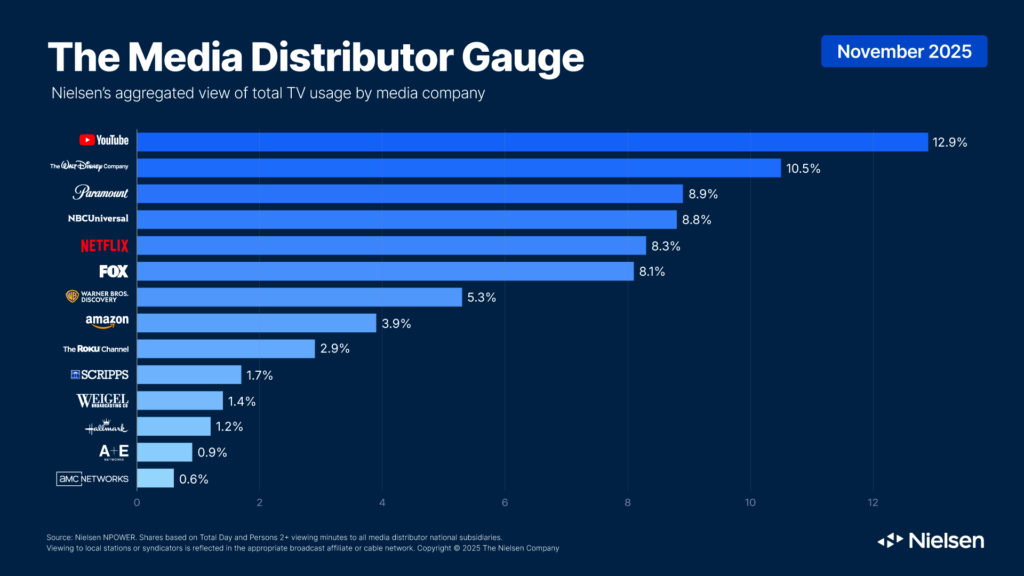
Nielsen’s November 2025 Media Distributor Gauge revealed a television landscape shaped by live sports, strategic streaming releases, and the Thanksgiving holiday, with Paramount and Netflix posting notable gains.
Paramount led the month’s growth, recording a 14% increase in overall viewing and securing its largest share of TV since April. The media company captured 8.9% of total watch-time, climbing to No. 3 in the Media Distributor rankings. Its 0.7-point gain was the largest among all distributors, driven equally by broadcast and streaming properties. CBS affiliates and Paramount+ each rose more than 18%, contributing 0.5 and 0.2 share points, respectively, to Paramount’s total.
Netflix also delivered a strong performance in November, posting a 10% gain and adding 0.3 share points to reach 8.3% of TV viewing. The streamer benefited from the return of its flagship series Stranger Things, which alone accounted for nearly 12 billion viewing minutes. Additional original content, including The Beast in Me and Guillermo del Toro’s reimagined Frankenstein film, contributed nearly 7 billion viewing minutes collectively, highlighting the impact of a deep and diverse content slate.
Hallmark recorded the month’s largest percentage increase via Nielsen, rising 28% in total viewing. Its holiday programming and original series Mistletoe Murders drove 0.2 additional share points, giving Hallmark 1.2% of total TV watch-time.
Despite these shifts, YouTube and Disney retained the top two spots, with 12.9% and 10.5% of total TV, respectively. YouTube’s share remained flat month-over-month, while Disney dropped 0.9 share points. The decline was linked to decreased viewership on ABC affiliates and ESPN due to a carriage dispute with YouTube TV.
NBCUniversal (NBCU) posted a 7% increase in overall viewing, achieving its highest total since October 2024 with 8.8% of TV share. Streaming on Peacock surged 22%, driven by NFL Sunday Night Football, Thanksgiving programming, and the original drama All Her Fault. Peacock reached a non-Olympic monthly record with 1.9% share of television.
FOX experienced uneven swings across its broadcast and cable networks. Broadcast affiliates rose 22%, led by the Thanksgiving Day NFL matchup between Green Bay and Detroit and World Series Games 4–7, with the final game ranking as the sixth most-watched telecast of November. However, cable networks were down, with Fox News Channel falling 9% and FS1 impacted by the absence of the MLB Postseason. Overall, FOX finished with a modest 2.4% gain but ceded 0.3 share points due to broader increases in total TV usage, finishing with 8.1% share.
The November 2025 reporting interval spanned five weeks, from October 27 through November 30, following Nielsen’s broadcast calendar with weekly intervals beginning on Monday.
The Media Distributor Gauge November 2025 (Courtesy Nielsen)
Barrett Media produces daily content on the music, news, and sports media industries. Sign up for our newsletters to stay updated and get the latest information right in your inbox.
Cumulus Media has promoted Debra Killick to Vice President and Market Manager for its Melbourne, Florida operations, effective January 1, 2026. She rises from her role as General Sales Manager, a position she has held for more than five years. In that role, she oversaw sales strategy for the cluster’s three radio stations and associated digital brands.
Killick’s promotion places her in charge of one of Cumulus’ key Florida markets. Her role will oversee all programming, sales, and operational functions. The move reflects the company’s continued emphasis on experienced local leadership as it navigates an increasingly digital and client-driven media landscape.
Before joining Cumulus Media, Killick built extensive experience in broadcast and digital sales across several major media companies and markets. Most recently, she served as a Digital Sales Account Manager for the Gannett/USA TODAY Network in Melbourne. Her prior experience includes roles as Local Sales Manager for Sinclair Broadcast Group in Washington, D.C., Vice President of National Sales for Univision in New York, and Local Sales Manager for CBS 4 Television in Boston.
Across more than two decades in media and digital sales, Killick has worked with both local and national advertisers. She’s developed revenue strategies that span traditional broadcasting and emerging platforms. Cumulus executives point to that breadth of experience as a key factor in her selection for the market manager role.
Bob Walker, President of Operations for Cumulus Media, said Killick has consistently shown an ability to adapt to changing local media dynamics. He added that Killick has delivered measurable results for advertisers.
“We are excited to promote Debra to this new role to lead our team in Melbourne,” Walker said. “She is a proven sales leader who has delivered results for her clients and embraced the changing landscape in local media. She has a very client-focused approach to growing our business by helping clients grow theirs.”
Killick said she is eager to take on the expanded leadership responsibilities. She looks forward to continuing to build on the momentum within the Melbourne cluster.
“I’m excited to take on the role of VP/Market Manager at Cumulus Melbourne and collaborate with this highly talented team,” she said. “I look forward to building on the momentum of our much-loved brands and making 2026 our strongest year yet.”
Cumulus Media owns and operates three radio stations in the Melbourne market. They include 107.1 A1A/WAOA-FM, a contemporary hit radio outlet. Another is 102.7 The HitKicker/WHKR-FM, which features a country format. The group also includes 95.9 The Rocket/WROK-FM, a classic rock station.
Barrett Media produces daily content on the music, news, and sports media industries. Sign up for our newsletters to stay updated and get the latest information right in your inbox.
Nicole Alvarez is returning to Los Angeles radio, this time on a different dial. After exiting middays at Audacy’s 106.7 KROQ earlier this year following a 22-year run, Alvarez is joining iHeartMedia’s Alt 98.7 as a fill-in host.
Her first appearance on the station is scheduled for today, when she will handle middays from 10 a.m. to 2 p.m. while Christin Limon is out.
The move brings Alvarez back to the Los Angeles airwaves just months after her departure from KROQ, where she spent more than two decades building one of the market’s most recognizable alternative radio careers. Alvarez joined the legendary station in 2003 and steadily climbed the ranks, working overnights and nights before settling into the midday role she held until August.
During her tenure, Alvarez also tracked programming for additional Audacy alternative stations nationwide. A Miami native, she began her radio career with brief stints at WPLA in Jacksonville and WZTA in Miami before eventually making her mark in Southern California.
Alvarez confirmed the news in a lengthy and emotional Instagram post, reflecting on her departure from KROQ and her next chapter in radio. She described her time away from the air as challenging but necessary, calling it a period that allowed her to reconnect with her passion for music, creativity, and the bond she shares with listeners.
“Losing the ability to speak to you every day taught me just how much that connection means,” Alvarez wrote. “I’m returning in a different way. I had to let go of everything to fully understand what I had.”
While she emphasized that KROQ will always remain a defining chapter of her life, Alvarez made it clear she is energized by the opportunity at Alt 98.7. She referred to the station as her “new home” and said she is grateful for the chance to contribute, learn, and earn the trust of her new colleagues.
“For the first time in a long time, I’m just going to go for it,” she wrote. “This time there is no fight, only my love of the game.”
Barrett Media produces daily content on the music, news, and sports media industries. Sign up for our newsletters to stay updated and get the latest information right in your inbox.
A planned 60 Minutes investigative report examining alleged abuses at a high-security El Salvador detention center was pulled less than 48 hours before airtime, igniting internal backlash at CBS News and placing renewed scrutiny on the network’s editorial independence under new leadership.
The segment, which had been scheduled to air Sunday night, focused on conditions at CECOT, a controversial Salvadoran prison where the Trump administration sent hundreds of Venezuelan migrants in March. According to multiple reports, CBS News Editor-in-Chief Bari Weiss halted the piece because it lacked an on-the-record response from a Trump administration official.
The decision was made roughly a day and a half before broadcast, an unusually late intervention for the long-running newsmagazine.
The move drew sharp criticism from within 60 Minutes. Correspondent Sharyn Alfonsi, who reported the story, sent an email to colleagues Sunday night condemning the call. She wrote that the decision was “not an editorial decision, it is a political one,” arguing that repeated outreach had already been made to the White House, the Department of Homeland Security and the State Department.
“Government silence is a statement, not a veto,” Alfonsi wrote, warning that allowing officials to block stories by declining comment would amount to a “kill switch” on investigative journalism.
CBS declined to comment beyond noting that the revised programming announcement said the report would air at a later date. A promotional release distributed Friday morning had teased the segment as an inside look at “one of El Salvador’s harshest prisons,” citing accounts of “brutal and tortuous conditions” described by recently released detainees.
That language was later revised, and on-air and social media promos were removed.
The controversy comes amid broader turmoil at CBS News. Earlier this year, the network’s news chief and the top executive at 60 Minutes resigned. The departures came as CBS explored settlement talks tied to a lawsuit filed by Donald Trump. The suit concerned the editing of a 60 Minutes interview with then-Democratic nominee Kamala Harris. Paramount ultimately paid Trump $16 million to settle the case. The move helped smooth federal approval for the company’s sale to Skydance Media. The company is led by David Ellison.
Weiss joined CBS News in October after Skydance acquired her digital publication, The Free Press. Her arrival has drawn attention due to her criticism of mainstream media bias. It also reflects Skydance’s commitments to regulators to broaden ideological perspectives at the network.
BREAKING
Sharyn Alfonsi, a correspondent for 60 Minutes, sent an internal email to colleagues stating that CBS News editor in chief Bari Weiss “spiked our story” about the Trump administration and the transfer of deportees to a prison in El Salvador.
Barrett Media produces daily content on the music, news, and sports media industries. To stay updated, sign up for our newsletters and get the latest information delivered straight to your inbox.
Saying goodbye on-air to a radio audience and a job you love is hard. It’s emotional and signals the end of a chapter in your career. As challenging as it may be, others pay attention to how you conduct yourself signing off. Especially executives. They won’t call, text or email you, but thanks to the wonders of social media, most see and remember your final act.
I listened Friday to part of Brandon Tierney’s final show on WFAN. He showed exactly how it should be done. The conversations with Alex Rodriguez and Rick Pitino were awesome but hearing his father call-in as his final caller was special. Hearing BT’s voice shake as he talked about how much WFAN and the audience meant allowed listeners to feel what he was going through. Many listening became fans for life. It was real, honest, emotional and left listeners wondering ‘how could this guy not be part of WFAN moving forward’.
Many of those listeners will continue to love WFAN but they’ll also follow BT anywhere he goes. He’s launching a new show today on YouTube. Without even saying one word on the channel, he’s already had nearly 4K subscribe.
The week prior, I listened to Sal Licata say goodbye to WFAN too. Similar to BT, he was appreciative, reflective, open, and honest. As he spoke his final words on the WFAN midday show, you felt sadness because you didn’t want him to go. The final goodbyes between BT and Sal were genuine and showed why their partnership worked.
Both Brandon and Sal conducted themselves as true professionals amid a difficult and highly publicized situation. If either had expressed frustration and sounded off it’d have been understandable. But they didn’t. They understood the bigger picture. I’m certain their phones will ring and their DMs and inboxes will be full. Talent and successful track records coupled with the ability to rise above difficult circumstances leads to others wanting to do future business with you.
Then on Friday I listened to Doug Gottlieb’s last show on Fox Sports Radio. Once again, well executed and handled with class. Anyone who enjoyed Doug’s show and style left that broadcast feeling like they were saying goodbye to a friend. They were happy for his success coaching basketball and understood why he was stepping away from full-time radio hosting.
Doug made the final show about trips down memory lane and his journey from ESPN Radio to CBS Sports Radio to FSR. He explained why radio meant so much to him and how Jim Rome’s show influenced his desire to do it. Hearing Chuck Wilson, Adam Klug, and Louise Cornetta call in was cool. It felt like a thank you to all who listened and helped him create 23 amazing years in radio. His stories of sacrifice, family, and why he believed in saying yes, showcased why Gottlieb became a respected and trusted voice on national sports radio.
BT and Gottlieb have both spent over two decades entertaining sports radio audiences. They’re pros who will do much more in the media world moving forward. Sal will too. BT and Doug exited Friday, the same day as many at Infinity Sports Network. Ironically, Brandon and Doug were once teammates at CBS Sports Radio, which later became Infinity. They helped launch the network in 2012. Tierney co-hosted mornings with Tiki Barber and Dana Jacobsen while Gottlieb handled afternoons.
But not everyone at their former network signed off in similar fashion.
Bart Winkler’s sign off last week was good for us at Barrett Media because it made for a solid sports media story. It left a bad taste in the mouths of some programming folks though. The amount of texts I received over it surprised me. I didn’t think it was Bart’s best moment but I understood where he was coming from. The end of his show and news of Infinity shutting down was hard for him to accept.
But whether I agreed with Bart or not is irrelevant. It’s about the next opportunity at that point. Why use your final minutes on the air potentially turning off any decision maker who might consider you for future work? Maybe it creates some buzz, clicks, views and a story on Barrett Media, but will that matter in a few weeks when you’re hunting for the next gig?
In his farewell address, Bart said he was bitter because the listeners of the Infinity Sports Network were an afterthought. He said management never considered how they felt. He talked about the past 2 months behind the scenes, why he didn’t understand the need for a new network, and expressed that although radio isn’t dying, it will if the people in charge continue to make decisions based on how to do things cheaper and more effectively.
Talent sometimes are so focused on their show that they don’t look at the full scope of the business. Good executives are always going to seek ways to be more effective while spending less. It works that way in sports, politics, music, media, and many other industries. This is a business not a hobby. The goal is to boost profitability while limiting expense.
Bart Winkler signing off from the Infinity Sports Network – December 18th, 2025 https://t.co/rPjIzXoo02
Were Westwood execs supposed to choose programming based on positive emails or tweets? Westwood One has a stronger brand identity than Infinity and the advantage of being the NFL and NCAA’s radio partner. That gives them options to use for trying to gain more weekday clearance for shows and national dollars from advertising agencies. Audacy keeps the BetMGM side of the partnership which is important, and with Bruce Gilbert guiding WW1, an exec who has led ESPN and Fox Sports Radio and forgotten more about national sports radio than most know, and Armen Williams running programming, they’ll be fine.
Westwood One is introducing a lot of new names to a national stage. Jim Rome is the one name who needs no introduction. It will take time for these shows to catch on, and it’s possible that they won’t. Bruce Gilbert and Armen Williams understand that. But that’s no different than what CBS Sports Radio and Infinity Sports Network did introducing the country to many new voices including Bart’s.
I thought CBS Sports Radio did some great things over the years. They featured a lot of quality talent and sharp programming minds. But to many operators outside of NY, it was perceived as WFAN National. Gregg Giannotti, Tiki Barber, Brandon Tierney, and Shaun Morash graduated from CBSSR to WFAN. Damon Amendolara earned mornings with Mike Babchik at Mad Dog Sports Radio. Maggie Gray moved to CBSSR from WFAN and multiple anchors went back and forth between both brands.
It’s not just about clearing nights and weekends and weekday shows in smaller rural cities. Becoming a larger part of lineups in bigger cities matters too. Fox Sports Radio makes sure that Dan Patrick and Colin Cowherd are cleared in top cities. ESPN Radio pushes Unsportsmanlike and Rich Eisen in similar fashion. The CBS Sports Minutes and guest call-ins were good but the success of Audacy’s local stations made it tougher to gain clearance on big local brands. That limits being able to attract national dollars. I don’t fault Audacy and Cumulus for modifying their approach in the national space to try and grow their business.
Most who flooded social media with messages at the network were reflective and appreciative while acknowledging the uncertainty. I thought Zach Gelb did a great job highlighting CBSSR alumni on his show the past few weeks. Damon Amendolara’s video talking about his time at CBSSR with Shaun Morash, Andrew Bogusch and others was excellent. Bill Reiter’s goodbye was delivered in a classy manner, making it easy to want to follow him on Substack. Maggie Gray and Andrew Perloff kept the focus on their show, reminding folks that it’s ok to say little when noise around you is swirling.
Being sad, confused, concerned, angry, and emotional is natural when a job you love is going away. But part of a public job involves dealing with situations that are stressful and difficult. How you handle them says a lot about your maturity and ability to navigate sensitive business situations. Bart may not have handled this perfectly but he’s a good host. I’m looking forward to seeing him bounce back in the future.
I’ve always advised folks to look at the odds and play the long game. Are you in better shape landing your next media gig with 20 decision makers interested or 10? You can still prevail with 10, but why cut the odds in half if you don’t have to? You can disagree with a decision or direction but how you discuss and deal with it gets noticed.
But hey, don’t take it from me. Maybe just watch Brandon Tierney and Doug Gottlieb. They gave you the blueprint last week.
Quick Hits
Barrett Media Holiday Newsletters: Similar to last year, newsletters this week and next are being sent 1x per day at Noon ET. There are no newsletters on Christmas Eve, Christmas, New Year’s Eve and New Year’s Day.
Writer Changes: If you read Ken Johnson‘s column last week or Perry Simon‘s piece today, you learned that both won’t be with us in 2026. Charese Fruge has also signed off after writing a great feature last week on Heather Bermudez. All three did a great job for us and I hope you enjoyed reading their work. They were consummate professionals who I’d recommend to anyone looking. I wish them the very best moving forward.
Facebook Links: Meta is working on an experiment that could limit the number of links users can post on Facebook. The only way around it would be with a paid Meta Verified subscription. Facebook confirmed the news to TechCrunch. If implemented, it will impact creators and brands posting links from their blogs and other platforms.
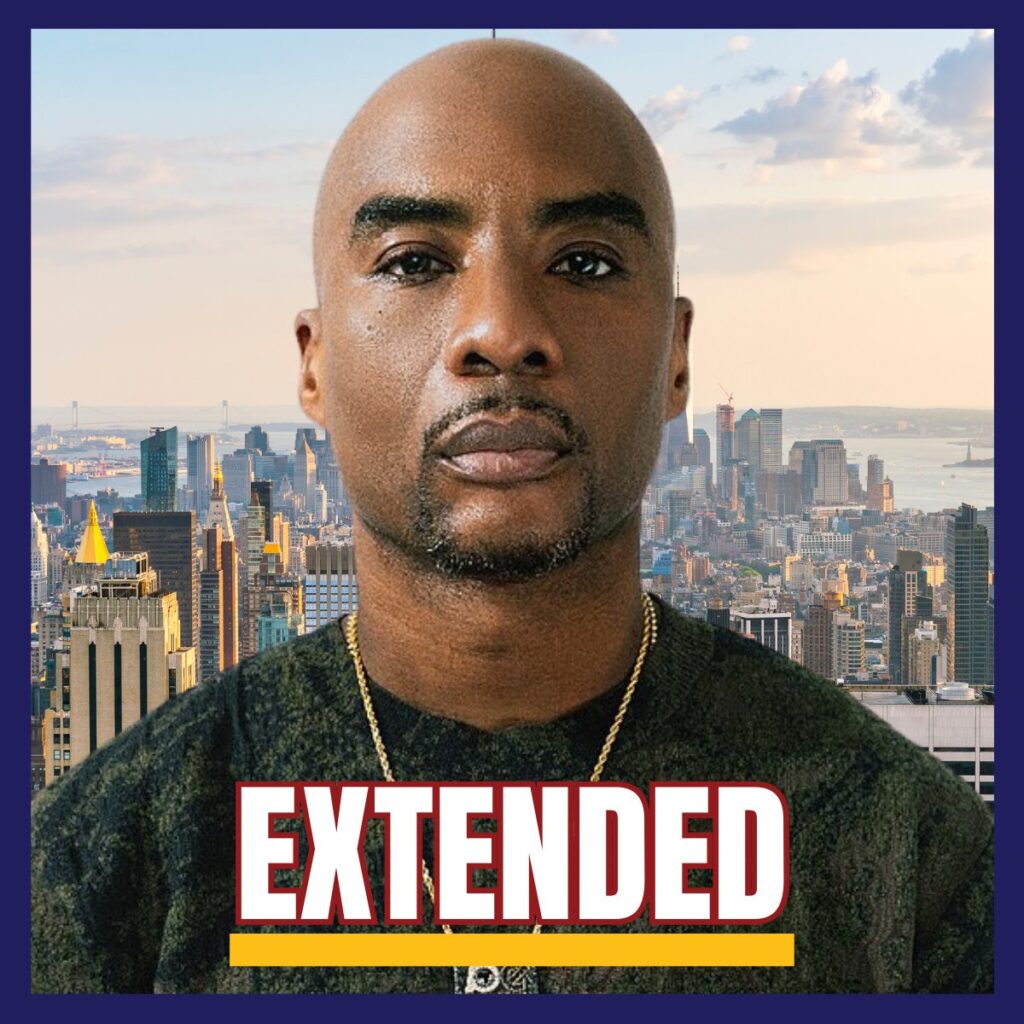
Charlamagne Gets the Bag: Congrats to Charlamagne Tha God on his extension with iHeartMedia. Reports have suggested that the number is $200 million over 5-years. If accurate, that’s reportedly double what Stephen A. Smith got at ESPN. That not only reinforces Charlamagne’s value to iHeart, it suggests that his Black Effect Network is a big part of future business, and radio is more than willing to pay top dollar for top performers.
Sid Rosenberg Suspended on X: Platforms are really still doing this immature nonsense? The host of a popular New York City talk radio show, who has been honored and asked to speak on multiple occasions in the nation’s capital by the President should not be unable to communicate with his audience on a platform such as X which claims to be all-about free speech. Hey Elon, how is this still happening?
HOT 97 Morning Drama: A post late Friday on the Hot 97 Facebook page promoted three new hosts joining the radio station. They are Ronndell, Lana and Million. The post did not say if the three would be working mornings or elsewhere on the station. Building up intrigue is fine, and announcing additions during the holidays when less people pay attention has less value. Nonetheless, EBro, Peter and Lauren were installed in mornings for a long time and listeners deserve to know who’s taking the reins next.
Damion “Damizza” Young: I wasn’t familiar with Damion before last week but am glad that I stumbled on to his Instagram account. His video commentaries on the music and radio business are timely and refreshing. Give him a follow if you’re into those specific areas of content.
Barrett Media produces daily content on the music, news, and sports media industries. Sign up for our newsletters to stay updated and get the latest information right in your inbox.
“You just gotta have some fun now.” That was my wife Fran’s reaction when I told her that this column, the one you’re reading now, would be my last. Not just the last for Barrett Media, but the last one, period, at least about radio.
Honestly, writing about a moribund industry became a dreaded chore sometime around, um, 2003 or so. I kept going because I couldn’t stop myself.
It was also because I loved that moribund industry. Not in the way old radio hands fetishize the WABC past on Facebook, but in all its messy, disintegrating glory. As much of a pain as it was to come up with material that didn’t repeat what I’d previously written, and as hellish as some of the conventions and travel could be, I wouldn’t have had it any other way.
Think of it. I spent something like 30 years working from an office in my house. I could write about whatever I wanted without objection from Joel or Jason. I reached an audience that included most of the people working in radio and many of those wanting back in.
There was no commuting, a major perk for someone who lived near Los Angeles or Miami for most of those 30 years. I could work from any place in the world with Wi‑Fi. And I got to write about what I knew and liked best, the media in general and radio in particular.
I’d have liked to make more money doing all that, but there are worse careers, right? And that doesn’t even touch on getting to be a program director and occasional host in Los Angeles and New Jersey, or being in on the early days of podcasting. I was blessed enough to get to do a lot.
So, why give that up? Well, I often wrote about knowing when it’s time to go, time to hang it up, and how to recognize when that time comes for you. Maybe it was living in an area teeming with retirees from Long Island complaining that you can’t get good Chinese food or bagels here. Maybe it was a belated recognition that I’d said all I had to say. Maybe I just got tired.
Fran was right. (She’s always right.) I need more fun.
Look, when you hit my age, the cold fact that you don’t have unlimited time left hits hard. Did I want to spend any of that time working? Of course not. I want to sleep in, read books, go to ballgames and the beach, and play with the cats. The column was one last reminder that I hadn’t entirely freed myself from the psychological restraints of work. I’m free of that now.
It’s not like I’m disappearing. I may write things from time to time, for whomever is willing to pay for them. As long as I’m alive, I’ll be reachable via email and social media. Anyone who wants to buy me lunch can find me in South Florida. I’ll go anywhere between Jupiter and the Upper Keys for lunch with friends. But I’m looking forward to disengaging from the daily grind, disengaging from schedules and deadlines, from clockwatching and caring about.
No, that last part is not true. I will always care. I’m hopeless that way. And I will miss, most of all, the people, especially those who helped me through the years.
(There are too many to mention by name here, due to my fear of leaving someone out. Rest assured, I haven’t forgotten and will always be grateful for you. Yes, you. I can see you through the screen.)
And here we are, the end of the line. This is my station, time to get off the train and have a life. Happy holidays, Go Birds, good night and good luck, so long and thanks for all the fish, That’s All, Folks!, I’m so glad we had this time together, I bid you a fond adieu, so long, farewell, Auf Wiedersehen, good night, we’re done here.
In the words of the great philosopher Bill Watterson, it’s a magical world. Let’s go exploring!
I talked last Friday about the concept of change in sports radio. With headlines surrounding hires, fires, and retirements, it’s impossible to fully grasp how impactful change can be for the many people the headlines don’t mention. There’s another change being signaled at Audacy’s WFAN, separate from the lineup switch coming the first week in January. It’s a change that has arrived much later than it has at many counterparts around the country.
Many of the utility appointments that once made talk radio so valuable have disappeared with time and the evolution of technology. Radio stations used to have their own roster of personalities delivering traffic, weather, sports, and other updates intermingled with their on-air talent. Today, the information those appointments provided is available at the touch of a button, through an app, or via alerts on social feeds.
WFAN is positioning itself to remove sports updates, something many sports radio stations eliminated long ago. The age of change that has affected countless sports radio brands is finally reaching WFAN. While overdue, it should also be recognized as a station that valued the format longer than many others before letting it go.
WFAN is the pinnacle of the sports radio industry, many around the country believe this to be true. It was the first to sign on and remains a destination where, if you arrive, you’ve indeed “made it.” Over time, however, the station has faced the same challenges confronting every other outlet across the country over the past two decades.
Talent aging out. Clients move advertising dollars to digital. Station-based content has become less essential to New York City sports fans due to the rise of digital creators and content feeds online. Fans no longer view WFAN as the default destination the way my generation once did.
As a result, the challenge of remaining relevant in the content race has reached an all-time high. One clear example is the consolidation of the CBS Sports Network/Infinity Sports Network with the BetMGM Network. Operational costs become unsustainable when the demand for new, fresh, and differentiated content continues to rise. Especially on traditional methods for that entertainment.
Many around the country may not recognize these names, but they deserve just as much acknowledgment as any others. Erika Herskowitz, Andrew Bogusch, and Rich Ackerman are among the many affected by this shift. It’s a change that WFAN and the Infinity Sports Network delayed longer than many of their contemporaries. In today’s digital age, sports updates are simply no longer necessary.
No one in traditional sports radio is immune, including WFAN.
The art of the sports update was straightforward. Information, cross-promotion, and sponsorship formed the foundation, though every station approached it differently. Some treated updates as appointment listening with impact, while others integrated them directly into the programs themselves.
Colin Cowherd does hourly segments with Jason McIntyre called “The Herd Line News.” My former station in Tampa employed a similar hourly segment, with the part-time producer serving in the update anchor role. 95.3 WDAE hasn’t had dedicated update anchors since 2015, as producers kept the role alive before the station fully moved away from the concept in 2018.
The goal was to deliver the biggest headlines of the day, use sound to enhance delivery, and sell what people needed to know. The time is a cross-promotional tool, highlighting key interviews or play-by-play broadcasts to drive tune-in.
Sports updates also provided significant value for sales departments. Yet two of the most damaging words in sports radio revenue eventually emerged: “added value.” Each additional giveaway to your sales team limited opportunities to generate new revenue.
Over time, the art grew stale. Top syndicated sports radio brands now offer optional updates for affiliates. Many affiliates opt to run inventory instead of maintaining a local information segment. Why pay someone to share information most listeners already know when that same time can generate revenue?
Programmers across the industry saw the writing on the wall. Sports updates were increasingly viewed as momentum disruptors that content audiences no longer desired. Change isn’t always easy, but it must be acknowledged and applied when the time arrives. While it’s unfortunate for those affected with WFAN who did nothing wrong, every sports radio station, including WFAN, must look forward rather than rely on what worked in the past.
All-day sports updates are simply another casualty of that evolution.
A Focus on the Future
Change in sports radio rarely announces itself as progress in real time. It usually arrives quietly, framed as efficiency, evolution, or necessity, long before consensus forms on whether the product is better. The potential removal of sports updates at WFAN is not an indictment of the craft or the professionals who executed it at a high level for decades.
Instead, it serves as a reminder that sports radio no longer competes with other stations for information. It competes for time watched, attention, reach, and habit.
Sports updates didn’t disappear because they failed. They disappeared because the industry stopped asking what purpose they served. Once information became ubiquitous, the update lost its leverage, and without leverage, radio loses relevance. That reality doesn’t spare WFAN, regardless of how iconic the call letters may be.
This is the uncomfortable truth of progress. Not every tradition earns a place in the future simply because it shaped the past. Sports radio can no longer afford to sound like a service when the audience already feels served.
The next era will belong to stations that understand they’re no longer in the information business, but in the connection business. Those who fail to adjust won’t fade loudly. They’ll simply be replaced quietly.
Barrett Media produces daily content on the music, news, and sports media industries. To stay updated, sign up for our newsletters and get the latest information delivered straight to your inbox.
As 2025 winds down and we get ready for a new year it seems like a good time to look at the music being played in the Classic Rock format to see if there are any valuable lessons to be learned for the year ahead.
Thanks to Mediabase I was able to pull year-to-date statistics for Classic Rock airplay. I decided to look at which artists are receiving the most attention at the format. I also pulled archived numbers for last year, 2020 (5 years ago), 2015 (10 years ago) and 2000 (25 years ago). Here’s what stood out to me.
Consistency Since 2015
When you compare the top artists to last year the best words to describe the results would be incredibly consistent. Aerosmith is still the most-played artist with, in order, AC/DC and Led Zeppelin trading spots to take second and third this year. In fact, while there is some jockeying for position, every one of the top twenty five most-played artists from this year were in the top twenty five last year.
It’s worth noting that the three true Mount Rushmore acts, Aerosmith, Led Zeppelin and Pink Floyd have ranked in the top five for twenty five years. However, five more artists, AC/DC, Queen, Guns N’ Roses, Def Leppard and Journey have taken up residence in the top 10 but, as the chart below shows, haven’t always been there.
Artist
2000 Rank
2015 Rank
2020 Rank
2024 Rank
2025 Rank
AC/DC
26
4
2
3
2
QUEEN
23
7
6
6
5
GUNS N’ ROSES
81
12
9
7
6
DEF LEPPARD
53
8
7
8
8
JOURNEY
24
9
10
10
10
The Next Generation
Going deeper to look over the entirety of the one hundred most-played artists from last year to this year, there aren’t a lot of big changes in rank, though the ones that did occur tell a story.
The Red Hot Chili Peppers took the biggest jump inside the top thirty going up four spots to twenty-eight. In addition, The Offspring are up nine spots to sixty-three, Linkin Park up twelve spots to seventy and Smashing Pumpkins up eight spots eighty while 3 Doors Down and Sublime debuted in the top one hundred for the first time at 86 and 94, respectively. In addition, here is how several other nineties artists have ranked over time. The chart illustrates how the format adopted these acts but also how their growth has slowed significantly leaving them unable to reach true core artist status.
Artist
2000 Rank
2015 Rank
2020 Rank
2024 Rank
2025 Rank
METALLICA
n/a
38
27
13
14
NIRVANA
n/a
43
33
18
16
PEARL JAM
n/a
41
37
23
21
RED HOT CHILI PEPPERS
n/a
68
41
32
28
GREEN DAY
n/a
69
43
30
29
STONE TEMPLE PILOTS
n/a
53
45
35
34
FOO FIGHTERS
n/a
74
54
43
41
R.E.M.
n/a
n/a
66
53
51
ALICE IN CHAINS
n/a
83
67
54
53
Conversely, the biggest losers include John Mellencamp down seven spots to thirty-five, Jimi Hendrix down eight spots to fifty, Kansas off five spots to sixty-two, Dire Straits and Phil Collins both off six spots to 69 and 76 respectively while Eric Clapton was also off five spots coming in at 89. To further illustrate how the format is changing, here are some other artists who were once considered staples if not Mount Rushmore type acts that have slid down the ranker.
Artist
2000 Rank
2015 Rank
2020 Rank
2024 Rank
2025 Rank
THE WHO
14
14
25
36
33
BOB SEGER
7
22
31
33
36
BAD COMPANY
17
25
36
41
40
DOORS
22
27
29
40
42
BEATLES
3
20
46
62
64
ELTON JOHN
16
47
61
65
65
SUPERTRAMP
35
50
63
79
83
BILLY JOEL
33
65
73
85
85
DOOBIE BROTHERS
21
55
72
90
88
The new guard is slowly supplanting the old guard, but evolution is a slow process. Meanwhile these charts also show how the overall sound of the format is getting a little harder due to the changes as softer sounds are falling out of favor.
After a short holiday break, I’ll be back to look under the hood and see what trends are happening in the world of Classic Hits. Hope you have a great holiday season.
Barrett Media produces daily content on the music, news, and sports media industries. Sign up for our newsletters to stay updated and get the latest information right in your inbox.
Jim Russell, co-host of The Jon & Jim Show on San Diego Sports 760, announced Friday that he will leave the program, with his final broadcast scheduled for December 29. Russell said the decision to step away from the show and the city was motivated by family considerations.
“I’m leaving the Jon and Jim show, and my final show will be on December 29,” Russell said during Friday’s broadcast. Russell, who has been with San Diego Sports 760 for 6 years, explained that the decision came after a deeply personal experience.
“A couple months after we found out that Eryn was pregnant, she had a miscarriage. That was brutal, and it kind of just clicked that we could not raise a family and raise a child in San Diego,” he said.
The host described the choice to leave San Diego after 15 total years of service was exceptionally difficult.
“This was a very tough decision for me and Eryn, especially because I love what I do. I love the show, and have been in San Diego for 15 years now, and it’s become my home. So it was… very difficult to even think about leaving San Diego. But once Eryn experienced the miscarriage and that whole thing happened, it was actually very easy to move,” Russell explained.
He emphasized that the move is intended to be closer to family, providing support and a sense of community as he and his wife plan to start a family.
“The main reason why myself and my wife decided to move, and that’s to be closer to family, because we want to start a family. We know that it’s very difficult to be on an island by yourself to do that. When the miscarriage happened, it just put a lot of things in perspective,” Russell said.
Russell’s departure marks a significant shift for the station. He has been a fixture in the local sports radio scene. The Jon & Jim Show has built a loyal following in San Diego. It blends sports analysis with personal commentary and community engagement
Russell’s presence on the program has been noted for his candid, relatable style. He is also committed to engaging fans both on and off the air. Station management has not yet announced a replacement or how the show’s lineup will be adjusted following Russell’s departure.
Barrett Media produces daily content on the music, news, and sports media industries. To stay updated, sign up for our newsletters and get the latest information delivered straight to your inbox.
Doug Gottlieb officially signed off from his daily live radio duties Friday, announcing the end of The Doug Gottlieb Show on FOX Sports Radio as he shifts his professional focus toward coaching and leading the men’s basketball program at Wisconsin–Green Bay.
Gottlieb, who has hosted nationally syndicated sports radio shows for more than two decades, made the announcement during his final broadcast, emphasizing both gratitude for his audience and clarity about what comes next. While the daily live show is ending, Gottlieb made clear he is not leaving audio entirely.
“This will be my last show with live radio,” Gottlieb said. “So just to clarify, I’m still going to do a podcast. TheDoug Gottlieb Show podcast. We will use the All Ball platform, and iHeartMedia has been great, and we’re going to work together on it. There are no negatives there.”
The decision marks a significant turning point in Gottlieb’s media career, one that he framed as a necessary step to fully commit to his coaching responsibilities. Gottlieb was hired as head coach at Wisconsin–Green Bay in 2023, a role he has repeatedly described as a dream job.
“Green Bay basketball is incredibly important to me, and you can’t say something’s your dream job and then not be willing to literally and figuratively give your all for it,” Gottlieb said. “The reality to it is Green Bay basketball hasn’t suffered the last year and a half because I haven’t worked hard enough at it. I would say there are times which you guys have picked me up, which has been great, and it’s been all the other things in my life which would suffer.”
Throughout his final show, Gottlieb reflected on the relationship he built with listeners during a 23-year run in sports radio, a stretch that included stints across multiple networks and formats. He leaned into the personal nature of the medium, acknowledging both the connection and occasional friction that comes with opinion-driven programming.
“To those of you who listened for the last 23 years. You’ve been moving through basketball, different jobs, marriage, kids, divorce. Now, coaching, I appreciate you,” Gottlieb said. “Radio is a relationship, consider me your friend. I said something to piss you off is just because I thought your sports team or your player wasn’t as good as some other sports team or player. It was, for the most part, never personal. It’s a pleasure.”
Gottlieb’s departure from daily live radio comes at a time when several established sports media personalities are reevaluating workloads amid expanding responsibilities beyond broadcasting. As he wrapped up the broadcast, Gottlieb left the door open for continued connection through his podcast while offering a seasonal farewell.
“It’s not goodbye forever,” he said. “You can still check out the podcast, but for now, it’s fitting I do Merry Christmas, Happy Hanukkah.”
FOX Sports Radio has not announced who will replace Gottlieb in their afternoon drive timeslot.
Barrett Media produces daily content on the music, news, and sports media industries. To stay updated, sign up for our newsletters and get the latest information delivered straight to your inbox.