Edison Research has released its third-quarter Share of Ear data, and there are some interesting takeaways, especially for rural AM/FM radio broadcasters.
The study, which has been continuous since 2014, reveals that time spent listening to AM/FM radio figures in rural communities outpace both suburban and urban listeners.
In rural areas, 34% of all audio listening is spent with AM/FM radio. Meanwhile, that figure drops to 30% with suburban listeners and 28% for urban respondents.
Conversely, urban listeners spent 40% of their daily time spent listening on mobile devices. That declines slightly to 36% for suburban listeners, and even further for rural listeners, down to 34%.

Edison Research co-founder and President Larry Rosin said there isn’t one singular reason for why those figures shook out the way they did. But he does have theories for why the AM/FM radio listenership in rural areas has a higher time spent listening than its urban and suburban counterparts.
People in rural areas tend to use their phones less,” Rosin shared. “Phone use is expensive, and if you identify people who don’t have expensive phone plans or don’t even use smartphones, they’re much more likely to be concentrated in more rural areas. So that’s part of it.”
He added that it’s just as likely, however, that the hyper-local nature of AM/FM radio in those same areas could be a driving factor behind that difference.
“I think we also have to consider the utility of radio in rural areas,” Rosin added. “I think radio maybe means a little bit more in those parts of the country. So, I think some of the things that broadcasters do, they often are very attuned to the needs of more rural listeners. It’s definitely partially that as well.”
As different as the data is for the location of those survey respondents, the difference in listening habits is even greater between age demographics.
“The variable that matters the most, by far, is age,” said Rosin. “It’s like three different worlds. If you divide 13-to-34, 35-to-54, and 55-plus. It’s like yesterday, today, and tomorrow.
“I don’t know what it would have looked like in 1990, but it’s probably what 55-plus looks like today. Some of these technologies were long in the future in 1990, but it was a world where radio was super dominant and ‘owned music’ was the only other option, or things like that. 35 to 54-year-olds are in the middle, and 13 to 34 look completely different from 55-plus, as you might imagine,” Rosin continued. “So much of it is phone-based audio options, as opposed to say a dedicated AM/FM radio or any other device when you get those three different worlds.”
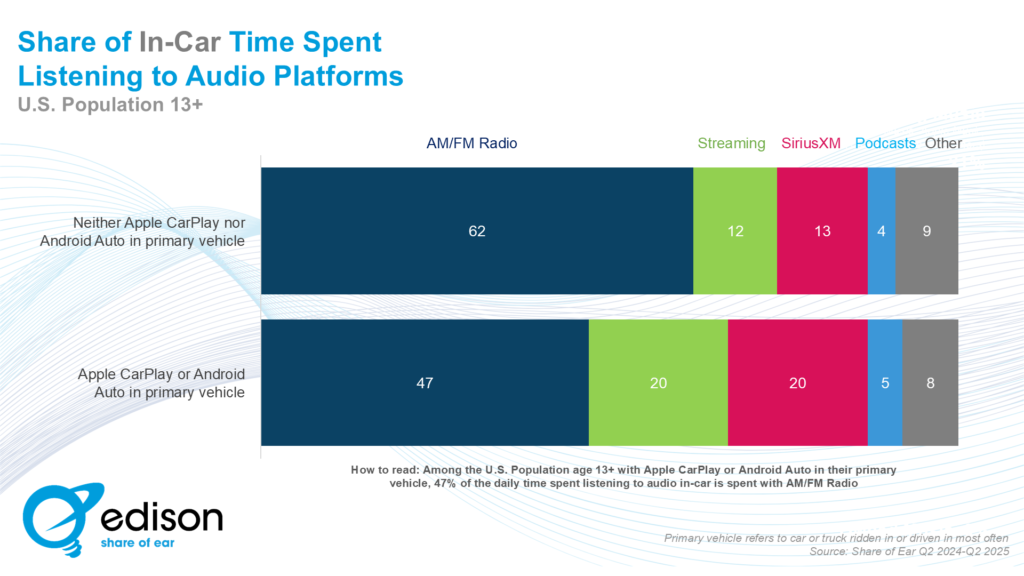
An additional factor in the daily time spent listening between terrestrial radio and mobile device listening is the proliferation of Apple CarPlay and Android Auto.
Auto owners who had neither Apple CarPlay nor Android Auto spent 62% of their time spent listening to AM/FM radio, 13% listening to SiriusXM, 12% listening to streaming audio options like Spotify or Pandora, and 4% listening to podcasts, Share of Ear data from Edison Research shows.
Those who had either Apple CarPlay or Android Auto? Only 47% of their time spent listening was with terrestrial radio, with the streaming and SiriusXM numbers both climbing to 20%, individually, and podcasts rising slightly to 5%.
Largely, listeners aren’t using their mobile devices to stream AM/FM radio brands, the Edison Research President shared.
“It only gets single-digit percentage of listening on a phone and does a little bit better on a smart speaker, but the overwhelming majority of radio listening happens on a radio device,” Rosin shared. “In the car, virtually nobody streams radio stations. If you’re going to listen to radio in the car, overwhelmingly, they’re going to stream stuff that’s unique to streaming, because they have a radio in their car.
“Yes, there are cases where I live here in New Jersey, I grew up in Chicago, and I’m a Cubs fan. I wanted to listen to (670) The Score to talk about the Cubs or something like that, there are fringe cases like that. But overwhelmingly, if people listen to the radio in the car, it’s on the radio. And if they’re using their phones, it’s because they want to choose something that isn’t on the radio.”
Barrett Media produces daily content on the music, news, and sports media industries. To stay updated, sign up for our newsletters and get the latest information delivered straight to your inbox.