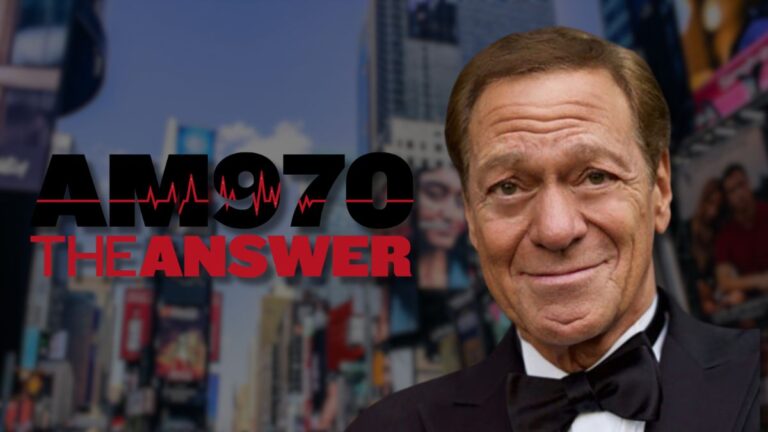
AM 970 The Answer morning host Joe Piscopo isn’t going anywhere. He’s signed a three-year contract extension with the Salem Media New York news/talk station.
The Joe Piscopo Show will remain in morning drive through 2028 after the former Saturday Night Live star inked a deal to remain with the station he’s worked at since 2014. The show airs from 6-10 AM.
“Our audience relies on us for honesty, respect, and straight talk about the issues that matter, and that trust means the world to me,” said Piscopo. “And let’s be honest — only in New York do you wake up at 3 AM and call it show business! I’m honored, grateful, and excited to keep sharing these mornings with such an amazing audience.”
“Joe Piscopo remains one of the most dynamic talents in New York radio,” said AM 970 The Answer and Salem Media of New York General Manager Laura Sheaffer. “His authenticity and connection with our listeners are extraordinary, and extending his presence on AM 970 The Answer was an easy decision. Joe continues to raise the bar every single morning.”
Joining Piscopo in morning drive are producer Joe Sibilia, news anchor Al Gattullo, traffic anchor Debbie DuHaime, and weather anchor Stephen Parr.
Barrett Media produces daily content on the music, news, and sports media industries. To stay updated, sign up for our newsletters and get the latest information delivered straight to your inbox.
On Tuesday, Tucker Carlson said President Donald Trump was set to announce plans to go to war with Venezuela. That didn’t come to fruition and the podcaster was widely lampooned by the news media in the aftermath.
While speaking with Judge Andrew Napolitano on his Judging Freedom podcast, Carlson said he had been informed that the President was going to announce a military invasion of the South American country during his primetime address to the nation on Tuesday evening.
“Here’s what I know so far: Members of Congress were briefed yesterday that a war is coming and that it’ll be announced in the address to the nation tonight at nine o’clock by the President,” Carlson said. “Who knows — by the way — if that will actually happen. I don’t know. And I never want to overstate what I know, which is pretty limited, in general.”
During his address, President Donald Trump did not mention anything relating to the ongoing military operations against drug smugglers originating from Venezuela.
In response, many news media figures, especially from the conservative side, took Tucker Carlson to task for his incorrect prediction.
Qatarlson said yesterday his Capitol Hill sources told him the President last night was going to announce war on Venezuela, or some such bull crap. Well, it didn’t happen. World War III with Iran didn’t happen. World War III with Russia didn’t happen.
Correct me if I’m wrong – but wasn’t Tucker saying he had it on good authority Trump was going to announce war with Venezuela tonight? Lots of shark jumping from the podcast crowd this week.
Barrett Media produces daily content on the music, news, and sports media industries. To stay updated, sign up for our newsletters and get the latest information delivered straight to your inbox.
Ben Shapiro and Tucker Carlson have been at odds in recent weeks over a variety of topics. But Shapiro has now argued that Carlson should be ignored for his comments about the U.S. government.
While speaking at a Heritage Foundation event, Ben Shapiro took Carlson to task for what he labeled as conspiratorial thinking when it comes to who now controls the United States government.
“To Tucker Carlson, unfortunately, the Constitution is a mere ruse, a sham,” Shapiro said. “Instead, Tucker Carlson promotes a conspiracy theory by which the American people have lost total control of their lives and thus have no real ability to shape policy.
“Now this criticism by Carlson is rooted in a fundamental truth, the regulatory state never envisioned by the founders has overrun all boundaries and it has run out of control,” Shapiro said. “The executive branch has become the repository of nearly all policymaking, in a way the founders certainly never intended. But conservatism argues that a return to the traditional structures of checks and balances between the branches and federalism, between the states and the federal government, ought to be the goal.
Ben Shapiro added that the rhetoric floated by Carlson is dangerous to the nation.
“Tucker Carlson believes that foreign powers have hijacked our government,” Shapiro continued. “That conspiratorial elite — immovable and undefeatable, other than through centralized power — has taken control. In 2018, Tucker Carlson said Washington leaders have confirmed our country’s democracy is fake. If the population starts to believe it’s all fake, that they’re not really in charge, their votes don’t matter. What will they do? Well, what they would do, presumably, is revolution, because if our constitutional structures are utterly insufficient, we have lost control.”
It does not appear as if Tucker Carlson has responded publicly to the comments made by Ben Shapiro as of this publication.
Barrett Media produces daily content on the music, news, and sports media industries. To stay updated, sign up for our newsletters and get the latest information delivered straight to your inbox.
Beasley Media Group has promoted John Coury to Vice President of Treasury and Corporate Controller, effective immediately.
In the role, Coury oversees the company’s treasury operations, accounts receivable, accounts payable, and traffic functions. Those areas are part of Beasley Media Group’s cash management and financial strategy.
“John’s leadership, strategic insight, and strong financial acumen have been instrumental in strengthening our company’s financial foundation,” said Beasley Media Group CEO Caroline Beasley. “His dedication and expertise will continue to play an important role in advancing Beasley’s fiscal efficiency and long-term growth.”
Coury acknowledged the promotion and outlined his focus moving forward.
“I am honored to take on this expanded role and continue supporting Beasley’s strong financial foundation,” Coury said. “It’s a privilege to work alongside such a talented team across our markets as we strengthen our operations and position the company for long-term growth and success.”
Coury joined Beasley Media Group in 2016 following the company’s acquisition of Greater Media, Inc., where he held financial leadership positions. During his time with Beasley, he has worked across multiple areas of the finance organization.
Barrett Media produces daily content on the music, news, and sports media industries. To stay updated, sign up for our newsletters and get the latest information delivered straight to your inbox.
Bay Area broadcasting icon Greg Papa is set to make an earlier-than-expected return to the San Francisco 49ers radio booth, stepping back into the team’s play-by-play role while continuing treatment for cancer. The longtime KNBR host and voice of the 49ers will rejoin the broadcast beginning with San Francisco’s December 28 regular-season matchup against the Chicago Bears.
Papa is also scheduled to call the season finale against the Seattle Seahawks the following week, reuniting with longtime color analyst Tim Ryan. The announcement came Wednesday during KNBR’s Papa & Silver midday show. The news was delivered through a lighthearted football-themed skit featuring 49ers director of broadcast partnerships Bob Sargent.
“I have just completed paperwork with the league, and we have officially activated Greg Papa off the ‘NFI’ list,” Sargent said. “So his 21-day practice window has officially been opened.”
Papa’s co-host, Greg Silver, celebrated the moment on air while confirming the details of Papa’s return to the booth. The news marks a significant milestone in Papa’s recovery after he was diagnosed with a form of leukemia in July.
Papa immediately stepped away from KNBR’s daily programming and was sidelined from his 49ers duties during training camp. At the time, his son Derek Papa — also a KNBR host — said it was unlikely his father would be on the air at any point during the 2025 NFL season.
Progress since then has exceeded expectations. Papa returned to KNBR’s four-hour midday show in September and has contributed remotely to 49ers-related content throughout the season. However, he had not returned to the radio play-by-play role, with the team rotating five different broadcasters to fill in during his absence.
Speaking publicly Wednesday for the first time, Papa addressed his recent medical updates. Testing at UC San Francisco shows his cancer is now in remission.
“I’m healthy,” Papa said. “I could not go through all the people at UCSF, where I was yesterday, that have basically saved my life and put me on a course to live my life again, as normal as I can.”
While emphasizing that his battle is not yet over, Papa used familiar football language to describe his mindset. He noted he has not undergone chemotherapy in two months and is awaiting clearance for a bone marrow transplant.
“I’m not running victory formation yet,” Papa said. “But I’m strong enough to do this. I’m strong enough mentally and physically to sit and prepare.”
KNBR confirmed that Guy Haberman will remain part of the radio team for the rest of the season. Haberman is the current play-by-play voice. Papa has been cleared to travel for potential playoff games. He said he hopes for a top NFC seed. That outcome would keep San Francisco at home.
Here's the moment Greg Papa was officially activated by 49ers Director of Broadcast Partnerships Bob Sargent.
Barrett Media produces daily content on the music, news, and sports media industries. To stay updated, sign up for our newsletters and get the latest information delivered straight to your inbox.
Doug Gottlieb is all in on coaching moving forward, for now. The longtime national radio host has stepped away from his daily afternoon show to fully commit to his role as head coach of the University of Wisconsin–Green Bay men’s basketball program, marking a significant professional pivot after years of balancing media and coaching responsibilities.
Gottlieb revealed the decision following UWGB’s 67–64 win over UC Santa Barbara on Wednesday night, using his postgame press conference to explain why the dual-track career was no longer sustainable.
“You only get one shot at this thing,” Gottlieb said. “And if there’s any ounce of lack of preparation or any ounce of fatigue — and this is going to sound crazy — but last week we go down to IU Indy and because of the timing of my show, the bus had to leave without me and I flew. I don’t think that’s what I want to do as a coach.”
That moment served as a turning point. Gottlieb has long been one of the industry’s most recognizable multi-taskers. Over time, the logistical strain increased. Juggling national radio with daily Division I coaching demands created unavoidable conflicts. Travel schedules, preparation time, and the simple reality of being present were all being tested.
Gottlieb was hired by Green Bay in May 2024. He initially continued hosting The Doug Gottlieb Show on FOX Sports Radio. At the same time, he transitioned into life on the sidelines. Entering his second season with the Phoenix, however, the toll of that balancing act became increasingly clear.
Gottlieb told the Green Bay Press Gazetteearlier this year that he intended to focus more on basketball during game days as he approaches his second season leading the Phoenix. UWGB Athletic Director Josh Moon said in May he has not directed Gottlieb to shrink his radio involvement in any way and that it is the FOX Sports Radio host’s job to ensure that he is doing his best work at both endeavors.
“There’s obviously a bit of a financial hit and I’ll work through it,” Gottlieb said. “I’ve been blessed beyond all measure. But the Doug Gottlieb Show on radio in the afternoon, as of now, we’re going to take a break from it. I’ve got to have a life. I’ve got to be here for those kids, and I’ve got to really dig in because we’re building something cool here.”
While the daily radio show is paused, Gottlieb is not disappearing from media altogether. He plans to remain active through podcasts. The format offers flexibility. It does not interfere with practice schedules, travel, or recruiting responsibilities.
“I’ll still be doing podcasts,” Gottlieb noted. “We’ll transition to a different version of it. It’ll still be the same stuff, but I’ll do it off office hours and at home.”
FOX Sports Radio has not commented on Gottlieb’s decision.
JUST IN: Doug Gottlieb is stepping away from his radio gig to focus on being a full-time division one head basketball coach for UW-Green Bay. He will still be doing the podcast.
Barrett Media produces daily content on the music, news, and sports media industries. To stay updated, sign up for our newsletters and get the latest information delivered straight to your inbox.
Netflix is on a massive holiday shopping spree. With the company focused on bringing a podcast experience to its platform, it has opened the checkbook and is moving forward with its plan. In the last two months, the streaming giant has secured exclusive video agreements with several top sports podcasts, ensuring their video product is exclusive to the Netflix subscriber.
That’s the question I continue to have about all of this: the word subscriber. I asked in October the same question I have today. Would you pay to watch a podcast that you’ve always gotten for free? Especially if there are still free options to consume the content elsewhere?
There are positives and negatives for the podcaster, and the same is true for the distributor. Without a doubt, Netflix is flexing its collective financial muscle and taking away content from its top competitor on YouTube. In the end, will it matter and at what cost for the creator themselves?
Consumers pay close attention to their pocketbooks now more than ever. We’ve seen costs rise while wages remain flat, or at least not keep up with the costs of everyday life. The costs of watching entertainment have gone up. You need multiple streaming services to watch NBA, MLB, and NHL products. The WWE moved from Peacock to ESPN, and the UFC begins its Paramount+ journey in 2026.
Netflix is becoming more of a player in the sports content game and has become more involved over the last couple of years. Between Jake Paul, Monday Night Raw, and the NFL, the streaming giant has become a normal destination for sports fans to find sports action.
But does your appetite for your favorite podcast make the subscription cost easier to swallow?
Breaking: I’m proud to announce in our continuing 20 plus year evolution we are now partnering with @netflix for exclusive video podcasts. pic.twitter.com/BHGbzJvB37
I think it would be unrealistic to expect a massive subscriber influx for Netflix based on exclusive podcast video deals. Shows like Pardon My Take, The Breakfast Club, and Bill Simmons have devoted followings. Those audiences may believe they will follow anywhere. Still, adding another subscription fee will not be an easy decision for many.
There are several ways to look at this.
From a creator standpoint, Netflix is cutting you a check to produce the same content you always have. Your content still lives in audio form and can be distributed anywhere your consumer receives your podcast. The video portion (assuming you had one already) now belongs to Netflix, meaning the video content that you housed for your audience for free on YouTube now requires a subscription cost from the same consumers you built that relationship with over the years.
What was once free is no longer. This is a test of audience loyalty, and more than likely, not for the better. It won’t affect a massive amount of your audience—or will it?
Pardon My Take has over 659,000 subscribers, with a daily average of 283,000 views over the past two weeks, according to Social Blade. Does the paycheck from Netflix negate the viewership that the podcast could lose by moving to Netflix? For the creator, this is a money grab.
YouTube has been a proven commodity not only in how consumers watch podcast content but also in how they search for it. It is a free tool that allows anyone to find niche programming their heart desires.
When Pat McAfee signed with ESPN, he made it very clear that staying on YouTube was an important factor for his show to come to the network. Allowing a free option to remain alongside a big paycheck from a network has only benefitted the program’s growth and influence in the creator economy.
To eliminate yourself from that free content pool in exchange for a paycheck to put your content behind a paywall would seem foolish. In fact, Dan Le Batard assured his audience that Bill Simmons is not thrilled with the idea of being on Netflix because paywalls damage loyalty to brands.
Here’s another item to consider. Does the exclusive video component on Netflix apply to all videos? Does this mean clips of podcasts housed on Netflix cannot be shared on social channels, reels, or shorts? Doesn’t that hurt reach and influence in the creator economy? Does the Netflix money cover that lost engagement as well?
Questions need answers for the creator economy.
For generations, ubiquity has been the new exclusivity. For a podcast to thrive and survive, it must be made available everywhere for all to consume. Putting content behind paywalls builds walls to connect, rather than harvest, audiences.
From Netflix’s standpoint, shelling out money to podcasts that consumers can get for free could be seen as burning money. The company is betting that people will choose its platform for the video format. It assumes viewers prefer video over audio. The audio version remains free. It is also widely available beyond Netflix.
Another item to consider is whether Netflix buying content will eventually make costs rise for the consumer. Will my $20 a month go to $25 because Netflix had to acquire Chelsea Handler’s podcast?
If Netflix can pay movie studios to produce their own feature films, why not take a page from its own book: get unique content, invest in partnerships, and build programs, instead of simply repackaging content already available for free elsewhere?
That’s the exclusivity Netflix should chase: creating content unique to the platform it serves, with proven voices in the space. Build a network of creators under its own banner and make them the faces of a global content movement for the platform.
At the end of the day, creators are trading a guaranteed check for a partnership with an unproven player—one that may even put barriers between them and the audience they’ve spent years building. Netflix may be writing the check, but the question of loyalty, reach, and long-term influence remains unpaid.
Whether this gamble will pay off or leave creators wishing they had stayed in the free-for-all world of YouTube is a story only time can tell.
Barrett Media produces daily content on the music, news, and sports media industries. To stay updated, sign up for our newsletters and get the latest information delivered straight to your inbox.
Heather Bermudez has built her radio career in one of the most demanding markets in the country. Her approach to the business is rooted in authenticity, pride, and an unwavering love for radio. Born and raised in New Jersey, Bermudez is proudly Peruvian American. She says her background shapes how she shows up both on and off the air. “I’m really proud of where I come from and who I am,” she says. “That identity influences how I connect with people and how I approach storytelling.”
She entered the industry straight out of college in 2018, landing a part-time role as a News Production Assistant at the legendary 1010 WINS. “People always say once you’ve worked at WINS, working anywhere else is a breeze,” Bermudez says. “It’s intense, but it teaches you discipline, urgency, and how to handle pressure. That experience shaped me.”
After four years in the newsroom, she made the move to WCBS-FM. That’s where she met Scott Shannon and Patty Steele and became their producer. “Working with Scott and Patty reignited my love for morning radio,” she explains. “After spending so much time in news, I had forgotten what it felt like to be in the driver’s seat during the early hours. I loved knowing I was part of people’s morning routines again, helping them wake up, making them laugh.”
In addition to producing, Bermudez took on managing the station’s social media presence, a role she views as critical to radio’s future. “Since COVID and the work-from-home era, listening habits have changed,” she says. “Everyone is scrolling now. If we want people to stay connected to radio, we have to be where they already are.”
Following Scott Shannon’s retirement, Bermudez helped launch a brand-new morning show with John Foxx, an experience that tested her creatively and professionally. “Starting a show from scratch is a lot of hard work, but it’s incredibly rewarding,” she says. “It forces you to trust your instincts and collaborate in a whole new way.” That chapter led seamlessly into her current role producing Mornings with Race Taylor, another ground-up build alongside one of radio’s most respected voices. “Working with Race is exciting,” Bermudez says. “We’ve already had so many incredible moments, and it feels special to help shape something new.”
Working in New York, she says, brings a unique responsibility. “This market is loud, proud, and incredibly diverse,” Bermudez explains. “You’re talking to people from all walks of life across the five boroughs and beyond. That’s something you don’t take lightly.”
Community involvement has remained a constant throughout her career. “The best way to be a community is to actually connect with people,” she says. “Meeting them where they are, sharing their stories, and giving them a voice is the least we can do.” Bermudez has helped spearhead initiatives benefiting children’s hospitals, food and diaper drives, and programs pairing veterans with service animals.
When it comes to A-level talent, Bermudez believes confidence is non-negotiable. “I’ve been around some incredibly confident people,” she says. “Sometimes it challenges you, sometimes it lifts you up, but it always pushes you to grow. Being comfortable with yourself is how you really find your voice.”
She’s equally passionate about authenticity, especially when it comes to attracting younger audiences. “The younger generation is looking for someone they can relate to,” Bermudez says. “They’re not looking for perfection; they want something real.” That mindset carries over into her approach to digital content. “Keeping up with trends is important, especially when they naturally fit the station,” she adds. “A lot of current trends feature ’80s music, which is right in WCBS-FM’s wheelhouse. It’s better to try than not try at all.”
Looking ahead to 2026, Bermudez remains focused on personal and professional growth. “My biggest passion project right now is myself,” she says. “I want to keep learning, keep growing, and keep getting better at what I do.”
Hear Heather Bermudez on Mornings with Race Taylor, weekdays from 6a–10a on WCBS-FM.
Barrett Media produces daily content on the music, news, and sports media industries. Sign up for our newsletters to stay updated and get the latest information right in your inbox.
The pending retirement of 1130 WISN morning show host Jay Weber comes during what he views as a changing of the guard, if you will.
When one of the most successful voices in news/talk radio starts reflecting on the past tense of an entire format, it deserves attention from anyone who cares about news/talk radio.
Weber is stepping away at the end of the month after decades behind the microphone. Along the way, he became synonymous with Milwaukee mornings and with an era of talk radio that shaped the industry as we know it. His assessment of the present landed with blunt honesty.
“No disrespect to the new generation of talkers, but I feel like my generation of talk radio is over,” said Weber after announcing his retirement.
That’s a heavy statement. It also raises an uncomfortable question for today’s programmers and hosts. Is he right? Is that generation of talk radio truly finished?
To understand the point Weber is making, you have to go back to what he’s referencing. The explosion of The Rush Limbaugh Show didn’t just create stars. It created a genre. Talk radio suddenly became loud, combative, funny, and impossible to ignore.
Weber described that period as something that can’t be recreated today.
“We were inventing an entirely new aggressive, important, and game-changing genre,” Weber said. “And it really has been a game changer in this country: some will argue for the better. Others will argue for the worse. I’ll leave that to the historians. All I know is, it was a blast to do.”
That word matters. “Blast.” For many hosts of that era, politics were the canvas, not the entire painting. The focus leaned heavily on entertainment value. Listeners tuned in as much for the performance as the position.
In that sense, Weber is right. That generation of talk radio is largely over.
Today’s news/talk landscape is far more overtly political. Advocacy often sits front and center. Many shows feel less like performances and more like daily stump speeches with a microphone.
Entertainment is still advocacy, by the way, just by another name. It persuades through humor, storytelling, theater of the mind, and personality rather than constant ideological reinforcement. That balance has shifted. The industry didn’t drift there accidentally. It followed audience habits, political polarization, and corporate expectations.
Yet acknowledging the end of that era doesn’t mean lamenting it.
This isn’t necessarily a bad thing. It’s simply a different brand and breed of talk radio host. That isn’t good or bad. It’s just different. And as I often say, different isn’t bad, different just means different.
The mistake would be pretending nothing has changed. The bigger mistake would be assuming the past model is the only one that ever worked. It worked brilliantly for its time. That time, however, isn’t this one. With so many different avenues of content available to consumers today, talk radio had to change, with the “old” — meant much more as a term of endearment rather than a shot across the bow — generation of news/talk hosts being forced to change their ways.
Still, there’s something to learn from Weber’s statements. Fun matters. Sounding engaged matters. Enjoying the work matters. Audiences can tell when a host would rather be doing something else.
I take real solace in Weber saying, “it was a blast to do,” because this business is supposed to be fun. Radio is supposed to be theater of the mind. When the host is having fun, the listener usually is too.
That approach undeniably worked for Jay Weber. He didn’t just dominate talk radio. He hosted the most listened-to radio show in Wisconsin, period. Not the most listened-to talk show. The most listened-to show in all of radio in the state, on a station with some of the highest ratings in the format.
That doesn’t happen by accident. It happens when information, opinion, and entertainment intersect in a way that feels effortless.
So yes, that generation of talk radio may be over. The industry has changed. Formats evolve. Audiences change.
What shouldn’t be lost is the spirit behind it. Fun can still coexist with conviction. Personality can still matter as much as position. If today’s hosts remember that, the next generation might one day say the same thing Weber did: “It was a blast to do.”
Barrett Media produces daily content on the music, news, and sports media industries. To stay updated, sign up for our newsletters and get the latest information delivered straight to your inbox.
At this time of the year, I like to look back at the goals I set personally and professionally, and plan for the new year ahead. In many ways, I’ve envied those in sales over programming. You have a number to hit, an actual number. The same exists for those in podcasting and streaming. Real numbers. But those who live in a Nielsen ratings world know we’re at the mercy of the sample.
I spent some time early this year working with a morning show that was very frustrated with what they were seeing in the ratings. They are a great show. I told them that they did not have a content problem, they had a Nielsen problem. I advised them to keep doing things exactly like they were and sooner or later they would see the results they wanted. Last week, they were finally #1 in their target demo.
If you are judging your success in 2025, the worst measure of that could be “the ratings”. I would ask instead, “did I make a difference?”
Broadcasting has dramatically changed over the past 20 years in radio and TV. Revenue has dropped forcing management to downsize staffs. All of us have either been told our position has been eliminated or seen co-workers pack up and move on. You may have asked yourself “why me” or “why NOT me” during that period of time.
In most cases (not all), those who avoid the RIF are those who make a difference. You control your own destiny more than you may think.
As you reflect back on 2025, I’d like to ask you to consider these questions.
#1 – Has my show (or station) gotten better this year? Don’t think about ratings, has the product improved? Have you innovated? Is your content more authentic? Can you honestly say you did things to improve your work? Have you reached out to others for new ideas or attended industry conferences (like Barrett Media’s Audio Summit in 2026) to hear new viewpoints for growth?
#2 – Have you been more collaborative with sales this year? There is less spot revenue in media, but there is digital and podcast growth. How have you helped your sales department grow revenue? Social media revenue can be additive not only to a talent’s income, but also to the sellers. I work with a talent on a show who was a wrestling fan. He took that avenue to increase followers tenfold by going after that audience even though the radio show he is a part of has nothing to do with wrestling.
#3 – Did you step up and do more to help your organization? Often times volunteering to help with another show or station is a huge help to the bottom line. Instead of asking “what extra money will you give me to do that?” just jumping in to help is memorable. Often times, doing more turns into a learning experience to foster career growth.
#4 – Did you do more to increase the bond with your listeners? Whether it involved personal appearances or simply responding to questions or comments on social media, little things can grow your bond with your audience. I firmly believe, those who interact with stations or talent are more likely to interact with Nielsen.
#5 – Have you been a good partner to your co-workers? I’m not saying you need to buy everyone in the office lunch, but often times taking the time to hear about someone’s misfortune or life victory is a win. Just like you need to ask yourself “what’s in it for the listener?” when doing a radio show, when you’re walking the halls, make it about the other person, not yourself.
These are simple reminders that we serve our shareholders, listeners, advertisers and co-workers. When you can look back at the end of the year and say “yes, I made a difference” you’ll know you had a very good year, regardless of what the ratings say.
Barrett Media produces daily content on the music, news, and sports media industries. Sign up for our newsletters to stay updated and get the latest information right in your inbox.