Home Blog Page 80

The Colorado Sound Triple A Format Changes Hands

0

Rocky Mountain Public Media (RMPR) is expanding its Colorado footprint. A signed asset purchase agreement gives Denver-based RMPM control of six full-power FM stations from Community Radio for Northern Colorado.

What We Know: RMPM will acquire CRNC’s six full-power FM licenses, including KUNC in Greeley and KJAC in Timnath, which airs The Colorado Sound in a Triple A format. The deal also includes 11 FM translators, intellectual property, social media accounts, and donor and underwriting data. Notably, the transaction involves no cash exchange. Instead, CRNC must repay a $900,000 loan to Mountain 300 LLC before closing. current

What’s at Stake: RMPM already operates Rocky Mountain PBS, jazz station KUVO, and Urban Alternative outlet The Drop 104.7. Adding six FM licenses significantly strengthens its reach across Colorado. The deal also protects jobs — RMPM plans to offer employment to all CRNC employees in good standing at closing. Furthermore, the Triple A format on The Colorado Sound gives RMPM a new programming lane to grow. currentcurrent

What Remains Unclear: FCC approval is still pending, so the transaction is not yet finalized. The two organizations announced in March they were exploring a merger, citing the rescission of federal public media funding as a catalyst. However, a definitive closing timeline has not been publicly disclosed. How RMPM integrates two distinct editorial and programming cultures also remains to be seen. current

What It Means: This deal reflects a broader consolidation trend reshaping public media. Smaller nonprofits can’t survive without federal support. Triple A radio is already a fragile format — and ownership changes make loyal listeners nervous. The Colorado Sound built something real around music discovery and community. That’s not easy to preserve in a transaction.

Barrett Media produces daily content on the music, news, and sports media industries. Sign up for our newsletters to stay updated and get the latest information right in your inbox.


CBS News Set to Debut Norah O’Donnell Podcast

0

Norah O’Donnell is taking on another high-profile assignment at CBS News with the launch of a new podcast focused on women’s health. The veteran journalist will debut Healthful on July 22 as she continues her expanded role following her departure from the CBS Evening News anchor desk.

What We Know: Healthful will feature weekly conversations with doctors and researchers covering topics including menopause, reproductive health, cancer, the gut microbiome, and women’s sexual health. In addition, each episode will include a recurring segment called “Turning the Tables,” where guests will ask O’Donnell questions about her own health habits and wellness routine. New episodes will be released every Wednesday beginning July 22nd.

What They Said: “Every week, I want to bring you the latest science and trusted medical expertise. Our goal is simple … to deliver fact-based information that you can trust.” -Norah O’Donnell

What Remains Unclear: CBS News hasn’t disclosed how long each episode will run or identified the full slate of guests for the podcast’s debut season. Likewise, it’s unknown whether the show will include video components or remain an audio-first production.

What It Means: The launch further broadens O’Donnell’s responsibilities after she transitioned into an expanded role as a CBS News senior correspondent. She now contributes to 60 Minutes and hosts Person to Person while adding original podcasting to her portfolio. Meanwhile, the project reflects continued investment by major news organizations in personality-driven podcasts that extend trusted brands beyond traditional television. By centering expert interviews and evidence-based reporting, CBS News also positions Healthful to compete in a crowded health podcast market where audiences increasingly seek reliable information.

Barrett Media produces daily content on the music, news, and sports media industries. Sign up for our newsletters to stay updated and get the latest information right in your inbox.

Kelly Ford Leaves 103.1 The Wolf Afternoon Host Role

0

Kelly Ford has departed WWWF in the Nassau-Suffolk market. The afternoon host and Music Director is headed to a new role that has yet to be announced.

What We Know: Ford joined Connoisseur Media’s WWWF in 2024 and earned her MD stripes later that same year. She also tracked nights at sister station KUPL in Portland, Oregon. Her resume includes stops at Backstage Country, WNSH/New York, KYGO/Denver, and the Ty, Kelly & Chuck brand. PD Robby Bridges has confirmed the departure and is actively searching for her replacement.

What’s at Stake: The open role carries real weight. Bridges is looking to fill both the MD and afternoon daypart simultaneously. Additionally, APD responsibilities could be added for the right candidate. The station needs someone who can perform on-air while also driving label and artist relationships.

What Remains Unclear: Ford has not publicly revealed her next destination. No timeline has been set for when the position will be filled. It is also unclear whether the APD title will be included or kept separate depending on the hire.

What It Means: This is a meaningful opportunity in a competitive market. Bridges spelled out exactly what he wants — someone with “strong relationships with country artists, management and record labels, along with the ability to build partnerships that support the station’s mission.” That combination of on-air presence and industry connectivity narrows the field considerably. Candidates who can deliver both will have a clear advantage. Interested applicants can apply directly through Connoisseur Media’s careers page.

Barrett Media produces daily content on the music, news, and sports media industries. Sign up for our newsletters to stay updated and get the latest information right in your inbox.

The Buffalo Bills May Have Changed NFL Rights on Sports Radio Forever, and for the Better

1

Congratulations to the Buffalo Bills, Good Karma Brands, and ESPN New York. With the announcement that ESPN New York will now be a Buffalo Bills Radio Network affiliate, I couldn’t be happier as a former sports radio programmer. The walls of exclusivity in New York City have finally been broken. More importantly, an NFL team and a sports radio station has recognized that the listener should be the priority.

It goes without question that sports media rights are the most valuable property in media today. They drive viewership and advertising revenue on television. For radio, they generate additional cume, strengthen branding, and create new advertising opportunities. Teams want to own as much real estate as they can, but controlling the conversation is even more important. They don’t just want to be heard on Sundays. They want fans talking about them throughout the week.

Now, there’s been a long-standing rule in the NFL when it comes to radio networks. According to Article X of the NFL bylaws, no NFL team was permitted to broadcast a game into the home territory of another team, specifically within a 75-mile radius of that team’s stadium. If you search the distance between Buffalo and New York City, though, the gap is more than 350 miles.

There are some exceptions in sports radio. The Las Vegas Raiders once called Los Angeles home, as well as Oakland for many years. The team’s radio network does still have a lone sports radio affiliate in Los Angeles. The black and silver also has a small AM outlet in the bay area on a spanish music format. Remember, the Raiders once owned real estate in both markets. Also, there are Baltimore Ravens games heard in metro Washington D.C. sports radio station, despite the 40 miles in between the two markets.

However, the Buffalo Bills have never before had a footprint in New York City. This addition is in a completely stratosphere because of the sports radio brand they’re partnering with. The two markets aren’t exactly next-door neighbors because of their distance, but the teams, in essence, are. In fact, division rivals with one New York City team.

It’s no secret that sports fandom is no longer as localized as it once was. For generations, people grew up, lived, and rarely left the markets they called home. Today, people are far more mobile, moving from one state to another for work, family, or new opportunities. With that comes greater demand for access to the teams fans still call their own. While people may leave their hometowns, their sports allegiances rarely leave them.

While television continues to make fans jump through more hoops to watch their favorite teams, radio has an opportunity to become more accessible than ever.

That’s why you see New York Yankees radio affiliates in New Mexico. You see the Dallas Cowboys Radio Network partnering with Compass Media Networks to place affiliates in several other NFL markets. It may not be Brad Sham on the call, but it’s Cowboys football broadcasts available in Houston. Want to listen to Lakers games in Hawaii? There’s a local radio option for that.

People are more on the go than ever before, and the demand for access has never been greater. NFL football remains America’s most popular sport, with fan loyalty running deep and rarely changing.

That’s why the Buffalo Bills, Good Karma Brands, and ESPN New York becoming partners is a change that sports radio needs more examples of in more markets around the country.

Adding Value To Radio

We talk all the time about how sports radio stations need to think outside the box. They need to find more ways to attract listeners to both the radio and their streaming platforms. Roughly nine million people live in New York City. Not all of them are Giants or Jets fans. They’re also not all part of Bills Mafia.

What this move does provide is access and choice, two things sports radio stations around the country should be striving to deliver. Sports radio is no longer confined to the radio dial. Consumers expect brands to be available online, on demand, through video, podcasts, apps, and social media.

What better way to provide access than by offering more choices? That adds value to your sports radio brand, invites more cume to the station, and offers something your competitors don’t.

The era of exclusivity has steadily eroded for years. Sports media personalities are a perfect example. How often do you see talent working for networks, hosting radio shows, while also owning media companies that distribute their content elsewhere? Success today isn’t about doing one thing. It’s about being everywhere people want to consume your content.

The Buffalo Bills are no different. They want a share of the audience in New York City because there are fans there. Of course, their NFL counterparts, the Giants and Jets, may not love it, but this is exactly how teams should rethink the value of their radio properties.

Bills President of Business Operations Pete Guelli told The Buffalo News that the added West Palm Beach market also announced was part of the expansion. Why? He pointed out that Florida has “the largest concentration of Bills fans outside of New York.” He even went on to say that the Bills aren’t finished adding affiliates.

There’s no good reason any franchise should be prevented from offering its product to sports radio brands willing to invest in carrying it.

The Listener First

Sports radio spends a lot of time talking about serving the audience, but too often the industry’s business decisions make it harder for fans to access the teams they love. Television rights continue to splinter games across broadcast networks, cable channels, streaming services, and subscription platforms, asking consumers to pay more while receiving less convenience. Radio has an opportunity to move in the opposite direction. That’s what happened here.

That’s why Good Karma Brands, the Buffalo Bills, and ESPN New York deserve credit. Instead of protecting severely outdated territorial boundaries, they recognized a simple reality: the listener comes first. More stations should take notice.

Fans don’t stop supporting their favorite teams because they move 300 miles away, and they shouldn’t lose easy access because of rules written for a different era. If sports radio wants to remain relevant while other platforms become increasingly fragmented, the answer isn’t creating more barriers. It’s creating more opportunities for people to listen.

This deal does exactly that, and hopefully it’s the first of many that put the fan—not market exclusivity—at the center of the conversation.

Barrett Media produces daily content on the music, news, and sports media industries. Sign up for our newsletters to stay updated and get the latest information right in your inbox.

How PodcastOne Went From Adam Carolla’s Studio to the NASDAQ

PodcastOne co-founder and CEO Kit Gray is a war dog of media who has built a platform with a tsunami of infotainment for the world to enjoy, and it all started in a bar in Chicago.

“I went to business school and I was a financial analyst for a couple of defense companies in Orlando, Florida. I literally couldn’t stand it. It was awful,” Gray recalled.

So Gray, a native Bostonian, traded the Sunshine State for Chicago’s shore on Lake Michigan. “I lived with some friends [and] was a bartender downtown,” Gray effused. “I met a lady there who worked for a company called Katz Media Group, which is part of the iHeart, Clear Channel world.”

This chance encounter ignited Gray’s career. Working in New York, Boston, and then Los Angeles, Gray landed what he thought was a dream gig at iHeart in 2002. “I had always wanted to live in Los Angeles,” Gray said. “It was a different, obviously a very different world back then [and] I’m a flip-flop, beach kind of guy. So it just kind of made sense for me to live in California, and I really loved it.”

From Vision to Public Company

Gray won iHeartMedia’s Salesman of the Year Award multiple times before moving on to a start-up company. “Right around 2007, the RAZR phone came out, and it was starting to get content on the phone where you’d have games and a little bit of social interaction, even some NBA broadcast games and stuff like that,” Gray, a visionary, affirmed.

He already could see where the media would be headed next. “It was very early-stage content on the phone, but you could really see the trends of where media was going and the consumption of media.” So he ditched the start-up company and did what he does best: sales.

“I sent an email to Adam [Carolla, who had just started his own podcast] on his website. I got an email back a day later from his team, and I went in and met with Adam at his studio in Glendale. We talked and I said, ‘I think I can bring some advertisers to you.’ And I did,” Gray boasted.

His pitch, to both Carolla and the advertisers, was simple: “If there were a lot of people who were out there downloading podcasts to listen to them, that, in the radio world, is what you call a P1. And a P1 is — those are your super fans. They listen every morning, they go to the remote radio station things, they sign up for the email. Those are the super fans.”

Turning P1s Into PodcastOne’s Breakout Success

But in 2007, if you were a person who was going through the then-laborious process of downloading an MP3 on the regular to listen to your favorite podcast, Gray had a different category for you. “Those are super P1s, right? And if I can bring those to advertisers, that would be a really cool, great experience for the advertisers and the shows so they can make money and get better and bigger.”

The idea didn’t initially land with all their advertisers. “When we took ProFlowers to Adam the first time [just before Valentine’s Day], I told the media buyer ‘it’s going to cost about a thousand bucks to do a spot on Adam’s show’. The buyer said, ‘that’s more than K-Rock morning drive. I’m not doing that,'” Gray recalled.

He and the buyer settled on $15 per person who used Adam’s code to order flowers. After Valentine’s Day, the buyer called Gray back, saying, “We owe you a check for almost $46,000.” Gray’s ability to spot super P1s before anyone else in the industry is what helped launch the success of PodcastOne.

The company continued to grow, and in 2023, PodcastOne went public on the NASDAQ as PODC. “Now we’re not only in the audio space, YouTube has become the number-one discovery spot for podcasting. All of our podcasts are on YouTube. We are able to add the video and audio numbers to get more impressions to deliver to clients,” Gray added. “We’re now actively selling social media. So really, we’re bringing communities to brands, and that’s what we do.”

Meeting the Goal

Gray noted that today’s technology has evolved where the audio experience kind of replicates the digital experience in terms of targetability and accountability. “We have attribution now.” He elaborated: “podcasting is the beauty between old-school radio, where you use endorsements, and the digital world to maximize the medium and work with brands, and [the brands] love it.”

For podcasters, Gray and the team have one simple goal: “to take a lot of the daily responsibilities and costs off the table. That means production, marketing, social media clips, rate and inventory maximization, talent booking, booking you on and off network for more promotion, running promos in our shows with special events or new programs coming on in our existing community of podcasts, video clips, all of it.”

“We do everything soup-to-nuts for them so they can do more of what they do, which is great interviews, more content, promoting consumption of backlog content, because in many cases, a lot of our content is evergreen. Once people discover a podcast, they go back and listen to certain episodes, and we can monetize that experience. So we’re in the world of doing more for our partners, and in turn, they do more for us.”

Staying Humble Amid the Success

Even with his success, Kit Gray is still a hardworking, flip-flop-and-shorts kind of guy, living his best life in the Florida panhandle. “Second to none, I’m really lucky. My right-hand man is Eli Dvorkin, who’s been with me since day one. Sue McNamara has been with me for six years. Stacie Para, who’s our head of production, has been with me for nine years. Head of talent booking, and even some salespeople, have been with me for seven, eight, and nine years,” Gray boasted. “This is not a Kit Gray operation. This is a team, and I think they’re tremendous. They love the business, and that’s what makes PodcastOne great, those guys.”

For those visionaries who are looking toward their own media ventures, Gray said, “Don’t be scared, you know. Go out, try new things, be bold, learn, be kind, don’t get into politics. And just test everything, learn. And when you say you’re gonna do something, come through with it. That’s the number-one thing.”

Gray added, “If you can be honest, upfront and true, and come back and say you did what you said you’d do, that’s it. That’s really everything. And that’s how you’re gonna be a good podcaster, a good person, a good business person. That’s everything.”

Barrett Media produces daily content on the music, news, and sports media industries. Sign up for our newsletters to stay updated and get the latest information right in your inbox.

Joe LaCroix Details His Journey From Listener To Leader At Baltimore’s 105.7 The Fan

0

Audacy’s 105.7 The Fan in Baltimore has undergone significant change over the past two years. Joe LaCroix has been there for all ot them. The lone FM sports radio outlet in the market has experienced shifts in staff, talent, and leadership. Following the departure of Chuck Sapienza in November 2024, the station brought in Scott Jameson as its new brand manager just a few months later. However, a year later, Jameson announced he planned to step away from the position for personal reasons.

The station found itself searching for a new leader once again, marking its second search in just over a year. After months of interviewing candidates from around the country, the station decided to look internally. That’s when opportunity was presented and LaCroix was elevated the station’s third brand manager in less than two years.

“I was elated, but also was a little surreal,” says LaCroix about when he officially received the news. “I didn’t start getting into radio till about eleven years ago… But if you told me a decade ago when I started here I’d be in this position, I would have trouble believing you.”

The 34-year-old programmer, with a decade of experience producing and guiding high-profile talent, now takes on a different challenge. He’s shifting away from the soundboard and phone lines to a leadership role, where he’ll continue developing a broader and more unique skill set.

Listener To Leader

Growing up listening to the station, LaCroix said he was instantly attracted to the content and the personalities behind it. After graduating with a degree in history, teaching wasn’t the right fit for his immediate future. Instead, he pursued a role at the station he had admired as a young listener.

More than a decade later, he now oversees the same brand that inspired his passion for radio years ago.

“This position wasn’t something on my radar. If I was making my goals for 2026, it wouldn’t have been on there. But after a while, it became clear to me that I was doing a lot of the things that a brand manager would be doing anyway,” explained LaCroix. “I felt like it was something I was very capable of doing despite my relative lack of experience compared to others who applied.”

LaCroix credits his experience working with established producers and talent for helping him find his voice. He chose to remain behind the scenes because of the satisfaction he gets from setting others up for success.

Following Sapienza’s departure in 2024, LaCroix said he underwent a crash course in what it takes to run a station. He described the experience as a trial by fire. Managing staff, coaching talent, writing imaging, and reinforcing relationships with market partners. That experience fueled his interest in programming, an interest that resurfaced when news of Jameson’s upcoming departure created another opportunity.

“I was somewhat surprised, but not shocked by Scott’s [Jameson] decision to leave. His family is back home. He expressed to me that he wasn’t really doing well with the aspect of being away,” said LaCroix. “As soon as the opportunity arose, I took a week to talk it over with people I know. Is this something I feel I can accomplish. After those discussions, I decided to go for it.”

Navigating The Process, Embracing Change

LaCroix said he enjoyed the interview process because it gave him an opportunity to share his vision, his goals, and what he believes the next evolution of 105.7 The Fan could become. His confidence, however, told a different story. He said after every interview, he walked away convinced it had been his worst.

When he learned he had been selected to lead the station, he immediately got to work. The transition from producer to manager, however, came with its challenges.

“It’s been a little bit of hard transition for me to let go of that [producing The Big Bad Morning Show]. Even in the six weeks I’ve been on the job, it’s become clear you can’t be singular in your focus with the role,” notes LaCroix, who has produced The Big Bad Morning Show since 2021. “I also have a love for that morning show. But this is my opportunity to try and put my fingerprints around here at the station.”

While helping transition new morning show producer Ben Hill into his role, LaCroix has also focused heavily on expanding 105.7 The Fan’s digital presence. He noted the station has lacked a strong social media presence and video strategy throughout much of his tenure as a producer.

That focus reflects a fresh perspective. LaCroix understands that being available wherever audiences consume content is essential to succeeding in today’s media landscape.

“We’re entering another phase of the station. We have to focus more on just being a terrestrial radio product,” says LaCroix about what he hopes to bring in his immediate tenure. “From Scott and Chuck, what I really learned was how to treat and deal with people. What I think I could do different is some more technical things. Maybe getting more into digital spaces than they could.”

With artificial intelligence becoming more common at radio stations around the country, LaCroix is no stranger to the technology. He views AI as a support tool and considers himself part of the “backend of the AI age.” While he doesn’t rely heavily on it today, he believes it can help the industry become more efficient and continue to evolve.

“I’m cautiously optimistic that AI won’t be a bad thing for the industry,” explains LaCroix. “It has helped us a lot in some aspects with YouTube and social media. I always try to make sure whatever we use it for; you can still tell that there’s a human touch there.”

Immediate Goals

LaCroix takes a realistic approach to change. He understands that while he has plenty of ideas for the station, meaningful progress takes time. As he adjusts to longer hours and a heavier meeting schedule, he said several top priorities are already at the forefront.

One initiative already underway is re-establishing a third voice on the station’s afternoon show, Inside Access with Tim Barbalace and Ken Weinman. Following Jason La Canfora’s departure in February, LaCroix said the future of the afternoon show became part of the interview process for the brand manager position.

“We’ve been in the process over the last couple of months that hopefully we’ll have a resolution very soon,” says LaCroix. “A trio is where we want to go with that show. That Inside Access team was a great show. Ken, Tim, and Jason. They were three of the people that when I started to take a bigger role at the station, they were there every step of the way. That was super helpful for me, and still helpful to me in this new role.”

In addition to adding a third voice to afternoon drive, LaCroix hopes to strengthen relationships with Baltimore’s professional sports teams. In addition to reinforcing the station’s role as the flagship home for Maryland athletics. After spending years in morning drive, he understands the work required to build a successful show. Now, as brand manager, he hopes to apply that experience across every daypart and position the station for long-term success.

Every programmer inherits a station. Few inherit one during a period of as much transition as 105.7 The Fan has experienced over the past two years. LaCroix knows there won’t be overnight fixes, but his priorities are clear: strengthen the station’s talent, expand its digital footprint, deepen its local connections, and preserve the personality that made Baltimore listeners embrace the brand in the first place.

It’s an ambitious to-do list, especially for someone just 34 years old stepping into the challenges of leading a major-market sports radio station. But for someone who spent years helping others succeed behind the scenes, it’s also a challenge he’s earned.

If his vision comes together, 105.7 The Fan won’t simply adapt to change. It could help define what local sports radio in Baltimore looks like for years to come.

Barrett Media produces daily content on the music, news, and sports media industries. Sign up for our newsletters to stay updated and get the latest information right in your inbox.

Live 105 Veteran Aaron Axelsen Still Chasing New Music

0

There’s a moment in every conversation with Aaron Axelsen where you forget you’re talking to someone with three decades of influence in Bay Area alternative radio. He’ll be mid-sentence about booking Arctic Monkeys at his club in 2005, or running a dance party in Oakland in the early ’90s, and it hits you — this guy is simply doing what he has always done. He’s turning people on to music.

That’s not a PR line. It’s the throughline of everything Axelsen has built.

A Career Rooted in Passion

His run at Live 105 in San Francisco spans from intern in 1994 to music director in 1997 to afternoon drive host — a full-time career from 1996 to 2020 — and now a weekly specialty show called Soundcheck. He launched Soundcheck back in 1999. He believes it may be one of the longest-running specialty programs in commercial alternative radio history. That’s not a small claim, and it’s hard to argue with it.

“I’ve always had this insatiable appetite to discover new music since I was in high school,” Axelsen said. “Whether it was going to Berkeley and buying records and making mixtapes, or working in record stores and college radio, I’ve just always had this penchant for discovering new music and introducing it to friends and people. That has been the impetus, the foundation of my entire career.”

That foundation produced results. Axelsen broke Coldplay, Arcade Fire, Billie Eilish, The Killers, and Imagine Dragons — among many others — long before the rest of the country caught up. He’s quick to say there’s no trade secret to it. Passion plus competition, blended together. “If you ever see me on the softball field, you know I’m competitive,” he said with a laugh. “I like to find the biggest new artists first and book them for Popscene or play them on Soundcheck.”

Thirty Years of Popscene

Pop Scene is the other pillar of Axelsen’s career, and it turned 30 this year. What started as a monthly dance party in San Francisco — a group of friends from a Berkeley record store who were self-described “hopeless Anglophiles” spinning Britpop, The Smiths, New Order, and Joy Division — grew into something no one planned on.

“We didn’t go into starting Popscene as, hey, we’re going to be doing this for 30 years,” Axelsen said. “It just kind of happened by our passion and a relentless commitment to creating a scene.”

The list of artists who played their Bay Area debut at Popscene reads like a music fan’s greatest hits. Amy Winehouse, Billie Eilish, Charlie XCX, The Killers, Glass Animals, Imagine Dragons, Sam Smith, 1975, Sam Smith, Calvin Harris, Maggie Rogers — and Muse, in 1999, in front of 132 people. That night mattered. It still does.

The formula Axelsen built was deceptively simple. A built-in crowd of 300 to 400 people already dancing, then a band takes the stage. The audience came for the experience. The artist got the audience. Booking agents noticed. Eventually, Marty Diamond called when he wanted Arctic Monkeys to play. That’s how you know you’ve built something real.

“Popscene is kind of a microcosm of my passions,” Axelsen said. “Radio is an audio form of introducing new music. But the club world is something tangible where people actually come and see live music. With everything that’s changed in this industry — with AI and all the crazy things going on — that has never been replicated. The experience of going to a venue, being around people with the same passions, seeing live music. That can’t be copied.”

Building Flood FM From the Ground Up

When Live 105 was shut down during COVID, Axelsen used the downtime to build another platform. Flood FM — a 24/7 indie streaming radio station built in partnership with the Flood music brand — is now in its fifth year. It’s available on Live 365, TuneIn, Apple Radio, iHeart, and the Odyssey app, reaching a global audience. The station runs 70% current music, with a strong catalog of Y2K indie titles underneath. He describes it as what would happen if someone handed him $10 million to start his own radio station. He just doesn’t have a terrestrial stick.

When Live 105 came back post-COVID, Axelsen came with it. He hosts Soundcheck once a week now, operating remotely from Salt Lake City — where he relocated five years ago when his wife took a lead graphic designer role with a western wear company. He returns to the Bay once a month, runs Popscene from there, and records Soundcheck from there as well.

The virtual era suits him fine. However, it also sharpens his concern about what’s being lost every time a station cuts a live, local personality in favor of automation or syndication.

Case for the On-Air Personality

“The average person, the average commercial radio listener — they don’t have time to sit there and listen to a thousand new records a week,” he said. “They listen to radio stations. They trust that you are going to do the heavy lifting. They expect you to bring the best 20 to them.”

Axelsen still finds music everywhere — KEXP, Spotify, Pitchfork, Stereogum, NME, music blogs, and trusted booking agents. But his strongest conviction cuts deeper. A skilled on-air personality — one who bridges the gap between an emerging artist and a mainstream listener without getting too heady or too obscure — beats any algorithm every time.

“If you can play someone Phoebe Bridgers and say, ‘Dave Grohl is a huge fan of this,’ you’ve connected the dots,” Axelsen said. “That’s the art of a good on-air personality. And that’s what always breaks my heart when I see personalities getting blown out, because I think that is our strongest asset.”

Thirty years of working from the inside shaped that conviction — from intern to music director to afternoon drive to the weekly specialty show he still hosts today, alongside a club in its fourth decade and a streaming station he built because he simply couldn’t stop.

“Everything I’ve done throughout my career has always just been for the pure, unadulterated love of music,” Axelsen said. “Period. Nothing else. That’s always been what’s driven me.”

For Aaron Axelsen, that’s not a philosophy. It’s just who he is.

Barrett Media produces daily content on the music, news, and sports media industries. Sign up for our newsletters to stay updated and get the latest information right in your inbox.

Why Nielsen Data Shows News Podcasters Can’t Ignore Audio

0

Nielsen’s latest podcasting data just handed the industry a reality check, and news podcasters would be wise to pay attention. The numbers focus on how audiences consume podcasts, and they reveal a format that’s still fundamentally rooted in audio — even as video keeps grabbing headlines and ad dollars across the broader podcast landscape.

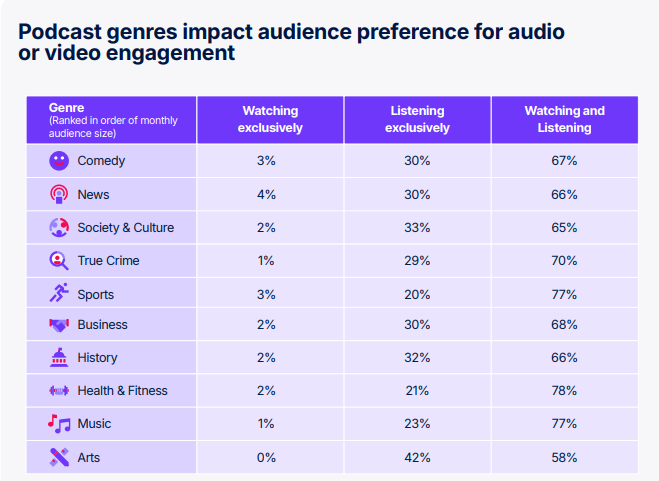
Here’s what Nielsen found. Two-thirds of news podcast consumers, 66%, both watch and listen to their shows. Nearly a third, 30%, stick to audio exclusively. Only 4% watch video only, meaning almost nobody treats news podcasts as a video-first product. Video clearly matters, but it’s not replacing the audio feed anytime soon.

So what should creators take from this? The path forward isn’t complicated. It just requires discipline about priorities.

Audio Isn’t Going Anywhere

News podcasts lean on audio more heavily than almost any other genre Nielsen tracked. True crime shows sit at 29% audio-exclusive, sports comes in at 20%, and music lands at 23%. News podcasts top all of them. That’s not a small gap, either. It’s a real signal about how this particular audience behaves.

Think about who’s actually listening to news podcasts. It’s the commuter catching up on the morning’s biggest stories. It’s the person mowing the lawn who wants context on a story they saw scroll past on their phone. It’s someone folding laundry who just wants smart analysis without needing to stare at a screen. These are multitaskers, and multitaskers gravitate toward audio because it fits into moments video simply can’t.

Creators chasing video growth sometimes let that pursuit come at the expense of audio quality, and that’s a mistake for this genre specifically. Sound design, pacing, and editing still matter more than lighting or camera angles when a third of the audience never watches at all. Skimping on production value to save budget for a camera setup risks alienating the very audience that built the show in the first place.

Video Still Deserves Investment

None of this means news podcasters should abandon video. Interestingly, news actually leads all major genres in exclusive video viewership, too. That tells us something important: there’s a real, distinct audience that wants the visual element, whether it’s for reaction shots, on-screen graphics, or simply watching hosts riff off each other in real time.

Clips distributed on YouTube and Rumble extend a show’s reach well beyond its core subscriber base. They help with discovery, and they often funnel new listeners back toward the audio product once they’ve found a host or a topic they like. Ignoring video means leaving an entire growth channel untapped, and no news podcaster can afford that in 2026’s competitive landscape.

The smartest programmers I’ve talked to already treat video as an amplifier rather than a replacement. They build their show around a strong audio core, then layer video on top to extend its life across platforms. That’s the model Nielsen’s data supports, and it’s the model that makes the most sense given how audiences are actually behaving.

The Bottom Line

Ultimately, this data points toward a hybrid approach, not an either/or decision. News podcasters who invest in both formats — while keeping audio as the foundation — stand the best chance of holding onto their full audience. Meanwhile, those who chase video at audio’s expense risk losing nearly a third of their listener base overnight.

It’s tempting to get swept up in the excitement around video podcasting right now. YouTube’s growth as a podcast destination is real, and it’s not slowing down. The same can be said for Netflix. Many of the big dollar deals are with the video platforms. But excitement doesn’t always match behavior, and Nielsen’s numbers make clear that news audiences still prize audio above all else.

The takeaway for creators is simple: don’t let the shiny appeal of video distract from the format that’s still doing the heavy lifting. Audio isn’t glamorous, and it doesn’t generate the same kind of buzz that a slick video clip does. But it’s still the backbone of news podcasting, and any creator who forgets that does so at their own risk.

Barrett Media produces daily content on the music, news, and sports media industries. Sign up for our newsletters to stay updated and get the latest information right in your inbox.

How Many Promos Does Your Radio Station Really Need?

0

One of the questions I get asked most as a consultant and morning show coach is, “Why doesn’t the audience know what’s going on at my station?” My answer: you’re not running enough promos promoting your contest, your morning show, or your brand depth. Secondarily, the promos you are running don’t stand out.

The brilliant Pierre Bouvard of Cumulus recently wrote about how many spots advertisers need to run for a successful campaign. He outlined how to compute audience turnover. I’m going to take it one step further and give you the actual numbers for several different stations in different formats — but I’m going to keep the call letters out to protect the guilty. All of these scenarios are based on total week, 6am–12 midnight, and what Pierre would call “high impact” — reaching two-thirds of the station’s audience an average of three times. In my opinion, that is the absolute minimum needed for a successful morning show launch or major promotion. Keep in mind, these promos would need to run equally throughout the day to achieve results, and we are not counting the overnight show. Yes, it could be a mix of recorded and live. And this is to promote the one big thing on the station.

The Numbers by Format

Let’s start with Hot AC. These numbers are based on the general format target of women 25–54.

A hugely successful top-5 market Hot AC: 115 promos per week

A struggling top-50 market Hot AC: 151 promos per week

Top 40/CHR is similar. I did the math on the target audience of women 18–49 for this format.

A household-name top-5 market CHR: 111 promos per week

A top-40 market CHR that has seen better days: 167 promos per week

Moving to Classic Hits, these numbers are based on the format target of adults 25–54.

A successful top-5 market Classic Hits: 127 promos per week

A struggling top-10 market Classic Hits: 164 promos per week

Finally, a format with extremely passionate P-1s and much less turnover than music radio — the format that actually founded Barrett Media — sports.

A very successful top-10 market sports station: 55 promos per week

A struggling top-10 market sports station: 86 promos per week

Music programmers’ heads are probably spinning after reading those numbers. But when you give a promotion four promos a day, nobody except you knows you’re running one.

What Your Promos Actually Say Matters

Now, let’s also visit the content of the promos. If you air recorded promos right out of a song — or, in the case of spoken word, right out of strong content — does that recorded promo grab the audience in the first four seconds? If your recorded promos begin with “WXXX is your station in Chicago for summertime fun,” forget it. I know you want your station name up front, but how about opening with “Win Free Tickets” or “Win Money”?

Consider the most effective commercials on your station. They are generally live endorsements by trusted talent. So, are all your promos done by Mister Big Voice, or do you have meaningful talent selling your latest promotion? This is also the perfect vehicle for talent cross-promotion. For example, if your afternoon host talks about how funny the morning show was at 7:20 — and says it almost caused a wreck because they were laughing so hard taking the kids to school — that gets attention. It is, in effect, an endorsement of another show on your station.

Talent doing live promos — or even recording them — gives you a pass, because the audience doesn’t perceive them as commercials. However, you can bet that any recorded promo by Mister Big Voice is thought of as a spot. The audience may know it’s a commercial for your station, but it’s a commercial nonetheless.

The Bottom Line: Frequency Sells

I’m going to once again mention my favorite Scott Shannon quote: “The greatest radio stations are built on a typewriter” — updated today to an iPad. You need better promos, and you need to run them more often. Every programmer needs to internalize the basic rule from your sales department: in radio, frequency sells.

Barrett Media produces daily content on the music, news, and sports media industries. Sign up for our newsletters to stay updated and get the latest information right in your inbox.
Tony Reali Proves He’s the ‘Real Deal’ With iHeartMedia Podcast Debut

0

Tony Reali was a fixture at ESPN for more than a quarter century. Wherever he went, classic shows followed. For a decade, he was the statistician known as Stat Boy on the long-running and still-running Pardon the Interruption (PTI) with Tony Kornheiser and Mike Wilbon. From there, he branched off to host ESPN’s version of a sports game show, Around the Horn. Reali brought a vibrant, fun and pleasantly wisecracking style to that program and launched the ESPN careers of many commentators. A native New Yorker, Reali brought a Big Apple sensibility to everything he did.

Around the Horn ended its 23-year run in May 2025 after nearly 5,000 episodes. This week, Reali boldly returned to the airwaves with Real Deal with Tony Reali, his own podcast on iHeartRadio Podcasts.

His approach has not changed. Reali brings the same verve and nerve that marked his ESPN work. He opened his first episode with an enthusiastic walking selfie through the halls of iHeartMedia and into his studio, stopping at the entrance to gleefully greet the receptionist, Nora.

Real Deal with Tony Reali reflects on some of the greatest sports events and athletes. Analyzing them in a way that recalls the emotion and feel of the moment. In fact, that’s what the show is all about — the moments and people who make sports so special.

You can actually sense and see Reali’s deep love of sports. This is not a show about current statistics or political stances. It is about one dude sharing his joy and passion for the games and those who play them.

Come Out Swimming

It is vintage Reali, jovial and personable with everyone he meets. During his walk to the studio, he sets up the show’s topic. His first episode looked back at the 4×100 freestyle relay team at the 2008 Beijing Olympics. That team worked together to pull off a huge upset of the French squad. It was the springboard for Michael Phelps and his record eight gold medals in Beijing.

Leave it to Reali to be ballsy enough to open a new show with swimming instead of one of the more mainstream sports. Moreover, this is his program, and he is going to put his stamp on it. During his work on PTI and Around the Horn, Reali made other personalities look good, but Real Deal with Tony Reali is his time to shine.

I like the show’s studio setup. Behind him is a glass window overlooking the iHeart offices. You can see people working at their desks and walking through the area. It’s pretty cool.

In this opening episode, Reali called the Beijing 4×100 relay win one of the greatest team moments in sports history. He then counted down his top sports teammate moments ever, including the Reggie Bush Push in USC’s game against Notre Dame, the Titans’ Music City Miracle featuring the lateral from Frank Wycheck to Kevin Dyson, Chris Bosh’s offensive rebound and pass to Ray Allen for his incredible shot against the Spurs in the NBA Finals, the Red Sox’s Game 4 win against the Yankees in the 2004 ALCS featuring Kevin Millar, Bill Mueller, David Ortiz and Dave Roberts, and Grant Hill’s pass to Christian Laettner for the memorable game-winning shot against Kentucky in the NCAA Tournament.

Reali’s number one moment was the Beijing relay team in the 2008 Olympics.

Fittingly, the first guest on Real Deal with Tony Reali was Rowdy Gaines, a U.S. swimming icon and the man who served as NBC’s color analyst for the 2008 Olympics. During the interview, Reali told Gaines that he loves sports announcers who bring their heart and spirit outside their bodies for viewers to see. In truth, this is a perfect description of Reali himself. Real Deal with Tony Reali is aptly named because Reali is as real as it gets.

Gaines brought similar emotion back in 2008 while calling that 4×100 freestyle Olympic relay race. It was where teammates Phelps, Garrett Weber-Gale, Cullen Jones and Jason Lezak collaborated to beat the heavily favored French team with a world-record time of 3:08.24. Gaines explained that the 4×100 relay was going to be the toughest race for Phelps to complete his gold-medal sweep at those Olympics. Thanks to his teammates, he did just that.

Gaines backed up Reali’s assertions, saying the relay team consisted of four guys who came together and did not want to disappoint Phelps, each other, their fans or their country.

Reflecting On Moments Together

Podcasts like Real Deal with Tony Reali are host-driven. It is pretty much a one-shot of Reali followed by a two-shot of him and his guest. You need a special kind of host to make this work. Additionally, that’s why Reali is that guy.

I was impressed with how he handled the spotlight alone for the first time in his career as we know it. He asked Gaines some terrific questions, bringing out the same emotion he brings to the podcast. Although Gaines and Reali had never met before, by the end of the show it seemed like they had known each other for decades. It felt more like a conversation than a Q&A, and you could tell Gaines was amused by Reali’s personality.

I learned a lot from this show. Moreover, that gives me a really good feeling about Real Deal with Tony Reali. It is not going to be a run-of-the-mill podcast. To demonstrate the depth of its commitment to the subject, the production team displayed a graphic featuring the actual transcript of Gaines’ and play-by-play announcer Dan Hicks’ NBC call of that 2008 relay race. Reali recited part of the transcript with a gigantic smile and matching emotion.

Reali’s passion was contagious as Gaines sentimentally talked about how true amateur Olympic athletes capture the imagination of the American public and why we love rooting for a group of kids who reach amazing milestones and accomplish unforgettable feats. In addition, the host and guest truly bonded on the show. So much so that Reali stood up, turned to the office staff behind him and joyfully yelled that he had just made friends with Rowdy Gaines. How can you not love that?

Throughout this debut edition of Real Deal, Reali said the 2008 Olympic relay team and Gaines’ call of the victory brought about “instant tears.” I can paraphrase something similar about the first episode of Real Deal with Tony Reali. It made me an instant fan. Moreover, I am looking forward to watching the show grow and develop.

Barrett Media produces daily content on the music, news, and sports media industries. Sign up for our newsletters to stay updated and get the latest information right in your inbox.