Home Blog Page 876

Why is a ‘Final Show’ Difficult for Talent and Management to Execute?

0

In sports, legends get farewell tours. In movies, beloved characters ride off into the sunset. But what about in broadcasting? The mic often goes silent when managers and/or talent choose to pursue new directions. That begs the question, should a final show be afforded by brands to established talent?

Last week’s saga at Mad Dog Sports Radio produced bad PR for SiriusXM. Michelle Beadle and Cody Decker learned that Stephen A. Smith would take over their timeslot in September and voiced their disappointment on-air. The duo learned of the news in The Hollywood Reporter rather than from their agents and employer. Understandably, Beadle and Decker were less than thrilled.

This put Stephen A. Smith in a bad spot also. It’s not his job to handle talent situations, that’s for SiriusXM management. What should’ve been an exciting day for Smith instead turned into having to defend his new opportunity, and respond to how the company handled another show’s exit.

Beadle also made it clear that she doesn’t think highly of Smith. She told Front Office Sports, “I just don’t respect him. I think he gets things wrong all the time. I’m not talking about opinions; those can never be wrong. But factually, when you spread yourself so thin, it’s hard to be right. Not a fan.” That gave Smith another issue to address.

Chris ‘Mad Dog’ Russo acknowledged on his show that Beadle and Decker probably shouldn’t have been put on the air. He reminded listeners that he didn’t get a final show at WFAN when he left in 2008. If not for Mike Francesa putting him on by phone against management’s wishes, Russo’s nearly two-decade connection with New York sports radio listeners would have ended in silence.

It’s a strange contradiction, especially for an industry built on connection. An established on-air talent who has helped influence a station’s identity, forming a bond with an audience and advertisers, is suddenly sent packing without notice. There’s no final show. No acknowledgment. No consideration for the audience. It’s just over.

This topic isn’t new. I wrote about this very issue 8 years ago. Managers are asked to protect the business, even if it doesn’t please the audience or personalities involved. John Mamola discussed it in his column on Friday. But it’s more complicated in 2025, and professionals should be able to find common ground to end public relationships in a professional way.

The Landscape Has Shifted

Listeners are more vocal today about sudden talent disappearances, especially with social media providing an immediate opportunity to reach brand leaders and those affected. Just as recently as two weeks ago, reports of the WWE parting ways with Ron ‘R-Truth’ Killings left fans chanting loudly at arenas in support of the popular wrestler. Heavy amounts of negative feedback hit the company on social media over its decision, and then this past weekend, R-Truth returned to WWE, playing a key role in the main event’s outcome.

The company heard the audience and corrected a mistake. Unfortunately, not all brands and individuals do the same. Whether it should have even been necessary though is where the issue lies. If the company wanted to cut ties with R-Truth, it had the right to do so. The way it was handled is what angered the fan base.

Companies can silence talent on the air if they choose but because most now own a direct connection with the audience, they’re going to get a final message to them. We’re in an era of personality-led brands. On-air talent don’t just belong to radio stations and television networks, they’re followed, shared, and supported across X, Facebook, YouTube, TikTok, LinkedIn, Instagram, podcasts, newsletters, and livestreams. The talent is the brand for many listeners. In some cases, more so than the station itself.

That makes abrupt departures even more jarring, and the silence surrounding them more damaging. Not just to the host, but to the station’s credibility, talent culture, and audience trust.

Connection is Currency

Listeners feel ownership of the personalities they invest time in. Whether it’s a morning show they’ve listened to for 15 years or a TV host they watch each night after work. The emotional tie is real for them.

Radio and television are intimate. Voices become part of daily habits. Hosts witness life changes, and react to news and opinions, shaping public conversation. When someone disappears without a trace, it’s not just a staffing move. It’s a break in trust with the audience who have supported the talent and brand.

A proper sendoff—whether it’s a final show, a tribute segment, or even a well-communicated exit such as Dan Patrick’s forthcoming retirement provides closure. It demonstrates that there’s respect for the bond created between audience and talent. It honors the investment both have made in it.

But It’s Not Always That Simple

Not every departure ends with hugs and hand shakes. Sometimes it gets messy or personal. Other times it’s as simple as a shift in business (budget cuts, format changes, a change in direction, etc.) making the sting less painful.

Media brands don’t always have the luxury or interest in providing a feel-good exit. There are non-disclosure agreements, HR protocols, and occasionally bruised egos to handle. None of those challenges justify though a lack of basic acknowledgment, especially when it leaves the audience confused.

There’s also the question of whether or not a talent has been with a brand long-enough and created a major business lift to warrant special treatment. This happens in sports far too often. Teams produce video tributes for players who don’t deserve them simply because they fear social media backlash. In Michelle Beadle and Cody Decker’s case, they deserved better communication than they received, but they weren’t at Mad Dog Sports Radio long enough to warrant the same victory parade that Chris Russo will receive when he elects to shut it down one day.

The Value of a Final Show or Farewell Tour

In recent years, we’ve seen many kinds of exits. Dan Le Batard left ESPN with a heartfelt farewell and instant pivot to his own platform. Fox News and CNN separated from Tucker Carlson and Don Lemon on the same day, offering neither a farewell. Mike Francesa’s departure from WFAN was treated special, but when Mike came back a few months later, taking back his former timeslot from Maggie Gray, Chris Carlin and Bart Scott, it felt empty. That played a part in how Mike’s exit was handled the second time around.

A final show shouldn’t be about ego. It should be about closure for the host, company, and audience. If all involved act professionally and execute it right, it sits better with the public, future employees/employers, and gives everyone involved peace of mind as they explore new directions.

Conclusion

If a final show isn’t possible due to a sudden departure, a host not wanting to do it, or legal/contractual issues preventing it, what matters then is acknowledgment. There are a few ways it can be done.

  • A social media tribute by the brand
  • An on-air message from colleagues
  • A farewell on-air promo, video messages or social media images
  • An interview by the departing host with another host on the station
  • A written article on the station website or a press release sent to media outlets

Even if the situation is delicate, there are ways to show respect, and avoid speculation. Silence often creates worse outcomes as rumors, distrust, and backlash from the audience and advertisers follows. It also puts the next show on your station or network in a difficult spot with your audience. Conversely, it can help the next show if you end the current relationship the right way. WIP did it perfectly two years ago with Angelo Cataldi.

Personalities now have their own platforms. You’re not going to silence them when they’re losing their job and looking for their next stop even if you threaten to hold up their severance. That said, talent can be insecure and ego driven and think before acting too. Someone else being valued more than them by their employer leads to not taking into consideration that management hasn’t had time to alert co-workers or advertising partners or finish crafting a message to inform the public of their upcoming exit. Instead, they rush to react, and in the process, create negativity, ruining references, and sometimes costing themselves money.

What it boils down to is treating folks with respect. I think established personalities who’ve played a key role in a brand’s audience and business growth deserve an opportunity to say goodbye. A final show isn’t about showing who has more stroke. It’s about ending well, so everyone involved can move forward stronger.

How things start and finish speaks volumes about the relationship between the talent, executive(s) and company. These are public roles, so the audience and advertisers deserve honesty. Saying goodbye is never easy, but not every ending has to create bad blood. With so many of these situations involving adults over the age of 35, it’s stunning that two sides can’t meet, address the elephant in the room, explain what each side wants as the relationship nears its end, and create a plan that all involved are comfortable with.


The Barrett Bash

Invitations went out last week to over 1,000 media industry professionals for the first-ever ‘Barrett Bash’. The invite-only event created to celebrate a decade in business, takes place Thursday September 4th from 5p-8p ET at 1604 Broadway in NYC. We can’t accommodate everyone so if you received the invite and are interested in attending, RSVP as soon as possible. It’s first-come first-served.

Many wait until the month before to confirm attendance at our evets but last week alone we received over 75 confirmations. We expect a few hundred people at the Bash, most representing the sports, news, music, and advertising industries and working in radio, television or digital.

I plan to add a host for this event. We have a DJ but I’m also talking with label contacts about having an artist play a short acoustic-set at the show. Additional surprises are planned as well. Those interested in hosting or supplying an on-site performance can email me at Jason@BarrettMedia.com.


2025 BNM Summit

The 2025 BNM Summit comes to New York City for the first-time ever on September 3-4, 2025. Announced already as speakers are Glenn Beck, Chris Ruddy, Mike Gallagher, Erick Erickson, Sid Rosenberg, Mark Simone, Drew Anderssen, Chris Berry, Ken Charles and Mary Sandberg Boyle. Tickets are on-sale until June 30th at the discounted rate of $224.99. Prices increase to $324.99 on July 1st. To secure your seat and reserve your hotel room at the lovely Park Central hotel, visit BNMSummit.com.


Barrett Media produces daily content on the music, news, and sports media industries. To stay updated, sign up for our newsletters and get the latest information delivered straight to your inbox.

How the Classic Rock Radio Format Can Connect With Gen Z And Millennials

0

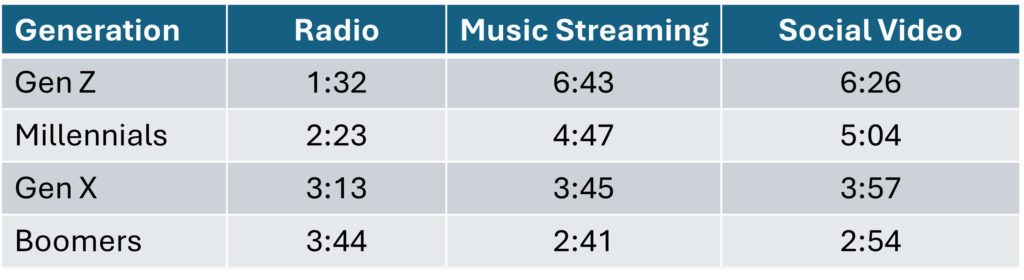
Here’s an interesting statistic for you to chew on: in the U.S., Millennials plus Generations A and Z make up 58% of all people in the country. The remaining 42% – the minority – is made up of Generation X, Baby Boomers, and the Silent Generation.

I mention this because, according to Evan Shapiro, known as the Cartographer of the Media Universe, this creates two very distinct media ecosystems: one for Gen X and older and a distinctly different one for Millennials and younger.

In an article on his Media War and Peace Substack, Shapiro explores the differences. Pointing out that both groups pursue the same sorts of content, what differs is how they want to consume it.

If you aren’t familiar with Shapiro, like I wasn’t until this week, he is currently the head of ESHAP. A change agency that offers partners media insights and strategy. He has a long history in media, including running TV Networks, launching streaming platforms, producing Portlandia, winning an Emmy and two Peabody awards, and much more.

I was intrigued by his concept of a generational divide in media consumption, but his post primarily focused on video streaming. Luckily, he was kind enough to share a few thoughts with me about where audio and radio fit into the two different media landscapes and how to best take advantage of each.

MS: Your column is primarily about television. What can you share about music consumption and, more specifically, radio consumption differences?

ES: The divide is similarly pronounced in audio, except for podcasting. Radio attracts older generations while music streaming brings in the younger two. 

MS: Classic Rock currently focuses on Rock music from the late sixties to the mid-nineties. Should we strategize about how to attract Millennials and Generations Z and A, or are they simply out of reach?

ES: All the research I’ve seen shows that the platform dictates the audience more than content. Many Gen Z and Millennials love seventies rock. But they watch/listen to it on Vevo or YouTube Music.

MS: If the consumption of Classic Rock is there with younger generations, how can Classic Rock outlets that have specialized in this music for years capitalize on that popularity?

ES: Play where the audiences are social video and media. Think about extensions like newsletters and podcasts about the artists and the music. Think about live shows. Gen Z and Millennials are three times as likely to go to live shows this summer than Gen X and Boomers. Create community, not audience. 

MS: Classic Rock stations have been slowly embracing music from the ‘90s. Should they just embrace anything that was released in the formative years for Gen X through the Baby Boomers, since that’s the demographic that exists together in a media ecosphere, or do you see a dividing line between music that came out pre- and post-Gen X?

ES: Build your business around your best customers. In the user-centric era, the currency is not reach, it’s love. Cater to the fans who love your stuff, and their passion will fuel your flywheel.

That’s a lot of good advice packed into just a few short answers. Here are my two main takeaways:

Let’s stop arguing specifically about the introduction of music from the nineties and focus more on playing the music that our listeners love.

It’s time to start thinking strategically about using digital assets to reach younger audiences.

We have the expertise and the reputation. We need to figure out how to get our content to Millennials and Gen Z. Radio may not be able to jump the generational divide, but Classic Rock can.

Barrett Media produces daily content on the music, news, and sports media industries. To stay updated, sign up for our newsletters and get the latest information delivered straight to your inbox.
The Jason Lee & Cluck Show Succeeds By Bringing Their Lives On The Air

0

The “Jason Lee and Kluck Show” is based at Federated Media’s 103.9 The Bear in South Bend, IN and syndicated to markets by Audio 1. The duo describes the show as a personality-driven show that is based on their lives.

“It seems like a lot of other shows try so hard to be relatable, but for us, it just seems like it comes naturally. We’re very personality-driven, which sounds like a weird word to me. A weird phrase to me. For personality, it has to be a person like Katy Perry. But we’re a personality show in the fact that the show is based around our lives. Our lives are regular and very relatable, so the relatability with our audience doesn’t seem forced,” said Lee.

“It’s not hard. It comes very easy for both of us. Sometimes I feel weird and guilty about it because I see all these shows constantly banging each other’s heads and talking about how quickly people are relatable. It’s just natural for us.”

Kluck added, “It’s been pretty easy from a show standpoint because it’s not like we have to go into work and fit some mold. We literally just come to work and be ourselves. It doesn’t get any easier and more fun than that. It’s not thinking, jeez, how are we going to relate to our audience because we are our audience?

“We got a great compliment a couple of weeks ago from somebody,’ said Lee. “I don’t know if they said something about the show and how it was funny and how it got them going in the morning. But then they also said something about, and then sometimes you’re serious, I thought was kind of a neat compliment that you can play both sides of the tracks like that. I thought that was a huge compliment.”

“This just dawned on me, but when all of us were growing up and we were listening to the radio, we loved the big, bombastic personalities because they were people in our community, and they were celebrities. So you wanted to hear about the cool celebrity shit that they did. And they would all play that up.”

“If a band was in town and they did a 30-second meet and greet, they would do four hours on that meet and greet because you wanted to hear about somebody that was doing something like that. But if that was on the radio today, I would punch out immediately. I don’t want to listen to this. I want to listen to somebody that I can relate to. I want to listen to somebody who’s living the same life as me.”

“I feel like the rock audience is particularly keen at sniffing out if you’re being even the slightest bit inauthentic. That’s also kind of cool about the relatability of this show because we’ll talk about stuff like that.

“Then you’ll hear the DJ across town. He’s like, yeah, man, I partied with Shinedown last night. And he’ll straight out say, we partied with Shinedown last night. No. We shook hands. We got an autograph. We walked away. There’s no party.”

“We take a different approach, too. It seemed like when we were coming out that you would try your hardest to make the shows seem as glitzy and glamorous and well-oiled and highfalutin as you could. But the more we pulled back the curtain on the fact that it is a low-rent show, in a building that has unsteady heating and air conditioning (we really don’t have any perks to speak of at all), that added to our relatability. It could not get any more low-budget, low-rent than what it is.”

The show has a theme that carries across all their platforms, like podcasts and social media. “Here’s your freaking podcast,” etc. And it had a funny start.

“A lot of that has kind of born out of our resistance to doing things. We’re like, ‘ Alright, fine. ‘ Here’s your freaking podcast. It has that air of extra work that we didn’t want to do, and everybody has that at their job.”

“I’m going to have you do some extra stuff this week. You know, like, fine here’s your freaking coffee that you made me go out and get for you. Here’s your freaking dry cleaning. It carries an air about that, which I think is really funny. And again, it goes back to being relatable. Everybody does stuff that they’re not really excited about doing. That’s the joke.”

“We don’t get paid for the podcast and all the little things. We don’t get a dime out of this. So if you don’t want to listen, don’t. It’s not like we’re going to make any money out of it, like our T-shirts and stuff like that. We don’t make any money off T-shirts. If you don’t want to buy one, don’t buy one.”

The show is in the early phases of syndication through Audio 1.

“We’ve talked about it for years, and we thought it would happen faster than it has. We were a show for 10 years, and then we got simulcast to the flagship station of the company in Fort Wayne. And that’s been going on for five years. We were doing pretty well, and then Audio 1 came along and offered to syndicate the show. And we’re now on in Dothan, Alabama, at a Bear station down there.”

Kluck added, “Jason’s right. We’ve been on it for a long time, maybe even before we were ready for it, we thought. But it’s a process. You’re fighting some big names and big brands out there. But we’ve had pretty great ratings success against every big dog that’s come through. We vanquished them to the ether.”

“You can take Fort Wayne, for example, our first out-of-market show. And we’ve had to go against everybody that we thought was big-time. “Bob and Tom,” “Free Beer and Hot Wings.” And they lasted not very long at all. And we thought, all right, that’s the ticket, because we’re beating all the big-name syndicated shows. That’s got to account for something, right? And it turns out that it really doesn’t.”

And how do we find the next generation of young people who are excited to be in radio?

Lee said, “Well, what we’ve found, with our company specifically, is that if you go to any college or university, there is a radio station there filled with people who are excited to be a part of the business. We’ve got one down the street, Goshen College, that has been a pipeline of people who have come through here, found jobs with the company, and have gone on to bigger radio and TV gigs.”

“Those kids are there. You just have to reach out a little bit. Our company has a fantastic relationship with that department. So, they’re out there. I mean, they might not be showing up. When I was coming up, I worked at a gas station. I just wanted to work at a radio station, so I walked in. And that’s how I got into the business. That doesn’t happen anymore. But if any company out there is looking for talent, just go to your nearest college radio station. It’s there.

 Listen to “Jason Lee and Kluck on 103.9 The Bear here.             

Contact Audio 1 for syndication information.   

Barrett Media produces daily content on the music, news, and sports media industries. To stay updated, sign up for our newsletters and get the latest information delivered straight to your inbox. 

8 Potential Non-Radio Careers Industry Professionals Should Consider

What’s next? We’ve often talked here about the need to have a career Plan B in case you can’t find a radio job. That’s become more critical as radio executives sit back in their office chairs and dream of a day when AI will take over all functions of a radio station – on air, sales, production, everything – and they can tell their private equity overlords that there are practically no salaries left to pay other than their own, at which point the investors will ask “why are you still here?” and replace them with AI as well.

And we’ll all have a good laugh about that while waiting in the queue for government cheese.

No, really. Having a Plan B for your career is a good idea, but it’s not like other industries are doing much better, and we’re approaching a major dip in the economy (and a whole lot of other horrible things, but I promised myself I wouldn’t make this political and I’m gonna stick to that).

When you plan alternative career possibilities, one of the things people always say when they’re giving advice on LinkedIn is to assess what your transferrable skills are and how they can translate into a new career. If you’re a radio host, what might those transferable skills be? Let’s see…

1.  Walmart greeter Communications skills, ability to relate to the public… wait, they don’t have greeters anymore, do they? And checking receipts as customers leave requires hostility, so forget that. How about…

2. Sports mascot. Really, any kind of mascot. You’ve shown you can interact with the public, you’re an entertainer, you can do this. Just be aware that those costumes really stink inside. Keep telling yourself, hey, it’s almost a living.

3. Air traffic controller. I hear there are openings. You know your way around a microphone headset and you can speak in clear, understandable tones. The job might drive you insane, though. Good thing you’re likely already there.

4. Lawyer. A gift of gab goes a long way in the legal profession. I can speak to this because I happen to be a lawyer, albeit a retired lawyer who hasn’t practiced since the ‘80s and hated every minute of it. Really, the only reason I have a law degree is to be able to say “I’m a lawyer” and watch people recoil in horror. Anyway, this takes three years of law school and passing the bar, which, I assure you, is no fun at all.

5. Cable news pundit/Trump administration appointee/cabinet member. You have opinions and communication skills, which is all you need. The cable news part isn’t really a Plan B since it’s another media job, but the goal is to get a prime government job in which you can screw everything up and not get fired, because screwing up is encouraged.

What did I say about not getting political? Scratch that. (By the way, have you seen Dan Bongino lately? Not a happy camper. Turns out being a podcaster and pundit is a lot different from having actual responsibility and finding out that what you pumped out on the air all those years was, let’s say, not quite accurate.)

6. Writer. Because everyone can do it, right? As someone who ended up going from radio to writing as a career, I get a lot of that when people find out what I do. “Writer? Oh, I love writing. Seems easy.” No, it isn’t, and no, you probably can’t. Also, the pay sucks, getting published requires a lot of rejection and a lot of social media followers, and the industry is at least as screwed up as radio, so you’ll be back at square one in no time at all.

7. Running the board at music venues. You know how to slide pots up and down and press buttons. Learn how to turn knobs and what they do, and you’re all set. The downside is that you’ll have to listen to a lot of lousy local bands. Earplugs are highly recommended.

8. Retiree puttering around a 55+ community in Florida. That’s what I ended up doing. The only skill needed is to know that it’s time. You’ll spend much of your day rummaging through junk mail regarding Medicare plans, complaining about the traffic and weather, and wondering what to have for dinner and when (earlier and earlier). Everybody can do that.

I hope that it doesn’t come to this, that you remain gainfully employed in radio and don’t need a career change. Doesn’t hurt to think about the next stage of life, though. Beats thinking about the news right now. Maybe they’ll be hiring at the reeducation camps.

Barrett Media produces daily content on the music, news, and sports media industries. To stay updated, sign up for our newsletters and get the latest information delivered straight to your inbox.
How Emery Songer Manages Hosting at Both 1110 KFAB and 1040 WHO in Day Different Dayparts

Two years ago, Emery Songer left the friendly confines of his hometown news/talk station — 1040 WHO — to embark on a new journey hosting afternoons at 1110 KFAB in Omaha. Little did he know that he would soon be back at his old stomping grounds…while also staying in Omaha.

Today, Emery Songer hosts from 9-11 AM on 1040 WHO (as well as at iHeartMedia sister station 600 WMT in nearby Cedar Rapids), in addition to hosting afternoon drive at 1110 KFAB.

Originally, Songer left Des Moines in search of an on-air opportunity that didn’t feel likely to come due to the cemented stable of shows at 1040 WHO. But it’s radio. Plans change, and personnel change all the time. So when changes were made at the iHeartMedia news/talk station, he hopped at the chance to step back into a show at his original radio home.

“I’ll be honest, I was so focused on trying to be good in Omaha,” he said of the opportunity at WHO. “And then there was a big shake up in Des Moines. It was only like seven or eight months after I had left. So, I mean, it really hadn’t been that long, and so I was an obvious choice … We got things set up so I could do that from Omaha, and I was happy to do that. I subbed from 9 to 11 countless times for Jeff Angelo while I was working in the market, so it wasn’t really any big deal.”

Songer noted that hosting the mid-morning show forced him to change his habits a little bit, for the good.

“I kind of like waking up earlier,” he said of the schedule. “I kind of like getting a chance to see the news in the morning and get to talk about it.”

Being on the air for six hours of daily radio doesn’t sound like it would set up Songer to feature a great work/life balance.

But he says it has had the opposite effect.

“It’s actually given me more life balance. I think it’s given me a great way to stay connected to Des Moines, to Cedar Rapids, to my home state of Iowa,” he shared. “Honestly, there are a lot of days I feel very wore out mentally. It has been a grind, basically doing what is two full-time jobs at the same exact time.

“It’s a bit of a challenge, but while I’m still young, I have a chance to chase some of this stuff. I get to be connected to more people. It’s an opportunity. I certainly don’t think I’d ever have gotten to be in two markets like this that mean so much to me at the exact same time. So it’s a difficult balance day to day, but it’s one I’m super grateful for, and one that I am so thankful to be able to have.”

For both of his shows, Emery Songer is aided by having national topics to discuss, which are pertinent to listeners in both Omaha and Des Moines. Focusing on local content for local listeners, however, remains a pivotal part of his strategy each day.

“You’re paying attention to two states and two areas at the same time. But I have a lot of tools at my fingertips. My bosses are very gracious in being able to help share some of the stuff that they’re seeing out there, because they know I’m not gonna be able to catch everything,” said Songer. “But, also my listeners and having a chance to kind of converse with them about it, and not just be a conduit of information, but also kind of a conversation starter. And being able to have that conversation with people when it’s something that they care about, that’s really where, you know, my bread is buttered, if you will.”

The news/talk radio space is dominated by — to attempt to put it delicately — those on the “upper end” of the 25-54 demographic.

Emery Songer doesn’t exactly fit that bill. A news/talk radio host in his early 30s, having the chance to host two shows, in two different dayparts, in two separate markets was a big undertaking. He was open about the mental strength it took to get over some of the hurdles to feel like he belonged.

“Just to be very open, I’m very much a mental health advocate,” he shared. “I have major imposter syndrome, because I do feel like I’m a little bit of a different type of person. Not just because of my age, but also I’m multiple generations younger than some of the guys I’m even working with. I think that perspective is valuable in news/talk — not just because you want to bring a younger audience in the hope that somebody their age can bring a younger audience, because I think I have a responsibility to grow in those demographics — but I also think it’s just a different way to converse.

“I see the world so differently than so many other people because of my age. I was 10 years old when 9/11 happened, right? So, I took in that event and that information in a very different place in my life than most of the other people that you’re going to hear talk about it that are on news/talk radio.

“I feel like I can strike just maybe a different chord, so I can talk about the same things, but I’m just coming at it from a very different angle,” he continued. “And I’m hopeful that that kind of freshness doesn’t just attract the audience that’s my age, but also the kind of listener who might be a generation or two older than me be like, ‘You know, I never really saw it or thought of it that way.’ If I can hit that note, I’m doing my job, and that’s everything that I’m striving to do no matter what we’re talking about.”

Barrett Media produces daily content on the music, news, and sports media industries. To stay updated, sign up for our newsletters and get the latest information delivered straight to your inbox.
The Watch: Inside Politics with Dana Bash, CNN

Inside Politics with Dana Bash on CNN is virtually unlike anything else in cable news in its timeslot.

There are plenty of news-focused shows in the midday Eastern timeslot. That’s not to say that the Bash-led show doesn’t fit that bill. But it isn’t a general news show. It’s solely focused on “Inside the Beltway” politics, which highlights Bash’s strengths.

But on Thursday, an atypical news day unfolded. It literally isn’t every day that the world’s richest man talks about the beef he has with the President of the United States of America.

That’s virtually as inside the beltway as politics can get, truly. So this story and day was right up Dana Bash’s alley.

The story evolved in real-time during the Noon ET program. Inside Politics spent a large portion of the middle of the show dedicated to the breaking news that Trump and Musk had essentially broken up. Included in the show was a live hit with correspondent Alayna Treene from the White House’s lawn, as well as live looks at Musk’s X feed on social media to see what he was saying about the President as it came in.

I actually liked that strategy. While it might not be the most visually appealing product, it is insanely interesting and generates intrigue. I had the advantage of hindsight while watching this Thursday episode of Inside Politics with Dana Bash, it watching the program still had me on the edge of my seat to see what Musk was going to tweet next, knowing that full-fledged nuclear bomb was still incoming later in the afternoon, well after the CNN show ended.

Knowing what that feud would turn into, I found it illuminating that Bash almost knew exactly where the feud between Trump and Musk was headed, essentially arguing that a complete breakdown of the relationship between the two was imminent. And at that time, it was only due to Trump arguing that he Musk was misguided in his criticism of the “big beautiful bill”, as the message basically claiming the President could be incriminated by the Epstein Files was yet to come.

I think that speaks to the knowledge level Dana Bash features. She knew, instinctively, that we were watching the dissolution of this partnership in real-time. Others might have attempted to argue that it was a mere squabble between two passionate forces. But anyone with half a brain knew that the relationship between two egomaniacs was never going to last. And Dana Bash shared an opinion that this was going to blow up before it really blew up. Again, watching it with the ability of hindsight, but I came away impressed.

At times, though, I thought the show was weakened by a trope that, in my view, CNN relies upon too frequently: a damn panel. Turn on CNN at what seems like any time of day, and you’ll see a host surrounded by four relatively unknown figures dishing on the top stories of the day.

Great. Cool. Interesting? Not especially. The panel format works in two instances: either the audience is intricately familiar with the cast you’ve regularly assembled or you’ve put together a panel with a group that features folks with strong name recognition. That’s basically it.

Does that stink? Absolutely. But we just live in a world where the audience has to know immediately why they should care about what the person speaking has to say. Credibility matters, but it’s often earned by the credibility of others on the set. So while Dana Bash herself is credible, and her credibility can be lent to others, it isn’t enough to keep a viewer’s attention with the insinuation that “If she values what they’re going to say, then so do I.” It just doesn’t really work like that anymore.

If the Inside Politics panel was filled with Sen. Ted Cruz (R-TX), Rep. Alexandria Ocasio-Cortez (D-NY), and former Secretary of State Condoleezza Rice, I don’t think even the most ardent CNN hater could argue that they should be using a panel format in that instance.

But that wasn’t who was joining Dana Bash at the desk. It was four people (CNN’s Kristen Holmes and Kylie Atwood, Josh Dawsey of The Wall Street Journal, and Zolan Kanno-Youngs of The New York Times), and — frankly — I had never heard of. It felt as if the introductions of the four-person panel was somewhat rushed, which I wholly understand. You’re in breaking news mode, but it felt like an important time to slow down and really hit home why the audience should care about what these people have to say. They’re White House correspondents and insiders. While I thought their content, opinion, and analysis were interesting and compelling, they were perceived as unknowns. And perception is reality.

Like almost all cable news shows, I saw good and bad with Inside Politics with Dana Bash. Ultimately, I thought the good outweighed the bad, especially because it’s unlike many other cable news shows in its timeslot. But it wasn’t dissimilar enough from other shows from CNN to make me think that it was something that I would need to watch every single day to feel as if I still had my finger on the pulse of what was happening in Washington.

Barrett Media produces daily content on the music, news, and sports media industries. To stay updated, sign up for our newsletters and get the latest information delivered straight to your inbox.

ESPN Finalizing Deal To Add One College Football Playoff Semifinal To TNT Sports: Report

0

According to a report by Ross Dellenger of Yahoo Sports, TNT Sports is on the verge of potentially taking on some added College Football Playoff programming as part of its sublicensing agreement with ESPN and the Walt Disney Company. Dellenger is reporting that ESPN is finalizing an agreement with TNT Sports to include the College Football Playoff semifinal round, with rights to one CFP semifinal annually in 2026, 2027, and 2028.

This report builds on the current agreement between the two networks that grants TNT Sports the rights to two first-round College Football Playoff games and two quarterfinal matchups, which began last year and runs through 2028.

Therefore, this means, barring any further CFP expansion, the networks will split the broadcasts of the other ten remaining College Football Playoff games in 2026–2028.

With the addition of the semifinal on TNT Sports, it would give the network five of the eleven total CFP games under the 12-team format—but still without the National Championship Game.

Since its inception in the 2014–15 season, ESPN has exclusively aired every single CFP semifinal. Furthermore, in early 2024, ESPN and the College Football Playoff agreed to a six-year contract to retain the network as the rightsholder of the event through the 2031–32 season. As part of that deal, the network has expanded its package of games in the final two years of the agreement to include all four of the new first-round games, in addition to the quarterfinals, semifinals, and CFP National Championship Game.

As a result of the expanded sublicensing agreement—combined with ESPN’s commitment to place at least one game per round on ABC—the network would not have exclusive coverage of either semifinal during any of those seasons.

In addition to the CFP agreement, ESPN has separately agreed to sublicense some Big 12 football and men’s basketball games to TNT in exchange for the right to license the network’s “Inside the NBA” studio show for its own NBA coverage starting next season.

David Haugh: ‘This is a Huge Day for the Chicago Sports Network’

1

More than eight months after it launched in the locale, the Chicago Sports Network has reached a carriage agreement with Comcast, granting users within the Xfinity Ultimate TV package access to programming. As the official home of the Chicago Blackhawks, Chicago Bulls and Chicago White Sox, sports fans using the Comcast service have been unable to view local game broadcasts unless subscribing to another service, watching on an over-the-air platform or subscribing to a direct-to-consumer plan. Outside of the game broadcasts, the network also contains studio shows and simulcasts two hours of the Mully & Haugh morning program.

“On behalf of the entire CHSN team, we’re proud to welcome Comcast’s Xfinity TV customers to a network built exclusively for Chicago sports fans,” Jason Coyle, president of the Chicago Sports Network, said in a statement. “With more than 300 live Bulls, Blackhawks, and White Sox games each year, along with original programming that highlights Chicago’s pro, college, and high school sports, CHSN delivers the most comprehensive and locally focused coverage available. This deal allows us to reach even more fans across the city and suburbs, deepen connections, and reinforce CHSN as the home for Chicago sports all day, every day.”

On Friday’s edition of the show, co-hosts Mike Mulligan and David Haugh discussed the deal that will further broaden the distribution and reach of the network. Mulligan sported Chicago Sports Network gear in the studio and explained part of the agreement before Haugh divulged that the channel is now accessible to users. In addition to his role with 670 The Score, Haugh also works directly with Chicago Sports Network appearing on The Chicago Lead and The Big Pro Football Show.

“This is a huge day for the Chicago Sports Network,” Haugh said. “It’s a great day for sports fans in the city. It just widens the reach and expands the scope of what they want to do. A lot of good people worked very long and hard on getting this deal done, and finally today, it’s arrived.”

The show subsequently welcomed Chicago White Sox broadcasters Connor McKnight and Brooke Fletcher onto the airwaves where they discussed the significance of the Friday night all-access broadcasts. Chicago Sports Network has been offering fans distinctive access to players and personnel surrounding the team during the Friday night games. As the White Sox prepare to face the Kansas City Royals on Friday at 6:30 p.m. CST, the broadcast will welcome manager Will Venable and pitching coach Ethan Katz as part of the guest lineup. Starting pitcher Adrian Houser is also going to join the presentation, and outfielder Joshua Palacios is going to wear a microphone throughout the game.

“All the on-air talent and the people behind the scenes just work really hard just to put this production together,” Fletcher said. “It’s Chris Withers, our producer – it’s kind of his baby, the Friday night all-access, and he’s just done a fantastic job, and the White Sox, we just appreciate all the access that they’ve given us, right? The future of this organization – there’s a lot of young stars on this team, and so we want to be able to give the White Sox fans an opportunity to get to know these guys.”

Barrett Media produces daily content on the music, news, and sports media industries. To stay updated, sign up for our newsletters and get the latest information delivered straight to your inbox.

Latin Hits 104.5 Picks Up ‘Tino Cochino Radio’ For Mornings

0

“Tino Cochino Radio” is taking over mornings at Spanish Top 40 104.5 Latino Hits in San Antonio. The show will take over for the incumbent “Enrique Santos Show.”

Cochino said, “San Antonio was the first city to believe in me before the rest of the country caught on. Now, partnering with iHeartRadio to host mornings on 104.5 Latino Hits is more than a milestone—it’s a statement. We’re not just doing radio, we’re building a movement rooted in culture, connection and consistency. I’m not here to blend in. I’m here to set the tone in the tone.”

Pedro Escalera, Director of Programming and Brand Strategy, said of the swap, “Tino’s deep connection to San Antonio, his authentic voice and his ability to resonate with our vibrant community make him the perfect fit for 104.5 Latino Hits. This partnership is a natural evolution for both Tino and our brand, and we can’t wait for listeners to wake up with his energy, humor and real talk every morning.”

Pedro Gonzalez, iHeartLatino SVP, added, “We’re thrilled to bring Tino Cochino back to San Antonio as the new voice of mornings on 104.5 Latino Hits. His passion for connecting with listeners with relatable content makes him the perfect fit for our station and our city. We know our audience is going to love waking up with Tino.”

Barrett Media produces daily content on the music, news, and sports media industries. To stay updated, sign up for our newsletters and get the latest information delivered straight to your inbox. 

‘Nights Live with Vicki’ Ochoa Comes To 99.5 The Wolf Dallas

0

Vicki Ochoa has joined Texas Country 99.5 The Wolf in Dallas for an evening show branded as “Nights Live with Vicki Ochoa.”

According to the station website, Ochoa boasts over a decade in media. Including “celebrity interviews from Kendrick Lamar to John Travolta, red carpets, and Billboard Music Awards radio row.”

Previous radio stops include Hot 93.3, New Country 96.3, K104 Dallas and Now 100.5 Sacramento.

Congratulate her here. 

Barrett Media produces daily content on the music, news, and sports media industries. To stay updated, sign up for our newsletters and get the latest information delivered straight to your inbox.