Home Blog Page 918

How Digital Transformation is Shaping the Future of Entertainment and Gambling

Digital transformation is one of the most significant drivers of change in today’s entertainment and gambling industries. From how content is delivered to the creation of new forms of interactive experiences, digital technologies are reshaping the way audiences engage with entertainment. One area that has particularly benefited from this transformation is the world of online gambling, where innovations in mobile gaming, digital platforms, and immersive experiences are setting new standards for player engagement and satisfaction.

The Shift to Online and Mobile Platforms

Gone are the days when players had to visit a physical casino to experience the thrill of gambling. Today, online gambling platforms like High Roller have made it possible for users to enjoy their favorite casino games, such as slots, poker, and table games, from the comfort of their own homes or even on the go via mobile devices. With the rise of smartphones and tablets, players now have instant access to gaming options, making gambling more accessible and convenient than ever before.

The growing popularity of mobile gaming is one of the key drivers of this digital shift. As more people opt for smartphones over traditional desktop computers, casinos are adapting to provide a mobile-friendly experience that replicates the excitement and thrill of an in-person casino. Platforms like High Roller offer mobile-optimized casino games that work seamlessly across devices, ensuring that players can enjoy a smooth and immersive experience wherever they are.

The Integration of Live Gaming

Another major advancement in digital transformation is the rise of live gaming. Many online casinos have introduced live dealer games, which allow players to interact with real-life dealers through live video streams. This creates a more authentic, social gaming experience that mimics the atmosphere of a physical casino, offering players the best of both worlds.

Live gaming is becoming an integral part of online gambling, and it represents a growing trend toward creating more immersive and interactive experiences. Whether it’s blackjack, roulette, or baccarat, live dealer games allow players to enjoy a realistic gambling experience from the comfort of their homes. The integration of live gaming is also a key feature on platforms like High Roller, which brings real dealers and cutting-edge technology together to enhance player engagement.

Immersive Technologies: VR and AR in Gambling

The entertainment and gambling industries are also exploring the potential of immersive technologies like virtual reality (VR) and augmented reality (AR). These technologies are beginning to find their place in the online gaming world, providing players with even more interactive and engaging experiences.

For example, virtual reality can transport players to a completely different world, where they can interact with their environment, place bets, and socialize with others in a fully immersive 3D casino setting. Similarly, augmented reality allows for digital elements to be overlaid onto the real world, offering unique gaming experiences that blend the physical and digital realms. As these technologies become more affordable and accessible, they will likely become a significant part of the future of online gambling, providing even greater opportunities for entertainment.

Platforms like High Roller are at the forefront of embracing new technologies to keep their games fresh and exciting. The integration of VR and AR into online casinos could revolutionize how players experience digital gambling, offering a more immersive and engaging environment than ever before.

The Role of Data and Personalization

Digital transformation has also led to a surge in the use of data and artificial intelligence (AI) to personalize gaming experiences. Online gambling platforms are now able to collect and analyze vast amounts of data on players’ preferences, behaviors, and gaming habits. This data is then used to offer more tailored experiences, such as personalized game recommendations, bonuses, and promotions based on individual player profiles.

By using data analytics and AI, online casinos can ensure that their players receive the most relevant content and offers, which in turn increases user engagement and retention. This level of personalization is revolutionizing the way online casinos operate, creating a more customized experience that appeals to a wide range of players.

The Future of Gambling and Entertainment

The future of gambling and entertainment is undoubtedly digital. With the rapid advancements in mobile gaming, immersive technologies, and data analytics, online gambling platforms will continue to innovate and provide players with exciting new ways to play. The growing role of digital transformation means that the boundaries between traditional entertainment, gaming, and gambling will continue to blur, creating more seamless, engaging, and personalized experiences.

As more people turn to online platforms for their entertainment, platforms like High Roller will continue to lead the way by embracing cutting-edge technologies and offering exciting new features to keep players engaged. The future of entertainment and gambling is digital, and the possibilities are endless.

For further insights into how digital transformation is shaping various industries, you can refer to this article on TechCrunch.

New Media Bias Chart Shows NewsNation Weekday Programs As Least Biased by Ad Fontes Media

0

The media bias chart from Ad Fontes Media has been a hotly debated topic in recent years. Many have their own opinions on what’s right and wrong with the chart. The company has done a recent examination of more than 700 episodes of cable news programs and found NewsNation was solidly the least biased of the group.

The company ranked the top 10 weekday cable news shows by media bias, and the top four slots were helmed by shows on NewsNation. NewsNation Now with Nichole Berlie took the top spot, while NewsNation Live with Marni Hughes, Morning in America, and NewsNation Now with Connell McShane followed behind in order. Another program on the network — Elizabeth Vargas Reports — earned the sixth spot on the list.

Special Report with Bret Baier from Fox News earned the fifth position on the list. It was the only show on the network to earn a spot in the top 10. Similarly, MSNBC’s Way Too Early with Ali Vitali was the only program from that network to crack the top 10, finishing ninth.

CNN held the other three positions on the list of the Media Bias Chart. The Situation Room with Wolf Blitzer and Pamela Brown was seventh, CNN This Morning with Audie Cornish was eighth, and The Arena with Kasie Hunt was the final selection in the top 10.

“Our research shows that the content varies from show to show and network to network,” Ad Fontes Media said of the new study. “In other words, not all content on a particular channel is the same when it comes to their bias and reliability.”

The company added that it wanted to focus on news reporting, not business news, so channels like CNBC and Fox Business Network were not included in the study, while CNN, MSNBC, Fox News, NewsNation, OAN, and Newsmax were the subjects reviewed.

It concluded that the shows listed “provide the most fact-based and minimally biased news coverage on cable TV channels.”

Barrett Media produces daily content on the music, news, and sports media industries. To stay updated, sign up for our newsletters and get the latest information delivered straight to your inbox.

KTAR News 92.3, KSL NewsRadio Earn Regional Edward R. Murrow Awards

0

The winners of the Region 3 Edward R. Murrow Awards from the Radio Television Digital News Association (RTDNA) have been announced, and KTAR News 92.3 and KSL NewsRadio each took home honors.

KTAR News 92.3, the Bonneville Phoenix news/talk station, earned the honor for best newscast in the Radio | Large Market category. It’s noon news broadcast from the day following the 2024 election — anchored by Jeff Munn — bested the competition.

Meanwhile, Bonneville Salt Lake City news/talk outlet KSL NewsRadio was bestowed the honor for best podcast. It’s series, Unsolved Histories: What Happened to Flight 293? — which centered on the 1963 air disaster off the coast of Alaska that killed 101 passengers on a military charter, earned the top honor for the station.

The Radio | Large Market category was dominated by Colorado Public Radio. The network earned 10 regional Edward R. Murrow Awards for its work. It took home the honors for Continuing Coverage; Digital; Excellence in Diversity, Equity, and Inclusion; Excellence in Sound; Feature Reporting; Investigative Reporting; News Documentary; News Series; Sports Reporting; and the Overall Excellence award.

Region 3 from the RTDNA includes Arizona, Colorado, New Mexico, Utah, and Wyoming.

Barrett Media produces daily content on the music, news, and sports media industries. To stay updated, sign up for our newsletters and get the latest information delivered straight to your inbox.

Local Digital Advertising Revenue Expected to Grow By 13% By 2028, New Borrell Associates Data Shows

0

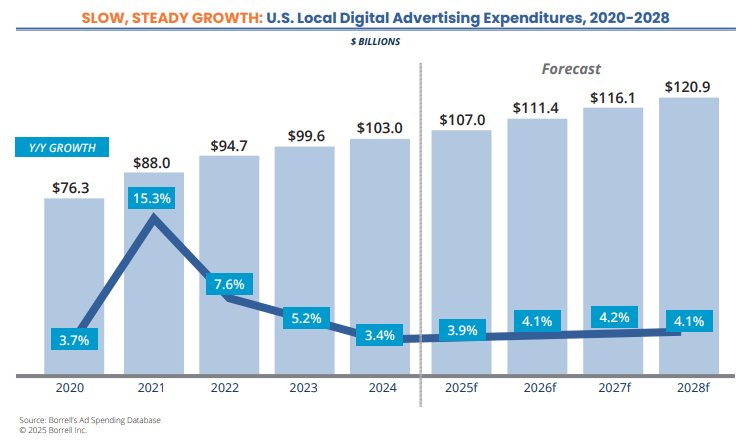
Borrell Associates has released its Annual Digital Benchmark Report, and it shows that local digital advertising revenue is expected to accelerate by more than 13% by 2028.

Local digital advertising hit a milestone in 2024, reaching $100 billion for the first time. It now accounts for 70% of local advertising.

That figure was significantly accelerated by the COVID-19 pandemic. And that doesn’t show any signs of slowing down anytime soon.

“Fully emerged from the effects of the pandemic, it’s clear that digital’s growth jag hasn’t ended,” the report says. “In fact, the trajectory is accelerating, albeit only mildly. It’s the same thing that occurred after the two other economic triggers that preceded it – the Dotcom Bubble Burst of 2000 and the Great Recession of 2008-2009. We foresee that acceleration as slight, growing 3.9% this year to roughly 4.2% annually over the next three years. Still, that growth is enough to continue the trend where digital forms of advertising gain market share at the expense of broadcast, print and cable advertising.”

Local digital advertising revenue is expected to increase by just under 4% in 2025, up to $107 billion. According to projections from Borrell Associates, that figure is expected to steadily increase at just over 4% each year until it hits $120.9 billion in 2028.

“The pandemic had another, more subtle effect. It altered the source of advertising expenditures – the thousands of SMBs in each market,” the report adds. “That reshaping has sparked an uneven growth pattern at the local level and has dislodged the accuracy of sales organizations’ longstanding prospecting methods. It’s a phenomenon which we’ll address further in Chapter 2.

“Finally, the pandemic triggered one more notable phenomenon. It familiarized people even more with streaming-video programs and short-form videos such as those found on TikTok and Instagram Reels. Note the trajectory of the green line – Video/CTV/OTT. Within three years, SEM, Banner Ads, and CTV/OTT will account for 78% of all digital advertising and 57% of all local advertising.”

Borrell Associates is offering its 2025 Annual Digital Benchmarking Analysis for free to those who attend the company’s webinar, scheduled for Thursday, May 29th at 11 AM ET. To register for the free-of-charge webinar, click here.

Barrett Media produces daily content on the music, news, and sports media industries. To stay updated, sign up for our newsletters and get the latest information delivered straight to your inbox.

Jessica Chenoweth Named MIW Country Radio Mentee

0

Jessica Chenoweth, producer of “John and Tammy: San Diego’s Morning Show” at 103.7 KSON San Diego, has been named the second Mentoring and Inspiring Women in Radio, Country Radio Mentee.

RJ Curtis, Executive Director of Country Radio Broadcasters, said, “Jessica is a standout talent whose energy, leadership, and heart embody the future of Country radio. We’re proud to support her journey through this partnership with MIW and look forward to seeing all she’ll accomplish.”

Chenoweth’s career includes time as Technical Producer for “The Ryan Seacrest Show,” writing for John Tesh and with Star 94.1 San Diego.

“I’m so excited for this opportunity to learn from the best in the business and further cement my career in Country radio,” Chenoweth said. “Thank you to the entire CRB/MIW team for believing in me. I can’t wait to get started!”

MIW Board President Sheila Kirby added, “The MIW in Country Radio mentorship is about investing in rising leaders who are already making an impact, and Jessica is exactly that. Her story, drive, and passion for the format make her an ideal fit, and we’re thrilled to walk alongside her in this next chapter of her career.”

The Mentoring and Inspiring Women in Country Radio program offers a year-long mentorship initiative designed to connect emerging professionals with industry leaders.

Participants will engage in personalized discussions, gain critical access to various facets of the industry, and develop essential leadership skills. This initiative aims to support mentees as they advance toward senior positions within the Country radio sector.

Additionally, participants will have the opportunity to attend CRS 2026 in Nashville.

Barrett Media produces daily content on the music, news, and sports media industries. To stay updated, sign up for our newsletters and get the latest information delivered straight to your inbox.

Netflix Presenting NFL Christmas Day Doubleheader for Second Consecutive Year

0

Netflix will be presenting a doubleheader of games on Christmas Day for the second consecutive year during the 2025 NFL regular-season slate, officially revealing its matchups ahead of the National Football League schedule release later in the day. The streaming provider, which has 301.6 million subscribers globally, will be airing a matchup between the Dallas Cowboys and Washington Commanders on December 25 at 1 p.m. EST emanating live from Northwest Stadium in Landover, Md. The action will stay in the NFC at 4:30 p.m. EST when the Minnesota Timberwolves host the Detroit Lions from U.S. Bank Stadium in Minneapolis, Minn.

NFL commissioner Roger Goodell revealed the news on stage while wearing a Santa Claus coat from the Perelman Performing Arts Center in New York, N.Y. While he was delivering the information to the audience, he mentioned how viewers in 218 countries watched the doubleheader of games last year, which garnered a global average minute audience of more than 30 million people. The games will once again be produced by CBS Sports, and NFL Media will be handling the pregame, halftime and postgame studio shows. Talent for the NFL game presentation will be revealed at a later date, and there is no news on a potential halftime performer at the moment.

Throughout the Upfront presentation, Netflix made several announcements surrounding sports content, including a live appearance by Dallas Cowboys owner, president and general manager Jerry Jones. Alongside Goodell, he revealed that there will be a second season of America’s Sweethearts: Dallas Cowboys Cheerleaders and also an August release of a documentary titled America’s Team: The Gambler and His Cowboys. Netflix will also be airing a documentary series about Colorado Buffaloes football head coach Deion Sanders titled Prime Time and a movie about rebuilding following the tragic plane crash that killed the U.S. Amateur Boxing Team in 1980.

In addition to Netflix, Amazon’s Prime Video will stream NFL games throughout the season as part of its Thursday Night Football schedule. On top of that, YouTube is going to present a Week 1 NFL game emanating from São Paulo, Brazil between the Kansas City Chiefs and Los Angeles Chargers. The NFL reportedly has an opt out for most of its existing media rights deals (excluding ESPN), said to be worth about $13 billion per annum, following the 2029 season.

Barrett Media produces daily content on the music, news, and sports media industries. To stay updated, sign up for our newsletters and get the latest information delivered straight to your inbox.

Tim Convy Departs ‘The Courtney Show’ At 106.5 The Arch

0

Tim Convy is departing “The Courtney Show” at 106.5 The Arch in St. Louis. Convy, who has been with the show for three years, made the announcement on air.

Convy said, “I’ve been spread pretty thin, and I have some opportunities in some of the other things I do that I’m excited to spend some more time on.”

He is a stand-up comedian and plans to focus on that part of his career. He is also in a band and hosts a podcast.

Convy is not completely departing the station. Beginning June 9, he will take over hosting duties on “Throwback Live. “

“This whole radio career, which has been less than ten years, has been amazing, and I’m grateful for the last three years, Convy added.

106.5 The Arch Program Director Marty Linck said, “Tim has more talent than he has time!  He’s following his dream, and I respect the move. Happy he’s sticking around to host one of our biggest benchmarks on “The Courtney Show.'”

Afton (Wentzville) Spriggs will be taking Convy’s spot on the morning show.

Convy also co-hosted mornings at Top 40 Now 96.3  and Hot AC Y98 in St. Louis.

Barrett Media produces daily content on the music, news, and sports media industries. To stay updated, sign up for our newsletters and get the latest information delivered straight to your inbox.

Dari Nowkhah Joining The REF Sports Radio Beginning This July

0

SEC Network lead anchor Dari Nowkhah is headed back to the home of his alma mater, as The REF 99.3FM and 1400AM has announced that the ESPN personality is joining the radio station’s lineup for a new weekday program. In an announcement earlier today on T-Row in the Morning Show, host Toby Rowland revealed that Nowkhah will begin hosting a weekday radio show from 9 a.m. to noon Central Time beginning in July.

Currently, Dari Nowkhah is a host and anchor on SEC Network, regularly appearing on SEC Now throughout the week, including Saturday evenings during the college football season. Additionally, he serves as the host for Saturday Football Final on the SEC Network and calls play-by-play for men’s basketball and baseball.

“Dari Nowkhah will be an incredible addition to our daily lineup,” said Casey Vinyard, KREF owner. “We are thrilled to have Dari join our team and bring his vast radio experience and deep knowledge of the SEC.”

Moreover, Nowkhah will be co-hosting the new program alongside Josh Helmer, who currently hosts The Plank Show alongside Oklahoma sideline reporter and softball play-by-play voice Chris Plank. Notably, Plank will be replacing Rowland, who announced in February that he will be leaving the morning show to take a new role as sports director at News 9, the local CBS television affiliate. Meanwhile, Blake Gamble will serve as Plank’s co-host beginning in July.

For the past 14 years, Nowkhah has co-hosted the popular weekend program The Dari and Mel Show on ESPN Radio alongside ESPN NFL draft insider Mel Kiper Jr.

Originally from Tulsa, Okla., Nowkhah graduated from the University of Oklahoma in 1998 with a degree in broadcast journalism. In 2013, he was recognized by his alma mater and named Young Professional of the Year by the Gaylord College of Journalism and Mass Communication.

Prior to joining ESPN, Nowkhah worked as a sports anchor and reporter at KOTV, a CBS affiliate in Tulsa, Okla. Earlier in his career, he also had stops in Lincoln, Nebraska, with previous experience in Kalispell, Montana.

Barrett Media produces daily content on the music, news, and sports media industries. To stay updated, sign up for our newsletters and get the latest information delivered straight to your inbox.

Predicting the Unpredictable: How Analysts Navigate the Chaos of NBA Playoff Upsets

Predicting NBA playoff upsets is a complex challenge, as the nature of these surprises often defies certainty. While historical data, player statistics, and the dynamics of play-in tournaments provide valuable insights, no single formula can guarantee accurate forecasts. Analysts rely on advanced metrics and deep expertise, also factoring in psychological influences that can sway game outcomes. This ongoing quest to uncover potential upsets amid the unpredictability of the playoffs invites continued exploration and analysis.

Key Takeaways

  • Analysts leverage advanced analytics, like RAPTOR and Synergy, to predict matchup vulnerabilities and potential playoff upsets,
  • Injury analysis is crucial, with All-Star absences reducing win probabilities by approximately 18% for top teams,
  • Defensive efficiency metrics, especially pre-All-Star break ratings, are vital indicators for upset potential,
  • Coaching experience and strategic adaptability play significant roles in navigating unpredictable playoff scenarios,
  • Play-in tournament dynamics and team psychological resilience test and inform upset predictions.

Analyzing Historical Precedents for Insight

While examining the history of the NBA playoffs, it’s clear that understanding past upsets offers valuable insights into future possibilities. Seasons like 2007, 1994, and 1999, where lower-seeded teams like the Golden State Warriors, Denver Nuggets, and New York Knicks caused significant upsets, highlight patterns favorable to underdog success. The fact that these teams often have strong chemistry and exploit matchups effectively plays no small part in their status as giant killers.

The dynamic between seed disparities, like the 30.5% performance gap in 2007’s upset, showcases lower pressure on underdogs, which can lead to surprises. Analyzing basketball teams odds in these scenarios further reinforces how rare but impactful these events are. Then there’s historical context, which reveals that a No. 1 seed has fallen to No. 8 seed only six times, indicating the rarity of such outcomes and the unpredictability they bring to sportsbooks. Recognizing how these factors influence outcomes offers a strategic edge in predicting potential playoff shockers.

The Impact of Statistical Variables

When evaluating playoff outcomes, statistical variables play a pivotal role in shaping the dynamics of NBA matchups. Injuries to key players, such as All-Stars, drastically alter series results, dropping win probabilities for top defenses missing anchors. Meanwhile, offensive rating differentials widen considerably when primary scorers sit it out.

Defensive efficiency, especially pre-All-Star break ratings, can elevate upset chances, with Switch-heavy schemes improving effectiveness. On offense, system adaptability, clutch-time performance, and secondary scoring matter more during playoffs. Advanced analytics like RAPTOR and Synergy tracking help pinpoint vulnerabilities and inform predictions, while situational factors like home-court advantage in Game 7s further influence outcomes. Moreover, teams with prior success against an opponent, such as the Orlando Magic’s series history with the Boston Celtics, use these statistical insights to strengthen strategies.

Play-In Tournament Dynamics and Their Effects

The NBA’s play-in tournament serves as an exciting prelude to the playoffs, significantly altering team dynamics and the path to victory. Teams ranked 7th to 10th compete fiercely for a coveted playoff spot, turning every game into a high-stakes battle. While higher seeds benefit from home-court advantage, unpredictable outcomes remain common. Injuries and compressed schedules increase pressure, testing each team’s resilience.

Victories in the play-in mean facing top-seeded opponents immediately, reshaping traditional playoff trajectories. This format intensifies competition and uncertainty, where every decision and play can influence team morale and confidence. Fans embrace the heightened excitement, driving increased engagement and generating substantial financial benefits for the league.

Key Metrics for Upset Detection

Understanding the key metrics for detecting potential upsets in the NBA playoffs is crucial for fans and analysts alike. NBA game predictions and stats often rely on head-to-head records like series history and recent matchups, as they highlight teams prone to upsets. Analyze statistical advantages such as defensive efficiency, three-point shooting, rebounding margins, and turnover differential, as these can tell you which teams control games.

Don’t overlook the significance of player health, especially how injuries impact lineup effectiveness. Finally, consider coaching experience and strategy adjustments, which offer essential insights.

Psychological Elements at Play

Psychological factors considerably influence NBA playoff outcomes. Teams are maneuvering intense schedules, which can mentally exhaust players and alter their performance.

Injuries shift team dynamics, while mutual trust within the team remains essential. Mental resilience under pressure affects decision-making and stress management is key to staying focused.

Crowds, media attention, and travel demands test players’ mental edges, with home court often offering psychological boosts. Emotional control guides strategic decisions, helping players recover from setbacks.

Future Trends and Forecasting Challenges

Charting the future of NBA playoff predictions requires addressing evolving trends and overcoming forecasting challenges with accuracy. Savvy bettors are turning to machine learning to analyze vast multi-season datasets, focusing on player patterns and team dynamics.

Real-time tracking and injury probability algorithms further refine predictions, while alternative metrics-such as net ratings during clutch moments-become increasingly important. Staying ahead in rapidly shifting markets demands accounting for oddsmakers’ adjustments related to schedule fatigue and market corrections. Additionally, the dynamic between youth and experience presents unique challenges, requiring agile strategies to adapt as series unfold unpredictably.

Bringing Order to the Chaos

As you sift through the swirling storm of numbers and player dynamics, imagine yourself at the helm of a ship steering through the tumultuous seas of NBA playoff upsets. You use historical charts, statistical compasses, and barometers of team morale to steady the course.

The shadows of the play-in battles loom, while the glow of advanced metrics lights your path. Despite the chaos, you aim to predict the unpredictable, uncovering hidden treasures amidst the stormy waters of playoff season.

How to Find Information About a Specific Person Online Using Smart Search Techniques

Explore the Right Way to Search for Someone Online

The Digital Footprint We Leave Behind

Imagine being able to trace a life story using nothing but internet clues. In today’s hyperconnected world, discovering details about someone online has become a skill — a mix of curiosity, patience, and digital sleuthing. Whether you’re reconnecting with long lost friends or verifying details before a personal meeting, the digital universe offers a treasure trove of accessible public data. People often underestimate how much can be retrieved from scattered online sources — provided you know where to look and how to search smartly.

A Reliable Starting Point

Among various people search sites, https://peoplefinder.info/ aggregates publicly available details into a centralized and easy-to-navigate tool. By consolidating free people search results, this platform simplifies the process for those looking to find information that may otherwise be spread across multiple government databases, online directories, and social media profiles.

Let’s unpack the steps, tools, and ethical considerations behind how to find information about a specific person online — without falling into legal or moral gray areas.

Online
Photo Credit: PeopleFinder.info

Start with the Basics: The Person’s Full Name

Names Are a Double-Edged Sword

Begin with the full legal name if you know it. But remember — people with the same name are common. A “John Smith” could lead to hundreds of irrelevant search results. This is why pairing a name with additional identifiers like city, state, or occupation helps narrow down the results meaningfully.

Search for people creatively. Enclose names in quotes (“Emily Carter”) and add extra terms like their college or past employer. These advanced search filtering options can drastically refine your results.

Social Media: An Underrated Goldmine

Scanning Social Media Sites for Clues

Platforms like Facebook, Instagram, X, LinkedIn, and even TikTok often show social links, professional networking details, and posts that hint at someone’s location history or interests.

Reverse image search becomes invaluable when you have a photograph. Upload it to platforms like Google Images or TinEye to discover where else the image appears. Sometimes, a single image opens a gateway to blogs, profiles, or even online directories.

Use platform-specific search functions: LinkedIn is ideal for professional ties, Facebook for family members, and Instagram for visual context like hobbies or places visited.

People Search Tools: Organizing Chaos

Why Use a People Search Tool?

When information is scattered, a people search tool like those found on people search websites or search sites helps stitch together scattered data. These platforms often provide structured search functions — allowing filters by phone numbers, age, city, or known associates.

They help access:

  • Basic information (where available)
  • Phone directories
  • Contact details
  • Free people search engine access

Note: these reports aren’t suitable for employment screening, tenant vetting, or financial decision-making.

The Role of Reverse Phone Lookup

When You Only Have a Number

What if you only know someone’s phone number? That’s where reverse phone lookup comes in. These tools allow you to identify:

  • Name associated with the number
  • Potential address

This function can be part of general people search tools or standalone services. Use it to trace older contacts, verify unknown callers, or reconnect with someone whose number you found in old correspondence.

Online Search Is Not Always Linear

Overcoming Name Ambiguity

Running into someone with the same name? Try layering the query. Add:

  • “John Smith” + “Boston” + “MIT”
  • “Samantha Lin” + “Court records” + “Atlanta”

Refining search results using known family members or old email handles can help, especially when dealing with common names.

Also try:

  • Checking search bar suggestions
  • Using different search websites or tools
  • Trying alternative spellings or nicknames

Check Online Directories and Forums

Sometimes, the Answers Hide in Plain Sight

Online directories may offer basic contact info like addresses and phone numbers, especially for those who haven’t locked down their privacy settings.

Some individuals may also leave breadcrumbs on niche forums, Q&A sites, or local community platforms. Look for usernames that resemble their name, or reverse image search any avatars or profile photos.

Tapping into Social Networks for Clues

Don’t Underestimate Shared Posts

Family members often tag one another in posts, creating a web of visible connections. From birthdays to engagements, these posts form a timeline of someone’s life.

Use that data to confirm identity, match faces, and spot cross-platform usernames. Social media profiles may even link to public-facing professional pages or portfolios.

The Importance of Cross-Referencing

Accuracy Demands Multiple Sources

Never trust a single piece of data. A reverse phone lookup might suggest a city — confirm it with social media activity or court documents. If property records suggest ownership of a home, check tax maps or databases.

The idea is to piece together relevant information from several directions. Always aim to verify through at least two independent sources.

What You Can Ethically and Legally Access

Stay on the Right Side of the Law

All the methods above rely on information anyone can find online. You won’t need unauthorized access, illegal scraping, or private login credentials.

Everything described falls within ethical and legal boundaries when used responsibly and respectfully.

Reconnecting with Old Friends and Long Lost Connections

Sentiment Meets Strategy

The internet has become a bridge between past and present. Whether trying to reconnect with old mates from school or track down long lost friends, people search tools often uncover details like current cities, marital status, or mutual connections.

When reaching out, proceed with respect. Reconnection only works when it honors privacy and emotional context.

Knowing the Limits: What You Should Not Expect

No Guarantees, No Overpromises

It’s important to maintain realistic expectations. A people search tool gathers information that’s already available through public records, social media, or search engines — it doesn’t “uncover” secret data. You won’t find someone’s private messages, credit scores, or sensitive financial information.

Why Context and Cross-Checks Are Crucial

Interpretation Requires Nuance

Let’s say a background check reveals a name on a list of court records. Is it the same person you’re searching for? Or someone with the same name?

Without context, such data can mislead. Cross-checking names with addresses, business records, or even social media sites is essential to avoid mistaken identity.

Search Engines and the Art of Query Crafting

Think Like a Librarian, Search Like a Detective

The average person types in “John Doe New York” and stops there. But refining a search with logical operators helps:

  • Use quotes for exact names: “Emily Zhang”
  • Add qualifiers: “Emily Zhang” + “graphic designer” + “Austin”
  • Use minus signs to exclude: “Emily Zhang” -“San Diego”

Search engines become powerful when paired with curiosity and structure.

Combining Phone Lookups with Location Data

Connecting the Dots with Precision

Let’s say you’ve found phone numbers, but no names. Use phone lookup tools and public record databases to match them with known locations, court records, or even property records.

This layered approach builds a fuller picture from fragments.

Conclusion: Digital Diligence Without Assumptions

The art of finding valuable information about a person online lies in navigating facts, not fantasies. Use digital footprints, structured tools, and publicly available data — while staying within ethical lines.

Whether you’re tracing old classmates, verifying a new contact, or simply indulging in curiosity, the digital trail tells stories — but only when interpreted with care, context, and a commitment to truth over speculation.

FAQ:

1. Can I use these tools to find out if someone is married?

If that information appears in public records such as marriage or divorce records, and those records are available online, you may come across it. Always confirm through official databases.

2. What if the person has deleted all their social media?

Try indirect searches through known family members, mentions in online articles, or reverse searches via their past contact info. Sometimes their old posts or photos may still appear in search engines or be visible via archive tools.

3. Can I find someone’s phone number for free?

Free phone directories and reverse phone lookup tools may offer partial results. Full contact details depend on availability in public sources and whether the person has opted out.

4. What do I do if I find something incorrect?

Public databases aren’t always perfect. If a background check or online listing shows incorrect info, look for correction options or contact the data provider. Some people search sites allow users to request updates or removals.

5. Are these searches anonymous?

Generally, yes. Using a people search tool or search websites does not notify the person you’re looking for. However, logging into platforms or interacting with them may change that.