Sinclair Broadcast Group Director of Network Programming and Podcasts Peter Gianesini has announced a new addition to the company’s growing podcast network. Alabama sports fans will soon have a new go-to destination for all things Crimson Tide, as THE DYNASTY podcast is set to debut Wednesday, May 28. The weekly show promises a fresh take on Alabama athletics year-round. Furthermore, it will feature in-depth discussions led by three names synonymous with the program’s storied success.
Former Alabama football stars AJ McCarron and Trent Richardson will join longtime play-by-play announcer Chris Stewart to break down the past, present, and future of one of college football’s most dominant programs. Together, they’ll deliver exclusive insight into the inner workings of Alabama football and beyond.
Notably, McCarron and Richardson led the Crimson Tide to two BCS National Championships in 2009 and 2011. McCarron then went on to win another BCS title for Alabama the following year in 2012, as Richardson was drafted with the third overall pick in the 2012 NFL Draft. Importantly, this will be the first venture into the podcasting space for both McCarron and Richardson.
McCarron, the former Alabama quarterback, revealed the news at the Regions Tradition Celebrity Pro-Am golf tournament at Greystone in Hoover, Alabama earlier this week. He told reporters, “At least I don’t have to hold back,” McCarron said. “I don’t have any media people saying, ‘Hey, let’s not say this.’”
In addition to football, THE DYNASTY will tackle topics across Alabama’s championship-winning athletic department, including men’s basketball, baseball, and other varsity sports. From spring practices and SEC clashes to College Football Playoff contention, THE DYNASTY aims to offer fans unparalleled access and behind-the-scenes perspectives.
Moreover, listeners can expect expert analysis, passionate commentary, and authentic storytelling from those who have helped shape Alabama’s legacy. In turn, this unique blend of voices and experience will provide fans with content they can’t find anywhere else.
New episodes will be released weekly. Fans can watch on YouTube or listen on Apple Podcasts, Spotify, or their preferred podcast platform.
Barrett Media produces daily content on the music, news, and sports media industries. To stay updated, sign up for our newsletters and get the latest information delivered straight to your inbox.
Patriot Talk 920 AM has announced the expansion of its local lineup, with a new afternoon show hosted by Craig Collins.
The Craig Collins Show will air from 4-5 PM on the Houston news/talk station. Another hour of the program — airing from 5-6 PM — will be exclusive the the station’s digital platforms.
Collins comes to the station after spending more than 20 years working in the news/talk radio space. After beginning his career working on the show of Radio Hall of Famer Garry Meier at WGN Radio in Chicago, Collins has spent time at other notable news/talk outlets like 93 WIBC in Indianapolis and 620 WTMJ in Milwaukee, among others.
Additionally, Collins is often the guest host for Radio America’s The Dana Show — hosted by Dana Loesch — when the regular host is on vacation or unavailable.
“Patriot Talk 920 AM is excited to add Craig Collins to our radio lineup”, says station owner Matt Velasquez. “Our mission to provide the best mix of strong national syndicated voices and local Houston talent will continue to expand in 2025, and the addition of The Craig Collins Show is a huge step in expediting our growth!”
The new program is scheduled to start on Monday, May 19th.
Barrett Media produces daily content on the music, news, and sports media industries. To stay updated, sign up for our newsletters and get the latest information delivered straight to your inbox.
American roads became the backdrop of tragedies in 2022: 1,005 cyclists lost their lives, and 46,000 were injured. In California alone, cyclists accounted for 4% of all traffic fatalities – people whose lives were brutally cut short by reckless drivers, poor infrastructure, and institutional failures. But there is one Phoenix law firm that is taking a stand for justice on behalf of victims of accidents. This article covers their efforts and real case examples.
The Dark Side of Cycling
Cycling’s popularity grows in the U.S. – bike journeys have increased since 2000 from 0.4% to 0.6% of all journeys. But greater popularity means danger. The National Highway Traffic Safety Administration (NHTSA) sees deaths of cyclists increase 15% since 2013 and injuries 11% alone in 2021–2022. In cities where 83% of deadly crashes occur, cyclists face dense traffic, bad bike lanes, and inattentive drivers.
California stands out: 177 cyclists sustained fatal traumas in California in 2022, 64% on high-speed roads with no provision for bicycles. 37% were alcohol-related, and 51% of the nighttime crashes were due to visibility. Medical expenses following a crash cost an average of $45,000, and traumatic brain injury (TBI) can exceed $200,000. Emotional damage – fear, loss of confidence, and inability to ride again – is incalculable. Financial losses, such as lost wages, can persist for years, especially for those who rely on manual labor.
Fighting for Justice
And, predictably enough, the biggest obstacle for hurt bikers is insurance companies. They have various tactics: disputing fault, raising the point of a missing helmet, or arguing injuries are unrelated to the accident. However, founded in 1998 by UC Berkeley School of Law graduate Robert Goldwater, Bicycle Accident Lawyers Group has made its business defending cyclists.
The firm counters these tactics by relying on:
Medical reports;
Accident reconstructions;
Expert testimonies;
Crash site photographs;
Correspondence with insurers.
Having secured over $1 billion for clients, the agency operates nationwide, from Phoenix to Los Angeles, helping victims of dooring incidents, hit-and-run cases, and wrongful death claims.
Major Victories: Real Cases of Justice for Cyclists
Despite insurance companies often delaying the process, hoping victims will accept minimal settlements, the agency employs aggressive negotiations and, when necessary, litigation, securing fair compensation for its clients. Here are a few notable cases:
#1. Emily, Phoenix
Emily Davis, 34, a teacher, cycled to school daily in Phoenix. In 2021, a driver distracted by his phone opened his car door directly in front of her – a dooring incident. A broken wrist and chronic pain threatened her ability to work. The insurance company offered only $10,000, blaming Emily for not paying attention. The firm’s attorneys gathered camera footage and witness statements, proving the driver’s liability. Result: $95,000, covering medical costs, lost wages, and emotional distress. Emily returned to teaching but now chooses bike-friendly routes.
#2. Michael, Sarasota
In Sarasota, 28-year-old designer Michael Rivera was the victim of a hit-and-run. A driver struck him and fled, leaving Michael with multiple fractures and internal injuries. Police closed the case due to a lack of evidence, but the firm found street camera footage and GPS data, identifying the perpetrator. Settlement: $1.5 million, covering medical treatment, rehabilitation, and lost income. Michael returned to work and now advocates for improved road lighting, inspired by the lawyers’ support.
#3. Knopp, Los Angeles
In Knopp v. City of Los Angeles, a 45-year-old father lost his life due to an unsafe road and a negligent driver. A wrongful death lawsuit became the family’s only path to justice. The insurance company initially offered $80,000, but attorneys pushed the case to trial, securing $4.7 million. The settlement provided financial stability, and the lawsuit led to new safety signs at the intersection – a prime example of how legal advocacy can improve infrastructure.
Bottom Line
Bicycle Accident Lawyers Group turns personal tragedies into catalysts for change, securing not only compensation but also systemic improvements in infrastructure and legislation. Their work serves as a bridge between victims and justice and between today’s accidents and safer roads tomorrow. Moreover, the firm ensures legal services remain accessible through its contingency fee model – payment only upon victory, usually 30–40% of the settlement, removing financial barriers for Indigenous communities and families with limited resources.
We sincerely hope you never need these services, but if you do, you now know where to find support. Call or visit the website – free consultations are available by phone or online for everyone. Let’s work together to make roads safer for all.
There’s reason for celebration at Marketron, as the company is in the midst of celebrating its 55th year in business.
The revenue operations and digital advertising technology firm is marking its more than five decades in business by celebrating the advancements it has made in the traffic and billing operations for media enterprises, as well as its digital advertising sales platform specifically designed for radio stations.
“For more than five decades, Marketron has been a trusted partner in the media industry, empowering broadcasters with the tools they need to grow revenue and streamline operations,” said Marketron CEO Jimshade Chaudhari. “While our technology and the media landscape have transformed significantly, our commitment to innovation and customer success has remained constant.”
“Reaching 55 years is a testament to our team, partners and clients who have supported us throughout the years,” added Senior Vice President of Sales Todd Kalman. “We are more excited than ever about what’s to come as we continue to redefine what’s possible for media companies and their revenue-driving efforts.”
Marketron shared that while it celebrates the milestone, it also remains focused on the future with innovation and investment in its technology and products continuing to stay at the forefront of its next generation.
Barrett Media produces daily content on the music, news, and sports media industries. To stay updated, sign up for our newsletters and get the latest information delivered straight to your inbox.
This morning, it was announced that Kayla Anderson will no longer be a part of Ramon, Kayla, and Will on Nashville’s 104.5 The Zone. The morning show began the day with the news, coming just one day after the release of the Tennessee Titans’ 2025 schedule last night. Anderson joined 104.5 The Zone in 2022 and has spent her entire tenure hosting mornings alongside Ramon Foster and Will Boling.
To begin the show, Boling opened the program this morning with the announcement that Anderson and the station have parted ways.
“Kayla Anderson is no longer on this show, or a member of our team here at 104.5 The Zone,” Boling opened. “Decisions like this are never easy. Announcements like this are difficult, because Kayla has been a valuable member of our show and the station’s work both on and off the air. We truly wish Kayla all the best.”
Shortly afterward, Anderson took to social media this morning on her personal X account to share her thoughts on her exit from the radio station she called home for the last three years.
“First and foremost, thank you so much to our loyal listeners, you made my time in radio here so amazing,” Anderson posted. “You all are so passionate about your teams here in Middle Tennessee and I love that.”
However, Anderson did not discuss how her dismissal came about from 104.5 The Zone, nor did she provide any details regarding her next steps. Instead, she emphasized that she’s not looking backwards, but only forwards.
“I’m gearing up for the next chapter of my book to write itself,” said Anderson. “All I’ve ever known is to keep navigating it to the best of my ability.”
Meanwhile, former co-host Ramon Foster also shared his thoughts on Anderson no longer being a member of RKW on The Zone.
“Change is made. There is a lot that has to happen to go through this process, so it’s never easy,” said Foster. “There is a lot that can be said, but I’ll say this. I appreciate Kayla, she’s an awesome lady. A pro’s pro when it comes down to what she does, and how much she does too. I’m looking forward to seeing what’s next for her.”
In conclusion, Boling stated that the duo will continue in the daypart and will be further known as Ramon and Will. Additionally, the station’s website has already been updated as of this morning.
— Kayla Anderson ✨ (@KaylaAndersonTV) May 15, 2025
Barrett Media produces daily content on the music, news, and sports media industries. To stay updated, sign up for our newsletters and get the latest information delivered straight to your inbox.
Every Account Executive who sells Rock Radio, Podcasts or anything Audio should be shouting this from the rooftops. I’ll get to that in a minute, but let’s start with programming.
Basic logic: Rock, Alternative and all Radio programmers use “vocal hooks” in research because they are considered the most memorable and best parts of the song. More so than a blazing guitar solo or drum fill. The reason formats like AC use jingles; they’re memorable, sometimes unforgettable.
This is simple and tied to brain function, and all in the Audio world should take notice.
I can count to ten in Japanese. I’ve never taken a Japanese language class, read a book, downloaded an app, traveled to the country, I don’t follow their baseball, and rarely recite the count. I love the food and people, though.
The numbers were taught to me in elementary school, just before a field trip to a local Japanese steakhouse. In between getting shrimp and beef flipped at us from the teppanyaki grill, our teacher thought it would be great if we dazzled the chef with our counting skills.
I’ve never forgotten how to say those ten words for numbers.
The reason it sticks with me isn’t because my young brain had endless gigabytes of space for words like “Hachi” (the number “eight”); it was because, in terms of duration, echoic memory (audible) is stronger than iconic (visual) memory.
The teacher didn’t write the lesson on the blackboard. There was no chance we were reading Japanese. It was verbal, audible learning, just like hearing and remembering a Linkin Park song or the “SUNDAY, SUNDAY, SUNDAY” monster truck spots.
In contrast, as I’ve said before, everyone reading this has forgotten most of the billboards they saw on the way to work this morning. I love billboards; they can work, but most don’t for reasons marketers understand. Oh, and there’s no sound. To be fair, not every audio spot or song works, either.
Every audio-based account executive should be shouting from the rooftops about echoic vs. iconic memory. Video sellers and advertisers should also have this on their frontal lobes. Sell or buy all the video ads you want; they CAN work, but the audio in the spots may be the real star.
Media examples:
Songs: While I’ve seen it countless times, I visually can’t remember much of the “Enter Sandman” video, but I can growl along to every word on 98 KUPD.
Radio Spots: You probably couldn’t sketch their logo, but if you wanted to donate your 4Runner to Kars 4 Kids, you know the number.
TV Spots: It dates me, but I remember every word of the “two all-beef, special sauce, lettuce, cheese…” song, even though my iconic memory of the spot is shaky at best.
Movies: We can get a movie trailer with no voiceover, and we’ll probably tune-out and check our phones. But add some great bombs and explosions and we might even pre-order tickets.
Social: Turn off the volume and watch TikTok videos. Have fun with that.
Comedy: You remember great jokes but have probably forgotten what shirt the comedians were wearing.
Other factors can be added to this brain matter – do we care about this, do we want to remember, reach and frequency, and the words used. Some may even dispute these memory claims, but it’s an unarguable reminder of how powerful audio can be – or not be.
Do the creative promos and the imaging cut through
Is the copywriting really on point
Are stop sets full of ineffective spots
If I had a dollar for every time a Production Director complained about bad ad copy or the terrible spots sent in for air, I’d be on a beach writing about tropical drinks.
At Radio, Podcasts, Streaming – audio is EVERYTHING, and that includes every word spoken. I was recently reminded of a great quote by Roy H. Williams – “Use half as many words and they’ll hit twice as hard.” (I should take his advice!)
The best programmers, imaging ninjas and talent understand this already. The audio we create and the words we write, say, sing or yell can leave lasting marks.
I haven’t heard the mighty 99.9 KISW lately, but I know exactly how their Legal ID audio signature sounds. “Thaaa Raaawk.” I won’t be forgetting that, neither will their listeners.
Concerns have grown that the tariff policy enacted by President Donald Trump could cause problems in the local advertising market. But Borrell Associates CEO Gordon Borrell believes that 2025 still looks bright.
Earlier this month, data from the Interactive Advertising Bureau (IAB) showed that 60% of local advertisers had forecasted a 6-10% decline in their advertising budgets due to the tariffs placed on countries like China by the Trump administration.
However, since Trump has since reversed course, a market that could have been previously labeled “reticent” has since slightly course corrected, with Gordon Borrell remaining bullish that 2025 will still be a strong year for the sector.
“(Local advertisers) are really very practical, not often political,” Borrell said. “I think there was a hunkering down period that we detected in our Business Barometer … It did detect a little bit of, ‘We better put some things on hold.’ Since then, I think the strategy on tariffs has become clear. It’s just a business strategy. It’s just a negotiation strategy. And now it’s become clear, and I think people have a bit more confidence.
“That said, I don’t think there’s a strong surge in advertising,” he admitted.
Some in the local advertising game can find reason to limit or stop their spending at some of the slightest objections, like elections, natural disasters, or concern about economic downturns. Borrell said those things do occur, but trying to compare quarter-to-quarter can be a difficult encapsulation.
That’s why he looks at trends. And the trends for 2025 don’t match up with the trends seen during one of the worst years for local advertising in history, 2020.
“If there’s something really dramatic, like we saw during the pandemic — when advertising went down 50% — something did happen then. I don’t think you’re gonna you’re gonna see that,” said Borrell. “We draw up more conclusions on the sentiment of advertisers. When they say they’re going to increase something, they don’t always do it, but it signals confidence. And it signals a greater willingness to take risks. When they say they’re going to hold back on budget, it signals a lack of confidence.”
He joked that smaller advertisers can be cautious — comparing them to flocks of birds that hear a noise and then fly off in the distance until they believe the coast is clear — but believes the sentiments are that things are looking positive for this calendar year.
“I feel that the year is going to be ok. I really feel like it’s going to be fine. It’s not going to be a downer or dismal year for people. People aren’t going to stop buying. There’s plenty of money,” said Borrell. “The interest rates are still low. People are still borrowing on credit, which is fine. I’m not picking up anything from the seller’s level, either, that we’re in trouble.”
When asked what tell-tale signs there are for a potentially sagging local advertising market, Gordon Borrell had a clear-cut answer.
“Traditional forms (of media) — or more expensive forms of advertising — decline, and the cheaper forms — traditionally digital — increase,” said Borrell. “They continue to increase and decline a little bit more, but everything in traditional will go negative in a really bad period, and digital will stay positive. The only thing that increased during the pandemic was digital advertising.
“So you think about that, it wasn’t flat, it didn’t go negative, it increased. So they increased their spending in digital, not quite as much, but they cut out all the other stuff,” Borrell concluded. “That’s one key indicator that it’s still reliable. Digital is getting more and more expensive, but it’s still a reliable indicator of being off-trend.”
Barrett Media produces daily content on the music, news, and sports media industries. To stay updated, sign up for our newsletters and get the latest information delivered straight to your inbox.
Two big — and very different — stories struck me this week: Pope Leo XIV and Pete Rose.
Could these two men be any more different? Pope Leo XIV, a humble man from Chicago who loved baseball, rooting for the Second City’s second team. And the Hit King, who was anything but humble, and soiled the game I love with scandal.
I spent 30 years in Chicago, married my high school sweetheart from the Western suburbs, raised my children there, and worked in local news at WLS and WBBM, then was a National Correspondent for NBC News, based in the beautiful NBC tower overlooking the Chicago River and Lake Michigan. I rooted for the Cubs, but do not hate the White Sox. Plus, I witnessed Pete Rose tie the hit record in Wrigley Field, before his betting ruined the accomplishment.
It was tragic to see baseball’s best hitter, Charlie Hustle, turn into an embarrassing gambling addict, who could not stop himself from betting on the game. He claimed he only bet on the Reds to win. But he was the manager and could easily have turned wins into losses by leaving a pitcher in too long or pinch-hitting for a star.
And now, baseball has hurt its own image by jumping into bed with gambling companies. Seeing Draft King ads on the backstop and pitcher’s mound today makes Pete Rose’s sins no easier to take.
He made a mess — and despite President Trump’s Truth Social posts urging baseball writers to induct him posthumously into the Hall of Fame — he doesn’t deserve to be in the hallowed halls of Cooperstown, with the likes of Sandy Koufax or Babe Ruth.
Not only did he break the rules, he flaunted them, and when he was kicked out of eligibility, he made things worse by being a despicable human. Selling his name and likeness wherever he could, sleeping with a 16-year-old girl (she says she was even younger), and of course going to prison for tax evasion.
The best article I read this week about Rose’s “legacy” was written by Ken Rosenthal, who understood that baseball commissioner Rob Manfred decided not to stand up to Donald Trump, someone who has little regard for the rules or even the law. Manfred allowed baseball to be compromised by the first convicted President. So Pete Rose, the disgraced hitter who swung and missed at the rules — a convicted criminal — is now eligible for the Hall, which, if the baseball writers let him, he will disgrace Cooperstown.
On the other side of the news ledger is the uplifting story of a priest from Chicago’s south suburbs. Pope Leo or, as he was known in Chicago Heights, Father Bob. I am not Catholic, but I do respect integrity, humility, and good works. Leo demonstrated his love for the disadvantaged in Peru and by standing up to Donald Trump on the issue of immigration. Unlike the President, who claims to be a Christian but handles the bible like it is kryptonite, Pope Leo lives it. And he shut down the newly converted Catholic, J.D. Vance, saying he is “wrong” about immigrants.
He is a strong counterpoint to hate and division, and his presence promises to be a strong one.
While I was in Chicago at the same time as “Father Bob,” I lived in the humble suburb south of the city. I never met him, but one of the thrills of my career was meeting one of his predecessors, Pope John Paul II. Chicago is very Catholic and very Polish, so when John Paul teamed up with Lech Wałęsa to bring down the Iron Curtain, WBBM sent me to the Vatican and to Gdansk to cover the story.
My colleagues at CBS in Rome arranged an audience for me and my crew. He was gentle, and yes, Holy. He also had a sense of humor and was media savvy. I was not granted an interview, but I did sneak in a request. I asked him to say hello to Chicago. He looked into the camera and smiled. Saying in his Polish-accented English, “Hello, Chicago”. We ran that 3-second clip until the images fell off the tape and Chicago loved it.
So this week caused me to reflect on two very different men. One who had it all and threw it away, and the other who remains humble. I have to say, I like baseball more than religion, but this Pope may change that.
Barrett Media produces daily content on the music, news, and sports media industries. To stay updated, sign up for our newsletters and get the latest information delivered straight to your inbox.
Since the dawn of MySpace in 2003, social media use in the United States has continued to grow like a runaway freight train. With every new innovation comes another audience to connect to, engage with, and entertain. For over twenty years, traditional broadcast radio has faced challenges in how to grow audience through social platforms as the industry gives way to a more digitally educated audience with more ease of search and shortened attention spans. Very few sports radio stations have tackled the challenges of growing on social media like SKOR North, headed by Phil Mackey.
For the last 15 years, Mackey has been one of the leading minds with Hubbard Broadcasting in Minnesota, transforming what was ESPN 1500 into SKOR North, a totally digital sports media juggernaut. Mackey, whose background began in traditional sports radio, understands the mistakes that sports radio stations make in regard to how audiences find content in today’s playing field.
“We think of radio as the only distribution platform that we should pour our energy into, and if we get to the other stuff, so be it,” said Mackey. “The problem is when we half-ass those other platforms—social media, the longer form platforms, podcasts, or YouTube—what we’re doing is preventing people from discovering our content.”
A study from Data Reportal shows that of the 411 million mobile connections that were active in the United States in early 2025, it found 253 million total social media user identities, equating to 73% of the population of the country. The highest user bases are found on YouTube, Facebook, and Instagram, according to the study.
With Social Media Week underway this week, Mackey discussed how, over his time in the sports radio industry, he has seen stations and personalities be too narrow-minded when it comes to reaching the audiences available on social and digital.
“It’s hard to continue to try and keep the legacy business thriving if we’re cutting off all access to younger people that might stumble into our brands,” noted Mackey. “We’ve got to think more about content and brand across all of the platforms, even if radio remains our core business and our legacy business.”
Evolving Sports Radio Into SKOR North
The approach changed for Mackey in the fall of 2018 as he met with Hubbard Radio Minnesota Vice President/Region Manager Dan Seeman and developed a strategy that would transition a traditional radio programming lineup on ESPN 1500 to a compilation of shows and podcasts that migrated to a podcast network. Rebranded as SKOR North, the station continued to produce between six to eight hours of live radio each day. When the COVID-19 pandemic struck the country, another transition was made as all the locally created content moved to digital media.
“We thought about radio for decades as the center of the wheel and everything must point back,” said Mackey. “The brand and the content are the center of the wheel, and distribution are the spokes around it. We have to treat all of those platforms, even if they don’t lead directly to revenue right now. We have to treat them as lifelines for the audience.”
For the first time ever, the radio industry’s digital revenue for a calendar year surpassed $2 billion in 2024, according to the latest RAB-Borrell Associates Digital Benchmarking Report. The issue remaining for most sports radio brands is how to truly take a locally produced product for digital and monetize—a struggle that Mackey faced head-on with the transition of SKOR North.
“It’s an education process internally and externally,” explained Mackey. “The content and audience building has been about three years ahead of the revenue building. Early on, we were selling radio spots and throwing in added value for podcast and social media exposure. Now it’s the other way around. Companies are buying the YouTube and podcast product, and we are selling radio completely separately as an ESPN-branded radio station.”
Mackey notes that there is no difference in selling social media or a podcast network compared to a radio program. The characteristics of building an audience, connecting a community, and then connecting the community to local advertisers is the core of how any sales department should approach the task.
“It’s a constant discussion and education process about where media is going and where it is right now,” Mackey says.
While there is no one way to approach how personalities and sports radio brands should always approach a social media strategy, the need to do so is paramount. With so many content options presented to a consumer in a given day, it is becoming more difficult by the hour to connect with audiences and market a product—more now than ever. Instead of playing to just a specific group of social audiences to market your sports radio brand or talent, Mackey notes it’s an all-in competition.
“At SKOR North, we still create content for all of our different platforms, but we prioritize podcast and YouTube as the business drivers, with the other social media platforms (Instagram, TikTok, Facebook, X) as marketing tools for us,” said Mackey. “We still put some revenue on those social platforms, but we consider those to be top-of-the-funnel, short-form, discovery-driven strategy versus the longform strategy.”
Furthermore, Mackey suggests that any sports radio talent or show that may have trouble finding which clips to use to market on social platforms should come in with a plan.
“I absolutely think if you’re going into a live radio show, you should be thinking in your pre-prep what are the things, topics, subjects that could be great on other social platforms,” said Mackey. “Always have your radar up for what could translate to more bite-sized or snackable platforms. Quite frankly, if you’re not thinking about that, it’s going to be hard to gain traction on those platforms where the younger audience is waiting to be connected with.”
A Talent’s Job Is To Build On Air And On Social
Bookmark this so you can all dunk on me in a couple weeks…
The Timberwolves have an *INCREDIBLE* shot to win the NBA title.
Since Jan. 1, only three teams have a better net rating than the Wolves:
Celtics (down 3-1, Tatum hurt) Cavs (down 3-1, Mitchell hurt) OKC (in a war…
Sports radio personalities also differ on how they use social media to connect with their audience. Some talent choose to be more open and engage with their following, while others prefer to stray away, fearing too much exposure. Unfortunately, there are dangers and consequences that come from how some talent use social media, with no seven-second delay to protect them. This leads to some in the industry choosing to completely ignore social media usage altogether, which Mackey says would be a huge mistake.
“I think it’s hard to just not be engaging because part of your job is to build that community,” said Mackey. “We pride ourselves at SKOR North saying we are the most fan-friendly interactive podcast in the Twin Cities. If you are a fan with an opinion on something, we will create space for that interaction. If I were to go dark and never reply to anybody in a comment section or on social media, would I really be aligned with our mission statement as content creators? Probably not.”
Under Mackey’s leadership, SKOR North continues to be a model of success for how companies can take a traditional model and reshape it for a new generation of consumers utilizing digital and social media. As he embarks on his fifth anniversary of being named Director of Digital Content Development for Hubbard Radio, Mackey is always on the lookout for the next great challenge as an industry leader in the evolution of sports content.
Barrett Media produces daily content on the music, news, and sports media industries. To stay updated, sign up for our newsletters and get the latest information delivered straight to your inbox.
In a career spanning over three decades, PJ Butta has become a staple in L.A. urban radio. Starting with 100.3 KKBT The Beat in 1993, he spent 13 years there before moving to Hot 92.3, which is now known as Real 92.3. In 2012, he migrated to the historic 93.5 KDAY, where he worked from 2012 to 2024.
I caught up with PJ to learn what he’s been up to and what brought him the most joy during his time in the business. His career started in LA and blossomed there, opening the door to travel worldwide. He wore many hats in broadcasting outside the radio world, but his path into the business started in Southern California at the University of La Verne.
“I’m originally from San Diego, and when I was a senior in high school, I took a Greyhound bus to take a tour of the college on my own,” explained PJ. “The tour stopped at the radio station, a major I was looking at. There was a girl at the radio station who showed me around.”
“Fast forward, three years later, in my junior year, it’s time to look for an internship. And there was a posting via fax (that’s how old this is!). It was a fax machine posting from a radio station called 92.3 The Beat, looking for people to work and promote.”
“At the time, my whole goal was to be in the music industry, working records was what I wanted to do. But they didn’t have any majors at that time. They didn’t have any music business schools in L.A. that concentrated on the music business.”
“So that’s why I pursued radio and broadcasting. I thought that was the closest thing to the record business. In college, you need an internship. So, I was looking for an internship at a record label, but because I had a full class load during the day, I could intern at the radio station at night.”
What did you love most about being an on-air personality?
“I think, for one, I love that it’s not a blue-collar type of job. You only work for like four to five hours. You’re not doing hard labor. You are working hard, but you’re not breaking your back. I love to be in an environment that plays the music I love.
“Also, the listeners, and the community that was built every day. It was always about interacting with the listeners. The people I grew up listening to back in the day, such as Diana Steele, Theo, or the house party crowd, and Rick Chase in the Bay, all had great interactions with their listeners.”
Looking back on your time at KDAY, what was your biggest takeaway?
“They made a decision in February 2024 that they were going to eliminate the midday position, as most radio stations across the nation have been doing. They didn’t offer to move me anywhere or do anything else. So that was it. I got let go. But I loved my time there!”
“One of my favorite things there was the music—the hip-hop from the ’90s and early 2000s. And the great thing about KDAY at that time was that it always felt like the underdog because it was just as well-known worldwide from its 1580 AM days. KDAY was the first hip-hop station west of the Mississippi in the late ’80s and early 90s. But when it was an FM station, it just had a small signal.”
“Its transmitter is on a hill in Redondo Beach. So that’s why you can’t get it all throughout L.A., you can get through certain places. We were an underdog trying to beat all these big dogs who had bigger sticks than us. So it was always that underdog mentality that I liked.”
“We got great feedback from the streets and the listeners, too! Random people who you would never even think listened to KDAY. The actor John C. Riley was being interviewed somewhere and randomly started talking about how much he loves listening to KDAY! I didn’t even know he was a hip-hop head like that. Even though the ratings didn’t show how popular KDAY was, you saw it in other places. We always wondered if KDAY had a bigger stick. I bet you it would be in the top five without question.
Today, with all of these options for audio, including streaming services on YouTube, why does radio still have an advantage over the consumer?
“It’s just a habit, especially for the older generation. They grew up listening to the radio. They’re familiar with the radio. It was passed down to them, so I think that’s why it’s still relevant for the most part. And then the easiest answer is, it’s free. You don’t have to pay for it. You turn it on, and it’s right there.”
If you were given the opportunity to go back to radio, would you take it?
“It depends. I’d have to look at the opportunity and see if it makes sense. I’ve been offered a couple of jobs, but not in L.A.. I’d have to move, and I don’t mind moving. My daughter’s away, she’s grown now, so I’m definitely open to it. Another job wanted me to voice track, which I could easily do. I also host a syndicated international top 20 countdown show called the Official World Chart. It’s in Africa, New Zealand, Mexico, all over the world! I had been doing that show since 2000, but I never knew how big it was until social media.”
“My thing is that I don’t want to voice track because I want to be in that city. I want to live and breathe what the people there are doing. I want to talk about the things that people are talking about.”
What advice do you have for anyone who wants to get into radio?
My question is, who’s getting into radio? Radio is not doing a good job of recruiting young talent. There are a lot of issues with radio. Radio has been around forever. There’s always been things threatening it, from when vinyl came out to CDs, then to satellite radio.”
“When TV first came out, people were saying radio wouldn’t last. People always predict that radio will die. It’s always been like that, and I think it’ll always be here. It just needs to find a way to be relevant again. It might take an influencer or someone to figure out how to make radio cool again.”
“I think part of the problem is we’ve got too many old people who aren’t in touch with what’s hip and what’s new. We’ve got to get someone who’s thinking outside the box. Someone who can make it relevant again, and cater to young talent, so you have young blood who are interested in radio.”
“For those interested in radio, my advice is you’ve got to love it. I teach radio courses at Mt. San Antonio College. We don’t even call it radio anymore, because a lot of the younger generation don’t even know what radio is. We call it audio courses. They don’t know radio, but a lot of them want to be podcasters.”
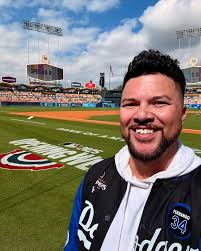
“Since 2005, I’ve always told my students to have a plan B. For me, I’ve had my teaching job, I’ve had DJing, I have hosting gigs, and I do work with the Dodgers, which has been amazing.
Photo LinkedIn
“I do voiceover work. And now I’ve had relationships with people in radio who represent brands that do endorsements. I’ve done radio commercials for Big Al, a campaign where I’ve remixed Sir Mix-A-Lot’s “Baby Got Back.” I had another opportunity to mix jingles for a local LA pawn shop. I’m at the age where I don’t wanna have a job that I don’t like anymore.”
“I will admit towards the end of my radio days (especially at KDAY), radio had changed so much that it was like ‘I’m there to collect the check.’ Most people still in radio (the majority) are just there to collect a check. They probably hate the environment, the workplace isn’t great, and you want to work for a great place.”
“I always compare it to sports. The Dodgers look like they’re having fun! You don’t want to play for the Chicago White Sox. Would I go back into radio? It would have to be for a team that I really love, want to work with, and fight for. And radio has missed that because it’s become more of a business.”
“It’s funny because radio is about talking to people and the community. I remember one PD told me, ‘Radio is in the communication business, but it doesn’t communicate with its own people.’ I’ve been blessed to have the Dodger job, voiceover gigs, teaching, and more things that are fun!
Barrett Media produces daily content on the music, news, and sports media industries. To stay updated, sign up for our newsletters and get the latest information delivered straight to your inbox.