

A new study from Crowd React Media suggests that while the Super Bowl continues to command massive reach across platforms and generations, advertisers face an increasingly uphill battle when it comes to cutting through distractions and cementing brand memory in a multitasking, multi-screen environment that has fundamentally reshaped how viewers experience live television.
The research division of Harker Bos Group surveyed 512 viewers within 12 hours of the final whistle, an approach designed to measure unaided recall while impressions remained fresh, and found that approximately 67% of adults 18 and older tuned into the game, reinforcing the Super Bowl’s status as a rare mass-reach property in a fragmented media ecosystem where audience aggregation has become more difficult each year.
Traditional television still accounted for the largest single share of Super Bowl viewing, with 53% watching via cable or satellite, yet streaming platforms represented nearly half of total consumption, including 20% who watched on Peacock and another 24% who streamed through the NBC Sports app, YouTube TV, or authenticated cable apps, underscoring how quickly digital distribution has moved from secondary option to central delivery mechanism.
Generational differences sharpened that divide, as 53% of adults ages 18 to 34 streamed the game compared with 42% who watched on traditional television, while 67% of viewers 55 and older remained anchored to linear TV, illustrating how media habits continue to diverge even around tentpole events that historically unified audiences.
Engagement with the Super Bowl itself remained robust, however, as 60% reported watching from start to finish and another 29% said they viewed most of the broadcast, yet strong tune-in did not automatically translate into strong advertising recall.
When asked in an open-ended format to name specific advertisers, 24% of respondents could describe a Super Bowl commercial but failed to identify the brand behind it, and an additional 12% admitted they could not remember any ads at all, even though the survey fielded within hours of the game’s conclusion.
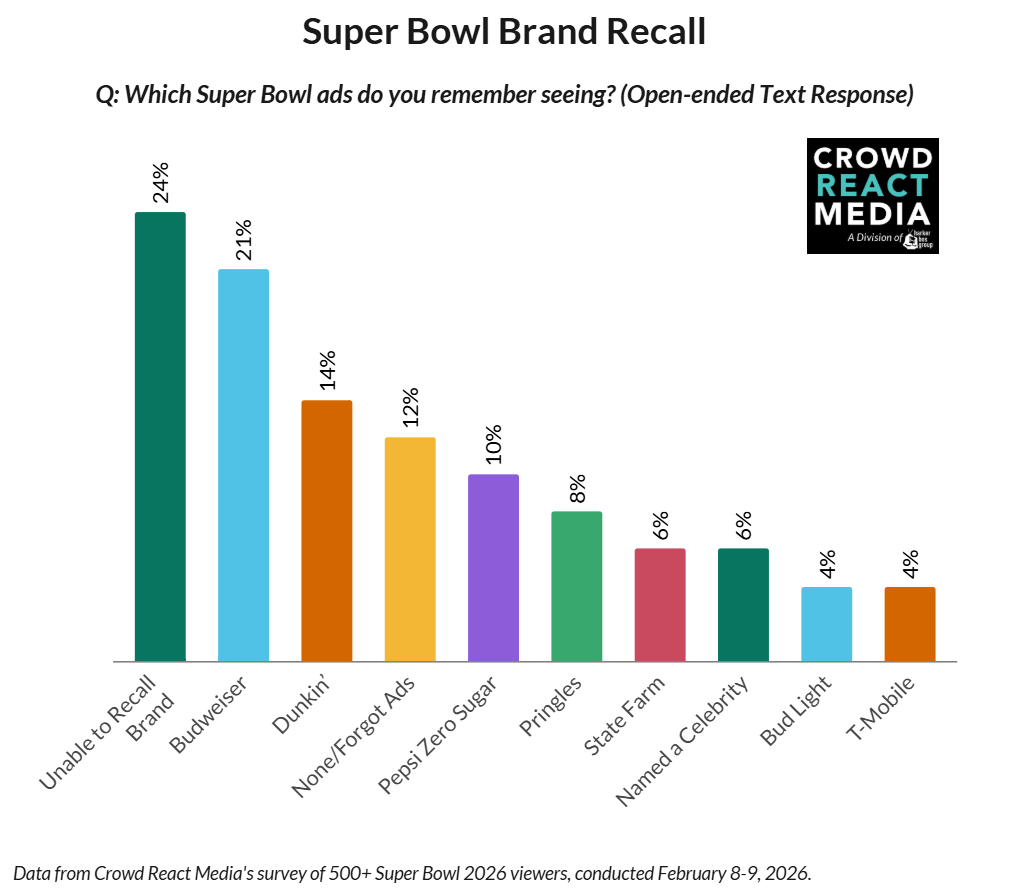
Budweiser led overall recall at 21%, though that performance skewed heavily older, with 34% of viewers 55-plus remembering the brand compared with just 18% of adults under 35, while Dunkin’ followed at 14% and Pepsi Zero Sugar posted 10% recall, one of the few brands to align creative buzz with measurable memory.
Celebrity-driven spots generated attention but not always attribution, as 6% of viewers could name a celebrity from a commercial without identifying the sponsoring brand, highlighting a persistent disconnect between star power and brand linkage in cluttered advertising pods.
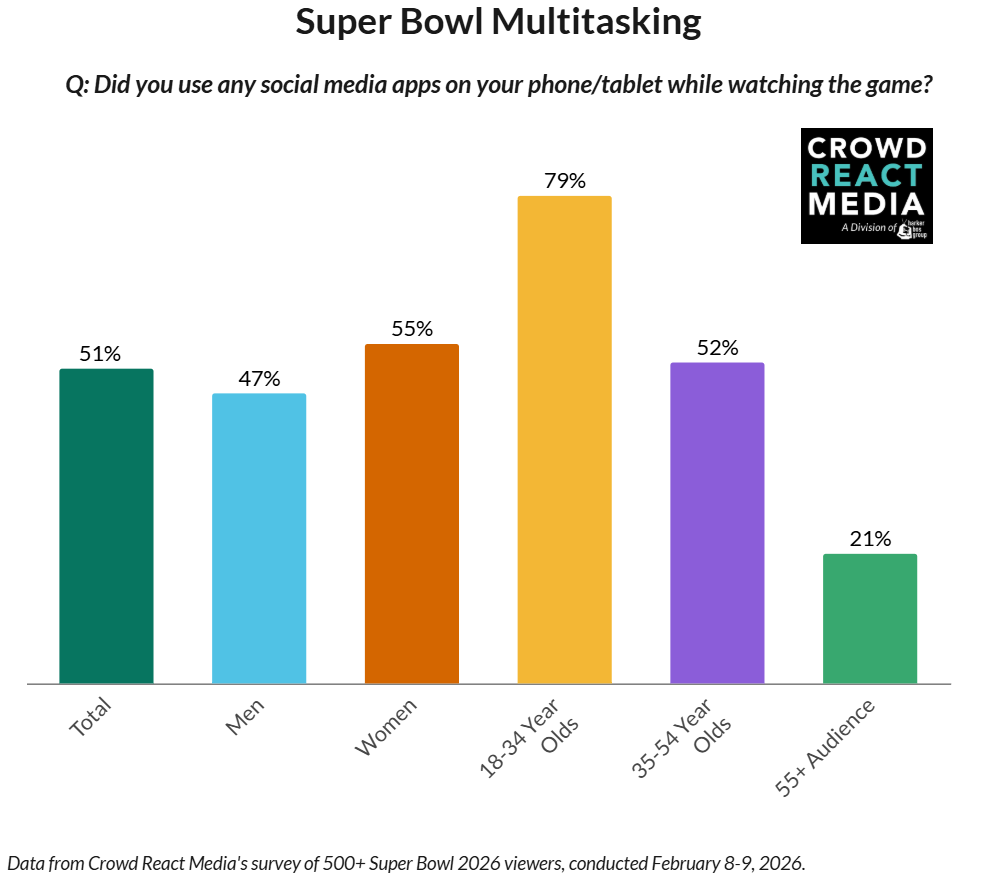
The multitasking Super Bowl environment complicates matters further, with 51% of viewers reporting social media usage during the game and 79% of adults 18 to 34 acknowledging second-screen activity, primarily on Instagram and TikTok, creating competition not only among advertisers but across entirely separate platforms vying for cognitive bandwidth.
Meanwhile, Apple Music emerged as the most effectively recalled brand of the night, as 27% correctly identified it as the halftime sponsor and 34% of younger viewers did so, marking the strongest unaided recall in the study and suggesting that integrated brand moments may outperform traditional 30-second spots in today’s attention economy.
The findings reinforce a clear takeaway for media companies and marketers alike: in an era defined by streaming adoption, generational fragmentation, and constant digital distraction, attention alone does not guarantee memory, and memory remains the metric that ultimately determines return on investment.
To view the full report, click here.
Barrett Media produces daily content on the music, news, and sports media industries. Sign up for our newsletters to stay updated and get the latest information right in your inbox.
