Somewhere along the way, radio stations decided mascots were corny.
Budget cuts. Fewer street teams. Less local marketing. More promotions that could be copied, pasted, in 40 markets.
The mascot got stuffed into a closet next to the faded remote tent, the broken prize wheel, and 400 leftover keychains.
And we lost more than a costume.
We lost one of the few brand assets that could walk into a school, wave at a kid, hug a listener, show up to a client event, survive a down music cycle, and still belong completely to the station.
Why a Mascot?
Each company deck now has a slide about artificial intelligence. Every memo finds a way to include the buzzwords of 2026: “efficiency,” “scale,” and “content first.”
But a mascot can always protect the brand because it can’t age out of the demo, hold you hostage during a contract negotiation, get poached by a competitor, or go on Facebook and rant about the President.
The company owns it.
The company can build social accounts around it. And the company can put it at schools, charity events, client appearances, concerts, parades, sponsor activations, and anywhere else the morning show does not want to go unless there is a talent fee.
And here is the part radio should understand better than anyone: mascots matter to the consumer.
Planters famously “killed” Mr. Peanut in 2020, held a Big Game funeral, brought him back as Baby Nut (also my AOL screen name), then aged him back into the beloved character.
Mr. Clean recently “retired” only to return two weeks later with a glow-up — a reminder that the bald man in the white shirt is a star (line doubles as a Phil Becker plug).
And if anyone thinks mascots are only for legacy brands, go watch the Savannah Bananas. Their mascot, Split, is not some small-market, local-ballpark afterthought. He is part of their entertainment machine that understands fans want characters, rituals, and shareable moments. Split stands seven feet tall and was named by the audience, not by the research team.
At the time I was leaving my role as EVP of Alpha Media, I created the return of WGTZ Z-93 in Dayton. And of course, you cannot relaunch Z-93 without the historic Zebra. That tells the listener everything they need to know about the brand before a song ever played.
The CashSquatch
A Portland station, for example, could build a character called the CashSquatch. It plays off the lore of Sasquatch, Bigfoot, whatever name you prefer for the world’s most famous blurry local celebrity.
The CashSquatch would be the deliverer of cash, concert tickets, and all things prize-related. He could hold coloring contests, with pages handed out to kids and hung in Safeway grocery windows. He could voice promos, star in a cartoon series on social, help stuff buses, show up at client events, and be onsite for photos people would actually want.
Because I assure you, no listener has ever said, “You know what would crush on Instagram? A picture of me next to a car salesman on an empty lot with a koozie and a tablecloth.”
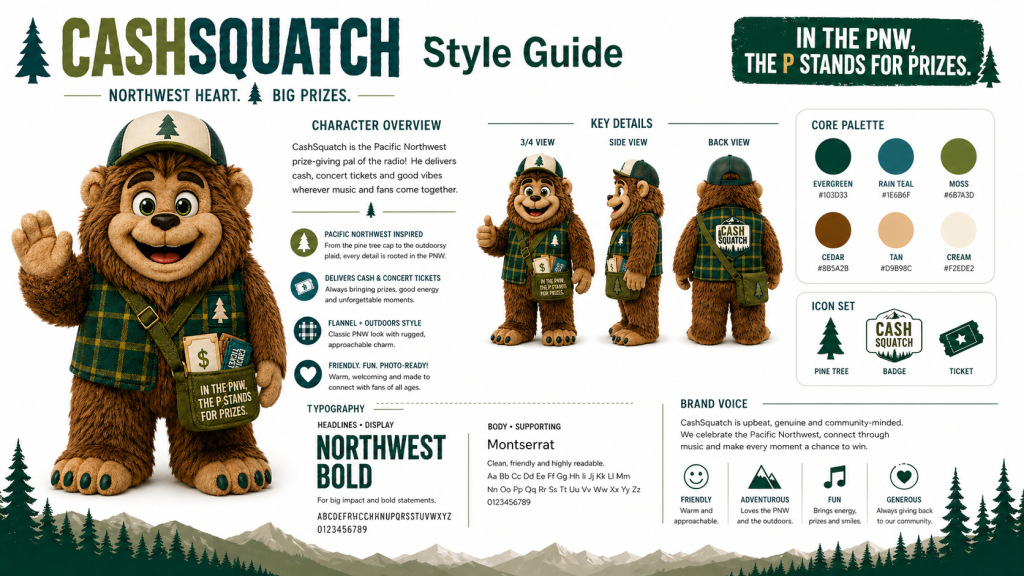


A market-specific mascot can do something “Spring Into Cash” never will. It can be local, it can be entertaining, it can be funny, it can give promotions a starting place, and it can give programming something that is more interesting than another keyword contest. This hour’s keyword is “forgettable.”
And yes, it is also “guaranteed human.” Somebody has to wear the Jammin’ Salmon costume.
In an industry wanting to prove it still has human connection, we need to bring back the most physical, entertaining, touchable, IRL tool we ever had.
Real-Life Examples
Here are a few big-brand mascot starters I would build tomorrow:
KIIS-FM Los Angeles: The Kiss Cam Cupid — onsite at Staples Center, standing next to artist photos and not saying “I’m the one on the left.” Romance pics, couple photos.
KROQ Los Angeles: The Roq Rat — a scrappy, underground, nocturnal mascot. More Shredder, less Mickey, slight resemblance to Stephen Pearcy.
Power 106 Los Angeles: The Power Plug — The Plug delivers tickets, backstage passes, and merch drops.
B96 Chicago: The Bee — Dude, how is there not a B96 mascot?
Ready to build your station mascot? To start, ask yourself:
- What local legend, food, animal, landmark, or attitude could only belong here?
- Can a listener explain the character in one sentence?
- Can a kid color it?
- Would you buy the stuffy?
- Can a sponsor support it?
- Can social animate it?
- Can it survive a format tweak or a talent exit?
Sometimes the person sweating inside the costume becomes the night guy, the next promotions director, the MD, APD, PD, OM, GM, station owner, EVP, or the author of this article.
They are guaranteed human — and how some of us became radio people in the first place.
Barrett Media produces daily content on the music, news, and sports media industries. Sign up for our newsletters to stay updated and get the latest information right in your inbox.