

Radio stations are at a crossroads in their use of artificial intelligence. Every panel at the three-day Barrett Media Audio Summit included some level of discussion about the technology. From the biggest talent to the highest-ranking executives, navigating AI has become one of the industry’s top priorities.
With each passing day, AI becomes less of an outlier and more commonplace. We’ve gone from calling out “AI slop” to seeing nearly every brand use the technology to create graphics and text designed to capture consumers’ attention in an increasingly crowded attention economy. As AI becomes more integrated into everyday life, consumers are becoming less able to distinguish what’s real from what’s artificial. So much so, that a recent survey found that, when tested blindly, the appeal of both was nearly identical.
Harker Bos Group’s Crowd React Media recently conducted a survey of 1,326 people between the ages of 18 and 45 who identified as weekly radio listeners. The focus wasn’t on the content itself, but on the elements that surround the content — specifically, station imaging and promotional spots.
Without knowing which voice was AI and which was human, the results should give anyone in the radio industry pause. When a human voice was played, only 59% of respondents correctly identified it as human. When an AI voice was played, only 55% correctly identified it as synthetic.
The results were remarkably close for a blind test. Not knowing which voice was which, only 4% more respondents correctly identified a human voice than an AI voice. Even more interesting, overall appeal ratings favored the AI voice by 1%.
Does Disclosure Matter If….
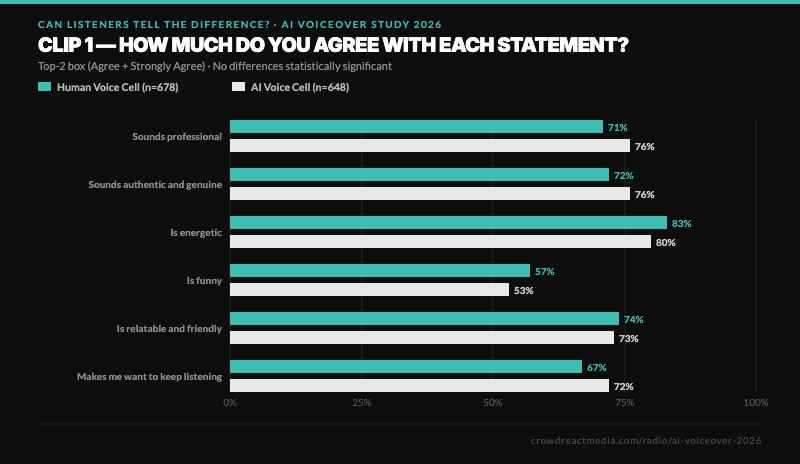
Based on those results, here’s the bigger question. As AI continues to evolve and become a larger part of everyday life, will disclosure of use even matter to consumers? Especially if the human consumer can’t tell the difference between the two, and overall satisfaction is better for the AI than a human voice. I’m a big fan of McDonald’s and love Chicken McNuggets, but should the company be required to explain every step of how they’re made? Would I care to know? Is it demanded?
The same question applies to AI across all entertainment. There are AI songs climbing music charts. AI-generated images appear across major media platforms. AI is generating personalized podcasts, creating customized sports reports and producing short-form videos that generate massive digital engagement.
Companies are now in a public relations race over AI disclosure. Google is the latest to announce AI disclosure labels for advertisements across Search, YouTube and Discover. Spotify has added AI labels to songs on its platform. Record labels continue pushing streaming services to follow suit. Meanwhile, iHeartMedia has adopted a “Guaranteed Human” approach to identify human voices, even as on-air talent across the country increasingly use AI as part of their daily workflow.
The bigger question is whether disclosure is already becoming outdated. Will disclosure really influence consumer behavior as AI becomes an accepted part of everyday life?
The findings suggest many weekly radio listeners struggle to distinguish between human and AI voices. If a blind test reveals that human and AI voices deliver a comparable experience, what’s to stop companies from investing more heavily in technology to reduce costs?
People continue to buy Chicken McNuggets. If McDonald’s found a way to produce more of them at a lower cost while delivering the same level of customer satisfaction, do you think the company would worry about disclosing its production process? More importantly, would consumers care?
Defining The Value Of Human
And that’s the root of this discussion about AI. Referencing Funk Flex’s comments from the Barrett Media Audio Summit, he’s right. It all comes down to revenue. Companies bought property, in Flex’s words, at $300 million, and now it’s worth $30 million. To remain profitable, businesses have to operate within the revenue they generate.
Keeping radio human is expensive. More work continues to fall on fewer people, often without additional compensation or greater job security. The realities of today’s media landscape are unforgiving in a content race driven by attention. Radio no longer competes with radio. It competes with everything, everywhere.
If listeners eventually stop caring whether the voice behind the microphone is human or artificial, then the industry’s obsession with AI disclosure may be missing the bigger picture. Disclosure only matters if consumers believe there’s meaningful value in knowing the difference. Based on the latest research, they’re already showing they don’t.
That’s the uncomfortable reality radio has to confront. If an AI voice delivers the same level of satisfaction as a human voice or better with each new day, companies will inevitably ask why they’re paying significantly more for the human option. That’s not an argument for replacing talent. It’s an acknowledgment of the financial pressure the industry already faces.
The challenge for broadcasters, then, isn’t simply proving a voice is human. It’s proving why the human behind the microphone matters. If audiences no longer distinguish between AI and human delivery, stations will have to create value beyond what’s just coming through the speakers. They’ll have to strengthen their brands through personalities, community involvement, digital engagement, live experiences and authentic relationships that artificial intelligence can’t easily duplicate.
AI may eventually make voices interchangeable. It shouldn’t make connections interchangeable. If radio wants to remain relevant in an AI-driven future, that’s where its investment belongs.
Barrett Media produces daily content on the music, news, and sports media industries. Sign up for our newsletters to stay updated and get the latest information right in your inbox.
