Beasley Media Group saw a total revenue decline during the second quarter but did see encouraging results in its digital sector.
Beasley reported a revenue dip of 4.8% during April, May, and June. In total, the company brought in $60.4 million during the quarter.
Despite the total revenue decline, the company did see digital revenue increases of 5.7%. In that category, Beasley earned $13 million of revenue, marking 21.5% of its net revenue.
The company added that revenue declines were mitigated by that digital performance and also an influx of political advertising that is expected to continue through the third quarter.
“Beasley’s second quarter results highlight the ongoing progress we are making to position the Company for sustainable, profitable growth,” CEO Caroline Beasley said. “The continued success of our digital transformation strategy led to a 10.4% year-over-year increase in same-station second-quarter digital revenue, partially offsetting ongoing challenges related to softness in the audio advertising spot market. Digital revenue accounted for nearly 22% of total second-quarter revenue, in-line with our full-year 2024 goal of 20% to 25% of total revenue.”
While revenue lagged behind in year-over-year comparisons, losses were exponentially less for Beasley Media Group during the second quarter. In 2023 the company lost $10.4 million. However, during the same timeframe in 2024, its net loss was estimated at $300,000.
North Radio has spun the format wheel and flipped Top 40 WCDY (107.9 CDY)/Cadillac, MI, to Hot AC positioned as “Cadillac’s Best Mix.”
Owner-General Manager Jennifer Theodore said, “The new sound of 107.9 CDY, along with Classic Rock sister station 107.1 The Drive, is the perfect pair to reach adult Men and Women in the US 131 corridor from US 10 to Grand Traverse County. This was a totally unserved market in our area, and we are thrilled with the positive response so far. This change, combined with Classic Hits WBZX, B-103.9 in Big Rapids, makes up North Radio the only group in the US 131 corridor with reach from the north suburbs of Grand Rapids to southern Grand Traverse County, giving advertisers one-stop shopping.”
The on-air staff remains with Rich Spicer in the mornings and Scott Gunther in the afternoons.
Podcast growth agency Bumper revealed its new “Bumper Dashboard,” a tool that combines various podcast data metrics to measure podcast performance.
The platform, now available to all Bumper clients, solves the complex task of measuring podcast success. “The Bumper Dashboards” removes the need to toggle through different platforms or download multiple CSV files by bringing data into one place.
The dashboard includes verified listeners, total listen time, average listen time, followers, and downloads at both show and episode levels.
Download numbers may not accurately reflect true audience size, as seen by the increase in verified listeners despite a decrease in monthly downloads for one popular podcast.
The company’s team will showcase the Dashboard at the annual Podcast Movement conference in Washington, D.C. which begins Monday, Aug. 19.
The 2024 BNM Summit is adding six more speakers to its lineup. Forty seven professionals will appear on stage on September 4-5, 2024 at the Jack Morton Auditorium. Tickets remain available through BNMSummit.com. Sponsorships are also available. Stephanie Eads can share details. Email her at Stephanie@BarrettMedia.com if interested. I do want to thank Talk Media Network and Subtext for coming on board to support the show.
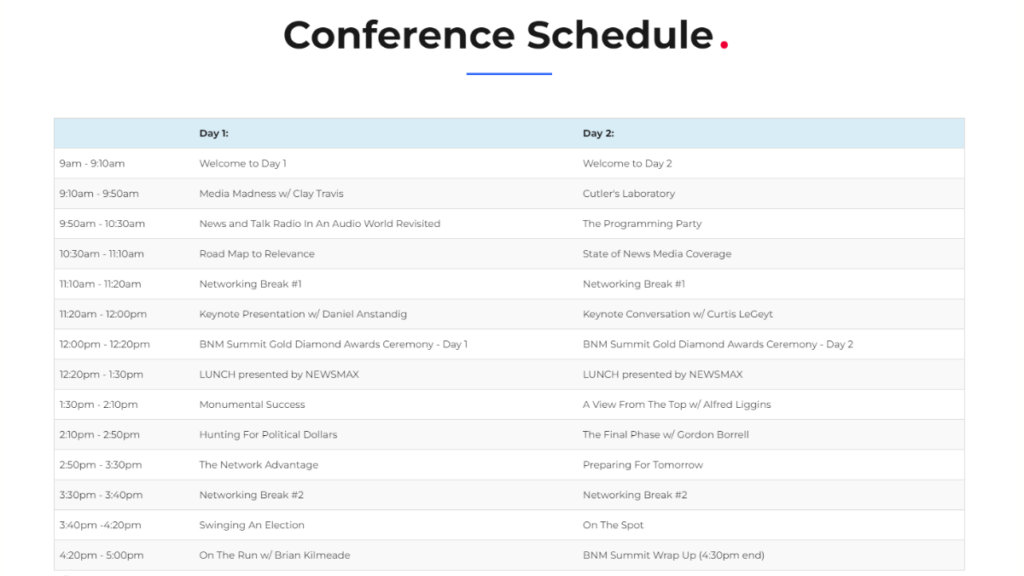
Many have inquired about our schedule. It is now available on BNMSummit.com. Scroll below the main image on the conference website and you’ll find it right above the speakers. I purposely wait until closer to the event to release final details. This is because people’s situations change, and news breaks, requiring a change in content focus. I’ve long believed it’s more important to have the best, most relevant show for attendees than rush out an advance schedule that undergoes frequent adjustments.
The six speakers we’ve added to our lineup bring a variety of experiences to our stage. Starting with the talent, Todd Starnes has a unique background. He’s heard on hundreds of radio stations through his nationally syndicated program, is watched daily on television on Newsmax, is firmly entrenched in his community in Memphis, TN and understands the pressures broadcasting executives face as he owns the Mighty 990 KWAM in Memphis. I’m excited to have Todd joining us for a session on Wednesday September 4th. He’ll be alongside Tony Katz, and Jeff Katz. Mike McVay will guide the conversation.
Lee Harris is also joining the show. His credentials in the news/talk format speak for themselves. A radio hall of famer with decades spent informing New Yorkers on the airwaves of 1010 WINS, Lee now serves as NewsNation’s Director of Integrated Operations. He understands the industry from both a talent and management perspective, and I’m looking forward to having him guide a fascinating discussion on Wednesday September 4th with John Sylvester of Fox News Radio, Liz Alesse of ABC Audio, Kevin DeLany of Westwood One, and former CBS News Radio GM and current WYPR President and GM Craig Swagler.
Having just mentioned Swagler, Craig is now based in Baltimore and fully immersed in the NPR world. Adding that perspective to the show is valuable for all in the room. In addition, Craig spent over two decades with CBS News Radio so he understands how vital the relationship is between networks and local stations. I’m looking forward to having him offer his insights with the room.
Two new faces will appear on programming panels at the Summit. First, I’m excited to have my friend Mike Schaefer in the room from WBT in Charlotte. Mike runs a great radio station with a lot of strong local talent, and learned the business out west in Los Angeles at KFI. He’s part of our final programming panel on Thursday September 5th alongside Bill Hess of WMAL, David Wood of WIBC, and Jeff Wade of WBAL. What we’ve got planned for the finale is going to be a lot of fun.
Next, I’m looking forward to having Michael Spaulding of WTMJ in Milwaukee on stage with us. If history is any indicator, a handful of states will have a strong effect on the upcoming election. Wisconsin being one of them. Recognizing the significance of what’s at stake, we’ve decided to dive deeper into programming in swing states by creating a cool, and different programmer’s panel. Greg Stocker of WPHT in Philadelphia, Ken Charles of WSB in Atlanta, and Martha Maurer of KTAR News 92.3, along with Spaulding will take part in an in-depth discussion on the role their brands play in influencing and potentially swinging an election. KCMO Host/PD and Barrett News Media columnist Pete Mundo will guide the conversation.
Equally important is hearing from market managers who have to keep brands profitable in a challenging economy. Marsha Landess knows that responsibility well as she oversees both Charlotte and Richmond, VA for Radio-One. Great stations like WBT require resources to remain on top, but tough decisions have to be made along the way to do so. Marsha will add her perspective to a GM’s panel that includes Tim Wenger of Audacy Buffalo, and Michael Spacciapoli of Audacy Pittsburgh. An additional GM may join this group too. I’m hoping to know this week. Barrett Media Chief Media Officer Dave Greene will serve as moderator.
Announcing our remaining awards recipients comes next. We’ll name our three recipients over the next two weeks. I’m also awaiting confirmation from two other talents who I’ve asked to join a panel. Finalizing their involvement is a priority for this week. Everything else is locked in, and ready to go.
We put a ton of time, energy, and thought into making this conference valuable for news media professionals. It’s worth two days of your time. You’ll leave smarter, more connected, and eager to put things you picked up into action inside your workplace. Especially if you’re in the DMV area, there’s no excuse to not be in the room if you make your living in the news media business. To join us, buy a ticket at BNMSummit.com. Hope to see you there!
JJ Surma is a voice actor and branding specialist. He is a lover of left-handed guitars, coffee, and baseball. JJ lives with his family in surburban Washington, DC.
Jeff Lynn: Give me a career synopsis.
JJ Surma: After a childhood spent making tapes of my favorite DJs, I started in radio at 17 in my hometown of Richmond, Virginia. I spent years on the air before I realized the production studio was really home for me. I went from commercial production to imaging as I moved to Washington, DC, in the early 2000s.
Voiceover went from side hustle to full-time just before the pandemic. Now, I’m servicing clients worldwide from my suburban Maryland studio, while my kids are wishing I’d go back to working in an office and get out of their business.
JL: How many clients do you currently have? And how do you manage to keep them all straight and updated?
JJS: I’m a full-time voice actor working at the highest level. However, I’ve made a very intentional decision to hold on to a select few freelance production jobs because it keeps me connected to the people I serve. To think like a producer, you have to BE a producer. I feel that keeping a toe in that water benefits all involved. It makes for some long days with a lot of juggling, though. I guess you could say I’m living the dream!
JL: Has AI impacted the Voice Actor business and what if any concerns do you have for the future?
JJS: I don’t see AI as an existential threat, but a challenge to make myself more flexible and human. And that’s the crux of what I do. I provide heritage and legacy brands a fresh-sounding option — an “announcer” if you will — who also has the ability to shift into the gears that most producers in formats like News, Rock, and Sports need.
Sounds like that authoritative voice to address a crisis or the comical big voice that’s a parody of yesteryear. In parallel with the ability to downshift into everyman or the guy next door, sometimes within the same line of copy! Artificial Intelligence can’t do that like a human with years of experience can.
JL: Who is the one client that you don’t have that you have always wanted?
JJS: I am not currently on the air in NYC, but I have my eye on one particular station in the greatest city in the world.
JL: Voice actors pioneered the concept of working from home even before COVID. What is your studio setup?
JJS: I use a Studiobricks VO edition and all the typical mics and outboard equipment. To be honest I spend more time with my guitar collection than my mic locker. Making music is how I de-stress.
JL: Biggest Blooper?
JJS: I usually keep my audio pretty clean to make it easy on the producers I work with. Some people actually want to hear your flubs though. I had a producer at one of my rock stations ask for a bit on their Storm Desk, and during the session, I just blurted out “sperm desk” by accident. What can I say? It had been a long day!
I sent it unedited, thinking it would be between us, but then later got a note from the PD with a clip from their morning show where they had a great segment about “The Sperm Desk”. As embarrassing as it was, the PD loved it, and I’m told the morning guys still have it in their Shortcut to this day.
JL: Do you live in fear of getting a cold or sore throat?
JJS: I do, especially with a wife who teaches in the petri dish of early elementary school. Having to balance being Hot For Teacher and staying Claritin clear is no easy task, friends!
Find out more about JJ Surma and hear his demos here.
Have you scrolled through your Facebook feed lately? If not, take thirty minutes today and do it. What you’ll find is a lot of clutter. Feeds are now full of ads, content from pages you didn’t request that Facebook’s AI thinks you’d like, and drastically reduced are posts from your friends and the brands you enjoy following.
In the past month, I saw JJ Surma, Matt Nahigian, and Amy Lawrence all mention how their pages had become a mess. Noticing the same myself, I decided to investigate to see if it was a short-term thing or regular problem. It’s the latter unfortunately.
What you’ll discover often is the following sequence: Post from a friend, promotion of Threads, People You May Know section, promotion of Reels, promotion of a page you didn’t like, Ad, promotion for another page you didn’t like, Ad, another Ad, promotion of another page you didn’t like, another ad, etc.. It’s a complete mess.
I logged on and off of my account ten times to see if the pattern changed, and it did slightly. Nearly twenty posts stood between a friend posting a comment or picture, and the next friend sharing something similar the first time I reviewed. The second login attempt showed me four friends posts per twenty. The best experience I had saw eight friends posts out of twenty. With over 4,000 connections on the platform, I’m sure I’m missing 99% of posts from people I follow.
There are tricks to reach more of your audience. For example, after submitting a post, you can add @highlight or @followers in a comment below, and it will alert a number of your connections that you’ve posted. Facebook’s algorithm is not a fan of it though. Two of my posts went through unscathed, but the third got blocked and returned with a warning.
Clicking on the feeds section and posting in groups can also help but most people live on the main page. Facebook has turned its main hub into a wasteland, and there appears to be no end in sight.
Why does that matter? Well, if you run a brand, and you’ve spent years building an audience, trying to keep people aware of your audio, video, and written content, how are you supposed to reach them if the platform isn’t showing your content to your fans? Have you looked at your impressions, and engagement numbers lately? If you did, they’re likely down. I’ve seen that consistently across numerous brands I work with, and the story is the same for Barrett Media‘s accounts.
What’s become clear is that Facebook and X both want video and high profile people commenting on their platforms. They also want you spending money to be seen. If you rely on organic posts and don’t have a paid social strategy, good luck. The platforms also value celebratory news and feel good moments. Those don’t happen every day though.
The story isn’t much better on X either. Reach and engagement per post are way down. I reviewed how publishing brands and radio stations performed for a few full days, and the percentages were abysmal. For example, Axios had an average of 20K in reach per post for a full day last week. The brand tweeted 24x in 24 hours to their 680K followers. This means they reached roughly 3% of their audience on X. With most of their tweets pushing articles, X has no interest in sending people off of its platform to read their content.
The Hill experienced a similar fate. Though much more active with 140 tweets over a full day, 138 of which were promoting articles, the news publisher averaged just 8,800 per post. With 4.4 million following the account, that means their content reached less than 1% of their audience over 24 hours.
Rolling Stone and The Athletic weren’t much different. For a full day, The Athletic tweeted 37x generating an average of 30K in reach per post. They mixed up their posting strategy, using 5-6 video posts, a handful of images, and mostly articles, but with an audience of 558K on X, they reached roughly 5% of their audience. Rolling Stone on the other hand tweeted 36x over a full day, landing 21K per post. All of their posts promoted articles. With 6.1 million followers, they reached 0.3% of their audience.
Large market radio stations faced similar issues. WFAN for example posted 26x on X on Friday. 4 were video posts, 3 were images, 1 was an audio clip, and 18 promoted articles. Collectively they generated 19K impressions per post. The good news, two of their videos performed 3-5x higher on average per post. WFAN has 158K following on X, so when you look at an average of 19K per post, it means they’re reaching 8% of their followers. Pull away the two videos though that delivered 165K combined, and the average falls to 13K per post.
I also looked at ESPN LA on X, and they too are feeling the sting of organic reach being suppressed. The station has 97K followers, and over the span of 24 hours, they pushed out 27 tweets. Those posts included 12 videos, 2 GIF’s, a few promotional texts and a poll. They recorded an average of just 2K per post, and slightly above 2% per reach per post. Facebook, which is where ESPN LA especially shines with over 521K following, also had problems. The brand did a great job of pushing out a ton of video, but even the engagement and reach of their videos has been drastically reduced.
Using 2015-2020’s social media strategy in 2024 isn’t going to produce results for brands. Platforms have made massive changes, and with artificial intelligence now part of their business model, the game is changing rapidly. Media companies have greatly valued social media over the past decade, often to the detriment of their own networks, stations, podcasts, and websites. As the percentage of reaching people shrinks, it reminds us of how important it is to have a direct relationship with your audience. Whether that’s through you’re over the air product, podcasts, newsletters, text databases or in-person events, you’ve got to have a fan to brand strategy.
By the way, search is going to go through transformation in the future too. Google last week lost a landmark case, the first antitrust decision against a technology giant in the modern internet era. What happens when the content you’ve been creating for SEO search on Google has different rules for different search engines, and AI influencing what gets boosted and diminished?
Most media outlets don’t depend on social media for revenue. They use the platforms to ‘market’ their content to fans in the places they gather. Social media still has billions of people on it, so to suggest that it’s not important would be foolish. The point of this column is to open your eyes on how much harder it is now to be seen. Many of the brands I cited earlier are all successful, and even they are feeling the sting.
YouTube has far greater value right now, because people are watching content on the platform more than they are television. You can also monetize your videos if you have a decent subscriber base and regular viewing. Having said that, we are renting space on all of these platforms. If Facebook, X, YouTube or any other social media platform decides to change their rules, rates or reach, it’s on you to adapt. Otherwise, you risk losing relevance, and potentially revenue.
What brand leaders and executives need to be asking is ‘how much promotion is necessary’, ‘what type of content matters’, ‘how much should we be spending to market our content’, and ‘how do we use these platforms to grow our business?’ Do you need 5-10 people in a digital department if 50% of your reach continues evaporating? Are you helping your brand prosper by focusing on written content if platforms are making sure less people see the content? Do you need 50-100 posts per day if you’re literally spitting into the wind?
Executives have to do a better job of defining their digital strategies. Are you focused on live video audience, total video views, podcast listens or downloads, website/article pageviews, newsletter open and click rates, app sessions, social media reach or something else? You can call it all digital but some offer limited return on investment. Others provide greater bang for your buck. All require different strategies though.
These are the issues that should keep you up at night. As a publisher myself, I know how difficult it is. It’s why we’ve placed greater focus over the past year on our newsletter and events strategy. Even then, we don’t have it all figured out. As Rowdy Roddy Piper once said, just when they think they know the answers, I change the questions. Facebook and X are doing just that. It’s on us to adapt or spend a lot of time and resources learning the hard way that what we’re doing now isn’t making the same impact.
Our full schedule for next month’s show in Washington D.C. is now posted on BNMSummit.com. I listed a copy below too. Six more speakers have been added to the lineup, bringing our total to forty seven. For tickets, visit BNMSummit.com. For sponsorship questions, email Stephanie@BarrettMedia.com. My thanks to Josh Leng and Talk Media Network for signing on as an event partner.
I’ll be contacting all speaker groups this week to allow everyone to connect, ask questions, and get prepared for the show. I hope to see you in the nation’s capital. It’s going to be an excellent conference.
News, Notes and Reactions
Give our own Jeff Lynn a shout to thank him for an excellent job on Barrett Media’s ‘20 Brands in 20 Days‘ series. It was a good introduction for music radio folks to our site, and showcased some great brands and leaders. If you didn’t read it, click the link above. Up next, a series titled ‘Behind the Voices’. It debuts today, and will run through the middle of next week.
Congrats to all involved at 610 Sports in Kansas City on the move to the FM dial and rebranding as 96.5 The Fan. With the Chiefs on a historic run, and interest in sports in KC consistently strong, it makes sense for the market to have a larger presence on the FM band.
Lots of positive feedback on the socials for Morning Show Bootcamp in San Diego. Congrats to Don Anthony and his team on pulling off another great event. I’m hoping to make it to the 2025 event. Events that support the industry deserve support in return.
A tip of the cap to Drew Anderssen at Audacy Dallas on the masterful job reshaping KRLD. With Chad Benson, Joe Kelley, and Will Cain added to the lineup, the radio station has added exceptional talent to continue serving its Dallas listeners. Well done.
Taylor Swift cancelled three shows in Vienna after police spoiled a terrorist attack, which was planned to occur at one of her concerts. What took place outside of her hotel afterwards demonstrates the power of connection between artist and fan. Truly awesome.
Layoffs are never good but I wish companies put more thought into when they executed them. iHeartMediacuts came out last week on the same day that the company revealed its first uptick in revenue since 2022. That’s a PR move that just doesn’t look good.
Congratulations to Susie Hedrick on being named the new CEO at WideOrbit. Hedrick previously led vCreative before joining the company. She’s well respected, and has had time to learn the ropes under Eric Matthewson who is transitioning to a strategic role on the Board of Directors for Lumine Group Inc. which bought WideOrbit in 2023.
Props to Nick Wright for his remarks last week on YouTube. Wright said Colin Cowherd is the face of FS1, and to suggest otherwise is inaccurate. No disagreement here. As I said on social media Monday, Nick’s points were fair, and FS1 execs have many strong options to consider as they determine the best path forward for their new lineup.
Oliver Darcy left CNN last week, and announced the launch of a new newsletter, Status. I’ve signed up for it. You should too if you like staying informed on media industry happenings. Go here to do so.
Is there any artist doing more right now than Jelly Roll? He’s got his own songs topping the charts, appeared on singles with Eminem, Falling in Reverse, and MGK, showed up at WWE Summerslam, and his single ‘Get By’ was chosen by ESPN as the new College Football anthem for the 2024-2025 season. The guy is on fire, and a brilliant songwriter.
I’m Hearing
Fox Sports 1 would like to debut their new on-air lineup on Monday August 26th.
The city and date for the 2025 BSM Summit are nearing the finish line. Expect an announcement in September.
Reality Check
Broadcasting trade sites continue to decline. That’s not good news for the media industry. Axios laid off 10% of its staff last Monday morning, and hours later Broadcasting & Cable and Multichannel News announced plans to shut down. That follows changes within the past year at TV News Check, The Big Lead, The Messenger, All Access, and others.
I hope our readers and industry friends understand that our existence isn’t guaranteed. We work our tails off to keep the lights on, and it isn’t easy. A simple gesture like sharing our stories on social media, passing along a news tip, or supporting our work by sponsoring our newsletters, website or conferences matters. Media companies have not done a great job of supporting trades who tell their stories. I remain optimistic, but am also realistic. Here’s to hoping we’re on the right side of this game, and not following in the footsteps of others who did great work but were forced to exit.
One day, they’re there. The next, they’re gone. And there’s no explanation offered. Media layoffs and format changes, just happen.
That’s how the radio industry does things, and television, and most media. Hosts get fired (best of luck to the iHeartMedia employees laid off last week) and it’s treated on the air like they’ve never been there. Stations change format and either it’s an abrupt change without notice or it’s a lame stunt – hey, let’s just play the same song over and over for the weekend to “flush away” the old audience – or there are promos directing fans of the old format to an HD2 channel or online stream they’ll never visit.
It’s disrespectful. It’s disrespectful to those who got let go, and, critically, to the audience, which deserves at least some notice and explanation. Sure, when a format changes, it indicates that there weren’t enough listeners to support the old format, but those listeners were radio loyalists at a time when radio needs every listener it can get. In the olden days when there were no other options, those listeners would go find another station. Today, they’re just as likely to bolt from radio altogether and fire up Spotify or Apple Music.
The same goes for TV news. Anchors and reporters build trust with the audience over the years. Suddenly, the trusted are gone, and there’s a new person reporting. In fairness, local TV stations do often let viewers know about personnel changes and allow the anchors and reporters to say goodbye on the air. (Radio doesn’t like that, because management has never trusted laid-off hosts to have one last show, lest they say something untoward or unprofessional, like “this is my last show here, thanks for listening.”)
One of the things that went away with consolidation and private equity investment is that there isn’t time to just let formats and hosts and shows have time to build a loyal audience. Management talks a good game about wanting to increase engagement and loyalty, but if ratings and revenue aren’t growing (fast), changes get made, heads roll, you know the drill. On one hand, it’s understandable: if the money’s not there, voice tracking becomes attractive and AI becomes a manager’s dream – no salary, no benefits, no vacation days, just a reliable personality-free “personality” to fill the schedule. Talk radio may not be the ideal fit for AI, but you know someone’s going to try it. But on the other hand, unexplained changes turn off one audience at the same time they may be exciting for incoming listeners.
Audiences generally don’t read media trade sites, as much as we at those sites would like it if they did. They don’t know why their favorite host disappeared, their favorite Alternative station is suddenly a sports talk station, the morning TV news hosts have changed. Would it hurt anyone to let them know?
Count me as one who’d like to see radio and TV stations take that risk and let departing hosts do “last shows.” Yes, it might be dangerous, but, hey, if the fired jock goes ahead and plays the same song over and over, or trashes management, or goes way off format, it’ll at least get attention. People will talk about it. It won’t really matter in the long run (unless they do something to endanger the license, but that’s what dump buttons and security guards are for). And you might get another outrageous “radio story” you can tell at reunions and conventions, if, that is, there are still such things in the future.
Oh, yeah, good luck to those finding themselves laid off, let go, fired, newly at leisure, forcibly retired, on the beach. It might be tough finding another media job, but it’s not impossible. And if you can’t land a media job, there’s life after radio and TV. You might even like it more.
The Sunday brunch restaurants we frequent had long waiting lists. It was back-to-school week, and summer vacations were over. Not wanting to wait an hour, we opted for a standby restaurant we hadn’t visited in a while: the warm, friendly, and filling Cracker Barrel.
We added another 20 minutes on the way out because my companions had to browse the Old Country Store. I was going to the porch to sit in one of their comfortable Heritage Rocking Chairs when my eye caught an odd site. A Christmas tree. I did one of those non-verbal head tilts and said, “It’s the first week of August.”
If your brand plays Christmas music, you’re thinking about this year’s playlist. If the strategy involves promotions and events, the meetings start in March.
Fun Old-Fashioned Family Christmas
How do we prepare and freshen our brand’s purpose during the Holidays? Consider Clark Griswold’s search for the perfect tree in National Lampoon’s Christmas Vacation.
When young Russ Griswold tells his dad the tree is too big and won’t fit in the yard, Clark delivers the line that sets the storyline for the rest of the movie. “It’s not going in our yard, Russ. It’s going in our living room.”
The tree, the decorations, the large family, the dinner scene, the Christmas bonus… everything has an exaggerated theme as Clark attempts to create a “fun, old-fashioned family Christmas.”
Let’s use those exaggerated themes to review the Christmas branding and promotions strategy for radio stations.
The Tree
Where is the “tree” going? Every market has a heritage Christmas music brand. That radio station has a larger “living room” for the playlist and can push the boundaries a bit with the tree’s fullness.
However, the playlist curator knows why the brand has continuously maintained the neighborhood’s Best Tree award. The tree may be larger, but the owner knows it must fit the space, look the part, and feel right whenever someone walks into the room.
If your space is smaller or you’re trying to move in on Martha May Whovier’s territory in How The Grinch Stole Christmas (2000), there’s more pressure for your smaller tree to look and sound bigger than it is. Be tight but full.
P1 Media Group’s annual Christmas Music Research results will reveal that the most played and most popular songs will be traditional tunes, or what we call classics. You know, The Christmas Song, Jingle Bell Rock, White Christmas, Have a Holly Jolly Christmas, etc.
The playlist must include what listeners expect from this format, but some of the fullness might come from heavily played streaming songs to give your tree more fullness. If you’re a Christian music station, you get your fullness by leaning into traditional religious-themed songs.
Decorations
Clark Griswold did what most dads have done at least once: climb on a roof or up an outdoor tree to hang lights. “Dad, you taught me everything I know about exterior illumination,” Clark said to his father once the Christmas lights finally lit up, thanks to Clark’s wife.
Martha May Whovier has the best Christmas decorations every year. When her neighbor, Betty Lou Who starts decorating her house to jealously compete for the best Christmas lights, we see her walking on the roof and stringing lights like Clark and the rest of us.
Martha May steps outside to reveal her newest gadget: a Gatling gun light stringer. The machine perfectly places the lights along the roofline in 15 seconds compared to the hours of work it has taken Betty Lou to have a less impressive display.
Radio values what comes between the records because those moments create the difference and the companionship. However, Christmas programming becomes stale if we keep recycling the same audio year after year.
The non-Christmas formats have an opportunity to get creative and have fun with audio imaging and promotions during the Holidays. Rock stations give Christmas an attitude to match the station’s purpose.
Plus, are we wasting time stringing lights on top of the roof when we have access to faster-generated copy, sound effects, and voices through AI? Let the technology help us with options for using our creative talent to create a more memorable or meaningful presentation.
The Family Dinner
The Griswold family Christmas dinner makes us laugh and cringe because we’ve been there. The writer has most of the movie’s characters participate in that scene with their personality traits and quirks to create real-life family dysfunction.
Get your radio family involved early to help generate ideas for promotions and events. Most people have an opinion about Christmas decorations. It’s the same with ideas. Christmas music is the most passionate genre. You’ll likely get emotional input from everyone about what they like and dislike. This is a great season for inclusion of participation.
If your station is involved in a Christmas parade, invite the non-on-air staff to decorate a float or walk in the parade. Most of those employees find it much more exciting to participate in an event than the announcers who have been walking and smiling in parades for years. Give everyone a seat at the family dinner table to improve the listener experience.
The Christmas Bonus
In National Lampoon’s Christmas Vacation, the main character, Clark Griswold, wants to surprise his family with the announcement that he’s installing a backyard swimming pool with his Christmas bonus.
Promotions like Christmas Wish or The 12 Days of Christmas Gifts work year after year and should be a part of the radio marketing and promotions landscape. But what are you doing differently to get noticed like Clark did? When he announced his idea, the whole family rejoiced because it was unique and fun.
Like those classic, traditional hit songs, the classic promotions work, and you should keep doing it if you own the feature. The opportunities are created in those secondary and tertiary promotions to keep the tree looking full, just like the playlist.
Social media posts and videos are a great place to reach beyond the limits of the radio presentation and create fun, emotional, and different content to enhance audience engagement. Start with your internal staff. If you need more help, contact people who think differently to give you 19 new ideas. You don’t need all 19. You need one great one to run with.
Finally, be prepared for it not to go the way you planned. The conflict for Griswold was he didn’t receive his typical Christmas bonus (spoiler alert). He didn’t have a backup plan to save Christmas until Cousin Eddie stepped in and kidnapped Clark’s boss.
In How the Grinch Stole Christmas, the residents of Whoville surprised the Grinch when they came together to celebrate their community bond after the Grinch robbed their gifts. They had a backup plan and didn’t lose the Christmas spirit.
Christmas music creates audience cume and gets attention. What is the backup plan when a third, fourth, or fifth radio station in your market goes All Christmas? What is the plan when the promotion budget is reduced again? If you’re not one of those Christmas stations, what is the plan to get noticed for an outstanding promotion or bit you created? The stations with the most opportunity to have fun at Christmas are the non-Christmas music stations.
We gasp when we walk into a department store in August and see Christmas decorations. However, it has been this way for a long time. Start planning for the “hap-hap-happiest Christmas since Bing Crosby tap-danced with Danny…” Okay, I won’t finish the Griswold line.
When PPM was commercialized in the ‘aughts, a couple of new weighting variables were added. For years, we knew that Arbitron weighted the diary service estimates on age/sex, geography, and race/ethnic, depending on the composition of the market. That carried over to PPM although adding 6–11-year-olds brought in two more demographic subcategories. PPM debuted two new variables: employment status (for persons 18+) and the presence of children in the home, with children defined as someone 17 or younger living in the household.
Weighting variables are chosen because they have a reasonably strong relationship with radio listening. Obviously, age, gender, geography, and race or ethnicity make sense. Working status is reasonable as well because people who work full or part time probably commute (although I wouldn’t have used the word “probably” prior to COVID) and may listen at work, while those who don’t work spend more time at home and likely watch more video content.
Presence of children seemed to make sense as well, statistical analyses aside, in that prior to kids having cell phones and in the days before lots of streaming, a child may dictate what is heard in the car. So far, so good.
The problem with that last weighting variable was that Nielsen has done a poor job of getting the sample anywhere near the universe estimate, in other words, what they believe is the accurate percentage in the population. If you subscribe to Nielsen Audio in a PPM metro, I strongly urge you to check the latest E-book for your market, click on the “Population Estimates & Sample Summary” at the top, and then choose the “Population Estimates and Average Installed and In-Tab Persons by Demographics” option on the left. Go down through the table and look at “Persons With Children in HH”. You’ll find a number estimating the persons and next to it a percentage for your market. A few columns to the right, you’ll see how the sample performed for that survey. Go ahead and do it…I’ll wait for you.
I’m not Nostradamus or even Kreskin (if you remember The Amazing Kreskin), but my crystal ball says that the sample will be well below the population percentage, in fact, the sample may be way off, probably by ten percentage points or more. Those of us who look at this sort of thing have known about this problem for a long time. When I was at Cumulus, this happened in just about every one of the company’s PPM markets.
What this means to you is that ceteris paribus (Latin for all other things being equal and you’ve now picked up a usable Latin phrase!), panelists who live in households with someone under 18 are worth more. Each quarter hour that they spend with a radio station represents more audience than a panelist from a household without children. It’s that simple.
Beyond complaining to Nielsen, you may be able to take advantage of the situation. When Scott Jameson was VP/Classic Rock for Cumulus and PD of KQRS in Minneapolis-St. Paul, a heritage classic rocker, we’d talk about the PPM situation in his market. At the time, Nielsen was perhaps 15 points low on households with children, so Scott invented a couple of contests aimed at families. One was “Kiss Kids” when Kiss came to town for a concert (thanks to Scott for the pic!). The goal was to target panelists with children at home who could contribute “heavier” quarter hours. It’s impossible to know if the stunts worked, but this approach certainly couldn’t have hurt.
You can do the same in your PPM market. Look at the sample performance and then start brainstorming. I don’t think it matters what formats you have, it’s just a matter of what angle you take to entice listening from households with children. Be original. You don’t have to spend a lot of money (which you probably don’t have anyway) but think about ways to exploit Nielsen’s woeful sample.
In the back of my mind, this is not the way to “do good radio” but we’re all fighting for ratings. This might be a small piece, but as we know from Any Given Sunday, we have to fight for those inches or in our world, those heavyweight quarter hours.
Think about the children, however corny and contrived it might sound, but your bonus may depend on it!