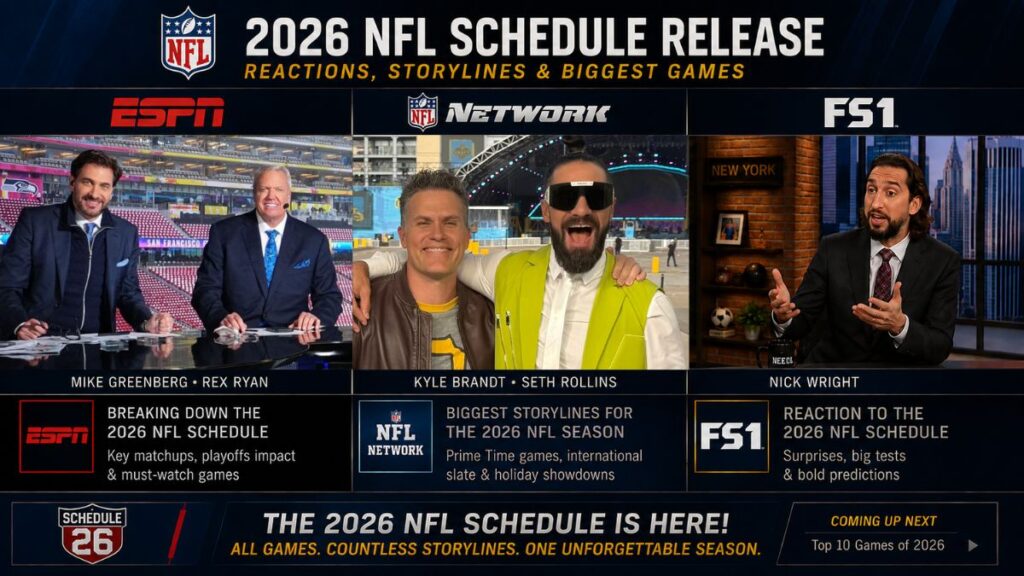
FOX Sports is set to acquire two more NFL games to its schedule this season, CEO Lachlan Murdoch shared during the FOX Corp. investor call Monday morning.
What We Know: There were five games up for grabs during the NFL season. Early reports suggested that the games would be split between Netflix and YouTube. However, YouTube has since reportedly balked at the idea of splitting the package. During the call on Monday, Murdoch shared that FOX Sports has taken one game in week 10. That game is scheduled to be played in Munich, Germany. It will provide FOX with a Sunday tripleheader on Sunday, November 15th. The second game FOX Sports acquired is a Saturday game on December 19th.
What They Said: “(The NFL) has been a key partner with Fox for over 30 years … There is no tension, really, with the NFL … We’ve had no substantive discussions with the NFL (about a new TV deal).” -FOX Corp. CEO Lachlan Murdoch
What Remains Unclear: Which teams are playing in the two new broadcasts acquired by FOX Sports. The NFL schedule release is set for Thursday, May 14th. Additionally, financial terms for FOX’s purchase of the package were not made immediately available.
What It Means: Two of the five games up for grabs are taken off the board. After YouTube said “thanks, but no thanks” to splitting the package with Netflix, it is perhaps easy to see why. The other three broadcasts, which conceivably will go to the streaming giant, include games on the day before Thanksgiving, a second Black Friday game, and a Christmas Eve game. Those are all much more likely to provide larger audiences than a 9:30 AM ET game on a Sunday morning and a Saturday in the run-up to Christmas.
Barrett Media produces daily content on the music, news, and sports media industries. Sign up for our newsletters to stay updated and get the latest information right in your inbox.
Townsquare Media has unveiled its 2026 first-quarter financial results. In totality, the company saw a slight revenue decline.
What We Know: Overall, Townsquare Media saw a 1.9% revenue decline during the first three months of 2026. Despite the dip, the company saw a large increase in net income during the quarter.
What the Numbers Show:
Segment
Revenue
Change
Net Revenue
$96.7 million
↓ 5.0%
Broadcast Net Revenue
$38 million
↓ 6.6%
Digital Advertising Net Revenue
$39.2 million
↑ 6.8%
Net Income
$3 million
↑ 296%
Adjusted EBITDA
$16.4 million
↓ 9.7%
What They Said: “Looking forward, due to our confidence in our Digital First Local Media strategy, our focus on markets outside of the Top 50 U.S. cities, and the strong cash generation characteristics of our business model, we remain assured in our ability to build shareholder value for our investors through long-term net revenue, Adjusted EBITDA and cash flow growth, net leverage reduction, and future dividend payments.” -Townsquare Media CEO Bill Wilson
What It Means: Townsquare adjusted its net revenue guidance for the second quarter following the release of the results. It expects second-quarter revenue to be between $114 and $116 million. Its total year revenue projections remain between $420 million and $440 million.
Barrett Media produces daily content on the music, news, and sports media industries. Sign up for our newsletters to stay updated and get the latest information right in your inbox.
Cumulus Media is selling its 97.9 FM translator in Atlanta. Meanwhile, the company is realigning frequencies for two of its key brands.
What We Know: OG, Atlanta’s Classic Hip Hop station, moves from 97.9 FM to 98.9 FM. Additionally, OG shifts from WWWQ-FM/HD3 to HD2. 99X continues on 100.5 FM but drops its simulcast on 98.9 FM. Until the 97.9 sale closes, Cumulus will temporarily run OG on both frequencies.
What They Said: Justin Schaflander, VP/Market Manager for Cumulus Atlanta, framed the moves as strategic housekeeping. “These moves strengthen signal efficiency and position our brands for continued growth,” he said. Furthermore, Schaflander called it a “disciplined approach to optimizing our Atlanta assets.”
What Remains Unclear: The buyer of the 97.9 FM translator has not been identified. No timeline for closing the sale has been announced publicly. It’s also unclear whether additional format or programming changes will follow the frequency shift.
What It Means: Smart operators don’t just run stations — they position them. Cumulus does exactly that here. OG gains a stronger signal on 98.9 FM, delivering better reach in a competitive Atlanta market. 99X, meanwhile, finally stands alone on 100.5 FM with no simulcast splitting its identity. The sale of the 97.9 FM translator proves this isn’t reactive — it’s deliberate portfolio management. Cumulus is trimming what it doesn’t need and strengthening what it does. Both brands emerge sharper, stronger, and better positioned for what comes next.
Barrett Media produces daily content on the music, news, and sports media industries. Sign up for our newsletters to stay updated and get the latest information right in your inbox.
Nielsen has discovered something astounding — sometimes, multiple people watch video content together. This concept is called co-viewing. The announcement was made last Tuesday.
Despite the snarky opening, it’s not as momentous as you might think, but it’s worth discussing.
If I understand the press release correctly, Nielsen already collects co-viewing data but has added more using — you guessed it — the PPM. Once again, Nielsen indirectly thanked the radio industry for funding all of the R&D to make PPM the successful video measurement tool that Arbitron thought it would be in the 1990s.
Here’s how their release explains co-viewing: Nielsen “layers in panelists using wearable devices inside of the home.” Those wearable devices were not previously applied to the co-viewing modeling. Nielsen has been introducing more high-tech wearables into the panel. Those “wearable devices” are PPM watches.
What the Pilot Study Showed
Nielsen ran a pilot study during six major live events:
Super Bowl LX
The Olympics Closing Ceremony
The NBA All-Star Game
The Daytona 500
The Olympics Men’s Hockey Gold Medal Game
The State of the Union Address
The data showed an average lift of 4.19% in total viewers. Nielsen will now include this additional co-viewing data beginning with the 2026–27 season. An article in Front Office Sports included a positive quote from a higher-up at one of the most powerful organizations in the United States — not the federal government, the Catholic Church, or even OpenAI, but the Chief Data and Analytics Officer of the National Football League.
Paul Bellew said, “I have to give Nielsen credit. We’ve pushed them really hard about this.” If the NFL likes what you’re doing, you’re in great shape.
Where Radio Fits Into Nielsen’s Priorities
What rubs me the wrong way is a quote in the Nielsen release attributed to Karthik Rao, Nielsen’s CEO. He said, “Our Co-Viewing pilot exemplifies our unwavering commitment to providing the most accurate measurement for our clients during these dynamic times of change. In the past year alone, we’ve made continued improvements to our ratings to better reflect the power of live TV in reaching massive audiences.”
Any press release includes some level of puffery. However, if anyone in radio believes Nielsen has an “unwavering commitment to providing the most accurate measurement” with respect to radio and audio, please drop me a note. Nielsen Audio employees are excluded from that request.
All I’ve seen for radio and audio is a software tweak. They’ve changed the definition of a quarter hour from five minutes to three — and likely down to one minute soon. Then consider the online diary, which has been worked on in fits and starts since at least 2006. I’ve been told this isn’t a money-saving move for Nielsen Audio. However, that doesn’t ring true to me after all my years in the business.
Questioning Radio’s Importance
Meanwhile, the company is doing its best to show love for the radio industry by fighting with Cumulus. The court is specifically reviewing whether Cumulus must buy local Nielsen data in all of their markets in order to purchase Nationwide for Westwood One.
I can’t say whether Nielsen’s “Network Policy” is what drove Cumulus back to bankruptcy court for a second time in less than a decade. However, it had to be a contributing factor. Perhaps the two parties could have worked something out. The huge amounts both sides are paying to white-shoe law firms could have been used for more productive purposes.
Admittedly, Nielsen is in a competitive situation with respect to TV estimates, and there’s big money at stake. If a competitor were to somehow dethrone Nielsen as the dominant national TV ratings supplier, the company would be in serious trouble. The private equity owners would be in a difficult position. We’re already seeing the strain of Nielsen Audio’s pricing, based on the assertion in a recent Cumulus filing in their court battle that the company couldn’t justify the cost of Nielsen data in more than half of their local markets.
I have no idea what financial criteria the company used. Considering the rumored Nielsen price hikes, attention, and apparent investment given to the TV side of the business, it appears the Cumulus finance team may have been right.
If Karthik Rao’s quote is something more than puffery, he and his company need to show some love to the radio side of Nielsen’s business.
Let’s meet again next week.
Barrett Media produces daily content on the music, news, and sports media industries.Sign up for our newsletters to stay updated and get the latest information right in your inbox.
The NFL schedule drops Thursday night. What separates the brands that win this week from the ones that simply participate is preparation, creativity, and understanding what the moment is actually worth.
This is the one offseason event every NFL fan cares about simultaneously — regardless of market or team. The draft favors teams with high picks. Free agency builds gradually. The schedule release is different. In a single compressed moment, every fan finds out exactly what their team’s season looks like.
Brands that understand its value build toward it all week. Outlets that treat it as a Thursday night news item leave audience on the table. No other sport generates the sustained cross-platform interest the NFL produces every month it touches — including May. The best brands in sports media plan for this weeks in advance. They build sponsorships around it and prepare their talent to lead the conversation rather than follow it.
The Local Sports Radio Reality
If you’re running WFAN, WIP, 98.5 The Sports Hub, KFAN, The Ticket in Dallas, or any other high performing sports radio brand, you already understand your audience’s emotional temperature better than anyone. Right now that temperature is complicated. Several of your markets have NBA Playoff teams still alive. The Mets, Yankees, Cubs, and Dodgers are generating daily content. So are the Lakers, Knicks, Sixers, Pistons, Cavs, and T-Wolves. Shortening your focus on those hot buttoned issues for schedule speculation could be a mistake. But not prioritizing the NFL could be equally shortsighted.
The answer is structured integration. Starting Monday, build a daily NFL schedule segment into your shows. Make it hyper-local and hyper-specific. Which prime time slots does your local team land? How does their strength of schedule compare to last year and division rivals? What’s a realistic expectation for wins and losses? Which games are most intriguing and provide produce the best storylines, intensity, or opportunity to create revenue generating promotions?
This is a week where four days of audience interaction, social content, and appointment listening is critical. Great brands have already armed their sales teams with opportunity to capitalize on a week-long drama. Good brands deliver a single-night event with limited value to excite sponsors. Bad brands do nothing besides reveal the results afterwards.
Consider the revenue structure specifically. Your major market audience and the NFL’s brand equity together create a premium advertising environment. Sell it that way. Every major market sports radio station should have Thursday night’s live schedule reaction special fully sponsored before the schedule drops. The only debates are whether the on-air special is on your radio station or YouTube-X-IG-Facebook, and if it’s a standalone opportunity or year round client association with games, benchmarks, and offseason events.
The National Television Imperative
If you’re at ESPN, Fox Sports 1, NFL Network, etc., the NFL schedule release is one of the few offseason moments that generates genuine national appointment viewing. Build toward it all week. Discussion and debate drives ratings, and Thursday is the ultimate payoff.
Photo Credit: ChatGPT
For streaming and digital-first brands, this is a subscription and follower acquisition moment broadcast brands can’t fully exploit. A live reaction stream Thursday night with real-time fan interaction and shareable clips converts casual viewers into paying subscribers. Barstool Sports does this better than anyone — they become your friends on your phone who you watch along with.
Post your best moments as standalone clips. Optimize each caption for the specific matchup it covers. Each clip becomes a search-driven discovery vehicle for fans who missed the live reveal. Schedule releases generate enormous organic search volume Thursday night and Friday morning. Film the reactions. Post the predictions. Create custom images. Post poll questions. Own the search term.
The NFL Social Media Phenomenon
X states that the NFL is the most discussed sport on the app. On Facebook, the NFL is viewed as the dominant sports property. Among all topics on Instagram in the US, sports is the second most followed content category. Within sports, the NFL is the most followed American professional league.
Among all topics on TikTok in the US, the NFL ranks as the most searched and most engaged sports property. Within sports on YouTube in the US, the NFL is the single most watched property. Among all topics on YouTube in the US, the NFL ranks in the top five most searched terms during the season and during major offseason moments.
However your station, network or show chooses to execute this week, understand that the numbers don’t lie. The NFL doesn’t need you to make it interesting. It already is. Your job is to make sure your brand is the place your audience comes to experience it. If handled properly, the results will speak for themselves.
Fans flock to NFL content regardless of the medium or platform. Each minute you spend talking about something else, is a minute you dare fans to find the content they care most about elsewhere. Juggling topics when other important events are happening isn’t easy, but show me a brand that loses by leaning too much into the NFL. I’ll hang up and listen.
Barrett Media produces daily content on the music, news, and sports media industries. Sign up for our newsletters to stay updated and get the latest information right in your inbox.
Rich Shertenlieb has seen it all over his career in Boston sports radio. He was part of the launch of 98.5 The Sports Hub in 2009 and became a major contributor to the station’s rise to the top. He’s also experienced the other side of the business, departing a role he held for 17 years after promising growth leading a morning show on Boston music radio, only to have that opportunity cut short by a company-wide reduction in force.
Now, more than a year after leaving the Boston radio market, Shertenlieb has found his second act in sports radio at WEEI, hosting afternoon drive.
“From the very beginning when the Sports Hub launched… I remember telling Mike Thomas [former 98.5 The Sports Hub programmer] and Mark Hannon [Audacy market manager] that I hate WEEI and everything that they do,” recalled Shertenlieb about when it was revealed he would be hosting mornings on 98.5 The Sports Hub in 2009. “I can’t do what they do over there. They’re the angriest people I’ve ever heard discussing things that bring me joy.”
If history tells the story, the product Shertenlieb helped build as a counter to his direct competition proved successful. Since then, time has passed and a new opportunity presented itself last month. Additionally, several of the people who helped build the foundation of success at The Sports Hub now occupy the hallways of Audacy’s WEEI.
Shertenlieb said his decision to return to sports radio was rooted in relationships strengthened over time and a passion for sports.
“I love Boston sports. It’s the format that I’m the most comfortable with. I’ve been lucky enough to do sports radio at the highest levels. I know that Mike Thomas programs the format better than anyone else,” said Shertenlieb. “He’s putting a lot of resources into the program. When you have a situation like that, it’s tough to say no.”
Cultivating Chemistry
That level of comfort also extends to Shertenlieb’s new teammates on WEEI afternoons, though with a mix of familiarity and newness. The trio reunites Shertenlieb with former New England Patriots linebacker Ted Johnson, someone he has extensive experience working alongside. The show also includes Ken Laird, who serves as the brand manager of WEEI.
When Shertenlieb learned he would be returning to sports radio, one of the first things he did was try to connect with Laird on a more personal level.
“Ted and I have chemistry already. Ken and I, we went out to lunch and had some meetings. We didn’t even talk about the show or the format. I wanted to get to know about his life,” said Shertenlieb. “That’s the thing about this format in Boston. Sports will fall in your lap. You’re bathing in sports. That part we have covered, but I want to know about you and everything about you… Because at times, we need to talk about each other and our lives on the air.”
That personal connection is something Shertenlieb has learned is vital to success. Just weeks after launching the program on WEEI, he has already developed an appreciation for his team and the station staff. He admits he is loyal to a fault with the people around him as he continues building what he hopes becomes a legitimate competitor in the daypart.
Despite the obvious ratings challenge against an established competitor, Shertenlieb understands success is not earned overnight.
“The one thing about a new show, it takes reps to get things correct. Every show that I’ve ever launched, the first six months are just a mumbled mess because you’re developing that chemistry,” said Shertenlieb.
Approach Is Everything
The content approach is simple: sports-first, but with the fun and authenticity Boston sports fans crave.
“I’m not going to go over WAR stats on a series that nobody cares about in the middle of July. I just can’t do that,” explained Shertenlieb. “If I don’t care, I can’t fake caring about it. It’s been a flaw of mine. I can’t come up with fake takes, because I’m not smart enough to remember them.”
Shertenlieb said he respects the longevity and success of his new direct competition at his former radio home. He complimented the success of Mike Felger and Tony Massarotti, referring to them as a “juggernaut” of a program, and refused to trash their product.
However, for Shertenlieb, a win for WEEI’s afternoon program means more than ratings alone.
“I don’t care about the ratings for the first six months to a year. That is the time with the launch of every show that you’re still developing. You’re not what you’re going to be. That takes time to get everything gelled the right way,” noted Shertenlieb. “My success is having a station and show that can ignore the noise for the first year. After that, hopefully continue to find growth in every metric, every single book and week.”
That mindset also guided Shertenlieb during his morning show run on WZLX in Boston. During the six months the program lasted, he said he was proud of the growth the show experienced, something he hopes continues with WEEI.
“During that short time, we took that morning show from 14th place to 5th place. It was sad that it ended so soon because the trajectory over the last month was excellent,” said Shertenlieb. “I’m really proud of that time, but it’s all for the better. Now, I get to work with Mike Thomas again. To me, that’s probably the best part of all of this.”
Inspiration To Try Again
There’s no denying Shertenlieb’s passion for sports radio and entertaining Boston sports fans. That passion stems from a deeply personal place. Shertenlieb’s wife, Mary, has battled a rare form of leukemia four separate times over the last 13 years. Throughout that time, Shertenlieb has witnessed her fight firsthand, gaining a perspective he has applied to both his life and career.
“It’s only gotten clearer in what’s truly important,” explained Shertenlieb. “It also helps me appreciate the opportunity to talk about millionaires bouncing a ball for four hours with my friends. I’m so grateful, because I know there’s people that would give anything to just be outside of a hospital. For me, to complain about the Alex Cora firing for a living is such a gift.”
As his wife’s battle continues, Shertenlieb has become a major supporter of the Dana-Farber Cancer Institute and the annual Jimmy Fund, which supports cancer research. Even while part of the 98.5 The Sports Hub lineup, Shertenlieb said he was jealous of WEEI’s role in the annual fundraiser and even found time to cross-promote the effort while working for the station’s competitor.
Now, Shertenlieb looks forward to playing a major role in the annual event with WEEI and hopes to help set a new fundraising record later this summer.
“The fact that I get to be one of the major voices of that telethon and say what it’s like from the inside with a family member going through it. It’s an absolute honor, and I couldn’t be more excited about the opportunity,” said Shertenlieb. “They’re going to have to pull me off the air. I’m going to be obnoxious and want to stay on the air for the entire 48 hours of the event.”
In many ways, Rich Shertenlieb’s return to Boston sports radio feels less like a comeback story and more like a reminder that longevity in this business is never solely about ratings books, viral clips, or winning a head-to-head battle. It’s about perspective.
After career highs, unexpected setbacks, and years spent watching his wife battle cancer with unimaginable strength, Shertenlieb has arrived at a place where authenticity and genuine connection matter more than performative noise.
That perspective may ultimately become WEEI’s greatest advantage. Shertenlieb isn’t entering afternoons trying to recreate the past or tear down the competition. He’s entering the role understanding that chemistry takes time, trust requires patience, and success is built one show at a time.
For Shertenlieb, this opportunity is bigger than simply returning to sports radio. It’s about reconnecting with a format he loves, teammates he trusts, and a city whose sports culture helped shape his career.
Barrett Media produces daily content on the music, news, and sports media industries. Sign up for our newsletters to stay updated and get the latest information right in your inbox.
iHeartRadio opened a large can of worms recently when they removed the all-important words “Classic Rock” from the branding on several of their stations. This includes the biggest market, where WAXQ (Q104.3) has become “New York’s Rock Station.” Other stations that made the change include KRFX/Denver and KGB/San Diego. But this isn’t a company-wide edict, as WBIG/Washington DC and others continue to use Classic Rock branding.
Both Sean Ross and Fred Jacobshave already authored articles about this topic. It was his Ross on Radio column where Sean surfaced these changes. He went back through the history of stations that have dropped Classic Rock from their positioning — several of which quietly came back to it later. That led to a post on the Jacoblog where Fred Jacobs, the father of the format, shared his thoughts.
In the post, he retells part of the story of how the format initially launched with the positioner “Good Time Rock n’ Roll,” but that never resonated. In focus groups, listeners loved the music and the station but could not recall the positioning. They did, however, consistently refer to the music as “classic,” and the rest is history. Until now, I guess.
While both Sean and Fred did a great job dissecting the pros and cons of using the Classic Rock positioner, I’d like to add someone I never thought would appear in one of my columns — William Shakespeare. Consider this quote from Romeo and Juliet: “What’s in a name? That which we call a rose by any other name would smell as sweet.”
In the play, this line poses the question: if Romeo didn’t have the wrong last name, would he still be the same person Juliet fell in love with? Put another way, if your station doesn’t say Classic Rock ten times an hour, will listeners still love the music as much as they did the day before? I don’t know the answer to whether Juliet would still fall in love, but I do know what would happen with the listeners.
Focus Groups Built Classic Rock Radio — Here’s What They’re Saying
As a veteran moderator of many radio-related focus groups, I can unequivocally tell you that listeners almost never parrot back a station’s positioner. They know the station’s frequency, and sometimes they know a station’s moniker like Z100 or The Fox. Rarely will they say a station is today’s hit music station or that it’s #1 for the ’80s and Classic Hits. That doesn’t mean they don’t love the station — they just don’t use that name.
Going further, most positioners don’t directly impact ratings. In PPM markets, stations are judged on actual listening, not whether the audience knows the positioner. In diary markets, where listeners must remember who they listen to and write them down, most entries are a station frequency with a few station names thrown in. Not a huge impact there either.
But here’s the rub with Shakespeare and positioners — he was a storyteller, not a marketer. As programmers, it’s our job to find a way to own a spot in the listener’s mind. When they turn on the radio and are in the mood for the type of music you play, they should tune to your station.
That means the more pertinent question isn’t whether stations should use the words Classic Rock as their positioner. It’s what stations can do with whatever positioner they use to own that position with the audience. That’s where the real effort comes in.
Saying “Classic Rock” Isn’t Enough
I have been in many conversations with stations where I argued that you can’t just say the words Classic Rock — or Rock, or Alternative — and win the positioning and ratings battle. You must illustrate how the station is committed to your genre. Good positioning proves that you understand what the audience wants and that you are the place that delivers.
So maybe we should spend less time debating whether Classic Rock fits stations that play Nirvana and Pearl Jam. Instead, focus on making sure your positioner is more than just words. Use it to make Juliet fall in love with you, regardless of your name.
Barrett Media produces daily content on the music, news, and sports media industries. Sign up for our newsletters to stay updated and get the latest information right in your inbox.
For nearly two full years, CNN has talked about going digital. The network’s leadership made no secret of its ambitions. While cable ratings sagged, the company committed to building out streaming products, digital channels, and online offerings — a strategic hedge against a linear TV landscape that wasn’t being kind to anyone outside of Fox News and MS NOW.
That hedge made sense at the time. When your ratings are struggling, you can’t simply shrug and move on. You have to find other revenue streams. You have to stay relevant. So the digital push wasn’t a reckless gamble. It was a practical response to a real problem.
But here’s the thing — the ratings problem looks a little different now.
In April, CNN’s primetime viewership jumped 71% compared to the same month in 2025. That’s not a rounding error. That’s genuine growth, and the industry noticed. Does CNN still trail Fox News and MS NOW? Yes, by a significant margin. But momentum matters in this business, and CNN has some right now.
So What Does That Mean For The Digital Push?
That’s where the conversation gets interesting. The original rationale for CNN’s digital investment was rooted — at least partly — in the network’s linear struggles. If cable isn’t working, go find the audience somewhere else. That logic held up. It still holds up, frankly, because no serious media company in 2026 ignores digital distribution. That would be a mistake regardless of what Nielsen says.
But the urgency changes when the linear product starts gaining ground. Executives who once pointed to flat or falling cable numbers as proof that digital was the future now have to reconcile that argument with a ratings rebound. The case for digital doesn’t disappear — but it evolves.
The harder question is whether CNN’s digital rollout has kept pace with the moment. And if we’re being generous, the answer is: not quite. The execution has been slow. There are still significant problems with CNN’s digital channel offerings that haven’t been resolved. Subscribers and casual viewers alike have noticed. So even as the strategy remains sound in theory, the implementation has lagged behind the timeline anyone would have hoped for.
The Risk Of A False Sense Of Security
Here’s where the ratings bump could actually become a trap. A 71% primetime increase is encouraging — but it doesn’t erase the structural challenges facing cable news broadly. Cord-cutting continues. Younger audiences aren’t building news habits around linear television. Those trends don’t reverse because of one strong month.
If CNN’s leadership looks at April’s numbers and quietly deprioritizes its digital work, that would be a short-sighted mistake. The rebound is real, but it’s also fragile. The network still trails its competition by enough that celebrating feels premature. And the digital audience — the one CNN has been courting for two years — isn’t going to wait around while the network figures out whether cable is cool again.
The smarter path is to treat the ratings recovery as a sign that the core product still has value, then use that confidence to accelerate the digital work rather than slow it down. Fix the issues with the streaming channels. Improve the user experience. Stop rolling things out at a pace that feels deliberate to the point of being stalled.
CNN has a window right now that it didn’t have 18 months ago. The cable numbers are moving in the right direction. The brand still carries weight. But a window doesn’t stay open forever — and the digital infrastructure needed to make CNN competitive long-term isn’t going to build itself while the network enjoys a nice spring ratings run.
The push was right. The execution needs to catch up.
Barrett Media produces daily content on the music, news, and sports media industries. Sign up for our newsletters to stay updated and get the latest information right in your inbox.
I’ve never been a fan of the intersection of sports and politics. Every time partisanship entered the sports arena, I shunned the discussion. It didn’t matter which party, person, or issue was involved. Sports are meant to provide an escape from the realities of day-to-day life, where we share in the viewing experience and embrace the community sports provide.
However, as I’ve aged, that’s changed. It’s hard to go more than a day or two without some political angle making its way into the sports ecosphere. The latest example involves broadcast network owners currying favor with the political establishment to secure what they believe is best for business. FOX owner Rupert Murdoch meeting with President Donald Trump during a reported dinner in February is the latest example.
According to The Wall Street Journal, Murdoch met with Trump to raise concerns about the NFL’s rights deals with streaming companies. The report states that Murdoch argued the prospect of streamers (Netflix, YouTube, etc.) acquiring more games had the potential to “kill broadcast networks.”
Kill broadcast networks? Is that a little much? Keep in mind, this is the same man who owns FOX News, which has bathed in sensationalism for decades. Also, consider the source of the reporting. Murdoch owns The Wall Street Journal as well.
Taking that for what it’s worth, would losing the NFL to streaming companies truly kill broadcast networks?
Timing Is Everything
Using FOX Sports as an example, the company currently pays a reported $2.2 billion per season for NFL rights. Last September, NFL Commissioner Roger Goodell said he was open to renegotiating the league’s television deals as soon as this year. The NFL season came and went, and by taking advantage of new measurement tactics through Nielsen Big Data + Panel, the league saw 10% growth in regular-season viewership.
Higher audiences give the NFL more leverage in pricing negotiations. It would with any league.
CNBC reported earlier this year that the NFL is seeking a 50% increase from CBS, now owned by Paramount Skydance. By the way, that’s a company that received approval for its purchase of CBS after making concessions to the current administration.
There’s politics again, but maybe that’s just business.
Then, months after discussions began with CBS, Goodell pushed back against claims that the league’s rights deals with streaming companies are “anti-consumer.” He told Vanity Fair that the majority of NFL games are still distributed through broadcast television and that streaming services are “incredibly widely distributed.”
“Netflix is not a small distribution. In fact, you can make an argument it’s bigger than some of the networks,” said Goodell.
Just days after that extensive Vanity Fair profile, news broke from the Murdoch-owned Wall Street Journal about a dinner with Trump regarding the NFL’s media rights with broadcasters.
In politics, timing is everything. You can read the tea leaves here. If one network executive can curry favor with the political establishment, why can’t another?
Oh, how I long for the days of just watching games again.
FOX Has Options
Now that the roadmap has been explained, does the Murdoch meeting with Trump say more about the NFL’s power or network television’s lack of creativity? When I worked in radio and we lost rights deals, we reinvested in programming and assets to attract the same audience or a larger one. When we wanted to retain rights, we examined the budget closely and reallocated resources to free up more money for franchise deals.
The NFL costs FOX $2.2 billion annually, easily its largest sports-rights expense. FOX doesn’t have the financial flexibility of streaming companies or even some broadcast competitors. Because of that, FOX CEO and executive chair Lachlan Murdoch said in February that the company could “rebalance” its sports portfolio.
“We have the ability to offset a portion of any kind of cost increases. Because we look at our sports portfolio as a whole. We would certainly consider balancing or rebalancing our portfolio as we move forward, when those opportunities become available. So we feel comfortable about the sports business.”
FOX currently has agreements with the NFL, MLB, NASCAR, FIFA, IndyCar, UFL, and the Big Ten Conference, among others. Could FOX survive without one or more of those properties to retain the gold standard of viewership the NFL delivers? Surely it could, That would also create opportunities for other networks and streaming platforms to enter the live sports business. See my recent discussion with CW Sports executives as an example.
The NFL is not keeping broadcast television alive by itself.
Yes, it remains the most-watched live programming available. But to suggest survival without it is impossible is laughable. NFL programming occupies roughly five months of the broadcast calendar year. It also overlaps with the NHL, NBA, college football and basketball, the MLB postseason, and numerous other live sporting events that networks still deliver to broadcast audiences.
If you want the most expensive car on the lot, and demand continues to rise, you’ll have to pay a higher premium. That’s smart business, not the death knell of the automobile industry for generations to come.
The Price of Doing Business
Like it or not, the NFL is in the driver’s seat. The league has every right to sell its product to whoever is willing to pay a reasonable price. As long as local markets maintain free access, which they have throughout this process on broadcast television, there should be no debate.
FCC Chairman Brendan Carr said that an inquiry the commission launched into the rising cost of watching sports on TV may not lead to any regulatory action https://t.co/EHCEL295oL
The reality is that this fight isn’t about preserving the sanctity of broadcast television. It’s about preserving leverage, control, and economics in a media landscape that no longer guarantees permanent dominance to any company. The NFL understands its value better than anyone else in sports, and it is operating accordingly.
If broadcasters want to remain major players in that future, the answer cannot simply be private dinners, political influence, or fear-based warnings about streaming destroying television. The answer has to be innovation, adaptation, and proof that they can still deliver value in a changing marketplace.
Because at some point, networks must stop acting like victims of disruption and start behaving like competitors within it. The audience has already evolved. The technology has evolved as well. Distribution models are changing in real time.
Network television can either evolve with it or spend the next decade blaming everyone else for why it didn’t.
And honestly, maybe that’s the most disappointing part of all this. Not that politics found its way into sports media once again, but that instead of competing for the future, some of the industry’s biggest power brokers seem more interested in lobbying against it.
Barrett Media produces daily content on the music, news, and sports media industries. Sign up for our newsletters to stay updated and get the latest information right in your inbox.
Reinvention, rebranding, regrouping — no one embodies these words quite like rock legend Ron Keel. We hear them a lot these days. The changing landscape of the media business forces us to re-evaluate what we once knew. And how we once did things. We have been told “Change is good”, good perhaps, but not easy.
I’m always fascinated to have conversations with those who have a vision and can execute it. I’ve had some really interesting guests on my Carr Stereo Podcast since starting it in September of 2025. One of the most surprising and enterprising of the 50 episodes I’ve done is Ron Keel. Does the name sound familiar to 80’s rock fans?
Ron is the frontman for the band Keel, best known for their 80’s anthem “The Right To Rock.” They were one of the first hair bands played on MTV, and the network even used the band in their promotional trailers for years. Keel released seven albums.
Ron also took a stab at country music in the 90’s, which he still does successfully, and was christened “The Metal Cowboy.”
Inside Ron Keel’s RFK Media
What fascinated me most about Ron Keel was his 2022 pivot from singer to music mogul and his formation of RFK Media. It is a record label and multimedia company that not only releases his music and select reissues from his back catalog, but is also home to a slew of new bands, including Bad Marriage, Cold Sweat, Generation Landslide, and more.
RFK Media also hosts KRFK Radio, Ron’s personal station that delivers hair metal, new music, and syndicated music shows hosted by rock legends Dee Snider and Joe Elliott. RFK also released a movie in 2025 and a “Metal Cowboy” comic book. Lots to unpack. Why does Ron do it? Because he believes in it — the connection, the community, the creative process.
I loved stepping into “Keel World” for a chat with the Metal Cowboy. It was about rock, reinvention, and putting the fans first. And creating a home for bands to rock and be heard.
Ron Keel In His Own Words
*Editor’s Note: Answers have been edited for clarity and length.*
Terrie Carr: Well, I talked to you just before we got going and I said you are like the king of reinvention. What aren’t you doing? You’ve got your own multimedia company, a podcast, a radio station, which I highly admire — that’s incredible. There are re-releases of your classic albums, and you’ve got comic books, your movie, your multi-vignette horror movie, and it’s super cool.
There’s just so much going on with you. I also want to touch on that picture behind you — “Ronnie Lee Keel” in your country days. It’s so funny because I remember that episode of VH1’s Where Are They Now? They kind of made fun of you! But think about it now. You were a visionary 30 years ago, thinking the rock world might move into another lane and that country was catching fire. You wanted to reinvent and be a part of it. Do you feel like you got the last laugh?
Ron Keel: Absolutely. My country career, my metal career, my rock career — all of those reinventions have been part of my personal and musical evolution. I’ve never subtracted anything. I just keep adding to my toolbox, my resume, and my body of work. I’m very proud of each phase and each era. To have been part of that 80’s Hollywood revolution with Keel and Steeler — two cornerstone hair bands of that era — was something special.
Going into the 90’s, I was wondering what to do next. The record deal was gone, No more beach house, no more sports cars. I had to sing, create, write songs, and entertain people. It was that simple. My urge to create and entertain is at the core of everything I do. In the early 90’s, the songs coming out of me were no longer about sex, drugs, and rock and roll, but about real life — emotions, heartbreak, chasing women, and drinking beer.
A lot of those common elements exist in 80’s metal too. So I embraced that art form and that format. I grew up in Georgia and moved to Nashville at 17, so country music was always close to me. And it wasn’t as simple as just putting on a hat. You don’t just put on a hat and suddenly you’re country. You don’t walk out into a rodeo arena full of 10,000 country fans and pretend. Because they’ll kick your ass, throw things at you, and you will not make it from the stage to the bus!
Terrie Carr: Your newest release, Keel World — I think there are so many facets of who you are as an artist. And none of this is a money grab for you. Just looking at your media company, RFK Media, I can tell these are labors of love. They sustain you not only as an artist, but as a human being and as a man.
“I work my ass off every day. I’ve done it for the last 50 years. And yeah, it’s a labor of love.”
Ron Keel: Well, I appreciate that — what a great compliment. And it is. But I think every job, and this is my job, involves making money. You go to work to get paid, right? I go to work and I work my ass off every day. I’ve done it for the last 50 years. And yeah, it’s a labor of love. I do it because I love it. I have a drive to create and entertain. But if it doesn’t make a profit, then it’s a hobby. Music has never been a hobby to me. It’s always been a way of life — my business, my job. It put my kids through college and paid the bills up to this present day.
I’m very thankful to have a life and career that has enabled me to pay the bills and use that revenue to fuel the creativity that drives me. And I think that’s a lesson for us all. When you feel something deeply and keep doing it, and someone tries to take it away from you, you’re going to say, “No — that’s not happening.” You’re going to find another way, and you’ll get just as much satisfaction, if not more, doing it at this phase in your life.
Want to learn more about Ron’s reinvention and RFK Media? They are always looking for talented artists for Ron’s record label. Check out my full chat with Ron Keel — Welcome to Keel World and RFK Media.
Barrett Media produces daily content on the music, news, and sports media industries. Sign up for our newsletters to stay updated and get the latest information right in your inbox.