Home Blog Page 283

Joe Scarborough, Mika Brzezinski Sign Contract Extensions with MS NOW

0

The long-running morning duo of Joe Scarborough and Mika Brzezinski isn’t going anywhere. They’ve signed multi-year contract extensions with MS NOW.

On Wednesday morning, they revealed that they have inked a new deal to remain with MS NOW through 2029, where they’ve been for nearly two decades.

The news of a contract extension for the Morning Joe hosts comes a week after MS NOW unveiled a new programming lineup that included the show shrinking by one hour. A new show, hosted by Stephanie Ruhle, will take the final hour of the show and run from 9 AM-11 AM ET.

 “Mika and I are excited to be staying with our Morning Joe family and friends who have been watching regularly for almost 20 years,” Joe Scarborough said to Axios, who first reported the extension.

The MS NOW morning show debuted in 2007, with the trio of Joe Scarborough, Mika Brzezinski, and Willie Geist still intact on the show.

“We are about to celebrate 20 years of ‘Morning Joe’ — Joe and Mika have created something that cannot be replicated,” MS NOW President Rebecca Kutler told Axios. “As we build towards the 2026 midterms and 2028 presidential election, Morning Joe will continue to be a singular destination for presidents and newsmakers from all political parties.”

Barrett Media produces daily content on the music, news, and sports media industries. Sign up for our newsletters to stay updated and get the latest information right in your inbox.

Robert Griffin III: Dan Orlovsky’s CAA Ties Makes His Ty Simpson Opinion Questionable

0

FOX Sports college football analyst Robert Griffin III is weighing in on the growing debate surrounding ESPN NFL analyst Dan Orlovsky’s evaluation of Alabama quarterback Ty Simpson, and his response is adding fuel to an already active pre-draft conversation.

Orlovsky recently made headlines by calling Simpson the top quarterback in this year’s NFL draft class during an appearance on ESPN’s Get Up. The take surprised many, as Indiana quarterback Fernando Mendoza has widely been projected as the top overall pick. Orlovsky defended his stance by pointing to Simpson’s ability to deliver in high-pressure moments and carry his team.

Soon after, questions surfaced regarding a potential conflict of interest. Both Orlovsky and Simpson are represented by Creative Artists Agency (CAA), leading some to question whether that connection influenced the evaluation. Orlovsky denied those claims on The Pat McAfee Show, saying he was not asked to promote Simpson and had no ulterior motive

Griffin, however, took issue with both the evaluation and the process behind it.

“Everybody is entitled to feel how they feel and have an opinion on who they think the best quarterback is and how they rank them,” Griffin said on social media. “But when you go about it in a way that’s discrediting Fernando Mendoza… It’s worse than stepping out of the back of the end zone.”

Griffin’s criticism did not stop at the comparison between quarterbacks. He also addressed how analysts approach film study during the draft process, suggesting that intent can shape conclusions.

“Watching the film is essential to evaluating people in the draft process,” he said. “But when you go into the film trying to find something, you end up finding things that lead you down a dangerous path.”

That point led directly into Griffin’s broader concern about perception and credibility. While he did not directly accuse Orlovsky of bias, he acknowledged why others have raised questions given the shared representation.

“Film watching is important, and all the top analysts do it,” Griffin added. “But you can’t go into watching that film trying to find something to say to sound interesting on TV. That is why people are saying Dan Orlovsky might be doing something. Because him and Ty Simpson are represented by the same agency, CAA. Whether you do that to be true or not. The bottom line is, it looks like that way”

Griffin emphasized that whether the connection is meaningful or not, the optics matter.

“The things that he is saying as to why he’s ranking Ty Simpson over Fernando Mendoza. Everyone who has watched the tape and the games and didn’t go into it trying to find something says it doesn’t make sense,” said Griffin.

Barrett Media produces daily content on the music, news, and sports media industries. Sign up for our newsletters to stay updated and get the latest information right in your inbox.

Gamut Podcast Network Expands 312 Sports With New ‘Off The Ivy’ Chicago Cubs Podcast

0

Hubbard Radio is expanding its podcast portfolio with a new daily show centered on one of Major League Baseball’s most recognizable franchises. Gamut, the company’s podcast network, announced the launch of Off the Ivy: A Chicago Cubs Podcast.

The show debuts today, just ahead of Opening Day. It will be distributed on YouTube and all major podcast platforms.

The addition strengthens Gamut’s 312 Sports network, which focuses on Chicago-based teams and storylines. The lineup already includes Dan Bernstein Unfiltered, Forward Progress: A Chicago Bears Podcast, and Organizations Win Championships, which covers the Chicago Bulls. With another team-specific program, the network continues to expand its reach across the city’s sports landscape.

“This isn’t just another recap show,” said John Goforth, head of the Gamut Podcast Network. “Chicago fans don’t think about their teams in a vacuum, and we’re not going to talk about them that way either. Off the Ivy is about what it all means.”

Off the Ivy will feature a trio of familiar voices in Chicago media. Dan Bernstein, Matt Abbatacola and Cody Delmendo will host the show. Together, they aim to provide daily insight that moves beyond game recaps and surface-level discussion.

Instead of focusing strictly on scores and highlights, the program will explore broader themes tied to the Cubs. That includes roster construction, clubhouse dynamics and long-term expectations for the franchise. The hosts will also examine how daily results connect to postseason aspirations.

Hubbard Chicago Market President Keith Lawless said the launch reflects the company’s continued investment in local content. He pointed to the Cubs’ deep connection with the city as a key factor in building out the network.

“Chicago is one of the most passionate sports markets in the country, and the Cubs are a cornerstone of that identity,” Lawless said. “With Off the Ivy, we’re continuing to invest in premium, locally relevant content that reflects the voice of our fans.”

Bernstein emphasized that today’s audience is looking for deeper analysis and context. He said the show will focus on explaining trends and decisions, rather than simply reacting to them.

“Cubs fans don’t just want highlights — they want answers,” Bernstein said. “Why things are happening, what it says about the team, and whether it’s actually building toward something real.”

New episodes of Off the Ivy will be released each weekday. In addition to standard podcast platforms, the show will have a presence on YouTube to reach a broader digital audience. Listeners can find more details and additional programming through the 312 Sports platform, as Hubbard Radio continues to build a year-round destination for Chicago sports coverage.

Barrett Media produces daily content on the music, news, and sports media industries. Sign up for our newsletters to stay updated and get the latest information right in your inbox.

Michael Kay Opens Up on ESPN New York Changes, MLB’s Fragmented Future and Yankees Opening Day on Netflix

0

The Major League Baseball season has finally arrived as the New York Yankees kick off the 2026 regular season this evening against the San Francisco Giants. This year, the pageantry of the first baseball game of the season will be broadcast to a national audience on Netflix as part of a three-year media rights deal signed last November. For Yankees fans, that means the voice of Michael Kay will not be on the telecast for a second straight season.

“Last year I missed Opening Day with ESPN taking the game and Joe Buck on the call. That was odd. But the thing that saved it for me was that I got a chance to sit in the stands with my son,” says Kay. “ My family is coming up to San Francisco. We’re going to get another opportunity to sit in the stands for the game.”

Tonight, Kay enters his 35th season on the call for New York Yankees baseball. Over the past three decades, he has guided the Yankee faithful through the ups and downs of every season, along with a number of World Series championships. Kay is living out his childhood dream as the voice of his hometown team.

Now, with another Opening Day arriving, Kay believes the sport is in a great position coming off a record-setting World Baseball Classic. However, the sport continues to face several challenges, including the ongoing fragmentation of how fans watch games.

MLB Fragmentation

Several Major League Baseball teams moved this offseason from a traditional regional sports network model to in-house production without a traditional platform for distribution. As a result, many fans are anxious and somewhat confused about where to watch their teams entering the season.

“The fragmentation is concerning. Especially for older fans. Baseball should not forget that a big part of their audience are older fans,” notes Kay. “They either don’t have the money for the streaming service, or can’t navigate it. There has to be a way to make it easier… I’m a capitalist, and I know that they’re trying to make as much money as they can. But you also have to serve your customers too.”

Major League Baseball opens this season with three new media rights deals, including Netflix, NBC Sports, and a revamped ESPN package. Kay is especially interested in how NBC Sports will present baseball for the first time since the turn of the century.

“NBC is taking a great step by hiring Jason Benetti. Also, I think it’s smart to have the analysts be local guys,” said Kay. “That’s one of the things I’ve always pushed for. People think it’s selfish. But when a team makes the post season, there should be an option for local audio with the home team announcers. This way you can still get the ratings, but with the hometown call.”

Change At ESPN New York

Kay doesn’t just serve as the hometown voice of the New York Yankees. Since 2001, he has also been an original member of the roster at ESPN New York. For 19 years, Kay attempted what many consider impossible. He hosted an afternoon drive talk show while serving as the local voice for a Major League Baseball team.

In late 2024, Kay decided a change was needed. He announced he would move The Michael Kay Show back to a midday time slot for the first time since 2005. With the move, Kay became the program’s lone host, departing from co-hosts Don La Greca and Peter Rosenberg.

“I feel more pressure doing this show than I did the last ten years of our show in the afternoons. We never had a hiccup, because we knew when each other was going to talk,” explained Kay. “The first week of the show, people were still finding it. The calls were not abundant, and I started to panic. Even though two hours is not a long talk radio show. If you don’t have calls or a co-host, talking for two hours can be a bear.”

Now in a solo hosting role, Kay treats his callers as co-hosts. The more interaction, the less pressure. He notes that his prep approach has changed with the new format and timeslot. He now tends to overprepare in case conversations with the audience slow. Without a true second or third voice to lean on, Kay still finds challenges in determining what resonates with listeners.

“The hardest thing is to be funny alone, because there’s no audience that you can hear,” said Kay. “When Peter [Rosenberg] or Don [La Greca] are sitting next to me. They validate whether it’s funny or not based on their reactions. Now, it’s really difficult… A team show, there’s so much dialogue. Now, you have to guard against pontificating.”

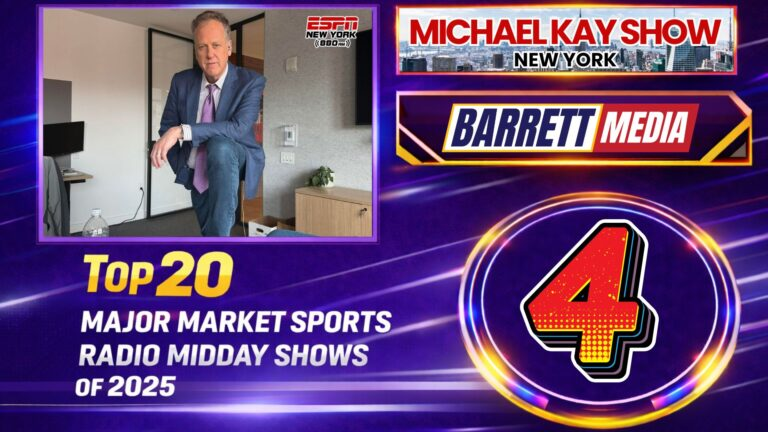
Despite the pressure and challenges of the new daypart and format, Kay continues to be recognized as one of the top voices in sports radio. The Michael Kay Show ranked fourth in the 2025 Barrett Media major market midday show rankings—an honor Kay has earned many times before, but never as a solo host.

“I was pleasantly surprised when I saw it because I think it took some people to get used to me being alone and in a new timeslot,” said Kay. “It felt really nice. I’m proud of the show. It’s been an incredible amount of fun. More than I thought it would be. That was quite an honor.”

While the recognition from the industry carries significant pride, the move to the new timeslot also holds personal meaning for Kay.

“It might have saved me some years on my life,” explained Kay when reflecting on how the first year of the new timeslot balanced with his duties with the Yankees. “I loved working with Don [La Greca] and Peter [Rosenberg], but as I was getting older that was and unbelievable challenge to do both as I was for so long.”

Kay said he reached a point where he could no longer continue the afternoon drive routine. He shared his concerns with management at Good Karma Brands, which operates ESPN New York. That conversation led to the idea of a two-hour solo show in an earlier timeslot.

“They [Good Karma Brands] made it so easy for me. They’ve been so great and supportive. Once I started doing it, I love it. It changed my life,” explained Kay.

Fully invested in the concept, Kay signed a multi-year extension as part of the move to middays. When announcing the extension and schedule change in December 2024, he felt the show’s final stretch in afternoons was handled properly in both timing and execution.

Fighting For Don La Greca

Even a year later, the legacy of The Michael Kay Show continues to be debated across media circles. Recently, Don La Greca admitted to former WFAN host Brandon Tierney that he wished he had fought harder to have his name included in the program’s branding.

“I knew Don [La Greca] wanted his name on the show, and I totally understood it. He was as much a part of the show’s success as I was,” said Kay. “I wish he would have fought harder too.”

Kay said he supported La Greca behind the scenes by approaching station management about adding his name. However, management resisted due to the show’s marketing ties to Kay’s Yankees affiliation.

“They kept fighting me on it. I said this is not my fight. If Don [La Greca] had said he was going to leave, maybe that would have moved the needle a bit,” explained Kay. “They were telling him different stuff than they were telling me. At one point, they told Don that I didn’t want the name change. Which is completely untrue… I knew it bothered Don, but it was Don’s hill to die on.”

Kay remains close with La Greca and was excited to see his former co-host named the television play-by-play voice of the New Jersey Devils last summer.

“Once it happened, I believe I was one of the first people that he told. I kind of got emotional because I realize what it’s like to broadcast your childhood team and live your dream,” noted Kay. “We hugged in the studio, and I was so happy for him.”

Hope Springs Excitement

Now, another season arrives for Michael Kay and Yankees fans across the country. As the game takes center stage tonight in San Francisco, Kay will spend another Opening Day not behind the microphone, but among the fans—a rare pause for a voice synonymous with Yankees baseball.

In a sport and industry navigating sweeping change—from streaming deals to shifting timeslots—Kay remains a steady voice connecting generations of fans to the game across New York City.

Now entering year two of a life-changing professional shift, Kay is more energized than ever for the season ahead, with a renewed appreciation for the opportunity.

“The balance between life and work has never ever been better. I have zero complaints,” said Kay. “At this point, and it could change. I could see myself doing this for a long time… I’m really enjoying it.”

Whether he’s calling a pivotal October moment, navigating the evolving sports media landscape, or fielding calls as a solo host, Kay continues to bring fans together.

Opening Day will look different. The booth may sound different. The way fans find the game will continue to change. But the essence of baseball hasn’t—and neither has Michael Kay.

Whether he’s behind the mic or in the stands, he remains part of the rhythm of the sport, proving that even in a time of change, some voices never lose their place in the game.

Barrett Media produces daily content on the music, news, and sports media industries. Sign up for our newsletters to stay updated and get the latest information right in your inbox.

WFAN’s Gregg Giannotti, Brandon Tierney Feud Shows Why Sports Radio Should Embrace Noise Over Silence

0

The New York City sports radio scene has had an interesting couple of days to start the week leading into another MLB season beginning today. What began with a simple gesture of entertainment has blossomed into a viral and heated back-and-forth between WFAN talent and former WFAN personalities.

I’ve written many times on this site that sports radio needs moments like what we’ve been seeing from WFAN’s Gregg Giannotti and former WFAN host Brandon Tierney. Sports radio beef always spikes interest. Controversy sells better than ice cream on a hot summer day. Eyeballs and ears await the next jab, right cross, or uppercut, pushing forward the storyline of a battle between two talents.

For the silence others choose to live by, there is plenty to learn from the past two days of back-and-forth involving WFAN. When opportunity presented itself, every party dove in, and everyone struck gold.

Let’s start at the beginning with Giannotti pranking Brandon Tierney over a year ago by acting as a caller into his show. Is this the first time a fellow talent has called into a teammate’s program to pull a fast one? Of course not. However, in watching Tierney’s response to the question asked by Evan Roberts last Friday, you can tell he had been harboring feelings about it for some time.

The question is why? If the rapport between the talent was as tight as everyone was led to believe, why not address it between the two of you? Sure, WFAN is built around a Howard Stern model where everything becomes content. That doesn’t mean it can’t be addressed off-air and squashed.

That answer by Tierney this past Friday, as a former WFAN talent, created an opportunity for Giannotti and WFAN. Needless to say, everything that has transpired since has been gold.

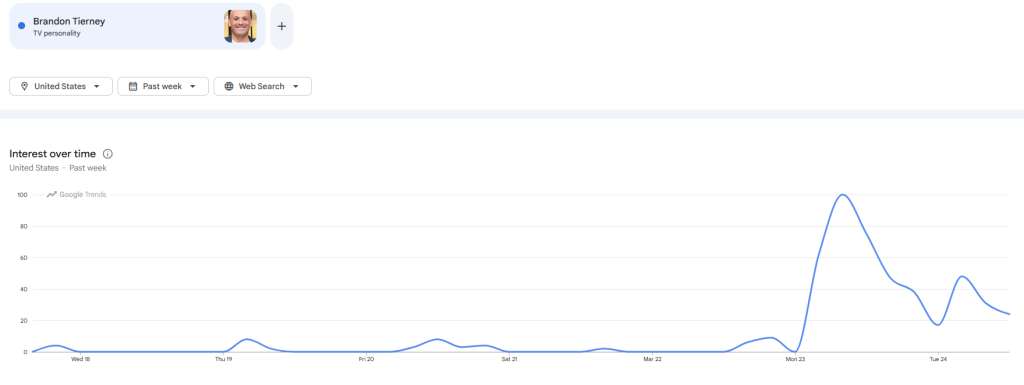
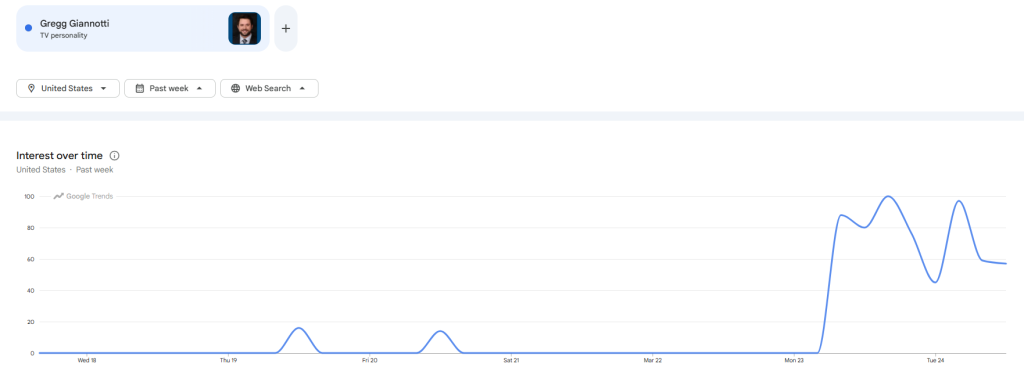
It’s not often that sports radio stations or talent trend online. Usually, it happens when events like the past two days involving WFAN and Tierney occur, or when breaking news hits. Yet, if you look at Google Trends, which tracks search history in real time, you’ll see spikes in searches for “Gregg Giannotti,” “WFAN,” and “Brandon Tierney.”

If the goal in the attention economy is to capture as much attention as possible, then credit goes to WFAN, Giannotti, and Tierney. Sex sells, and controversy always wins.

Last week, when a very similar situation arose involving Sportsradio 94 WIP, I wrote that silence from those being criticized missed an opportunity to tell their story and rebut their critics. It’s not rocket science. It’s about controlling the narrative and using the moment to lift all boats, including your own.

Instead, I received feedback from many asking why they should give oxygen to those on smaller platforms who no longer matter to the greater good of the listener.

Sports radio is a passion-fueled format where listeners connect with personalities more than in any other format. That connection, whether the personality is currently on the station or not, never wavers. I can’t tell you how many times, even after his death, listeners of WDAE in Tampa Bay have asked me about Steve “Big Dog” Duemig.

Personalities leave lasting impressions and connect in ways few others can.

But silence on the matter persists. In contrast, did WFAN benefit from the past couple of days? Absolutely, especially when you consider how many people sought out content involving the parties.

Did Gregg Giannotti benefit? If I were in Ryan Hurley’s shoes, I’d be looking forward to reviewing Media Monitors on Sunday afternoon, likely with a cigar and a glass of my favorite cocktail. If Giannotti’s rant drove added listening from people waiting for his next words, that’s a win for WFAN. They didn’t need to embrace the controversy on social media because they didn’t have to.

Did Brandon Tierney benefit? If you trust data from Social Blade, which tracks YouTube performance for individual channels. Tierney gained more than 200 subscribers in the past two days alone. On Tuesday, he generated over 42,000 views on his channel—his best day in weeks—which also led to some nice “earnings,” according to the tracking site.

Will this back-and-forth continue through the end of the week? Probably not. But what better way to ramp up listening and interest in the light days leading up to Opening Day for Major League Baseball in a hot MLB market?

And that’s really the point.

Moments like this aren’t accidents—they’re opportunities. In a media landscape where attention is fragmented, loyalty is fleeting, and competition extends far beyond the station across town. You don’t win by playing it safe.

You win by being heard, by being felt, and sometimes by being uncomfortable.

Silence might protect you in the short term, but it rarely builds an audience in the long term.

What WFAN and the personalities involved showed over the past few days is that controversy, when rooted in authenticity, doesn’t damage the product—it energizes it. It gives listeners a reason to tune in, pick a side, and become part of the conversation.

That’s the currency of sports radio. Not perfection. Not politeness. Connection.

And connection isn’t built in the quiet.

For every programmer or host who believes ignoring criticism is the high road, it’s worth asking: high road to where? Because while you’re staying above the fray, someone else is owning the moment—and the audience that comes with it.

Sports radio has always thrived at the intersection of opinion, personality, and tension. That hasn’t changed. If anything, it matters more now than ever.

So the next time controversy knocks, don’t turn the lights off and pretend you’re not home.

Open the door.

Because in this business, the stations and talent willing to lean into the noise are usually the ones heard the loudest. Job well done.

Barrett Media produces daily content on the music, news, and sports media industries. Sign up for our newsletters to stay updated and get the latest information right in your inbox.

Women’s History Month: Why Greta Van Susteren Believes a ‘Facts Only’ Approach is the Secret to Thriving Across Every Network

In honor of Women’s History Month, Barrett Media is sitting down for conversations with some of the most respected women in the industry, including Newsmax’s Greta Van Susteren.

“I’m sort of an accidental anchor,” she remarked.

After finishing law school and starting her own practice with a friend, Van Susteren was asked to do courthouse commentary. “Anyone could do courthouse commentary and be a lawyer and just explain what an opening statement is,” she said. “Then after that, William Kenny Smith’s trial went gavel to gavel at CNN. So CNN called me up to do the gavel to gavel.”

Van Susteren was teaching as an adjunct professor at Georgetown and thought the CNN gig would be over in roughly two weeks. “Well, that was 30 years ago,” she joked.

So a two-week gig turned into an entirely new career path. Van Susteren has spanned the media’s political spectrum from CNN to Fox News, MSNBC, and now Newsmax. The secret to this wide-ranging success: just provide the facts.

“I grew up trying cases and in the courtroom, [and there] you can only do facts. The only opinion you can provide in the courtroom is that a witness is allowed to give an opinion — whether someone looks drunk or not, oddly enough.” She added, “I’m very fact-driven. If you look at my shows through all the networks I’ve [been at], I can get Republicans and Democrats on every single network I’m on, regardless of what the network is perceived to be.”

She also noted that aside from her CNN shows, all the other networks gave her show a similar name. “On the Record, For the Record, The Record. I’ve used the same sort of names.” It goes to her point — she’ll cover politics, but she is not taking a political side. Instead, she’s presenting the facts, and she sometimes does it with the help of artificial intelligence.

“You know, [AI] depends on who’s using it and how you use it. I use it as a research tool. I don’t use it to write anything for me.” She noted AI has gotten some facts about her wrong. “I looked it up once and said, ‘How did Greta Van Susteren do in high school?’ And it said I was great. Well, I’ve got to tell you, that was a failing on the part of AI.”

“Frankly, with AI I use about three different ones — Perplexity, Grok, ChatGPT — and I compare and contrast them. I don’t rely on one of them, because I’ve seen too many things that are inconsistent.” She noted, “AI can be a wonderful tool, but it can also be frightening — because it’s so possible to poison people.”

To young journalists who are truly searching for the pursuit of truth, Van Susteren can be considered an icon, but it’s a label not on her own personal radar. “I don’t have that sense of, like, I’m an icon. I have a sense that this is my job, but my rest of my life is so regular.” She added, “People aren’t driving me around in cars, unless it happens to be an Uber or something. My perception is so vastly different. I just happen to have a ringside seat on the most interesting things that happen in our lives.”

She later noted, “I don’t feel, quote, iconic at all. I feel lucky, but not iconic. I don’t have that sense of me, and it sort of surprises me when I hear that. And I think I’m a survivor.”

“I work very hard, I study hard, and I show up for my show. I get up in the morning early and I’m studying. And I read everything in sight. I read so much more beyond what the average person would do.”

She gave an example: “Recently, we had a guest who was going to be talking about the war. It would have been enough just to have his name and the fact that he was going to be covering the war. But I dug deeper and found out that when he was in high school, he went to school in Tehran. So I dig a little deeper. I’m curious.”

For those looking to follow in Van Susteren’s footsteps, she suggests, “Obviously, they need to distinguish themselves.” She proceeded by saying, “I’ll tell you what I think is a mistake. People want to be anchors. Anchors, for the most part, are in studios. What you really want to be is a reporter. I’ve been fortunate enough to be an anchor-reporter, because a reporter gets out and investigates and learns things. And I think if you want to be an anchor, spend 10 or 15 years as a reporter so that you build up a portfolio of experience.”

Imparting words of wisdom she received from Ted Turner and Larry King, Van Susteren attested, “Ted Turner said, ‘The news is the star.’ And he was really right. That taught me that you are there to deliver the news. It’s not about you.” She went on to say, “Something else that Larry King told me: ‘Don’t talk too much.’ The reason he told me that is he said people may be interested in you in the first four or five, six, seven, eight nights. But after that, they’re going to get bored with you. They tune in to watch your guest and hear what your guest has to say.”

Barrett Media produces daily content on the music, news, and sports media industries. Sign up for our newsletters to stay updated and get the latest information right in your inbox.

What Ebro Leaving HOT 97 Has Already Proven

1

In December, when Ebro in the Morning wrapped at Hot 97, many saw it as an ending. I saw it as an evolution.

Not because radio stopped mattering. Because radio had done its job.

That’s the part many in broadcasting still miss. We keep treating the station like the product when the station is the billboard/amplifier/awareness machine/daily reminder/habit builder. If done right, radio can have more slashes than Crystal Lake.

After Hot 97 ended the morning show, within days, Ebro, Laura Stylez, and Peter Rosenberg launched The Ebro, Laura & Rosenberg Show as a daily live YouTube show. The show runs weekdays from 8 a.m. to 9 a.m., with a subscriber-only Patreon version every Wednesday at 10 a.m.

Hot 97 gave them a legendary platform, repetition, familiarity, cultural weight, and a very underrated and funny VH1 reality show. It helped create one of the most recognizable morning show relationships in hip-hop; a show that understands there is no digital sequel without the terrestrial original (sounds like a ship that would be commandeered by Mando and Grogu).

Equity Is Portable

For legacy thinkers still clinging to the idea that the building is the brand and the talent is just lucky to be inside the door, here’s the reality: talent at Ebro’s level was always building portable equity. Every Guru break, every Nicki Minaj Summer Jam no-show, every viral moment with Lil Uzi Vert or Kanye was doing more than serving the station. Those moments built trust, familiarity, and cultural authority in Ebro, Laura, and Rosenberg themselves.

Ebro was never just a New York morning host.

At Apple Music, he is the host of The Ebro Show and Rap Life Radio, as well as the company’s Global Editorial Head of Hip-Hop and R&B. Apple has also positioned him front and center around its Super Bowl Halftime Show coverage, including programming tied to the halftime appearances of Bad Bunny, Kendrick Lamar, and Rihanna. He has also been one of the contributors to Verzuz, the battle series made famous through Apple and Complex.

So Ebro leaving Hot 97 was not some local personality trying to figure out YouTube in a panic. That’s more what I’m doing.

He’s not trying to become digital. He was already living there. Hot 97 just happened to still be the most visible piece of the old structure.

Radio Is the Promotion. Digital Is the Product.

Radio gave him mass awareness. Social gives him audience portability. YouTube gives him archive, discovery, and monetizable passive shelf life. Patreon gives him intimacy, premium access, and recurring revenue.

And hand-selecting his team gives him control over cadence, packaging, clips, messaging, and monetization. That’s not a side hustle until he finds his next station, the next station is the side hustle and lucky to be along for the ride (plus, a radio station wearing sidecar goggles is adorable imagery).

In less than 90 days, the new show has reached 63,000 YouTube subscribers, generated more than 4 million views, produced social clips that have pulled in tens of millions of views, established a direct relationship with listeners through daily podcasts, and built a paid Patreon layer starting at $10 a month.

What we’re watching is not a nostalgia brand merely surviving the jump, it’s an audience being successfully converted into a direct-to-consumer media product.

On the surface, there are shades of Stern going to Sirius or The Breakfast Club expanding to Netflix. But while those were digital extensions through larger company-owned platforms, Ebro, Laura, and Rosenberg are doing this independently.

And, honestly, there’s nothing more hip-hop than that (I think I just titled my debut hip-hop album).

The Opportunity Hot 97 Didn’t Take

The basic lens would say, “poor Ebro,” or “radio is dying,” or “look, another creator economy pivot.” What I see is something deeper. Something preventable. And something broadcasters should study.

Hot 97 had a talent who was not only huge in New York radio, but also globally connected to Apple Music. Hot had a chance to think beyond one market, one daypart, one syndication deal.

Management had a chance to ask a level-201 question: how do we use radio, streaming, digital, and social together to make this brand and the Hot brand even bigger while attaching our name to the upside?

That would have been the expansive move, but companies often confuse expansive with expensive. Vowels, they’ll get you every time. Just ask the contestants on Wheel.

A New Morning Show Model Is the Old Morning Show Model

Now, the show doesn’t have to fit inside today’s terrestrial logic. It doesn’t have to worry about line items, PPM tactics, or overly sponsored features. It can be designed around audience behavior, live video, clipped social moments, searchable archives, direct membership, premium extensions, merch, and community.

That’s not abandoning radio. That’s getting back to the reason radio was built!

Promotion.

Awareness.

Habit formation.

Top-of-funnel power.

Side note: Dyson needs to trademark “top-of-funnel” power.

Betting on Himself

Ebro is self-funding this operation, building out a top-tier studio and staffing it with his former co-hosts and people who understand chemistry, storytelling, tone, POV, and product, including former Hot 97 morning show producer Jason Griffin and a broad off-mic team of producers, editors, designers, and video talent.

This isn’t being treated like a hobby. It isn’t a post-radio vanity project. That’s more what I’m doing.

Ebro is approaching this like a product launch, complete with catchphrases, merch, and elevated quality.

On paper, moving from a four-hour terrestrial morning show to a one-hour daily live YouTube venture can sound like downsizing.

It’s not.

Strip music, spots, promos, and service elements out of a morning show, and the actual content core is about an hour. This cast spent 13 years mastering exactly that rhythm.

The Lesson for Those of Us Not Named Ebro (AKA all of us)

This idea resonates far beyond Ebro.

Every talent in radio should be paying attention to this. Not because everybody needs to quit tomorrow. Not because stations are the enemy. In fact, it’s the opposite. And not because every host can pull off what Ebro can pull off. They can’t. I’ve already accepted that Phil-Up Your Nights probably isn’t taking off.

But because the blueprint is sitting right there in plain sight: use broadcast to build demand, then use digital to capture value, data, different revenue streams, and new fans.

And the companies that understand that will build stronger brands. They’ll have higher ratings, more digital relevance, and less dependence on the whims of Nielsen or the pricing structure of an ad agency they can’t control. They’ll also have a better shot at lowering the median age of the audience they serve.

Hot 97 may have ended the show.

But they accidentally unlocked the new business for the rest of us.

Barrett Media produces daily content on the music, news, and sports media industries. Sign up for our newsletters to stay updated and get the latest information right in your inbox.
The TikTok Jock: How Josh ‘Bru’ Brubaker Bridges Radio and Social Media

0

This week I’m introducing you to someone who might be the first TikTok jock. Someone who has millions of followers on social media, yet has an unabashed love of radio. Josh “Bru” Brubaker was just added to the lineup at WNEW in New York this week.

He continues on all of the Audacy CHR stations, led by B96 in Chicago.

Even though his entry into radio happened just 10 years ago at age 18, his early story is like those of a different generation.

Jim Ryan: Let’s start at the beginning. How did you ever get interested in radio and decide to pursue it as a career?

Bru: Growing up in the suburbs of Detroit, we had a long drive into school every morning. So we’d listen to the great Mojo in the Morning. There was another show on KISS FM Toledo we liked, and we’d float around to WNIC and Jim Harper on 105.1. My mom, sister, brother, and I built relationships with these people on the radio. It’s one of those things I never really knew was a path or even an option as a career.

My grandpa bought me a little cassette recorder. And I would record fake shows with an iPad for sound effects, use my sister as a contestant, do games, fake callers, and all that. I did that growing up and always had a desire to entertain. It wasn’t until I stumbled across a school in Southeast Michigan — Specs Howard School of Media Arts — that it clicked in my brain that this could be a path. Honestly, at first, my ultimate goal was to end up on SportsCenter, because sports is such a passion of mine.

When I got into that school, they would teach you radio on some days and TV on the others. But there was something about radio — getting to be in the studio and find your voice. That unlocked a different level of comfort and creativity. I love music and people and how the two come together.

I ended up falling in love with that side of things. At 18, I started pursuing internships. Those turned into part-time jobs. I’d then bother every PD I could get in touch with, and began the radio gauntlet of bouncing around. I was lucky to stay pretty close to my home state of Michigan. I eventually ended up in Detroit. That obviously led me to where I am now, 10 years later. It feels like it’s been one year and also 30 — but an absolute blast. I wouldn’t change a thing.

How TikTok Helped

JR: How did social media come about for you? Was it a companion to your radio show, or was it a separate goal to be big on TikTok and Instagram?

Bru: It almost became like a void filler. When COVID hit, it cut a bunch of stuff that we all love so much about radio. I was starting to get my footing in Detroit. So it was my first experience doing promos, going to concerts, interacting with listeners, and putting on our own station shows. I really began to value and love that community we built. Once that was gone, I started looking for a way to continue it and still reach people who were craving the type of connection radio provided.

Social media grew into something even beyond that. I think the very first TikTok I did was about a sleep app recorder I used, and I had some wild response during a nightmare that went nuts. Then I recorded myself talking about it on the radio, and people just became really intrigued with what I was doing.

It felt like a bridge for the next generation that really hadn’t experienced radio yet, or what the medium was. It blew my mind that kids were commenting, “What is this?” or “What is radio?” It snowballed into different series of content. Showing behind the scenes of my job and life. Doing trends with games on air. Or letting followers chime in with words to use on the radio. And it was a great all-encompassing thing that shared my personality while also shedding light on our station and something I was really passionate about.

When all those things come together, it just works so well. I’ve learned that usually a piece of content or a story that works on the radio will work on social media. It’s about knowing how to reformat it for the right platform. They play off each other, and it’s been working so far.

JR: I think one of your secrets is that you’re very likable and have a lot of charisma. But short of having a great personality, what would you suggest other radio people do to grow their social media presence?

Bru: I think it’s finding the thing you truly love to do — content you can’t wait to make over and over. Not saying it’s always easy, but you’re inspired to do it. It doesn’t have to be focused on radio either. People will be drawn to you.

We can all fall victim to solely doing trends that are just content to throw up online and maybe get a one-off viral moment. But when you find what’s unique to your voice and passion, that’s when the community will come. I look back at old videos I did and think, ‘These are edited so poorly.’ Or ‘These just aren’t best practices for great-performing content.’ But it was so genuinely what I found interesting and entertaining, and people are drawn to that.

JR: How many followers do you currently have across all your platforms?

Bru: A little over five million. TikTok’s the biggest, with about four and a half million over there, but YouTube and Instagram provide great opportunities to try out content as well.

Balancing Social Media and Radio

JR: This week you’re starting on WNEW in New York, a station with a couple million listeners every week. Will that grow your social media platform?

Bru: It’s tough to say in that scope. It’s interesting because I’m lucky to have followers from all over, and certainly some in New York. I think it’ll be a really fun opportunity to work with WNEW’s team — on air and on socials — to connect with the strong audience they already have. I’m ready to help in any way I can. I’m so excited to make content in New York and bring my audience on this journey of being on air in such an iconic city and market. I feel like that’s what people will connect with.

JR: Social media has afforded you so many opportunities to travel the world. Of all the amazing things you’ve done, what is the most memorable?

Bru: That’s probably the thing I’m most grateful for in that aspect of my career. It’s hard to pick one, but the few that immediately pop into my head are: my first-ever international travel, getting to film The Circle with Netflix in Manchester, England back in 2021 — that whole thing still feels like a fever dream. Working with NBC for the 2024 Summer Olympics in Paris, where I basically got to live my best Parisian summer life in a dream job. And getting to take my dad out of the country for his first time to Rome to see the Ryder Cup in 2023 with Ralph Lauren. All-time memories.

Defining Yourself

JR: You won Sports Emmys for your work at the Olympics. When you meet someone new, what do you tell them you do?

Bru: I always start by saying I’m on the radio. I always lead with that. People will mention the Netflix show or interviews — people really want to know what Harry Styles smells like, or they’ll say they know me from my girlfriend or from TikTok — but I always say I’m a radio host. Then I’ll say I make some videos on social media.

Radio is my first passion and love. And I wouldn’t still be doing it if I didn’t absolutely love it. I’m so honored to be a part of the stations and brands I’m on at Audacy. I love learning new things and growing and becoming a better on-air talent. Because I think it really does help everything else I’m doing in my career.

I will also say, radio people are some of the best at being multi-faceted. Whether that’s storytelling, hosting, social media, or marketing. Through all the hosting jobs I’ve been blessed to get through social media, when I get client feedback, it’s always about how impressed they are with the ability to interview, hold a conversation, and make someone feel comfortable.

Those are all things radio taught me. Those skills are so valuable. And being able to let them shine in different formats like social media is a way to let the world know how special radio is.

Barrett Media produces daily content on the music, news, and sports media industries. Sign up for our newsletters to stay updated and get the latest information right in your inbox.

ABC’s ‘The Bachelorette’ Scandal Exposes What’s Rotten in Network TV

0

When an explosive video leaked showing Taylor Frankie Paul — the controversial lead character of ABC’s The Bachelorette — throwing chairs at her ex-boyfriend in 2023 while her child cried nearby, it raised a painfully obvious question. This isn’t just about her spectacular misconduct. It’s about why the network chose to make her a star in the first place.

TMZ posted the 2023 video last week of her ex-boyfriend, Dakota Mortensen, filming her chasing him in front of her daughter. She was arrested for alleged domestic violence and faced misdemeanor charges of assault, criminal mischief, and domestic violence in the presence of a child. CBS News reported at the time that she faced child abuse charges.

She pleaded guilty to aggravated assault and is currently on a three-year probation, while other charges were dropped.

And police just confirmed a current “domestic assault” investigation between Taylor and her ex.

Season 22 of the long-running romantic reality series was filmed and set to debut on Hulu on Sunday. In a rare, last-minute moment of self-preservation, ABC pulled the plug, sending the media, the show’s legion of fans, and the entertainment industry itself into a full-blown meltdown. The network is forfeiting $35 million in advertising, the Wall Street Journal says.

“We have made the decision to not move forward with the new season of The Bachelorette at this time, and our focus is on supporting the family,” ABC said.

Was the video deliberately leaked to torpedo the program? Mortensen, her ex-boyfriend, has dismissed the idea and has filed a restraining order as he seeks custody of their 2-year-old son, Ever.

A spokesperson for Paul told People magazine, “It’s sad to see the latest installment of his never-ending, desperate, attention-seeking, destructive campaign to harm Taylor without any regard for the consequences for their child.”

Paul recently starred in Secret Lives of Mormon Wives. She was cast because her chaotic personal life had already drawn millions of viewers online when she created #MomTok, featuring eight Utah-based influencer moms.

Disney/ABC executives clearly knew what they were getting by hiring Paul as the Bachelorette star. In the first episode of Wives, she was taken away in handcuffs by police for a domestic disturbance. It seems pretty clear the network wanted her crazy antics — no matter how immoral or illegal — to translate into cash. Ratings and revenue have been sagging.

And they know their audience. A contestant on the 24th season of The Bachelor admitted she was “a little bit bummed” the season won’t air because, “I wanted to watch this train wreck.”

In an era when reality television increasingly blurs the line between entertainment and real-life dysfunction, the decision to continue developing a show tied to a figure who faced serious legal trouble feels less like an oversight and more like a cold-blooded calculation. Why? Controversy drives clicks, and clicks drive revenue.

Some networks don’t seem to be vetting characters responsibly and may well be normalizing a troubling new standard.

Reality TV, going back to such shows as Survivor, has always thrived on over-the-top personalities and their chaotic personal sagas. But there is a difference between casting someone who can catfight and casting someone entangled in criminal behavior. Background checks are not optional — they are absolutely essential.

If Paul’s arrest came after production began, the question becomes even sharper: What protocols are in place when a participant’s circumstances change so dramatically? And if the behavior predated the casting, as in this case, the failure by ABC is all the more glaring. Either way, it points to a breakdown — or a deliberate unraveling — of “standards,” which obviously requires air quotes.

Rachel Lindsay, the first Black lead of The Bachelorette in 2017, told NBC: “This is bad for Disney. This is bad for Hulu … because somebody is going to have to take the blame for not vetting this out.” But will they? I doubt it.

This happened in the first week of the new Disney president’s tenure, and he ultimately must have made the call to pull the show, costing ABC a truckload of revenue. Josh D’Amaro had a heck of a welcome. His longtime predecessor, Bob Iger, got out just in time.

In today’s media environment, networks often don’t act until the public forces their hand. That’s not accountability. That’s damage control.

There’s also the repulsive possibility that what we’re seeing isn’t negligence, but strategy. But at what point does documenting someone’s slow unraveling stop being storytelling and cross into sheer exploitation?

Reality TV has long crossed that line. The difference now is scale. Social media turns personal crises into gripping serials before a network even steps in. By the time a show airs, the storyline — and the audience — are already panting for more.

Social media influencers are often paid to promote the program, sometimes without disclosing it. Their value lies in attention. The more chaotic the narrative, the more engagement they generate — the more valuable they become to networks hungry for built-in audiences.

But maybe the most unsettling question is not about the network, but about the audience.

The show’s popularity reveals a cultural appetite for watching people in crisis, even those facing criminal allegations. What does it say about our culture that shows like this are incredibly popular? It’s a vicious circle. Demand creates a powerful incentive for networks to push boundaries further — until their audience, or the media, rebels.

We are no longer just consuming reality TV. We are watching real consequences — not just for stars, but for other contestants, producers, and hired online promoters who put blood, sweat, and tears into the product.

Ultimately, the burden falls on the gatekeepers — in this case, ABC. Networks have the resources and the obligation to vet participants thoroughly and to reassess rather than be overwhelmed by stars behaving badly. As soon as the network knew she broke the law, it should have cut her. And how could it not have known? Her arrest was part of the public record. Their choice not to act prioritized ratings over responsibility.

There’s nothing inherently wrong with airing the trials and tribulations of C-listers and revealing trashy, unbelievable stories. But there is something wrong with airing entertainment featuring those deranged enough to commit crimes while starring in a popular TV show.

Where is the ethical oversight? At some point, networks have to decide whether hiring every viral influencer is worth the risk of not only pulling a show off the air, but ending the franchise forever.

Barrett Media produces daily content on the music, news, and sports media industries. Sign up for our newsletters to stay updated and get the latest information right in your inbox.
Will More CNN Personnel Follow Kara Swisher Out the Door When Paramount Skydance Takes Over?

0

Kara Swisher made it crystal clear this week — she’s done with CNN the moment Paramount Skydance completes its takeover of Warner Bros. Discovery.

She’s not quiet about it, either. The question worth asking isn’t whether Swisher means it. It’s whether she’ll have company.

Let’s be honest. CNN has never been a place that embraces change warmly. The network’s resistance to editorial shifts is practically institutional at this point.

Remember Chris Licht? He arrived in 2022 with a mandate from Warner Bros. Discovery to recalibrate the network.

He didn’t last two years.

The internal resistance was fierce. Staffers leaked. Critics piled on. The whole thing collapsed under the weight of its own drama. Licht didn’t just fail — he flamed out. Spectacularly. And a big part of that failure came from people inside the building who simply didn’t want what he was selling.

So here comes Paramount Skydance. Here come the Ellisons. Anyone who believes CNN’s culture has fundamentally changed since the Licht era might want to reconsider.

Look at what’s already happened at CBS News. Larry and David Ellison took over, installed Bari Weiss as Editor-in-Chief, and the departures started almost immediately. Layoffs have been enacted. Twice. CBS News Radio — the venerable division with nearly 100 years of history — will be shuttered in May. Anderson Cooper — one of the biggest names in cable news — walked. Others questioned whether the network could maintain editorial independence. It wasn’t pretty. It still isn’t.

If that’s the preview, CNN’s staff has every reason to be watching closely. And from what we’re hearing, they are. Reports suggest the mood inside CNN right now is, to put it mildly, not great.

Kara Swisher is vocal. She’s financially independent. She’s got her own podcast, her own audience, and her own platform. She said it plainly: she doesn’t have to do this. She can walk. And she will. Those factors make her uniquely positioned to be the first name out the door. They also make her somewhat of an outlier. Most CNN staffers don’t have that same safety net.

But here’s the thing: that safety net is also getting easier to build. It’s never been simpler to go independent in media. Substack, podcasting, YouTube, direct-to-consumer everything. The infrastructure for building your own audience without a network behind you is more accessible now than it’s ever been. Kara Swisher herself is living proof. So is Scott MacFarlane, the former CBS correspondent who just landed at MeidasTouch. The exit ramp exists. It’s well-lit. The pavement is as wide as can be. And it’s gotten a lot less scary.

That matters. It means the calculus for a CNN personality weighing whether to stay or go has genuinely shifted. It’s not just about pride or politics. It’s about practicality. For some, leaving will make sense — financially and professionally.

CNN does need to change. That’s not a controversial take. The ratings have been rough. The media landscape has been brutal to linear news. Something has to give. Whether the Ellisons are the right people to engineer that change is a separate debate — but the network can’t just keep drifting.

Change at CNN has been met with resistance from within. That likely hasn’t gone away. The same instinct that torpedoed Chris Licht’s tenure is still present in that building. Editorial shifts that might be welcomed elsewhere will likely be viewed with deep suspicion inside those walls.

Kara Swisher isn’t the biggest name at CNN. She’s a contributor. She matters, but her departure won’t break the network. What would matter — what would be genuinely significant — is if higher-profile anchors and correspondents start making the same calculation she has. Don’t rule it out.

The combination of cultural resistance and newly accessible independence makes for an interesting dynamic. Some will stay and fight from the inside. Some will quietly adapt. But some — maybe more than Paramount expects — will simply decide it’s not worth it.

Swisher’s making her move. I’d bet you she won’t be the last.

Barrett Media produces daily content on the music, news, and sports media industries. Sign up for our newsletters to stay updated and get the latest information right in your inbox.