Megyn Kelly and Mark Levin reignited their feud over the weekend, with the pair trading lewd remarks at each other. President Donald Trump weighed in, too.
The two have traded insults in recent months. The issue between the two stems from Kelly’s support of Tucker Carlson, who Levin has clashed with over his stances on Israel and Iran, and her speaking glowingly of Nick Fuentes.
Levin and Kelly have lobbed shots at one another on social media, with the feud moving to a new level on Sunday.
In a post on social media, Mark Levin took issue with recent comments from Megyn Kelly, stating that she is showing her true colors by failing to condemn the synagogue attack in Michigan last week.
“Poor Megyn Kelly. An emotionally unhinged, lewd, and petulant wreck,” wrote Levin. “She’s completely revealed and destroyed herself. She’s everything people say she is, but much worse. Never an intelligent, thoughtful, or substantive comment. Utterly toxic.”
Poor Megyn Kelly. An emotionally unhinged, lewd, and petulant wreck. She’s completely revealed and destroyed herself. She’s everything people say she is, but much worse. Never an intelligent, thoughtful, or substantive comment. Utterly toxic.
Kelly responded by accusing Levin of being more obsessed with her than a stalker.
“Micropenis Mark Levin thinks he has the monopoly on lewd,” Kelly wrote. “He tweets about me obsessively in the crudest, nastiest terms possible. Literally more than some stalkers I’ve had arrested. He doesn’t like it when women like me fight back. Bc of his micropenis.”
Micropenis Mark @marklevinshow thinks he has the monopoly on lewd. He tweets about me obsessively in the crudest, nastiest terms possible. Literally more than some stalkers I’ve had arrested. He doesn’t like it when women like me fight back. Bc of his micropenis. https://t.co/7cl3Efc3N7
“Busy Sunday morning for Megyn Kelly. She wakes up and has ‘micrope*is’ on her mind,” he said. “Suffice to say, if it talks like a harlot, and posts like a harlot, it’s … well, you know the rest. Shalom!”
Following the trading of barbs, President Donald Trump weighed in on the situation, supporting Mark Levin in the process.
“Mark Levin, a truly Great American Patriot, is somewhat under siege by other people with far less Intellect, Capability, and Love for our Country,” Trump wrote. “Mark is Tough, Strong, and Brilliant, hence the nickname, ‘THE GREAT ONE,’ conceived by our MAGA friend, the wonderful Sean Hannity, after years of dealing with Mark in Legal, Media, and other capacities … He is a true Conservative, and Intellect, far smarter than those who criticize him but, above all, he is a man of Great Wisdom and Common Sense who truly loves our Country.
“When you hear others unfairly attack Mark, remember that they are jealous and angry Human Beings, whose ‘sway’ is much less than the Public understands, and will, now that they know where I stand, rapidly diminish. Other than for his wonderful wife and family, Mark Levin only cares and wants one thing, GREATNESS AND SUCCESS FOR AMERICA! Those that speak ill of Mark will quickly fall by the wayside, as do the people whose ideas, policies, and footings are not sound.”
Levin responded to Trump’s remarks with a glowing retort.
“Mr. President: I am beyond humbled by your words and graciousness in writing such a beautiful note and sharing it on Truth Social,” Levin said. “I am honored that you took the time to write it. Your courage, strength, and moral clarity are truly unparalleled. And your leadership has made our country and the world much safer. Both you and what you are doing deserve our support.
“And I will not be intimidated or bow to threats,” Levin continued. “Through your insight and steady hand, America has been made great again. It is an enormous honor to know you as my family and I do and call you, Mr. President, our friend. You’re one of a kind. Truly remarkable. Please be safe and God bless.”
Mr. President:
I am beyond humbled by your words and graciousness in writing such a beautiful note and sharing it on Truth Social. I am honored that you took the time to write it.
Your courage, strength, and moral clarity are truly unparalleled. And your leadership has made… pic.twitter.com/aYjG5S2Tyx
Megyn Kelly added that she believes Levin asked President Donald Trump to make the post supporting him.
“Micro penis Mark Levin is such a SMALL MAN he had to go beg the president for a pat on the head (in the middle of a war!) to make himself feel better about … well, you know,” Kelly wrote. “This, after one mean tweet about him – following his 111 (!) nasty, non-stop, personal, misogynistic attacks on me. (Fox has an OBSESSED HARASSER on its hands.) Just like all feckless, weakling bullies Micro can dish it out but he can’t take it. After just one post putting the so-called ‘great one’ in his place, he ran crying to Daddy.”
Micro penis @marklevinshow is such a SMALL MAN he had to go beg the president for a pat on the head (in the middle of a war!) to make himself feel better about … well, you know. This, after one mean tweet about him – following his 111 (!) nasty, non-stop, personal,…
Barrett Media produces daily content on the music, news, and sports media industries. Sign up for our newsletters to stay updated and get the latest information right in your inbox.
The New England Revolution have expanded their efforts to reach Spanish-speaking soccer fans in Massachusetts through a newly announced partnership with iHeartMedia that will place the club’s home matches on Boston’s leading Spanish-language radio station, Rumba 97.7 FM, beginning with the 2026 season.
Under the agreement, Rumba 97.7 FM will air all 17 Revolution home games throughout the upcoming Major League Soccer campaign. Fans across Metro Boston and the South Shore will also be able to stream the broadcasts online at rumba977.iheart.com and through the iHeartRadio app.
The partnership strengthens the Revolution’s multilingual broadcast strategy while creating new opportunities to connect with Boston’s rapidly growing Latino population. In addition to Spanish-language coverage on Rumba 97.7, the club already provides English and Portuguese radio broadcasts while all MLS matches remain available globally through Apple TV.
“In what promises to be an unforgettable year for soccer in New England, the Revolution are happy to partner with iHeartMedia and Rumba 97.7 FM – Boston’s leading Spanish-language radio destination – to bring the excitement of Major League Soccer to even more fans,” Revolution President Brian Bilello said in a statement announcing the collaboration. “Rumba’s passionate audience adds a powerful new dimension to our radio network. Together with Rumba 97.7, we’re excited to forge deeper and more meaningful connections with Boston’s vibrant and growing Latino community.”
Beyond the game broadcasts, the agreement also includes several community and cultural initiatives designed to strengthen the connection between the team and Spanish-speaking supporters. Among them is the Revolution’s annual Noche Latina e Hispana celebration, which takes place Sept. 19 at Gillette Stadium. A Rumba 97.7 DJ will appear as the featured in-house entertainment for the match as part of the festivities.
The partnership also opens the door for additional community programming across the Boston area, including youth soccer clinics and cultural events organized jointly by the station and the club.
“Rumba 97.7 is proud to be the official Spanish-language flagship station for all New England Revolution home game broadcasts,” said Eliseo Cierra, the station’s program director. “Together, Rumba and the Revolution will celebrate Latino culture in Boston through the fusion of music, community and fútbol. In 2026, Rumba 97.7 won’t just broadcast the games — we’ll join the Revolution in being an active, vibrant presence across the city, connecting fans and celebrating our community.”
The Spanish-language broadcast team will feature three familiar voices with decades of experience covering soccer in the region. Play-by-play announcer Omar Cabrera will lead the coverage alongside analysts Marcelo Briones and Juan David Rozo, who also handled the Revolution’s Spanish radio broadcasts during the 2025 season. Collectively, the trio brings more than 50 years of experience covering MLS and the club.
The new radio partnership arrives during a milestone year for the sport in the United States, as Foxborough prepares to host seven matches during the upcoming 2026 FIFA World Cup between June 13 and July 9.
The Revs are teaming up with Rumba 97.7 FM! 🎧
Escucha todos los partidos en casa en la emisora #1 en español de Boston.
Barrett Media produces daily content on the music, news, and sports media industries. Sign up for our newsletters to stay updated and get the latest information right in your inbox.
Philadelphia sports radio host Jon Marks did not hold back when responding to recent criticism directed at SportsRadio 94 WIP by retired morning show legend Angelo Cataldi, delivering a pointed rebuttal that reflected frustration with the tone of Cataldi’s remarks about his former employer and colleagues.
Cataldi, who stepped away from his morning show in 2023 after a 33-year run that helped define Philadelphia sports talk radio, recently said he no longer listens to WIP because the current programming approach frustrates him and does not resemble the style that once drove the station’s identity. The longtime host also suggested the tone of Philadelphia sports radio has softened compared with the era in which his show dominated morning drive.
Marks, who also previously worked at SportsRadio 94 WIP, addressed those comments and expressed disappointment with how Cataldi publicly characterized the station and the people currently working there.
“I don’t have respect for his comments, and I’ve lost a lot of respect for him based on what he said about his former colleagues and his former radio station,” Marks said. “He essentially has his number retired by WIP. Thirty-three years, the franchise player for so many years, and he was treated very, very well.”
Marks continued by noting the success Cataldi enjoyed during his lengthy tenure and the support he received from management and coworkers throughout that run.
“He made a lot of money. He made a lot of money for the station. Everybody had great success,” Marks said. “His a** was kissed by management, by everybody, by the colleagues.”
The Fanatic host argued that the public criticism felt misplaced given the professional success Cataldi experienced during his time at the station and the respect he received throughout his career in Philadelphia radio.
Marks also took issue with what he viewed as a lack of appreciation for the current lineup of hosts and staff members working at WIP, emphasizing that those individuals continue to carry the station’s legacy forward in a competitive media landscape.
“Everybody kissed your a** and treated you so well, and you never reciprocated that towards anybody,” Marks said. “It’s been about you always. Really disappointing to hear these comments that you had.”
Marks added that the remarks surprised him because he expected Cataldi to show more respect toward both the station and the people currently representing it on the air.
“I thought you had more respect for the station,” Marks said. “I thought you had more respect for Joe [DeCamara] and Jon [Ritchie] and Joe Giglio and Spike [Eskin] and Jack [Fritz] and Ike [Reese] and everybody at the station right now. They deserve more respect than you gave them.”
The exchange underscores how conversations about Philadelphia sports radio often remain as spirited as the on-air debates that have defined the format for decades. While Cataldi’s influence on the market remains undeniable, Marks’ response highlights the tension that can emerge when prominent figures evaluate the direction of the industry after stepping away from the microphone.
Barrett Media produces daily content on the music, news, and sports media industries. Sign up for our newsletters to stay updated and get the latest information right in your inbox.
The most difficult thing in life is embracing change. You never truly prepare for it, and as we age, we often dismiss the new as never better than what once was. Sports radio is no different. With time, things evolve. People evolve, and expectations of products evolve.
Last week offered two reminders of how easy it is to romanticize the past. As we age, we tend to remember what was instead of embracing the present and looking ahead to what’s coming. WFAN’s Joe Benigno and WIP’s Howard Eskin and Angelo Cataldi used digital programs on YouTube to dismiss what their former sports radio homes have become. Benigno said WFAN will “never be what it once was,” while Eskin and Cataldi shared their disappointment in the current direction of their former radio station.
The irony is that both brands those legends criticized remain two of the healthiest in the sports radio industry today. They continue to post strong ratings, generate significant revenue, and expand their digital footprints in modern sports media. There’s no question that sports radio, as an industry, must do a better job telling the story of the audience it still holds. At the same time, former sports radio legends should also do a better job elevating their former homes instead of attempting to bury them.
I’m not naive enough to believe every sports radio legend gets a proper exit. The business has always been cutthroat, and few leave exactly the way they hoped. I can empathize the feelings that come with being cut or removed for any reason outside of your own control. The industry also has flaws, like any other, while it continues trying to position itself for an evolving audience.
When I was let go in November of 2024, my first comments centered around the slogan “support local.” It was my attempt to explain to my audience that without their support, local voices will likely disappear. There wasn’t bad blood or negative feelings about the station itself. The message was simply to continue supporting those who remained.
Every time I’ve spoken publicly about the station — both here and on social media — my goal has been to elevate and support the local sports radio voices in the community that I once called teammates.
I don’t have the devoted following that Joe Benigno, Angelo Cataldi, or Howard Eskin have, and I never will. But shouldn’t they be sharing that same message instead of blasting the station that once paid their bills and helped raise their profiles?
Retired legends should always be the biggest cheerleaders for the next generation.
That doesn’t mean they have to love every programming decision or every voice that replaces them. No industry veteran is going to agree with every direction their former employer takes after they’re gone. That’s unrealistic. But there’s a difference between constructive criticism and publicly declaring that a brand’s best days are behind it.
When people like Joe Benigno, Angelo Cataldi, and Howard Eskin say those things, they aren’t just sharing an opinion. They’re shaping perception. These are voices that helped build the credibility of WFAN and WIP over decades.
Listeners trust them. Younger hosts grew up listening to them, and respect them. When legends frame the present as inferior to the past, it doesn’t just criticize programming decisions — it undermines the very brands that helped make their own careers possible.
More importantly, it dismisses the people currently trying to carry the torch.
“The Phillies would lose a big playoff game and the next day the host would talk about how nobly they fought. That’s not the Philadelphia I was in. When you don’t win here, you should pay a price,” said Cataldi.
Could it be that the audience wants something different than it once did? Maybe an older audience desires what Philadelphia sports radio used to provide, but a younger audience may not.
How about instead of dismissing, more legends of the industry should be embracing.
Maybe they forget that every generation of sports radio has faced the same skepticism. When the loud, opinionated format exploded in the late 1980s and early 1990s, traditional broadcasters said it wasn’t “real radio.”
When debate-driven shows became dominant in the 2000s, some veterans complained the format had lost its substance. When digital platforms began taking a larger role over the past decade, critics declared the entire industry to be on life support.
Yet WFAN is still here. 94 WIP is still here. The format is still here and continues to make an impact.
The voices may change. The platforms may change. Audience expectations certainly change. But the appetite for passionate sports conversation — the foundation of sports radio — hasn’t disappeared.
If anything, it has expanded.
Today’s hosts aren’t just talking on terrestrial radio signals. They’re podcasting, streaming, creating video clips, interacting with audiences on social media, and building digital communities that extend far beyond the traditional listening experience.
The job has evolved. The platform has evolved. Audience habits have evolved. That doesn’t make the current generation worse. It simply makes them different.
If sports radio legends want their legacies to continue carrying weight in the industry they helped build, the best thing they can do is reinforce the value of the platform rather than diminish it.
There is power in saying, “The game has changed, but the place I helped build is still thriving.”
Because legacy isn’t only defined by what you did behind the microphone. It’s also defined by how you speak about the institution after you step away from it.
Sports radio will continue to evolve whether anyone likes it or not. New hosts will emerge, formats will develop, and platforms will rise. And someday, the people hosting shows today will find themselves in the same position — looking back at an industry that no longer operates exactly the way it did during their prime.
When that day comes, the smartest move won’t be to say the best days are behind us.
It will be to remember that the best thing a legend can do for the next generation is make sure the door stays open behind them.
Barrett Media produces daily content on the music, news, and sports media industries. Sign up for our newsletters to stay updated and get the latest information right in your inbox.
Each year, the same tired narrative pops up. Someone declares radio is dying. Others long for what was and label the present as inferior. In fact, Howard Eskin and Angelo Cataldi, and Joe Benigno just said it last week. They’re not alone either, others have said the same many times.
Some point to the rise of streaming, podcasting, video, and social media, ignoring how radio performs in those spaces. The industry takes bullets for a lack of revenue and ratings, layoffs, and low executive trust, things most consumers pay little attention to. People inside the industry or previously involved in it are often the most critical.
I’ve never understood that.
How often do you see television, advertising or social media professionals blasting their industries publicly? I’ll hang up and listen. Knowing what I know, I’ll be on hold for a while.
But those quick to devalue the radio business have likely never been to CRS. If they were, they might have a different point of view.
Last year I wrote that if someone doubts radio’s relevance, they should spend three-days in Nashville at CRS. The energy in the building is through the roof, and the music is outstanding. The conversations are sharp, and the networking is nonstop. More importantly, the people in the room want to be there and move the business forward. There’s a special connection between Country Radio and the Country Music industry, which is why I’m excited to make the trip once again.
What I’m Interested in Learning
This year’s seminar runs March 18–20. The programming agenda covers everything from audience research, listener perceptions, digital music strategy, emerging platforms and more. I’m especially interested in the sessions and workshops, especially Phil Becker‘s, who does a great job writing for us. The Digital Music Summit should be fascinating too and the live performances are always a hit.
You can learn from research presentations, panelists, and even hear the next big song during a showcase, but the biggest takeaway may come from a conversation with someone you didn’t expect to meet. That part can’t be ignored or undervalued. It matters at events like these.
The country format continues to evolve as streaming platforms, social media, and new discovery channels influence audience behavior. Radio still plays a huge role in breaking country artists, but our industry must adapt to how listeners consume music. Many of those issues will be explored at this year’s show.
One Big Question
Last year I left CRS wondering why similar events don’t exist for other formats. How cool would it be if the hip-hop community also created a 3-day event like this? Or if the rock radio industry built a show focused on collaboration and growth. It’d be awesome. But I’ve yet to see anything quite like CRS.
When I’ve asked folks in other formats they often cite expenses, the difficulty of uniting people, and a not as strong relationship with artists and labels in other genres. Those issues may be real, but making greater impact requires creating new ideas and solutions. Few will convince me otherwise that business wouldn’t improve if a similar event existed that united both sides of a format.
See You in Nashville
I’m looking forward to returning to Nashville this week. Stephanie Eads and Dylan Barrett are making the trip with me. I’m interested in connecting with as many people as possible, especially record label folks. If you’re attending, say hello or reach out in advance to schedule a meeting or meetup. Stephanie is managing our schedule and is reachable at Stephanie@BarrettMedia.com.
Barrett Media has covered music radio for less than two-years. You’ll see our influence continue to grow in the weeks, months and years ahead. Our columnists and Top 20 series have been well received, and our Music Radio Summit in NYC this summer, and the addition soon of a new Music Radio Editor will help us take further steps forward.
But as proud as I am of what we do, events like CRS are a massive production that few can pull off. The event not only features the biggest names in Country music, it helps format attendees become more informed, connected, and inspired. I know what goes into building events, and this is the best one I’ve attended in over ten years of covering the industry. It’s well worth your time.
CRS delivers a positive energy across the city, venues and hallways. Broadcasters are treated to great music, private and public events, face to face meetings with labels, artists, managers and business people, and those conversations and relationships help move business forward.
Country radio and the country music industry operate like a family more than a collection of competing businesses. Three days, countless conversations and ideas, and increased relationships await. Good luck to RJ Curtis and the CRS team on a successful event. We’re excited to attend and support the event.
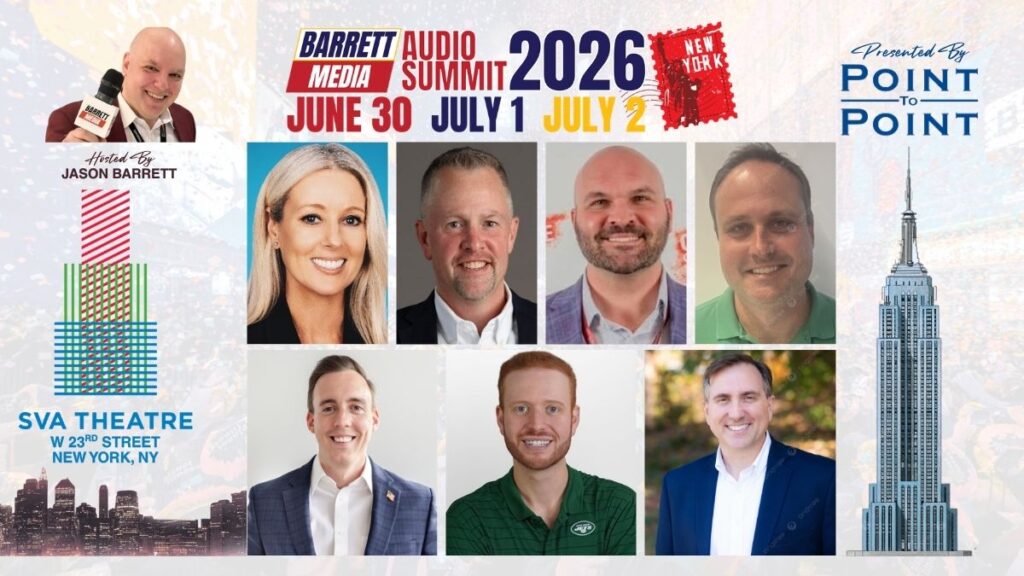
More Speakers Join the 2026 Barrett Media Audio Summit
Last week we revealed a few speakers for our Music Show at the 2026 Barrett Media Audio Summit presented by Point to Point Marketing. We’ll announce more names for the music conference this Wednesday. Today though, we have a few new additions to unveil for our Sports and News/Talk shows.
Starting with sports, I’m pleased to welcome back ESPN’s Vice President of Digital & Audio Production Justin Craig, 94WIP Brand Manager Rod Lakin, and 104.5 ESPN Program Director and Afternoon Host, Matt Moscona. In addition, I’m also thrilled to have Jake Asman joining us for a session on building an independent content business.
Switching to news, it’s my pleasure to have WGN Radio VP/GM Mary Sandberg-Boyle and Cumulus Media News/Talk format captain and 94.1 KCMO morning host and PD Pete Mundo returning to the show. I’m also looking forward to having WBT Radio Afternoon Host Brett Winterble in the building for the first time.
You can purchase Summit tickets and reserve your hotel room here. For sponsorship opportunities, email Stephanie Eads at Stephanie@BarrettMedia.com.
Quick Hits
Kevin Callahan of Pamal Broadcasting wrote a fantastic piece on LinkedIn this week. If you haven’t read it, it’s worth your time. It focuses on local being an advantage but only if the content and personality are good.
Charlamagne tha God announced the Black Effect Podcast Festival is coming back on April 25th in Atlanta. For tickets, go here.
Last week on HOT 97, Noreaga appeared on Mornings With Mero. During the chat, he said ‘this is the first time in a long time New York radio sounds like New York‘. Former morning host Peter Rosenberg took exception and called it out on social media. I can’t blame Peter for being bothered. It came across as a cheap shot whether intended or not.
Man I peep a lot of people I love (like Nore) casually dropping subtle shots like this and it's absolutely bonkers. When it comes to New York people get real conservative about immigration lol. Dad from Brooklyn, moved here in 07. Married a New Yorker–Misshattan no less. Bought… https://t.co/IWAl5pqHBY
In a recent article, CNN revealed that Buzzfeed had substantial doubt about its ability to continue as a business. The digital outlet was at its peak in the mid-2010’s, boasting over 200 million monthly readers. Now, it reportedly had a net loss of $57.3 million in 2025. Ouch!
A tip of the cap to Clay Travis. Clay and his wife Laura made a $10 million dollar commitment to the Vanderbilt Law School to fund a number of key priorities. Among them include the First Amendment Clinic, the Law School’s “Respectfully Dissent” debate series, merit- and need-based scholarship aid, child care funding for student-parents, support services for student veterans, and the Law School’s ongoing building renovation. The Travis’ investment directly supports the university’s historic Dare to Grow campaign.
Arash Markazi‘s story on WWE’s Paul Heyman is excellent. Heyman was doing press for WWE 2K26 and offered his insights on the future of sports media. He shared how things in media change at a rapid pace, and evolving is vital to future success. What especially stood out was this quote from Heyman: “However you or I feel about it is totally irrelevant. I’m not the one driving the train. I can sit here and say, ‘Back in my day.’ But my day is forward. My day is today, tomorrow, next year., and five years from now. That train is leaving the station. I can either let it leave without me, or I can get on that train.”
Credit to Chris McMonagle of WFAN in New York. It’s one thing to talk sports alongside Craig Carton and earn praise for it. It’s another to belt out the chorus of Drops of Jupiter in front of Train’s lead singer Pat Monahan and earn respect for a job well done. That moment certainly had to feel better than the fake ad prank pulled on him by Craig.
Speaking of WFAN, former midday host Brandon Tierney just reached a milestone. In less than two full months on YouTube, Tierney just passed the one-million views mark. Well done, BT.
Congrats as well to Brodie Brazil who just reached 99,000 subscribers on YouTube. A super talented and underrated Bay Area host, it’s stunning to me that local sports television didn’t sign this guy for years to come. Regardless, he’s shown that the company/brand isn’t as important as the star creating the content.
Barrett Media produces daily content on the music, news, and sports media industries. Sign up for our newsletters to stay updated and get the latest information right in your inbox.
The supergroup has always been a magical combination of talent, usually for a record or two. Bands such as Asia, The Firm, or Velvet Revolver leave us with killer singles. They present a wow factor when we hear some of our favorite musicians playing together.
Supergroups traditionally encompass a few things. Killer musicians grouping together to make next-level noise. Now, they’re making a comeback.
These days, classic rock artists in particular are finding both creativity and comfort playing with “their friends.” There are some really solid bands emerging because of this. Making music that should not go unnoticed.
Two supergroups that are on my radar are both on the ever-growing “Frontiers Music” record label. A label that also features Lynyrd Skynyrd, Sammy Hagar, Journey among others.
Black Swan and Generation Radio.
Black Swan is a group featuring MSG vocalist Robin McAuley and Winger guitarist Reb Beach. The lineup also includes Dokken and Foreigner bassist Jeff Pilson. Drummer Matt Starr rounds out the group. Starr has performed with Ace Frehley and Mr. Big.
Their third release, Paralyzed, came out a few weeks ago. If you are a fan of melodic hard rock with well-crafted songs and explosive playing, this one is for you. It’s a top-to-bottom return to hard rock. Songs like I’m Ready and When the Cold Wind Blows stand out as two of my favorite tracks on the album.
I had an in-depth chat with vocalist Robin McAuley on my Carr Stereo podcast about the freedom of choice as you enter a new phase of your musical career. Also, why he is so proud of this album.
Generation Radio will release their second album, Take Two, on April 17.
Generation Radio mixes some of the most incredible melodies, with a hook to jump over in every song. No surprise, as Jay DeMarcus of Rascal Flatts and Jason Scheff, longtime bassist for Chicago, combine their talents on a 12-song sophomore album. Scheff joined Chicago in 1985 at age 23. The project also reimagines some of their favorite melodic covers for live performance.
This supergroup also consists of Tom Yankton and Chris Rodriguez on guitar. Also the “pocket king,” legendary Steve Ferrone (Tom Petty, Clapton, Duran Duran, Average White Band, just to name a few), on drums.
There is an ease of art on Take Two. The harmonies, musicianship, and songwriting are so damn amazing. This talented band is also taking to the road, a ticket I hope I get the chance to buy.
I caught up with Jay and Jason from Generation Radio, who explained why the band is so important to them. The supergroup serves as a completely different creative vessel. They also discussed how Rascal Flatts based their craft on being fans of melodic hard rock. Plus, Jason tells a great story about teaming up onstage with Alex Lifeson for his RUSH moment.
There is a reason we have an affinity for a supergroup. The name alone says it all.
Barrett Media produces daily content on the music, news, and sports media industries. Sign up for our newsletters to stay updated and get the latest information right in your inbox.
The Classic Rock world lost one of our best recently when Uncle Joe Benson passed away late last month at the age of 77.
Possibly best known for his three decades behind the mic at KLOS, Benson also worked at Classic Rock stations like KLSX (97.1), Arrow 93.1 KCBS-FM, and 100.3 The Sound KSWD. He also hosted the syndicated show Ultimate Classic Rock for three years and the weekend show Off the Record from 1998 until 2025.
The outpouring of love and grief that followed Benson’s passing was profoundly moving. So many people in the industry took to social media to share their memories, and I felt that, even though I never got to meet Uncle Joe, it was important to memorialize him in this Classic Rock column.
But I didn’t want to just chronicle his career or how people felt about him. Instead, I wanted to see if it was possible to create something positive out of this loss. I asked several people who knew Uncle Joe if they would share lessons they learned from collaborating with him.
The people kind enough to assist me are:
Rita Wilde, a legend in her own right, worked with Joe at KLOS starting in the early 1980s as a fellow host and as his Program Director.
Michael Sherry, a producer, worked closely with Joe when he came back to KLOS in 2003 and stayed with him continuously until his last Ultimate Classic Rock broadcast in 2024.
Michael Haase, an account executive who worked with Joe for two decades at KLOS and 100.3 The Sound.
Dave Beasing, the Program Director who hired Joe at 100.3 The Sound in Los Angeles.
Joe Limardi, Classic Rock Format Lead for Townsquare Media, who programmed Ultimate Classic Rock when Joe was the host.
Kurt Johnson, President of Local Programming at Townsquare Media, who hired Uncle Joe to host Ultimate Classic Rock.
I asked them each to share a radio lesson they learned from Uncle Joe, and here’s what they wrote:
“The biggest impact on me was his relationship with the audience. Joe helped me understand that to really know your listeners, you needed to become their friend, because that is who you are talking to every day.” – Rita Wilde
“Be yourself, be natural. Don’t fake it. Also, don’t become friends with the rock stars. He was kidding, of course. He had great friendships with Steve Miller, Steve Perry, and Billy Gibbons, to name a few.” – Michael Sherry
“No matter your success, stay humble, work hard, and stay true to yourself. Legacy and reputation were everything.” – Michael Haase
“Every break he did was a reminder to be in the moment — solely focused on one listener. Everything on the air revolves around that. Also, he was incredibly connected to the music, and the listeners could feel it.” – Kurt Johnson
“His show was seamless. He made every break count. In what could have been a ‘nothing,’ Joe would find a way to make it a something with just the right inflection, tone, and content.” – Joe Limardi
“Watching Joe, I saw that an audience is built one listener at a time. When Joe wasn’t on the air, he was probably out meeting people at a concert, a remote, the state fair — wherever he could find listeners.” – Dave Beasing
I also asked each of them to share what made Uncle Joe such a great air talent:
“Joe was a program director’s dream. Every break was ‘tight and bright,’ got everything said quickly and efficiently, was positive, upbeat, and so warm. On air and off, Joe was the same — always laughing and smiling.” – Dave Beasing
“The first thing that stood out was his voice. Those unmistakable pipes commanded your attention without pretense or ego. It was authoritative and credible with every story, every anecdote, and every interview.” – Joe Limardi
“He brought it every show. Joe instinctively understood the alchemy of radio, rock music, people, personality, and point of view. He was one of one.” – Kurt Johnson
“The band relationships and knowledge that Joe had were unmatched, along with the incredible interviews and stories. People loved the music, but more so they loved Uncle Joe — especially if they had the honor to meet him.” – Michael Haase
“He really was like the cool uncle who knew everything about music and had such joy telling you about it. You could hear his smile coming through the speakers. He also knew how to edit himself in the moment. I think that’s a really important tool that the great DJs have.” – Michael Sherry
“Joe researched and read constantly and always took notes on everything having to do with music. He also constantly hosted station events whether he was paid or not. When KLOS used to partner with the American Red Cross, Joe would be one of the first to volunteer his time. I have never known a better self-promoter than Joe Benson. He loved what he did, and the audience loved him.” – Rita Wilde
Finally, I asked each person for a story about Uncle Joe, and they had so many great anecdotes there is simply not enough space to include them all. So I made the difficult editorial choice to close with a story from Rita Wilde that hopefully imparts one more lesson.
“One thing that I didn’t know about him was how much he mentored other people. An important part of the legacy of KLOS was the Community Switchboard, which consisted of volunteers who helped with the request lines and contest giveaways. So many of them told me their stories of how Joe would listen to their airchecks and give advice about making it in the radio business or their chosen field and line of work.” – Rita Wilde
Hopefully, reading this column taught or reminded you of something that helps make your radio show or station great. While I didn’t have the honor of knowing him, I hope that trying to find wisdom for the industry in Uncle Joe’s passing is a fitting tribute.
My humble thanks to all six people who shared their thoughts for this column.
Barrett Media produces daily content on the music, news, and sports media industries. Sign up for our newsletters to stay updated and get the latest information right in your inbox.
We see protests on a regular basis in the US. Pro-Trump, anti-Trump, for and against whatever issue is bothering enough people to get them out of their homes and into the streets. After reading this column, some group may head down to L Street, Northeast, in Washington, carrying their “Abolish the FCC” signs!
Recently, Radio World, which focuses on engineering topics, ran an article about a paper entitled “Disbanding the Federal Communications Commission.” The author was Professor Mark Jamison of the University of Florida. He is also director of their Public Utility Research Center. The paper was written as a working paper for the American Enterprise Institute, a conservative DC think tank.
Of course, I downloaded the paper and read the whole thing to spare you the effort!
The Idea
Some readers would probably be very happy if the FCC were abolished. Odd and/or outdated rules, paperwork, and limitations on what your station can do — as against the freedom given to streamers and SiriusXM — well, it’s understandable. Dr. Jamison offers other reasons for eliminating this piece of the federal government.
The argument in favor of the FCC stems from a word I’ve used in this column before: “scarcity.” When I was growing up, most markets had three commercial television stations and one public TV operation. If you lived in a top 10–20 market, there might have been an independent TV station as well. Most markets also had perhaps 10–20 radio stations, and no entity could own more than one AM and one FM. Then there was the telephone situation, also regulated by the FCC.
There was a landline company, typically owned by Ma Bell, which also handled long distance. A few independent phone companies existed, but this didn’t mean competitive — it meant that each one had its own monopoly service area. My hometown had Rochester Telephone, which was not part of the Bell system. For decades, if you wanted phone service, you used them. Your phone or phones were supplied by the company as well. All of that represented “scarcity” and lack of consumer choice.
Let’s consider the current media environment. Assuming you have decent internet access — essentially a given almost anywhere in the US — how many video choices do you have at any given time? An unlimited amount. How about audio? Same answer.
How many phone companies can you choose from? Plenty, even if there are only three true nationwide cell networks. Do you have to lease a phone from the same company? Not at all — BYOP (bring your own phone)!
Dr. Jamison’s argument is that the raison d’être for the formation of the FCC under the Communications Act of 1934 no longer exists.
Dr. Jamison also argues that eliminating the FCC would remove the political aspects that come with a federal agency able to regulate content, either de jure or de facto. This “political intrusion,” as Dr. Jamison calls it, started in the Clinton administration with respect to the internet. It then moved to content under the Obama administration in 2012. Later, “net neutrality” became an issue under Chairman Wheeler in 2013, along with other issues favored by Congressional Democrats.
Per the report, the first Trump administration was lighter on the FCC under Chairman Pai. However, when Commissioner O’Reilly said he didn’t believe a Trump executive order targeting Twitter and Facebook for alleged bias was within the FCC’s authority, his nomination for another term was withdrawn.
Less political influence at the FCC occurred under President Biden. Much of that was due to having an equal number of Democratic and Republican commissioners for much of his term. You may remember the failed attempt to get Gigi Sohn confirmed as the fifth commissioner, and the subsequent delay in nominating a more Senate-acceptable candidate.
Now, Chairman Carr has his agenda, which hews closely to President Trump’s views. It seems that no matter which party is in the White House, the FCC becomes a political football.
What Would Replace the FCC?
If the FCC is gone, what replaces it? Dr. Jamison cites some FCC positives — for example, the spectrum auction process. He suggests staff and operations could be transferred to another agency, such as the National Institute of Standards and Technology (NIST). Broadband subsidies could be handled by state telecom offices. Remaining functions could move to the Federal Trade Commission, NIST, and elsewhere.
That leaves our world — broadcasting. On this point, Dr. Jamison is nearly silent, except to say that “broadcast content oversight would end.” The biggest need is ensuring broadcast spectrum licensing continues to operate, keeping interference to a minimum and ensuring operators can keep their stations on the air.
The lack of an FCC would not be carte blanche to drop F-bombs on the air. Laws exist to keep George Carlin’s Seven Words off the airwaves for the foreseeable future. While I don’t expect the FCC to go away any time soon — papers like these are released regularly to influence policy and legislation — it’s an intriguing idea.
Let’s meet again next week.
Barrett Media produces daily content on the music, news, and sports media industries. Sign up for our newsletters to stay updated and get the latest information right in your inbox.
At some point, you have to stop calling it a pattern and start calling it a strategy. FCC Chairman Brendan Carr spent part of his weekend at Mar-a-Lago with President Donald Trump — and sure enough, the latest round of license-revocation threats wasn’t far behind. If you didn’t know any better, you’d think Carr was putting together an audition reel for a prime-time slot on Fox News, Newsmax, or OAN.
That’s not an insult dressed up as a joke. It’s an honest observation about where Carr’s priorities seem to lie.
On Saturday, Carr posted a warning on social media aimed at broadcasters, declaring that those “running hoaxes and news distortions — also known as the fake news — have a chance now to correct course before their license renewals come up.”
Bold words. They’re also largely empty ones. The FCC hasn’t denied a license renewal in decades, and any government action against a licensee would trigger a protracted legal battle with First Amendment implications. Anna Gomez, one of Carr’s contemporaries at the FCC, said as much in a post on social media. “The FCC can issue threats all day long, but it is powerless to carry them out,” she said. “Such threats violate the First Amendment and will go nowhere. Broadcasters should continue covering the news, fiercely and independently, without fear of government pressure.”
Legal experts agree. “Chairman Carr’s threats are hollow,” public interest lawyer Andrew Jay Schwartzman told CNN.
But hollow threats, where the threatmaker seems like the big bad wolf, make for great television, and that seems to be the point.
Carr was at Trump’s Mar-a-Lago resort on Saturday and was seen talking with Trump there, according to a report from CNN’s Brian Stelter. Coincidence? Doubtful. Carr’s post on X came directly after Trump criticized The New York Times, Wall Street Journal, and “other lowlife papers” for their coverage of the U.S.-Israel war in Iran.
The sequencing wasn’t subtle. Trump posts. Carr amplifies. That’s the arrangement, and Carr’s more than comfortable playing his role.
It’s worth being clear about what Brendan Carr is doing here. He’s not acting as an independent regulator operating in the public interest. He’s functioning as a mouthpiece — a more than willing and eager one — for the President of the United States. That might be acceptable if it came paired with meaningful regulatory work. It doesn’t. Instead, Carr’s chairmanship has been defined by headline-chasing and culture war theatrics. His bully-pulpit strategy has been evident for more than a year, as he’s railed against alleged media bias and welcomed disputes with the likes of ABC’s Jimmy Kimmel.
Here’s the thing about the FCC — and really, about most regulatory bodies. Most Americans couldn’t tell you who chairs it. That’s not ignorance, it’s the way it’s supposed to be. Think about the referees working an NFL game on Sunday afternoon. You don’t know their names. You don’t notice them until something goes wrong or until one of them decides to make the broadcast about themself rather than the game being played. The best officials are invisible. They do their jobs quietly, competently, and without demanding attention.
The same should be true of the people running the FCC. The commission has real work to do. The problem is none of it is glamorous. Most of it won’t land you on a talk show. It won’t get your name trending on social media. But it matters, and it’s what the job actually requires.
Carr’s apparently not interested in that version of the job. He’d rather be the story than run the agency. Media advocacy groups have argued that Carr is trying to pressure media companies into submission and self-censorship — achieving what Trump wants without explicit government action and plausible deniability, even when the dots aren’t hard to connect.
That’s a damning characterization, but it’s hard to argue with given the evidence. Nexstar and Sinclair were accused of backing down before Carr when they pulled Jimmy Kimmel’s show from their ABC affiliates — both companies had pending business before the FCC at the time.
There’s a reason people in broadcasting know Brendan Carr’s name. There’s a reason the general public has started to recognize it, too. It isn’t because he’s made a series of consequential regulatory mistakes. It’s because he keeps showing up on your timeline, echoing the president, threatening broadcasters, and making sure the cameras find him in the process.
That’s not what an FCC chair is supposed to be. Then again, maybe that’s not what Brendan Carr actually wants to be.
Barrett Media produces daily content on the music, news, and sports media industries. Sign up for our newsletters to stay updated and get the latest information right in your inbox.
Tucker Carlson claims the CIA is preparing a criminal referral against him to the Department of Justice, alleging he violated the Foreign Agents Registration Act by communicating with Iranian contacts prior to a recent conflict.
Carlson addressed the matter directly, saying the agency was viewing conversations he had with people in the country as part of its investigation.
“What’s that crime? Well, talking to people in Iran before the war,” he shared. “They read my texts. So, the crime under consideration apparently would be the Foreign Agent Act or something like that, acting as an agent of a foreign power.”
Tucker Carlson dismissed the seriousness of the potential case, stating, “I don’t expect this to go anywhere.”
He pushed back firmly on the underlying allegation, arguing, “I’m not an agent of a foreign power. Unlike a lot of people commenting on US politics and global affairs, I have only one loyalty, and that’s the United States, and have never acted against it.”
The former Fox News host also denied ever receiving outside financial compensation — “I’ve also never taken money from anybody. Don’t need it, don’t want it. And that’s provable” — and framed his conversations with foreign nationals as a core part of his professional responsibilities.
“It’s my job to talk to everybody all the time and try and figure out what’s happening around the world,” he said. “That’s literally what I do for a living.”
Carlson expressed confidence that the matter would not advance into a formal criminal case.
“Legally, I think the case is ludicrous, and I doubt it will even become a case,” he said. He added that he has every right to engage with foreign sources as an American. “I have no secrets to divulge.”
Neither the CIA nor the Department of Justice has issued a public statement after Carlson’s comments.
Barrett Media produces daily content on the music, news, and sports media industries. Sign up for our newsletters to stay updated and get the latest information right in your inbox.