WPHM in Port Huron, Michigan, has announced it plans to shift its signal from 1380 AM to 1450 AM and 105.5 FM in April.
On April 6th, the 1380 AM signal will be turned off. The station is largely moving away from its news/talk station.
During The Paul Miller Show on Monday morning, Radio First General Manager Scott Shigley said the news and reasoning behind the move.
“Every radio station has towers, and every radio station has a license. We have a lot of programming across our stations, and some of it just really isn’t focused,” said Shigley. “And one of the things that we’re going to do is we’re going to make Paul available, not only to an AM audience, but we’re going to make you available on an FM dial too.
“We are going to take the WPHM call letters, and we are going to move it down the dial to 1450. The reason for that is because 1450 is also attached to 105.5 FM. So now we’re going to be able to offer The Paul Miller Show on an FM to an FM audience as well as AM, and we feel like that is a really, really important thing for us to be able to do.”
Shigley added that the current rock, country, and folk music format featured on the 1590 AM and 92.7 FM signals in the market will then be added to WPHM from 10 AM throughout the remainder of the day.
Currently, 1380 AM WPHM airs nationally syndicated news/talk shows like The Brian Kilmeade Show, The Guy Benson Show, Will Cain Country, and Coast to Coast AM. It also airs Bleck & Abdalla from Westwood One Sports, as well as FOX Sports Radio in the evening hours.
Following the signal shuffle, the cluster will have three stations: QCountry 107, 96.9 WBTI, and 105.5 FM/1450 AM WPHM.
Barrett Media produces daily content on the music, news, and sports media industries. Sign up for our newsletters to stay updated and get the latest information right in your inbox.
Netflix co-CEO Ted Sarandos is addressing the company’s failed pursuit of Warner Bros. Discovery, and he is doing so with the same direct tone that has long defined his public commentary on the evolving media landscape.
During an interview with Bloomberg, Sarandos characterized the competing bidder that ultimately secured the deal as “unusual” and even “irrational,” signaling clear frustration over how the process unfolded while also projecting confidence in Netflix’s strategic position moving forward.
“It’ll be fascinating to see the next steps,” said Sarandos. “I’m confident in our future that we’re not impacted by all that. In fact, maybe it’s to our advantage. But I hope I’m wrong for the sake of the industry.”
Sarandos acknowledged the irregular nature of the competition and suggested that outside factors influenced the trajectory of the sale. Even so, Sarandos emphasized that Netflix remains well positioned regardless of the outcome.
He argued that the company’s long-term strategy does not hinge on any single acquisition and could ultimately benefit from staying disciplined while others stretch beyond traditional valuation models.
Political noise also entered the conversation, when Sarandos was asked whether public pressure from President Donald Trump may have rattled shareholders at Warner Bros. Discovery.
“It’s a lot cheaper to make noise than it is to actually raise your bid,” Sarandos said. “So they tried that path first. Once it was clear that we weren’t in the CNN business, it was a lot less interesting. He didn’t care that much more about our deal.”
Ultimately, Sarandos said Netflix operated within a clearly defined valuation framework and refused to deviate from it, even as the bidding intensified. The company submitted what he described as a tight offer range and later shifted to an all-cash structure in an effort to streamline the process, yet leadership determined that exceeding those parameters would undermine the disciplined approach that has fueled Netflix’s sustained growth.
“I’m happy where we got in and happy where we got out,” said Sarandos. “We knew right away, when we got the notice on Thursday that they had a superior offer and the details of that deal. We knew exactly what we were going to do.”
For a company that has built its brand on calculated risk-taking, the decision underscores a willingness to walk away when the numbers no longer align with long-term objectives, reinforcing Sarandos’ belief that patience and fiscal restraint can sometimes offer more competitive leverage than winning a headline-grabbing auction.
Barrett Media produces daily content on the music, news, and sports media industries. Sign up for our newsletters to stay updated and get the latest information right in your inbox.
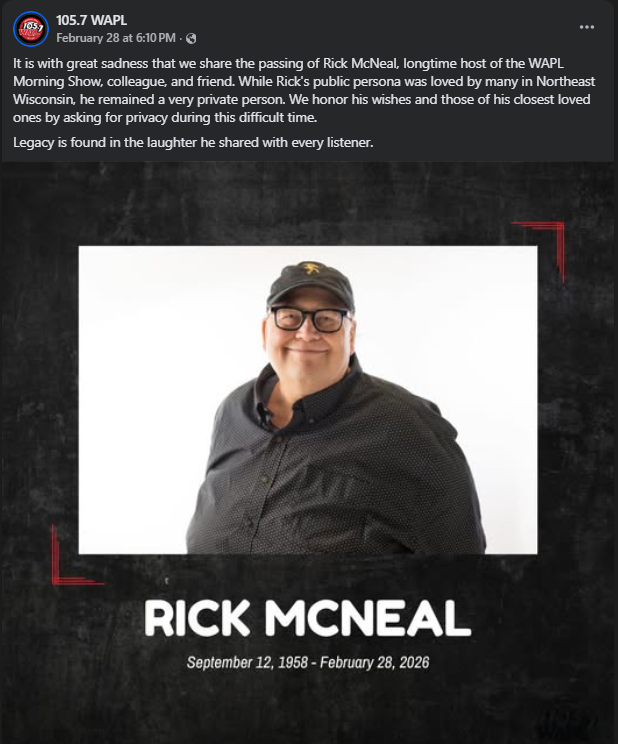
Rick McNeal, a longtime presence on Northeast Wisconsin radio and co-host of the popular Rick and Len morning show on 105.7 WAPL, has died, according to the station. He retired in 2024 after battling health issues, closing out a run that made him one of the most recognizable voices in the Appleton and Green Bay markets.
WAPL-FM shared news of McNeal’s passing with listeners over the weekend, prompting an outpouring of tributes across social media from fans who started their mornings with his brand of humor and rock-focused commentary.
For decades, McNeal helped set the tone for the station’s identity, blending music knowledge with a conversational style that resonated with a loyal audience.
McNeal formed one half of the Rick and Len pairing with Len Nelson. The duo became synonymous with mornings on WAPL. Their chemistry blended sharp humor with a deep love of rock music. That dynamic helped the show stay competitive in a crowded regional market. The program endured despite shifting listening habits and expanding platform choices over the past decade.
McNeal had been in a coma for a week in an intensive care unit after an infection led to sepsis, according to a Facebook post from Len Nelson, his close friend and former on-air partner who spent 35 years in the studio with him on The Rick & Len Show.
“Suffice to say, it’s devastating,” Nelson said. “However, because I try to apply pragmatism even in tragic moments, I am grateful that he no longer has to struggle with the health issues that forced his retirement a couple of years ago and which have made his life since a very difficult one.
In a statement, WAPL General Manager BJ DeGroot reflected on McNeal’s impact both on and off the air.
“It is with great sadness that we share the passing of Rick McNeal. Longtime host of the WAPL Morning Show, colleague, and friend,” DeGroot said. “While Rick’s public persona was loved by many in Northeast Wisconsin, he remained a very private person. We honor his wishes and those closest to him and ask for privacy through this difficult time. Legacy is found in the laughter he shared with every listener.”
Barrett Media produces daily content on the music, news, and sports media industries. Sign up for our newsletters to stay updated and get the latest information right in your inbox.
I’ve argued for the past decade that the radio and advertising industries have been operating with an outdated view of who matters most. I’ve written about it, questioned it on social media and have led discussions about it at our annual Summits. We’ve even let others use this website to examine the issue.
Yet the obsession with Adults/Men 25-54 has been treated as gospel for so long that many in our business forgot to ask a simple question: Does it still reflect reality?
Audacy’s Latest Research
I read through Audacy’s newest research piece last week presented by Ray Borelli, Reggie Shah and the company’s Insights team. It provided serious data and sound logic to a conversation that needs greater attention. If you haven’t read it, take some time and do so. It’s worth it.
Their case for expanding the industry’s primary buying demo from Adults 25-54 to Adults 25-64 isn’t just persuasive — it’s overdue. Audacy didn’t provide a hot take, corporate press release or dress this up as insight. It was well-researched, thoughtfully presented and highlighted real audience behavior and economic reality.
The industry should be paying attention because this affects everyone not just Audacy.
Adulthood looks different today than it did when the 25-54 demographic standard was created. Audacy points out that shifting from Adults 25-54 to Adults 25-64 expands radio’s national audience from 107 million to 140 million people — a 31% increase in reach and 33 million additional adults.
Think about that for a moment.
Without creating a single new show, hiring a single new host, or flipping a single format, radio instantly becomes dramatically larger, simply by measuring the audience in a way that reflects modern life.
Photo Credit: Audacy’s ‘The Demographic Reset’
And the best part? The economic quality of the audience doesn’t decline. In fact, homeownership rates increase and income levels remain strong across the broader group.
That’s not theoretical upside. That’s measurable business opportunity.
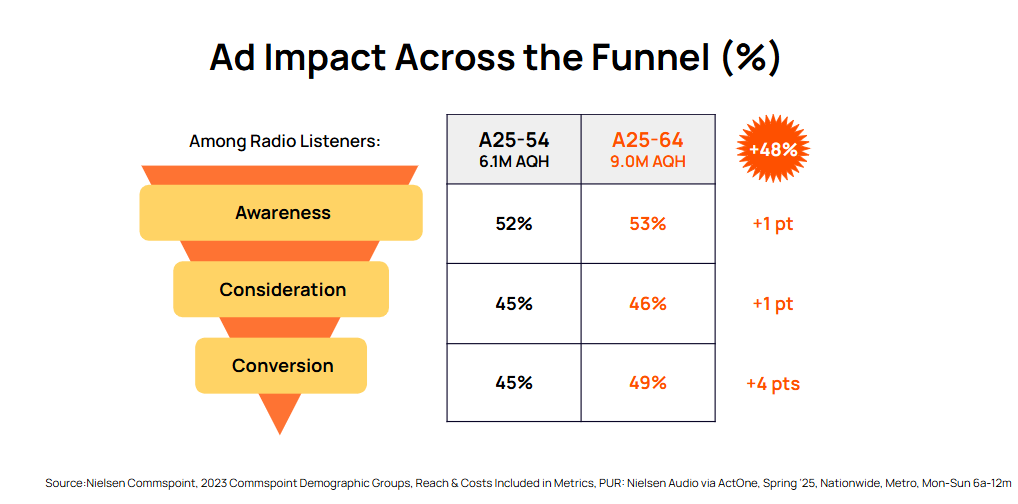
Audacy’s research even showed a four-point lift in conversion among exposed listeners within the broader demographic. That’s the kind of performance metric advertisers claim they want. If the goal of advertising is to drive results, why would we intentionally ignore millions of consumers with proven spending power?
Mike Francesa Has Said This For Years
If this argument sounds familiar, it should. Mike Francesa has been pounding the table on this issue for years.
Francesa has repeatedly challenged Nielsen and the advertising community to stop ignoring older audiences. His point has always been straightforward: Americans are living longer, working longer, and spending longer. Media consumption habits have evolved, but measurement standards haven’t kept pace.
Mike joined me at our conference in New York City in 2020 and emphatically called on Nielsen and the advertising industry to look at this issue with fresh eyes He cited how the majority of buying power in this country sits with older consumers. Cars, travel, financial services, insurance, and home improvement aren’t categories dominated by 27-year-olds. They’re dominated by adults who have established careers, families, and assets.
Francesa understood something many programmers and sellers learned firsthand: loyal audiences often skew older, and loyal audiences drive consistent revenue. Audacy’s work reinforced exactly what Mike has been saying.
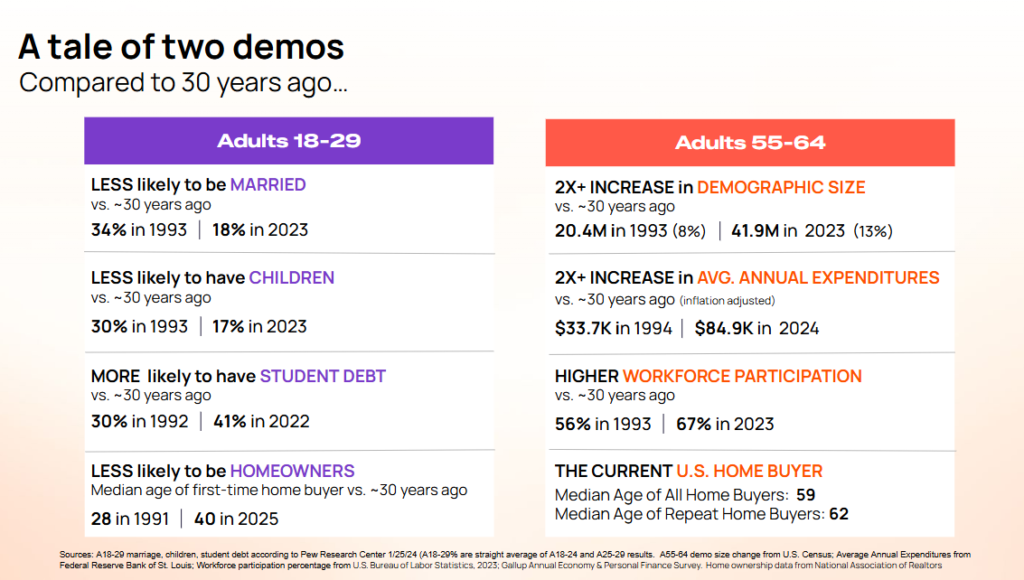
The 55-64 audience segment represents a significant share of households and spending, and retirement ages continue to climb. That’s not a niche group. That’s a major economic force.
The Industry’s Comfort Zone Has Become Its Limitation
The advertising industry didn’t land on Adults 25-54 by accident. For decades it represented the sweet spot of consumers establishing households and brand preferences.
But that model was built for a different era.
People bought homes earlier. They started families earlier. They retired earlier.
None of those assumptions hold up the way they once did.
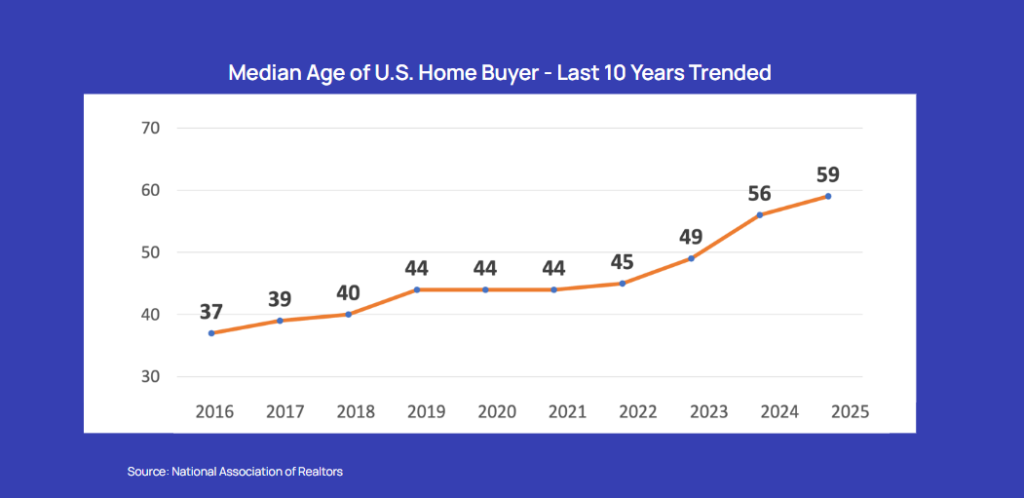
Today, the median age of a first-time homebuyer is 40, and the median age of all homebuyers is nearly 60. That reality alone should make every media planner reconsider how they define “prime consumers.”
Yet the industry continues to cling to 25-54 as if it were a law of physics rather than a marketing convention. Radio has paid the price for that inertia. Stations routinely deliver strong total audiences and highly engaged listeners but struggle to monetize them because the measurement currency ignores a meaningful portion of their value.
This isn’t a programming problem. It’s a measurement problem.
Nielsen Needs a Fresh Look
Nielsen deserves credit for the role it has played in helping radio demonstrate its value. Ratings have been important to many companies throughout the years. However, many larger groups have lost trust due to rising costs, small sample sizes, and an unwillingness to evolve and consider new information.
It’s no secret that measurement systems don’t capture the current climate effectively. Groups like Cumulus, Good Karma Brands, Saga, Townsquare and others have found ways to run their businesses without Nielsen. If expanding a demographic from 25-54 to 25-64 more accurately reflects how modern consumers live, work, and spend, which benefits the brands and advertisers paying Nielsen for the information, what exactly is the argument against it?
Photo Credit: Audacy’s ‘The Demographic Reset’
We’ve seen Nielsen make methodological changes before such as adjusting PPM rules and refining measurement standards. Why wouldn’t they want to provide a better snapshot of what’s actually happening?
The industry has an opportunity to rethink the foundation of its buying currency. Inflating numbers artificially isn’t necessary. All groups need is to represent reality more accurately.
This Is Bigger Than Radio
What makes Audacy’s argument particularly compelling is that it isn’t just about helping radio look bigger. It’s about helping brands make smarter decisions. Ignoring millions of consumers with high incomes and active buying behavior doesn’t make advertising more efficient. It makes it less effective.
Audacy’s research makes clear that expanding the demo aligns measurement with how adulthood actually works in 2026, not how it worked in 1986.
That’s a critical distinction.
Media habits have changed. Life stages have changed. Economic realities have changed. Measurement standards must change too.
Key Demographic Changes (1986–2026)
Aging Population: The 65+ population has grown substantially, with the oldest boomers turning 80 in 2026. The 80-plus population is projected to double between 2025 and 2045.
Increased Diversity: The population is more diverse, with significant growth in Hispanic, Asian, and multi-racial populations. Hispanics have jumped from roughly 18-19 million in 1986 to approximately 68 million in 2024. The Asian population grew from roughly 11.9 million in 2000 to 24.8 million by 2023. And the Black population grew from 36.2 million in 2000 to 49.2 million by 2024.
Increased Education: The percentage of the voting-age population with a college degree has roughly doubled.
The Data Can’t Be Ignored
In the mid-1980s, wealth was concentrated in older, but not exclusively retirement-age, households. According to research on wealth trends in 1983, households headed by persons between 45 and 69 years of age held the largest share of wealth.
Fast forward to 2026, and wealth is now heavily concentrated in the oldest living generations, specifically those who have already retired or are nearing retirement. As of early 2026, Americans in their 60s and 70s are the wealthiest, with average net worth’s exceeding $1.4 million, according to data from Empower. Baby Boomers (born 1946–1964) are the wealthiest, holding more than half of all U.S. household wealth, despite making up less than 20% of the population.
Photo Credit: Audacy’s ‘The Demographic Reset’
The U.S. population has soared from approximately 240 million in 1986 to a projected 348 million in 2026. Our demographic center is shifting rapidly toward older age groups and a more diverse, and educated, yet smaller, younger generation.
Conclusion
To summarize, consumers are smarter, larger, wealthier, more diverse, and living longer. Yet our industry continues to prioritize the same demographics as if we’re living in 1986.
That needs to change.
Adults 25-64 isn’t a radical idea. It’s a realistic one. Heck, I’d be fine if Nielsen tweaked it to 29-64 or 31-64. Either way, it’s more reflective of the modern world we live, consume and make purchases in.
For years, many have challenged Nielsen and advertisers to recognize older audiences. Audacy deserves credit for putting real data behind it. The Insights team didn’t just suggest a demographic reset, they made a credible business case for it. And they did so with clarity, evidence, and practical logic.
The question now is whether the advertising community and Nielsen care to listen.
Radio doesn’t need artificial growth. It needs its real audience counted. If the goal is to help brands succeed while accurately valuing one of America’s most powerful media platforms, then a demographic reset isn’t just logical — it’s necessary.
Barrett Media produces daily content on the music, news, and sports media industries. Sign up for our newsletters to stay updated and get the latest information right in your inbox.
I have known Darryl “DMC” McDaniels personally for close to 20 years. He is one of my favorite people on the planet. In all my years in rock radio, this hip hop legend has still been the most incredible interview to grace my airwaves.
McDaniels was a regular on my radio show because he is a musical and cultural encyclopedia. Always bringing positivity and inspiration. He’s a rocker and rock star in his own right.
McDaniels is a founding member of the iconic Run-D.M.C. He’s a Rock and Roll Hall of Famer, best-selling author, comic book creator, philanthropist, and survivor. He’s always making music with everyone, and with no boundaries. McDaniels has collaborated with rock royalty such as Myles Kennedy, Santana, Agnostic Front, and Sammy Hagar. The list is endless. He fits everywhere, and everyone loves working with him.
Run-D.M.C. made history in 1986, bringing Aerosmith back from the dead and merging rock and rap long before Korn, Cypress Hill, and Linkin Park were born. In fact, they started the process in 1984 with their debut, Rock Box, featuring live metal guitars courtesy of Eddie Martinez.
McDaniels just released a slamming new single,She Gets Me High, sampling the Ram Jam classic Black Betty. It also features Sebastian Bach on vocals, Mick Mars on guitar, Duff McKagan on bass, with Travis Barker on drums.
He gave me some information on his new album, America, which will drop at the end of the summer. The effort features collaborations from Joan Jett and Sammy Hagar.
I caught up with McDaniels at a local NJ coffeehouse, Catfight Coffee in Boonton. We taped my Carr Stereo Podcast, where we hipped and hopped through his early days, Hall of Fame induction, his love of local radio as a kid. Also his recent efforts crafting new music as an independent artist.
*Editor’s Note: Answers have been edited for clarity and length.*
Terrie Carr – I know hip hop came before Run-D.M.C. But you guys did something completely different.
Darryl “DMC” McDaniels – We took it global.
TC– You also did something that I don’t think you get the credit for, because you got the credit when you merged with Aerosmith. You merged rock and hip hop before that, way before that. I remember seeing and hearing Rock Box, because that was one of the first hip hop videos on MTV ever. The thing I remember the most was Eddie Martinez on guitar!
Eddie was most memorable because I had never seen a hip hop video with a guy out front playing a guitar solo at the very beginning of the video.
DMC– Yeah. On top of the Cadillac.
TC– The video was so great. There was a little white kid running around, and Eddie’s there. I had never seen anything like it at the time. It was groundbreaking. The director who put that together was brilliant.
Coming from the early days of hip hop. People such as Kurtis Blow, Grandmaster Flash, and Melle Mel. They made different records than Run-D.M.C.
DMC– We were trying to do a record like Billy Squier. We wanted to make a record like Billy Squier’s Big Beat.
TC– You guys wanted songs, and you had them.
DMC– It was because of the radio. Hip hop today ain’t even hip hop. It’s inspired by hip hop, but that’s a whole other story.
We grew up with New York City radio. In the beginning, it was the black station and the white station. But then 77 WABC did something groundbreaking. They started playing the black music and the white music together.
When I was younger, you would have to listen to WWRL. You would have to listen to that station to get the black music. You had to listen to other stations to get the white music. But on 77 WABC, you could hear Sly and the Family Stone and Crosby, Stills, Nash & Young together. You could hear Elton John, James Brown., Aretha Franklin, and Joni Mitchell.
We were children of that. The hip hop generation is made up of children of late ’60s and ’70s radio. Everybody is a child of that. On Saturday mornings, besides the cartoons for every kid — Black, white, Italian, Asian — there was Soul Train at 12 o’clock.
TC– Get on the line dance, baby.
DMC– Then you still didn’t go outside until 2 because at 1 o’clock on ABC there was Dick Clark with American Bandstand. All of that music was us.
When we started doing hip hop, we utilized the records we were hearing on Soul Train, American Bandstand, and 77 WABC. Our inspiration wasn’t about color. It was about vibration and sound.
Growing up, I loved Harry Chapin, Jim Croce, Bob Dylan, and all of the folk music. That was our music. Ginger Baker said, “it’s just F*****g music. You don’t separate it, it’s just music.” He got mad at the industry for trying to separate it.
I’m a rock guy, so I agreed with Gene Simmons. All my friends cursed me out. Gene Simmons said the Rock and Roll Hall of Fame was really made for bands and musicians. You could argue and say they should have created an annex for soul music, hip hop, and everything else.
The Rock and Roll Hall of Fame people what’s the criteria to get in. Because I agreed with Gene since I’m a rock fan.
They said, “Darryl, if you take a flute,” and I cut them off. I questioned if taking a flute meant you’re playing in the band. They followed up saying, “If all you have is a flute and you sell out Madison Square Garden three nights in a row, that’s some rock and roll s**t.”
All of Run DMC’s hits are rock songs. Taken from rock songs. It’s Tricky is My Sharona. Mary Mary is The Monkees. We all grew up this way. Coming home from school, after your mother and father would tell you is do your homework and eat your dinner. You’d turn the TV on and it was The Brady Bunch, The Monkees, and Fred Flintstone.
With Run-D.M.C., at first hip hop it was Black music. It was about what was going on in the Bronx and Harlem. When hip hop came over the bridge from the city into Queens, we were in the suburbs. So, we had drugs and gangs.
TC– But you also had college.
DMC– We also had college, double dutch, and hopscotch. When I got into hip hop, Bob Dylan and all these people talked about politics and social issues. They also talked about your grandmother.
I asked why isn’t nobody rapping about the other things like that? There were black kids in my hood who were ashamed to wear a Judas Priest shirt because they thought you weren’t supposed to do that.
But when we dropped Rock Box, those kids felt comfortable to wear their Judas Priest shirt now. The same thing happened for the rock kids into hip hop who were running around in their Misfits shirts. That was us.
TC– You’ve got a new tune out with some incredibly iconic performers.
DMC– The song started like this. I was working with and R&B and hip hop producer. He’s just working on stuff, messing around. He goes to the [New York] Giants game at the stadium. Now, you know at sports games — especially hockey games — during intermission and timeouts, the DJs always play music.
He’s sitting there and Rage Against the Machine, Motley Crue, Guns N’ Roses, Blink-182, and AC/DC comes on. The Rolling Stones, Audioslave, Soundgarden — all of that comes on. Then Walk This Way comes on followed by Ozzy [Osbourne], Black Sabbath, and then Tricky.
He comes back and tells me, “D, we got to do this record.” At the game, Ram Jam’s Black Betty comes on, which led him to saying he’s got an idea and let’s do it.
We did a sampled version of Ram Jam’s Black Betty with me rapping over it. Then we sat down, and he thought about all the music he heard at the game. That’s when he decided to do this record live.
And that’s all he said. So now we have to find some musicians.
They found musicians and put out a killer rebirth of a classic taken from a Leadbelly song. How did Darryl hook up with four rock legends for his new tune? Who is he making a horror film with? What was it like merging with Aerosmith 40 years ago? Which radio DJs inspired him? What is his new album going to be like?
Check out my full hang with Darryl McDaniels on The Carr Stereo Podcast.
Barrett Media produces daily content on the music, news, and sports media industries. Sign up for our newsletters to stay updated and get the latest information right in your inbox.
There is no doubt that Pat McAfee gets the biggest names in sports and entertainment to join his program. This past week, following a short hiatus after the Super Bowl, McAfee was live and in charge at the NFL Combine in Indianapolis. He personally works alongside the city of Indianapolis to bring the biggest events to his home market. I wouldn’t be shocked if he were personally involved in bringing several WWE events to town, along with serving as the emcee of the city’s recent announcement that the NFL Combine will remain in Indianapolis for 2027 and 2028.
It seems only fitting that the city’s favorite adopted son would have the biggest stage at the NFL Combine last week, and he did — front and center with the field at Lucas Oil Stadium as his backdrop. The three days in Indianapolis were not disappointing. The guest list would make any other sports content program envious. NFL general managers and head coaches. Gold medal-winning hockeyplayers. Even an appearance from the Governor of Indiana, who is attempting to lure the Chicago Bears to the state for a new stadium.
More than ten hours of content were created, including twenty interviews. While the roster was impressive, what did it leave the audience? What stood out from the three days in Indianapolis? While the lineup of appearances was indeed impressive, does McAfee use the moment differently than any other sports talk talent would? And if so, is that what the audience expectation should be?
It’s unfair to compare what McAfee’s brand does to a typical local sports radio station. However, what is comparable is the approach. For example, whenever a big event offers a “media row” setting, sports radio outlets chase exclusivity. They want the ability to land a guest they typically would not get time with because they are “broadcasting from the house.”
The NFL Combine provides a unique window of exclusivity. NFL owners, coaches, general managers, and prospects looking to impress ahead of the NFL Draft are all “in the house.” It’s a rare opportunity unmatched at any other point during the year. There is a chance to spend time with nearly anyone in the National Football League who is constructing rosters or auditioning for draft selections.
McAfee caters to a national sports audience through his YouTube platform and ESPN simulcast. His reach extends beyond a single market, unlike many of the sports radio brands that attended the NFL Combine’s “radio row.” ESPN Radio, FOX Sports Radio, and Westwood One Sports did not broadcast live from Indianapolis. Jim Rome, Dan Patrick, and Colin Cowherd all remained in their studios.
SiriusXM NFL Radio, a partner with the NFL, broadcast live from Indianapolis with its full daytime lineup “from the house” all week. If we’re comparing apples to apples, the guest roster for SiriusXM NFL Radio was equally, if not more, impressive.
When you don’t spend thirty to forty minutes with a guest, as McAfee often does, you can create more variety and depth in the interviews you present.
Comparing how McAfee and SiriusXM NFL Radio handle their interview schedules is like comparing podcasting to radio. That’s the element McAfee has always mastered. He’s a podcaster that radio executives continue to study in hopes of replicating the attraction.
His interviews aren’t interviews; they’re conversations. He elevates the ego and rarely puts the subject in an uncomfortable position.
It’s not softballs, as many often suggest. Rather, the approach is to protect the shield. Athletes, executives, and key personnel view McAfee as a safe space. They know his style isn’t the typical Q&A filled with wasted minutes.
It’s more like chilling with your buddies than conducting a topical interview designed to make news.
McAfee doesn’t often make news with his interviews. He doesn’t need to, despite the star power he attracts. But isn’t the old rule of thumb that the quality of an interview is based on the answers you get instead of the questions you ask?
Maybe times have changed. The audience may no longer value probing questions — they value authenticity and vibe.
This week, we learned that Tennessee Titans head coach Robert Saleh’s wife has sex with him while he sleeps. WWE Superstar Randy Orton said he would love to ‘RKO’ Tom Brady. Plus, Team USA stars Jack Hughes and Megan Keller joined the show for more than an hour combined, and not one answer from either interview truly stood out.
"I'm just having fun at this stage of my career..
If this was twenty years ago I would have been HOT about that comment from @TomBrady..
Is that capitalizing on the moment with the platform you’ve been given? Is there value if there’s no insight to gain? McAfee has already established trust with every celebrity who appears on his program, but what memorable moments is he really creating for the audience?
Does he even have to create moments? Or is the value McAfee brings more aligned with what a podcasting listener desires more than traditional broadcasting audience?
For McAfee, it works — and it has for some time. It’s taken him from podcasting to radio to streaming and now to television worldwide. Is his interview approach something sports talent around the country should consider moving forward? Has audience expectation changed so dramatically that style now outweighs substance?
Do answers even matter when the hook to listen has evolved into what a podcast audience desires? If you get unprecedented access but produce little insight, are you maximizing the moment for The Pat McAfee Show?
McAfee creates an environment where he and the guest sit on the back porch, cracking a cold one. No monotonous questions, just genuine conversation. Where he falls short is in addressing the compelling subject matters that most hosts don’t ask — or don’t think to ask. He has the opportunity, but he rarely (if ever) takes a swing.
He’s never done what people expect; he does what he feels. It’s the motto his entire media empire has been built on. Why continue to do what has always been done when you can craft your own lane and leave others questioning theirs? Why even take the swing?
I couldn't believe what I heard from @danorlovsky7 yesterday..
Access has never been McAfee’s issue. What he does with it raises the bigger question. The danger is whether it’s becoming predictable in a world that craves something new and fresh in entertainment.
Pat McAfee’s numbers say he’s winning. The influence says he’s winning. The access says he’s winning. For now. But the question isn’t whether he’s successful. It’s whether the moment is being maximized and are these wasted opportunities going to lead to the audience craving something more substantial?
In a world where everyone is fighting for bookings, he’s already won. The stage is his. The guests line up. The cameras roll. Eventually, however, access alone stops being the differentiator. What separates great from influential isn’t who you can get — it’s what you can get out of them.
Then again, maybe the modern audience truly prefers the hang over the headline. Maybe comfort beats confrontation. And maybe that’s not a flaw — it’s simply evolution.
However, if every conversation becomes safe and every moment predictable, even the biggest platform risks blending into background noise. McAfee built his empire by being different. The real challenge now isn’t getting the room. It’s doing something in it that no one else can.
Barrett Media produces daily content on the music, news, and sports media industries. Sign up for our newsletters to stay updated and get the latest information right in your inbox.
Trying to develop a new radio format, or even a new version of an existing format, is always a gamble. So it only makes sense that a new iteration of the Adult Hits format would launch in the city best known for placing bets — Las Vegas, where iHeartMedia recently flipped Classic Rock KYMT to “Neon 93.1,” which they describe as a high-energy adult hits station playing a mix of music from the nineties and 2000s that includes pop, rock, and hip-hop.
But just how similar or different is the new station from other Adult Hits stations across the country? I decided to look under the hood to find out. Using Mediabase, I compared one day of music (6 a.m. to midnight) on Neon 93.1 to the same day on 93.1 Jack-FM (KCBS/Los Angeles) and 103.5 Bob-FM (KBPA/Austin).
It turns out this really is a whole new approach.
The first, most notable difference is the eras of music the stations focus on. Of the two traditional Adult Hits stations, KCBS is a little more contemporary, with 56% of the titles played coming from before 1990, while KBPA approaches 70%. For the new Neon 93.1, pre-nineties music is only 6% of the playlist. Instead, over 60% of Neon’s songs were released after the nineties, compared to just over 10% of KCBS and Bob-FM’s titles.
Eras
KYMT
KCBS
KBPA
Pre-1990’s
6%
54%
69%
90’s
31%
33%
21%
Post 90’s
63%
12%
11%
That makes a huge difference in the average year of a song played on the stations, with Neon coming in at 2003.2 while the other stations average 1988 — a difference of fifteen years. Looking at the ten-year span that each station focuses on the most, both traditional Adult Hits stations are centered on 1980–1989, while Neon’s core decade is 1994–2003.
Looking at the music by genre, Neon isn’t as attached to rock-based sounds as the other two stations. Titles that would fall under Classic Rock, Classic Hits, or Active Rock make up 25% of KCBS’ playlist and 30% of KBPA’s. Those same sounds make up just 3% of what Neon played.
Instead, Neon’s playlist leans toward pop and rhythmic sounds, which make up just under 60% of the songs they played. Those pop-leaning titles make up 20% and 35% of KCBS and KBPA, respectively. The overlap between the three stations is with alternative-leaning songs, which make up a third to half of each station’s list.
Genre
KYMT
KCBS
KBPA
Pop & Rhythmic
58%
19%
35%
Rock
3%
26%
30%
Alternative
38%
55%
34%
Breaking the sounds down a little further, of the nearly 60% of Neon’s playlist that is pop-leaning, about 20% comes from the 2010s, another 20% from the 2000s, and the rest is from before the turn of the century. Bob-FM and KCBS barely touch any pop titles from after 1999.
On the day I looked at, there was a list of pop artists that included Bruno Mars, Katy Perry, Rihanna, Nelly, Taylor Swift, Justin Timberlake, Usher, and Lady Gaga, who all got three to five spins on Neon but didn’t appear on KBPA or KCBS.
While I’ve been writing about how Adult Hits stations are struggling to add nineties music to their mix, Neon skipped right over that issue, embracing music released in the 2000s and 2010s. It will be interesting to see how the new approach plays out in the roulette-like game known as the Nielsen ratings.
Barrett Media produces daily content on the music, news, and sports media industries. Sign up for our newsletters to stay updated and get the latest information right in your inbox.
If you’ve spent even five minutes around cable news Twitter this week, you’ve seen the anxiety. CNN employees are reportedly uneasy about the prospect of being acquired by Paramount Skydance. When the words “CNN” and “Paramount” share the same headline, it’s bound to rattle nerves inside a newsroom that has already endured more than its fair share of turbulence.
That fear is understandable. Change is hard. Few people truly enjoy it, especially when their careers and editorial integrity feel like they’re hanging in the balance. Add in concerns about potential editorial interference from the Ellisons or even someone like Bari Weiss, and the temperature rises quickly. I totally get it.
Journalists are wired to protect their independence. The idea that Trump-friendly billionaires could exert influence over coverage sets off alarms. Reports that promises of “robust changes” were floated to President Donald Trump only amplify those worries. In a hyper-polarized era, perception can be as damaging as reality.
But here’s the thing: CNN has already undergone massive change. You could argue it has already experienced editorial interference. The building didn’t just wake up one day with these anxieties. They’ve been living through them for years.
Remember when David Zaslav installed Chris Licht as CEO? That wasn’t a subtle move. It was a deliberate attempt to steer the network back toward its so-called “just the news” roots. The mandate was clear. Tone down the opinionated edge. Reclaim the middle. Showcase outside opinions rather than drive the conversation themselves. Restore credibility with audiences who felt alienated.
It didn’t go so well.
Licht’s tenure was brief and bruising. His efforts were met with internal skepticism and very public scrutiny. Staffers questioned his strategy. On-air talent bristled at shifts in direction. Ultimately, he didn’t last. You could argue the consternation from CNN employees played a role in that outcome.
And where did that leave the network?
CNN still hasn’t regained its past relevance. Ratings remain inconsistent. Cultural influence feels diminished compared to its heyday. The brand that once defined breaking news now fights for oxygen in a fragmented media environment. None of that happened because of Paramount Skydance.
Leadership change is not new to that building. Editorial recalibration is not new either. The difference now is the perceived politics of potential ownership. That’s what makes this moment feel heavier.
Still, I find myself agreeing with CEO Mark Thompson when he suggests staffers shouldn’t rush to judgment. It’s easy to react to headlines. It’s harder to assess what an acquisition would actually mean in practice. Deals look dramatic on paper. Reality often proves more nuanced.
Yes, the Ellisons have reputations. Yes, their political relationships are well documented. And yes, the idea of ownership tied to power players who have reportedly signaled openness to sweeping changes is unsettling. But let’s not ignore a fundamental truth about billionaires: they love money.
Influence matters. Power matters. Yet profit usually matters more.
There isn’t an obvious business lane for CNN to swerve hard right. That territory is already crowded. Fox News dominates the conservative space. Newsmax has carved out its niche. You could now argue NewsNation occupies at least a center-right position. Why would Paramount Skydance push CNN into a fight it’s unlikely to win?
Cable news is not an open frontier. It’s a mature battlefield with entrenched brands and loyal audiences. A dramatic ideological pivot would risk alienating CNN’s existing viewers without guaranteeing new ones. That’s not just a political gamble, it’s a financial one.
From a cold business perspective, the smarter play would be brand stabilization. Expand digital reach. Find a sustainable identity that doesn’t hinge on chasing whichever partisan lane appears lucrative in the moment. That strategy may not generate viral outrage, but it has a better chance of generating revenue.
None of this dismisses employee concerns. They’re correct about being vigilant about protecting editorial independence. They should ask hard questions of ownership. Healthy skepticism is part of the job description.
However, panic rarely produces productivity. CNN has survived ownership shifts before. It has weathered executive overhauls. It has endured public criticism from both sides of the aisle. The network’s biggest challenge isn’t whether it becomes a conservative outlet overnight. It’s whether it can rediscover a compelling reason for viewers to choose it at all.
Fear of change is human. In media, it’s almost institutional. But change alone isn’t the villain. Poor strategy is. So is a failure to adapt to evolving audience habits.
If Paramount Skydance ultimately takes control, the proof will be in the programming. Until then, measured patience makes more sense than preemptive outrage. CNN’s future will hinge less on political whispers and more on whether it can deliver journalism people feel is worth their time.
And that’s a challenge no billionaire can solve with ideology alone.
Barrett Media produces daily content on the music, news, and sports media industries. Sign up for our newsletters to stay updated and get the latest information right in your inbox.
Two weeks ago, I used quotes from the classic movie Casablanca for the ongoing Cumulus – Nielsen litigation. This week, let’s channel an even older movie, The Wizard of Oz (1939). The line “Pay no attention to that man behind the curtain” is apt when describing how PPM credits listening. Nielsen doesn’t advertise the rules that operate “behind the curtain,” nor do they hide them, and any electronic system will have a whole series of intricacies.
Consider all the editing twists in the diary service, and that’s just a paper system. Almost no one outside of the company knows exactly what the Nielsen wizards do (some of you may prefer to use wicked witches instead of wizards), so let’s cover their activities here. If you’re reading this on Monday morning when my column first appears in Barrett Media, have some strong coffee handy.
Our trip down the yellow brick road begins with two rules that you may have heard of and that I’ve written about in the past: the lead-in edit and the bridging edit. If you are thinking, “Huh?” here are the reasonable explanations. The lead-in edit assumes that the meter needs a bit of time to pick up codes, so if the panelist didn’t just switch from one station to another, one minute is credited ahead of the time that the meter picks up a solid code.
If your brain is functioning right now, the answer is yes – a less than three-minute quarter hour is possible when you think about actual listening.
The bridging edit does just that. It bridges. If a panelist listened to station A, then the data shows a gap of up to one full minute, followed by a resumption of listening to station A, that “blank” minute is credited to station A, which makes sense. So far, so good.
Next is the PPM code itself. A PPM code contains a small amount of information, including a signal that tells the meter that information is on the way, a unique code that identifies the station, and a time stamp from the encoder. The codes are transmitted if the station is broadcasting some level of energy, as the code is a sound and must operate “underneath” the station’s audio. If a PPM-encoded radio station or stream runs dead air, it’s as good as off-the-air for Nielsen purposes, as the code can’t be sent.
When a panelist’s meter receives codes, it does a couple of things. First, it must store the code. It also must add its own time stamp, as well as look at the quality of the code. Generally, all the codes stored by a meter for a given day will be sent to Nielsen via the cell network.
Now let’s look at what happens after a panelist’s codes arrive at Nielsen and are processed. The system starts with 15-second increments and rolls them up to 30-second increments based on “clock minutes,” in other words, 7:00:00 to 7:00:30 and 7:00:30 to 7:01:00. The system allows only one station to get credit for a 30-second increment. What if someone changes stations within a 30-second increment? The rule is usually the “last best code.” The exception: if the last code is not “complete” – because sometimes complete codes don’t come through to the meter – then the last complete code (representing a station) will get the credit.
What if the code is “incomplete,” but there are no other saved codes in that 30 seconds? The system looks 15 minutes behind and ahead for that panelist to see if there is a complete code that is off by one character. If it finds one, credit is given to that station. That clears up most of the incomplete codes.
What of the remaining incomplete codes? The PPM system looks five minutes before and after that code was received and will credit it to a complete code in the same medium. Radio goes to radio and TV to TV. Got it so far? Don’t worry – only my Western Kentucky University students must take exams.
The next step is to go from 30-second increments to minutes, and much like three minutes gets you the quarter hour, 30 seconds earns you the minute. If KAAA “wins” the first 30 seconds and KBBB wins the second 30 seconds, both get credit for that minute. Now the wizard – I mean system – builds a quarter hour, and under the current rules, three minutes earns you credit for the quarter hour from that panelist, who is hopefully in your core demo.
As you’ve probably figured out, multiple stations can get credit for the same quarter hour. One other note: all along, the system has worked with PPM codes. Once the system determines which code or codes will get credit for the quarter hour, the codes are matched to the database, and now the credit is given to KAAA, KBBB, and maybe even KCCC!
In the past, it was possible for three stations to receive credit for the same quarter hour. With 3MQ, my assumption (although I’ve not verified this with anyone at Nielsen) is that five or more stations could get credit for the same quarter hour. It’s not likely, but it’s possible.
That’s how PPM crediting works, and other than the change to 3MQ, it’s worked that way since Arbitron implemented the system 20 years ago. This isn’t meant for radio wizards to think about ways to game the system, but for educational purposes. Once you understand it, you’ll realize you’re not in Kansas anymore – or even Columbia, Maryland!
Let’s meet again next week.
Barrett Media produces daily content on the music, news, and sports media industries. Sign up for our newsletters to stay updated and get the latest information right in your inbox.
Linda Cohn did not let Keith Olbermann’s personal attack go unanswered.
After Olbermann labeled his former SportsCenter colleague a “self-obsessed politically motivated clown” in response to her defense of Toronto Maple Leafs captain Auston Matthews, Cohn fired back with a pointed message of her own that further intensified an already public dispute between two of ESPN’s most recognizable former anchors.
“Amazing Keith Olbermann that you describe me how the world actually describes you,” Cohn wrote on X. “What happened to you? Gaslighting and bullying a former colleague? Is that really your thing now? It’s really sad and disappointing. Everyone knows you’ve been irrelevant since you left sports and decided to share your uninvited warped world views with the rest of us. You sound bitter and miserable. I hope you get the help you need.”
The sharp exchange marked a dramatic escalation from what began as a disagreement over a Toronto Star opinion column criticizing Matthews for visiting the White House following Team USA’s gold medal win at the 2026 Winter Olympics, a traditional stop for American championship teams that in this case drew political scrutiny because of the current occupant of the Oval Office.
Cohn initially objected to the framing of the column, which suggested Matthews had chosen politics over his obligations to the Maple Leafs during a tight NHL playoff race, and she questioned whether the piece reflected the sentiments of Toronto’s fan base rather than the perspective of a single columnist.
Olbermann responded with a blistering post aimed directly at Cohn, accusing her of political bias and asserting that colleagues had long “indulged” her views, a remark that drew immediate attention given the pair’s shared tenure at ESPN during the 1990s and their joint appearance on a 2018 SportsCenter reunion special.
Cohn’s rebuttal shifted the focus from Matthews and the White House visit to Olbermann himself, accusing him of gaslighting and bullying while arguing that his relevance has waned since departing sports media to concentrate primarily on political commentary after leaving ESPN in 2020.
The broader backdrop to the dispute remains Matthews’ decision to attend the White House celebration with most of his U.S. teammates. The Toronto Star column also criticized his post-Olympic downtime in Miami as the Leafs fight to secure a playoff spot.
However, what might have remained a debate about athlete responsibility and tradition has instead evolved into a personal feud between two veteran broadcasters whose careers once intersected at the height of ESPN’s SportsCenter dominance.
Hate to finally break it to you @lindacohn. I'd say "be better to you" but it's an impossibility
You're a self-obsessed politically motivated clown who thinks HER leanings are sacrosanct and everyone else's must be suppressed
Amazing @KeithOlbermann that you describe me how the world actually describes you. What happened to you? Gaslighting and bullying a former colleague? Is that really your thing now? It’s really sad and disappointing. Everyone knows you’ve been irrelevant since you left sports and…
Barrett Media produces daily content on the music, news, and sports media industries. Sign up for our newsletters to stay updated and get the latest information right in your inbox.