WTOP business reporter Jeff Clabaugh has died after a battle with cancer.
Clabaugh has been a daily fixture at the Washington, D.C. all-news brand for more than 30 years. He joined during the 1990s and continued until airing his final business report last week.
In addition to his time at WTOP, he also worked at the Washington Business Journal and worked in radio in Omaha before joining WTOP.
“Jeff had the kind of voice and writing style that was conversational yet informative,” WTOP GM Joel Oxley said.
“Jeff Clabaugh made WTOP’s Business Reports what they are today,” WTOP Director of News and Programming Julia Ziegler said. “His work ethic was incredible. And his voice was so smooth. He was one of the best storytellers in the WTOP newsroom.”
The death of Clabaugh comes after longtime news anchor Dimitri Sotis died earlier this year. Ziegler added that it has been a difficult year for the WTOP newsroom.
“To lose a titan like Jeff the same year we lose the titan Dimitri Sotis is devastating,” Ziegler said. “These two men were two of the best journalists I’ve ever worked with.”
Jeff Clabaugh was 63.
Barrett Media produces daily content on the music, news, and sports media industries. To stay updated, sign up for our newsletters and get the latest information delivered straight to your inbox.
ESPN still has three years left on its deal with Pat McAfee, but the network’s top content executive is already planning for a longer partnership. Burke Magnus, ESPN’s president of content, said on a upcoming episode of The Sports Media Podcast he envisions McAfee remaining part of the network’s lineup well beyond the five-year, $85 million-plus licensing agreement that began in 2023.
“For sure, on an ongoing basis beyond the current relationship we have with him,” Magnus said. “No doubt about that. One hundred percent. I think his show is hitting on all cylinders. … He’s an incredible interviewer and conversationalist. There is a validation for athletes and executives to be on his show. Every commissioner wants to be on his show. Every athlete wants to be on the show. There’s a cool factor, a relevance factor. It’s fun and funny and entertaining. As we sit here today, I could not imagine our daytime schedule without his show.”
Magnus and ESPN chairman Jimmy Pitaro have been consistent in their support for McAfee since he joined the company. That includes standing by him during controversy. Such as when McAfee amplified an unverified rumor involving an Ole Miss student last year, which he later apologized for.
McAfee signed a multi-year agreement with ESPN in 2023 to simulcast his daily talk program on the network. As part of the agreement, full content control remained with McAfee. While ESPN received 230 fully produced shows a year that it can sell advertising against.
The praise from Magnus underscores how much leverage top sports media stars hold in 2025. Personal brands often carry as much weight as the networks themselves, and McAfee represents a prime example. While McAfee’s daily show drives ESPN’s daytime schedule, Magnus also highlighted his impact on College GameDay. McAfee’s two remaining years on that contract are separate from his licensing agreement, but his contributions have proven critical.
The former NFL punter created The Pat McAfee Kicking Contest, the show’s most popular new element since Lee Corso’s iconic headgear picks. The segment has helped maintain ESPN’s advantage over Fox’s Big Noon Kickoff in the Saturday morning ratings battle.
“We navigated through what a few years ago would have been described as really perhaps the biggest transformation or change to College GameDay that you could possibly imagine, meaning Lee Corso’s retirement,” Magnus said. “I feel like the show, from a content perspective and a cast-contributor perspective, is as good as it’s ever been, and Pat is an enormous reason for that.”
Magnus pointed to the chemistry between McAfee, Nick Saban, Rece Davis, Desmond Howard, and Kirk Herbstreit as proof of the program’s stability. He added that McAfee’s weekly field goal competition and his on-air personality have become “must-see television.”
“Long story short, both his show and his work on GameDay, I’ll take that in as far into the future as you want to go,” Magnus said.
Magnus noted that ESPN management maintains regular conversations with McAfee about potential new content opportunities. He added that the network plans to release updated viewership data later this month showing significant year-over-year growth for McAfee’s program on linear television.
Barrett Media produces daily content on the music, news, and sports media industries. To stay updated, sign up for our newsletters and get the latest information delivered straight to your inbox.
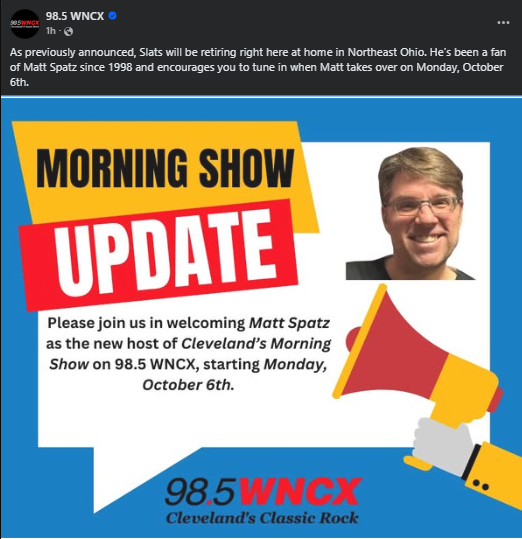
Cleveland classic rock fans will soon wake up to a new voice on 98.5 WNCX. The radio station announced that Matt Spatz will take over mornings on October 6, succeeding longtime host Tim Slats. Slats, who has been with the station for 14 years, will retire after his final show on October 3.
Slats became a staple for WNCX listeners, delivering a familiar and consistent presence in Cleveland radio. His sign-off comes with gratitude both from management and from the man himself.
“Slats is a true Cleveland legend, and we can’t thank him enough for being the rock of our mornings for so long,” said Nard, Brand Manager at 98.5 WNCX. “We are delighted that Spatz will bring his dynamic energy and deep passion for rock music. He is inheriting an important legacy. We are confident in his ability to connect with our listeners and excited for how he shapes the future of mornings on WNCX.”
Slats offered his own farewell with a simple, signature style. “21 years in Cleveland, 14 years at WNCX, and it’s been an honor and a privilege,” he said. “I’ll see ya around… Avon, OH-IO.”
The man stepping into the role is far from a newcomer. Spatz is a Berea native with more than two decades of experience in Northeast Ohio radio. Most recently, he served as the morning show host and Program Director at WONE in Akron. Where he guided the station’s rock identity while staying engaged with local audiences.
For Spatz, the chance to return home and inherit the morning slot from Slats is more than just a professional move.
“I’ve been incredibly fortunate to have some great W’s in my career — WLVQ, WROV, WYFM, WONE, WRQK and WNCD, to name a few — but having the opportunity to take the morning reins from Slats at WNCX in my hometown is truly a dream come true,” Spatz said. “Thank you so much to the Audacy Cleveland team led by Jeff Miller, Chase Daniels and Nard, as well as Jeff Sottolano, Dave Richards and Vince Richards for your trust and belief in me. Can’t wait to get started!”
Barrett Media produces daily content on the music, news, and sports media industries. To stay updated, sign up for our newsletters and get the latest information delivered straight to your inbox.
The topics of free speech and the First Amendment are in the spotlight after ABC pulled Jimmy Kimmel Live! from its lineup last week after threats were made by FCC chair Brendan Carr. In response, NAB CEO and President Curtis LeGeyt is now addressing concerns about the situation.
In a blog published to the organization’s website, LeGeyt made no bones about his stance on the topic.
“Broadcasters must be able to make decisions about the content on our airwaves free from government influence,” he shared. “The First Amendment affords our stations — and all Americans — this fundamental right, and the mere perception that broadcasters acted because of undue pressure is a problem for our credibility and the trust we have built with our audiences.”
After noting that issues about freedom of the press and freedom of speech have surfaced under past administrations as well, LeGeyt made a definitive statement against any such motion by the current administration.
“Today, we continue to see veiled threats suggesting broadcasters should be penalized for airing content that is contrary to a particular point of view,” LeGeyt wrote. “These attempts were wrong then, and they are wrong now. The First Amendment makes clear that broadcasters — not the government — bear the responsibility for editorial decisions. Local radio and television stations take this obligation seriously, working every day to reflect the unique and diverse needs of our communities, especially on sensitive issues. This is what makes local stations the most trusted sources of information. Ultimately, broadcasters are accountable to the viewers and listeners we serve.”
He continued by noting that the risk of political interference will “drive investment further away from local stations at the very moment we need more resources to sustain local journalism.”
“Make no mistake, NAB is fighting every day in Washington to ensure broadcasters have the scale to compete with national and global behemoths, to invest in newsrooms and local programming, to innovate and deliver freely available content to every American — whether on a television, radio, smartphone or car dashboard,” LeGeyt concluded. “But all of that is futile if we cannot fulfill our most sacred responsibility: reporting to our communities without fear of government retribution.”
Barrett Media produces daily content on the music, news, and sports media industries. To stay updated, sign up for our newsletters and get the latest information delivered straight to your inbox.
Sports radio talent contracts have always been a double-edged sword. Early in a career, they are something to strive for. Once signed, however, they can feel restrictive, limiting freedoms once available as a general employee.
But hey, that ratings bonus that isn’t achievable and digital bonus look nice. In lieu of an actual raise—which is guaranteed money for your work in sports radio. Here’s a carrot on a stick to keep you running.
Last week’s events should serve as a wake-up call for both the nation and the sports radio industry. Disney’s decision was a reaction to government pressure, not to what Jimmy Kimmel actually said. Why was the company able to act? Because broadcast contracts contain provisions that allow it. Sports radio talent should pay close attention.
Let’s not mistake what happened last week with the FCC, Disney, Nexstar, Sinclair, and Kimmel.
The freedom of free expression everywhere, including sports radio, is being tested. What Jimmy Kimmel said was factually incorrect. Have you ever seen a State of the Union speech on any broadcast network in your lifetime? Lots of incorrect statements are made on both sides of our political aisle, but the FCC chair has never threatened networks to censor that.
The FCC licenses local broadcast stations in television and radio. Sports radio is not cable, satellite, or streaming, despite some companies promoting their apps more than their air signals.
Did Disney have the right to act? Yes. Most contracts allow it. Was Kimmel’s comment truly beyond the line? That depends on whom you ask. But the question for sports radio talent is clear: would your contract protect you in a similar situation?
So, I took a look at my old iHeartMedia contract to see.
I signed a contract extension to remain the program director of WDAE and WFLA in Tampa, FL, back in February of 2023. It was, I believe, my fourth or fifth contract with the company I was proud to represent. The agreement kicked in on September 1, 2023, and would expire on August 31, 2026. A three-year deal cut short because I was part of the company’s reduction in force last November.
I have no regrets for my time at iHeartMedia, and revealing this data is not in any way a method of exposing the inner workings of the company. It’s just what I signed, and my superiors entrusted in me. Sports radio is my passion, and this was an opportunity to continue to work in it.
In my contract, there is a section of the agreement simply labeled TERMINATION. Big bold letters, and yes, all in caps for effect, I’m sure. Looking at Section 8, item (c) in my agreement, it lists the reasons why “Company” may terminate employment with or without cause. “Cause” means the following, as determined by “Company” in its sole discretion.
There are ten items listed under this section in my former contract with iHeartMedia, with one that stood out to me in the wake of what happened last week to Jimmy Kimmel.
Item nine states:
An act or failure to act which threatens the qualification of the Company Group to maintain a broadcast license issued by the Federal Communications Commission (“FCC”), or which results in a violation of any Federal Trade Commission (“FTC”) or FCC rule or regulation, including but not limited to any utterance on the air that is obscene, indecent, or profane as determined by Company, or by a court upon review of a ruling from the FCC; or
Item nine bleeds into item ten:
Making disparaging oral or written statements while on air or performing duties on behalf of Company regarding the Company Group, including without limitation their officers, shareholders, or management team, or making disparaging oral or written statements regarding the Company Group’s clients, sponsors, or advertisers, or Employee acting in a tortious manner toward another co-worker, listener, client, sponsor, or advertiser.
This kind of covers all the bases, doesn’t it? Seems very legalese, but it allows the Company (your employer) the right to not stand by you no matter what you may say, no matter how harmless it may seem. Your employer can fire you for the same exact reasons that Disney acted with Kimmel.
Don’t believe me? Check your contract.
Setting a New Standard
Jimmy Kimmel said what he said. The FCC, as we know it today, led by Chairman Brendan Carr, considered those comments enough to “threaten” the qualification of the company (Disney-owned ABC television network stations and their affiliate stations) for license.
BREAKING – FCC Chairman Brendan Carr is threatening action against Jimmy Kimmel, and ABC for falsely claiming to millions of viewers that Charlie Kirk’s assassin was MAGA, warning Kimmel could be fired and ABC may lose its broadcasting license.pic.twitter.com/LXherP5GH7
“The broadcasters are entirely different than people that use other forms of communication,” stated Carr on the Benny Johnson podcast. “They have a license granted by us at the FCC and that comes with an obligation to operate in the public interest. We can get into some ways that we’ve been trying to reinvigorate the public interest and some changes that we’ve seen. But frankly, when you see stuff like this, I mean, we can do this the easy way or the hard way. These companies can find ways to change conduct and take action—frankly on Kimmel—or there’s going to be additional work for the FCC ahead.”
Why wouldn’t this happen in sports radio? What if a potential Audacy and Cumulus merger needed government approval under the Trump administration. Then a talent from either company gets the attention of the president for saying something similar to what Kimmel said. Or if Patrick Mahomes began taking a knee on the field. Possibly LeBron James wears a t-shirt in warmups sending a message about a social or political issue going on in America.
Check the contract. Even if you host a show in sports radio, you are not protected. Business is more important than any employee on any station or network. With Kimmel, the words are written, approved, said, recorded, and approved in post production taking upwards of hours. Sports radio talent (in most cases) has a delay less than 30 seconds to determine content approval.
Heed the Warning
History provides examples. The events of Jimmy Kimmel being pulled from ABC television is a wake-up call for sports radio talent. The words you say both on air and online are not as protected any longer as you may think they are. It’s clear that broadcast companies are more concerned about their bottom line than any employee they sign.
The government body in charge of regulating the broadcast station you work for is now in the business of censoring speech and talent by putting pressure on the stations they license. Remember, the easy way or the hard way. This includes sports radio too.
Your contract from your company is a double-edged sword. Sports radio, this is not just a wake-up call to look inward at your content, but also a warning to your future.
In the end, that’s business.
Barrett Media produces daily content on the music, news, and sports media industries. To stay updated, sign up for our newsletters and get the latest information delivered straight to your inbox.
The Toast to 10 series, presented by Premiere Networks, is a month-long look back at ten years of Barrett Media. Throughout the month, you’ll hear from those who have shaped the company, managed and created content, read the site, and partnered with the brand between 2015 and 2025, sharing how they’ve seen it play a role in covering the media industry and educating, celebrating, and challenging the business.
One of the fascinating parts of publishing media industry content is learning what generates interest. You’d assume that the stories delivering the most lift feature the biggest names and brands. Sometimes that’s true, but the more attention a story gets, the harder it is for a trade site like ours to stand out. Then you have to factor in where the activity came from, Search, direct accessing of the website, newsletters, X, Facebook, LinkedIn, Newsbreak, referral websites, or something else. It’s something I monitor frequently to make sure we’re on the right track.
Though it’s fun to see a flood of traffic, if the approach needed to attract eyeballs requires gotcha headlines and ruined relationships, I’ll pass. The exception is when I see wrongdoing being done. Those issues are messy and create tension but sometimes bad things have to be called out to make them better. Every writer here puts their name on their opinions. You don’t have to agree or even read the content, but if you do, know that we’re striving to be honest and factual. We’re also accessible to address questions and complaints.
When we launched in 2015, my mantra was that I’d rather reach 100 Bob Iger’s than 1,000 fans. That holds true today. If leaders, talent, and business professionals value the content and respect those writing it, that trumps general interest. I care more about reaching the right audience than the largest audience. I also value why or how something happened more than the fact that it did happen. To celebrate, educate, and challenge industry professionals, you need a crew that knows the subjects inside and out. We’ve had strong advertising partnerships for years, none who have ever bought us based on traffic. It’s about reach and influence, and you can’t earn that trust without knowing the ins and outs of the business.
A great example is the recent attention placed on Wake Up Barstool’s TV ratings on FS1. Numerous sites have preyed on the brand’s poor numbers after two weeks because it generates clicks. Media personalities have a habit of taking the bait and sharing the content on social media anytime you say something good or bad about them. But if you’ve worked in the industry and know how ratings and new shows work, this isn’t a surprise. You’re also aware that Fox isn’t measuring the success or failure of its partnership with Barstool based on FS1 TV ratings. I saw this exact situation last year with Tom Brady and previously with GetUp! and Tony Romo. What separates us, a column like John Mamola’s on Friday that details how it works.
Aside from leaning into experience, daily news is a part of our world too. We produce a LOT of it, in my opinion, too much. Attacking the news cycle doesn’t start here with using 5-10 people’s names to chase clicks. That’s not our business strategy. I’ve actually considered reducing how much attention we place on daily news. I know many rely on us to stay updated on industry news, but it also restricts creativity and storytelling. Most people read 1-3 stories per day, not 8-10. Included in that activity are columns and features, the items we do best. Yet some days we have 12-15 news stories. Breaking news is one thing, that matters a lot, but whether or not we need everything else, is part of a larger internal discussion.
With Barrett Media running this series throughout the month of September, I thought it’d be interesting for readers to learn which ten stories have performed best across music, news, and sports media since 2015. I’m not including company layoffs stories or Top 20 lists, both produce massive attention. Keep in mind that we’ve covered sports media since September 2015, news media since September 2020, and music radio since July 2024. These aren’t necessarily the most important or impactful, they’re just the ones that garnered the most interest. Enjoy!
I didn’t like Jimmy Kimmel‘s remarks, but to be fair, I don’t watch his show much. I used to love late-night television but find today’s offerings to be less funny. They’re also too quick to embrace political commentary that divides the audience. Jay Leno, David Letterman, and Conan O’Brien valued laughs over division. Judging by the ratings, that strategy worked better.
But this is a situation the FCC shouldn’t be sticking its nose in. Ted Cruzcalled them out for it over the weekend and was spot on. Disney reserves the right to take a talent off the air. Kimmel reportedly planned to double down on his comments on Wednesday’s show, which is just stupid. When Nexstar and Sinclair pull your show and advertising pressure mounts, it’s wiser to quiet the noise than fan the flames.
If nothing else was at stake and Bob Iger and Dana Walden made the call to send Kimmel to the sidelines, I’d support it 100%. However, when the companies involved are known to have other business interests in motion requiring FCC/Political support, why would anyone think those issues aren’t directly connected to this decision? The corporations involved look like they took a stand to protect those interests. Kimmel’s inaccurate comments and lack of decency after a human being has been murdered did him no favors. And Brendan Carr and the FCC come across as a group trying to silence speech they disagree with and influence how media groups operate. I’m not sure that anyone looks good in this situation.
Quick Hits
A tip of the cap to Newsmax, Fox News, and NewsNation for airing Charlie Kirk’s funeral. Networks that chose not to show it missed an opportunity to lure new viewers from the other side. I want to applaud Turning Point USA, the Salem Radio Network, and the numerous hosts/networks who’ve worked together the past two weeks to turn an impossible and tragic situation into something positive. Charlie Kirk‘s death has crushed many across the media industry, but seeing so many accomplished people step into his studio to discuss his impact, legacy, and share old stories and clips has reminded us how important he was to the news media industry. Garrett Searight wrote a piece last week which addressed it perfectly.
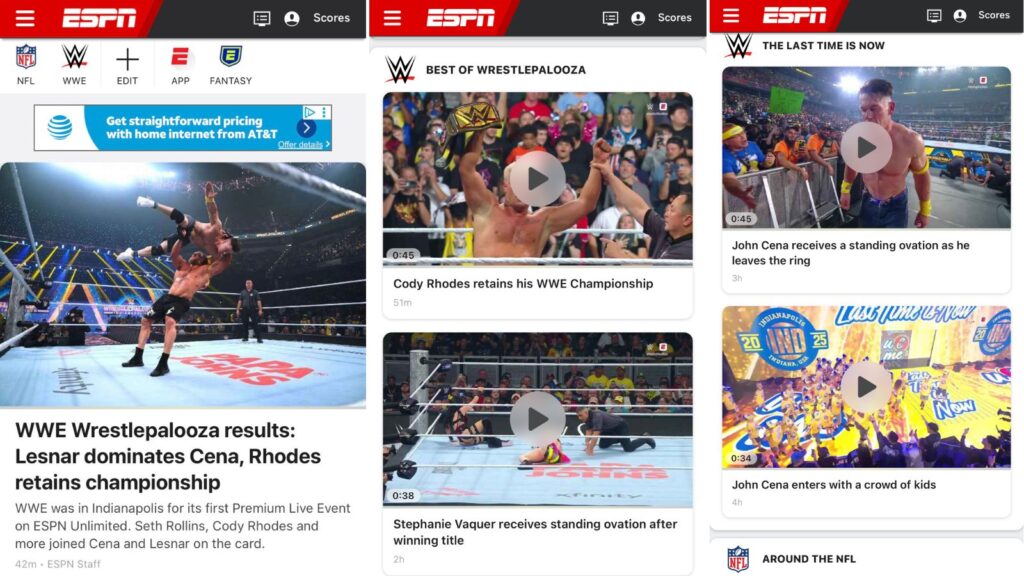
I could be wrong but I don’t remember ever seeing the WWE featured on ESPN.com as the top story. That was the case Saturday night following the company’s premium live event Wrestlepalooza which aired on ESPN’s app. Even more impressive, WWE owned the main page over College Football and other pro sports leagues. The SportsCenter social media accounts were also actively promoting the event. This clip by Omar Raja was my personal favorite. Based on first impressions, ESPN appears to be all-in on the new relationship.
Photo Credit: ESPN.com Screenshots
Fantastic work by the CBS NFL Today team with Sunday’s throwback edition to celebrate the show’s 50th anniversary. The open voiced by Brent Musburger and the crew donning wigs was absolutely perfect.
Years from now media people who were late to the party are going to look back and wish they had paid more attention to Jesse Cole of the Savannah Bananas. In my opinion, he’s one of the sharpest minds in brand building and marketing. Take ten minutes and watch this interview on CNBC. For those thinking of taking a professional risk, this video is even better.
Aerosmith-Yungblud hit a homerun with My Only Angel. Becky Lynch‘s new entrance theme New Lows by The Wonder Years is rapidly growing on me. Avril Lavigne‘s Feel My Pain which features Jelly Roll is strong, so too is Butterflies by All Time Low. Finally, Hardy‘s Dog Years can reduce you to tears if you’re a dog lover. Ask Stephanie Eads, haha.
Barrett Media produces daily content on the music, news, and sports media industries. To stay updated, sign up for our newsletters and get the latest information delivered straight to your inbox.
The memorial service for Charlie Kirk on Sunday was the kind of story that stops the media world in its tracks. No matter your politics, no matter your opinion of him, the death of someone who founded one of the largest conservative youth organizations in America is news.
Yet, the way some cable news outlets handled coverage of the funeral revealed just how fractured the media landscape has become when it comes to deciding what is — and what isn’t — the biggest story of the day.
Fox News, Newsmax, and NewsNation treated the funeral as a major event. Each network carried hours of coverage, from the service itself to the eulogies and analysis afterward. They understood that, for millions of viewers, this was not just another Sunday. It was a moment of mourning, reflection, and remembrance for a figure who had an undeniable impact on political conversation over the past decade.
Meanwhile, CNN and MSNBC took a different route. Yes, they mentioned Kirk’s death. Yes, they included brief packages, segments, or live look-ins noting the funeral. But the sustained, live coverage you saw on other channels? That was largely absent. Instead, the two networks continued with their usual Sunday political panels and regularly scheduled programming.
The question isn’t whether CNN and MSNBC had the “right” to program their networks how they saw fit. Of course they did. The question is whether they acknowledged what was the biggest story of the afternoon. Topic A is Topic A. No matter if it doesn’t align with political ideology or whatever other reason you could try to use to justify not covering the event.
Sunday wasn’t short on news. There were ongoing debates about the presidential campaign, global unrest, and the ever-present horse race of politics. But when more than 750,000 people were watching the funeral live on YouTube across the Turning Point USA, Charlie Kirk, and the LiveNOW from Fox News channels, it’s hard to argue there was anything more pressing in that moment. That number doesn’t even count television viewership. That’s three-quarters of a million people actively choosing to watch on a single platform.
It’s not difficult to see why conservative outlets dedicated so much time to it. Kirk’s reach with young audiences, his role in shaping conservative media, and his reputation as both a firebrand and organizer made him a central figure in American politics. But that’s precisely why other outlets should have recognized the significance, too. His influence went far beyond one ideological camp.
Consider the optics: one set of networks gave the story wall-to-wall treatment, while others gave it passing mentions. For viewers who were curious, or for those who didn’t consider themselves deeply invested in Kirk’s career, CNN and MSNBC left them on the proverbial table. Viewers looking for coverage had to go elsewhere, and many did. That’s not just a matter of ideology, it’s a matter of understanding audience demand.
Cable news networks will often talk about “owning the story.” Whoever provides the best, most comprehensive coverage during a major event usually wins the ratings and the credibility. By not fully leaning into coverage of Kirk’s funeral, some outlets surrendered that ground before the battle even started.
No one is saying that every second of the day should have been dedicated to the service. But when the story of the day is clear, it deserves the kind of coverage that reflects its importance. The fact that Fox News, Newsmax, and NewsNation recognized that, while CNN and MSNBC largely did not, shows how divided our definition of “biggest story” can be.
The funeral of Charlie Kirk wasn’t just a political event. It was a cultural one, too. It drew national figures, media personalities, and grassroots supporters alike. Raw emotion was brought out, there was genuine reflection, and it created more than a few headlines of its own. That’s what makes it newsworthy — and why ignoring or downplaying it doesn’t do justice to viewers.
At the end of the day, the media’s job is to identify what matters most. On Sunday afternoon, the funeral of Charlie Kirk was what mattered most. That’s not a partisan statement. It’s simply an acknowledgment of reality: Topic A is Topic A. And when networks decide not to treat it that way, they risk losing viewers — and credibility — to those that do.
Barrett Media produces daily content on the music, news, and sports media industries. To stay updated, sign up for our newsletters and get the latest information delivered straight to your inbox.
Imagine if you were tasked with creating the first ever Classic Rock station. I’m not talking about going back in time. I’m saying imagine you live in today’s world, and this giant body of incredibly popular music exists, but the format isn’t available on the radio. The songs are streaming, the bands are touring, and other mediums are using the music in various ways, but radio is just now getting its first opportunity. Would you do exactly what you are doing today or would the blank slate without preconceived notions lead you in new directions?
That’s sort of the challenge presented to the team at Bleacher Report. In January, the NFL and Bleacher Report announced a multi-year content partnership giving the organization access to NFL game footage to “use in original content across its social and owned and operated platforms.” The access includes highlights, eight full-game broadcasts and access to tent pole events like the NFL Draft and the Super Bowl.
It’s not the exact same thing as the Classic Rock scenario I presented, but there are parallels. The NFL, a giant content behemoth that already exists and is covered on many media outlets, is suddenly available to Bleacher Report. What an amazing, and possibly intimidating, opportunity.
Jessica Davies at Digiday wrote about how the platform has risen to the challenge. There are a few notable takeaways from what she found that apply to our world.
Fan First Content
The first notable observation is in the headline, “Bleacher Report Puts a Fan First Spin on NFL Coverage.” Davies reports that the platform is not focused on typical football coverage. Instead, it has tried to emulate what a fan might do if they were suddenly granted an all-access pass to an NFL game.
To accomplish this Bleacher Report is tapping into the NFL’s Local Content Creator (LCC) Network for things like touchdown celebrations, player entrances and even closer looks at the equipment teams use. This is the type of stuff a curious fan might investigate that the major networks never talk about.
Take some time and apply this idea to your station and your music. Consider the elements of the music and of broadcasting that we take for granted but a fan would likely find fascinating. You may come away with new ideas.
Fan Involvement
Beyond the content that fans love that isn’t covered on other platforms, Bleacher Report is also tapping into their creator network. It is currently six hundred people strong and being used to generate special content from fans. For example, when a game is close they might feature side by side creators with one fan of each team showing their reactions as the game progresses. With their special “Creator Studio,” Bleacher Report can create content like this and have it on their app in minutes.
That sort of real time reaction may not be feasible for many radio stations, but the important takeaway is looking beyond our walls to harness fans of the stations. The music is an almost untapped opportunity that may help grow audiences beyond your existing cume.
Experts and Celebrities
Bleacher Report is also using experts to dig deeper into the world of the NFL. For example, “Cleats and Convos” with Deebo Samuel gives the superstar a chance to talk with other wide receivers from around the league. But not just about running routes. Samuel says the show goes beyond the game, “it’s the real conversations we share with each other about football and life.” Imagine having musicians talking with other musicians about not just the notes of the songs, but what it’s like to be a star.
In addition to using NFL insiders, the “Field-side Correspondent” series mics up celebrities, drops them on the sideline of the game and captures their experience. Imagine the content we could generate working with a celebrity as they go through a special, all-access concert experience at a show.
I’d be remiss if I didn’t mention that Bleacher Report’s team is using these new shows and content formats to generate a lot of revenue. They are forecasting a 50% year-over-year increase in revenue all tied to their NFL deal. That includes sponsor specific formats like a partnership with Little Caesars called “Game Show on the Go” which is produced at tailgates outside NFL games.
With all of that to consider, go back to my original scenario. If you were creating an all-new Classic Rock station what would you do? With the smart people I know who program Classic Rock stations, I’m confident that pausing your daily grind, and pretending for a moment the canvas is completely blank, would result in a batch of new, unique content, and probably revenue, for your station.
First, let’s get this week’s Big Media Story out of the way. No, ABC should not have suspended or fired Jimmy Kimmel.
No, Kimmel didn’t say what everyone seems to think he said. No, it is not necessary to praise someone who said the things Charlie Kirk said, nor is it necessary to produce nothing but hagiographies about him. And no, it is not a good thing for people to be shot and killed for their political beliefs, whatever they may be.
I wonder how many of you would do the right thing in this instance if you were the CEO of a broadcast company and your company had an acquisition needing approval by a federal agency, while the current administration was signaling that if you aired a certain host’s show, you might not get that approval. Put enough money on the line, and cowardice becomes an option. That’s where we are in America today, and we’ll unfortunately have plenty of time to talk about that as we circle the drain for at least the next three years.
One thing about the story that has gone largely unnoticed is how it reflects the network-affiliate relationship and how dramatically it has changed in what feels like the blink of an eye.
In television, having one of the big four network affiliations has always determined a station’s profitability and viability. Lose an affiliation and end up independent, and the valuation plummets, programming costs rise, and trouble looms. That’s not quite the case anymore, because broadcast television stations’ value has shriveled in an age when viewers stream their content.
Ask anyone on the street—even old-timers—what’s on CBS Wednesday nights, and they likely don’t know. Hell, you probably don’t know without looking it up. Ask them what channel ABC is on, and you’ll get a lot of puzzled stares (except in Philadelphia, where 6abc is one of the most familiar brands in the region and people will start singing the Action News theme unprompted).
It’s no longer about networks and stations; it’s about shows. It has always been about the shows, but now viewers search their Roku stick for which streaming service carries what they want to watch. Chances are, you can get your local news via streaming—live or on demand—rather than a broadcast or cable channel.
Even live sports coverage is slowly migrating to streaming, which frustrates fans who must figure out which platform has tonight’s game (“Is tonight’s game on Apple TV+, the Roku Channel, or that new ESPN thing we don’t get?”). Other than live events—mostly sports—the carrier is irrelevant. To the public, everything is on Netflix until proven otherwise, or on Roku, Google TV, or Fire TV’s home page. There are better ways to get what you want than watching local television channels.
Chances are you never stayed up late to watch Kimmel (or Colbert, or Meyers, or, heaven forbid, Gutfeld! —not really a late-night show, not really a comedian — or Fallon). Chances are you watched clips on YouTube, or entire episodes on the network’s website, Hulu, or another service.
If your local ABC affiliate is owned by Nexstar or Sinclair, and the show returns to the air but not on those affiliates, you might not notice any difference. The whole broadcast model is antiquated, and the networks know it. You can start taking bets now on which TV network will be the first to dump its broadcast affiliates and go all-in on streaming—a move that may coincide with local affiliates balking at paying ever-higher retransmission consent fees.
Consider WPLG-TV in Miami. Owned by Warren Buffett’s company, it decided ABC was asking too much and sent the network packing. ABC is now relegated to a digital subchannel in a second-rate position. This wasn’t the first case, and it won’t be the last.
The same dynamic applies to other media. Radio faces customizable music streamers and increased competition even in its stronghold—the car dashboard. If I want to hear the music I like, no local station in South Florida has it; it’s Spotify for me. If I want local news and talk, the broadcast stations here don’t offer much. Sports? OK, that’s still available. But that’s it, and I expect more teams to move from broadcast to streaming.
Newspapers? Many have cut back or eliminated print editions. You can’t buy the Newark Star-Ledger at your local Wawa or 7-Eleven anymore, but you can go to NJ.com and get the same thing. The Atlanta Journal-Constitution won’t have a printed edition after New Year’s. Movies in theaters still exist, but let’s be honest—you now wait for them to hit streaming.
Broadcast licenses aren’t sacred. Neither are printing presses or movie theaters. Times change, technology changes. If you’re — like practically everybody on LinkedIn claims to be — a “content creator,” there’s more opportunity than ever. But the public’s taste has changed (TikTok!), the distribution channels have changed, and marketing has changed. If you define yourself as a radio or TV personality, or a reporter, and you haven’t started thinking of yourself as a content creator, now would be a good time to start. Maybe those LinkedIn clones are onto something.
Turning Point USA founder and news/talk radio and podcast host Charlie Kirk was laid to rest on Sunday afternoon, in a massive funeral at State Farm Stadium in Glendale, Arizona.
Generally, funerals aren’t riveting radio, especially for a spoken word format like news/talk radio.
But this funeral was atypical. Charlie Kirk, gunned down while speaking at an event at Utah Valley University, was only 31 years old. He leaves behind a wife, two children, and a legacy as a political activist, accomplished podcaster, and radio host.
Furthermore, the event was a who’s who of Republican dignitaries, politicians, and media members. President Donald Trump and Vice President JD Vance spoke to the more than 70,000 in attendance. Secretaries Marco Rubio, Pete Hegseth, and Robert F. Kennedy Jr. also delivered messages, as did Tucker Carlson.
One of the more powerful speeches was made by Kirk’s widow, Erika, who was recently named his successor as CEO of the Turning Point USA organization he founded. Kirk revealed that she had forgiven the assassin who killed her husband, arguing that that is what Charlie Kirk would have wanted her to do.
Around the nation, more than 30 iHeartMedia news/talk stations carried the event live on Sunday afternoon, with comprehensive coverage beginning at 2 PM ET.
And iHeartMedia Executive Vice President of News, Talk, and Sports Programming Chris Berry believed as soon as the shooting occurred that this was a monumental moment for the company’s dedicated audience.
“For talk radio, the assassination of Charlie Kirk quickly became not just another news story; it became a defining event for our listeners, one that touches on politics, culture, faith, and the national conversation about free speech and public life,” Berry said.
Obviously, the shooting and death of Charlie Kirk was a jarring moment for millions. And in the process of grieving Kirk, Berry shared that it was paramount for the company’s stations to be there as a friend and trusted source for news and information surrounding the situation.
“Coverage of the memorial service allowed our listeners to grieve collectively and hear directly from leaders and others who share in their loss,” said Berry. “It is precisely in these times that news/talk radio fulfills its highest calling — not just to inform, but to provide a trusted space where the community can come together.”
Berry added that the fact that Charlie Kirk hosted a nationally syndicated program for a competitor — Salem Radio Network — never entered the picture in deciding coverage plans for the shooting, the aftermath, and ultimately the funeral of Kirk.
He continued by noting that it was important for iHeartMedia to strive to provide the best coverage of the most important topics, and this was a case in point.
“Providing live coverage of the memorial service demonstrated that our stations are focused on what matters most to our listeners at a time when they were looking for connection, context, and community,” Berry said.
Some observers questioned why other networks did or didn’t provide more long-form coverage of the event. In some cases, the fact that the memorial for Charlie Kirk was held on a weekend was a hindrance.
But Chris Berry said that weekends have never been viewed as an afterthought.
“We have never seen it that way and we never will,” he concluded. “Talk radio has always been at its best when it steps beyond the ordinary to meet extraordinary moments, and our commitment to our listeners is to always be the trusted voice they can turn to for coverage of important events. It is these moments when the bond between our stations and our audiences becomes even stronger.”
Barrett Media produces daily content on the music, news, and sports media industries. To stay updated, sign up for our newsletters and get the latest information delivered straight to your inbox.